Linear PDE with Constant Coefficients
Pinaki Pal
Department of Mathematics
National Institute of Technology Durgapur
West Bengal, India
pinaki.pal@maths.nitdgp.ac.in
Pinaki Pal (NIT Durgapur) MA331; Odd Semester, 2020-21 1 / 54
Linear PDE
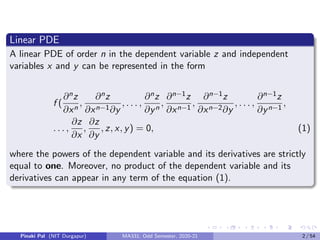
A linear PDE of order n in the dependent variable z and independent
variables x and y can be represented in the form
f (
∂nz
∂xn
,
∂nz
∂xn−1∂y
, . . . ,
∂nz
∂yn
,
∂n−1z
∂xn−1
,
∂n−1z
∂xn−2∂y
, . . . ,
∂n−1z
∂yn−1
,
. . . ,
∂z
∂x
,
∂z
∂y
, z, x, y) = 0, (1)
where the powers of the dependent variable and its derivatives are strictly
equal to one. Moreover, no product of the dependent variable and its
derivatives can appear in any term of the equation (1).
Pinaki Pal (NIT Durgapur) MA331; Odd Semester, 2020-21 2 / 54
Examples
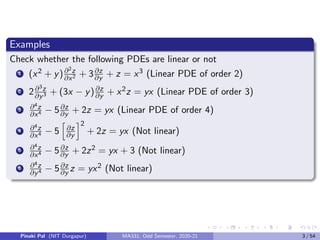
Check whether the following PDEs are linear or not
1 (x2 + y)∂2z
∂x2 + 3∂z
∂y + z = x3 (Linear PDE of order 2)
2 2∂3z
∂y3 + (3x − y)∂z
∂y + x2z = yx (Linear PDE of order 3)
3 ∂4z
∂x4 − 5∂z
∂y + 2z = yx (Linear PDE of order 4)
4 ∂4z
∂x4 − 5
h
∂z
∂y
i2
+ 2z = yx (Not linear)
5 ∂4z
∂x4 − 5∂z
∂y + 2z2 = yx + 3 (Not linear)
6 ∂4z
∂y4 − 5∂z
∂y z = yx2 (Not linear)
Pinaki Pal (NIT Durgapur) MA331; Odd Semester, 2020-21 3 / 54
Linear PDE with constant coefficients
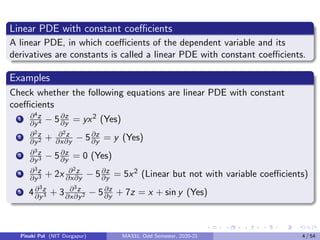
A linear PDE, in which coefficients of the dependent variable and its
derivatives are constants is called a linear PDE with constant coefficients.
Examples
Check whether the following equations are linear PDE with constant
coefficients
1 ∂4z
∂y4 − 5∂z
∂y = yx2 (Yes)
2 ∂2z
∂y2 + ∂2z
∂x∂y − 5∂z
∂y = y (Yes)
3 ∂3z
∂y3 − 5∂z
∂y = 0 (Yes)
4 ∂3z
∂y3 + 2x ∂2z
∂x∂y − 5∂z
∂y = 5x2 (Linear but not with variable coefficients)
5 4∂3z
∂y3 + 3 ∂3z
∂x∂y2 − 5∂z
∂y + 7z = x + sin y (Yes)
Pinaki Pal (NIT Durgapur) MA331; Odd Semester, 2020-21 4 / 54
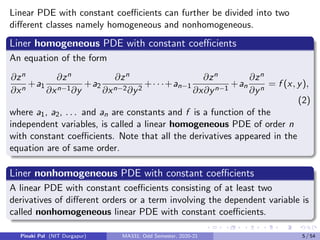
Linear PDE with constant coefficients can further be divided into two
different classes namely homogeneous and nonhomogeneous.
Liner homogeneous PDE with constant coefficients
An equation of the form
∂zn
∂xn
+a1
∂zn
∂xn−1∂y
+a2
∂zn
∂xn−2∂y2
+· · ·+an−1
∂zn
∂x∂yn−1
+an
∂zn
∂yn
= f (x, y),
(2)
where a1, a2, . . . and an are constants and f is a function of the
independent variables, is called a linear homogeneous PDE of order n
with constant coefficients. Note that all the derivatives appeared in the
equation are of same order.
Liner nonhomogeneous PDE with constant coefficients
A linear PDE with constant coefficients consisting of at least two
derivatives of different orders or a term involving the dependent variable is
called nonhomogeneous linear PDE with constant coefficients.
Pinaki Pal (NIT Durgapur) MA331; Odd Semester, 2020-21 5 / 54
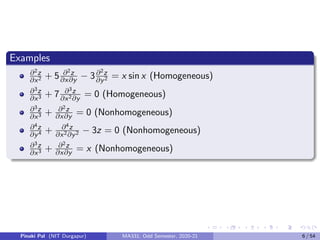
Examples
∂2z
∂x2 + 5 ∂2z
∂x∂y − 3∂2z
∂y2 = x sin x (Homogeneous)
∂3z
∂x3 + 7 ∂3z
∂x2∂y
= 0 (Homogeneous)
∂3z
∂x3 + ∂2z
∂x∂y = 0 (Nonhomogeneous)
∂4z
∂y4 + ∂4z
∂x2∂y2 − 3z = 0 (Nonhomogeneous)
∂3z
∂x3 + ∂2z
∂x∂y = x (Nonhomogeneous)
Pinaki Pal (NIT Durgapur) MA331; Odd Semester, 2020-21 6 / 54
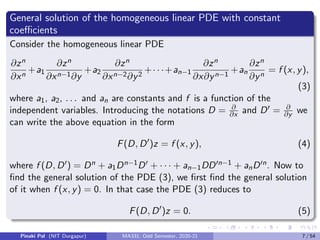
General solution of the homogeneous linear PDE with constant
coefficients
Consider the homogeneous linear PDE
∂zn
∂xn
+a1
∂zn
∂xn−1∂y
+a2
∂zn
∂xn−2∂y2
+· · ·+an−1
∂zn
∂x∂yn−1
+an
∂zn
∂yn
= f (x, y),
(3)
where a1, a2, . . . and an are constants and f is a function of the
independent variables. Introducing the notations D = ∂
∂x and D0 = ∂
∂y we
can write the above equation in the form
F(D, D0
)z = f (x, y), (4)
where f (D, D0) = Dn + a1Dn−1D0 + · · · + an−1DD0n−1 + anD0n. Now to
find the general solution of the PDE (3), we first find the general solution
of it when f (x, y) = 0. In that case the PDE (3) reduces to
F(D, D0
)z = 0. (5)
Pinaki Pal (NIT Durgapur) MA331; Odd Semester, 2020-21 7 / 54
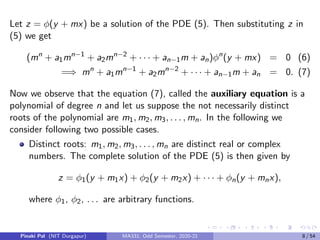
Let z = φ(y + mx) be a solution of the PDE (5). Then substituting z in
(5) we get
(mn
+ a1mn−1
+ a2mn−2
+ · · · + an−1m + an)φn
(y + mx) = 0 (6)
=⇒ mn
+ a1mn−1
+ a2mn−2
+ · · · + an−1m + an = 0. (7)
Now we observe that the equation (7), called the auxiliary equation is a
polynomial of degree n and let us suppose the not necessarily distinct
roots of the polynomial are m1, m2, m3, . . . , mn. In the following we
consider following two possible cases.
Distinct roots: m1, m2, m3, . . . , mn are distinct real or complex
numbers. The complete solution of the PDE (5) is then given by
z = φ1(y + m1x) + φ2(y + m2x) + · · · + φn(y + mnx),
where φ1, φ2, . . . are arbitrary functions.
Pinaki Pal (NIT Durgapur) MA331; Odd Semester, 2020-21 8 / 54
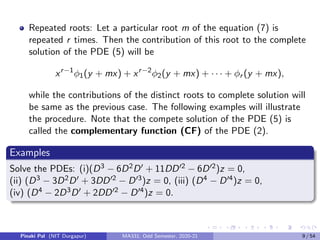
Repeated roots: Let a particular root m of the equation (7) is
repeated r times. Then the contribution of this root to the complete
solution of the PDE (5) will be
xr−1
φ1(y + mx) + xr−2
φ2(y + mx) + · · · + φr (y + mx),
while the contributions of the distinct roots to complete solution will
be same as the previous case. The following examples will illustrate
the procedure. Note that the compete solution of the PDE (5) is
called the complementary function (CF) of the PDE (2).
Examples
Solve the PDEs: (i)(D3 − 6D2D0 + 11DD02 − 6D02)z = 0,
(ii) (D3 − 3D2D0 + 3DD02 − D03)z = 0, (iii) (D4 − D04)z = 0,
(iv) (D4 − 2D3D0 + 2DD02 − D04)z = 0.
Pinaki Pal (NIT Durgapur) MA331; Odd Semester, 2020-21 9 / 54
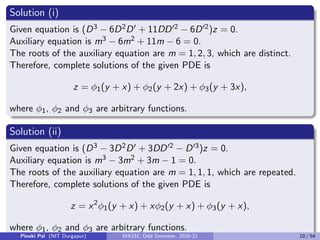
Solution (i)
Given equation is (D3 − 6D2D0 + 11DD02 − 6D02)z = 0.
Auxiliary equation is m3 − 6m2 + 11m − 6 = 0.
The roots of the auxiliary equation are m = 1, 2, 3, which are distinct.
Therefore, complete solutions of the given PDE is
z = φ1(y + x) + φ2(y + 2x) + φ3(y + 3x),
where φ1, φ2 and φ3 are arbitrary functions.
Solution (ii)
Given equation is (D3 − 3D2D0 + 3DD02 − D03)z = 0.
Auxiliary equation is m3 − 3m2 + 3m − 1 = 0.
The roots of the auxiliary equation are m = 1, 1, 1, which are repeated.
Therefore, complete solutions of the given PDE is
z = x2
φ1(y + x) + xφ2(y + x) + φ3(y + x),
where φ1, φ2 and φ3 are arbitrary functions.
Pinaki Pal (NIT Durgapur) MA331; Odd Semester, 2020-21 10 / 54
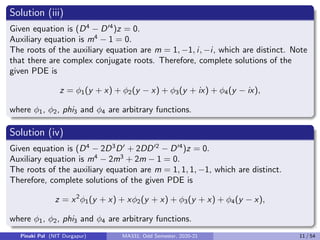
Solution (iii)
Given equation is (D4
− D04
)z = 0.
Auxiliary equation is m4
− 1 = 0.
The roots of the auxiliary equation are m = 1, −1, i, −i, which are distinct. Note
that there are complex conjugate roots. Therefore, complete solutions of the
given PDE is
z = φ1(y + x) + φ2(y − x) + φ3(y + ix) + φ4(y − ix),
where φ1, φ2, phi3 and φ4 are arbitrary functions.
Solution (iv)
Given equation is (D4
− 2D3
D0
+ 2DD02
− D04
)z = 0.
Auxiliary equation is m4
− 2m3
+ 2m − 1 = 0.
The roots of the auxiliary equation are m = 1, 1, 1, −1, which are distinct.
Therefore, complete solutions of the given PDE is
z = x2
φ1(y + x) + xφ2(y + x) + φ3(y + x) + φ4(y − x),
where φ1, φ2, phi3 and φ4 are arbitrary functions.
Pinaki Pal (NIT Durgapur) MA331; Odd Semester, 2020-21 11 / 54
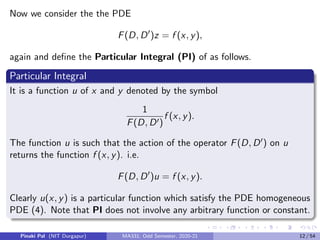
Now we consider the the PDE
F(D, D0
)z = f (x, y),
again and define the Particular Integral (PI) of as follows.
Particular Integral
It is a function u of x and y denoted by the symbol
1
F(D, D0)
f (x, y).
The function u is such that the action of the operator F(D, D0) on u
returns the function f (x, y). i.e.
F(D, D0
)u = f (x, y).
Clearly u(x, y) is a particular function which satisfy the PDE homogeneous
PDE (4). Note that PI does not involve any arbitrary function or constant.
Pinaki Pal (NIT Durgapur) MA331; Odd Semester, 2020-21 12 / 54
General Method
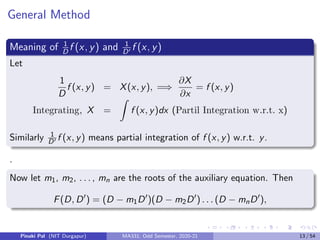
Meaning of 1
D
f (x, y) and 1
D0 f (x, y)
Let
1
D
f (x, y) = X(x, y), =⇒
∂X
∂x
= f (x, y)
Integrating, X =
Z
f (x, y)dx (Partil Integration w.r.t. x)
Similarly 1
D0 f (x, y) means partial integration of f (x, y) w.r.t. y.
.
Now let m1, m2, . . . , mn are the roots of the auxiliary equation. Then
F(D, D0
) = (D − m1D0
)(D − m2D0
) . . . (D − mnD0
),
Pinaki Pal (NIT Durgapur) MA331; Odd Semester, 2020-21 13 / 54
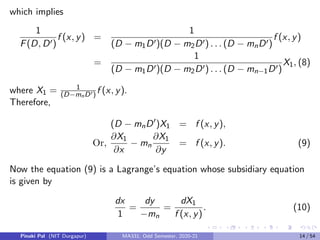
which implies
1
F(D, D0)
f (x, y) =
1
(D − m1D0)(D − m2D0) . . . (D − mnD0)
f (x, y)
=
1
(D − m1D0)(D − m2D0) . . . (D − mn−1D0)
X1, (8)
where X1 = 1
(D−mnD0) f (x, y).
Therefore,
(D − mnD0
)X1 = f (x, y),
Or,
∂X1
∂x
− mn
∂X1
∂y
= f (x, y). (9)
Now the equation (9) is a Lagrange’s equation whose subsidiary equation
is given by
dx
1
=
dy
−mn
=
dX1
f (x, y)
. (10)
Pinaki Pal (NIT Durgapur) MA331; Odd Semester, 2020-21 14 / 54
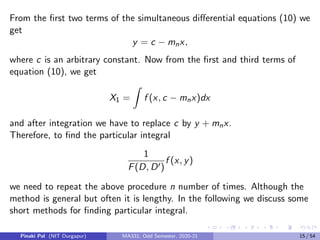
From the first two terms of the simultaneous differential equations (10) we
get
y = c − mnx,
where c is an arbitrary constant. Now from the first and third terms of
equation (10), we get
X1 =
Z
f (x, c − mnx)dx
and after integration we have to replace c by y + mnx.
Therefore, to find the particular integral
1
F(D, D0)
f (x, y)
we need to repeat the above procedure n number of times. Although the
method is general but often it is lengthy. In the following we discuss some
short methods for finding particular integral.
Pinaki Pal (NIT Durgapur) MA331; Odd Semester, 2020-21 15 / 54
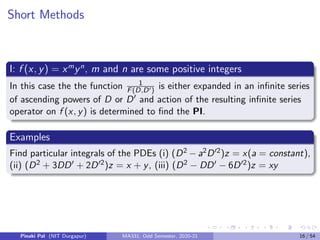
Short Methods
I: f (x, y) = xm
yn
, m and n are some positive integers
In this case the the function 1
F(D,D0) is either expanded in an infinite series
of ascending powers of D or D0 and action of the resulting infinite series
operator on f (x, y) is determined to find the PI.
Examples
Find particular integrals of the PDEs (i) (D2 − a2D02)z = x(a = constant),
(ii) (D2 + 3DD0 + 2D02)z = x + y, (iii) (D2 − DD0 − 6D02)z = xy
Pinaki Pal (NIT Durgapur) MA331; Odd Semester, 2020-21 16 / 54
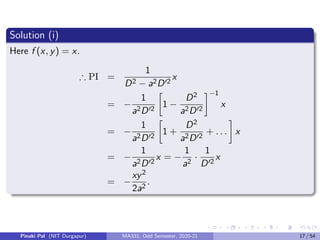
Solution (i)
Here f (x, y) = x.
∴ PI =
1
D2 − a2D02
x
= −
1
a2D02

1 −
D2
a2D02
−1
x
= −
1
a2D02

1 +
D2
a2D02
+ . . .

x
= −
1
a2D02
x = −
1
a2
·
1
D02
x
= −
xy2
2a2
.
Pinaki Pal (NIT Durgapur) MA331; Odd Semester, 2020-21 17 / 54
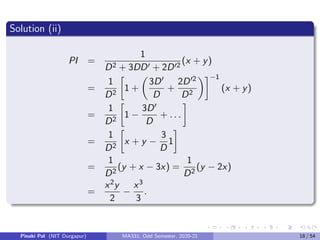
Solution (ii)
PI =
1
D2 + 3DD0 + 2D02
(x + y)
=
1
D2

1 +

3D0
D
+
2D02
D2
−1
(x + y)
=
1
D2

1 −
3D0
D
+ . . .

=
1
D2

x + y −
3
D
1

=
1
D2
(y + x − 3x) =
1
D2
(y − 2x)
=
x2y
2
−
x3
3
.
Pinaki Pal (NIT Durgapur) MA331; Odd Semester, 2020-21 18 / 54
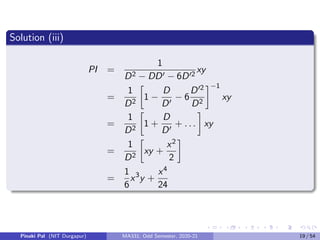
Solution (iii)
PI =
1
D2 − DD0 − 6D02
xy
=
1
D2

1 −
D
D0
− 6
D02
D2
−1
xy
=
1
D2

1 +
D
D0
+ . . .

xy
=
1
D2

xy +
x2
2

=
1
6
x3
y +
x4
24
Pinaki Pal (NIT Durgapur) MA331; Odd Semester, 2020-21 19 / 54
Lecture 5: 01.10.2020
Pinaki Pal (NIT Durgapur) MA331; Odd Semester, 2020-21 20 / 54
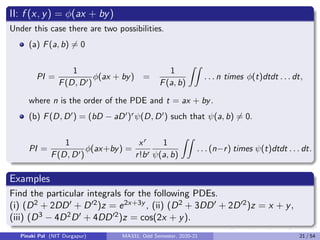
II: f (x, y) = φ(ax + by)
Under this case there are two possibilities.
(a) F(a, b) 6= 0
PI =
1
F(D, D0)
φ(ax + by) =
1
F(a, b)
ZZ
. . . n times φ(t)dtdt . . . dt,
where n is the order of the PDE and t = ax + by.
(b) F(D, D0
) = (bD − aD0
)r
ψ(D, D0
) such that ψ(a, b) 6= 0.
PI =
1
F(D, D0)
φ(ax+by) =
xr
r!br
1
ψ(a, b)
ZZ
. . . (n−r) times ψ(t)dtdt . . . dt.
Examples
Find the particular integrals for the following PDEs.
(i) (D2 + 2DD0 + D02)z = e2x+3y , (ii) (D2 + 3DD0 + 2D02)z = x + y,
(iii) (D3 − 4D2D0 + 4DD02)z = cos(2x + y).
Pinaki Pal (NIT Durgapur) MA331; Odd Semester, 2020-21 21 / 54
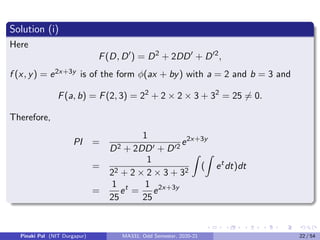
Solution (i)
Here
F(D, D0
) = D2
+ 2DD0
+ D02
,
f (x, y) = e2x+3y is of the form φ(ax + by) with a = 2 and b = 3 and
F(a, b) = F(2, 3) = 22
+ 2 × 2 × 3 + 32
= 25 6= 0.
Therefore,
PI =
1
D2 + 2DD0 + D02
e2x+3y
=
1
22 + 2 × 2 × 3 + 32
Z
(
Z
et
dt)dt
=
1
25
et
=
1
25
e2x+3y
Pinaki Pal (NIT Durgapur) MA331; Odd Semester, 2020-21 22 / 54
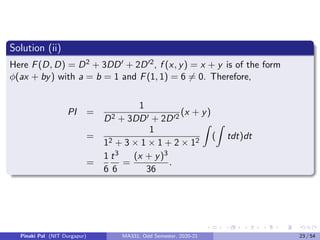
Solution (ii)
Here F(D, D) = D2 + 3DD0 + 2D02, f (x, y) = x + y is of the form
φ(ax + by) with a = b = 1 and F(1, 1) = 6 6= 0. Therefore,
PI =
1
D2 + 3DD0 + 2D02
(x + y)
=
1
12 + 3 × 1 × 1 + 2 × 12
Z
(
Z
tdt)dt
=
1
6
t3
6
=
(x + y)3
36
.
Pinaki Pal (NIT Durgapur) MA331; Odd Semester, 2020-21 23 / 54
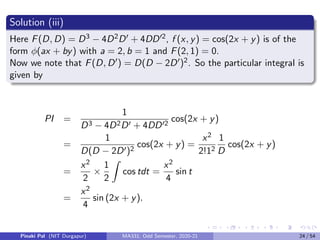
Solution (iii)
Here F(D, D) = D3 − 4D2D0 + 4DD02, f (x, y) = cos(2x + y) is of the
form φ(ax + by) with a = 2, b = 1 and F(2, 1) = 0.
Now we note that F(D, D0) = D(D − 2D0)2. So the particular integral is
given by
PI =
1
D3 − 4D2D0 + 4DD02
cos(2x + y)
=
1
D(D − 2D0)2
cos(2x + y) =
x2
2!12
1
D
cos(2x + y)
=
x2
2
×
1
2
Z
cos tdt =
x2
4
sin t
=
x2
4
sin (2x + y).
Pinaki Pal (NIT Durgapur) MA331; Odd Semester, 2020-21 24 / 54
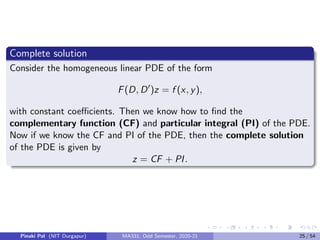
Complete solution
Consider the homogeneous linear PDE of the form
F(D, D0
)z = f (x, y),
with constant coefficients. Then we know how to find the
complementary function (CF) and particular integral (PI) of the PDE.
Now if we know the CF and PI of the PDE, then the complete solution
of the PDE is given by
z = CF + PI.
Pinaki Pal (NIT Durgapur) MA331; Odd Semester, 2020-21 25 / 54
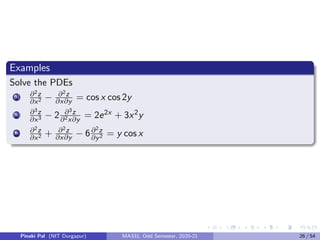
Examples
Solve the PDEs
(i) ∂2z
∂x2 − ∂2z
∂x∂y = cos x cos 2y
(ii) ∂3z
∂x3 − 2 ∂3z
∂2x∂y
= 2e2x + 3x2y
(iii) ∂2z
∂x2 + ∂2z
∂x∂y − 6∂2z
∂y2 = y cos x
Pinaki Pal (NIT Durgapur) MA331; Odd Semester, 2020-21 26 / 54
Solution (i)
Auxiliary Equation is
m2
− m = 0 and the roots of it are m = 0, 1.
Therefore complementary function is z = φ1(y) + φ2(y + x).
Now
PI =
1
D2 − DD0
cos x cos 2y =
1
2
1
D2 − DD0
[cos(x + 2y) + cos(x − 2y)]
=
1
2

1
1 − 2
ZZ
cos tdtdt +
1
1 + 2
ZZ
cos t1dt1dt1

=
1
2

cos t −
1
3
cos t1

=
1
2
cos(x + 2y) −
1
6
cos(x − 2y)
Hence the complete solution is give by,
z = φ1(y) + φ2(y + x) +
1
2
cos(x + 2y) −
1
6
cos(x − 2y).
Pinaki Pal (NIT Durgapur) MA331; Odd Semester, 2020-21 27 / 54
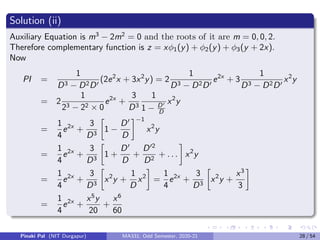
Solution (ii)
Auxiliary Equation is m3
− 2m2
= 0 and the roots of it are m = 0, 0, 2.
Therefore complementary function is z = xφ1(y) + φ2(y) + φ3(y + 2x).
Now
PI =
1
D3 − D2D0
(2e2
x + 3x2
y) = 2
1
D3 − D2D0
e2x
+ 3
1
D3 − D2D0
x2
y
= 2
1
23 − 22 × 0
e2x
+
3
D3
1
1 − D0
D
x2
y
=
1
4
e2x
+
3
D3

1 −
D0
D
−1
x2
y
=
1
4
e2x
+
3
D3

1 +
D0
D
+
D02
D2
+ . . .

x2
y
=
1
4
e2x
+
3
D3

x2
y +
1
D
x2

=
1
4
e2x
+
3
D3

x2
y +
x3
3

=
1
4
e2x
+
x5
y
20
+
x6
60
Pinaki Pal (NIT Durgapur) MA331; Odd Semester, 2020-21 28 / 54
So the complete solution is given by
z = xφ1(y) + φ2(y) + φ3(y + 2x +
1
4
e2x
+
x5y
20
+
x6
60
.
Solution (iii)
Auxiliary Equation is m2 + m − 6 = 0 and the roots of it are m = 2, −3.
Therefore complementary function is z = φ1(y + 2x) + φ2(y − 3x).
Now
PI =
1
D2 + DD0 − 6D02
y cos x =
1
(D + 3D0)(D − 2D0)
y cos x
=
1
(D + 3D0)
Z
(c − 2x) cos xdx [∵ y = c − 2x]
=
1
(D + 3D0)
[c sin x − 2x sin x − cos x]
=
1
(D + 3D0)
[(y + 2x) sin x − 2x sin x − cos x]
Pinaki Pal (NIT Durgapur) MA331; Odd Semester, 2020-21 29 / 54
∴ PI =
1
(D + 3D0)
[y sin x − cos x]
=
Z
[(c + 3x) sin x − cos x] dx [∵ y = c + 3x]
= −c cos x − sin x − 3x cos x + 3 sin x
= −(y − 3x) cos x − sin x − 3x cos x + 3 sin x
= −y cos x + 2 sin x
Hence the complete solution is given by
z = φ1(y + 2x) + φ2(y − 3x) − y cos x + 2 sin x.
Pinaki Pal (NIT Durgapur) MA331; Odd Semester, 2020-21 30 / 54
Pinaki Pal (NIT Durgapur) MA331; Odd Semester, 2020-21 31 / 54
Lecture 6: 08.10.2020
Pinaki Pal (NIT Durgapur) MA331; Odd Semester, 2020-21 32 / 54
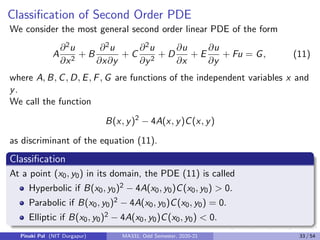
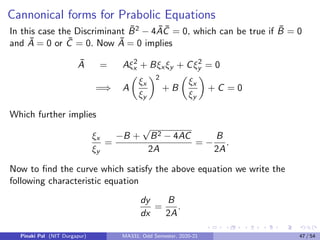
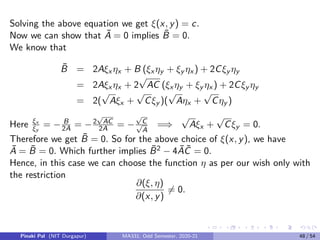
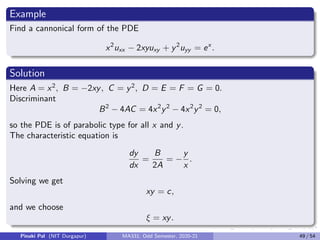
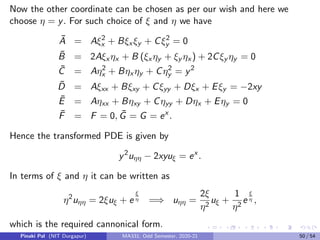
Classification of Second Order PDE
We consider the most general second order linear PDE of the form
A
∂2u
∂x2
+ B
∂2u
∂x∂y
+ C
∂2u
∂y2
+ D
∂u
∂x
+ E
∂u
∂y
+ Fu = G, (11)
where A, B, C, D, E, F, G are functions of the independent variables x and
y.
We call the function
B(x, y)2
− 4A(x, y)C(x, y)
as discriminant of the equation (11).
Classification
At a point (x0, y0) in its domain, the PDE (11) is called
Hyperbolic if B(x0, y0)2 − 4A(x0, y0)C(x0, y0)  0.
Parabolic if B(x0, y0)2 − 4A(x0, y0)C(x0, y0) = 0.
Elliptic if B(x0, y0)2 − 4A(x0, y0)C(x0, y0)  0.
Pinaki Pal (NIT Durgapur) MA331; Odd Semester, 2020-21 33 / 54
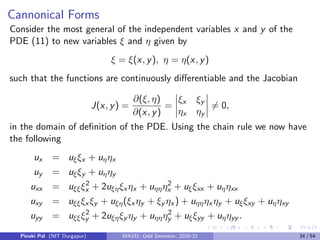
Cannonical Forms
Consider the most general of the independent variables x and y of the
PDE (11) to new variables ξ and η given by
ξ = ξ(x, y), η = η(x, y)
such that the functions are continuously differentiable and the Jacobian
J(x, y) =
∂(ξ, η)
∂(x, y)
=
ξx ξy
ηx ηy
6= 0,
in the domain of definition of the PDE. Using the chain rule we now have
the following
ux = uξξx + uηηx
uy = uξξy + uηηy
uxx = uξξξ2
x + 2uξηξx ηx + uηηη2
x + uξξxx + uηηxx
uxy = uξξξx ξy + uξη(ξx ηy + ξy ηx ) + uηηηx ηy + uξξxy + uηηxy
uyy = uξξξ2
y + 2uξηξy ηy + uηηη2
y + uξξyy + uηηyy .
Pinaki Pal (NIT Durgapur) MA331; Odd Semester, 2020-21 34 / 54
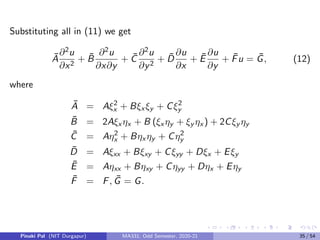
Substituting all in (11) we get
Ā
∂2u
∂x2
+ B̄
∂2u
∂x∂y
+ C̄
∂2u
∂y2
+ D̄
∂u
∂x
+ Ē
∂u
∂y
+ F̄u = Ḡ, (12)
where
Ā = Aξ2
x + Bξx ξy + Cξ2
y
B̄ = 2Aξx ηx + B (ξx ηy + ξy ηx ) + 2Cξy ηy
C̄ = Aη2
x + Bηx ηy + Cη2
y
D̄ = Aξxx + Bξxy + Cξyy + Dξx + Eξy
Ē = Aηxx + Bηxy + Cηyy + Dηx + Eηy
F̄ = F, Ḡ = G.
Pinaki Pal (NIT Durgapur) MA331; Odd Semester, 2020-21 35 / 54
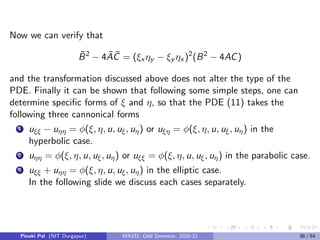
Now we can verify that
B̄2
− 4ĀC̄ = (ξx ηy − ξy ηx )2
(B2
− 4AC)
and the transformation discussed above does not alter the type of the
PDE. Finally it can be shown that following some simple steps, one can
determine specific forms of ξ and η, so that the PDE (11) takes the
following three cannonical forms
1 uξξ − uηη = φ(ξ, η, u, uξ, uη) or uξη = φ(ξ, η, u, uξ, uη) in the
hyperbolic case.
2 uηη = φ(ξ, η, u, uξ, uη) or uξξ = φ(ξ, η, u, uξ, uη) in the parabolic case.
3 uξξ + uηη = φ(ξ, η, u, uξ, uη) in the elliptic case.
In the following slide we discuss each cases separately.
Pinaki Pal (NIT Durgapur) MA331; Odd Semester, 2020-21 36 / 54
Lecture 7: 09.10.2020
Pinaki Pal (NIT Durgapur) MA331; Odd Semester, 2020-21 37 / 54
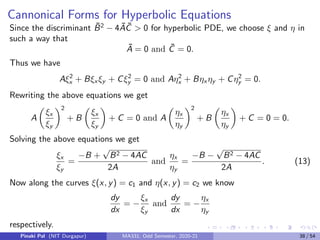
Cannonical Forms for Hyperbolic Equations
Since the discriminant B̄2
− 4ĀC̄  0 for hyperbolic PDE, we choose ξ and η in
such a way that
Ā = 0 and C̄ = 0.
Thus we have
Aξ2
x + Bξx ξy + Cξ2
y = 0 and Aη2
x + Bηx ηy + Cη2
y = 0.
Rewriting the above equations we get
A

ξx
ξy
2
+ B

ξx
ξy

+ C = 0 and A

ηx
ηy
2
+ B

ηx
ηy

+ C = 0 = 0.
Solving the above equations we get
ξx
ξy
=
−B +
√
B2 − 4AC
2A
and
ηx
ηy
=
−B −
√
B2 − 4AC
2A
. (13)
Now along the curves ξ(x, y) = c1 and η(x, y) = c2 we know
dy
dx
= −
ξx
ξy
and
dy
dx
= −
ηx
ηy
respectively.
Pinaki Pal (NIT Durgapur) MA331; Odd Semester, 2020-21 38 / 54
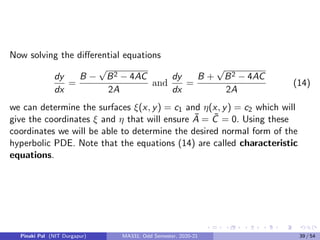
Now solving the differential equations
dy
dx
=
B −
√
B2 − 4AC
2A
and
dy
dx
=
B +
√
B2 − 4AC
2A
(14)
we can determine the surfaces ξ(x, y) = c1 and η(x, y) = c2 which will
give the coordinates ξ and η that will ensure Ā = C̄ = 0. Using these
coordinates we will be able to determine the desired normal form of the
hyperbolic PDE. Note that the equations (14) are called characteristic
equations.
Pinaki Pal (NIT Durgapur) MA331; Odd Semester, 2020-21 39 / 54
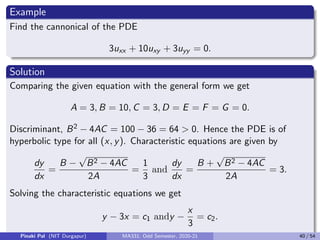
Example
Find the cannonical of the PDE
3uxx + 10uxy + 3uyy = 0.
Solution
Comparing the given equation with the general form we get
A = 3, B = 10, C = 3, D = E = F = G = 0.
Discriminant, B2 − 4AC = 100 − 36 = 64  0. Hence the PDE is of
hyperbolic type for all (x, y). Characteristic equations are given by
dy
dx
=
B −
√
B2 − 4AC
2A
=
1
3
and
dy
dx
=
B +
√
B2 − 4AC
2A
= 3.
Solving the characteristic equations we get
y − 3x = c1 andy −
x
3
= c2.
x
Pinaki Pal (NIT Durgapur) MA331; Odd Semester, 2020-21 40 / 54
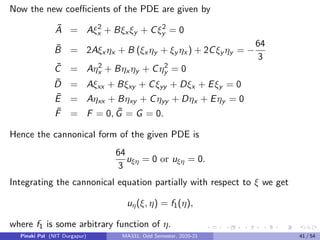
Now the new coefficients of the PDE are given by
Ā = Aξ2
x + Bξx ξy + Cξ2
y = 0
B̄ = 2Aξx ηx + B (ξx ηy + ξy ηx ) + 2Cξy ηy = −
64
3
C̄ = Aη2
x + Bηx ηy + Cη2
y = 0
D̄ = Aξxx + Bξxy + Cξyy + Dξx + Eξy = 0
Ē = Aηxx + Bηxy + Cηyy + Dηx + Eηy = 0
F̄ = F = 0, Ḡ = G = 0.
Hence the cannonical form of the given PDE is
64
3
uξη = 0 or uξη = 0.
Integrating the cannonical equation partially with respect to ξ we get
uη(ξ, η) = f1(η),
where f1 is some arbitrary function of η.
Pinaki Pal (NIT Durgapur) MA331; Odd Semester, 2020-21 41 / 54
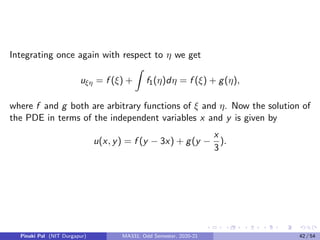
Integrating once again with respect to η we get
uξη = f (ξ) +
Z
f1(η)dη = f (ξ) + g(η),
where f and g both are arbitrary functions of ξ and η. Now the solution of
the PDE in terms of the independent variables x and y is given by
u(x, y) = f (y − 3x) + g(y −
x
3
).
Pinaki Pal (NIT Durgapur) MA331; Odd Semester, 2020-21 42 / 54
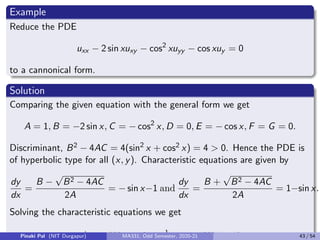
Example
Reduce the PDE
uxx − 2 sin xuxy − cos2
xuyy − cos xuy = 0
to a cannonical form.
Solution
Comparing the given equation with the general form we get
A = 1, B = −2 sin x, C = − cos2
x, D = 0, E = − cos x, F = G = 0.
Discriminant, B2 − 4AC = 4(sin2
x + cos2 x) = 4  0. Hence the PDE is
of hyperbolic type for all (x, y). Characteristic equations are given by
dy
dx
=
B −
√
B2 − 4AC
2A
= − sin x−1 and
dy
dx
=
B +
√
B2 − 4AC
2A
= 1−sin x.
Solving the characteristic equations we get
y + x − cos x = c1 andy − x − cos x = c2.
Pinaki Pal (NIT Durgapur) MA331; Odd Semester, 2020-21 43 / 54
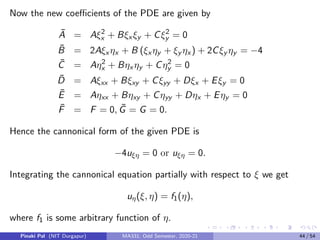
Now the new coefficients of the PDE are given by
Ā = Aξ2
x + Bξx ξy + Cξ2
y = 0
B̄ = 2Aξx ηx + B (ξx ηy + ξy ηx ) + 2Cξy ηy = −4
C̄ = Aη2
x + Bηx ηy + Cη2
y = 0
D̄ = Aξxx + Bξxy + Cξyy + Dξx + Eξy = 0
Ē = Aηxx + Bηxy + Cηyy + Dηx + Eηy = 0
F̄ = F = 0, Ḡ = G = 0.
Hence the cannonical form of the given PDE is
−4uξη = 0 or uξη = 0.
Integrating the cannonical equation partially with respect to ξ we get
uη(ξ, η) = f1(η),
where f1 is some arbitrary function of η.
Pinaki Pal (NIT Durgapur) MA331; Odd Semester, 2020-21 44 / 54
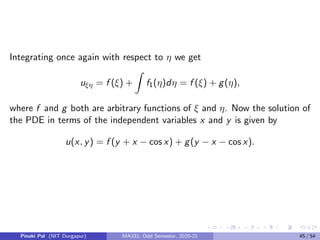
Integrating once again with respect to η we get
uξη = f (ξ) +
Z
f1(η)dη = f (ξ) + g(η),
where f and g both are arbitrary functions of ξ and η. Now the solution of
the PDE in terms of the independent variables x and y is given by
u(x, y) = f (y + x − cos x) + g(y − x − cos x).
Pinaki Pal (NIT Durgapur) MA331; Odd Semester, 2020-21 45 / 54
Lecture 8: 29.10.2020
Pinaki Pal (NIT Durgapur) MA331; Odd Semester, 2020-21 46 / 54

Lectures4 8

  • 1.
    Linear PDE withConstant Coefficients Pinaki Pal Department of Mathematics National Institute of Technology Durgapur West Bengal, India pinaki.pal@maths.nitdgp.ac.in Pinaki Pal (NIT Durgapur) MA331; Odd Semester, 2020-21 1 / 54
  • 2.
    Linear PDE A linearPDE of order n in the dependent variable z and independent variables x and y can be represented in the form f ( ∂nz ∂xn , ∂nz ∂xn−1∂y , . . . , ∂nz ∂yn , ∂n−1z ∂xn−1 , ∂n−1z ∂xn−2∂y , . . . , ∂n−1z ∂yn−1 , . . . , ∂z ∂x , ∂z ∂y , z, x, y) = 0, (1) where the powers of the dependent variable and its derivatives are strictly equal to one. Moreover, no product of the dependent variable and its derivatives can appear in any term of the equation (1). Pinaki Pal (NIT Durgapur) MA331; Odd Semester, 2020-21 2 / 54
  • 3.
    Examples Check whether thefollowing PDEs are linear or not 1 (x2 + y)∂2z ∂x2 + 3∂z ∂y + z = x3 (Linear PDE of order 2) 2 2∂3z ∂y3 + (3x − y)∂z ∂y + x2z = yx (Linear PDE of order 3) 3 ∂4z ∂x4 − 5∂z ∂y + 2z = yx (Linear PDE of order 4) 4 ∂4z ∂x4 − 5 h ∂z ∂y i2 + 2z = yx (Not linear) 5 ∂4z ∂x4 − 5∂z ∂y + 2z2 = yx + 3 (Not linear) 6 ∂4z ∂y4 − 5∂z ∂y z = yx2 (Not linear) Pinaki Pal (NIT Durgapur) MA331; Odd Semester, 2020-21 3 / 54
  • 4.
    Linear PDE withconstant coefficients A linear PDE, in which coefficients of the dependent variable and its derivatives are constants is called a linear PDE with constant coefficients. Examples Check whether the following equations are linear PDE with constant coefficients 1 ∂4z ∂y4 − 5∂z ∂y = yx2 (Yes) 2 ∂2z ∂y2 + ∂2z ∂x∂y − 5∂z ∂y = y (Yes) 3 ∂3z ∂y3 − 5∂z ∂y = 0 (Yes) 4 ∂3z ∂y3 + 2x ∂2z ∂x∂y − 5∂z ∂y = 5x2 (Linear but not with variable coefficients) 5 4∂3z ∂y3 + 3 ∂3z ∂x∂y2 − 5∂z ∂y + 7z = x + sin y (Yes) Pinaki Pal (NIT Durgapur) MA331; Odd Semester, 2020-21 4 / 54
  • 5.
    Linear PDE withconstant coefficients can further be divided into two different classes namely homogeneous and nonhomogeneous. Liner homogeneous PDE with constant coefficients An equation of the form ∂zn ∂xn +a1 ∂zn ∂xn−1∂y +a2 ∂zn ∂xn−2∂y2 +· · ·+an−1 ∂zn ∂x∂yn−1 +an ∂zn ∂yn = f (x, y), (2) where a1, a2, . . . and an are constants and f is a function of the independent variables, is called a linear homogeneous PDE of order n with constant coefficients. Note that all the derivatives appeared in the equation are of same order. Liner nonhomogeneous PDE with constant coefficients A linear PDE with constant coefficients consisting of at least two derivatives of different orders or a term involving the dependent variable is called nonhomogeneous linear PDE with constant coefficients. Pinaki Pal (NIT Durgapur) MA331; Odd Semester, 2020-21 5 / 54
  • 6.
    Examples ∂2z ∂x2 + 5∂2z ∂x∂y − 3∂2z ∂y2 = x sin x (Homogeneous) ∂3z ∂x3 + 7 ∂3z ∂x2∂y = 0 (Homogeneous) ∂3z ∂x3 + ∂2z ∂x∂y = 0 (Nonhomogeneous) ∂4z ∂y4 + ∂4z ∂x2∂y2 − 3z = 0 (Nonhomogeneous) ∂3z ∂x3 + ∂2z ∂x∂y = x (Nonhomogeneous) Pinaki Pal (NIT Durgapur) MA331; Odd Semester, 2020-21 6 / 54
  • 7.
    General solution ofthe homogeneous linear PDE with constant coefficients Consider the homogeneous linear PDE ∂zn ∂xn +a1 ∂zn ∂xn−1∂y +a2 ∂zn ∂xn−2∂y2 +· · ·+an−1 ∂zn ∂x∂yn−1 +an ∂zn ∂yn = f (x, y), (3) where a1, a2, . . . and an are constants and f is a function of the independent variables. Introducing the notations D = ∂ ∂x and D0 = ∂ ∂y we can write the above equation in the form F(D, D0 )z = f (x, y), (4) where f (D, D0) = Dn + a1Dn−1D0 + · · · + an−1DD0n−1 + anD0n. Now to find the general solution of the PDE (3), we first find the general solution of it when f (x, y) = 0. In that case the PDE (3) reduces to F(D, D0 )z = 0. (5) Pinaki Pal (NIT Durgapur) MA331; Odd Semester, 2020-21 7 / 54
  • 8.
    Let z =φ(y + mx) be a solution of the PDE (5). Then substituting z in (5) we get (mn + a1mn−1 + a2mn−2 + · · · + an−1m + an)φn (y + mx) = 0 (6) =⇒ mn + a1mn−1 + a2mn−2 + · · · + an−1m + an = 0. (7) Now we observe that the equation (7), called the auxiliary equation is a polynomial of degree n and let us suppose the not necessarily distinct roots of the polynomial are m1, m2, m3, . . . , mn. In the following we consider following two possible cases. Distinct roots: m1, m2, m3, . . . , mn are distinct real or complex numbers. The complete solution of the PDE (5) is then given by z = φ1(y + m1x) + φ2(y + m2x) + · · · + φn(y + mnx), where φ1, φ2, . . . are arbitrary functions. Pinaki Pal (NIT Durgapur) MA331; Odd Semester, 2020-21 8 / 54
  • 9.
    Repeated roots: Leta particular root m of the equation (7) is repeated r times. Then the contribution of this root to the complete solution of the PDE (5) will be xr−1 φ1(y + mx) + xr−2 φ2(y + mx) + · · · + φr (y + mx), while the contributions of the distinct roots to complete solution will be same as the previous case. The following examples will illustrate the procedure. Note that the compete solution of the PDE (5) is called the complementary function (CF) of the PDE (2). Examples Solve the PDEs: (i)(D3 − 6D2D0 + 11DD02 − 6D02)z = 0, (ii) (D3 − 3D2D0 + 3DD02 − D03)z = 0, (iii) (D4 − D04)z = 0, (iv) (D4 − 2D3D0 + 2DD02 − D04)z = 0. Pinaki Pal (NIT Durgapur) MA331; Odd Semester, 2020-21 9 / 54
  • 10.
    Solution (i) Given equationis (D3 − 6D2D0 + 11DD02 − 6D02)z = 0. Auxiliary equation is m3 − 6m2 + 11m − 6 = 0. The roots of the auxiliary equation are m = 1, 2, 3, which are distinct. Therefore, complete solutions of the given PDE is z = φ1(y + x) + φ2(y + 2x) + φ3(y + 3x), where φ1, φ2 and φ3 are arbitrary functions. Solution (ii) Given equation is (D3 − 3D2D0 + 3DD02 − D03)z = 0. Auxiliary equation is m3 − 3m2 + 3m − 1 = 0. The roots of the auxiliary equation are m = 1, 1, 1, which are repeated. Therefore, complete solutions of the given PDE is z = x2 φ1(y + x) + xφ2(y + x) + φ3(y + x), where φ1, φ2 and φ3 are arbitrary functions. Pinaki Pal (NIT Durgapur) MA331; Odd Semester, 2020-21 10 / 54
  • 11.
    Solution (iii) Given equationis (D4 − D04 )z = 0. Auxiliary equation is m4 − 1 = 0. The roots of the auxiliary equation are m = 1, −1, i, −i, which are distinct. Note that there are complex conjugate roots. Therefore, complete solutions of the given PDE is z = φ1(y + x) + φ2(y − x) + φ3(y + ix) + φ4(y − ix), where φ1, φ2, phi3 and φ4 are arbitrary functions. Solution (iv) Given equation is (D4 − 2D3 D0 + 2DD02 − D04 )z = 0. Auxiliary equation is m4 − 2m3 + 2m − 1 = 0. The roots of the auxiliary equation are m = 1, 1, 1, −1, which are distinct. Therefore, complete solutions of the given PDE is z = x2 φ1(y + x) + xφ2(y + x) + φ3(y + x) + φ4(y − x), where φ1, φ2, phi3 and φ4 are arbitrary functions. Pinaki Pal (NIT Durgapur) MA331; Odd Semester, 2020-21 11 / 54
  • 12.
    Now we considerthe the PDE F(D, D0 )z = f (x, y), again and define the Particular Integral (PI) of as follows. Particular Integral It is a function u of x and y denoted by the symbol 1 F(D, D0) f (x, y). The function u is such that the action of the operator F(D, D0) on u returns the function f (x, y). i.e. F(D, D0 )u = f (x, y). Clearly u(x, y) is a particular function which satisfy the PDE homogeneous PDE (4). Note that PI does not involve any arbitrary function or constant. Pinaki Pal (NIT Durgapur) MA331; Odd Semester, 2020-21 12 / 54
  • 13.
    General Method Meaning of1 D f (x, y) and 1 D0 f (x, y) Let 1 D f (x, y) = X(x, y), =⇒ ∂X ∂x = f (x, y) Integrating, X = Z f (x, y)dx (Partil Integration w.r.t. x) Similarly 1 D0 f (x, y) means partial integration of f (x, y) w.r.t. y. . Now let m1, m2, . . . , mn are the roots of the auxiliary equation. Then F(D, D0 ) = (D − m1D0 )(D − m2D0 ) . . . (D − mnD0 ), Pinaki Pal (NIT Durgapur) MA331; Odd Semester, 2020-21 13 / 54
  • 14.
    which implies 1 F(D, D0) f(x, y) = 1 (D − m1D0)(D − m2D0) . . . (D − mnD0) f (x, y) = 1 (D − m1D0)(D − m2D0) . . . (D − mn−1D0) X1, (8) where X1 = 1 (D−mnD0) f (x, y). Therefore, (D − mnD0 )X1 = f (x, y), Or, ∂X1 ∂x − mn ∂X1 ∂y = f (x, y). (9) Now the equation (9) is a Lagrange’s equation whose subsidiary equation is given by dx 1 = dy −mn = dX1 f (x, y) . (10) Pinaki Pal (NIT Durgapur) MA331; Odd Semester, 2020-21 14 / 54
  • 15.
    From the firsttwo terms of the simultaneous differential equations (10) we get y = c − mnx, where c is an arbitrary constant. Now from the first and third terms of equation (10), we get X1 = Z f (x, c − mnx)dx and after integration we have to replace c by y + mnx. Therefore, to find the particular integral 1 F(D, D0) f (x, y) we need to repeat the above procedure n number of times. Although the method is general but often it is lengthy. In the following we discuss some short methods for finding particular integral. Pinaki Pal (NIT Durgapur) MA331; Odd Semester, 2020-21 15 / 54
  • 16.
    Short Methods I: f(x, y) = xm yn , m and n are some positive integers In this case the the function 1 F(D,D0) is either expanded in an infinite series of ascending powers of D or D0 and action of the resulting infinite series operator on f (x, y) is determined to find the PI. Examples Find particular integrals of the PDEs (i) (D2 − a2D02)z = x(a = constant), (ii) (D2 + 3DD0 + 2D02)z = x + y, (iii) (D2 − DD0 − 6D02)z = xy Pinaki Pal (NIT Durgapur) MA331; Odd Semester, 2020-21 16 / 54
  • 17.
    Solution (i) Here f(x, y) = x. ∴ PI = 1 D2 − a2D02 x = − 1 a2D02 1 − D2 a2D02 −1 x = − 1 a2D02 1 + D2 a2D02 + . . . x = − 1 a2D02 x = − 1 a2 · 1 D02 x = − xy2 2a2 . Pinaki Pal (NIT Durgapur) MA331; Odd Semester, 2020-21 17 / 54
  • 18.
    Solution (ii) PI = 1 D2+ 3DD0 + 2D02 (x + y) = 1 D2 1 + 3D0 D + 2D02 D2 −1 (x + y) = 1 D2 1 − 3D0 D + . . . = 1 D2 x + y − 3 D 1 = 1 D2 (y + x − 3x) = 1 D2 (y − 2x) = x2y 2 − x3 3 . Pinaki Pal (NIT Durgapur) MA331; Odd Semester, 2020-21 18 / 54
  • 19.
    Solution (iii) PI = 1 D2− DD0 − 6D02 xy = 1 D2 1 − D D0 − 6 D02 D2 −1 xy = 1 D2 1 + D D0 + . . . xy = 1 D2 xy + x2 2 = 1 6 x3 y + x4 24 Pinaki Pal (NIT Durgapur) MA331; Odd Semester, 2020-21 19 / 54
  • 20.
    Lecture 5: 01.10.2020 PinakiPal (NIT Durgapur) MA331; Odd Semester, 2020-21 20 / 54
  • 21.
    II: f (x,y) = φ(ax + by) Under this case there are two possibilities. (a) F(a, b) 6= 0 PI = 1 F(D, D0) φ(ax + by) = 1 F(a, b) ZZ . . . n times φ(t)dtdt . . . dt, where n is the order of the PDE and t = ax + by. (b) F(D, D0 ) = (bD − aD0 )r ψ(D, D0 ) such that ψ(a, b) 6= 0. PI = 1 F(D, D0) φ(ax+by) = xr r!br 1 ψ(a, b) ZZ . . . (n−r) times ψ(t)dtdt . . . dt. Examples Find the particular integrals for the following PDEs. (i) (D2 + 2DD0 + D02)z = e2x+3y , (ii) (D2 + 3DD0 + 2D02)z = x + y, (iii) (D3 − 4D2D0 + 4DD02)z = cos(2x + y). Pinaki Pal (NIT Durgapur) MA331; Odd Semester, 2020-21 21 / 54
  • 22.
    Solution (i) Here F(D, D0 )= D2 + 2DD0 + D02 , f (x, y) = e2x+3y is of the form φ(ax + by) with a = 2 and b = 3 and F(a, b) = F(2, 3) = 22 + 2 × 2 × 3 + 32 = 25 6= 0. Therefore, PI = 1 D2 + 2DD0 + D02 e2x+3y = 1 22 + 2 × 2 × 3 + 32 Z ( Z et dt)dt = 1 25 et = 1 25 e2x+3y Pinaki Pal (NIT Durgapur) MA331; Odd Semester, 2020-21 22 / 54
  • 23.
    Solution (ii) Here F(D,D) = D2 + 3DD0 + 2D02, f (x, y) = x + y is of the form φ(ax + by) with a = b = 1 and F(1, 1) = 6 6= 0. Therefore, PI = 1 D2 + 3DD0 + 2D02 (x + y) = 1 12 + 3 × 1 × 1 + 2 × 12 Z ( Z tdt)dt = 1 6 t3 6 = (x + y)3 36 . Pinaki Pal (NIT Durgapur) MA331; Odd Semester, 2020-21 23 / 54
  • 24.
    Solution (iii) Here F(D,D) = D3 − 4D2D0 + 4DD02, f (x, y) = cos(2x + y) is of the form φ(ax + by) with a = 2, b = 1 and F(2, 1) = 0. Now we note that F(D, D0) = D(D − 2D0)2. So the particular integral is given by PI = 1 D3 − 4D2D0 + 4DD02 cos(2x + y) = 1 D(D − 2D0)2 cos(2x + y) = x2 2!12 1 D cos(2x + y) = x2 2 × 1 2 Z cos tdt = x2 4 sin t = x2 4 sin (2x + y). Pinaki Pal (NIT Durgapur) MA331; Odd Semester, 2020-21 24 / 54
  • 25.
    Complete solution Consider thehomogeneous linear PDE of the form F(D, D0 )z = f (x, y), with constant coefficients. Then we know how to find the complementary function (CF) and particular integral (PI) of the PDE. Now if we know the CF and PI of the PDE, then the complete solution of the PDE is given by z = CF + PI. Pinaki Pal (NIT Durgapur) MA331; Odd Semester, 2020-21 25 / 54
  • 26.
    Examples Solve the PDEs (i)∂2z ∂x2 − ∂2z ∂x∂y = cos x cos 2y (ii) ∂3z ∂x3 − 2 ∂3z ∂2x∂y = 2e2x + 3x2y (iii) ∂2z ∂x2 + ∂2z ∂x∂y − 6∂2z ∂y2 = y cos x Pinaki Pal (NIT Durgapur) MA331; Odd Semester, 2020-21 26 / 54
  • 27.
    Solution (i) Auxiliary Equationis m2 − m = 0 and the roots of it are m = 0, 1. Therefore complementary function is z = φ1(y) + φ2(y + x). Now PI = 1 D2 − DD0 cos x cos 2y = 1 2 1 D2 − DD0 [cos(x + 2y) + cos(x − 2y)] = 1 2 1 1 − 2 ZZ cos tdtdt + 1 1 + 2 ZZ cos t1dt1dt1 = 1 2 cos t − 1 3 cos t1 = 1 2 cos(x + 2y) − 1 6 cos(x − 2y) Hence the complete solution is give by, z = φ1(y) + φ2(y + x) + 1 2 cos(x + 2y) − 1 6 cos(x − 2y). Pinaki Pal (NIT Durgapur) MA331; Odd Semester, 2020-21 27 / 54
  • 28.
    Solution (ii) Auxiliary Equationis m3 − 2m2 = 0 and the roots of it are m = 0, 0, 2. Therefore complementary function is z = xφ1(y) + φ2(y) + φ3(y + 2x). Now PI = 1 D3 − D2D0 (2e2 x + 3x2 y) = 2 1 D3 − D2D0 e2x + 3 1 D3 − D2D0 x2 y = 2 1 23 − 22 × 0 e2x + 3 D3 1 1 − D0 D x2 y = 1 4 e2x + 3 D3 1 − D0 D −1 x2 y = 1 4 e2x + 3 D3 1 + D0 D + D02 D2 + . . . x2 y = 1 4 e2x + 3 D3 x2 y + 1 D x2 = 1 4 e2x + 3 D3 x2 y + x3 3 = 1 4 e2x + x5 y 20 + x6 60 Pinaki Pal (NIT Durgapur) MA331; Odd Semester, 2020-21 28 / 54
  • 29.
    So the completesolution is given by z = xφ1(y) + φ2(y) + φ3(y + 2x + 1 4 e2x + x5y 20 + x6 60 . Solution (iii) Auxiliary Equation is m2 + m − 6 = 0 and the roots of it are m = 2, −3. Therefore complementary function is z = φ1(y + 2x) + φ2(y − 3x). Now PI = 1 D2 + DD0 − 6D02 y cos x = 1 (D + 3D0)(D − 2D0) y cos x = 1 (D + 3D0) Z (c − 2x) cos xdx [∵ y = c − 2x] = 1 (D + 3D0) [c sin x − 2x sin x − cos x] = 1 (D + 3D0) [(y + 2x) sin x − 2x sin x − cos x] Pinaki Pal (NIT Durgapur) MA331; Odd Semester, 2020-21 29 / 54
  • 30.
    ∴ PI = 1 (D+ 3D0) [y sin x − cos x] = Z [(c + 3x) sin x − cos x] dx [∵ y = c + 3x] = −c cos x − sin x − 3x cos x + 3 sin x = −(y − 3x) cos x − sin x − 3x cos x + 3 sin x = −y cos x + 2 sin x Hence the complete solution is given by z = φ1(y + 2x) + φ2(y − 3x) − y cos x + 2 sin x. Pinaki Pal (NIT Durgapur) MA331; Odd Semester, 2020-21 30 / 54
  • 31.
    Pinaki Pal (NITDurgapur) MA331; Odd Semester, 2020-21 31 / 54
  • 32.
    Lecture 6: 08.10.2020 PinakiPal (NIT Durgapur) MA331; Odd Semester, 2020-21 32 / 54
  • 33.
    Classification of SecondOrder PDE We consider the most general second order linear PDE of the form A ∂2u ∂x2 + B ∂2u ∂x∂y + C ∂2u ∂y2 + D ∂u ∂x + E ∂u ∂y + Fu = G, (11) where A, B, C, D, E, F, G are functions of the independent variables x and y. We call the function B(x, y)2 − 4A(x, y)C(x, y) as discriminant of the equation (11). Classification At a point (x0, y0) in its domain, the PDE (11) is called Hyperbolic if B(x0, y0)2 − 4A(x0, y0)C(x0, y0) 0. Parabolic if B(x0, y0)2 − 4A(x0, y0)C(x0, y0) = 0. Elliptic if B(x0, y0)2 − 4A(x0, y0)C(x0, y0) 0. Pinaki Pal (NIT Durgapur) MA331; Odd Semester, 2020-21 33 / 54
  • 34.
    Cannonical Forms Consider themost general of the independent variables x and y of the PDE (11) to new variables ξ and η given by ξ = ξ(x, y), η = η(x, y) such that the functions are continuously differentiable and the Jacobian J(x, y) = ∂(ξ, η) ∂(x, y) =
  • 38.
  • 42.
    6= 0, in thedomain of definition of the PDE. Using the chain rule we now have the following ux = uξξx + uηηx uy = uξξy + uηηy uxx = uξξξ2 x + 2uξηξx ηx + uηηη2 x + uξξxx + uηηxx uxy = uξξξx ξy + uξη(ξx ηy + ξy ηx ) + uηηηx ηy + uξξxy + uηηxy uyy = uξξξ2 y + 2uξηξy ηy + uηηη2 y + uξξyy + uηηyy . Pinaki Pal (NIT Durgapur) MA331; Odd Semester, 2020-21 34 / 54
  • 43.
    Substituting all in(11) we get Ā ∂2u ∂x2 + B̄ ∂2u ∂x∂y + C̄ ∂2u ∂y2 + D̄ ∂u ∂x + Ē ∂u ∂y + F̄u = Ḡ, (12) where Ā = Aξ2 x + Bξx ξy + Cξ2 y B̄ = 2Aξx ηx + B (ξx ηy + ξy ηx ) + 2Cξy ηy C̄ = Aη2 x + Bηx ηy + Cη2 y D̄ = Aξxx + Bξxy + Cξyy + Dξx + Eξy Ē = Aηxx + Bηxy + Cηyy + Dηx + Eηy F̄ = F, Ḡ = G. Pinaki Pal (NIT Durgapur) MA331; Odd Semester, 2020-21 35 / 54
  • 44.
    Now we canverify that B̄2 − 4ĀC̄ = (ξx ηy − ξy ηx )2 (B2 − 4AC) and the transformation discussed above does not alter the type of the PDE. Finally it can be shown that following some simple steps, one can determine specific forms of ξ and η, so that the PDE (11) takes the following three cannonical forms 1 uξξ − uηη = φ(ξ, η, u, uξ, uη) or uξη = φ(ξ, η, u, uξ, uη) in the hyperbolic case. 2 uηη = φ(ξ, η, u, uξ, uη) or uξξ = φ(ξ, η, u, uξ, uη) in the parabolic case. 3 uξξ + uηη = φ(ξ, η, u, uξ, uη) in the elliptic case. In the following slide we discuss each cases separately. Pinaki Pal (NIT Durgapur) MA331; Odd Semester, 2020-21 36 / 54
  • 45.
    Lecture 7: 09.10.2020 PinakiPal (NIT Durgapur) MA331; Odd Semester, 2020-21 37 / 54
  • 46.
    Cannonical Forms forHyperbolic Equations Since the discriminant B̄2 − 4ĀC̄ 0 for hyperbolic PDE, we choose ξ and η in such a way that Ā = 0 and C̄ = 0. Thus we have Aξ2 x + Bξx ξy + Cξ2 y = 0 and Aη2 x + Bηx ηy + Cη2 y = 0. Rewriting the above equations we get A ξx ξy 2 + B ξx ξy + C = 0 and A ηx ηy 2 + B ηx ηy + C = 0 = 0. Solving the above equations we get ξx ξy = −B + √ B2 − 4AC 2A and ηx ηy = −B − √ B2 − 4AC 2A . (13) Now along the curves ξ(x, y) = c1 and η(x, y) = c2 we know dy dx = − ξx ξy and dy dx = − ηx ηy respectively. Pinaki Pal (NIT Durgapur) MA331; Odd Semester, 2020-21 38 / 54
  • 47.
    Now solving thedifferential equations dy dx = B − √ B2 − 4AC 2A and dy dx = B + √ B2 − 4AC 2A (14) we can determine the surfaces ξ(x, y) = c1 and η(x, y) = c2 which will give the coordinates ξ and η that will ensure Ā = C̄ = 0. Using these coordinates we will be able to determine the desired normal form of the hyperbolic PDE. Note that the equations (14) are called characteristic equations. Pinaki Pal (NIT Durgapur) MA331; Odd Semester, 2020-21 39 / 54
  • 48.
    Example Find the cannonicalof the PDE 3uxx + 10uxy + 3uyy = 0. Solution Comparing the given equation with the general form we get A = 3, B = 10, C = 3, D = E = F = G = 0. Discriminant, B2 − 4AC = 100 − 36 = 64 0. Hence the PDE is of hyperbolic type for all (x, y). Characteristic equations are given by dy dx = B − √ B2 − 4AC 2A = 1 3 and dy dx = B + √ B2 − 4AC 2A = 3. Solving the characteristic equations we get y − 3x = c1 andy − x 3 = c2. x Pinaki Pal (NIT Durgapur) MA331; Odd Semester, 2020-21 40 / 54
  • 49.
    Now the newcoefficients of the PDE are given by Ā = Aξ2 x + Bξx ξy + Cξ2 y = 0 B̄ = 2Aξx ηx + B (ξx ηy + ξy ηx ) + 2Cξy ηy = − 64 3 C̄ = Aη2 x + Bηx ηy + Cη2 y = 0 D̄ = Aξxx + Bξxy + Cξyy + Dξx + Eξy = 0 Ē = Aηxx + Bηxy + Cηyy + Dηx + Eηy = 0 F̄ = F = 0, Ḡ = G = 0. Hence the cannonical form of the given PDE is 64 3 uξη = 0 or uξη = 0. Integrating the cannonical equation partially with respect to ξ we get uη(ξ, η) = f1(η), where f1 is some arbitrary function of η. Pinaki Pal (NIT Durgapur) MA331; Odd Semester, 2020-21 41 / 54
  • 50.
    Integrating once againwith respect to η we get uξη = f (ξ) + Z f1(η)dη = f (ξ) + g(η), where f and g both are arbitrary functions of ξ and η. Now the solution of the PDE in terms of the independent variables x and y is given by u(x, y) = f (y − 3x) + g(y − x 3 ). Pinaki Pal (NIT Durgapur) MA331; Odd Semester, 2020-21 42 / 54
  • 51.
    Example Reduce the PDE uxx− 2 sin xuxy − cos2 xuyy − cos xuy = 0 to a cannonical form. Solution Comparing the given equation with the general form we get A = 1, B = −2 sin x, C = − cos2 x, D = 0, E = − cos x, F = G = 0. Discriminant, B2 − 4AC = 4(sin2 x + cos2 x) = 4 0. Hence the PDE is of hyperbolic type for all (x, y). Characteristic equations are given by dy dx = B − √ B2 − 4AC 2A = − sin x−1 and dy dx = B + √ B2 − 4AC 2A = 1−sin x. Solving the characteristic equations we get y + x − cos x = c1 andy − x − cos x = c2. Pinaki Pal (NIT Durgapur) MA331; Odd Semester, 2020-21 43 / 54
  • 52.
    Now the newcoefficients of the PDE are given by Ā = Aξ2 x + Bξx ξy + Cξ2 y = 0 B̄ = 2Aξx ηx + B (ξx ηy + ξy ηx ) + 2Cξy ηy = −4 C̄ = Aη2 x + Bηx ηy + Cη2 y = 0 D̄ = Aξxx + Bξxy + Cξyy + Dξx + Eξy = 0 Ē = Aηxx + Bηxy + Cηyy + Dηx + Eηy = 0 F̄ = F = 0, Ḡ = G = 0. Hence the cannonical form of the given PDE is −4uξη = 0 or uξη = 0. Integrating the cannonical equation partially with respect to ξ we get uη(ξ, η) = f1(η), where f1 is some arbitrary function of η. Pinaki Pal (NIT Durgapur) MA331; Odd Semester, 2020-21 44 / 54
  • 53.
    Integrating once againwith respect to η we get uξη = f (ξ) + Z f1(η)dη = f (ξ) + g(η), where f and g both are arbitrary functions of ξ and η. Now the solution of the PDE in terms of the independent variables x and y is given by u(x, y) = f (y + x − cos x) + g(y − x − cos x). Pinaki Pal (NIT Durgapur) MA331; Odd Semester, 2020-21 45 / 54
  • 54.
    Lecture 8: 29.10.2020 PinakiPal (NIT Durgapur) MA331; Odd Semester, 2020-21 46 / 54