It isdefined as an equation involving two or
more independent variables like x,y……., a
dependent variable like u and its partial
derivatives.
Partial Differential Equation can be formed
either by elimination of arbitrary constants or
by the elimination of arbitrary functions from
a relation involving three or more variables .
FORMATION OF PARTIAL DIFFERENTIAL
EQUATIONS
3.
The generalform of a first order partial
differential equation is
where x, y are two independent variables, z
is the dependent variable and p = zx and
q = zy
GENERAL FORM
)
1
......(
0
)
,
,
,
,
(
)
,
,
,
,
(
q
p
z
y
x
F
y
z
x
z
z
y
x
F
4.
1) COMPLETE INTEGRALSOLUTION
2) PARTICULAR SOLUTION
3) SINGULAR SOLUTION
4) GENERAL SOLUTION
DIFFERENT INTEGRALS OF PARTIAL
DIFFERNETIAL EQUATION
5.
Let
be thePartial Differential Equation.
The complete integral of equation (1) is given
by
where a and b are two arbitrary constants
COMPLETE SOLUTION
)
1
......(
0
)
,
,
,
,
(
)
,
,
,
,
(
q
p
z
y
x
F
y
z
x
z
z
y
x
F
)
2
(
..........
0
)
,
,
,
,
(
b
a
z
y
x
6.
A solutionobtained by giving the particular
values to the arbitrary constants in a complete
integral is called particular solution.
PARTICULAR SOLUTION
7.
It isthe relation between those specific
variables which involves no arbitrary constant
and is not obtainable as a particular integral
from the complete integral.
So, equation is
SINGULAR SOLUTION
0
,
0
0
)
,
,
,
,
(
b
a
b
a
z
y
x
8.
A relationbetween the variables involving
two independent functions of the given
variables together with an arbitrary function
of these variables is a general solution.
In this given equation
assume an arbitrary relation of form
GENERAL SOLUTION
)
2
(
..........
0
)
,
,
,
,
(
b
a
z
y
x
)
(a
f
b
9.
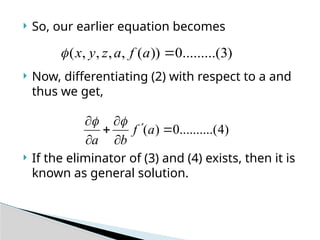
So, ourearlier equation becomes
Now, differentiating (2) with respect to a and
thus we get,
If the eliminator of (3) and (4) exists, then it is
known as general solution.
)
3
.........(
0
))
(
,
,
,
,
(
a
f
a
z
y
x
)
4
(
..........
0
)
(
a
f
b
a
10.
TYPE-1
The PartialDifferential equation of the form
has solution
and
STANDARD TYPES OF FIRST ORDER
EQUATIONS
0
)
,
(
q
p
f
c
by
ax
z
0
)
,
(
b
a
f
11.
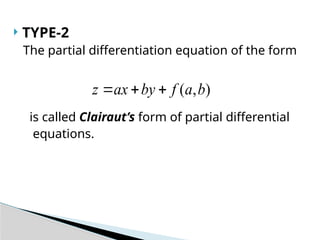
TYPE-2
The partialdifferentiation equation of the form
is called Clairaut’s form of partial differential
equations.
)
,
( b
a
f
by
ax
z
12.
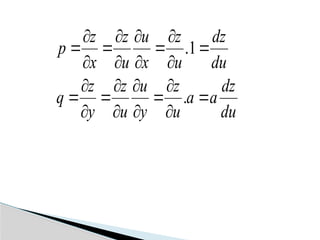
TYPE-3
Ifthe partial differential equations is given by
Then assume that
0
)
,
,
(
q
p
z
f
)
(
)
(
u
z
ay
x
u
ay
x
z
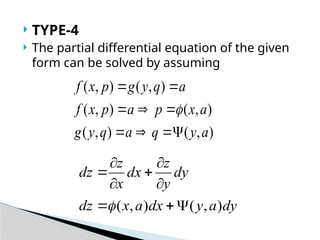
TYPE-4
Thepartial differential equation of the given
form can be solved by assuming
)
,
(
)
,
(
)
,
(
)
,
(
)
,
(
)
,
(
a
y
q
a
q
y
g
a
x
p
a
p
x
f
a
q
y
g
p
x
f
dy
a
y
dx
a
x
dz
dy
y
z
dx
x
z
dz
)
,
(
)
,
(
15.
1.Solve thepde and find the
complete and singular solutions
Solution
Complete solution is given by
with
EXAMPLES
1
2
q
p
c
by
ax
z
1
1
2
2
a
b
b
a
16.
c
y
a
ax
z
)
1
(2
d.w.r.to. a and c then
0
1
2
c
z
ay
x
a
z
Which is not possible
Hence there is no singular solution
17.
2.Solve pde
(or)xy
y
z
x
z
xy
pq
)
)(
(
Solution q
y
x
p
Assume that
dy
a
y
axdx
qdy
pdx
dz
a
y
q
ax
p
a
q
y
x
p
,