Laplace Transform
Why use Laplace Transforms?
 Find solution to differential equation using algebra
 Relationship to Fourier Transform allows easy way to
characterize systems
 No need for convolution of input and differential equation
solution
 Useful with multiple processes in system
How to use Laplace
 Find differential equations that describe system
 Obtain Laplace transform
 Perform algebra to solve for output or variable of interest
 Apply inverse transform to find solution
What are Laplace transforms?









j
j
st
st
dsesF
j
sFLtf
dtetftfLsF


)(
2
1
)}({)(
)()}({)(
1
0
 ‘t’ is real, ‘s’ is complex!
 Inverse requires complex analysis to solve
 Note “transform”: f(t)  F(s), where t is integrated
and s is variable
 Conversely F(s)  f(t), t is variable and s is
integrated
 Assumes f(t) = 0 for all t < 0
Evaluating F(s) = L{f(t)}
 Hard Way – do the integral

 



 











0
0 0
)(
0
)sin()(
sin)(
1
)(
)(
1
)10(
1
)(
1)(
dttesF
ttf
as
dtedteesF
etf
ss
dtesF
tf
st
tasstat
at
st
let
let
let
Integrate by parts
Evaluating F(s)=L{f(t)}- Hard Way
remember
  vduuvudv
)cos(,)sin(
,
tvdttdv
dtsedueu stst

 

 


 



0
0 0
0
)cos()1(
)cos()cos([)sin( ]
dttese
dttestedtte
stst
ststst
)sin(,)cos(
,
tvdttdv
dtsedueu stst

 










00
0
0
)sin()0()sin()sin([
)cos(
] dttesedtteste
dtte
stststst
st 2
0
0
2
0 0
2
1
1
)sin(
1)sin()1(
)sin(1)sin(
s
dtte
dttes
dttesdttse
st
st
stst






 




 

let
let
Substituting, we get:
It only gets worse…
Evaluating F(s) = L{f(t)}
 This is the easy way ...
 Recognize a few different transforms
 See table 2.3 on page 42 in textbook
 Or see handout ....
 Learn a few different properties
 Do a little math
Table of selected Laplace Transforms
1
1
)()()sin()(
1
)()()cos()(
1
)()()(
1
)()()(
2
2








s
sFtuttf
s
s
sFtuttf
as
sFtuetf
s
sFtutf
at
More transforms
1
!
)()()( 
 n
n
s
n
sFtuttf
66
5
2
1
120!5
)()()(,5
!1
)()()(,1
1!0
)()()(,0
ss
sFtuttfn
s
sFttutfn
ss
sFtutfn



1)()()(  sFttf 
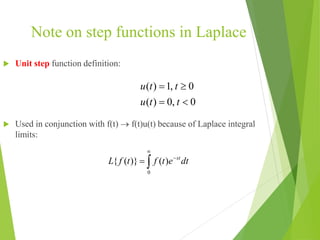
Note on step functions in Laplace




0
)()}({ dtetftfL st
 Unit step function definition:
 Used in conjunction with f(t)  f(t)u(t) because of Laplace integral
limits:
0,0)(
0,1)(


ttu
ttu
Properties of Laplace Transforms
 Linearity
 Scaling in time
 Time shift
 “frequency” or s-plane shift
 Multiplication by tn
 Integration
 Differentiation
Properties: Linearity
)()()}()({ 22112211 sFcsFctfctfcL 
Example :
1
1
)
1
)1()1(
(
2
1
)
1
1
1
1
(
2
1
}{
2
1
}{
2
1
}
2
1
2
1
{
)}{sinh(
22













ss
ss
ss
eLeL
eey
tL
tt
tt
Proof :
)()(
)()(
)]()([
)}()({
2211
0
22
0
11
22
0
11
2211
sFcsFc
dtetfcdtetfc
dtetfctfc
tfctfcL
stst
st












)(
1
)}({
a
s
F
a
atfL 
Example :
22
22
2
2
)(
1
)1
)(
1
(
1
)}{sin(












s
s
s
tL Proof :
)(
1
)(
1
1
,,
)(
)}({
0
)(
0
a
s
F
a
dueuf
a
du
a
dt
a
u
tatu
dteatf
atfL
a
u
a
s
st










let
Properties: Scaling in Time
Properties: Time Shift
)()}()({ 0
00 sFettuttfL st

Example :
as
e
tueL
s
ta





10
)10(
)}10({ Proof :
)()(
)(
,
)(
)()(
)}()({
00
0
0
0
0
0
)(
00
0
0
00
00
sFedueufe
dueuf
tutttu
dtettf
dtettuttf
ttuttfL
stsust
t
tus
t
st
st



















let
Properties: S-plane (frequency) shift
)()}({ asFtfeL at

Example :
22
)(
)}sin({






as
teL at Proof :
)(
)(
)(
)}({
0
)(
0
asF
dtetf
dtetfe
tfeL
tas
stat
at










Properties: Multiplication by tn
)()1()}({ sF
ds
d
tftL n
n
nn

Example :
1
!
)
1
()1(
)}({



n
n
n
n
n
s
n
sds
d
tutL Proof :
)()1()()1(
)()1(
)(
)()}({
0
0
0
0
sF
s
dtetf
s
dte
s
tf
dtettf
dtetfttftL
n
n
nst
n
n
n
st
n
n
n
stn
stnn























The “D” Operator
1. Differentiation shorthand
2. Integration shorthand
)()(
)(
)(
2
2
2
tf
dt
d
tfD
dt
tdf
tDf


)()(
)()(
tftDg
dttftg
t

 
)()(
)()(
1
tfDtg
dttftg
a
t
a


 if
then then
if
Properties: Integrals
s
sF
tfDL
)(
)}({ 1
0 
Example :
)}{sin(
1
1
)
1
)(
1
(
)}cos({
22
1
0
tL
ss
s
s
tDL





Proof :
let
stst
st
e
s
vdtedv
dttfdutgu
dtetgtL
tfDtg









1
,
)(),(
)()}{sin(
)()(
0
1
0



 
t
stst
dttftg
s
sF
dtetf
s
etg
s
0
0
)()(
)(
)(
1
])(
1
[




0
)()( dtetft st
If t=0, g(t)=0
for so
slower than


0
)()( tgdttf 0st
e
Properties: Derivatives
(this is the big one)
)0()()}({ 
 fssFtDfL
Example :
)}sin({
1
1
1
)1(
1
1
)0(
1
)}cos({
2
2
22
2
2
2
2
tL
s
s
ss
s
s
f
s
s
tDL














Proof :
)()0(
)()]([
)(,)(
,
)()}({
0
0
0
ssFf
dtetfstfe
tfvdttf
dt
d
dv
sedueu
dtetf
dt
d
tDfL
stst
stst
st













let
Difference in
 The values are only different if f(t) is not continuous @ t=0
 Example of discontinuous function: u(t)
)0(&)0(),0( fff 
1)0()0(
1)(lim)0(
0)(lim)0(
0
0









uf
tuf
tuf
t
t
?)}({ 2
tfDL
)0(')0()()0('))0()((
)0(')}({)0()()}({
)0(')0()0(),()(
2
2
fsFsFsffssFs
ftDfsLgssGtgDL
fDfgtDftg


let
)0()0()0(')0()()}({ )'1()'2()2()1( 
 nnnnnn
fsffsfssFstfDL 
NOTE: to take
you need the value @ t=0 for
called initial conditions!
We will use this to solve differential equations!

)(),(),...(),( 21
tftDftfDtfD nn
)}({ tfDL n
Properties: Nth order derivatives
)0()()}({ fssFtDfL 
)}({ 2
tfDL
)0()()}({)}({)(
)0(')0(
)()(
)0()()}({
)()()()( 2
fssFtDfLtgLsG
fg
tDftg
gssGtDgL
tfDtDgandtDftg





)0(')0()()0(')]0()([)0()()}({ 2
fsfsFsffssFsgssGtDgL 
.),(),( 43
etctfDtfD
Start with
Now apply again
let
then
remember
Can repeat for
)0()0()0(')0()()}({ )'1()'2()2()1( 
 nnnnnn
fsffsfssFstfDL 

Laplace transform

  • 1.
  • 2.
    Why use LaplaceTransforms?  Find solution to differential equation using algebra  Relationship to Fourier Transform allows easy way to characterize systems  No need for convolution of input and differential equation solution  Useful with multiple processes in system
  • 3.
    How to useLaplace  Find differential equations that describe system  Obtain Laplace transform  Perform algebra to solve for output or variable of interest  Apply inverse transform to find solution
  • 4.
    What are Laplacetransforms?          j j st st dsesF j sFLtf dtetftfLsF   )( 2 1 )}({)( )()}({)( 1 0  ‘t’ is real, ‘s’ is complex!  Inverse requires complex analysis to solve  Note “transform”: f(t)  F(s), where t is integrated and s is variable  Conversely F(s)  f(t), t is variable and s is integrated  Assumes f(t) = 0 for all t < 0
  • 5.
    Evaluating F(s) =L{f(t)}  Hard Way – do the integral                    0 0 0 )( 0 )sin()( sin)( 1 )( )( 1 )10( 1 )( 1)( dttesF ttf as dtedteesF etf ss dtesF tf st tasstat at st let let let Integrate by parts
  • 6.
    Evaluating F(s)=L{f(t)}- HardWay remember   vduuvudv )cos(,)sin( , tvdttdv dtsedueu stst              0 0 0 0 )cos()1( )cos()cos([)sin( ] dttese dttestedtte stst ststst )sin(,)cos( , tvdttdv dtsedueu stst              00 0 0 )sin()0()sin()sin([ )cos( ] dttesedtteste dtte stststst st 2 0 0 2 0 0 2 1 1 )sin( 1)sin()1( )sin(1)sin( s dtte dttes dttesdttse st st stst                let let Substituting, we get: It only gets worse…
  • 7.
    Evaluating F(s) =L{f(t)}  This is the easy way ...  Recognize a few different transforms  See table 2.3 on page 42 in textbook  Or see handout ....  Learn a few different properties  Do a little math
  • 8.
    Table of selectedLaplace Transforms 1 1 )()()sin()( 1 )()()cos()( 1 )()()( 1 )()()( 2 2         s sFtuttf s s sFtuttf as sFtuetf s sFtutf at
  • 9.
    More transforms 1 ! )()()(  n n s n sFtuttf 66 5 2 1 120!5 )()()(,5 !1 )()()(,1 1!0 )()()(,0 ss sFtuttfn s sFttutfn ss sFtutfn    1)()()(  sFttf 
  • 10.
    Note on stepfunctions in Laplace     0 )()}({ dtetftfL st  Unit step function definition:  Used in conjunction with f(t)  f(t)u(t) because of Laplace integral limits: 0,0)( 0,1)(   ttu ttu
  • 11.
    Properties of LaplaceTransforms  Linearity  Scaling in time  Time shift  “frequency” or s-plane shift  Multiplication by tn  Integration  Differentiation
  • 12.
    Properties: Linearity )()()}()({ 22112211sFcsFctfctfcL  Example : 1 1 ) 1 )1()1( ( 2 1 ) 1 1 1 1 ( 2 1 }{ 2 1 }{ 2 1 } 2 1 2 1 { )}{sinh( 22              ss ss ss eLeL eey tL tt tt Proof : )()( )()( )]()([ )}()({ 2211 0 22 0 11 22 0 11 2211 sFcsFc dtetfcdtetfc dtetfctfc tfctfcL stst st            
  • 13.
    )( 1 )}({ a s F a atfL  Example : 22 22 2 2 )( 1 )1 )( 1 ( 1 )}{sin(             s s s tLProof : )( 1 )( 1 1 ,, )( )}({ 0 )( 0 a s F a dueuf a du a dt a u tatu dteatf atfL a u a s st           let Properties: Scaling in Time
  • 14.
    Properties: Time Shift )()}()({0 00 sFettuttfL st  Example : as e tueL s ta      10 )10( )}10({ Proof : )()( )( , )( )()( )}()({ 00 0 0 0 0 0 )( 00 0 0 00 00 sFedueufe dueuf tutttu dtettf dtettuttf ttuttfL stsust t tus t st st                    let
  • 15.
    Properties: S-plane (frequency)shift )()}({ asFtfeL at  Example : 22 )( )}sin({       as teL at Proof : )( )( )( )}({ 0 )( 0 asF dtetf dtetfe tfeL tas stat at          
  • 16.
    Properties: Multiplication bytn )()1()}({ sF ds d tftL n n nn  Example : 1 ! ) 1 ()1( )}({    n n n n n s n sds d tutL Proof : )()1()()1( )()1( )( )()}({ 0 0 0 0 sF s dtetf s dte s tf dtettf dtetfttftL n n nst n n n st n n n stn stnn                       
  • 17.
    The “D” Operator 1.Differentiation shorthand 2. Integration shorthand )()( )( )( 2 2 2 tf dt d tfD dt tdf tDf   )()( )()( tftDg dttftg t    )()( )()( 1 tfDtg dttftg a t a    if then then if
  • 18.
    Properties: Integrals s sF tfDL )( )}({ 1 0 Example : )}{sin( 1 1 ) 1 )( 1 ( )}cos({ 22 1 0 tL ss s s tDL      Proof : let stst st e s vdtedv dttfdutgu dtetgtL tfDtg          1 , )(),( )()}{sin( )()( 0 1 0      t stst dttftg s sF dtetf s etg s 0 0 )()( )( )( 1 ])( 1 [     0 )()( dtetft st If t=0, g(t)=0 for so slower than   0 )()( tgdttf 0st e
  • 19.
    Properties: Derivatives (this isthe big one) )0()()}({   fssFtDfL Example : )}sin({ 1 1 1 )1( 1 1 )0( 1 )}cos({ 2 2 22 2 2 2 2 tL s s ss s s f s s tDL               Proof : )()0( )()]([ )(,)( , )()}({ 0 0 0 ssFf dtetfstfe tfvdttf dt d dv sedueu dtetf dt d tDfL stst stst st              let
  • 20.
    Difference in  Thevalues are only different if f(t) is not continuous @ t=0  Example of discontinuous function: u(t) )0(&)0(),0( fff  1)0()0( 1)(lim)0( 0)(lim)0( 0 0          uf tuf tuf t t
  • 21.
    ?)}({ 2 tfDL )0(')0()()0('))0()(( )0(')}({)0()()}({ )0(')0()0(),()( 2 2 fsFsFsffssFs ftDfsLgssGtgDL fDfgtDftg   let )0()0()0(')0()()}({ )'1()'2()2()1(  nnnnnn fsffsfssFstfDL  NOTE: to take you need the value @ t=0 for called initial conditions! We will use this to solve differential equations!  )(),(),...(),( 21 tftDftfDtfD nn )}({ tfDL n Properties: Nth order derivatives
  • 22.
    Properties: Nth orderderivatives )0()()}({ fssFtDfL  )}({ 2 tfDL )0()()}({)}({)( )0(')0( )()( )0()()}({ )()()()( 2 fssFtDfLtgLsG fg tDftg gssGtDgL tfDtDgandtDftg      )0(')0()()0(')]0()([)0()()}({ 2 fsfsFsffssFsgssGtDgL  .),(),( 43 etctfDtfD Start with Now apply again let then remember Can repeat for )0()0()0(')0()()}({ )'1()'2()2()1(   nnnnnn fsffsfssFstfDL 