Introduction 
 All braking systems require the use of a rotating (turning) unit 
and a nonrotating unit. Each of these units contains braking 
surfaces that, when rubbed together, give the braking action. 
 Brakes are either external contracting or internal expanding 
depending upon how the nonrotating braking surface is forced 
against the rotating braking surface. 
 The nonrotating unit may be placed inside the rotating drum with 
the drum acting as a cover for the braking surfaces. This type of 
brake is known as an internal-expanding brake because the 
nonrotating braking surface is forced outward against the drum to 
produce braking action. 
 This type of brake is used on the wheel brakes of cars and trucks 
because it permits a more compact and economical construction.
Construction 
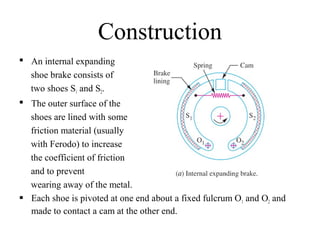
 An internal expanding 
shoe brake consists of 
two shoes S1 and S2. 
 The outer surface of the 
shoes are lined with some 
friction material (usually 
with Ferodo) to increase 
the coefficient of friction 
and to prevent 
wearing away of the metal. 
 Each shoe is pivoted at one end about a fixed fulcrum O1 and O2 and 
made to contact a cam at the other end.
Construction 
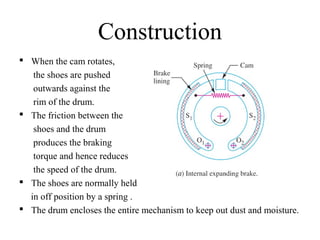
 When the cam rotates, 
the shoes are pushed 
outwards against the 
rim of the drum. 
 The friction between the 
shoes and the drum 
produces the braking 
torque and hence reduces 
the speed of the drum. 
 The shoes are normally held 
in off position by a spring . 
 The drum encloses the entire mechanism to keep out dust and moisture.
Working 
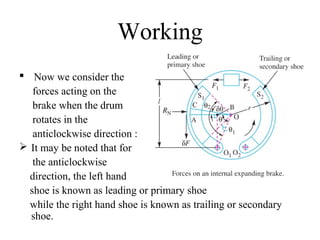
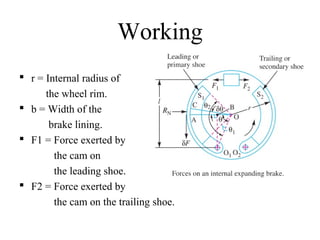
 Now we consider the 
forces acting on the 
brake when the drum 
rotates in the 
anticlockwise direction : 
 It may be noted that for 
the anticlockwise 
direction, the left hand 
shoe is known as leading or primary shoe 
while the right hand shoe is known as trailing or secondary 
shoe.
Working 
 r = Internal radius of 
the wheel rim. 
 b = Width of the 
brake lining. 
 F1 = Force exerted by 
the cam on 
the leading shoe. 
 F2 = Force exerted by 
the cam on the trailing shoe.
Working 
 r = Internal radius of 
the wheel rim. 
 b = Width of the 
brake lining. 
 F1 = Force exerted by 
the cam on 
the leading shoe. 
 F2 = Force exerted by 
the cam on the trailing shoe.

Internal expanding shoe brake short presentation

  • 1.
    Introduction  Allbraking systems require the use of a rotating (turning) unit and a nonrotating unit. Each of these units contains braking surfaces that, when rubbed together, give the braking action.  Brakes are either external contracting or internal expanding depending upon how the nonrotating braking surface is forced against the rotating braking surface.  The nonrotating unit may be placed inside the rotating drum with the drum acting as a cover for the braking surfaces. This type of brake is known as an internal-expanding brake because the nonrotating braking surface is forced outward against the drum to produce braking action.  This type of brake is used on the wheel brakes of cars and trucks because it permits a more compact and economical construction.
  • 2.
    Construction  Aninternal expanding shoe brake consists of two shoes S1 and S2.  The outer surface of the shoes are lined with some friction material (usually with Ferodo) to increase the coefficient of friction and to prevent wearing away of the metal.  Each shoe is pivoted at one end about a fixed fulcrum O1 and O2 and made to contact a cam at the other end.
  • 3.
    Construction  Whenthe cam rotates, the shoes are pushed outwards against the rim of the drum.  The friction between the shoes and the drum produces the braking torque and hence reduces the speed of the drum.  The shoes are normally held in off position by a spring .  The drum encloses the entire mechanism to keep out dust and moisture.
  • 4.
    Working  Nowwe consider the forces acting on the brake when the drum rotates in the anticlockwise direction :  It may be noted that for the anticlockwise direction, the left hand shoe is known as leading or primary shoe while the right hand shoe is known as trailing or secondary shoe.
  • 5.
    Working  r= Internal radius of the wheel rim.  b = Width of the brake lining.  F1 = Force exerted by the cam on the leading shoe.  F2 = Force exerted by the cam on the trailing shoe.
  • 6.
    Working  r= Internal radius of the wheel rim.  b = Width of the brake lining.  F1 = Force exerted by the cam on the leading shoe.  F2 = Force exerted by the cam on the trailing shoe.