ADVANCE ENGINEERING
MATHEMATICS
MADE BY:
MIHIR JAIN-36
AMIT JHALANI-37
ARNAV BHATT-38
ANMOL KHARE-39
SAJAL KHARE-40
PPT ON:
FIRST ORDER NON-LINEAR PARTIAL DIFFERENTIAL
EQUATION
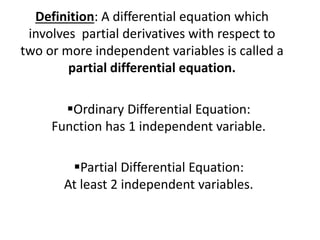
Definition: A differential equation which
involves partial derivatives with respect to
two or more independent variables is called a
partial differential equation.
Ordinary Differential Equation:
Function has 1 independent variable.
Partial Differential Equation:
At least 2 independent variables.
3
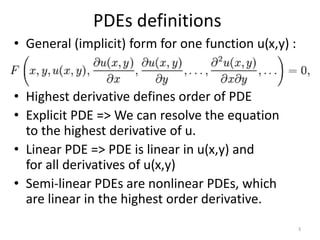
PDEs definitions
• General (implicit) form for one function u(x,y) :
• Highest derivative defines order of PDE
• Explicit PDE => We can resolve the equation
to the highest derivative of u.
• Linear PDE => PDE is linear in u(x,y) and
for all derivatives of u(x,y)
• Semi-linear PDEs are nonlinear PDEs, which
are linear in the highest order derivative.
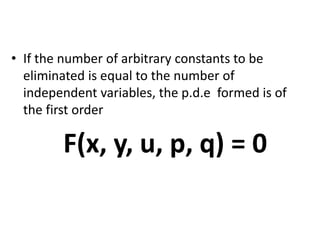
• If the number of arbitrary constants to be
eliminated is equal to the number of
independent variables, the p.d.e formed is of
the first order
F(x, y, u, p, q) = 0
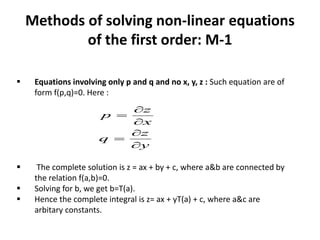
Methods of solving non-linear equations
of the first order: M-1
y
z
q
x
z
p






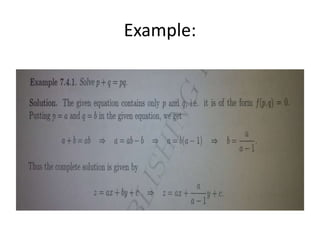
 Equations involving only p and q and no x, y, z : Such equation are of
form f(p,q)=0. Here :
 The complete solution is z = ax + by + c, where a&b are connected by
the relation f(a,b)=0.
 Solving for b, we get b=T(a).
 Hence the complete integral is z= ax + yT(a) + c, where a&c are
arbitary constants.
Example:
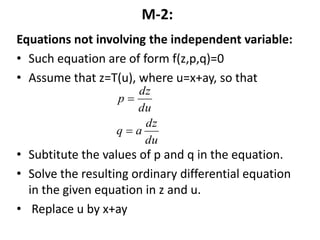
M-2:
Equations not involving the independent variable:
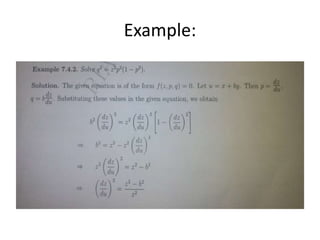
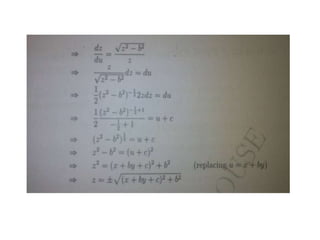
• Such equation are of form f(z,p,q)=0
• Assume that z=T(u), where u=x+ay, so that
• Subtitute the values of p and q in the equation.
• Solve the resulting ordinary differential equation
in the given equation in z and u.
• Replace u by x+ay
du
dz
aq
du
dz
p


Example:
M-3: Separable equations
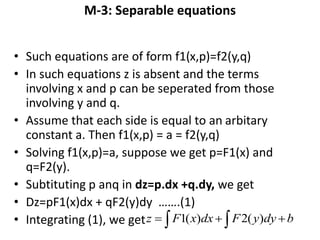
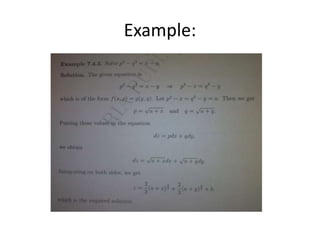
• Such equations are of form f1(x,p)=f2(y,q)
• In such equations z is absent and the terms
involving x and p can be seperated from those
involving y and q.
• Assume that each side is equal to an arbitary
constant a. Then f1(x,p) = a = f2(y,q)
• Solving f1(x,p)=a, suppose we get p=F1(x) and
q=F2(y).
• Subtituting p anq in dz=p.dx +q.dy, we get
• Dz=pF1(x)dx + qF2(y)dy …….(1)
• Integrating (1), we get    bdyyFdxxFz )(2)(1
Example:
M-4: Equation reducible to standard form
• Many non-linear p.d.e of the first order do not
fall under any of the 4 standard forms.
However, it is possible to reduced a given
equation to any of the four forms by a change
of variable.
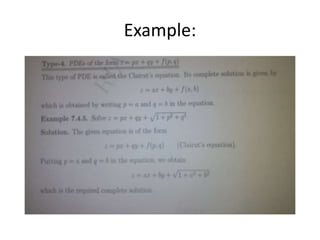
M-5: Clairauts’s form
• A first order p.d.e is said to be Clairaut’s form
if it can be written in the form
z = px + qy + f(p,q)
• The solution of this equation is :
z = ax + by + f(a,b), Where a and b are arbitary
constants.
Example:
Partial differential equations are fundamental
to :
• fluid mechanics
• heat transfer
• solid mechanics
• electrical engineering
• magnetism, relativity, planetary motion....
• Basis of many technical engineering jobs using e.g. CFD or
FEM software.
• New developments, (e.g. chaos, stochastic PDE’s for derivative
modelling).
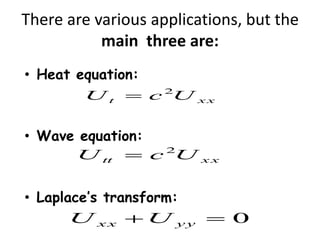
There are various applications, but the
main three are:
• Heat equation:
• Wave equation:
• Laplace’s transform:
x xt UcU 2

x xtt UcU 2

0 yyxx UU

Advance engineering mathematics

  • 1.
    ADVANCE ENGINEERING MATHEMATICS MADE BY: MIHIRJAIN-36 AMIT JHALANI-37 ARNAV BHATT-38 ANMOL KHARE-39 SAJAL KHARE-40 PPT ON: FIRST ORDER NON-LINEAR PARTIAL DIFFERENTIAL EQUATION
  • 2.
    Definition: A differentialequation which involves partial derivatives with respect to two or more independent variables is called a partial differential equation. Ordinary Differential Equation: Function has 1 independent variable. Partial Differential Equation: At least 2 independent variables.
  • 3.
    3 PDEs definitions • General(implicit) form for one function u(x,y) : • Highest derivative defines order of PDE • Explicit PDE => We can resolve the equation to the highest derivative of u. • Linear PDE => PDE is linear in u(x,y) and for all derivatives of u(x,y) • Semi-linear PDEs are nonlinear PDEs, which are linear in the highest order derivative.
  • 4.
    • If thenumber of arbitrary constants to be eliminated is equal to the number of independent variables, the p.d.e formed is of the first order F(x, y, u, p, q) = 0
  • 5.
    Methods of solvingnon-linear equations of the first order: M-1 y z q x z p        Equations involving only p and q and no x, y, z : Such equation are of form f(p,q)=0. Here :  The complete solution is z = ax + by + c, where a&b are connected by the relation f(a,b)=0.  Solving for b, we get b=T(a).  Hence the complete integral is z= ax + yT(a) + c, where a&c are arbitary constants.
  • 6.
  • 7.
    M-2: Equations not involvingthe independent variable: • Such equation are of form f(z,p,q)=0 • Assume that z=T(u), where u=x+ay, so that • Subtitute the values of p and q in the equation. • Solve the resulting ordinary differential equation in the given equation in z and u. • Replace u by x+ay du dz aq du dz p  
  • 8.
  • 10.
    M-3: Separable equations •Such equations are of form f1(x,p)=f2(y,q) • In such equations z is absent and the terms involving x and p can be seperated from those involving y and q. • Assume that each side is equal to an arbitary constant a. Then f1(x,p) = a = f2(y,q) • Solving f1(x,p)=a, suppose we get p=F1(x) and q=F2(y). • Subtituting p anq in dz=p.dx +q.dy, we get • Dz=pF1(x)dx + qF2(y)dy …….(1) • Integrating (1), we get    bdyyFdxxFz )(2)(1
  • 11.
  • 12.
    M-4: Equation reducibleto standard form • Many non-linear p.d.e of the first order do not fall under any of the 4 standard forms. However, it is possible to reduced a given equation to any of the four forms by a change of variable.
  • 13.
    M-5: Clairauts’s form •A first order p.d.e is said to be Clairaut’s form if it can be written in the form z = px + qy + f(p,q) • The solution of this equation is : z = ax + by + f(a,b), Where a and b are arbitary constants.
  • 14.
  • 15.
    Partial differential equationsare fundamental to : • fluid mechanics • heat transfer • solid mechanics • electrical engineering • magnetism, relativity, planetary motion.... • Basis of many technical engineering jobs using e.g. CFD or FEM software. • New developments, (e.g. chaos, stochastic PDE’s for derivative modelling).
  • 16.
    There are variousapplications, but the main three are: • Heat equation: • Wave equation: • Laplace’s transform: x xt UcU 2  x xtt UcU 2  0 yyxx UU