1
RMK COLLEGE OF ENGINEERING AND TECHNOLOGY
MA8353-Transforms and Partial Differential Equations [Regulation 2017]
II YEAR EEE-A & EEE – B 2018-19
UNIT-I PARTIAL DIFFERENTIAL EQUATIONS
Part-A
1. Form the partial differential equation by eliminating the arbitrary constants a and b from z = ax2
+by2
.
Soln: Given z = ax2
+by2
--------- (1)
Differentiating (1) partially w.r.to ‘x’ we get
ax
x
z
2


, (i.e.,) p = ax2 ---- (2)
Differentiating (1) partially w.r.to ‘y’ we get
by
y
z
2


, (i.e.,) q = by2 ----(3)
Substitute (2) & (3) in (1) we get the required PDE
.2
22
22
qypxz
y
qy
x
px
z 
2. Eliminate the arbitrary constants a and b from z = ax+by+a2
+b2
.
Soln: Given z = ax+by+a2
+b2
--------- (1)
Differentiating (1) partially w.r.to ‘x’ we get
a
x
z



(i.e.,) p = a ----------- (2)
Differentiating (1) partially w.r.to ‘y’ we get
b
y
z



,
(i.e.,) q = b ------------- (3)
substituting in equation (1) we get the required PDE z = px+qy+p2
+q2
.
3. Form the PDE by eliminating the arbitrary constants a and b from z = (x+a)2
+(y-b)2
.
Soln: Given z = (x+a)2
+(y-b)2
--------- (1)
p =
x
z


= 2(x+a), (i.e.,) x+a =
2
p
q =
y
z


= 2(y-b), (i.e.,) y-b =
2
q
22
22
)1( 












qp
z
z =
44
22
qp
  4z =
2 2
p q which is the required PDE.
4. Form the PDE by eliminating the constants a and b from z = axn
+byn
.
Soln: Given: z = axn
+byn
. ------------ (1)
p =
x
z


= anxn-1  1
 n
ax
n
p
.
Multiplying by ‘x’ we get,
n
px = axn
--------- (2)
q =
y
z


= bnyn-1
1
 n
by
n
q
Multiplying by ‘y’ we get, n
by
n
qy
 ---------- (3)
Substitute (2) and (3) in (1) we get the required PDE
.qypxzn 
5. Form the partial differential equation by eliminating a and b from z= (x2
+a)(y2
+b).
Soln: Given z= (x2
+a)(y2
+b).
p =
x
z


= 2x(y2
+b). ------------- (1)
q =
y
z


= 2y(x2
+a) -------------- (2)
2
From (1) and (2), the required PDE is 4zxy = pq.
6. Find the PDE of all planes having equal intercepts on the X and Y axis.
Soln: Intercept form of the plane equation is
1
c
z
b
y
a
x
.
Given: a=b. [Equal intercepts on the x and y axis]
1
c
z
a
y
a
x
------------ (1)
Here a and c are the two arbitrary constants.
Differentiating (1) p.w.r.to ‘x’ we get
0
11
 p
ca
p
ca
11
 ------------- (2)
Diff (1) p.w.r.to ‘y’ we get
0
11
 q
ca
q
ca
11
 . ----------------- (3)
From (2) and (3)  -
1 1
.p q
c c

.
qp  which is the required PDE.
7. Find the PDE of all planes at a constant distance k from origin.
Soln: The equation of all planes at a constant distance k from origin is
222
cbakczbyax  --- (1)
Differentiating (1) p.w.r.to ‘x’ we get a+cp = 0 -------- (2)
Differentiating (1) p.w.r.to y we get b+cq = 0 ------- (3)
Sub (2) & (3) in (1) we get
22222
cqcpckczcqycpx 
.122
 qpkqypxz
8. Find the differential equation of all spheres whose centre lie on the Z-axis.
Soln: x2
+ y2
+ (z-c)2
= r2
--------- (1)
Differentiating (1) p.w.r.to ‘x’ we get
0)(22  pczx
(z-c) = -
p
x
--------------- (2)
Differentiating (1) p.w.r.to y we get
0)(22  pczy
(z-c) = -
q
y
----------- (3) equating (2) &(3), we get ypxq  which is the required PDE .
9. Form the pde by eliminating the arbitrary function from z2
-xy=f(x/z).
Soln: Given z2
-xy = 





z
x
f -------(1)
Differentiating (1) p.w.r.to ‘x’ we get
.2 2
'





 







z
xpz
z
x
fyzp ---------- (2)
Differentiating (1) p.w.r.to y we get
.2 2
'





 







z
xq
z
x
fxzq ---------------- (3)
 zxzxyqpx  )2( 22
is the required PDE.
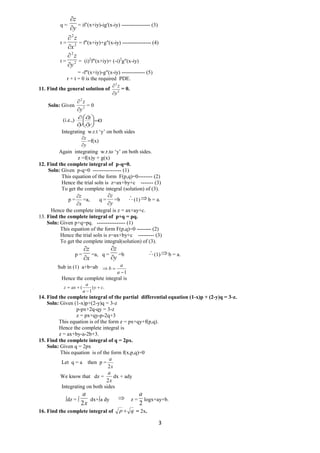
10. Eliminate the arbitrary functions f and g from z = f(x+iy) + g(x-iy) to obtain a PDE involving z,x,y.
Soln: Given: z = f(x+iy)+g(x-iy) ---------- (1)
p =
x
z


= f′(x+iy)+g′(x-iy) ---------------- (2)
3
q =
y
z


= if’(x+iy)-ig′(x-iy) ---------------- (3)
r = 2
2
x
z


= f″(x+iy)+g″(x-iy) ---------------- (4)
t = 2
2
y
z


= (i)2
f″(x+iy)+ (-i)2
g″(x-iy)
= -f″(x+iy)-g″(x-iy) ------------- (5)
r + t = 0 is the required PDE.
11. Find the general solution of 2
2
y
z


= 0.
Soln: Given 2
2
y
z


= 0
(i.e.,) 0









y
z
y
Integrating w.r.t ‘y’ on both sides
y
z


=f(x)
Again integrating w.r.to ‘y’ on both sides.
z =f(x)y + g(x)
12. Find the complete integral of p-q=0.
Soln: Given p-q=0 ---------------- (1)
This equation of the form F(p,q)=0-------- (2)
Hence the trial soln is z=ax+by+c ------- (3)
To get the complete integral (solution) of (3).
p =
x
z


=a, q =
y
z


=b (1)b = a.
Hence the complete integral is z = ax+ay+c.
13. Find the complete integral of p+q = pq.
Soln: Given p+q=pq. ---------------- (1)
This equation of the form F(p,q)=0 -------- (2)
Hence the trial soln is z=ax+by+c --------- (3)
To get the complete integral(solution) of (3).
p =
x
z


=a, q =
y
z


=b (1)b = a.
Sub in (1) a+b=ab
1

a
a
b
Hence the complete integral is
.)
1
( cy
a
a
axz 


14. Find the complete integral of the partial differential equation (1-x)p + (2-y)q = 3-z.
Soln: Given (1-x)p+(2-y)q = 3-z
p-px+2q-qy = 3-z
z = px+qy-p-2q+3
This equation is of the form z = px+qy+f(p,q).
Hence the complete integral is
z = ax+by-a-2b+3.
15. Find the complete integral of q = 2px.
Soln: Given q = 2px
This equation is of the form f(x,p,q)=0
Let q = a then p =
x
a
2
We know that dz =
x
a
2
dx + ady
Integrating on both sides
∫dz = ∫
x
a
2
dx+∫a dy  z =
2
a
logx+ay+b.
16. Find the complete integral of qp  = 2x.
4
Soln: Given qp  = 2x
The given equation can be written as
p 2x = q
This is of the form f(x,p) = φ(y,q)
Let p -2x = - q = a (say)
p =a+2x, q = -a
 2
2xap  ,
2
aq 
Now dz = pdx + qdy
= (a+2x)2
dx + a2
dy
z =
6
)2( 3
xa + a2
y + b is the complete integral.
17. Solve px + qy = z
Soln: Given px + qy = z -----------(1)
This equation is of the form Pp + Qq =R
where P = x, Q = y, R = z
The subsidiary equations are
R
dz
Q
dy
P
dx

(i.e.,)
z
dz
y
dy
x
dx

Take
y
dy
x
dx
 , Take
z
dz
x
dx

 
y
dy
x
dx
,  
z
dz
x
dx
logx = logy+logc1, logx = logz+logc2
logx = log(yc1), logx=log(zc2)
x = yc1, x = zc2
y
x
=c1,
z
x
=c
The solution is 0, 





z
x
y
x
 .
18. (i) Solve (D2
-2DD′+ D′2
)z = 0.
Soln: Given (D2
-2DD′+ D′2
)z = 0
The auxiliary eqn is m2
-2m+1=0
(i.e.,) m =1,1(equal roots)
Hence z = φ1(y+x)+xφ2(y+x).
(ii) Solve (D4
-D′4
)z = 0.
Soln: Given (D4
-D′4
)z = 0
The auxiliary equation is m4
-1= 0
[Replace D by m and D′ by 1]
Solving (m2
-1)(m2
+1) = 0
m2
-1=0, m2
+1 =0
m2
=1,m2
= -1
m =±1, m = ± 1 = ± i
(i.e.,) m =1,-1,i,-i
The solution is z = φ1(y+x)+ φ2(y-x)+φ3(y+ix)+φ4(y-ix).
(iii) Solve (D-D′)3
z = 0.
Soln: Given (D-D′)3
z = 0
The auxiliary equation is (m-1)3
= 0 (i.e.,) m =1,1,1
The solution is z = φ1(y+x)+ xφ2(y+x)+x2
φ3(y+x).
(iv) Solve (D3
-2D2
D′)z = 0.
Soln: Given (D3
-2D2
D′)z = 0.
The auxiliary equation is m3
-2m2
= 0 (i.e.,) m =0,0,2
The solution is z = φ1(y)+ xφ2(y)+φ3(y+2x).
19. (i) Find the P.I of
x
ezDDD  ]4[ 2
.
5
Soln: P.I = x
e
DDD 4
1
2
,
=
yx
e
DDD
0
2
4
1 

,
Replace D by 1and D by 0
P.I = 





 )0)(1(41
1x
e = ex
.
(ii) Solve ]2[ 22
DDDD  z = cos(x-3y).
Soln: Given ]2[ 22
DDDD  z = cos(x-3y).
The auxiliary equation is m2
-2m+1=0
(m-1)2
= 0, m =1,1
C.F =f1(y+x) + xf2(y+x).
P.I= )3cos(
2
1
22
yx
DDDD


=
9)3(21
)3cos(

 yx
= )3cos(
16
1
yx

The complete solution is z = f1(y+x) + xf2(y+x) -
16
1
cos(x-3y).
20. Solve (D+D′-2)z = 0.
Soln: Given (D+D′-2)z = 0
(i.e.,) [D-(-1)D′-2]z = 0
If (D-mD′-c)z = 0 then z = ecx
f(y+mx)
Here m = -1, c =2
 z = e2x
f[y+(-1)x] = e2x
f(y-x)
21. Solve (D-1)(D-D′+1)z = 0.
Soln: Given (D-1)(D-D’+1)z = 0
Here m1 = 0,c1 = 1,m2 = 1,c2 = -1
The solution is z = ex
f1(y)+ e-x
f2(y+x).
22. Solve 0
2
2
2









x
z
yx
z
x
z
Soln: Given D2
-DD’+D=0
(i.e.,)D(D-D’+1)=0
Here m1 = 0,c1 = 0,m2 = 1,c2 = -1
The solution is z = f1(y)+ e-x
f2(y+x).
PART – B
1. Form the partial differential equation by eliminating the arbitrary functions f and g
in ).()( ctxgctxfz 
2. Form the partial differential equation by eliminating the arbitrary functions f and g
in ).()( 22
xgyyfxz 
3. Form the partial differential equation by eliminating the arbitrary function from
.0,2





z
x
xyz
4. Form the partial differential equation by eliminating the arbitrary function from
  .0,222
 czbyaxzyx
5. Solve .22
qpqypxz 
6. Find the singular integral of the partial differential equation .22
qpqypxz 
7. Find the singular integral of the partial differential equation .22
qpqpqypxz 
8. Solve .1 22
qpz 
9. Solve ).1()1( 2
zqqp 
6
10. Solve 2222
)( yxqp  .
11. Solve ).)(()()( yxyxqxyzpxzy 
12. Solve .2)2()( zxqyxpzy 
13. Find the general solution of .)()( mxlyqlznxpnymz 
14. Solve ).2(2
yzxxyqpy 
15. Solve .)()( 222
xyzqzxypyzx 
16. Solve .)()( 22
yxzqyxzpyx 
17. Solve .)2()2( xyqyzpzx 
18. Find the general solution of .)( 22
qypxyxz 
19. Solve ).4sin()20( 522
yxezDDDD yx
 
20. Solve .)2cos()43( 22
xyyxzDDDD 
21. Solve .2cos)( 3223
yezDDDDDD x

22. Solve ).32sin()( 22
yxezDD yx
 
23. Solve .32)2( 22223
yxezDDD x

24. Solve .2sinsin)(2
yxzDDD 
25. Solve .cos62
22
2
2
xy
y
z
yx
z
x
z









26. Solve .)2332( 222 yx
ezDDDDDD 

27. Solve .)362( 22 y
xezDDDDDD 
28. Solve .4)2( 22
 yx
ezDDDD
29. Solve .7)33( 22
 xyzDDDD
30. Solve ).2sin()22( '22
yxzDDDDDD 
ASSIGNMENT I
PART A
1. Form the PDE by eliminating the arbitrary constants a and b from (x+a)2
+(y-b)2
= z2
cot 2
α.
2. Eliminate the arbitrary function from z=x 





x
y
f and form a PDE.
3. Find the complete integral of p2
+q2
+2pq = 0.
4. Solve : .qpxy 
5. Solve : .tantantan zyqxp 
6. Find the complete solution of .2 pqqypxz 
7. Find the Particular integral of ).3(cos]2[ 22
yxzDDDD 
8. Find the Particular integral of
x
ezDDD  ]4[ 2
.
9. Solve : 0][ 2
 zDDDD .
10. Solve : D .0]2[  zDD
PART B
1. Find the singular integral of .1622
 qpqypxz
2. Solve : .)()( 222
xyzqzxypyzx 
3. Solve:
22222
)( yxqpz  .
4. Solve : .2cos)( 3223
yezDDDDDD x

5. Solve : ).2sin()3222( '22
yxyxzDDDDDD 
***************************
7
RMK COLLEGE OF ENGINEERING AND TECHNOLOGY
TPDE (MA6351)
UNIT – II FOURIER SERIES
PART – A
1. State Dirichlet’s conditions for a given function to be expanded as a Fourier series.
Ans: Any function f(x) can be expressed as a Fourier series of the form
f(x)= 





11
0
sincos
2 n
n
n
nxbnxa
a
n
in (c,c+2π) where a0,an,bn are constants if
the following conditions are satisfied
a. f(x) is periodic, single valued and finite of period 2π in (c,c+2π).
b. f(x) has finite number of finite discontinuities in any one period and has no
infinite discontinuity.
c. f(x) has atmost finite number of maxima and minima in (c,c+2π).
2. Obtain the first term in the Fourier series of f(x) = x2
in –π<x<π.
Ans: Given f(x) = x2
, –π<x<π. Here f(-x)=f(x), therefore f(x) is an even function hence
bn=0. First term of the Fourier series is
2
0a
where a0= 

 0
)(
2
dxxf = dxx

 0
22
= 2
3
2
 .
Therefore
2
0a
= 2
3
1
 .
3. Define Root Mean Square value of a function f(x) in (a,b).
Ans: Let f(x) be a function defined in (a,b). Then  
b
a
dxxf
ab
2
)(
1
is called RMS value of
f(x) in (a,b).
4. If f(x) =







2,50
,cos
x
xox
and f(x)=f(x+2π) for all x, find the sum of the Fourier series of
f(x) at x=π.
Ans: Here x=π is the point of discontinuity and therefore sum of the Fourier series at x=π
is given by f(π)= .
2
49
2
50cos
2
)()(



 
 ff
5. Find the coefficient a5 in the Fourier series of the function f(x)=sin5x in the
interval (0,2π).
Ans:   dxnxxfan cos
1
2
0



.0
10
10cos2
10sin
2
5cos5sin
1
2
0
2
0
2
0
5 



 


x
dxxdxxxa
6. Find the RMS value of f(x) = x2
, 0<x<π.
Ans: RMS value is given by  
b
a
dxxf
ab
2
)(
1
=  

 0
221
dxx
8
.
55
11 2
0
5
0
4 








 
x
dxx
7. Find the coefficient bn in the Fourier series for f(x) = xsinx in (-2,2).
Ans: Given f(x) = xsinx in (-2,2) . f(-x) = -xsin(-x) = xsinx = f(x) therefore f(x) is an even
function in (-2,2) .0 nb
8. State Parseval’s identity for the function f(x) as a Fourier series in (0,2 ).
Ans: Parseval’s identity is   dxxf
22
0
)(
2
1



=  



1
22
2
0
2
1
4 n
nn ba
a
.
9. Does f(x) = tanx possess a Fourier expansion?
Ans: Though it is periodic, in any interval of length π, tanx is unbounded and has
infinite discontinuity. Hence Dirichlet’s conditions are not satisfied. So f(x) does
not have a Fourier expansion.
10. Find the Fourier sine series for f(x)=1, 0<x<π.
Ans: Fourier sine series of f(x) is the half range series f(x)= nxb
n
n sin
1



where
     011
2
0cos1cos
2
cos2
sin
2
sin)(
2
00 0









  
bn
n
n
n
n
nx
nxdxnxdxxfbn
n




 
When n is even and is -1 for odd values of n. Therefore bn=
n
4
hence
Fourier series is f(x)= .
5
5sin
3
3sin
sin
4





xx
x

11. What is harmonic analysis?
Ans: The process of finding the Fourier coefficients from the tabulated values of
x and y is called harmonic analysis.
12. Write the complex form of Fourier series for f(x) in (0, 2π).
Ans: In the interval (0,2π), f(x)= inx
n
neC


where Cn= .)(
2
1
2
0
dxexf inx




13. If the Fourier series for the function








2;sin
0;0
)(
xx
x
xf is
x
xxx
xf sin
2
1
7.5
6cos
5.3
4cos
3.1
2cos21
)( 





.
Deduce that
.
4
2
7.5
1
5.3
1
3.1
1 


Ans: To deduce put x=π/2. Since x=π/2 is a point of continuity, the sum of the
9
series when x=π/2 is f(π/2)=0. Therefore
4
2
......
5.3
1
3.1
1
2
2
.....
5.3
1
3.1
12
....
5.3
1
3.1
12
2
2
0
.........
5.3
2cos
3.1
cos21
2
sin
2
1
0



























14. What is the constant term 0a and the coefficient na of nxcos in the Fourier series
expansion of 3
)( xxxf  in ),(  ?
Ans: Here f(-x) = -x-(-x)3
= -x+x3
= -(x-x3
) = -f(x) implies f(x) is an odd function
therefore ao=an=0.
15. Write the Euler’s formula for finding a0, an, bn in (c,c+2π).
Ans: 




2
0 )(
1
c
c
dxxfa ; na 




2
cos)(
1
c
c
nxdxxf ; 




2
sin)(
1
c
c
n nxdxxfb
PART-B
16. Find the Fourier series of period 2 for the function




)2,(;2
),0(;1
)(


xf and hence
find the sum of the series  222
5
1
3
1
1
1
.
17. Obtain the Fourier series for





)2,(;2
),0(;
)(


x
x
xf .
18. Expand








2;0
0;sin
)(
x
xx
xf as a Fourier series of periodicity 2 and hence
evaluate 
7.5
1
5.3
1
3.1
1
.
19. Determine the Fourier series for the function
(i) 2
)( xxf  in 20  x
(ii) 2
)()( xxf   of period 2 in 20  x
(iii)






lxlxl
lxx
xf
2/;
2/0;
)( hence deduce .
965
1
3
1
1
1 4
44


(iv) f(x)=x(2π-x) and deduce .
63
1
2
1
1
1 2
222


(v) f(x)=e-x
deduce .
1
)1(
2
2

 

n
n
n
10
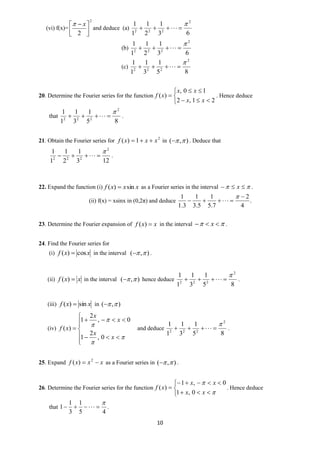
(vi) f(x)=
2
2 


  x
and deduce (a)
63
1
2
1
1
1 2
222


(b)
63
1
2
1
1
1 2
222


(c)
85
1
3
1
1
1 2
222


20. Determine the Fourier series for the function






21,2
10,
)(
xx
xx
xf . Hence deduce
that
85
1
3
1
1
1 2
222

 .
21. Obtain the Fourier series for 2
1)( xxxf  in ),(  . Deduce that
123
1
2
1
1
1 2
222

 .
22. Expand the function (i) xxxf sin)(  as a Fourier series in the interval   x .
(ii) f(x) = xsinx in (0,2π) and deduce .
4
2
7.5
1
5.3
1
3.1
1 


23. Determine the Fourier expansion of xxf )( in the interval   x .
24. Find the Fourier series for
(i) xxf cos)(  in the interval ),(  .
(ii) xxf )( in the interval ),(  hence deduce
85
1
3
1
1
1 2
222

 .
(iii) xxf sin)(  in ),( 
(iv)













x
x
x
x
xf
0,
2
1
0,
2
1
)( and deduce
85
1
3
1
1
1 2
222

 .
25. Expand xxxf  2
)( as a Fourier series in ),(  .
26. Determine the Fourier series for the function








xx
xx
xf
0,1
0,1
)( . Hence deduce
that
45
1
3
1
1

 .
11
27. Determine the Fourier series for the function






21,2
10,
)(
xx
xx
xf . Hence deduce that
.
85
1
3
1
1
1 2
222


28. Find the half range cosine series for 2
)()( xxf   in the interval ),0(  hence deduce
.
903
1
2
1
1
1 4
444


29. Find half range cosine series for f(x)=x in ),0(  and deduce (i)
903
1
2
1
1
1 4
444


and (ii) .
965
1
3
1
1
1 4
444


30. Obtain Fourier series for f(x) of period l2 where






lxl
lxxl
xf
2,0
0,
)( and deduce
(i)
45
1
3
1
1

 and (ii) .
85
1
3
1
1
1 2
222


31. Find the half range sine series of xxxf cos)(  in ),0(  .
32. Find the half range cosine series of xxxf sin)(  in ),0(  .
33. Obtain the half range cosine series for xxf )( in ),0(  .
34. Find the half range sine series for )()( xxxf   in the interval ),0( 
35. Find the half range sine series of 2
)( xxf  in ),0(  .
36. Find the complex form of the Fourier series of (i) f(x)=eax
in –π<x<π. (ii) f(x)=e-x
in -1<x<1.
37. Find the complex form of Fourier series of f(x) = cosax in (-π,π) where a is not an integer.
38. Find the Fourier series up to third harmonic from the following data.
x 0 π/3 2π/3 π 4π/3 5π/3 2π
y 1 1.4 1.9 1.7 1.5 1.2 1
39. Find the Fourier series up to second harmonic for the following data.
x 0 1 2 3 4 5
y 9 18 24 28 26 20
40. The following table gives the variations of periodic current over a period T.
t sec 0 T/6 T/3 T/2 2T/3 5T/6 T
A
amp
1.98 1.30 1.05 1.30 -0.88 -0.25 1.98
Show that there is a direct current part 0.75 amp in the variable current and obtain the
amplitudes of the first two harmonics.
**********************
12
MA6351 – TRANSFORMS AND PARTIAL DIFFERENTIAL EQUATIONS
UNIT 3 - APPLICATIONS OF PARTIAL DIFFERENTIAL EQUATIONS
PART A
II YEAR CSE-C
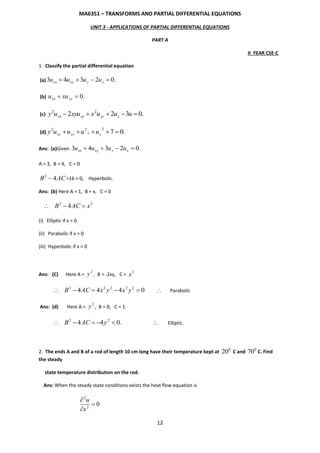
1. Classify the partial differential equation
(a) .02343  xyxyxx uuuu
(b) .0 yyxx xuu
(c) .0322 22
 uuuxxyuuy xyyxyxx
(d) .07
222
 yxyyxx uuuuy
Ans: (a)Given .02343  xyxyxx uuuu
A = 3, B = 4, C = 0
ACB 42
 =16 > 0, Hyperbolic.
Ans: (b) Here A = 1, B = x, C = 0
22
4 xACB 
(i) Elliptic if x > 0
(ii) Parabolic if x = 0
(iii) Hyperbolic if x < 0
Ans: (C) Here A =
2
y , B = -2xy, C =
2
x
0444 22222
 yxyxACB  Parabolic
Ans: (d) Here A =
2
y , B = 0, C = 1.
.044 22
 yACB  Elliptic.
2. The ends A and B of a rod of length 10 cm long have their temperature kept at
0
20 C and
0
70 C. Find
the steady
state temperature distribution on the rod.
Ans: When the steady state conditions exists the heat flow equation is
02
2



x
u
13
i.e., 21)( cxcxu  ………………(1)
The boundary conditions are (a) u(0) = 20, (b) u(10) = 70
Applying (a) in (1), we get
20)0( 2  cu
Substitute this value in (1), we get
20)( 1  xcxu ………………(2)
Applying (b) in (2), we get
702010)10( 1  cu
51 c
Substitute this value in (2), we get
205)(  xxu
3. Solve the equation ,023 





y
u
x
u
given that
x
exu 
 4)0,( by the method of separation of
variables.
Ans: Given 023 





y
u
x
u
………………..(1)
Let u = X(x).Y(y) ……………….(2)
Be a solution of (1)
,YX
x
u



YX
y
u



………………(3)
Substituting (3) in (1) we get
dyK
Y
dY
dxK
X
dX
KY
dy
dY
KX
dx
dX
KYYKXX
K
Y
Y
X
X
YXYX








2,3
2,3
02,03
23
023
Integrating we get
23
,
log2,log3
kykx
eYeX
KyYKxX


Therefore u = X .Y = 23
.
kykx
ee
14
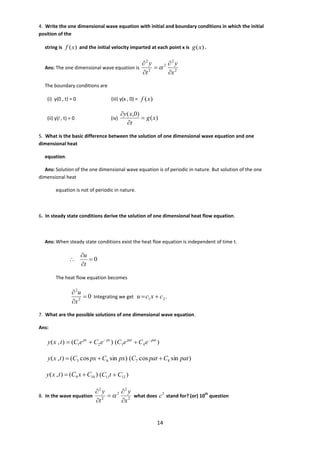
4. Write the one dimensional wave equation with initial and boundary conditions in which the initial
position of the
string is )(xf and the initial velocity imparted at each point x is )(xg .
Ans: The one dimensional wave equation is 2
2
2
2
2
x
y
t
y






The boundary conditions are
(i) y(0 , t) = 0 (iii) y(x , 0) = )(xf
(ii) y(l , t) = 0 (iv) )(
)0,(
xg
t
xy



5. What is the basic difference between the solution of one dimensional wave equation and one
dimensional heat
equation.
Ans: Solution of the one dimensional wave equation is of periodic in nature. But solution of the one
dimensional heat
equation is not of periodic in nature.
6. In steady state conditions derive the solution of one dimensional heat flow equation.
Ans: When steady state conditions exist the heat floe equation is independent of time t.
0



t
u
The heat flow equation becomes
02
2



x
u
Integrating we get .21 cxcu 
7. What are the possible solutions of one dimensional wave equation.
Ans:
)(),( 21
pxpx
eCeCtxy 
 )( 43
patpat
eCeC 

)sincos(),( 65 pxCpxCtxy  )sincos( 87 patCpatC 
)(),( 109 CxCtxy  )( 1211 CtC 
8. In the wave equation 2
2
2
2
2
x
y
t
y





 what does
2
c stand for? (or) 10
th
question
15
Ans: 2
c =
lengthunitpermass
Tension
9. State Fourier law of conduction.
Ans: The rate at which heat flows across an area A at a distance x from one end of a bar given by
xx
u
KAQ 







 is thermal conductivity and
xx
u








means the temperature gradient at x.
10. State any two laws which are assumed to derive one dimensional heat equation.
Ans: (i) The sides of the bar are insulated so that the loss or gain of heat from the sides by conduction or
radiation is negligible.
(ii) The same amount of heat is applied at all points of the face.
11. An insulated rod of length 10 cm has its ends at A and B maintained at
0
30 C and
0
40 C respectively.
Find the
steady state solution.
Ans:
The heat flow equation is
2
2
2
x
y
t
u





 ………………(1)
When the steady state condition exist the heat flow equation becomes
02
2



x
u
i.e., 21)( cxcxu  ………………(2)
The boundary conditions are (a) u(0) = 30, (b) u(l) = 40
Applying (a) in (2), we get
30)0( 2  cu
Substitute this value in (2), we get
30)( 1  xcxu ………………(3)
Applying (b) in (3), we get
4030)10( 1  lcu
11 c
Substitute this value in (3), we get
16
30)(  xxu
12. Solve using separation of variables method .0 yx xuyu
Ans:
Given .0 yx xuyu ………………..(1)
Let u = X(x).Y(y) ……………….(2)
Be a solution of (1)
,YX
x
u



YX
y
u



………………(3)
Substituting (3) in (1) we get
dyKy
Y
dY
dxKx
X
dX
KyY
dy
dY
KxX
dx
dX
KyYYKxXX
K
yY
Y
xX
X
YXxYXy








,
,
,
0..
Integrating we get
2
2
2
1
2
2
1
2
22
,
2
log,
2
log
kykx
ecYecX
k
y
kYk
x
kX



Therefore u = X .Y =
)(
2
21
22
yx
k
ecc

. .
17
PART –B
1. A tightly stretched string of length l has its ends fastened at x = 0 , x= l. The mid-point of the string is then
taken to height
h and then released from rest in that position. Find the lateral displacement of a point of the string at time t
from the instant of
release.
2. A tightly stretched string with fixed end points x = 0 and x = l. At time t = 0, the string is given a shape
defined by
f(x) =  x ( l - x ), where  is constant, and then released . Find the displacement of any point x of the string at
any time t >0.
3. A tightly stretched string of length l with fixed ends is initially in equilibrium position. It is set
vibrating by giving
each point a velocity v0 sin
3
( π x / l ). Find the displacement y(x,t).
4. A tightly stretched string with fixed end points x = 0 and x = l is initially in a position given by y = y0 sin
3
( π /l
). If it is
released from rest from this position, find the displacement y( x, t).
5. A tightly stretched string with fixed end points x = 0 and x = l is initially at rest in its equilibrium position. . It
is set vibrating
by giving each point a velocity  x l x 
,
find the displacement of the string at any distance x from one end
at any time t.
6. If a string of length l is initially at rest in its equilibrium position and
each of its points is given a velocity v such that v= determine the displacement
function y(x,t)
at any time t.
7. An insulated of length l has its ends A and B maintained at 0
0
C and 100
0
c respectively until steady state
conditions prevail. If
the change consists of raising the temperature of A to 20
0
c and reducing that of B to 80
0
c , find the
temperature at a distance x
from A at time t.
8. A square plate is bounded by the lines x =0, y = 0 , x =20 and y = 20. Its faces are insulated. The temperature
along the upper
horizontal edge Is given by u ( x, 20) = x ( 20 – x) when 0 < x < 20 while the other three edges are kept at 0
0
c.
Find the steady
state temperature in the plate.
18
9. An infinitely long rectangular plate with insulated surface is 10cm wide. The two long edges and one short
edge are kept at
zero temperature while the other short edge x = 0 is kept at temperature given
by






2010),10(20
100,20
yy
yy
u Find the
temperature distribution in the plate.
10. An infinitely long rectangular plate with insulated surface is 20cm wide. The two long edges and one short
edge are kept at
zero temperature while the other short edge y = 0 is kept at temperature given by
u = Find the temperature distribution in the plate.
11. An infinitely long – plane uniform plate is bounded by two parallel edges and an end at right angle to them.
The breadth of
this edge x =0 is π, this end is maintained at temperature as u = k (πy – y
2
) at all points while the other
edges are at zero
temperature. Determine the temperature u(x,y) at any point of the plate in the steady state if u satisfies
Laplace equation.
12. The points of trisection of a string are pulled aside through the same distance on opposite sides of the
position of equilibrium
and the string is released from rest. Derive an expression for the displacement of the string at subsequent
time and show that
the mid-point of the string always remains at rest.
13. Find the steady state temperature at any point of a square plate whose two adjacent edges are kept at 0
0
c
and the other two
edges are kept at the constant temperature 100
0
c.
14. Solve the BVP Uxx + Uyy = 0 , 0 < x, y <  with u( 0 ,y ) = u( , y) =u( x , ) = 0 and u(x,0) = sin
3
x.
15. A long rectangular plate has its surfaces insulated and the two long sides as well as one of the short sides
are maintained at 0
0
c . Find an expression for the steady state temperature u(x,y) if the short side y = 0 is cm long and is kept at
100
0
c.
ASSIGNMENT III / TUTORIAL PROBLEMS
PROBLEMS
PART-A
1. Write all possible solutions of one dimensional wave equation.
19
2. Write all possible solutions of one dimensional heat equation.
3. Write all possible solutions of two dimensional heat equation.
4. Classify the PDE .0322 22
 uuuxxyuuy xyyxyxx
5. An insulated rod of length 60 cm has its ends at A and B maintained at 0
30 C and 0
40 C respectively.
Find the steady state solution
PART-B
1. A tightly stretched string of length l has its ends fastened at x = 0 , x= l. The mid-point of the string is
then taken to height h and then released from rest in that position. Find the lateral displacement of a
point of the string at time t from the instant of release.
2. An insulated of length l has its ends A and B maintained at 0
0
C and 100
0
c respectively until steady state
conditions prevail. If the change consists of raising the temperature of A to 20
0
c and reducing that of B to
80
0
c , find the temperature at a distance x from A at time t.
3. An infinitely long rectangular plate with insulated surface is 20cm wide. The two long edges and one short
edge are kept at zero temperature while the other short edge x = 0 is kept at temperature given
by






2010),20(20
100,20
yy
yy
u Find the temperature distribution in the plate.
************
20
MA6351 TRANSFORMS AND PARTIAL DIFFERENTIAL EQUATIONS
UNIT-4 FOURIER TRANSFORMS II YEAR CSE - C
1. State the Fourier integral theorem.
Ans: If )(xf is a given function defined in (-l , l) and satisfies Dirichlet’s conditions, then

  
 


0
)(cos)(
1
)( ddtxttfxf
2. Define Fourier Transform pairs.
Sol: The function  
1
( ) ( ).
2
isx
F f x f x e dx



  ……(1)is called the Complex Fourier transform
of
)(xf .
Inversion Formula For The Complex Fourier Transform
21
The function  



 dsexfFxf isx
.)(
2
1
)(

……(2)is called the inversion formula for the
Complex Fourier transform of )]([ xfF and it is denoted by  .))((1
xfFF 
(1) & (2) called as
Fourier transform pair.
3.Define Fourier Sine Transform Pairs
Sol: The function  
0
2
( ) ( ).sinSF f x f x sx dx


  ….(1)is called the Fourier Sine Transform of )(xf
The function  


0
sin.)(
2
)( dssxxfFxf S

..(2) is called the inversion formula for the
Fourier
sine transform and it is denoted by  .))((
1
xfFF SS

(1) & (2) called as Fourier sine transform
pair.
4. Define Fourier Cosine Transform Pairs
Sol: The function  
0
2
( ) ( ).cosCF f x f x sx dx


  …(1)is called the Fourier Cosine Transform
of
)(xf .
The function  


0
cos.)(
2
)( dssxxfFxf C

...(2) is called the inversion formula for the
Fourier Cosine Transform and it is denoted by  .))((
1
xfFF CC

(1) & (2) called as Fourier
Sine transform pair.
PROPERTIES
5. Linearity Property
If F(s) and G(s) are the Fourier transform of )(xf and )(xg respectively then
  )()()()( sGbsFaxgbxfaF 
22
Proof:
 
)()(
).(
2
).(
2
).(
2
1
.)(
2
1
)()(
2
1
)]()([
sGbsFa
dxexg
b
dxexf
a
dxexgbdxexfa
dxexgbxfaxgbxfaF
isxisx
isxisx
isx




















6.Change of Scale Property
If F(s) is the Fourier transform of )(xf then   0,
1
)( 





 a
a
s
F
a
axfF
Proof:   


 dxeaxfaxfF isx
).(
2
1
)(

Put ax = y a dx = dy i.e., dx =
a
dy
When  yxandyx ,,
7. Shifting Property ( Shifting in x )
If F(s) is the Fourier transform of )(xf then   )()( sFeaxfF ias

Proof:   


 dxeaxfaxfF isx
).(
2
1
)(

Put x-a = y dx = dy When  yxandyx ,,
 
)(.).(
2
.).(
2
.).(
2
1
)( )(
sFedxexf
e
dyeyf
e
dyeyfaxfF
isaisx
ias
isy
ias
ayis













8. Shifting in respect of s
If F(s) is the Fourier transform of )(xf then   )()( asFxfeF iax

  





 









a
s
F
a
dyeyf
aa
dy
eyfaxfF
y
a
s
i
a
y
is 1
.).(
2
11
.).(
2
1
)(

23
Proof:   


 dxexfexfeF isxiaxiax
)(
2
1
)(





 )().(
2
1 )(
asFdxexf xasi

9. Modulation Theorem
If F(s) is the Fourier transform of )(xf then    )()(
2
1
cos)( asFasFaxxfF 
Proof:   


 dxeaxxfaxxfF isx
.cos).(
2
1
cos)(










 
 dx
ee
exf
iaxiax
isx
2
).(
2
1

 )()(
2
1
)(
2
1
)(
2
1
).(
2
1
.
2
1
).(
2
1
.
2
1 )()(
asfasfasfasf
dxexfdxexf xasixasi

 







   )()(
2
1
cos)( asFasFaxxfF 
COROLLARIES:    )()(
2
1
cos)()( asFasFaxxfFi CCC 
   )()(
2
1
sin)()( saFsaFaxxfFii SSC 
   )()(
2
1
cos)()( asFasFaxxfFiii SSS 
   )()(
2
1
sin)()( asFasFaxxfFiv CCS 
10.Derivatives of the Transform
If F(s) is the Fourier transform of )(xf then  
ds
sdF
ixfxF
)(
)()(. 
Extending, we get,   n
n
nn
ds
sFd
ixfxF
)(
)()(. 
11.Convolution Theorem
If F(s) and G(s) are the Fourier transform of )(xf and )(xg respectively then the Fourier
transform of
the convolution of f(x) and g(x) is the product of their Fourier transforms.
i.e.,   )().()(*)( sGsFxgxfF 
24
12.Parseval’s Identity (or) Energy Theorem
If )(xf is a given function defined in ),(  then it satisfy the identity
 




 dssFdxxf
22
)()(
where F(s) is the Fourier transform of )(xf
13.Find the Fourier sine transform of ax
exf 
)( (a > 0).
Ans:
  


0
sin).(
2
)( dxsxxfxfFS






 


22
0
2
sin.
2
as
s
dxsxe ax











0
22
sin
ba
b
dxbxe ax






 22
2
as
s

14. Find the Fourier sine transform of x
exf 
)( .
Ans:
  


0
sin).(
2
)( dxsxxfxfFS






 


1
2
sin.
2
2
0
s
s
dxsxe x











0
22
sin
ba
b
dxbxe ax

15. Find Fourier sine transform of
x
1
Ans:
  


0
sin).(
2
)( dxsxxfxfFS
 


0
sin.
12
dxsx
x 22
2 










0
0,
2
sin
adx
x
ax 

25
16.Find Fourier cosine transform of x
exf 
)(
Ans:   


0
sin).(
2
)( dxsxxfxfFC
 




 


1
12
cos.
2
2
0
s
dxsxe x











0
22
cos
ba
a
dxbxe ax

17. Show that f(x) =1,0 < x <∞ cannot be represented by a Fourier integral.
Ans. 

0
lf(x)ldx = 

0
dx =  
0x = ∞ .
Also this value tends to ∞ as x → ∞ (i.e) 

0
f(x)dx is not convergent.
Hence f(x) =1 cannot be represented by a Fourier integral
18.Find the Fourier cosine transform of f(x) = .
Solution: Fc(s) = 

0
2

f(x)cossxdx
= 
a
0
2

cosxcossxdx = 
a
02
12

[cos(s+1)x + cos(s-1)x]dx
=
a
s
s
s
xs
0
)1(
)1sin(
)1(
)1sin(
2
1












=
1 sin( 1) sin( 1)
.
( 1) ( 1)2
s a s a
s s
  
   
19.Find Fourier sine transform of 3e-2x
.
Sol:Let f(x) = 3e-2x
Fs[f(x)] = 

0
2

f(x)sinsxdx = 

0
2

3e-2x
sinsxdx = 3 

0
2

e-2x
sinsxdx
=
= 3 





 )(
4
1
0
2
2
s
s
=3

2




 42
s
s
=

2
2
3
.
4
s
s
 
  
20. (i) Give a function which is self reciprocal under Fourier sine & cosine transforms.
Ans: f(x) =1/√x
26
(ii) Given that 2
2
x
e

is self-reciprocal under Fourier cosine transform , find
a) Fourier sine transform of x 2
2
x
e

and b) Fourier cosine transform of
2
2 2
.
x
x e

Ans: Fc[ 2
2
x
e

] = 2
2
s
e

&Fs[x 2
2
x
e

] =
ds
d
Fc[x 2
2
x
e

]
=
ds
d
[ 2
2
s
e

]
= - 2
2
s
e

(-s)
= s 2
2
s
e

Fc[x 2 2
2
x
e

] =
ds
d
Fs[x 2
2
x
e

]
=
ds
d
[s 2
2
s
e

]= [s 2
2
s
e

(-s)+ 2
2
s
e

] = (1-s2
) 2
2
s
e

.
PART B
1. Find the Fourier transform of f(x) if







0,0
,1
)(
ax
ax
xf
Hence deduce that (i) 







0
2
sin 
dt
t
t
(ii) 







0
2
2
sin 
dt
t
t
2. Show that the Fourier transform of







00
)(
22
ax
axxa
xf is





 
3
cossin2
2
s
asasas

. Hence deduce that .
42
cos
cossin
0
3





dt
t
t
ttt
Using Parseval’s
identity show that .
15
cossin
0
2
3






 


dt
t
ttt
Hence prove that




0
3
.
16
3
2
cos
cossin 
dt
t
t
ttt
3. Find the Fourier cosine transform of .
x
e ax
27
4. Find the Fourier Transform of )(xf if







1,0
1,1
)(
x
xx
xf
Hence deduce that 







0
2
2
sin 
dt
t
t








0
4
3
sin 
dt
t
t
5. Find the Fourier transform of
xa
e

and hence deduce that
(i)
xa
e
a
dt
ta
xt 

 
0
22
2
cos 
(ii)   222
)(
22
as
as
ixeF
xa




6. Find the Fourier transform of )(xf if


 

otherwise
xx
xf
,0
1,
)(
7.Derive the parseval’s identity for Fourier transforms.
8. Find the Fourier sine transform of






xa
axx
xf
,0
0,sin
)(
9.Find the Fourier transform of
22
xa
e
,a>0, Hence show that
22
2
x
e

is self reciprocal under Fourier
transform.
10. Find the Fourier cosine transform of x
e 4
and hence deduce that
(i) 8
0
2
816
2cos 

 

edx
x
x 
(ii) 8
0
2
216
2sin 

 

edx
x
xx 
11. State and prove convolution theorem for Fourier transforms.
12. Using integral transforms evaluate ,
)(0
222

 xa
dx
(ii) dx
xa
x


0
222
2
)(
if a > 0.
13. Find the Fourier cosine transform of
22
xa
e
and hence find cosine transform of
2
x
e
and show that it is self reciprocal under cosine transform. Also evaluate  .
22
xa
s xeF 
.
28
14. (i) Find the Fourier cosine transform of
2
x
e
(ii) Find the Fourier sine transform of









20
21,2
10,
)(
x
xx
xx
xf
15. Find Fourier sine and cosine transform of x
e
and hence find the Fourier sine transform of
12
x
x
and Fourier cosine transform of
1
1
2
x
.
16. Find the Fourier cosine transform of






xa
axx
xf
,0
0,sin
)(
17. Find the Fourier cosine transform of
x
e ax
and hence find .




  
x
ee
F
bxax
c
18. Evaluate (i) 

0
2222
))(( bxax
dx
(ii) 

0
2222
2
))(( bxax
dxx
using transforms.
19. Using Parseval’s identity calculate
(i) ,
)(0
222

 xa
dx
(ii) dx
xa
x


0
222
2
)(
if a > 0.
20.Evaluate  1n
c xF if 0<x<1. Deduce that
x
1
is self reciprocal under Fourier cosine and sine
transforms. Find f(x) if its sine transform is
s
e as
. Hence find .
11




s
FS
21. Solve the integral equation 



0
cos)( 
 exdxxf and also show that .
21
cos
0
2
 


 edx
x
x
22. Solve the integral equation 


0
cos)( xdxxf 





1,0
10,1


.Hence evaluate .
sin
0
2
2
dt
t
t


29
RMK COLLEGE OF ENGINEERING AND TECHNOLOGY
(MA6351) TRANSFORMS AND PDE
UNIT – VZ-TRANSFORMS AND DIFFERENCE EQUATIONS
PART – A
30
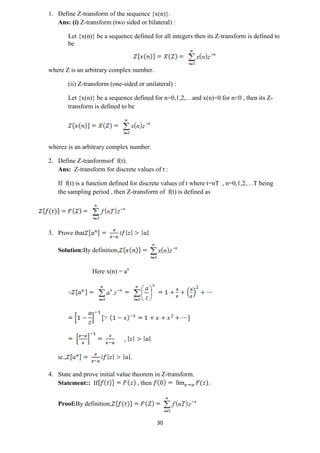
1. Define Z-transform of the sequence {x(n)}.
Ans: (i) Z-transform (two sided or bilateral) :
Let {x(n)} be a sequence defined for all integers then its Z-transform is defined to
be
where Z is an arbitrary complex number.
(ii) Z-transform (one-sided or unilateral) :
Let {x(n)} be a sequence defined for n=0,1,2,…and x(n)=0 for n<0 , then its Z-
transform is defined to be
wherez is an arbitrary complex number.
2. Define Z-tranformsof f(t).
Ans: Z-transform for discrete values of t :
If f(t) is a function defined for discrete values of t where t=nT , n=0,1,2,…T being
the sampling period , then Z-transform of f(t) is defined as
3. Prove that .
Solution:By definition,
Here x(n) = an
,
ie., .
4. State and prove initial value theorem in Z-transform.
Statement:: If , then .
Proof:By definition,
31
i.e.), .
5. State First Shifting theorem.
Statement:
(i) If , then
(ii) If , then
(iii) If Z , then
(iv) If , then
6. Find
Solution:
We know that
Here f(n) = n
7. State the Differentiation in the Z-Domain.
Statement:(i)
(ii)
8. Find
Solution: We know that
32
=
9. Find the Z-transform of (n+1)(n+2).
Solution:
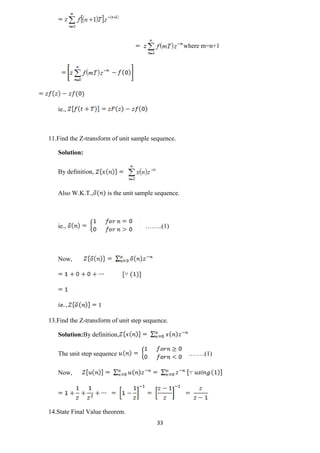
10. State and prove Second Shifting theorem.
Statement:If , then
Proof: By definition,
33
where m=n+1
ie.,
11.Find the Z-transform of unit sample sequence.
Solution:
By definition,
Also W.K.T., is the unit sample sequence.
ie., ……..(1)
Now,
1
13.Find the Z-transform of unit step sequence.
Solution:By definition,
The unit step sequence ……..(1)
Now,
14.State Final Value theorem.
34
Statement:
If , then
15. State Convolution theorem on Z-transform.
Statement:
(i) If Z[x(n)] = X(z) and Z[y(n)] = Y(z) then
Z{x(n) y(n)} = X(z).Y(z)
(ii) Z[f(t)] = F(z) and Z[g(t)] = G(z) then
Z{f(t) g(t)} = F(z).G(z)
16. Form a difference equation by eliminating arbitrary constant from un = a 2n+1
Solution:
Given, un = a 2n+1
......(1)
un+1 = a 2n+2
= a 2n+1
2
= 2a2n+1
…….(2)
Eliminating the constant ‘a’ , we get,
2un-un+1=0
17.Form the difference equation from yn=a+b3n
Solution:
Given, yn=a+b3n
......(1)
Yn+1=a+b3 n+1
=a+3b 3n
…….(2)
Yn+2=a+b3n+2
=a+9b 3n
…….(3)
Eliminating a and b from (1),(2)&(3) we get,
Yn[9-3]-(1)[9yn+1-3yn+2]+(1)[yn+1-yn+2] = 0
35
6yn-9yn+1+3yn+2+yn+1-yn+2 = 0
2yn+2-8yn+1+6yn = 0
yn+2-4yn+1+3yn = 0
18.Find .
Solution:
W.K.T.,
19.Find using Z-transform.
Solution:
[By shifting property]
20.Find the Z-Transform of n.
Solution:
W.K.T.,
Here
36
21.Find the Z-Transform of cosn and sinn .
Solution:
W.K.T.,
Equating the real and imaginary parts on both sides, we get
and Z[sinn ]
22.Find Z
Solution:
W.K.T.,
Here
37
Z
23.Find the inverse Z-transform of using convolution theorem.
Solution:
24.Evaluate .
Solution:
38
PART-B
1. Find  nrZ n
cos and  nrZ n
sin .
2. Find 







)1(
2
nn
n
Z .
3. Find
  





 21
1
nn
Z .
4. Find the Z- transform off(n) =
5. State and prove Initial and Final value theorem in Z- transform.
6. If 4
2
)1(
1452
)(



z
zz
zU , evaluate 2u and 3u .
39
7. Find
  







21
101
zz
z
Z
8. Find
 
   







2
2
1
11
2
zz
zzz
Z .
9. Find
  







42 2
2
1
zz
z
Z .
10 Find
   







21
2
3
1
zz
z
Z using partial fraction.
11. Evaluate 





1072
1
zz
z
Z .
12. Find
 
  







3
1
1
1
z
zz
Z
13. Find 







43
3
23
2
1
zz
zz
Z
14. State and prove convolution theorem on Z- transform.
15. Use convolution theorem to find the inverse Z- transform of (i)
  bzaz
z

2
(ii)
   32
2
3
 zz
z
(iii)
  31
2
 zz
z
16. Find the inverse Z- transform of
  1412
8 2
 zz
z
by using convolution theorem.
17. Form the difference equation corresponding to the family of curves 2
bxaxy  .
18. Using Z- transform method solve yn+2 +yn = 2 given that y0=y1=0.
19. Solve yn+2 +6yn+1+9yn = 2n
given y0=y1=0.
20. Using Z- transform, solve (i) yn+2+4yn+1-5yn=24n-8 given that y0=3 and y1=-5
(ii) y(n) + 3y (n-1) -4y(n-2) = 0, n≥2 given that y(0) = 3 and y(1) = -2.

MA8353 TPDE

  • 1.
    1 RMK COLLEGE OFENGINEERING AND TECHNOLOGY MA8353-Transforms and Partial Differential Equations [Regulation 2017] II YEAR EEE-A & EEE – B 2018-19 UNIT-I PARTIAL DIFFERENTIAL EQUATIONS Part-A 1. Form the partial differential equation by eliminating the arbitrary constants a and b from z = ax2 +by2 . Soln: Given z = ax2 +by2 --------- (1) Differentiating (1) partially w.r.to ‘x’ we get ax x z 2   , (i.e.,) p = ax2 ---- (2) Differentiating (1) partially w.r.to ‘y’ we get by y z 2   , (i.e.,) q = by2 ----(3) Substitute (2) & (3) in (1) we get the required PDE .2 22 22 qypxz y qy x px z  2. Eliminate the arbitrary constants a and b from z = ax+by+a2 +b2 . Soln: Given z = ax+by+a2 +b2 --------- (1) Differentiating (1) partially w.r.to ‘x’ we get a x z    (i.e.,) p = a ----------- (2) Differentiating (1) partially w.r.to ‘y’ we get b y z    , (i.e.,) q = b ------------- (3) substituting in equation (1) we get the required PDE z = px+qy+p2 +q2 . 3. Form the PDE by eliminating the arbitrary constants a and b from z = (x+a)2 +(y-b)2 . Soln: Given z = (x+a)2 +(y-b)2 --------- (1) p = x z   = 2(x+a), (i.e.,) x+a = 2 p q = y z   = 2(y-b), (i.e.,) y-b = 2 q 22 22 )1(              qp z z = 44 22 qp   4z = 2 2 p q which is the required PDE. 4. Form the PDE by eliminating the constants a and b from z = axn +byn . Soln: Given: z = axn +byn . ------------ (1) p = x z   = anxn-1  1  n ax n p . Multiplying by ‘x’ we get, n px = axn --------- (2) q = y z   = bnyn-1 1  n by n q Multiplying by ‘y’ we get, n by n qy  ---------- (3) Substitute (2) and (3) in (1) we get the required PDE .qypxzn  5. Form the partial differential equation by eliminating a and b from z= (x2 +a)(y2 +b). Soln: Given z= (x2 +a)(y2 +b). p = x z   = 2x(y2 +b). ------------- (1) q = y z   = 2y(x2 +a) -------------- (2)
  • 2.
    2 From (1) and(2), the required PDE is 4zxy = pq. 6. Find the PDE of all planes having equal intercepts on the X and Y axis. Soln: Intercept form of the plane equation is 1 c z b y a x . Given: a=b. [Equal intercepts on the x and y axis] 1 c z a y a x ------------ (1) Here a and c are the two arbitrary constants. Differentiating (1) p.w.r.to ‘x’ we get 0 11  p ca p ca 11  ------------- (2) Diff (1) p.w.r.to ‘y’ we get 0 11  q ca q ca 11  . ----------------- (3) From (2) and (3)  - 1 1 .p q c c  . qp  which is the required PDE. 7. Find the PDE of all planes at a constant distance k from origin. Soln: The equation of all planes at a constant distance k from origin is 222 cbakczbyax  --- (1) Differentiating (1) p.w.r.to ‘x’ we get a+cp = 0 -------- (2) Differentiating (1) p.w.r.to y we get b+cq = 0 ------- (3) Sub (2) & (3) in (1) we get 22222 cqcpckczcqycpx  .122  qpkqypxz 8. Find the differential equation of all spheres whose centre lie on the Z-axis. Soln: x2 + y2 + (z-c)2 = r2 --------- (1) Differentiating (1) p.w.r.to ‘x’ we get 0)(22  pczx (z-c) = - p x --------------- (2) Differentiating (1) p.w.r.to y we get 0)(22  pczy (z-c) = - q y ----------- (3) equating (2) &(3), we get ypxq  which is the required PDE . 9. Form the pde by eliminating the arbitrary function from z2 -xy=f(x/z). Soln: Given z2 -xy =       z x f -------(1) Differentiating (1) p.w.r.to ‘x’ we get .2 2 '               z xpz z x fyzp ---------- (2) Differentiating (1) p.w.r.to y we get .2 2 '               z xq z x fxzq ---------------- (3)  zxzxyqpx  )2( 22 is the required PDE. 10. Eliminate the arbitrary functions f and g from z = f(x+iy) + g(x-iy) to obtain a PDE involving z,x,y. Soln: Given: z = f(x+iy)+g(x-iy) ---------- (1) p = x z   = f′(x+iy)+g′(x-iy) ---------------- (2)
  • 3.
    3 q = y z   = if’(x+iy)-ig′(x-iy)---------------- (3) r = 2 2 x z   = f″(x+iy)+g″(x-iy) ---------------- (4) t = 2 2 y z   = (i)2 f″(x+iy)+ (-i)2 g″(x-iy) = -f″(x+iy)-g″(x-iy) ------------- (5) r + t = 0 is the required PDE. 11. Find the general solution of 2 2 y z   = 0. Soln: Given 2 2 y z   = 0 (i.e.,) 0          y z y Integrating w.r.t ‘y’ on both sides y z   =f(x) Again integrating w.r.to ‘y’ on both sides. z =f(x)y + g(x) 12. Find the complete integral of p-q=0. Soln: Given p-q=0 ---------------- (1) This equation of the form F(p,q)=0-------- (2) Hence the trial soln is z=ax+by+c ------- (3) To get the complete integral (solution) of (3). p = x z   =a, q = y z   =b (1)b = a. Hence the complete integral is z = ax+ay+c. 13. Find the complete integral of p+q = pq. Soln: Given p+q=pq. ---------------- (1) This equation of the form F(p,q)=0 -------- (2) Hence the trial soln is z=ax+by+c --------- (3) To get the complete integral(solution) of (3). p = x z   =a, q = y z   =b (1)b = a. Sub in (1) a+b=ab 1  a a b Hence the complete integral is .) 1 ( cy a a axz    14. Find the complete integral of the partial differential equation (1-x)p + (2-y)q = 3-z. Soln: Given (1-x)p+(2-y)q = 3-z p-px+2q-qy = 3-z z = px+qy-p-2q+3 This equation is of the form z = px+qy+f(p,q). Hence the complete integral is z = ax+by-a-2b+3. 15. Find the complete integral of q = 2px. Soln: Given q = 2px This equation is of the form f(x,p,q)=0 Let q = a then p = x a 2 We know that dz = x a 2 dx + ady Integrating on both sides ∫dz = ∫ x a 2 dx+∫a dy  z = 2 a logx+ay+b. 16. Find the complete integral of qp  = 2x.
  • 4.
    4 Soln: Given qp = 2x The given equation can be written as p 2x = q This is of the form f(x,p) = φ(y,q) Let p -2x = - q = a (say) p =a+2x, q = -a  2 2xap  , 2 aq  Now dz = pdx + qdy = (a+2x)2 dx + a2 dy z = 6 )2( 3 xa + a2 y + b is the complete integral. 17. Solve px + qy = z Soln: Given px + qy = z -----------(1) This equation is of the form Pp + Qq =R where P = x, Q = y, R = z The subsidiary equations are R dz Q dy P dx  (i.e.,) z dz y dy x dx  Take y dy x dx  , Take z dz x dx    y dy x dx ,   z dz x dx logx = logy+logc1, logx = logz+logc2 logx = log(yc1), logx=log(zc2) x = yc1, x = zc2 y x =c1, z x =c The solution is 0,       z x y x  . 18. (i) Solve (D2 -2DD′+ D′2 )z = 0. Soln: Given (D2 -2DD′+ D′2 )z = 0 The auxiliary eqn is m2 -2m+1=0 (i.e.,) m =1,1(equal roots) Hence z = φ1(y+x)+xφ2(y+x). (ii) Solve (D4 -D′4 )z = 0. Soln: Given (D4 -D′4 )z = 0 The auxiliary equation is m4 -1= 0 [Replace D by m and D′ by 1] Solving (m2 -1)(m2 +1) = 0 m2 -1=0, m2 +1 =0 m2 =1,m2 = -1 m =±1, m = ± 1 = ± i (i.e.,) m =1,-1,i,-i The solution is z = φ1(y+x)+ φ2(y-x)+φ3(y+ix)+φ4(y-ix). (iii) Solve (D-D′)3 z = 0. Soln: Given (D-D′)3 z = 0 The auxiliary equation is (m-1)3 = 0 (i.e.,) m =1,1,1 The solution is z = φ1(y+x)+ xφ2(y+x)+x2 φ3(y+x). (iv) Solve (D3 -2D2 D′)z = 0. Soln: Given (D3 -2D2 D′)z = 0. The auxiliary equation is m3 -2m2 = 0 (i.e.,) m =0,0,2 The solution is z = φ1(y)+ xφ2(y)+φ3(y+2x). 19. (i) Find the P.I of x ezDDD  ]4[ 2 .
  • 5.
    5 Soln: P.I =x e DDD 4 1 2 , = yx e DDD 0 2 4 1   , Replace D by 1and D by 0 P.I =        )0)(1(41 1x e = ex . (ii) Solve ]2[ 22 DDDD  z = cos(x-3y). Soln: Given ]2[ 22 DDDD  z = cos(x-3y). The auxiliary equation is m2 -2m+1=0 (m-1)2 = 0, m =1,1 C.F =f1(y+x) + xf2(y+x). P.I= )3cos( 2 1 22 yx DDDD   = 9)3(21 )3cos(   yx = )3cos( 16 1 yx  The complete solution is z = f1(y+x) + xf2(y+x) - 16 1 cos(x-3y). 20. Solve (D+D′-2)z = 0. Soln: Given (D+D′-2)z = 0 (i.e.,) [D-(-1)D′-2]z = 0 If (D-mD′-c)z = 0 then z = ecx f(y+mx) Here m = -1, c =2  z = e2x f[y+(-1)x] = e2x f(y-x) 21. Solve (D-1)(D-D′+1)z = 0. Soln: Given (D-1)(D-D’+1)z = 0 Here m1 = 0,c1 = 1,m2 = 1,c2 = -1 The solution is z = ex f1(y)+ e-x f2(y+x). 22. Solve 0 2 2 2          x z yx z x z Soln: Given D2 -DD’+D=0 (i.e.,)D(D-D’+1)=0 Here m1 = 0,c1 = 0,m2 = 1,c2 = -1 The solution is z = f1(y)+ e-x f2(y+x). PART – B 1. Form the partial differential equation by eliminating the arbitrary functions f and g in ).()( ctxgctxfz  2. Form the partial differential equation by eliminating the arbitrary functions f and g in ).()( 22 xgyyfxz  3. Form the partial differential equation by eliminating the arbitrary function from .0,2      z x xyz 4. Form the partial differential equation by eliminating the arbitrary function from   .0,222  czbyaxzyx 5. Solve .22 qpqypxz  6. Find the singular integral of the partial differential equation .22 qpqypxz  7. Find the singular integral of the partial differential equation .22 qpqpqypxz  8. Solve .1 22 qpz  9. Solve ).1()1( 2 zqqp 
  • 6.
    6 10. Solve 2222 )(yxqp  . 11. Solve ).)(()()( yxyxqxyzpxzy  12. Solve .2)2()( zxqyxpzy  13. Find the general solution of .)()( mxlyqlznxpnymz  14. Solve ).2(2 yzxxyqpy  15. Solve .)()( 222 xyzqzxypyzx  16. Solve .)()( 22 yxzqyxzpyx  17. Solve .)2()2( xyqyzpzx  18. Find the general solution of .)( 22 qypxyxz  19. Solve ).4sin()20( 522 yxezDDDD yx   20. Solve .)2cos()43( 22 xyyxzDDDD  21. Solve .2cos)( 3223 yezDDDDDD x  22. Solve ).32sin()( 22 yxezDD yx   23. Solve .32)2( 22223 yxezDDD x  24. Solve .2sinsin)(2 yxzDDD  25. Solve .cos62 22 2 2 xy y z yx z x z          26. Solve .)2332( 222 yx ezDDDDDD   27. Solve .)362( 22 y xezDDDDDD  28. Solve .4)2( 22  yx ezDDDD 29. Solve .7)33( 22  xyzDDDD 30. Solve ).2sin()22( '22 yxzDDDDDD  ASSIGNMENT I PART A 1. Form the PDE by eliminating the arbitrary constants a and b from (x+a)2 +(y-b)2 = z2 cot 2 α. 2. Eliminate the arbitrary function from z=x       x y f and form a PDE. 3. Find the complete integral of p2 +q2 +2pq = 0. 4. Solve : .qpxy  5. Solve : .tantantan zyqxp  6. Find the complete solution of .2 pqqypxz  7. Find the Particular integral of ).3(cos]2[ 22 yxzDDDD  8. Find the Particular integral of x ezDDD  ]4[ 2 . 9. Solve : 0][ 2  zDDDD . 10. Solve : D .0]2[  zDD PART B 1. Find the singular integral of .1622  qpqypxz 2. Solve : .)()( 222 xyzqzxypyzx  3. Solve: 22222 )( yxqpz  . 4. Solve : .2cos)( 3223 yezDDDDDD x  5. Solve : ).2sin()3222( '22 yxyxzDDDDDD  ***************************
  • 7.
    7 RMK COLLEGE OFENGINEERING AND TECHNOLOGY TPDE (MA6351) UNIT – II FOURIER SERIES PART – A 1. State Dirichlet’s conditions for a given function to be expanded as a Fourier series. Ans: Any function f(x) can be expressed as a Fourier series of the form f(x)=       11 0 sincos 2 n n n nxbnxa a n in (c,c+2π) where a0,an,bn are constants if the following conditions are satisfied a. f(x) is periodic, single valued and finite of period 2π in (c,c+2π). b. f(x) has finite number of finite discontinuities in any one period and has no infinite discontinuity. c. f(x) has atmost finite number of maxima and minima in (c,c+2π). 2. Obtain the first term in the Fourier series of f(x) = x2 in –π<x<π. Ans: Given f(x) = x2 , –π<x<π. Here f(-x)=f(x), therefore f(x) is an even function hence bn=0. First term of the Fourier series is 2 0a where a0=    0 )( 2 dxxf = dxx   0 22 = 2 3 2  . Therefore 2 0a = 2 3 1  . 3. Define Root Mean Square value of a function f(x) in (a,b). Ans: Let f(x) be a function defined in (a,b). Then   b a dxxf ab 2 )( 1 is called RMS value of f(x) in (a,b). 4. If f(x) =        2,50 ,cos x xox and f(x)=f(x+2π) for all x, find the sum of the Fourier series of f(x) at x=π. Ans: Here x=π is the point of discontinuity and therefore sum of the Fourier series at x=π is given by f(π)= . 2 49 2 50cos 2 )()(       ff 5. Find the coefficient a5 in the Fourier series of the function f(x)=sin5x in the interval (0,2π). Ans:   dxnxxfan cos 1 2 0    .0 10 10cos2 10sin 2 5cos5sin 1 2 0 2 0 2 0 5         x dxxdxxxa 6. Find the RMS value of f(x) = x2 , 0<x<π. Ans: RMS value is given by   b a dxxf ab 2 )( 1 =     0 221 dxx
  • 8.
    8 . 55 11 2 0 5 0 4           x dxx 7. Find the coefficient bn in the Fourier series for f(x) = xsinx in (-2,2). Ans: Given f(x) = xsinx in (-2,2) . f(-x) = -xsin(-x) = xsinx = f(x) therefore f(x) is an even function in (-2,2) .0 nb 8. State Parseval’s identity for the function f(x) as a Fourier series in (0,2 ). Ans: Parseval’s identity is   dxxf 22 0 )( 2 1    =      1 22 2 0 2 1 4 n nn ba a . 9. Does f(x) = tanx possess a Fourier expansion? Ans: Though it is periodic, in any interval of length π, tanx is unbounded and has infinite discontinuity. Hence Dirichlet’s conditions are not satisfied. So f(x) does not have a Fourier expansion. 10. Find the Fourier sine series for f(x)=1, 0<x<π. Ans: Fourier sine series of f(x) is the half range series f(x)= nxb n n sin 1    where      011 2 0cos1cos 2 cos2 sin 2 sin)( 2 00 0             bn n n n n nx nxdxnxdxxfbn n       When n is even and is -1 for odd values of n. Therefore bn= n 4 hence Fourier series is f(x)= . 5 5sin 3 3sin sin 4      xx x  11. What is harmonic analysis? Ans: The process of finding the Fourier coefficients from the tabulated values of x and y is called harmonic analysis. 12. Write the complex form of Fourier series for f(x) in (0, 2π). Ans: In the interval (0,2π), f(x)= inx n neC   where Cn= .)( 2 1 2 0 dxexf inx     13. If the Fourier series for the function         2;sin 0;0 )( xx x xf is x xxx xf sin 2 1 7.5 6cos 5.3 4cos 3.1 2cos21 )(       . Deduce that . 4 2 7.5 1 5.3 1 3.1 1    Ans: To deduce put x=π/2. Since x=π/2 is a point of continuity, the sum of the
  • 9.
    9 series when x=π/2is f(π/2)=0. Therefore 4 2 ...... 5.3 1 3.1 1 2 2 ..... 5.3 1 3.1 12 .... 5.3 1 3.1 12 2 2 0 ......... 5.3 2cos 3.1 cos21 2 sin 2 1 0                            14. What is the constant term 0a and the coefficient na of nxcos in the Fourier series expansion of 3 )( xxxf  in ),(  ? Ans: Here f(-x) = -x-(-x)3 = -x+x3 = -(x-x3 ) = -f(x) implies f(x) is an odd function therefore ao=an=0. 15. Write the Euler’s formula for finding a0, an, bn in (c,c+2π). Ans:      2 0 )( 1 c c dxxfa ; na      2 cos)( 1 c c nxdxxf ;      2 sin)( 1 c c n nxdxxfb PART-B 16. Find the Fourier series of period 2 for the function     )2,(;2 ),0(;1 )(   xf and hence find the sum of the series  222 5 1 3 1 1 1 . 17. Obtain the Fourier series for      )2,(;2 ),0(; )(   x x xf . 18. Expand         2;0 0;sin )( x xx xf as a Fourier series of periodicity 2 and hence evaluate  7.5 1 5.3 1 3.1 1 . 19. Determine the Fourier series for the function (i) 2 )( xxf  in 20  x (ii) 2 )()( xxf   of period 2 in 20  x (iii)       lxlxl lxx xf 2/; 2/0; )( hence deduce . 965 1 3 1 1 1 4 44   (iv) f(x)=x(2π-x) and deduce . 63 1 2 1 1 1 2 222   (v) f(x)=e-x deduce . 1 )1( 2 2     n n n
  • 10.
    10 (vi) f(x)= 2 2     x and deduce (a) 63 1 2 1 1 1 2 222   (b) 63 1 2 1 1 1 2 222   (c) 85 1 3 1 1 1 2 222   20. Determine the Fourier series for the function       21,2 10, )( xx xx xf . Hence deduce that 85 1 3 1 1 1 2 222   . 21. Obtain the Fourier series for 2 1)( xxxf  in ),(  . Deduce that 123 1 2 1 1 1 2 222   . 22. Expand the function (i) xxxf sin)(  as a Fourier series in the interval   x . (ii) f(x) = xsinx in (0,2π) and deduce . 4 2 7.5 1 5.3 1 3.1 1    23. Determine the Fourier expansion of xxf )( in the interval   x . 24. Find the Fourier series for (i) xxf cos)(  in the interval ),(  . (ii) xxf )( in the interval ),(  hence deduce 85 1 3 1 1 1 2 222   . (iii) xxf sin)(  in ),(  (iv)              x x x x xf 0, 2 1 0, 2 1 )( and deduce 85 1 3 1 1 1 2 222   . 25. Expand xxxf  2 )( as a Fourier series in ),(  . 26. Determine the Fourier series for the function         xx xx xf 0,1 0,1 )( . Hence deduce that 45 1 3 1 1   .
  • 11.
    11 27. Determine theFourier series for the function       21,2 10, )( xx xx xf . Hence deduce that . 85 1 3 1 1 1 2 222   28. Find the half range cosine series for 2 )()( xxf   in the interval ),0(  hence deduce . 903 1 2 1 1 1 4 444   29. Find half range cosine series for f(x)=x in ),0(  and deduce (i) 903 1 2 1 1 1 4 444   and (ii) . 965 1 3 1 1 1 4 444   30. Obtain Fourier series for f(x) of period l2 where       lxl lxxl xf 2,0 0, )( and deduce (i) 45 1 3 1 1   and (ii) . 85 1 3 1 1 1 2 222   31. Find the half range sine series of xxxf cos)(  in ),0(  . 32. Find the half range cosine series of xxxf sin)(  in ),0(  . 33. Obtain the half range cosine series for xxf )( in ),0(  . 34. Find the half range sine series for )()( xxxf   in the interval ),0(  35. Find the half range sine series of 2 )( xxf  in ),0(  . 36. Find the complex form of the Fourier series of (i) f(x)=eax in –π<x<π. (ii) f(x)=e-x in -1<x<1. 37. Find the complex form of Fourier series of f(x) = cosax in (-π,π) where a is not an integer. 38. Find the Fourier series up to third harmonic from the following data. x 0 π/3 2π/3 π 4π/3 5π/3 2π y 1 1.4 1.9 1.7 1.5 1.2 1 39. Find the Fourier series up to second harmonic for the following data. x 0 1 2 3 4 5 y 9 18 24 28 26 20 40. The following table gives the variations of periodic current over a period T. t sec 0 T/6 T/3 T/2 2T/3 5T/6 T A amp 1.98 1.30 1.05 1.30 -0.88 -0.25 1.98 Show that there is a direct current part 0.75 amp in the variable current and obtain the amplitudes of the first two harmonics. **********************
  • 12.
    12 MA6351 – TRANSFORMSAND PARTIAL DIFFERENTIAL EQUATIONS UNIT 3 - APPLICATIONS OF PARTIAL DIFFERENTIAL EQUATIONS PART A II YEAR CSE-C 1. Classify the partial differential equation (a) .02343  xyxyxx uuuu (b) .0 yyxx xuu (c) .0322 22  uuuxxyuuy xyyxyxx (d) .07 222  yxyyxx uuuuy Ans: (a)Given .02343  xyxyxx uuuu A = 3, B = 4, C = 0 ACB 42  =16 > 0, Hyperbolic. Ans: (b) Here A = 1, B = x, C = 0 22 4 xACB  (i) Elliptic if x > 0 (ii) Parabolic if x = 0 (iii) Hyperbolic if x < 0 Ans: (C) Here A = 2 y , B = -2xy, C = 2 x 0444 22222  yxyxACB  Parabolic Ans: (d) Here A = 2 y , B = 0, C = 1. .044 22  yACB  Elliptic. 2. The ends A and B of a rod of length 10 cm long have their temperature kept at 0 20 C and 0 70 C. Find the steady state temperature distribution on the rod. Ans: When the steady state conditions exists the heat flow equation is 02 2    x u
  • 13.
    13 i.e., 21)( cxcxu ………………(1) The boundary conditions are (a) u(0) = 20, (b) u(10) = 70 Applying (a) in (1), we get 20)0( 2  cu Substitute this value in (1), we get 20)( 1  xcxu ………………(2) Applying (b) in (2), we get 702010)10( 1  cu 51 c Substitute this value in (2), we get 205)(  xxu 3. Solve the equation ,023       y u x u given that x exu   4)0,( by the method of separation of variables. Ans: Given 023       y u x u ………………..(1) Let u = X(x).Y(y) ……………….(2) Be a solution of (1) ,YX x u    YX y u    ………………(3) Substituting (3) in (1) we get dyK Y dY dxK X dX KY dy dY KX dx dX KYYKXX K Y Y X X YXYX         2,3 2,3 02,03 23 023 Integrating we get 23 , log2,log3 kykx eYeX KyYKxX   Therefore u = X .Y = 23 . kykx ee
  • 14.
    14 4. Write theone dimensional wave equation with initial and boundary conditions in which the initial position of the string is )(xf and the initial velocity imparted at each point x is )(xg . Ans: The one dimensional wave equation is 2 2 2 2 2 x y t y       The boundary conditions are (i) y(0 , t) = 0 (iii) y(x , 0) = )(xf (ii) y(l , t) = 0 (iv) )( )0,( xg t xy    5. What is the basic difference between the solution of one dimensional wave equation and one dimensional heat equation. Ans: Solution of the one dimensional wave equation is of periodic in nature. But solution of the one dimensional heat equation is not of periodic in nature. 6. In steady state conditions derive the solution of one dimensional heat flow equation. Ans: When steady state conditions exist the heat floe equation is independent of time t. 0    t u The heat flow equation becomes 02 2    x u Integrating we get .21 cxcu  7. What are the possible solutions of one dimensional wave equation. Ans: )(),( 21 pxpx eCeCtxy   )( 43 patpat eCeC   )sincos(),( 65 pxCpxCtxy  )sincos( 87 patCpatC  )(),( 109 CxCtxy  )( 1211 CtC  8. In the wave equation 2 2 2 2 2 x y t y       what does 2 c stand for? (or) 10 th question
  • 15.
    15 Ans: 2 c = lengthunitpermass Tension 9.State Fourier law of conduction. Ans: The rate at which heat flows across an area A at a distance x from one end of a bar given by xx u KAQ          is thermal conductivity and xx u         means the temperature gradient at x. 10. State any two laws which are assumed to derive one dimensional heat equation. Ans: (i) The sides of the bar are insulated so that the loss or gain of heat from the sides by conduction or radiation is negligible. (ii) The same amount of heat is applied at all points of the face. 11. An insulated rod of length 10 cm has its ends at A and B maintained at 0 30 C and 0 40 C respectively. Find the steady state solution. Ans: The heat flow equation is 2 2 2 x y t u       ………………(1) When the steady state condition exist the heat flow equation becomes 02 2    x u i.e., 21)( cxcxu  ………………(2) The boundary conditions are (a) u(0) = 30, (b) u(l) = 40 Applying (a) in (2), we get 30)0( 2  cu Substitute this value in (2), we get 30)( 1  xcxu ………………(3) Applying (b) in (3), we get 4030)10( 1  lcu 11 c Substitute this value in (3), we get
  • 16.
    16 30)(  xxu 12.Solve using separation of variables method .0 yx xuyu Ans: Given .0 yx xuyu ………………..(1) Let u = X(x).Y(y) ……………….(2) Be a solution of (1) ,YX x u    YX y u    ………………(3) Substituting (3) in (1) we get dyKy Y dY dxKx X dX KyY dy dY KxX dx dX KyYYKxXX K yY Y xX X YXxYXy         , , , 0.. Integrating we get 2 2 2 1 2 2 1 2 22 , 2 log, 2 log kykx ecYecX k y kYk x kX    Therefore u = X .Y = )( 2 21 22 yx k ecc  . .
  • 17.
    17 PART –B 1. Atightly stretched string of length l has its ends fastened at x = 0 , x= l. The mid-point of the string is then taken to height h and then released from rest in that position. Find the lateral displacement of a point of the string at time t from the instant of release. 2. A tightly stretched string with fixed end points x = 0 and x = l. At time t = 0, the string is given a shape defined by f(x) =  x ( l - x ), where  is constant, and then released . Find the displacement of any point x of the string at any time t >0. 3. A tightly stretched string of length l with fixed ends is initially in equilibrium position. It is set vibrating by giving each point a velocity v0 sin 3 ( π x / l ). Find the displacement y(x,t). 4. A tightly stretched string with fixed end points x = 0 and x = l is initially in a position given by y = y0 sin 3 ( π /l ). If it is released from rest from this position, find the displacement y( x, t). 5. A tightly stretched string with fixed end points x = 0 and x = l is initially at rest in its equilibrium position. . It is set vibrating by giving each point a velocity  x l x  , find the displacement of the string at any distance x from one end at any time t. 6. If a string of length l is initially at rest in its equilibrium position and each of its points is given a velocity v such that v= determine the displacement function y(x,t) at any time t. 7. An insulated of length l has its ends A and B maintained at 0 0 C and 100 0 c respectively until steady state conditions prevail. If the change consists of raising the temperature of A to 20 0 c and reducing that of B to 80 0 c , find the temperature at a distance x from A at time t. 8. A square plate is bounded by the lines x =0, y = 0 , x =20 and y = 20. Its faces are insulated. The temperature along the upper horizontal edge Is given by u ( x, 20) = x ( 20 – x) when 0 < x < 20 while the other three edges are kept at 0 0 c. Find the steady state temperature in the plate.
  • 18.
    18 9. An infinitelylong rectangular plate with insulated surface is 10cm wide. The two long edges and one short edge are kept at zero temperature while the other short edge x = 0 is kept at temperature given by       2010),10(20 100,20 yy yy u Find the temperature distribution in the plate. 10. An infinitely long rectangular plate with insulated surface is 20cm wide. The two long edges and one short edge are kept at zero temperature while the other short edge y = 0 is kept at temperature given by u = Find the temperature distribution in the plate. 11. An infinitely long – plane uniform plate is bounded by two parallel edges and an end at right angle to them. The breadth of this edge x =0 is π, this end is maintained at temperature as u = k (πy – y 2 ) at all points while the other edges are at zero temperature. Determine the temperature u(x,y) at any point of the plate in the steady state if u satisfies Laplace equation. 12. The points of trisection of a string are pulled aside through the same distance on opposite sides of the position of equilibrium and the string is released from rest. Derive an expression for the displacement of the string at subsequent time and show that the mid-point of the string always remains at rest. 13. Find the steady state temperature at any point of a square plate whose two adjacent edges are kept at 0 0 c and the other two edges are kept at the constant temperature 100 0 c. 14. Solve the BVP Uxx + Uyy = 0 , 0 < x, y <  with u( 0 ,y ) = u( , y) =u( x , ) = 0 and u(x,0) = sin 3 x. 15. A long rectangular plate has its surfaces insulated and the two long sides as well as one of the short sides are maintained at 0 0 c . Find an expression for the steady state temperature u(x,y) if the short side y = 0 is cm long and is kept at 100 0 c. ASSIGNMENT III / TUTORIAL PROBLEMS PROBLEMS PART-A 1. Write all possible solutions of one dimensional wave equation.
  • 19.
    19 2. Write allpossible solutions of one dimensional heat equation. 3. Write all possible solutions of two dimensional heat equation. 4. Classify the PDE .0322 22  uuuxxyuuy xyyxyxx 5. An insulated rod of length 60 cm has its ends at A and B maintained at 0 30 C and 0 40 C respectively. Find the steady state solution PART-B 1. A tightly stretched string of length l has its ends fastened at x = 0 , x= l. The mid-point of the string is then taken to height h and then released from rest in that position. Find the lateral displacement of a point of the string at time t from the instant of release. 2. An insulated of length l has its ends A and B maintained at 0 0 C and 100 0 c respectively until steady state conditions prevail. If the change consists of raising the temperature of A to 20 0 c and reducing that of B to 80 0 c , find the temperature at a distance x from A at time t. 3. An infinitely long rectangular plate with insulated surface is 20cm wide. The two long edges and one short edge are kept at zero temperature while the other short edge x = 0 is kept at temperature given by       2010),20(20 100,20 yy yy u Find the temperature distribution in the plate. ************
  • 20.
    20 MA6351 TRANSFORMS ANDPARTIAL DIFFERENTIAL EQUATIONS UNIT-4 FOURIER TRANSFORMS II YEAR CSE - C 1. State the Fourier integral theorem. Ans: If )(xf is a given function defined in (-l , l) and satisfies Dirichlet’s conditions, then         0 )(cos)( 1 )( ddtxttfxf 2. Define Fourier Transform pairs. Sol: The function   1 ( ) ( ). 2 isx F f x f x e dx      ……(1)is called the Complex Fourier transform of )(xf . Inversion Formula For The Complex Fourier Transform
  • 21.
    21 The function      dsexfFxf isx .)( 2 1 )(  ……(2)is called the inversion formula for the Complex Fourier transform of )]([ xfF and it is denoted by  .))((1 xfFF  (1) & (2) called as Fourier transform pair. 3.Define Fourier Sine Transform Pairs Sol: The function   0 2 ( ) ( ).sinSF f x f x sx dx     ….(1)is called the Fourier Sine Transform of )(xf The function     0 sin.)( 2 )( dssxxfFxf S  ..(2) is called the inversion formula for the Fourier sine transform and it is denoted by  .))(( 1 xfFF SS  (1) & (2) called as Fourier sine transform pair. 4. Define Fourier Cosine Transform Pairs Sol: The function   0 2 ( ) ( ).cosCF f x f x sx dx     …(1)is called the Fourier Cosine Transform of )(xf . The function     0 cos.)( 2 )( dssxxfFxf C  ...(2) is called the inversion formula for the Fourier Cosine Transform and it is denoted by  .))(( 1 xfFF CC  (1) & (2) called as Fourier Sine transform pair. PROPERTIES 5. Linearity Property If F(s) and G(s) are the Fourier transform of )(xf and )(xg respectively then   )()()()( sGbsFaxgbxfaF 
  • 22.
    22 Proof:   )()( ).( 2 ).( 2 ).( 2 1 .)( 2 1 )()( 2 1 )]()([ sGbsFa dxexg b dxexf a dxexgbdxexfa dxexgbxfaxgbxfaF isxisx isxisx isx                     6.Change ofScale Property If F(s) is the Fourier transform of )(xf then   0, 1 )(        a a s F a axfF Proof:       dxeaxfaxfF isx ).( 2 1 )(  Put ax = y a dx = dy i.e., dx = a dy When  yxandyx ,, 7. Shifting Property ( Shifting in x ) If F(s) is the Fourier transform of )(xf then   )()( sFeaxfF ias  Proof:       dxeaxfaxfF isx ).( 2 1 )(  Put x-a = y dx = dy When  yxandyx ,,   )(.).( 2 .).( 2 .).( 2 1 )( )( sFedxexf e dyeyf e dyeyfaxfF isaisx ias isy ias ayis              8. Shifting in respect of s If F(s) is the Fourier transform of )(xf then   )()( asFxfeF iax                     a s F a dyeyf aa dy eyfaxfF y a s i a y is 1 .).( 2 11 .).( 2 1 )( 
  • 23.
    23 Proof:      dxexfexfeF isxiaxiax )( 2 1 )(       )().( 2 1 )( asFdxexf xasi  9. Modulation Theorem If F(s) is the Fourier transform of )(xf then    )()( 2 1 cos)( asFasFaxxfF  Proof:       dxeaxxfaxxfF isx .cos).( 2 1 cos)(              dx ee exf iaxiax isx 2 ).( 2 1   )()( 2 1 )( 2 1 )( 2 1 ).( 2 1 . 2 1 ).( 2 1 . 2 1 )()( asfasfasfasf dxexfdxexf xasixasi              )()( 2 1 cos)( asFasFaxxfF  COROLLARIES:    )()( 2 1 cos)()( asFasFaxxfFi CCC     )()( 2 1 sin)()( saFsaFaxxfFii SSC     )()( 2 1 cos)()( asFasFaxxfFiii SSS     )()( 2 1 sin)()( asFasFaxxfFiv CCS  10.Derivatives of the Transform If F(s) is the Fourier transform of )(xf then   ds sdF ixfxF )( )()(.  Extending, we get,   n n nn ds sFd ixfxF )( )()(.  11.Convolution Theorem If F(s) and G(s) are the Fourier transform of )(xf and )(xg respectively then the Fourier transform of the convolution of f(x) and g(x) is the product of their Fourier transforms. i.e.,   )().()(*)( sGsFxgxfF 
  • 24.
    24 12.Parseval’s Identity (or)Energy Theorem If )(xf is a given function defined in ),(  then it satisfy the identity        dssFdxxf 22 )()( where F(s) is the Fourier transform of )(xf 13.Find the Fourier sine transform of ax exf  )( (a > 0). Ans:      0 sin).( 2 )( dxsxxfxfFS           22 0 2 sin. 2 as s dxsxe ax            0 22 sin ba b dxbxe ax        22 2 as s  14. Find the Fourier sine transform of x exf  )( . Ans:      0 sin).( 2 )( dxsxxfxfFS           1 2 sin. 2 2 0 s s dxsxe x            0 22 sin ba b dxbxe ax  15. Find Fourier sine transform of x 1 Ans:      0 sin).( 2 )( dxsxxfxfFS     0 sin. 12 dxsx x 22 2            0 0, 2 sin adx x ax  
  • 25.
    25 16.Find Fourier cosinetransform of x exf  )( Ans:      0 sin).( 2 )( dxsxxfxfFC           1 12 cos. 2 2 0 s dxsxe x            0 22 cos ba a dxbxe ax  17. Show that f(x) =1,0 < x <∞ cannot be represented by a Fourier integral. Ans.   0 lf(x)ldx =   0 dx =   0x = ∞ . Also this value tends to ∞ as x → ∞ (i.e)   0 f(x)dx is not convergent. Hence f(x) =1 cannot be represented by a Fourier integral 18.Find the Fourier cosine transform of f(x) = . Solution: Fc(s) =   0 2  f(x)cossxdx =  a 0 2  cosxcossxdx =  a 02 12  [cos(s+1)x + cos(s-1)x]dx = a s s s xs 0 )1( )1sin( )1( )1sin( 2 1             = 1 sin( 1) sin( 1) . ( 1) ( 1)2 s a s a s s        19.Find Fourier sine transform of 3e-2x . Sol:Let f(x) = 3e-2x Fs[f(x)] =   0 2  f(x)sinsxdx =   0 2  3e-2x sinsxdx = 3   0 2  e-2x sinsxdx = = 3        )( 4 1 0 2 2 s s =3  2      42 s s =  2 2 3 . 4 s s      20. (i) Give a function which is self reciprocal under Fourier sine & cosine transforms. Ans: f(x) =1/√x
  • 26.
    26 (ii) Given that2 2 x e  is self-reciprocal under Fourier cosine transform , find a) Fourier sine transform of x 2 2 x e  and b) Fourier cosine transform of 2 2 2 . x x e  Ans: Fc[ 2 2 x e  ] = 2 2 s e  &Fs[x 2 2 x e  ] = ds d Fc[x 2 2 x e  ] = ds d [ 2 2 s e  ] = - 2 2 s e  (-s) = s 2 2 s e  Fc[x 2 2 2 x e  ] = ds d Fs[x 2 2 x e  ] = ds d [s 2 2 s e  ]= [s 2 2 s e  (-s)+ 2 2 s e  ] = (1-s2 ) 2 2 s e  . PART B 1. Find the Fourier transform of f(x) if        0,0 ,1 )( ax ax xf Hence deduce that (i)         0 2 sin  dt t t (ii)         0 2 2 sin  dt t t 2. Show that the Fourier transform of        00 )( 22 ax axxa xf is        3 cossin2 2 s asasas  . Hence deduce that . 42 cos cossin 0 3      dt t t ttt Using Parseval’s identity show that . 15 cossin 0 2 3           dt t ttt Hence prove that     0 3 . 16 3 2 cos cossin  dt t t ttt 3. Find the Fourier cosine transform of . x e ax
  • 27.
    27 4. Find theFourier Transform of )(xf if        1,0 1,1 )( x xx xf Hence deduce that         0 2 2 sin  dt t t         0 4 3 sin  dt t t 5. Find the Fourier transform of xa e  and hence deduce that (i) xa e a dt ta xt     0 22 2 cos  (ii)   222 )( 22 as as ixeF xa     6. Find the Fourier transform of )(xf if      otherwise xx xf ,0 1, )( 7.Derive the parseval’s identity for Fourier transforms. 8. Find the Fourier sine transform of       xa axx xf ,0 0,sin )( 9.Find the Fourier transform of 22 xa e ,a>0, Hence show that 22 2 x e  is self reciprocal under Fourier transform. 10. Find the Fourier cosine transform of x e 4 and hence deduce that (i) 8 0 2 816 2cos      edx x x  (ii) 8 0 2 216 2sin      edx x xx  11. State and prove convolution theorem for Fourier transforms. 12. Using integral transforms evaluate , )(0 222   xa dx (ii) dx xa x   0 222 2 )( if a > 0. 13. Find the Fourier cosine transform of 22 xa e and hence find cosine transform of 2 x e and show that it is self reciprocal under cosine transform. Also evaluate  . 22 xa s xeF  .
  • 28.
    28 14. (i) Findthe Fourier cosine transform of 2 x e (ii) Find the Fourier sine transform of          20 21,2 10, )( x xx xx xf 15. Find Fourier sine and cosine transform of x e and hence find the Fourier sine transform of 12 x x and Fourier cosine transform of 1 1 2 x . 16. Find the Fourier cosine transform of       xa axx xf ,0 0,sin )( 17. Find the Fourier cosine transform of x e ax and hence find .        x ee F bxax c 18. Evaluate (i)   0 2222 ))(( bxax dx (ii)   0 2222 2 ))(( bxax dxx using transforms. 19. Using Parseval’s identity calculate (i) , )(0 222   xa dx (ii) dx xa x   0 222 2 )( if a > 0. 20.Evaluate  1n c xF if 0<x<1. Deduce that x 1 is self reciprocal under Fourier cosine and sine transforms. Find f(x) if its sine transform is s e as . Hence find . 11     s FS 21. Solve the integral equation     0 cos)(   exdxxf and also show that . 21 cos 0 2      edx x x 22. Solve the integral equation    0 cos)( xdxxf       1,0 10,1   .Hence evaluate . sin 0 2 2 dt t t  
  • 29.
    29 RMK COLLEGE OFENGINEERING AND TECHNOLOGY (MA6351) TRANSFORMS AND PDE UNIT – VZ-TRANSFORMS AND DIFFERENCE EQUATIONS PART – A
  • 30.
    30 1. Define Z-transformof the sequence {x(n)}. Ans: (i) Z-transform (two sided or bilateral) : Let {x(n)} be a sequence defined for all integers then its Z-transform is defined to be where Z is an arbitrary complex number. (ii) Z-transform (one-sided or unilateral) : Let {x(n)} be a sequence defined for n=0,1,2,…and x(n)=0 for n<0 , then its Z- transform is defined to be wherez is an arbitrary complex number. 2. Define Z-tranformsof f(t). Ans: Z-transform for discrete values of t : If f(t) is a function defined for discrete values of t where t=nT , n=0,1,2,…T being the sampling period , then Z-transform of f(t) is defined as 3. Prove that . Solution:By definition, Here x(n) = an , ie., . 4. State and prove initial value theorem in Z-transform. Statement:: If , then . Proof:By definition,
  • 31.
    31 i.e.), . 5. StateFirst Shifting theorem. Statement: (i) If , then (ii) If , then (iii) If Z , then (iv) If , then 6. Find Solution: We know that Here f(n) = n 7. State the Differentiation in the Z-Domain. Statement:(i) (ii) 8. Find Solution: We know that
  • 32.
    32 = 9. Find theZ-transform of (n+1)(n+2). Solution: 10. State and prove Second Shifting theorem. Statement:If , then Proof: By definition,
  • 33.
    33 where m=n+1 ie., 11.Find theZ-transform of unit sample sequence. Solution: By definition, Also W.K.T., is the unit sample sequence. ie., ……..(1) Now, 1 13.Find the Z-transform of unit step sequence. Solution:By definition, The unit step sequence ……..(1) Now, 14.State Final Value theorem.
  • 34.
    34 Statement: If , then 15.State Convolution theorem on Z-transform. Statement: (i) If Z[x(n)] = X(z) and Z[y(n)] = Y(z) then Z{x(n) y(n)} = X(z).Y(z) (ii) Z[f(t)] = F(z) and Z[g(t)] = G(z) then Z{f(t) g(t)} = F(z).G(z) 16. Form a difference equation by eliminating arbitrary constant from un = a 2n+1 Solution: Given, un = a 2n+1 ......(1) un+1 = a 2n+2 = a 2n+1 2 = 2a2n+1 …….(2) Eliminating the constant ‘a’ , we get, 2un-un+1=0 17.Form the difference equation from yn=a+b3n Solution: Given, yn=a+b3n ......(1) Yn+1=a+b3 n+1 =a+3b 3n …….(2) Yn+2=a+b3n+2 =a+9b 3n …….(3) Eliminating a and b from (1),(2)&(3) we get, Yn[9-3]-(1)[9yn+1-3yn+2]+(1)[yn+1-yn+2] = 0
  • 35.
    35 6yn-9yn+1+3yn+2+yn+1-yn+2 = 0 2yn+2-8yn+1+6yn= 0 yn+2-4yn+1+3yn = 0 18.Find . Solution: W.K.T., 19.Find using Z-transform. Solution: [By shifting property] 20.Find the Z-Transform of n. Solution: W.K.T., Here
  • 36.
    36 21.Find the Z-Transformof cosn and sinn . Solution: W.K.T., Equating the real and imaginary parts on both sides, we get and Z[sinn ] 22.Find Z Solution: W.K.T., Here
  • 37.
    37 Z 23.Find the inverseZ-transform of using convolution theorem. Solution: 24.Evaluate . Solution:
  • 38.
    38 PART-B 1. Find nrZ n cos and  nrZ n sin . 2. Find         )1( 2 nn n Z . 3. Find          21 1 nn Z . 4. Find the Z- transform off(n) = 5. State and prove Initial and Final value theorem in Z- transform. 6. If 4 2 )1( 1452 )(    z zz zU , evaluate 2u and 3u .
  • 39.
    39 7. Find          21 101 zz z Z 8. Find              2 2 1 11 2 zz zzz Z . 9. Find           42 2 2 1 zz z Z . 10 Find            21 2 3 1 zz z Z using partial fraction. 11. Evaluate       1072 1 zz z Z . 12. Find             3 1 1 1 z zz Z 13. Find         43 3 23 2 1 zz zz Z 14. State and prove convolution theorem on Z- transform. 15. Use convolution theorem to find the inverse Z- transform of (i)   bzaz z  2 (ii)    32 2 3  zz z (iii)   31 2  zz z 16. Find the inverse Z- transform of   1412 8 2  zz z by using convolution theorem. 17. Form the difference equation corresponding to the family of curves 2 bxaxy  . 18. Using Z- transform method solve yn+2 +yn = 2 given that y0=y1=0. 19. Solve yn+2 +6yn+1+9yn = 2n given y0=y1=0. 20. Using Z- transform, solve (i) yn+2+4yn+1-5yn=24n-8 given that y0=3 and y1=-5 (ii) y(n) + 3y (n-1) -4y(n-2) = 0, n≥2 given that y(0) = 3 and y(1) = -2.