Spearman’s Rank Statistical Analysis to show Relationship Strength.www.i-study.co.uk
Is birth rate connected to economic development in  Central and South American countries?Data taken from Philip’s International School Atlas (2nd Edition) published 2006 www.i-study.co.uk
SPEARMAN’S RANK CORRELATION COEFFICIENTIt says …It allows us to  …Compare the RANK ORDER of TWO Data Setswww.i-study.co.uk
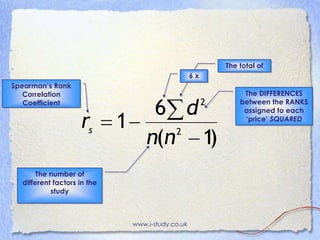
The total of6 xSpearman’s Rank Correlation CoefficientThe DIFFERENCES between the RANKS assigned to each ‘price’ SQUAREDThe number of different factors in the studywww.i-study.co.uk
The MathsFor Argentina:d (rank difference) = 8.5So d2 = 72.25Repeat this calculation for each countryMultiply the sum of all the d2 values by 6 to give the top line of the equationn = the number of countries in the sample =12. n³ - n : 1728 – 12 = 1716 (now we have the bottom line of the equation)Plug in the appropriate numbers to the full equation:			your answer for step 4 			your answer for step 6R =   1-www.i-study.co.uk
What does this R value mean?The closer Ris to +1 or -1, the stronger the likely correlation.  Perfect positive correlation is +1 Perfect negative correlation is -1. Therefore, what sort of relationship do your calculations suggest?www.i-study.co.uk
What is it showing?Total DisagreementOverall Neither Agree or DisagreeTotal Agreementrs close to -1rs close to 1rs close to 0www.i-study.co.uk
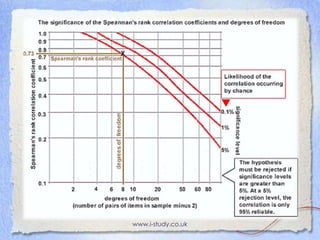
The significance of the relationship!The R value must be looked up on the Spearman Rank significance table.
'degrees of freedom' : This is the number of pairs in your sample minus 2 				(In this case, 12 – 2  = 10)
Using the R value (y axis) the degrees of freedom value (x axis) plot the position of the graph (next page).www.i-study.co.uk

Spearman Rank

  • 1.
    Spearman’s Rank StatisticalAnalysis to show Relationship Strength.www.i-study.co.uk
  • 2.
    Is birth rateconnected to economic development in Central and South American countries?Data taken from Philip’s International School Atlas (2nd Edition) published 2006 www.i-study.co.uk
  • 3.
    SPEARMAN’S RANK CORRELATIONCOEFFICIENTIt says …It allows us to …Compare the RANK ORDER of TWO Data Setswww.i-study.co.uk
  • 4.
    The total of6xSpearman’s Rank Correlation CoefficientThe DIFFERENCES between the RANKS assigned to each ‘price’ SQUAREDThe number of different factors in the studywww.i-study.co.uk
  • 5.
    The MathsFor Argentina:d(rank difference) = 8.5So d2 = 72.25Repeat this calculation for each countryMultiply the sum of all the d2 values by 6 to give the top line of the equationn = the number of countries in the sample =12. n³ - n : 1728 – 12 = 1716 (now we have the bottom line of the equation)Plug in the appropriate numbers to the full equation: your answer for step 4 your answer for step 6R = 1-www.i-study.co.uk
  • 6.
    What does thisR value mean?The closer Ris to +1 or -1, the stronger the likely correlation. Perfect positive correlation is +1 Perfect negative correlation is -1. Therefore, what sort of relationship do your calculations suggest?www.i-study.co.uk
  • 7.
    What is itshowing?Total DisagreementOverall Neither Agree or DisagreeTotal Agreementrs close to -1rs close to 1rs close to 0www.i-study.co.uk
  • 8.
    The significance ofthe relationship!The R value must be looked up on the Spearman Rank significance table.
  • 9.
    'degrees of freedom': This is the number of pairs in your sample minus 2 (In this case, 12 – 2 = 10)
  • 10.
    Using the Rvalue (y axis) the degrees of freedom value (x axis) plot the position of the graph (next page).www.i-study.co.uk