PRESENTED BY:
Y.Madhavasai
17A51A04B8
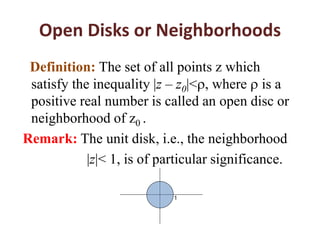
Open Disks or Neighborhoods
Definition: The set of all points z which
satisfy the inequality |z – z0|<, where  is a
positive real number is called an open disc or
neighborhood of z0 .
Remark: The unit disk, i.e., the neighborhood
|z|< 1, is of particular significance.
1
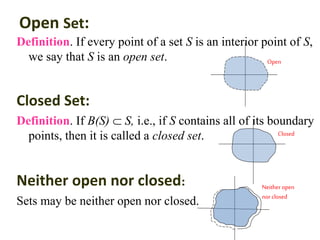
Open Set:
Definition. If every point of a set S is an interior point of S,
we say that S is an open set.
Closed Set:
Definition. If B(S)  S, i.e., if S contains all of its boundary
points, then it is called a closed set.
Neither open nor closed:
Sets may be neither open nor closed.
Open
Closed
Neitheropen
nor closed
Connected:
• An open set S is said to be connected if every pair of
points z1 and z2 in S can be joined by a polygonal line
that lies entirely in S. Roughly speaking, this means
that S consists of a “single piece”, although it may
contain holes.
S
z1 z2
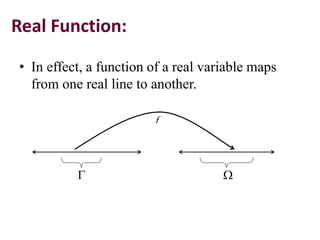
Real Function:
• In effect, a function of a real variable maps
from one real line to another.
 
f
Complex Function:
Definition: Complex function of a complex
variable. Let   C. A function f defined on 
is a rule which assigns to each z   a
complex number w. The number w is called a
value of f at z and is denoted by f(z), i.e.,
w = f(z).
The set  is called the domain of definition of
f. Although the domain of definition is often a
domain, it need not be.
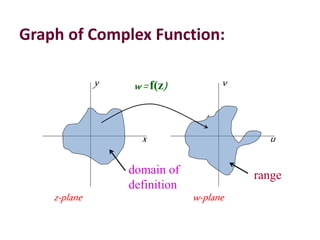
Graph of Complex Function:
x u
y v
z-plane w-plane
domain of
definition
range
w=f(z)
Example :
Describe the range of the function f(z) = x2 + 2i,
defined on (the domain is) the unit disk |z| 1.
Solution : We have u(x , y) = x2 and v(x , y) = 2.
Thus as z varies over the closed unit disk, u varies
between 0 and 1, and v is constant (=2).
Therefore w = f(z) = u(x , y) + iv(x , y) = x2 +2i is
a line segment from w = 2i to w = 1 + 2i.
x
y
u
v
f(z)
domain
range
Limit of a Function:
 We say that the complex number w0 is the limit of the
function f(z) as z approaches z0 if f(z) stays close to w0
whenever z is sufficiently near z0 . Formally, we state:
Definition: Limit of a Complex Sequence. Let f(z) be a
function defined in some neighborhood of z0 except
with the possible exception of the point z0 is the
number w0 if for any real number  > 0 there exists a
positive real number  > 0 such that |f(z) – w0|< 
whenever 0<|z - z0|< .
Properties of Limits:
 If z  z0, lim f(z)  A and lim g(z)  B,
then
• lim [ f(z)  g(z) ] = A  B
• lim f(z)g(z) = AB, and
• lim f(z)/g(z) = A/B. if B  0.
Analytic function
Definition : A complex function is said to be analytic on a
region if it is complex differentiable at every point.
 The terms holomorphic function , differentiable function,
and complex differentiable function are sometimes used
interchangeably with "analytic function“
 If a complex function is analytic on a region, it is
infinitely differentiable.
 A complex function may fail to be analytic at one or more
points through the presence of singularities, or along
lines or line segments through
 A necessary condition for a complex function to be analytic is
Let f(x, y) = u(x, y) + i v(x, y) be a complex function.
Since x = (
𝑧+ 𝑧
2
) and y = (
𝑧− 𝑧
2
)
substituting for x and y gives ,
f(z, 𝑧) = u(x, y) + iv(x, y) .
A necessary condition for f(z, 𝑧) to be analytic is
∂f /∂z = 0.
Therefore a necessary condition for f = u + iv to be analytic is
that f depends only on z.
In terms of the of the real and imaginary parts u, v of f
∂u/ ∂x = ∂v/ ∂y
∂u/ ∂y = − ∂v/ ∂x
The above equations are known as the Cauchy-Riemann
equations.
Necessary and sufficient conditions
for a function to be analytic
The necessary and sufficient conditions for a
function f = u +iv to be analytic are that:
 1. The four partial derivatives of its real and
imaginary parts
∂u /∂x , ∂v /∂x ,
∂u/ ∂y, ∂v/ ∂y
satisfy the Cauchy-Riemann equations
2. The four partial derivatives of its real and
imaginary parts ∂u /∂x , ∂v/ ∂y , ∂u /∂y , ∂v/ ∂x
are continuous.
Cauchy’s theorem
z
zfzzf
zf
z 



)()(
lim)( 00
0
0
Let f(z) bean analytic function everywherewithin and or a closed curvec then
𝐶
𝑓 𝑧 = 0 ,
where, c is traversed inpositive (anti clock wise) direction
C2
C1
Fig (a) Fig (b)
Fig (c)
Theshadedgreyareaistheregionandatypical
closed curveisshowninsidetheregion
The region contains a hole (the white area inside). The
shaded region between the two circles is not simply-
connected; curve C1 can shrink to a point but curve C2
cannot shrink to a point without leaving the region, due to
the hole inside it.
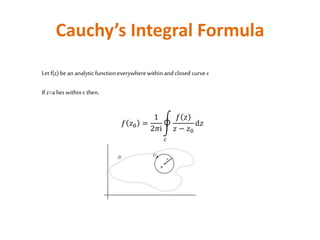
Cauchy’s Integral Formula
Let f(z) bean analytic function everywherewithin and closed curvec
If z=a lies within c then,
𝑓 𝑧0 =
1
2𝜋ⅈ
𝑐
𝑓 𝑧
𝑧 − 𝑧0
ⅆ𝑧
Proof:
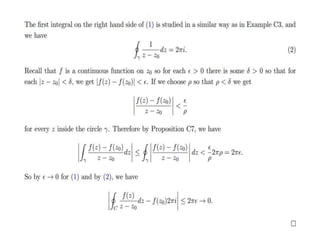
Suppose that γ is a circle of radius ρ and centered at Zo, followed in the
counterclockwise direction. Suppose further that ρ is sufficiently small
so that γ lies inside C. Note that a horizontal line through the point Zo
intersects C at two points and interests γ at two points and gives rise to
two lines inside C and outside γ
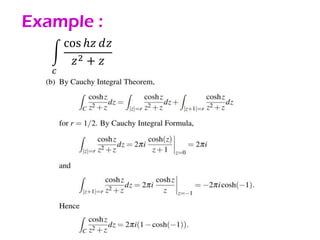
Example :









 y
yxuyyxu
zf
y
),(),(
lim)(' 0000
0
0
𝑐
cos ℎ𝑧 ⅆ𝑧
𝑧2 + 𝑧
).,(),()(' 00000 yx
y
v
yx
y
u
izf















 y
yxvyyxv
i
y
),(),(
lim 0000
0
Milne - Thomson method
x
v
y
u
y
v
x
u










and
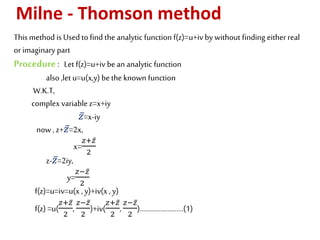
This method is Used to find the analytic function f(z)=u+iv by without finding eitherreal
orimaginary part
Procedure: Let f(z)=u+iv bean analytic function
also ,let u=u(x,y) bethe known function
W.K.T,
complex variable z=x+iy
𝑧=x-iy
now, z+ 𝑧=2x,
x=
𝑧+ 𝑧
2
z- 𝑧=2iy,
y=
𝑧− 𝑧
2
f(z)=u=iv=u(x , y)+iv(x , y)
f(z) =u(
𝑧+ 𝑧
2
,
𝑧− 𝑧
2
)+iv(
𝑧+ 𝑧
2
,
𝑧− 𝑧
2
)…………………….(1)
ye
x
v
ye
y
u
ye
y
v
ye
x
u
yieyezf
xxxx
xx
sin,sin,cos,cos
:Solution
sincos)(













.sincos)(' yieye
x
v
i
x
u
zf xx







Putting z= 𝑧 then ,
x=z and y=0
f(z)=u(z,0)+iv(z,0) ………………………(2)
now, equation 1 is same as equation 2
if we replacex by zand yby 0
i .e. , wecan express anyfunction in terms of z by replacingx by zand yby 0
now f(z)=
𝜕𝑢
𝜕𝑥
+ ⅈ
𝜕𝑣
𝜕𝑥
𝜕 𝑢
𝜕𝑦
+ ⅈ
𝜕 𝑣
𝜕𝑦
=
𝜕𝑢
𝜕𝑥
+ ⅈ
−2𝑢
2𝑦
Wecan express f(z) in terms of z by replacing x by z and yby 0
f(z)=
𝜕𝑢
𝜕𝑥
(Z,0)-i
𝜕 𝑢
𝜕𝑦
(Z,0)
BY integrating the above equation we get
f(z)=u +iv
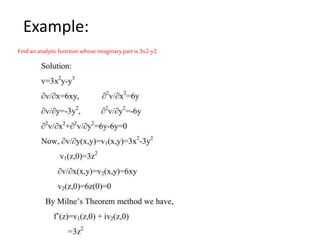
Example:
Find ananalytic functionwhose imaginarypart is 3x2-y2
Complex variables
Complex variables

Complex variables

  • 1.
  • 2.
    Open Disks orNeighborhoods Definition: The set of all points z which satisfy the inequality |z – z0|<, where  is a positive real number is called an open disc or neighborhood of z0 . Remark: The unit disk, i.e., the neighborhood |z|< 1, is of particular significance. 1
  • 3.
    Open Set: Definition. Ifevery point of a set S is an interior point of S, we say that S is an open set. Closed Set: Definition. If B(S)  S, i.e., if S contains all of its boundary points, then it is called a closed set. Neither open nor closed: Sets may be neither open nor closed. Open Closed Neitheropen nor closed
  • 4.
    Connected: • An openset S is said to be connected if every pair of points z1 and z2 in S can be joined by a polygonal line that lies entirely in S. Roughly speaking, this means that S consists of a “single piece”, although it may contain holes. S z1 z2
  • 5.
    Real Function: • Ineffect, a function of a real variable maps from one real line to another.   f
  • 6.
    Complex Function: Definition: Complexfunction of a complex variable. Let   C. A function f defined on  is a rule which assigns to each z   a complex number w. The number w is called a value of f at z and is denoted by f(z), i.e., w = f(z). The set  is called the domain of definition of f. Although the domain of definition is often a domain, it need not be.
  • 7.
    Graph of ComplexFunction: x u y v z-plane w-plane domain of definition range w=f(z)
  • 8.
    Example : Describe therange of the function f(z) = x2 + 2i, defined on (the domain is) the unit disk |z| 1. Solution : We have u(x , y) = x2 and v(x , y) = 2. Thus as z varies over the closed unit disk, u varies between 0 and 1, and v is constant (=2). Therefore w = f(z) = u(x , y) + iv(x , y) = x2 +2i is a line segment from w = 2i to w = 1 + 2i. x y u v f(z) domain range
  • 9.
    Limit of aFunction:  We say that the complex number w0 is the limit of the function f(z) as z approaches z0 if f(z) stays close to w0 whenever z is sufficiently near z0 . Formally, we state: Definition: Limit of a Complex Sequence. Let f(z) be a function defined in some neighborhood of z0 except with the possible exception of the point z0 is the number w0 if for any real number  > 0 there exists a positive real number  > 0 such that |f(z) – w0|<  whenever 0<|z - z0|< .
  • 10.
    Properties of Limits: If z  z0, lim f(z)  A and lim g(z)  B, then • lim [ f(z)  g(z) ] = A  B • lim f(z)g(z) = AB, and • lim f(z)/g(z) = A/B. if B  0.
  • 11.
    Analytic function Definition :A complex function is said to be analytic on a region if it is complex differentiable at every point.  The terms holomorphic function , differentiable function, and complex differentiable function are sometimes used interchangeably with "analytic function“  If a complex function is analytic on a region, it is infinitely differentiable.  A complex function may fail to be analytic at one or more points through the presence of singularities, or along lines or line segments through
  • 12.
     A necessarycondition for a complex function to be analytic is Let f(x, y) = u(x, y) + i v(x, y) be a complex function. Since x = ( 𝑧+ 𝑧 2 ) and y = ( 𝑧− 𝑧 2 ) substituting for x and y gives , f(z, 𝑧) = u(x, y) + iv(x, y) . A necessary condition for f(z, 𝑧) to be analytic is ∂f /∂z = 0. Therefore a necessary condition for f = u + iv to be analytic is that f depends only on z. In terms of the of the real and imaginary parts u, v of f ∂u/ ∂x = ∂v/ ∂y ∂u/ ∂y = − ∂v/ ∂x The above equations are known as the Cauchy-Riemann equations.
  • 13.
    Necessary and sufficientconditions for a function to be analytic The necessary and sufficient conditions for a function f = u +iv to be analytic are that:  1. The four partial derivatives of its real and imaginary parts ∂u /∂x , ∂v /∂x , ∂u/ ∂y, ∂v/ ∂y satisfy the Cauchy-Riemann equations 2. The four partial derivatives of its real and imaginary parts ∂u /∂x , ∂v/ ∂y , ∂u /∂y , ∂v/ ∂x are continuous.
  • 14.
    Cauchy’s theorem z zfzzf zf z     )()( lim)(00 0 0 Let f(z) bean analytic function everywherewithin and or a closed curvec then 𝐶 𝑓 𝑧 = 0 , where, c is traversed inpositive (anti clock wise) direction C2 C1 Fig (a) Fig (b) Fig (c) Theshadedgreyareaistheregionandatypical closed curveisshowninsidetheregion The region contains a hole (the white area inside). The shaded region between the two circles is not simply- connected; curve C1 can shrink to a point but curve C2 cannot shrink to a point without leaving the region, due to the hole inside it.
  • 15.
    Cauchy’s Integral Formula Letf(z) bean analytic function everywherewithin and closed curvec If z=a lies within c then, 𝑓 𝑧0 = 1 2𝜋ⅈ 𝑐 𝑓 𝑧 𝑧 − 𝑧0 ⅆ𝑧
  • 16.
    Proof: Suppose that γis a circle of radius ρ and centered at Zo, followed in the counterclockwise direction. Suppose further that ρ is sufficiently small so that γ lies inside C. Note that a horizontal line through the point Zo intersects C at two points and interests γ at two points and gives rise to two lines inside C and outside γ
  • 18.
    Example :           y yxuyyxu zf y ),(),( lim)('0000 0 0 𝑐 cos ℎ𝑧 ⅆ𝑧 𝑧2 + 𝑧 ).,(),()(' 00000 yx y v yx y u izf                 y yxvyyxv i y ),(),( lim 0000 0
  • 19.
    Milne - Thomsonmethod x v y u y v x u           and This method is Used to find the analytic function f(z)=u+iv by without finding eitherreal orimaginary part Procedure: Let f(z)=u+iv bean analytic function also ,let u=u(x,y) bethe known function W.K.T, complex variable z=x+iy 𝑧=x-iy now, z+ 𝑧=2x, x= 𝑧+ 𝑧 2 z- 𝑧=2iy, y= 𝑧− 𝑧 2 f(z)=u=iv=u(x , y)+iv(x , y) f(z) =u( 𝑧+ 𝑧 2 , 𝑧− 𝑧 2 )+iv( 𝑧+ 𝑧 2 , 𝑧− 𝑧 2 )…………………….(1)
  • 20.
    ye x v ye y u ye y v ye x u yieyezf xxxx xx sin,sin,cos,cos :Solution sincos)(              .sincos)(' yieye x v i x u zf xx        Puttingz= 𝑧 then , x=z and y=0 f(z)=u(z,0)+iv(z,0) ………………………(2) now, equation 1 is same as equation 2 if we replacex by zand yby 0 i .e. , wecan express anyfunction in terms of z by replacingx by zand yby 0 now f(z)= 𝜕𝑢 𝜕𝑥 + ⅈ 𝜕𝑣 𝜕𝑥 𝜕 𝑢 𝜕𝑦 + ⅈ 𝜕 𝑣 𝜕𝑦 = 𝜕𝑢 𝜕𝑥 + ⅈ −2𝑢 2𝑦 Wecan express f(z) in terms of z by replacing x by z and yby 0 f(z)= 𝜕𝑢 𝜕𝑥 (Z,0)-i 𝜕 𝑢 𝜕𝑦 (Z,0) BY integrating the above equation we get f(z)=u +iv
  • 21.