CORRELATION
                ANALYSIS
           It is a statistical measure which
           shows relationship between two
            or more variable moving in the
             same or in opposite direction


08/01/12            anilmishra5555@rediffmail.com   1
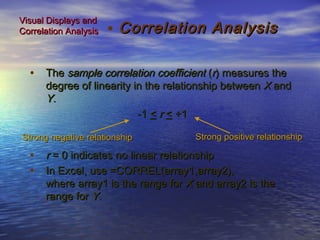
Visual Displays and
Correlation Analysis   • Correlation Analysis

  • The sample correlation coefficient (r) measures the
      degree of linearity in the relationship between X and
      Y.
                           -1 < r < +1

Strong negative relationship          Strong positive relationship

  • r = 0 indicates no linear relationship
  • In Excel, use =CORREL(array1,array2),
      where array1 is the range for X and array2 is the
      range for Y.
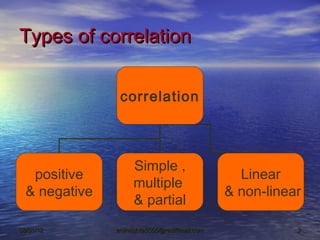
Types of correlation


                correlation


                    Simple ,
   positive                                      Linear
                    multiple
  & negative                                   & non-linear
                    & partial
08/01/12       anilmishra5555@rediffmail.com              3
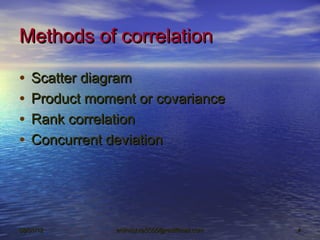
Methods of correlation

•   Scatter diagram
•   Product moment or covariance
•   Rank correlation
•   Concurrent deviation


08/01/12        anilmishra5555@rediffmail.com   4
Scatter diagram

• Perfectly +ve


08/01/12      anilmishra5555@rediffmail.com   5
Less-degree +ve


                    Weak Positive
                     Correlation


08/01/12   anilmishra5555@rediffmail.com   6
High degree +ve


                        Strong Positive
                          Correlation


08/01/12   anilmishra5555@rediffmail.com   7
Perfectly -ve


08/01/12   anilmishra5555@rediffmail.com   8
High degree -ve

           Strong Negative Correlation


08/01/12         anilmishra5555@rediffmail.com   9
Less degree -ve


           Weak Negative
            Correlation

08/01/12     anilmishra5555@rediffmail.com   10
Zero degree


08/01/12   anilmishra5555@rediffmail.com   11
Karl Pearson correlation coefficient

              cov( x, y )
           r=
               σ x .σ y

           r=
                     ∑ x. y
                    ∑ x .∑ y  2              2


08/01/12     anilmishra5555@rediffmail.com       12
Where


           x = X −X
           and
           y =Y −Y


08/01/12    anilmishra5555@rediffmail.com   13
problem

   From the following data find the
     coefficient of correlation by Karl
     Pearson method
   X:6 2 10 4 8
   Y:9 11 5 8 7
Sol.

 X     Y    X-6   Y-8   x2   y2   x. y

  6     9     0     1    0    1     0
  2    11    -4     3   16    9   -12
 10     5     4    -3   16    9   -12
  8     8    -2     0    4    0     0
  4     7     2    -1    4    1    -2
 30    40     0     0   40   20   -26
Sol.cont.


    X=
       ∑X      =
                 30
                    =6
         N        5

    Y =
        ∑ Y = 40 = 8
         N       5

    r=
          ∑ x. y = − 26 = − 26 ≈ −0.92
        ∑  x 2 .∑ y 2  40.20 800
Direct method


                      N .∑ XY − ∑ X .∑ Y
     r=
           [ N ∑ X − ( ∑ X ) ]. [ N.∑ Y − ( ∑ Y ) ]
                  2                  2                2   2


08/01/12              anilmishra5555@rediffmail.com           17
Short-cut method


                       N ∑ d x .d y − ∑ d x .∑ d y
           r=
                N ∑ d x − (∑ dx ) . N ∑ d y − (∑ d y )
                      2                 2                 2   2


08/01/12                  anilmishra5555@rediffmail.com           18
Where


           dx = X − A
           &
           dy = Y − A
           A = assume mean


08/01/12    anilmishra5555@rediffmail.com   19
Product moment method

           r = bxy .byx
           where

           bxy     =
                     ∑xy
                    ∑ y                     2


           byx     =
                     ∑xy

08/01/12
                     ∑x
            anilmishra5555@rediffmail.com
                                            2

                                                20
spearman’s Rank correlation

                          6∑ D        2

           R = 1−
                       N ( N − 1)2


           where
           D = Rx − R y
           Rx = rank .of . X
           R y = rank .of . y

08/01/12    anilmishra5555@rediffmail.com   21
problem


Calculate spearman’s rank correlation
 coefficient between advt.cost & sales from
 the following data
Advt.cost :39 65 62 90 82 75 25 98 36 78
Sales(lakhs): 47 53 58 86 62 68 60 91 51 84
X    Y    R-x   R-y   D         D   2


Sol.   39   47   8     10    -2   4
       65   53   6     8     -2   4
       62   58   7     7     0    0
       90   86   2     2     0    0
       82   62   3     5     -2   4
       75   68   5     4     1    1
       25   60   10    6     4    16
       98   91   1     1     0    0
       36   51   9     9     0    0
       78   84   4     3     1    1
                                  30
Sol.cont.

                     6∑ D 2
            R = 1−
                  N −N3

                       6.30
            ⇒ R = 1− 3
                     10 − 10
                      2
            ⇒ R = 1−
                     11
                   9
            ⇒ R = = 0.82
                  11
In case of equal rank

                    
                  6 ∑ D +
                         2   1 3
                            12
                                    (
                                 m −m +
                                         1 3
                                        12
                                                 )         
                                           m − m + ........(   )
           R = 1−                                         
                                   N N −1
                                      2
                                             (          )
           where
           m = no.of repeated items


08/01/12                anilmishra5555@rediffmail.com               25
problem
A psychologist wanted to compare two methods A
  & B of teaching. He selected a random sample
  of 22 students. He grouped them into 11 pairs so
  that the students in a pair have approximately
  equal scores in an intelligence test. In each pair
  one student was taught by method A and the
  other by method B and examined after the
  course. The marks obtained by them as follows
Pair:1 2 3 4 5 6 7 8 9 10 11
A: 24 29 19 14 30 19 27 30 20 28 11
B: 37 35 16 26 23 27 19 20 16 11 21
A    B    R-A   R-B   D       D2
Sol.   24   37   6     1     5      25
       29   35   3     2     1      1
       19   16   8.5   9.5   -1     1
       14   26   10    4     6      36
       30   23   1.5   5     -3.5   12.25
       19   27   8.5   3     5.5    30.25
       27   19   5     8     -3     9
       30   20   1.5   7     -5.5   30.25
       20   16   7     9.5   -2.5   6.25
       28   11   4     11    -7     49
       11   21   11    6     5      25
                                    225
Sol.cont.

in A series the items 19 & 30 are repeated twice and in B series16
is repeated twice ∴
               2( 4 − 1) 2( 4 − 1) 2( 4 − 1) 
       6 ∑ D +
             2
                         +         +
                  12        12        12    
R = 1-
                    11(121 − 1)
⇒ R = −0.0225
Properties of correlation coefficient

• r always lies between +1 & -1
i.e. -1<r<+1
• Two independent variables are
   uncorrelated but converse is not true
• r is independent of change in origin and
   scale
• r is the G.M. of two regression coefficients
• r is symmetrical
08/01/12        anilmishra5555@rediffmail.com   29
Probable error
                      1 −r          2
           SE ( r ) =
                         n
           PE ( r ) = 0.6745 × SE ( r )
           or
                              1 −r               2
           PE ( r ) = 0.6745 ×
                                 n

08/01/12         anilmishra5555@rediffmail.com       30
The coefficient of determination
It is the primary way we can measure the extent
    or strength of the association that exists
    between two variables x & y . Because we have
    used a sample of points to develop regression
    lines .
                       2
It is denoted by r
Thank you


08/01/12   anilmishra5555@rediffmail.com   32

Correlation analysis ppt

  • 1.
    CORRELATION ANALYSIS It is a statistical measure which shows relationship between two or more variable moving in the same or in opposite direction 08/01/12 anilmishra5555@rediffmail.com 1
  • 2.
    Visual Displays and CorrelationAnalysis • Correlation Analysis • The sample correlation coefficient (r) measures the degree of linearity in the relationship between X and Y. -1 < r < +1 Strong negative relationship Strong positive relationship • r = 0 indicates no linear relationship • In Excel, use =CORREL(array1,array2), where array1 is the range for X and array2 is the range for Y.
  • 3.
    Types of correlation correlation Simple , positive Linear multiple & negative & non-linear & partial 08/01/12 anilmishra5555@rediffmail.com 3
  • 4.
    Methods of correlation • Scatter diagram • Product moment or covariance • Rank correlation • Concurrent deviation 08/01/12 anilmishra5555@rediffmail.com 4
  • 5.
    Scatter diagram • Perfectly+ve 08/01/12 anilmishra5555@rediffmail.com 5
  • 6.
    Less-degree +ve Weak Positive Correlation 08/01/12 anilmishra5555@rediffmail.com 6
  • 7.
    High degree +ve Strong Positive Correlation 08/01/12 anilmishra5555@rediffmail.com 7
  • 8.
    Perfectly -ve 08/01/12 anilmishra5555@rediffmail.com 8
  • 9.
    High degree -ve Strong Negative Correlation 08/01/12 anilmishra5555@rediffmail.com 9
  • 10.
    Less degree -ve Weak Negative Correlation 08/01/12 anilmishra5555@rediffmail.com 10
  • 11.
    Zero degree 08/01/12 anilmishra5555@rediffmail.com 11
  • 12.
    Karl Pearson correlationcoefficient cov( x, y ) r= σ x .σ y r= ∑ x. y ∑ x .∑ y 2 2 08/01/12 anilmishra5555@rediffmail.com 12
  • 13.
    Where x = X −X and y =Y −Y 08/01/12 anilmishra5555@rediffmail.com 13
  • 14.
    problem From the following data find the coefficient of correlation by Karl Pearson method X:6 2 10 4 8 Y:9 11 5 8 7
  • 15.
    Sol. X Y X-6 Y-8 x2 y2 x. y 6 9 0 1 0 1 0 2 11 -4 3 16 9 -12 10 5 4 -3 16 9 -12 8 8 -2 0 4 0 0 4 7 2 -1 4 1 -2 30 40 0 0 40 20 -26
  • 16.
    Sol.cont. X= ∑X = 30 =6 N 5 Y = ∑ Y = 40 = 8 N 5 r= ∑ x. y = − 26 = − 26 ≈ −0.92 ∑ x 2 .∑ y 2 40.20 800
  • 17.
    Direct method N .∑ XY − ∑ X .∑ Y r= [ N ∑ X − ( ∑ X ) ]. [ N.∑ Y − ( ∑ Y ) ] 2 2 2 2 08/01/12 anilmishra5555@rediffmail.com 17
  • 18.
    Short-cut method N ∑ d x .d y − ∑ d x .∑ d y r= N ∑ d x − (∑ dx ) . N ∑ d y − (∑ d y ) 2 2 2 2 08/01/12 anilmishra5555@rediffmail.com 18
  • 19.
    Where dx = X − A & dy = Y − A A = assume mean 08/01/12 anilmishra5555@rediffmail.com 19
  • 20.
    Product moment method r = bxy .byx where bxy = ∑xy ∑ y 2 byx = ∑xy 08/01/12 ∑x anilmishra5555@rediffmail.com 2 20
  • 21.
    spearman’s Rank correlation 6∑ D 2 R = 1− N ( N − 1)2 where D = Rx − R y Rx = rank .of . X R y = rank .of . y 08/01/12 anilmishra5555@rediffmail.com 21
  • 22.
    problem Calculate spearman’s rankcorrelation coefficient between advt.cost & sales from the following data Advt.cost :39 65 62 90 82 75 25 98 36 78 Sales(lakhs): 47 53 58 86 62 68 60 91 51 84
  • 23.
    X Y R-x R-y D D 2 Sol. 39 47 8 10 -2 4 65 53 6 8 -2 4 62 58 7 7 0 0 90 86 2 2 0 0 82 62 3 5 -2 4 75 68 5 4 1 1 25 60 10 6 4 16 98 91 1 1 0 0 36 51 9 9 0 0 78 84 4 3 1 1 30
  • 24.
    Sol.cont. 6∑ D 2 R = 1− N −N3 6.30 ⇒ R = 1− 3 10 − 10 2 ⇒ R = 1− 11 9 ⇒ R = = 0.82 11
  • 25.
    In case ofequal rank  6 ∑ D + 2 1 3 12 ( m −m + 1 3 12 )  m − m + ........( ) R = 1−   N N −1 2 ( ) where m = no.of repeated items 08/01/12 anilmishra5555@rediffmail.com 25
  • 26.
    problem A psychologist wantedto compare two methods A & B of teaching. He selected a random sample of 22 students. He grouped them into 11 pairs so that the students in a pair have approximately equal scores in an intelligence test. In each pair one student was taught by method A and the other by method B and examined after the course. The marks obtained by them as follows Pair:1 2 3 4 5 6 7 8 9 10 11 A: 24 29 19 14 30 19 27 30 20 28 11 B: 37 35 16 26 23 27 19 20 16 11 21
  • 27.
    A B R-A R-B D D2 Sol. 24 37 6 1 5 25 29 35 3 2 1 1 19 16 8.5 9.5 -1 1 14 26 10 4 6 36 30 23 1.5 5 -3.5 12.25 19 27 8.5 3 5.5 30.25 27 19 5 8 -3 9 30 20 1.5 7 -5.5 30.25 20 16 7 9.5 -2.5 6.25 28 11 4 11 -7 49 11 21 11 6 5 25 225
  • 28.
    Sol.cont. in A seriesthe items 19 & 30 are repeated twice and in B series16 is repeated twice ∴  2( 4 − 1) 2( 4 − 1) 2( 4 − 1)  6 ∑ D + 2 + +  12 12 12   R = 1- 11(121 − 1) ⇒ R = −0.0225
  • 29.
    Properties of correlationcoefficient • r always lies between +1 & -1 i.e. -1<r<+1 • Two independent variables are uncorrelated but converse is not true • r is independent of change in origin and scale • r is the G.M. of two regression coefficients • r is symmetrical 08/01/12 anilmishra5555@rediffmail.com 29
  • 30.
    Probable error 1 −r 2 SE ( r ) = n PE ( r ) = 0.6745 × SE ( r ) or 1 −r 2 PE ( r ) = 0.6745 × n 08/01/12 anilmishra5555@rediffmail.com 30
  • 31.
    The coefficient ofdetermination It is the primary way we can measure the extent or strength of the association that exists between two variables x & y . Because we have used a sample of points to develop regression lines . 2 It is denoted by r
  • 32.
    Thank you 08/01/12 anilmishra5555@rediffmail.com 32