Partial Differential Equations,
Part I
2015.11.19 Enrique Valderrama, Ph.D.
Table of contents
1 Introduction
2 Laplace’s Equation
Steady-State temperature in a rectangular plate
Math. Parenthesis: The Fourier Series
3 The Diffusion or Heat Flow Equation
Flow of Heat through a slab of thickness
4 The Wave Equation
The Vibrating String
Introduction
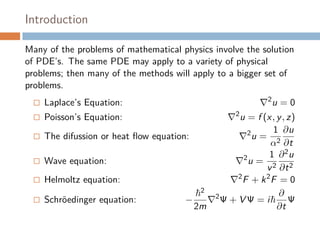
Many of the problems of mathematical physics involve the solution
of PDE’s. The same PDE may apply to a variety of physical
problems; then many of the methods will apply to a bigger set of
problems.
Laplace’s Equation: 2
u = 0
Poisson’s Equation: 2
u = f (x, y, z)
The difussion or heat flow equation: 2
u =
1
α2
∂u
∂t
Wave equation: 2
u =
1
v2
∂2u
∂t2
Helmoltz equation: 2
F + k2
F = 0
Schröedinger equation: −
2
2m
2
Ψ + V Ψ = i
∂
∂t
Ψ
Laplace’s Equation:
Example (Steady-State temperature in a rectangular plate)
We have a rectangular plate on the region:
R : {0 < x < 10 , 0 < y} with border conditions:
T(x = 0) = T(x = 10) = T(y = ∞) = 0◦ and T(y = 0) = 100◦
Solution
2
T = 0
∂2T
∂x2
+
∂2T
∂y2
= 0
T(x, y) = X(x)Y (y)
Y
∂2X
∂x2
+ X
∂2Y
∂y2
= 0
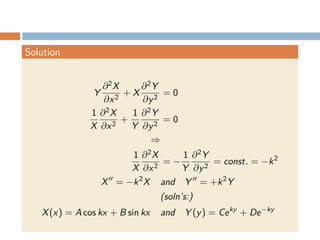
Solution
Y
∂2X
∂x2
+ X
∂2Y
∂y2
= 0
1
X
∂2X
∂x2
+
1
Y
∂2Y
∂y2
= 0
⇒
1
X
∂2X
∂x2
= −
1
Y
∂2Y
∂y2
= const. = −k2
X = −k2
X and Y = +k2
Y
(soln’s:)
X(x) = A cos kx + B sin kx and Y (y) = Ceky
+ De−ky
Solution
T(x, y) = X(x)Y (y) = (A cos kx + B sin kx)(Ceky
+ De−ky
)
B.C. : T(x, ∞) = 0 ⇒ C = 0
T(0, y) = 0 ⇒ A = 0 and
T(10, y) = 0 ⇒ sin 10k = 0 ⇒ k = n
π
10
)
⇒
T(x, y) = BD sin n
π
10
x e−n π
10
y
andT(x, 0) = 100 ⇒ BD sin n
π
10
x · 1 = 100
Solution
T(x, y) =
∞
n=1
bne−n π
10
y
sin n
π
10
x
For y = 0, we must have T = 100, then :
T(x, 0) =
∞
n=1
bn sin n
π
10
x
which is just the Fourier sine series · · ·
Fourier Series:
Similar to Taylor series, which we approx. a function using the
summation of the derivatives of the function and polynomials, a
Fourier series will approx. a function with the summation of cosine
and sine functions:
f (x) = a0 +
∞
k=1
an cos
nπx
+ bn sin
nπx
where the coefficients are given by the Euler formulas
a0 =
1
2 −
f (x) dx,
an =
1
−
f (x) cos
nπx
dx, n = 1, 2, · · ·
bn =
1
−
f (x) sin
nπx
dx, n = 1, 2, · · ·
Approximation to a square wave
Considere the square wave, which first wave is:
f = 4 if 0 ≤ x ≤ π
f = 0 if π < x < 2π
and so on
Example
Use FS to approximate the square wave function.
Solution
The Euler coefficients:
a0 =
1
2 −
f (x) dx =
1
2π
0
−π
0 dx +
π
0
4 dx = 2
Solution
an =
1
−
f (x) cos
nπx
dx =
1
π
0
−π
0 dx +
π
0
4 cos
nπx
π
dx
=
1
π
π
0
4 cos nx dx =
1
π
4 sin nx
n
π
0
= 0
bn =
1
−
f (x) sin
nπx
dx =
1
π
0
−π
0 dx +
π
0
4 sin
nπx
π
dx
=
1
π
π
0
4 sin nx dx = −
1
π
4 cos nx
n
π
0
=
4
πn
(1 − cos nπ)
⇒
f (x) = 2 +
8
π
sin x +
8
3π
sin 3x +
8
5π
sin 5x + · · ·
Let’s come back to Laplace PDE · · ·
Solution
T(x, 0) = 100 =
∞
n=1
bn sin n
π
10
x
We recognize f (x) = 100, = 10 therefore bn are given by:
bn =
1
10
0
−10
0 · sin
nπx
10
dx +
10
0
100 sin
nπx
10
dx
= 10
10
πn
−
10 cos πn
πn
=
200
nπ
, n = 1, 3, 5 · · ·
Finally:
T(x, y) =
∞
n=1
bne−n π
10
y
sin n
π
10
x
=
200
π
e− π
10
y
sin
π
10
x +
1
3
e−3π
10
y
sin
3π
10
x + · · ·
The Diffusion or Heat Flow Equation:
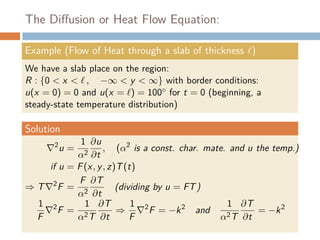
Example (Flow of Heat through a slab of thickness )
We have a slab place on the region:
R : {0 < x < , −∞ < y < ∞} with border conditions:
u(x = 0) = 0 and u(x = ) = 100◦ for t = 0 (beginning, a
steady-state temperature distribution)
Solution
2
u =
1
α2
∂u
∂t
, (α2
is a const. char. mate. and u the temp.)
if u = F(x, y, z)T(t)
⇒ T 2
F =
F
α2
∂T
∂t
(dividing by u = FT)
1
F
2
F =
1
α2T
∂T
∂t
⇒
1
F
2
F = −k2
and
1
α2T
∂T
∂t
= −k2
Solution
The solution of the DFQ dependent of the time is trivial:
T(t) = e−k2α2t
and in our particular problem, where we have a very long slab, the
diffusion will be only on the x-direction, then the DFQ dependent
on the space coordinates, also become trivial, because we
recognize as the SHO.
∂2F(x)
∂x2
+ k2
F(x) = 0
soln :
F(x) =A cos kx + B sin kx
Solution
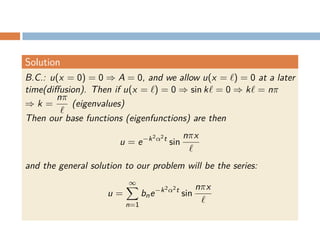
B.C.: u(x = 0) = 0 ⇒ A = 0, and we allow u(x = ) = 0 at a later
time(diffusion). Then if u(x = ) = 0 ⇒ sin k = 0 ⇒ k = nπ
⇒ k =
nπ
(eigenvalues)
Then our base functions (eigenfunctions) are then
u = e−k2α2t
sin
nπx
and the general solution to our problem will be the series:
u =
∞
n=1
bne−k2α2t
sin
nπx
Solution
The problem say at the beginning, a steady-state temperature
distribution is on the slab, which implies u0 satisfy Laplace’s
equation, i.e 2u0 = 0, i.e.
∂u2
0
∂x2 = 0, and the solution for this
equation is u0 = ax + b, then applying border condition we get
u0 =
100
x
Then for t = 0, u(x, t = 0) = u0, i.e.
u(x, t = 0) =
∞
n=1
bn sin
nπx
=
100
x
Which can be solved using F.S., for f (x) = 100
x and the
half-period equal to
Solution
The Euler coefficients:
an = 0 (we dont want solutions with cosine functions (B.C.))
bn =
1
−
f (x) sin
nπx
dx =
1 0
−
0 dx +
0
100
x sin
nπx
dx
=
100
2
π
0
x sin
nπx
dx ⇒ (Integration by parts:)
bn =
100(sin πn − πn cos πn)
π2n2
=
100
π
(−1)n−1
n
⇒
u =
100
π
∞
n=1
(−1)n−1
n
e−k2α2t
sin
nπx
The Wave Equation:
Example (The Vibrating String)
Let a string be stretched tightly and its ends fastened to supports
at x = 0 and x = . When the string is vibrating, its vertical
displacement y from its equilibrium position along the x-axis
depends on x and t. We assume the displacement y is very small
and that the slope ∂y/∂t is small at any point at any time.
Solution
∂2y
∂x2
=
1
v2
∂2y
∂t2
, (v = T/µ)
if y = X(x)T(t)
⇒
1
X
∂2X
∂x2
=
1
v2
1
T
∂2T
∂t2
= −k2
(soln’s:)
X(x) = A cos kx + B sin kx and T(t) = C cos kvt + D sin kvt
Solution
B.C.: y(x = 0) = 0 ⇒ A = 0,
u(x = ) = 0 ⇒ sin k = 0 ⇒ k = nπ ⇒ k = nπ
(eigenvalues)
Then: y1(x, t) = B sin
nπ
x C cos
nπ
vt + D sin
nπ
vt but at
t = 0 every piece of string is not varying with time, the ∂y/∂t = 0
Then D = 0 as well.
Then our base functions (eigenfunctions) are then
y1 = BC sin
nπ
x cos
nπ
vt
and the general solution to our problem will be the series:
y(x, t) =
∞
n=1
bn sin
nπ
x cos
nπ
vt
Solution
Then at t = 0, y(x, t) = y0 = f (x), then
y(x, t = 0) =
∞
n=1
bn sin
nπ
x = f (x)
· · ·

Partial Differential Equations, 3 simple examples

  • 1.
    Partial Differential Equations, PartI 2015.11.19 Enrique Valderrama, Ph.D.
  • 2.
    Table of contents 1Introduction 2 Laplace’s Equation Steady-State temperature in a rectangular plate Math. Parenthesis: The Fourier Series 3 The Diffusion or Heat Flow Equation Flow of Heat through a slab of thickness 4 The Wave Equation The Vibrating String
  • 3.
    Introduction Many of theproblems of mathematical physics involve the solution of PDE’s. The same PDE may apply to a variety of physical problems; then many of the methods will apply to a bigger set of problems. Laplace’s Equation: 2 u = 0 Poisson’s Equation: 2 u = f (x, y, z) The difussion or heat flow equation: 2 u = 1 α2 ∂u ∂t Wave equation: 2 u = 1 v2 ∂2u ∂t2 Helmoltz equation: 2 F + k2 F = 0 Schröedinger equation: − 2 2m 2 Ψ + V Ψ = i ∂ ∂t Ψ
  • 4.
    Laplace’s Equation: Example (Steady-Statetemperature in a rectangular plate) We have a rectangular plate on the region: R : {0 < x < 10 , 0 < y} with border conditions: T(x = 0) = T(x = 10) = T(y = ∞) = 0◦ and T(y = 0) = 100◦ Solution 2 T = 0 ∂2T ∂x2 + ∂2T ∂y2 = 0 T(x, y) = X(x)Y (y) Y ∂2X ∂x2 + X ∂2Y ∂y2 = 0
  • 5.
    Solution Y ∂2X ∂x2 + X ∂2Y ∂y2 = 0 1 X ∂2X ∂x2 + 1 Y ∂2Y ∂y2 =0 ⇒ 1 X ∂2X ∂x2 = − 1 Y ∂2Y ∂y2 = const. = −k2 X = −k2 X and Y = +k2 Y (soln’s:) X(x) = A cos kx + B sin kx and Y (y) = Ceky + De−ky
  • 6.
    Solution T(x, y) =X(x)Y (y) = (A cos kx + B sin kx)(Ceky + De−ky ) B.C. : T(x, ∞) = 0 ⇒ C = 0 T(0, y) = 0 ⇒ A = 0 and T(10, y) = 0 ⇒ sin 10k = 0 ⇒ k = n π 10 ) ⇒ T(x, y) = BD sin n π 10 x e−n π 10 y andT(x, 0) = 100 ⇒ BD sin n π 10 x · 1 = 100
  • 7.
    Solution T(x, y) = ∞ n=1 bne−nπ 10 y sin n π 10 x For y = 0, we must have T = 100, then : T(x, 0) = ∞ n=1 bn sin n π 10 x which is just the Fourier sine series · · ·
  • 8.
    Fourier Series: Similar toTaylor series, which we approx. a function using the summation of the derivatives of the function and polynomials, a Fourier series will approx. a function with the summation of cosine and sine functions: f (x) = a0 + ∞ k=1 an cos nπx + bn sin nπx where the coefficients are given by the Euler formulas a0 = 1 2 − f (x) dx, an = 1 − f (x) cos nπx dx, n = 1, 2, · · · bn = 1 − f (x) sin nπx dx, n = 1, 2, · · ·
  • 9.
    Approximation to asquare wave Considere the square wave, which first wave is: f = 4 if 0 ≤ x ≤ π f = 0 if π < x < 2π and so on Example Use FS to approximate the square wave function. Solution The Euler coefficients: a0 = 1 2 − f (x) dx = 1 2π 0 −π 0 dx + π 0 4 dx = 2
  • 10.
    Solution an = 1 − f (x)cos nπx dx = 1 π 0 −π 0 dx + π 0 4 cos nπx π dx = 1 π π 0 4 cos nx dx = 1 π 4 sin nx n π 0 = 0 bn = 1 − f (x) sin nπx dx = 1 π 0 −π 0 dx + π 0 4 sin nπx π dx = 1 π π 0 4 sin nx dx = − 1 π 4 cos nx n π 0 = 4 πn (1 − cos nπ) ⇒ f (x) = 2 + 8 π sin x + 8 3π sin 3x + 8 5π sin 5x + · · ·
  • 11.
    Let’s come backto Laplace PDE · · · Solution T(x, 0) = 100 = ∞ n=1 bn sin n π 10 x We recognize f (x) = 100, = 10 therefore bn are given by: bn = 1 10 0 −10 0 · sin nπx 10 dx + 10 0 100 sin nπx 10 dx = 10 10 πn − 10 cos πn πn = 200 nπ , n = 1, 3, 5 · · · Finally: T(x, y) = ∞ n=1 bne−n π 10 y sin n π 10 x = 200 π e− π 10 y sin π 10 x + 1 3 e−3π 10 y sin 3π 10 x + · · ·
  • 12.
    The Diffusion orHeat Flow Equation: Example (Flow of Heat through a slab of thickness ) We have a slab place on the region: R : {0 < x < , −∞ < y < ∞} with border conditions: u(x = 0) = 0 and u(x = ) = 100◦ for t = 0 (beginning, a steady-state temperature distribution) Solution 2 u = 1 α2 ∂u ∂t , (α2 is a const. char. mate. and u the temp.) if u = F(x, y, z)T(t) ⇒ T 2 F = F α2 ∂T ∂t (dividing by u = FT) 1 F 2 F = 1 α2T ∂T ∂t ⇒ 1 F 2 F = −k2 and 1 α2T ∂T ∂t = −k2
  • 13.
    Solution The solution ofthe DFQ dependent of the time is trivial: T(t) = e−k2α2t and in our particular problem, where we have a very long slab, the diffusion will be only on the x-direction, then the DFQ dependent on the space coordinates, also become trivial, because we recognize as the SHO. ∂2F(x) ∂x2 + k2 F(x) = 0 soln : F(x) =A cos kx + B sin kx
  • 14.
    Solution B.C.: u(x =0) = 0 ⇒ A = 0, and we allow u(x = ) = 0 at a later time(diffusion). Then if u(x = ) = 0 ⇒ sin k = 0 ⇒ k = nπ ⇒ k = nπ (eigenvalues) Then our base functions (eigenfunctions) are then u = e−k2α2t sin nπx and the general solution to our problem will be the series: u = ∞ n=1 bne−k2α2t sin nπx
  • 15.
    Solution The problem sayat the beginning, a steady-state temperature distribution is on the slab, which implies u0 satisfy Laplace’s equation, i.e 2u0 = 0, i.e. ∂u2 0 ∂x2 = 0, and the solution for this equation is u0 = ax + b, then applying border condition we get u0 = 100 x Then for t = 0, u(x, t = 0) = u0, i.e. u(x, t = 0) = ∞ n=1 bn sin nπx = 100 x Which can be solved using F.S., for f (x) = 100 x and the half-period equal to
  • 16.
    Solution The Euler coefficients: an= 0 (we dont want solutions with cosine functions (B.C.)) bn = 1 − f (x) sin nπx dx = 1 0 − 0 dx + 0 100 x sin nπx dx = 100 2 π 0 x sin nπx dx ⇒ (Integration by parts:) bn = 100(sin πn − πn cos πn) π2n2 = 100 π (−1)n−1 n ⇒ u = 100 π ∞ n=1 (−1)n−1 n e−k2α2t sin nπx
  • 17.
    The Wave Equation: Example(The Vibrating String) Let a string be stretched tightly and its ends fastened to supports at x = 0 and x = . When the string is vibrating, its vertical displacement y from its equilibrium position along the x-axis depends on x and t. We assume the displacement y is very small and that the slope ∂y/∂t is small at any point at any time. Solution ∂2y ∂x2 = 1 v2 ∂2y ∂t2 , (v = T/µ) if y = X(x)T(t) ⇒ 1 X ∂2X ∂x2 = 1 v2 1 T ∂2T ∂t2 = −k2 (soln’s:) X(x) = A cos kx + B sin kx and T(t) = C cos kvt + D sin kvt
  • 18.
    Solution B.C.: y(x =0) = 0 ⇒ A = 0, u(x = ) = 0 ⇒ sin k = 0 ⇒ k = nπ ⇒ k = nπ (eigenvalues) Then: y1(x, t) = B sin nπ x C cos nπ vt + D sin nπ vt but at t = 0 every piece of string is not varying with time, the ∂y/∂t = 0 Then D = 0 as well. Then our base functions (eigenfunctions) are then y1 = BC sin nπ x cos nπ vt and the general solution to our problem will be the series: y(x, t) = ∞ n=1 bn sin nπ x cos nπ vt
  • 19.
    Solution Then at t= 0, y(x, t) = y0 = f (x), then y(x, t = 0) = ∞ n=1 bn sin nπ x = f (x) · · ·