Acid Peptic Disorders
Acid peptic disorders include a number of
diseases, whose etiology can be linked to
gastric secretions.
Gastroesophageal reflux disease, and
peptic ulcer disease, are two most
common and well-defined disease states.
GERD is defined as chronic symptoms or mucosal
damage produced by the abnormal reflux of gastric
contents into the esophagus.
Reflux esophagitis refers to a subgroup of GERD
patients with histopathologically demonstrated
characteristic changes in the esophageal mucosa
Nonerosive reflux disease, also know as endoscopynegative reflux disease, refers to patients with typical
GERD symptoms caused by intraesophageal acid who
do not have visible mucosal injury at endoscopy.
Prevalence
Heartburn is a common problem in the United States and
in the Western world, since many individuals control
symptoms with over-the-counter medications and without
consulting a physician, the condition is likely
underreported.
Approximately 7% of the population experience
symptoms of heartburn daily. 20-40% of the people who
experience heartburn do indeed have GERD
No sexual predilection exists. GERD is as common in
men as in women
GERD occurs in all age groups.
The prevalence of GERD increases in people older than
40 years.
Etiology


Lower esophageal sphincter incompetence.



Transient lower esophageal sphincter
relaxation.



Hiatal hernia



Obesity: contributing factor in GERD
Typical Features
 Heartburn

 Regurgitation
Atypical Features
 Coughing and/or wheezing
 Hoarseness
 Pneumonia
 Belching
 Laryngitis
 Otitis media
 Enamel decay.
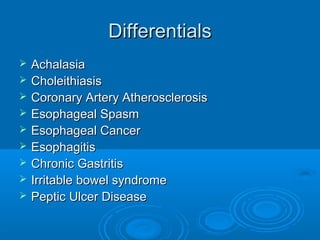
Differentials










Achalasia
Choleithiasis
Coronary Artery Atherosclerosis
Esophageal Spasm
Esophageal Cancer
Esophagitis
Chronic Gastritis
Irritable bowel syndrome
Peptic Ulcer Disease
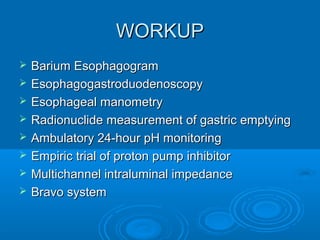
WORKUP









Barium Esophagogram
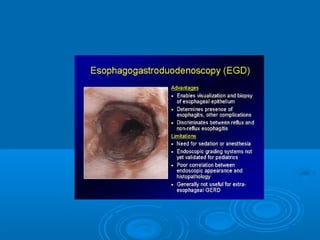
Esophagogastroduodenoscopy
Esophageal manometry
Radionuclide measurement of gastric emptying
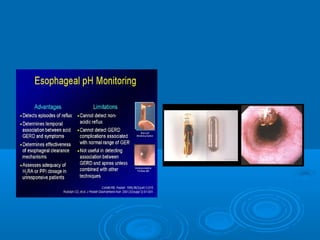
Ambulatory 24-hour pH monitoring
Empiric trial of proton pump inhibitor
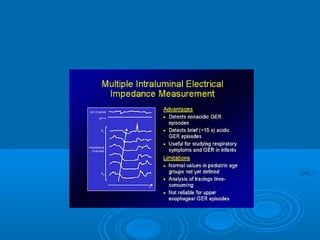
Multichannel intraluminal impedance
Bravo system
Medical Treatment
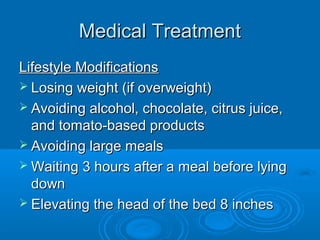
Lifestyle Modifications
 Losing weight (if overweight)
 Avoiding alcohol, chocolate, citrus juice,
and tomato-based products
 Avoiding large meals
 Waiting 3 hours after a meal before lying
down
 Elevating the head of the bed 8 inches
Treatment Cont.
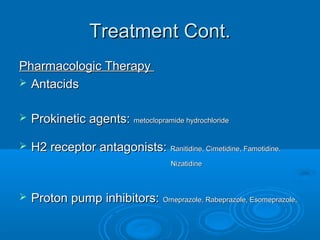
Pharmacologic Therapy
 Antacids


Prokinetic agents: metoclopramide hydrochloride



H2 receptor antagonists: Ranitidine, Cimetidine, Famotidine.
Nizatidine



Proton pump inhibitors: Omeprazole, Rabeprazole, Esomeprazole,
Treatments Cont.


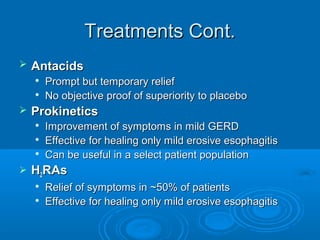
Antacids





Prokinetics






Prompt but temporary relief
No objective proof of superiority to placebo
Improvement of symptoms in mild GERD
Effective for healing only mild erosive esophagitis
Can be useful in a select patient population

H2RAs



Relief of symptoms in ~50% of patients
Effective for healing only mild erosive esophagitis
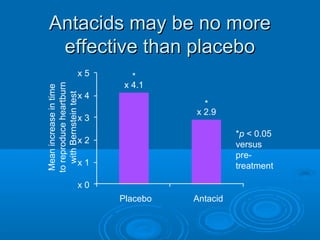
Antacids may be no more
effective than placebo
Mean increase in time
to reproduce heartburn
with Bernstein test

x5

*
x 4.1

x4

*
x 2.9

x3

*p < 0.05
versus
pretreatment

x2
x1
x0
Placebo

Antacid
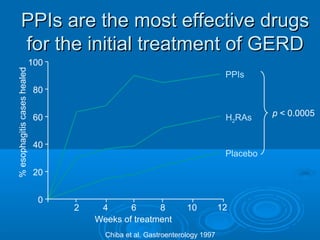
% esophagitis cases healed

PPIs are the most effective drugs
for the initial treatment of GERD
100
PPIs
80
60

H2RAs

40

Placebo

20
0

2

4
6
8
Weeks of treatment

10

Chiba et al. Gastroenterology 1997

12

p < 0.0005
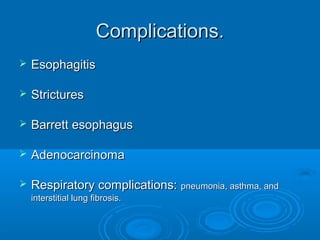
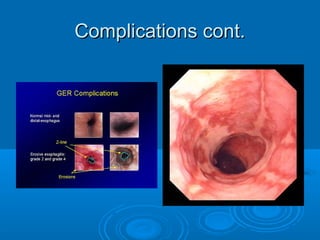
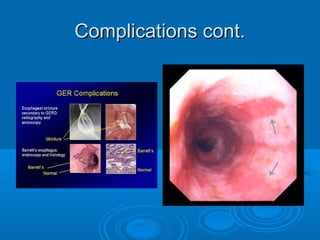
Complications.


Esophagitis



Strictures



Barrett esophagus



Adenocarcinoma



Respiratory complications: pneumonia, asthma, and
interstitial lung fibrosis.
Complications cont.
Complications cont.
Points to Remember


Endoscopy reveals that 50% of patients do not
have esophagitis.



The only way to determine if abnormal reflux is
present and if symptoms are actually caused by
GERD is through pH monitoring.



Achalasia can present with heartburn. Only
esophageal manometry and pH monitoring can
be used to distinguish achalasia from GERD.
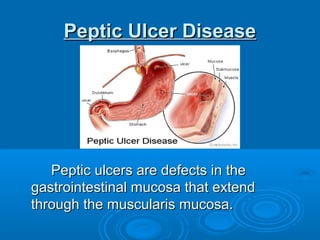
Peptic Ulcer Disease

Peptic ulcers are defects in the
gastrointestinal mucosa that extend
through the muscularis mucosa.
Prevalence
Lifetime prevalence is approximately 1114% for men.
Lifetime prevalence is approximately 811% for women.
Age trends for ulcer occurrence reveal
declining rates in younger men,
particularly for duodenal ulcer, and
increasing rates in older women.
Etiology
 Helicobacter pylori

infection

 Consumption of NSAIDS
 Severe physiologic stress
 Hypersecretory states
Symptoms
 Epigastric pain
 Nausea
 Vomiting
 Dyspepsia
 Heartburn
 Chest discomfort
 Anorexia, weight loss
 Hematemesis or melena
Signs
 Epigastric tenderness
 Epigastric pain
 Guaiac-positive stool
 Succussion splash
Differentials












Biliary Colic
Cholecystitis
Cholelithiasis
Gastritis, Acute
Gastritis, Chronic
Gastroesophageal Reflux Disease
Mesenteric Artery Ischemia
Myocardial Ischemia
Pancreatic Cancer
Pancreatitis, Acute
Pancreatitis, Chronic
WORKUP
 Double-contrast radiography
 Detection of

H pylori infection

 Endoscopic tests
 Serum gastrin
Medical Treatment
 H. pylori

eradication: Dual/Triple therapy
 Cessation of NSAIDs
 H2-receptor antagonists
 Proton Pump Inhibitors
 Prostaglandins misoprostol
 Sucralfate sucrose-aluminum complex promotes ulcer healing
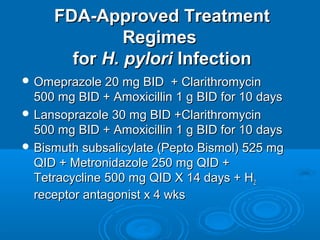
FDA-Approved Treatment
Regimes
for H. pylori Infection
 Omeprazole 20 mg BID

+ Clarithromycin
500 mg BID + Amoxicillin 1 g BID for 10 days
 Lansoprazole 30 mg BID +Clarithromycin
500 mg BID + Amoxicillin 1 g BID for 10 days
 Bismuth subsalicylate (Pepto Bismol) 525 mg
QID + Metronidazole 250 mg QID +
Tetracycline 500 mg QID X 14 days + H2
receptor antagonist x 4 wks
Adjunctive Treatment





Caffeine and Alcohol - Both of these stimulate
the secretion of stomach acid and should be
avoided in the acute phase of an ulcer.
Cigarettes - Nicotine will delay the healing of an
ulcer.
Antacids - These agents, can be used for relief
of peptic ulcer symptoms. Except for bismuth
(Pepto Bismol),- they do not help heal ulcers.
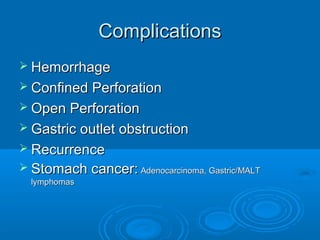
Complications
 Hemorrhage
 Confined Perforation
 Open Perforation
 Gastric outlet obstruction
 Recurrence
 Stomach cancer: Adenocarcinoma, Gastric/MALT
lymphomas
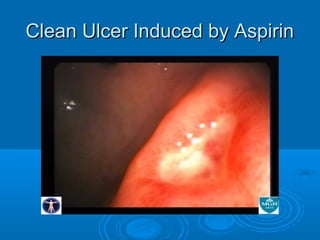
Clean Ulcer Induced by Aspirin
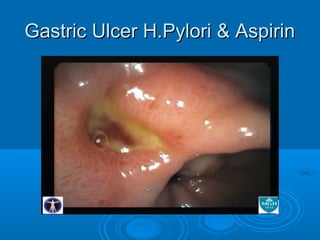
Gastric Ulcer H.Pylori & Aspirin
MCQS
1) Gold standard for investigating GERD?
A) Endoscopic Tests
B) Esophageal manometer
C) Multichannel intraluminal impedance
D) Bravo System
E) None of the above
2) Which of the following statements is false?
A) Antacids are not clearly superior to placebos
B) NSAIDS most common cause of PUD
C) Dysphagia is an alarm symptoms
D) H2RA Effective healing only mild esophagitis
E) Nicotine delays healing of an ulcer
Thanks

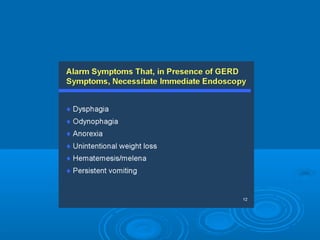
acid peptic disorders

  • 2.
    Acid Peptic Disorders Acidpeptic disorders include a number of diseases, whose etiology can be linked to gastric secretions. Gastroesophageal reflux disease, and peptic ulcer disease, are two most common and well-defined disease states.
  • 4.
    GERD is definedas chronic symptoms or mucosal damage produced by the abnormal reflux of gastric contents into the esophagus. Reflux esophagitis refers to a subgroup of GERD patients with histopathologically demonstrated characteristic changes in the esophageal mucosa Nonerosive reflux disease, also know as endoscopynegative reflux disease, refers to patients with typical GERD symptoms caused by intraesophageal acid who do not have visible mucosal injury at endoscopy.
  • 5.
    Prevalence Heartburn is acommon problem in the United States and in the Western world, since many individuals control symptoms with over-the-counter medications and without consulting a physician, the condition is likely underreported. Approximately 7% of the population experience symptoms of heartburn daily. 20-40% of the people who experience heartburn do indeed have GERD No sexual predilection exists. GERD is as common in men as in women GERD occurs in all age groups. The prevalence of GERD increases in people older than 40 years.
  • 6.
    Etiology  Lower esophageal sphincterincompetence.  Transient lower esophageal sphincter relaxation.  Hiatal hernia  Obesity: contributing factor in GERD
  • 7.
  • 8.
    Atypical Features  Coughingand/or wheezing  Hoarseness  Pneumonia  Belching  Laryngitis  Otitis media  Enamel decay.
  • 10.
    Differentials          Achalasia Choleithiasis Coronary Artery Atherosclerosis EsophagealSpasm Esophageal Cancer Esophagitis Chronic Gastritis Irritable bowel syndrome Peptic Ulcer Disease
  • 11.
    WORKUP         Barium Esophagogram Esophagogastroduodenoscopy Esophageal manometry Radionuclidemeasurement of gastric emptying Ambulatory 24-hour pH monitoring Empiric trial of proton pump inhibitor Multichannel intraluminal impedance Bravo system
  • 15.
    Medical Treatment Lifestyle Modifications Losing weight (if overweight)  Avoiding alcohol, chocolate, citrus juice, and tomato-based products  Avoiding large meals  Waiting 3 hours after a meal before lying down  Elevating the head of the bed 8 inches
  • 16.
    Treatment Cont. Pharmacologic Therapy Antacids  Prokinetic agents: metoclopramide hydrochloride  H2 receptor antagonists: Ranitidine, Cimetidine, Famotidine. Nizatidine  Proton pump inhibitors: Omeprazole, Rabeprazole, Esomeprazole,
  • 17.
    Treatments Cont.  Antacids    Prokinetics     Prompt buttemporary relief No objective proof of superiority to placebo Improvement of symptoms in mild GERD Effective for healing only mild erosive esophagitis Can be useful in a select patient population H2RAs   Relief of symptoms in ~50% of patients Effective for healing only mild erosive esophagitis
  • 18.
    Antacids may beno more effective than placebo Mean increase in time to reproduce heartburn with Bernstein test x5 * x 4.1 x4 * x 2.9 x3 *p < 0.05 versus pretreatment x2 x1 x0 Placebo Antacid
  • 19.
    % esophagitis caseshealed PPIs are the most effective drugs for the initial treatment of GERD 100 PPIs 80 60 H2RAs 40 Placebo 20 0 2 4 6 8 Weeks of treatment 10 Chiba et al. Gastroenterology 1997 12 p < 0.0005
  • 20.
  • 21.
  • 22.
  • 23.
    Points to Remember  Endoscopyreveals that 50% of patients do not have esophagitis.  The only way to determine if abnormal reflux is present and if symptoms are actually caused by GERD is through pH monitoring.  Achalasia can present with heartburn. Only esophageal manometry and pH monitoring can be used to distinguish achalasia from GERD.
  • 24.
    Peptic Ulcer Disease Pepticulcers are defects in the gastrointestinal mucosa that extend through the muscularis mucosa.
  • 25.
    Prevalence Lifetime prevalence isapproximately 1114% for men. Lifetime prevalence is approximately 811% for women. Age trends for ulcer occurrence reveal declining rates in younger men, particularly for duodenal ulcer, and increasing rates in older women.
  • 26.
    Etiology  Helicobacter pylori infection Consumption of NSAIDS  Severe physiologic stress  Hypersecretory states
  • 27.
    Symptoms  Epigastric pain Nausea  Vomiting  Dyspepsia  Heartburn  Chest discomfort  Anorexia, weight loss  Hematemesis or melena
  • 28.
    Signs  Epigastric tenderness Epigastric pain  Guaiac-positive stool  Succussion splash
  • 29.
    Differentials            Biliary Colic Cholecystitis Cholelithiasis Gastritis, Acute Gastritis,Chronic Gastroesophageal Reflux Disease Mesenteric Artery Ischemia Myocardial Ischemia Pancreatic Cancer Pancreatitis, Acute Pancreatitis, Chronic
  • 30.
    WORKUP  Double-contrast radiography Detection of H pylori infection  Endoscopic tests  Serum gastrin
  • 31.
    Medical Treatment  H.pylori eradication: Dual/Triple therapy  Cessation of NSAIDs  H2-receptor antagonists  Proton Pump Inhibitors  Prostaglandins misoprostol  Sucralfate sucrose-aluminum complex promotes ulcer healing
  • 32.
    FDA-Approved Treatment Regimes for H.pylori Infection  Omeprazole 20 mg BID + Clarithromycin 500 mg BID + Amoxicillin 1 g BID for 10 days  Lansoprazole 30 mg BID +Clarithromycin 500 mg BID + Amoxicillin 1 g BID for 10 days  Bismuth subsalicylate (Pepto Bismol) 525 mg QID + Metronidazole 250 mg QID + Tetracycline 500 mg QID X 14 days + H2 receptor antagonist x 4 wks
  • 33.
    Adjunctive Treatment    Caffeine andAlcohol - Both of these stimulate the secretion of stomach acid and should be avoided in the acute phase of an ulcer. Cigarettes - Nicotine will delay the healing of an ulcer. Antacids - These agents, can be used for relief of peptic ulcer symptoms. Except for bismuth (Pepto Bismol),- they do not help heal ulcers.
  • 34.
    Complications  Hemorrhage  ConfinedPerforation  Open Perforation  Gastric outlet obstruction  Recurrence  Stomach cancer: Adenocarcinoma, Gastric/MALT lymphomas
  • 35.
  • 36.
  • 37.
    MCQS 1) Gold standardfor investigating GERD? A) Endoscopic Tests B) Esophageal manometer C) Multichannel intraluminal impedance D) Bravo System E) None of the above
  • 38.
    2) Which ofthe following statements is false? A) Antacids are not clearly superior to placebos B) NSAIDS most common cause of PUD C) Dysphagia is an alarm symptoms D) H2RA Effective healing only mild esophagitis E) Nicotine delays healing of an ulcer
  • 39.

Editor's Notes

  • #19 Antacids may be no more effective than placebo This slide and the one that follows provide data supporting statements made on the previous slide. Although antacids have been the traditional therapy for GERD for many years and are still widely used, there is little evidence concerning their efficacy. Indeed, the results of some studies suggest that antacids may be no more effective than placebo in alleviating symptoms and influencing the natural history of the disease. For example, in one study, an antacid was compared with placebo in 32 patients with symptomatic gastroesophageal reflux (1). The two test treatments, each taken 7 times daily, both produced significant increases in the time needed to reproduce heartburn with a timed acid perfusion (Bernstein) test. However, the mean increase was somewhat greater with placebo (169 +/- 66 versus 41 +/- 20 seconds, or 4.1-fold) than with the antacid (120 +/- 57 versus 42 +/- 16 seconds, or 2.9-fold). (1) Graham, Patterson. Dig Dis Sci 1983; 28: 559–63.
  • #20 PPIs are the most effective drugs for the initial treatment of GERD This figure is taken from a meta- analysis of randomized, single- or double-blind clinical trials conducted in GERD patients with endoscopically proven erosive or ulcerative esophagitis (1). The meta-analysis incorporated a total of 43 studies involving 7635 patients treated for 2–12 weeks. The figure shows that, for all time points between 2 and 12 weeks, the mean percentage of patients in whom esophagitis was healed was considerably higher with PPIs than with H2RAs. Notably, the mean proportion healed after 2 weeks with PPIs (63.4%) was similar to the mean proportion healed after 12 weeks with H2RAs (60.2%). The overall proportion of cases healed, regardless of the duration of treatment, was 83.6% with PPIs, 51.9% with H2RAs and 28.2% with placebo (p &lt; 0.0005 between groups). (1) Chiba et al. Gastroenterology 1997; 112: 1798–810. Reproduced with permission from the American Gastroenterological Association.