Gastroesophageal
Reflux Disease
Arthur Harris, M.D.
GI Division, Jacobi Medical Center/NCBH
Assistant Professor of Medicine, AECOM
Objectives
Definition of GERD
Epidemiology of GERD
Pathophysiology of GERD
Clinical Manifestations
Diagnostic Evaluation
Treatment
Complications
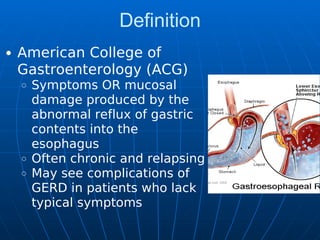
Definition
American College of
Gastroenterology (ACG)
Symptoms OR mucosal
damage produced by the
abnormal reflux of gastric
contents into the
esophagus
Often chronic and relapsing
May see complications of
GERD in patients who lack
typical symptoms
Physiologic vs Pathologic
Physiologic GERD
Post-prandial
Short-lived
Often asymptomatic
TLSER’s
No nocturnal sx
Pathologic GERD
Symptoms
Mucosal injury
Nocturnal sx
Epidemiology
About 44% of the US adult
population have heartburn at least
once a month
14% of Americans have symptoms
weekly
7% have symptoms daily
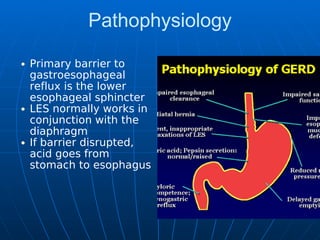
Pathophysiology
Primary barrier to
gastroesophageal
reflux is the lower
esophageal sphincter
LES normally works in
conjunction with the
diaphragm
If barrier disrupted,
acid goes from
stomach to esophagus
Clinical Manifestations
Most common symptoms
Heartburn—retrosternal burning
discomfort
Regurgitation—effortless return of
gastric contents into the pharynx
without nausea, retching, or
abdominal contractions
Clinical Manifestations
Dysphagia—difficulty swallowing
Other symptoms include:
Chest pain, water brash, globus sensation,
odynophagia, nausea
Extraesophageal manifestations
Asthma, laryngitis, chronic cough
Diagnostic Evaluation
If classic symptoms of heartburn and
regurgitation exist in the absence of
“alarm symptoms” the diagnosis of
GERD can be made clinically and
treatment can be initiated
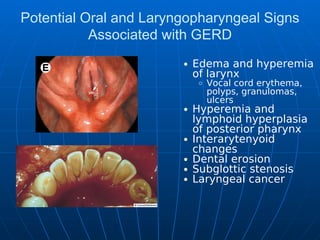
Potential Oral and Laryngopharyngeal Signs
Associated with GERD
Edema and hyperemia
of larynx
Vocal cord erythema,
polyps, granulomas,
ulcers
Hyperemia and
lymphoid hyperplasia
of posterior pharynx
Interarytenyoid
changes
Dental erosion
Subglottic stenosis
Laryngeal cancer
Alarms
Alarm Signs/Symptoms
Dysphagia
Early satiety
GI bleeding
Odynophagia
Vomiting
Weight loss
Iron deficiency anemia
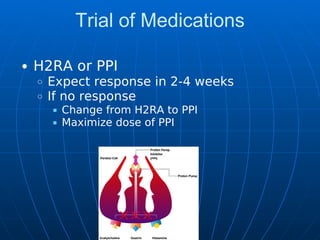
Trial of Medications
H2RA or PPI
Expect response in 2-4 weeks
If no response
Change from H2RA to PPI
Maximize dose of PPI
Trial of Medications
If PPI response inadequate despite
maximal dosage
Confirm diagnosis
EGD
24 hour pH monitoring
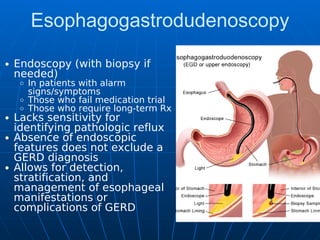
Esophagogastrodudenoscopy
Endoscopy (with biopsy if
needed)
In patients with alarm
signs/symptoms
Those who fail medication trial
Those who require long-term Rx
Lacks sensitivity for
identifying pathologic reflux
Absence of endoscopic
features does not exclude a
GERD diagnosis
Allows for detection,
stratification, and
management of esophageal
manifestations or
complications of GERD
Ambulatory pH Testing
24-hour pH monitoring
Accepted standard for establishing or
excluding presence of GERD for those
patients who do not have mucosal
changes
Trans-nasal catheter or a wireless,
capsule shaped device
Ambulatory 24 hour pH Monitoring -1
Physiologic study
Quantify reflux in
proximal/distal
esophagus
% time pH < 4
DeMeester score
Symptom
correlation
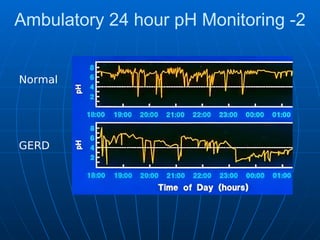
Ambulatory 24 hour pH Monitoring -2
Normal
GERD
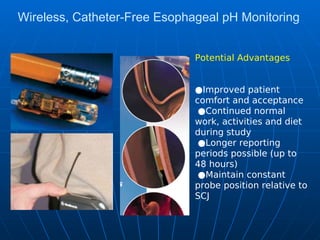
Wireless, Catheter-Free Esophageal pH Monitoring
Potential Advantages
●Improved patient
comfort and acceptance
●Continued normal
work, activities and diet
during study
●Longer reporting
periods possible (up to
48 hours)
●Maintain constant
probe position relative to
SCJ
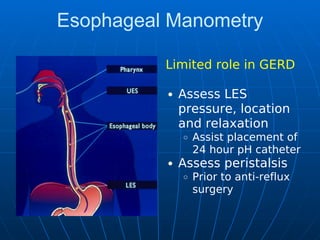
Esophageal Manometry
Limited role in GERD
Assess LES
pressure, location
and relaxation
Assist placement of
24 hour pH catheter
Assess peristalsis
Prior to anti-reflux
surgery
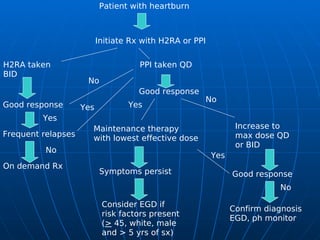
Patient with heartburn
Initiate Rx with H2RA or PPI
H2RA taken
BID
Good response
Frequent relapses
On demand Rx
PPI taken QD
Good response
Maintenance therapy
with lowest effective dose
Symptoms persist
Consider EGD if
risk factors present
(> 45, white, male
and > 5 yrs of sx)
Increase to
max dose QD
or BID
Good response
Confirm diagnosis
EGD, ph monitor
No
Yes Yes
No
Yes
Yes
No
No
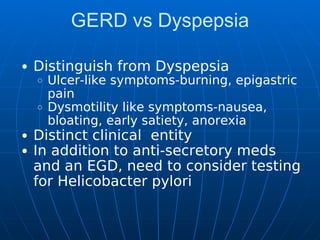
GERD vs Dyspepsia
Distinguish from Dyspepsia
Ulcer-like symptoms-burning, epigastric
pain
Dysmotility like symptoms-nausea,
bloating, early satiety, anorexia
Distinct clinical entity
In addition to anti-secretory meds
and an EGD, need to consider testing
for Helicobacter pylori
Treatment
Goals of therapy
Symptomatic relief
Heal esophagitis
Avoid complications
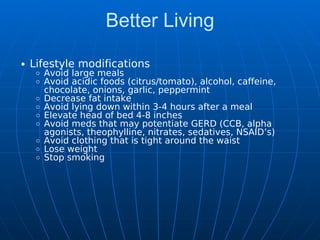
Better Living
Lifestyle modifications
Avoid large meals
Avoid acidic foods (citrus/tomato), alcohol, caffeine,
chocolate, onions, garlic, peppermint
Decrease fat intake
Avoid lying down within 3-4 hours after a meal
Elevate head of bed 4-8 inches
Avoid meds that may potentiate GERD (CCB, alpha
agonists, theophylline, nitrates, sedatives, NSAID’s)
Avoid clothing that is tight around the waist
Lose weight
Stop smoking
Treatment
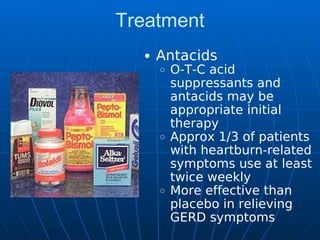
Antacids
O-T-C acid
suppressants and
antacids may be
appropriate initial
therapy
Approx 1/3 of patients
with heartburn-related
symptoms use at least
twice weekly
More effective than
placebo in relieving
GERD symptoms
Treatment
Histamine H2-Receptor Antagonists
More effective than placebo and
antacids for relieving heartburn in
patients with GERD
Faster healing of erosive esophagitis
when compared with placebo
Can use regularly or on-demand
Treatment
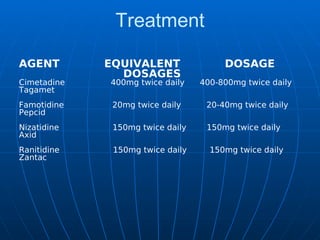
AGENT EQUIVALENT DOSAGE
DOSAGES
Cimetadine 400mg twice daily 400-800mg twice daily
Tagamet
Famotidine 20mg twice daily 20-40mg twice daily
Pepcid
Nizatidine 150mg twice daily 150mg twice daily
Axid
Ranitidine 150mg twice daily 150mg twice daily
Zantac
Treatment
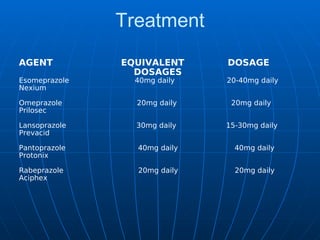
Proton Pump Inhibitors
Better control of symptoms with PPI’s vs
H2RAs and better remission rates
Faster healing of erosive esophagitis
with PPIs vs H2RAs
Treatment
AGENT EQUIVALENT DOSAGE
DOSAGES
Esomeprazole 40mg daily 20-40mg daily
Nexium
Omeprazole 20mg daily 20mg daily
Prilosec
Lansoprazole 30mg daily 15-30mg daily
Prevacid
Pantoprazole 40mg daily 40mg daily
Protonix
Rabeprazole 20mg daily 20mg daily
Aciphex
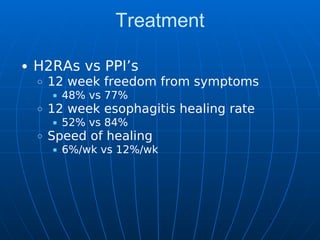
Treatment
H2RAs vs PPI’s
12 week freedom from symptoms
48% vs 77%
12 week esophagitis healing rate
52% vs 84%
Speed of healing
6%/wk vs 12%/wk
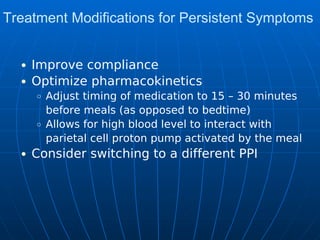
Treatment Modifications for Persistent Symptoms
Improve compliance
Optimize pharmacokinetics
Adjust timing of medication to 15 – 30 minutes
before meals (as opposed to bedtime)
Allows for high blood level to interact with
parietal cell proton pump activated by the meal
Consider switching to a different PPI
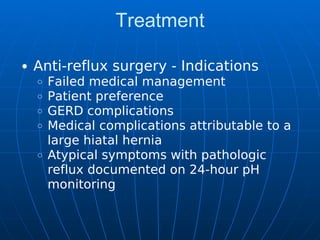
Treatment
Anti-reflux surgery - Indications
Failed medical management
Patient preference
GERD complications
Medical complications attributable to a
large hiatal hernia
Atypical symptoms with pathologic
reflux documented on 24-hour pH
monitoring
Treatment
Anti-reflux surgery candidates
EGD proven esophagitis
?Normal esophageal motility
Incomplete response to acid suppression
Treatment
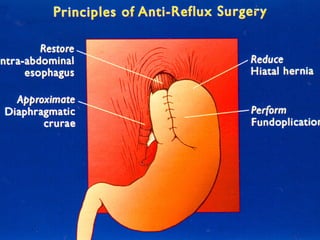
Anti-reflux surgery (laparoscopic)
Tenets of surgery
Reduce hiatal hernia
Repair diaphragm
Strengthen GE junction
Strengthen anti-reflux barrier via gastric wrap
75-90% effective at alleviating symptoms of
heartburn and regurgitation
Treatment
Post-surgery
10% have solid food dysphagia
2-3% have permanent symptoms
7-10% have gas, bloating, diarrhea,
nausea, early satiety
Within 3-5 years, up to 52% of patients
back on anti-reflux medications
Treatment
Endoscopic treatment
Relatively new
No clearly established indications
Well-informed patients with well-documented
GERD responsive to PPI therapy may benefit
Three categories
Radiofrequency application to increase LES reflux
barrier
Endoscopic sewing devices
Injection of a non-resorbable polymer into LES
region
Complications
Erosive esophagitis
Stricture
Barrett’s esophagus
Complications
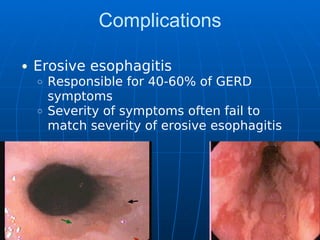
Erosive esophagitis
Responsible for 40-60% of GERD
symptoms
Severity of symptoms often fail to
match severity of erosive esophagitis
Complications
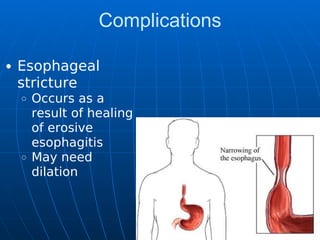
Esophageal
stricture
Occurs as a
result of healing
of erosive
esophagitis
May need
dilation
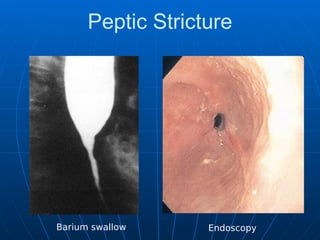
Peptic Stricture
Barium swallow Endoscopy
Complications
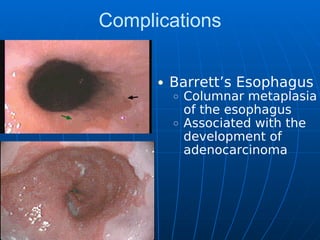
Barrett’s Esophagus
Columnar metaplasia
of the esophagus
Associated with the
development of
adenocarcinoma
Complications
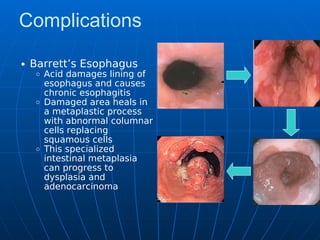
Barrett’s Esophagus
Acid damages lining of
esophagus and causes
chronic esophagitis
Damaged area heals in
a metaplastic process
with abnormal columnar
cells replacing
squamous cells
This specialized
intestinal metaplasia
can progress to
dysplasia and
adenocarcinoma
Complications
Patient’s who need EGD
Alarm symptoms
Poor therapeutic response
Long symptom duration
“Once in a lifetime” EGD for patient’s
with chronic GERD becoming accepted
practice
Many patients with Barrett’s are
asymptomatic
Complications
Barrett’s Esophagus
Manage in same manner as GERD
EGD every 3 years in patient’s without
dysplasia
In patients with dysplasia, annual to
even shorter interval surveillance is
recommended
Summary
Definition of GERD
Epidemiology of GERD
Pathophysiology of GERD
Clinical Manifestations
Diagnostic Evaluation
Treatment
Complications
?QUESTIONS?

GERD pharmacy information 2024-2023..pdf

  • 1.
    Gastroesophageal Reflux Disease Arthur Harris,M.D. GI Division, Jacobi Medical Center/NCBH Assistant Professor of Medicine, AECOM
  • 2.
    Objectives Definition of GERD Epidemiologyof GERD Pathophysiology of GERD Clinical Manifestations Diagnostic Evaluation Treatment Complications
  • 3.
    Definition American College of Gastroenterology(ACG) Symptoms OR mucosal damage produced by the abnormal reflux of gastric contents into the esophagus Often chronic and relapsing May see complications of GERD in patients who lack typical symptoms
  • 4.
    Physiologic vs Pathologic PhysiologicGERD Post-prandial Short-lived Often asymptomatic TLSER’s No nocturnal sx Pathologic GERD Symptoms Mucosal injury Nocturnal sx
  • 6.
    Epidemiology About 44% ofthe US adult population have heartburn at least once a month 14% of Americans have symptoms weekly 7% have symptoms daily
  • 7.
    Pathophysiology Primary barrier to gastroesophageal refluxis the lower esophageal sphincter LES normally works in conjunction with the diaphragm If barrier disrupted, acid goes from stomach to esophagus
  • 8.
    Clinical Manifestations Most commonsymptoms Heartburn—retrosternal burning discomfort Regurgitation—effortless return of gastric contents into the pharynx without nausea, retching, or abdominal contractions
  • 9.
    Clinical Manifestations Dysphagia—difficulty swallowing Othersymptoms include: Chest pain, water brash, globus sensation, odynophagia, nausea Extraesophageal manifestations Asthma, laryngitis, chronic cough
  • 10.
    Diagnostic Evaluation If classicsymptoms of heartburn and regurgitation exist in the absence of “alarm symptoms” the diagnosis of GERD can be made clinically and treatment can be initiated
  • 11.
    Potential Oral andLaryngopharyngeal Signs Associated with GERD Edema and hyperemia of larynx Vocal cord erythema, polyps, granulomas, ulcers Hyperemia and lymphoid hyperplasia of posterior pharynx Interarytenyoid changes Dental erosion Subglottic stenosis Laryngeal cancer
  • 12.
    Alarms Alarm Signs/Symptoms Dysphagia Early satiety GIbleeding Odynophagia Vomiting Weight loss Iron deficiency anemia
  • 13.
    Trial of Medications H2RAor PPI Expect response in 2-4 weeks If no response Change from H2RA to PPI Maximize dose of PPI
  • 14.
    Trial of Medications IfPPI response inadequate despite maximal dosage Confirm diagnosis EGD 24 hour pH monitoring
  • 15.
    Esophagogastrodudenoscopy Endoscopy (with biopsyif needed) In patients with alarm signs/symptoms Those who fail medication trial Those who require long-term Rx Lacks sensitivity for identifying pathologic reflux Absence of endoscopic features does not exclude a GERD diagnosis Allows for detection, stratification, and management of esophageal manifestations or complications of GERD
  • 16.
    Ambulatory pH Testing 24-hourpH monitoring Accepted standard for establishing or excluding presence of GERD for those patients who do not have mucosal changes Trans-nasal catheter or a wireless, capsule shaped device
  • 17.
    Ambulatory 24 hourpH Monitoring -1 Physiologic study Quantify reflux in proximal/distal esophagus % time pH < 4 DeMeester score Symptom correlation
  • 18.
    Ambulatory 24 hourpH Monitoring -2 Normal GERD
  • 19.
    Wireless, Catheter-Free EsophagealpH Monitoring Potential Advantages ●Improved patient comfort and acceptance ●Continued normal work, activities and diet during study ●Longer reporting periods possible (up to 48 hours) ●Maintain constant probe position relative to SCJ
  • 20.
    Esophageal Manometry Limited rolein GERD Assess LES pressure, location and relaxation Assist placement of 24 hour pH catheter Assess peristalsis Prior to anti-reflux surgery
  • 21.
    Patient with heartburn InitiateRx with H2RA or PPI H2RA taken BID Good response Frequent relapses On demand Rx PPI taken QD Good response Maintenance therapy with lowest effective dose Symptoms persist Consider EGD if risk factors present (> 45, white, male and > 5 yrs of sx) Increase to max dose QD or BID Good response Confirm diagnosis EGD, ph monitor No Yes Yes No Yes Yes No No
  • 22.
    GERD vs Dyspepsia Distinguishfrom Dyspepsia Ulcer-like symptoms-burning, epigastric pain Dysmotility like symptoms-nausea, bloating, early satiety, anorexia Distinct clinical entity In addition to anti-secretory meds and an EGD, need to consider testing for Helicobacter pylori
  • 23.
    Treatment Goals of therapy Symptomaticrelief Heal esophagitis Avoid complications
  • 24.
    Better Living Lifestyle modifications Avoidlarge meals Avoid acidic foods (citrus/tomato), alcohol, caffeine, chocolate, onions, garlic, peppermint Decrease fat intake Avoid lying down within 3-4 hours after a meal Elevate head of bed 4-8 inches Avoid meds that may potentiate GERD (CCB, alpha agonists, theophylline, nitrates, sedatives, NSAID’s) Avoid clothing that is tight around the waist Lose weight Stop smoking
  • 25.
    Treatment Antacids O-T-C acid suppressants and antacidsmay be appropriate initial therapy Approx 1/3 of patients with heartburn-related symptoms use at least twice weekly More effective than placebo in relieving GERD symptoms
  • 26.
    Treatment Histamine H2-Receptor Antagonists Moreeffective than placebo and antacids for relieving heartburn in patients with GERD Faster healing of erosive esophagitis when compared with placebo Can use regularly or on-demand
  • 27.
    Treatment AGENT EQUIVALENT DOSAGE DOSAGES Cimetadine400mg twice daily 400-800mg twice daily Tagamet Famotidine 20mg twice daily 20-40mg twice daily Pepcid Nizatidine 150mg twice daily 150mg twice daily Axid Ranitidine 150mg twice daily 150mg twice daily Zantac
  • 28.
    Treatment Proton Pump Inhibitors Bettercontrol of symptoms with PPI’s vs H2RAs and better remission rates Faster healing of erosive esophagitis with PPIs vs H2RAs
  • 29.
    Treatment AGENT EQUIVALENT DOSAGE DOSAGES Esomeprazole40mg daily 20-40mg daily Nexium Omeprazole 20mg daily 20mg daily Prilosec Lansoprazole 30mg daily 15-30mg daily Prevacid Pantoprazole 40mg daily 40mg daily Protonix Rabeprazole 20mg daily 20mg daily Aciphex
  • 30.
    Treatment H2RAs vs PPI’s 12week freedom from symptoms 48% vs 77% 12 week esophagitis healing rate 52% vs 84% Speed of healing 6%/wk vs 12%/wk
  • 31.
    Treatment Modifications forPersistent Symptoms Improve compliance Optimize pharmacokinetics Adjust timing of medication to 15 – 30 minutes before meals (as opposed to bedtime) Allows for high blood level to interact with parietal cell proton pump activated by the meal Consider switching to a different PPI
  • 32.
    Treatment Anti-reflux surgery -Indications Failed medical management Patient preference GERD complications Medical complications attributable to a large hiatal hernia Atypical symptoms with pathologic reflux documented on 24-hour pH monitoring
  • 33.
    Treatment Anti-reflux surgery candidates EGDproven esophagitis ?Normal esophageal motility Incomplete response to acid suppression
  • 34.
    Treatment Anti-reflux surgery (laparoscopic) Tenetsof surgery Reduce hiatal hernia Repair diaphragm Strengthen GE junction Strengthen anti-reflux barrier via gastric wrap 75-90% effective at alleviating symptoms of heartburn and regurgitation
  • 36.
    Treatment Post-surgery 10% have solidfood dysphagia 2-3% have permanent symptoms 7-10% have gas, bloating, diarrhea, nausea, early satiety Within 3-5 years, up to 52% of patients back on anti-reflux medications
  • 37.
    Treatment Endoscopic treatment Relatively new Noclearly established indications Well-informed patients with well-documented GERD responsive to PPI therapy may benefit Three categories Radiofrequency application to increase LES reflux barrier Endoscopic sewing devices Injection of a non-resorbable polymer into LES region
  • 38.
  • 39.
    Complications Erosive esophagitis Responsible for40-60% of GERD symptoms Severity of symptoms often fail to match severity of erosive esophagitis
  • 40.
    Complications Esophageal stricture Occurs as a resultof healing of erosive esophagitis May need dilation
  • 41.
  • 42.
    Complications Barrett’s Esophagus Columnar metaplasia ofthe esophagus Associated with the development of adenocarcinoma
  • 43.
    Complications Barrett’s Esophagus Acid damageslining of esophagus and causes chronic esophagitis Damaged area heals in a metaplastic process with abnormal columnar cells replacing squamous cells This specialized intestinal metaplasia can progress to dysplasia and adenocarcinoma
  • 44.
    Complications Patient’s who needEGD Alarm symptoms Poor therapeutic response Long symptom duration “Once in a lifetime” EGD for patient’s with chronic GERD becoming accepted practice Many patients with Barrett’s are asymptomatic
  • 45.
    Complications Barrett’s Esophagus Manage insame manner as GERD EGD every 3 years in patient’s without dysplasia In patients with dysplasia, annual to even shorter interval surveillance is recommended
  • 46.
    Summary Definition of GERD Epidemiologyof GERD Pathophysiology of GERD Clinical Manifestations Diagnostic Evaluation Treatment Complications
  • 47.