HYDROCELE
PRESENTED BY: SONIA DAGAR
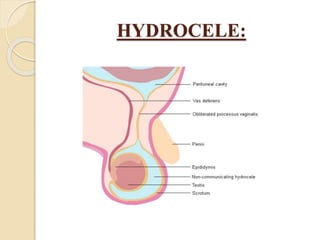
HYDROCELE:
DEFINITION
 Hydrocele is a collection of fluid around one or
both testicles and cause swelling of scrotum or
groin area.
 It commonly occurs in men older than 40 years.
TYPES
1) NONCOMMUNICATION
2) COMMUNICATING
1) NONCOMMUNICATING:A
noncommunicating hydrocele occurs when the
sac closes, but your body doesn’t absorb the
fluid. The remaining fluid is typically absorbed
into the body within a year.
2) COMMUNICATING: A communicating
hydrocele occurs when the sac surrounding
your testicle doesn’t close all the way. This
allows fluid to flow in and out.
ETIOLOGY
 Causes of hydrocele is unknown.
 Inflammation of infection of the
epididymis or testicles.
 In rare cases, may be caused by cancer of
testicle or left kidney.
 Men over the age of 40.
CLINICAL MENIFESTATIONS
 Swelling of scrotum
 Pain sometime
 Redness of scrotum
 Feeling of pressure at base of penis
present.
 Testicular torsion
 Infertility
DIAGNOSTIC EVALUATIONS
 History taking
 Physical examination
 Transillumination: It is a test used to identify
abnormalities in an organ or body cavity. The test is
performed in a dark room, with a bright light shined at
a specific body part to see the structures beneath the
skin
 Ultrasound of scrotum done to rule out presence of
fluid
 Blood test done to rule out infection.
TRANSILLUMINATION
TREATMENT
 Surgery: If your new infant has a hydrocele, it
will probably go away on its own in about a
year. If your child’s hydrocele doesn’t go away
on its own or becomes very large, he might need
surgery by a urologist
 Needle aspiration done.
 Sclerotherapy done to reduce reaccumulation.
 In adults, hydroceles typically go away within
six months
Hydrocele

Hydrocele

  • 1.
  • 2.
  • 3.
    DEFINITION  Hydrocele isa collection of fluid around one or both testicles and cause swelling of scrotum or groin area.  It commonly occurs in men older than 40 years.
  • 4.
  • 5.
    1) NONCOMMUNICATING:A noncommunicating hydroceleoccurs when the sac closes, but your body doesn’t absorb the fluid. The remaining fluid is typically absorbed into the body within a year. 2) COMMUNICATING: A communicating hydrocele occurs when the sac surrounding your testicle doesn’t close all the way. This allows fluid to flow in and out.
  • 6.
    ETIOLOGY  Causes ofhydrocele is unknown.  Inflammation of infection of the epididymis or testicles.  In rare cases, may be caused by cancer of testicle or left kidney.  Men over the age of 40.
  • 7.
    CLINICAL MENIFESTATIONS  Swellingof scrotum  Pain sometime  Redness of scrotum  Feeling of pressure at base of penis present.  Testicular torsion  Infertility
  • 8.
    DIAGNOSTIC EVALUATIONS  Historytaking  Physical examination  Transillumination: It is a test used to identify abnormalities in an organ or body cavity. The test is performed in a dark room, with a bright light shined at a specific body part to see the structures beneath the skin  Ultrasound of scrotum done to rule out presence of fluid  Blood test done to rule out infection.
  • 9.
  • 10.
    TREATMENT  Surgery: Ifyour new infant has a hydrocele, it will probably go away on its own in about a year. If your child’s hydrocele doesn’t go away on its own or becomes very large, he might need surgery by a urologist  Needle aspiration done.  Sclerotherapy done to reduce reaccumulation.  In adults, hydroceles typically go away within six months