
1CLUBBINGMedicine Basics RevisitedDr. S. Aswini Kumar. MD.Professor of MedicineMedical College HospitalThiruvananthapuram
What is clubbing?In simple terms clubbing is the bulbous enlargement of the fingertips along with an increase in anteroposterior as well as lateral curvature of the nails2
What is the definition of clubbing?Clubbing is defined as the bulbous enlargement of the terminal phalanges due to proliferation of connective tissue between the fingernail and the bone.3
4What is the importance of clubbing?The presence of clubbing in a person almost always indicates the presence of a serious underlying infection or neoplasm of one of the major systems of the body
Any other name for clubbing?Because it was Hippocrates who first described this clinical feature, clubbing is sometimes (but only rarely!) called as Hippocrates Fingers.. Otherwise it is simply called as clubbing of fingers5Father of Medicine
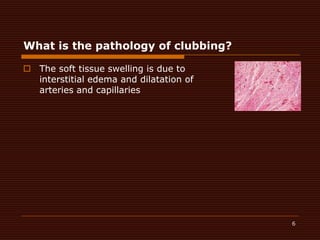
What is the pathology of clubbing?The soft tissue swelling is due to interstitial edema and dilatation of arteries and capillaries6
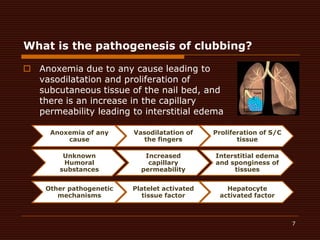
What is the pathogenesis of clubbing?Anoxemia due to any cause leading to vasodilatation and proliferation of subcutaneous tissue of the nail bed, and there is an increase in the capillary permeability leading to interstitial edema7
How to examine for clubbing?Bring the fingertip of the patient to the eye level of the examiner and carefully look at the angle between the nail and the nail bed. Normally it is acute.8
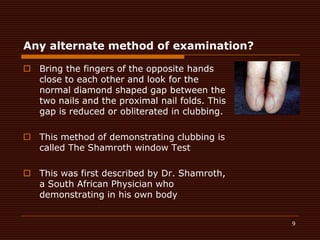
Any alternate method of examination?Bring the fingers of the opposite hands close to each other and look for the normal diamond shaped gap between the two nails and the proximal nail folds. This gap is reduced or obliterated in clubbing.This method of demonstrating clubbing is called The Shamroth window TestThis was first described by Dr. Shamroth, a South African Physician who  demonstrating in his own body  9
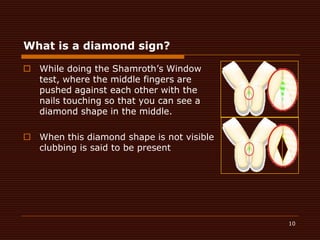
What is a diamond sign?While doing the Shamroth’s Window test, where the middle fingers are pushed against each other with the nails touching so that you can see a diamond shape in the middle.When this diamond shape is not visible clubbing is said to be present 10
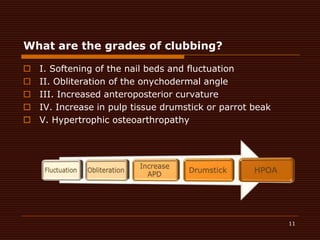
11What are the grades of clubbing?I. Softening of the nail beds and fluctuationII. Obliteration of the onychodermal angleIII. Increased anteroposterior curvatureIV. Increase in pulp tissue drumstick or parrot beakV. Hypertrophic osteoarthropathy
12What is the purpose of grading clubbing?Grading clubbing is only for the purpose of communication between examiners. It has no prognostic significance. When one says  there is grade III clubbing it is understood that the AP curvature of nails is increased.Clubbing may not be present even in presence of advanced malignancySevere clubbing may be present even in cases of congenital or traumatic clubbing.
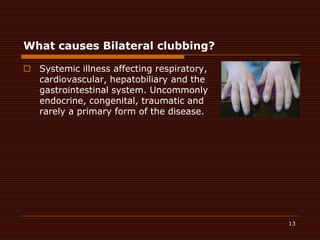
13What causes Bilateral clubbing?Systemic illness affecting respiratory, cardiovascular, hepatobiliary and the gastrointestinal system. Uncommonly endocrine, congenital, traumatic and rarely a primary form of the disease.
14What are the cardiac causes of clubbing?FallotTetralogyEisenmenger SyndromeSubacute Bacterial EndocarditisLeft atrial Myxoma
15What are the respiratory causes of clubbing?Bronchiectasis/Lung Abcess/EmpyemaBronchogenic Ca/Lung Mets/Pleural MesotheliomaFibrosingAlveolitis/Rarely Fibrocaseous TuberculosisPulmonary Arteriovenous Communication
16What are the GIT causes of clubbing?Ulcerative ColitisCrohn’s DiseaseMalabsorption syndromePolyposis of intestine
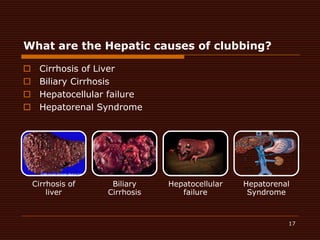
17What are the Hepatic causes of clubbing?Cirrhosis of LiverBiliary CirrhosisHepatocellular failureHepatorenal Syndrome
18What are the other causes of clubbing?Congenital/Familial/GeneticOccupational/TraumaticEndocrine/Thyroid AcropathyPrimary/Pachydermoperiostitis
19Bronchiectasis?Bronchiectasis is a chronic collection of pus inside the abnormally dilated bronchi of the lungs. It is usually present in both the lungs especially in the lower lobesIt presents with low grade fever, cough and expectoration of large quantities of foul smelling yellow sputumClubbing is almost always present in Bronchiectasis
20Lung Abscess?Lung abscess is suppuration of the lung; meaning collection of pus in the lung parenchyma. It forms a thick walled  abscess cavity containing pus below and air above.It usually presents with acute onset of high grade fever, chills toxemia, and features of consolidation in the lung.Clubbing can occur as early as 2 weeks in the course of Lung Abscess
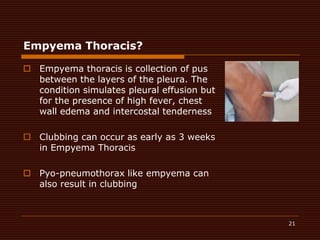
21Empyema Thoracis?Empyemathoracis is collection of pus between the layers of the pleura. The condition simulates pleural effusion but for the presence of high fever, chest wall edema and intercostal tendernessClubbing can occur as early as 3 weeks in EmpyemaThoracisPyo-pneumothorax like empyema can also result in clubbing
22Bronchogenic Carcinoma?Bronchogenic Carcinoma is cancer of the lung.  Especially it is the squamous cell carcinoma, which causes clubbing. The symptoms are several and include cough, hemoptysis, loss of appetite & emaciation Bronchogenic carcinoma is an important cause of ClubbingClubbing may precede the symptoms of malignancy by weeks or months
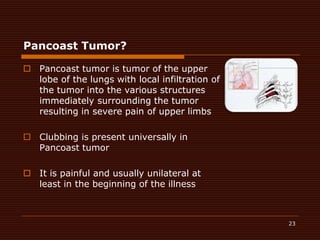
Pancoast Tumor?Pancoast tumor is tumor of the upper lobe of the lungs with local infiltration of the tumor into the various structures immediately surrounding the tumor resulting in severe pain of upper limbsClubbing is present universally in Pancoast tumor It is painful and usually unilateral at least in the beginning of the illness23
24Bacterial endocarditis?Bacterial endocarditis is due to infection of the endocardium of heart by bacteria of low virulence. It usually complicates valvular or congenital heart disease producing additional valve regurgitation.It presents with low grade fever, pallor, jaundice, hematuria, splenomegaly, splinter hemorrhage and oslers nodes.Clubbing is considered to be due to toxemia and unknown hormonal factors.
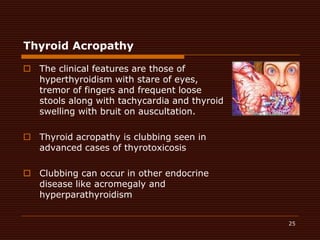
25Thyroid AcropathyThe clinical features are those of  hyperthyroidism with stare of eyes, tremor of fingers and frequent loose stools along with tachycardia and thyroid swelling with bruit on auscultation.Thyroid acropathy is clubbing seen in advanced cases of thyrotoxicosisClubbing can occur in other endocrine disease like acromegaly and hyperparathyroidism
26What is Pachydermoperiostosis ?This is the Primary form of Clubbing. In this instance, clubbing is accompanied by skin changes, such as hypertrophied skin on the dorsa of the hands It is very rare cause of clubbing in our population
27What causes Unilateral clubbing?Cervical RibPancoast tumorAneurysm of subclavian arteryPre-subclavian Coarctation of AortaAV Fistula involving brachial vessels
28What is differential clubbing?Clubbing limited to upper or lower limbs alone is called differential clubbing. Clubbing may be limited to the upper limbs in chronic obstruction of veins of the upper thorax.A common cause is phlebitis of the upper extremities as seen in IV drug users
29Differential clubbing in the lower limbs?Clubbing may be present in the lower limbs only totally sparing the upper limbs. It may be associated with cyanosis of the lower limbs.It is classically due to PDA with reversal of shunt( Eisenmenger PDA)It is also seen in in infected abdominal artery aneurysm.
30What is Hypertrophic Osteoarthropathy?Advanced stage of clubbing is called Hypertrophic (Pulmonary) Osteo Arthropathy . It demonstrates all the features of different  stages of clubbingIn addition there will be thickening and tenderness elicited over the ends of long bones of hands as well as feet.It is seen classically in Pancoast tumor; but also present in severe cases of Suppurative lung diseases and Ca Lung
31What are the bone changes in HPA?Hypertrophic Osteo Arthropathy can be diagnosed from X-Rays of ends of long bones. The periostium of the ends of long bones are elevatedPeriosteal new bone formation gives rise to the appearance called as Sun-Rise appearanceAlso there are symmetric arthritis-like changes in the shoulders, knees, ankles, wrists, and elbows
32Which conditions have clubbing & cyanosis?Fallot’sTetalogyEisenmenger Syndrome
33What is the treatment for clubbing?There is no treatment specific for clubbing. The treatment is for the primary condition. Cure of the primary condition can totally reverse the clubbing
34What is the prognosis of clubbing?
35Thank you for the patient listening

Clubbing

  • 1.
    1CLUBBINGMedicine Basics RevisitedDr.S. Aswini Kumar. MD.Professor of MedicineMedical College HospitalThiruvananthapuram
  • 2.
    What is clubbing?Insimple terms clubbing is the bulbous enlargement of the fingertips along with an increase in anteroposterior as well as lateral curvature of the nails2
  • 3.
    What is thedefinition of clubbing?Clubbing is defined as the bulbous enlargement of the terminal phalanges due to proliferation of connective tissue between the fingernail and the bone.3
  • 4.
    4What is theimportance of clubbing?The presence of clubbing in a person almost always indicates the presence of a serious underlying infection or neoplasm of one of the major systems of the body
  • 5.
    Any other namefor clubbing?Because it was Hippocrates who first described this clinical feature, clubbing is sometimes (but only rarely!) called as Hippocrates Fingers.. Otherwise it is simply called as clubbing of fingers5Father of Medicine
  • 6.
    What is thepathology of clubbing?The soft tissue swelling is due to interstitial edema and dilatation of arteries and capillaries6
  • 7.
    What is thepathogenesis of clubbing?Anoxemia due to any cause leading to vasodilatation and proliferation of subcutaneous tissue of the nail bed, and there is an increase in the capillary permeability leading to interstitial edema7
  • 8.
    How to examinefor clubbing?Bring the fingertip of the patient to the eye level of the examiner and carefully look at the angle between the nail and the nail bed. Normally it is acute.8
  • 9.
    Any alternate methodof examination?Bring the fingers of the opposite hands close to each other and look for the normal diamond shaped gap between the two nails and the proximal nail folds. This gap is reduced or obliterated in clubbing.This method of demonstrating clubbing is called The Shamroth window TestThis was first described by Dr. Shamroth, a South African Physician who demonstrating in his own body 9
  • 10.
    What is adiamond sign?While doing the Shamroth’s Window test, where the middle fingers are pushed against each other with the nails touching so that you can see a diamond shape in the middle.When this diamond shape is not visible clubbing is said to be present 10
  • 11.
    11What are thegrades of clubbing?I. Softening of the nail beds and fluctuationII. Obliteration of the onychodermal angleIII. Increased anteroposterior curvatureIV. Increase in pulp tissue drumstick or parrot beakV. Hypertrophic osteoarthropathy
  • 12.
    12What is thepurpose of grading clubbing?Grading clubbing is only for the purpose of communication between examiners. It has no prognostic significance. When one says there is grade III clubbing it is understood that the AP curvature of nails is increased.Clubbing may not be present even in presence of advanced malignancySevere clubbing may be present even in cases of congenital or traumatic clubbing.
  • 13.
    13What causes Bilateralclubbing?Systemic illness affecting respiratory, cardiovascular, hepatobiliary and the gastrointestinal system. Uncommonly endocrine, congenital, traumatic and rarely a primary form of the disease.
  • 14.
    14What are thecardiac causes of clubbing?FallotTetralogyEisenmenger SyndromeSubacute Bacterial EndocarditisLeft atrial Myxoma
  • 15.
    15What are therespiratory causes of clubbing?Bronchiectasis/Lung Abcess/EmpyemaBronchogenic Ca/Lung Mets/Pleural MesotheliomaFibrosingAlveolitis/Rarely Fibrocaseous TuberculosisPulmonary Arteriovenous Communication
  • 16.
    16What are theGIT causes of clubbing?Ulcerative ColitisCrohn’s DiseaseMalabsorption syndromePolyposis of intestine
  • 17.
    17What are theHepatic causes of clubbing?Cirrhosis of LiverBiliary CirrhosisHepatocellular failureHepatorenal Syndrome
  • 18.
    18What are theother causes of clubbing?Congenital/Familial/GeneticOccupational/TraumaticEndocrine/Thyroid AcropathyPrimary/Pachydermoperiostitis
  • 19.
    19Bronchiectasis?Bronchiectasis is achronic collection of pus inside the abnormally dilated bronchi of the lungs. It is usually present in both the lungs especially in the lower lobesIt presents with low grade fever, cough and expectoration of large quantities of foul smelling yellow sputumClubbing is almost always present in Bronchiectasis
  • 20.
    20Lung Abscess?Lung abscessis suppuration of the lung; meaning collection of pus in the lung parenchyma. It forms a thick walled abscess cavity containing pus below and air above.It usually presents with acute onset of high grade fever, chills toxemia, and features of consolidation in the lung.Clubbing can occur as early as 2 weeks in the course of Lung Abscess
  • 21.
    21Empyema Thoracis?Empyemathoracis iscollection of pus between the layers of the pleura. The condition simulates pleural effusion but for the presence of high fever, chest wall edema and intercostal tendernessClubbing can occur as early as 3 weeks in EmpyemaThoracisPyo-pneumothorax like empyema can also result in clubbing
  • 22.
    22Bronchogenic Carcinoma?Bronchogenic Carcinomais cancer of the lung. Especially it is the squamous cell carcinoma, which causes clubbing. The symptoms are several and include cough, hemoptysis, loss of appetite & emaciation Bronchogenic carcinoma is an important cause of ClubbingClubbing may precede the symptoms of malignancy by weeks or months
  • 23.
    Pancoast Tumor?Pancoast tumoris tumor of the upper lobe of the lungs with local infiltration of the tumor into the various structures immediately surrounding the tumor resulting in severe pain of upper limbsClubbing is present universally in Pancoast tumor It is painful and usually unilateral at least in the beginning of the illness23
  • 24.
    24Bacterial endocarditis?Bacterial endocarditisis due to infection of the endocardium of heart by bacteria of low virulence. It usually complicates valvular or congenital heart disease producing additional valve regurgitation.It presents with low grade fever, pallor, jaundice, hematuria, splenomegaly, splinter hemorrhage and oslers nodes.Clubbing is considered to be due to toxemia and unknown hormonal factors.
  • 25.
    25Thyroid AcropathyThe clinicalfeatures are those of hyperthyroidism with stare of eyes, tremor of fingers and frequent loose stools along with tachycardia and thyroid swelling with bruit on auscultation.Thyroid acropathy is clubbing seen in advanced cases of thyrotoxicosisClubbing can occur in other endocrine disease like acromegaly and hyperparathyroidism
  • 26.
    26What is Pachydermoperiostosis?This is the Primary form of Clubbing. In this instance, clubbing is accompanied by skin changes, such as hypertrophied skin on the dorsa of the hands It is very rare cause of clubbing in our population
  • 27.
    27What causes Unilateralclubbing?Cervical RibPancoast tumorAneurysm of subclavian arteryPre-subclavian Coarctation of AortaAV Fistula involving brachial vessels
  • 28.
    28What is differentialclubbing?Clubbing limited to upper or lower limbs alone is called differential clubbing. Clubbing may be limited to the upper limbs in chronic obstruction of veins of the upper thorax.A common cause is phlebitis of the upper extremities as seen in IV drug users
  • 29.
    29Differential clubbing inthe lower limbs?Clubbing may be present in the lower limbs only totally sparing the upper limbs. It may be associated with cyanosis of the lower limbs.It is classically due to PDA with reversal of shunt( Eisenmenger PDA)It is also seen in in infected abdominal artery aneurysm.
  • 30.
    30What is HypertrophicOsteoarthropathy?Advanced stage of clubbing is called Hypertrophic (Pulmonary) Osteo Arthropathy . It demonstrates all the features of different stages of clubbingIn addition there will be thickening and tenderness elicited over the ends of long bones of hands as well as feet.It is seen classically in Pancoast tumor; but also present in severe cases of Suppurative lung diseases and Ca Lung
  • 31.
    31What are thebone changes in HPA?Hypertrophic Osteo Arthropathy can be diagnosed from X-Rays of ends of long bones. The periostium of the ends of long bones are elevatedPeriosteal new bone formation gives rise to the appearance called as Sun-Rise appearanceAlso there are symmetric arthritis-like changes in the shoulders, knees, ankles, wrists, and elbows
  • 32.
    32Which conditions haveclubbing & cyanosis?Fallot’sTetalogyEisenmenger Syndrome
  • 33.
    33What is thetreatment for clubbing?There is no treatment specific for clubbing. The treatment is for the primary condition. Cure of the primary condition can totally reverse the clubbing
  • 34.
    34What is theprognosis of clubbing?
  • 35.
    35Thank you forthe patient listening