 Splenomegaly
Definition
Classification
Etiology
Symptom
Diagnosis
References
Splenomegaly is defined by increased splenic
dimensions and volume.
Spleen diameters averaged over 13 cm and an area
above 45 cm2 or weight above 400 g are considered
splenomegaly.
Normal Spleen Splenomegaly
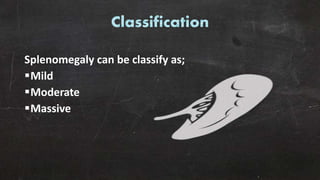
Splenomegaly can be classify as;
Mild
Moderate
Massive
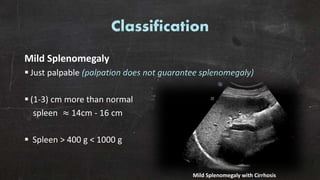
Mild Splenomegaly
 Just palpable
 (1-3) cm more than normal
spleen ≈ 14cm - 16 cm
 Spleen > 400 g < 1000 g
Mild Splenomegaly with Cirrhosis
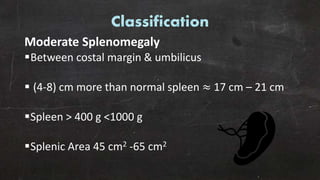
Moderate Splenomegaly
Between costal margin & umbilicus
 (4-8) cm more than normal spleen ≈ 17 cm – 21 cm
Spleen > 400 g <1000 g
Splenic Area 45 cm2 -65 cm2
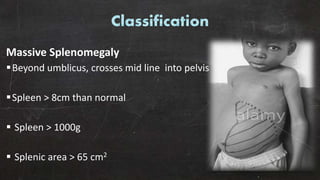
Massive Splenomegaly
Beyond umblicus, crosses mid line into pelvis
Spleen > 8cm than normal
 Spleen > 1000g
 Splenic area > 65 cm2
Splenomegaly (Splenic Length) Age Group
>6.0 cm 3 months
>6.5 cm 6 months
>7.0 cm 12 months
>8.0 cm 2 years
>9.0 cm 4 years
>9.5 cm 6 years
>10.0 cm 8 years
>11.0 cm 10 years
>11.5 cm 12 years
>12.0 cm 15 years
Splenomegaly due to exaggerated forms of normal splenic function;
- infections or inflammatory processes results from an increase in the
defense activities of the organ
- Removal of abnormal blood cells from the circulation is the usual
source of hyperplastic splenomegaly.
- Cirrhosis with portal hypertension, splenic vein occlusion or
congestive heart failure (CHF) causes congestive splenomegaly
- Infiltrative splenomegaly is the result of swelling of macrophages
with indigestible materials.
Cysts,
Hemangiomas,
Other malformations.
Several diseases can lead to splenomegaly; malaria,
anemias etc.
Associated symptoms or signs are typically related to the underlying
disorder.
 Fever
 Left Upper Quadrant pain (splenic infarct) (localize area of dead cell)
 Fullness and early satiety
 Feeling of heaviness in LUQ
 Jaundice
Most practical and cost effective method
Perform a complete blood count (CBC) with differential, platelet count,
and peripheral blood smear
 Computed Tomography
 Magnetic Resonance Imaging,
 Ultrasonography (High sensitivity & specificity, safe, noninvasive, quick, mobile, and
less costly)
Splenic Dimensions
Splenic Contour (Rounded Edge)
 Dilated Splenic vein (> 9 mm)
- Homogenous, slightly hyperechoic, with mild-
to-low echogenicity compare to liver, a smooth contour.
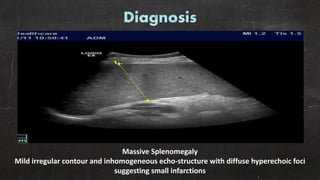
Massive Splenomegaly
Mild irregular contour and inhomogeneous echo-structure with diffuse hyperechoic foci
suggesting small infarctions
Splenomegaly with Splenic Vein Dilation
If the spleen is minimally enlarged, may be followed with careful
and regular observation.
Patients with enlarged spleens are more likely to have splenic
rupture from blunt abdominal or low thoracic trauma.
Splenomegaly most likely result in splenectomy
 Swaoop J, O’Reily RA. Splenomegaly at a University Hospital
compared to a nearby county hospital in 317 patients. Acta
Haematol 1999;102:83-8.
Ioanitescu S, Iliescu L, Harza M, Ismail G, Copaci I. Ultrasound of
the spleen, EFSUMB Course Book;1-46. Published by EFSUMB,
2012.
 Radhakrishnan N, Besa,C, E. Splenomegaly. Medscape. 2018
January 09;1-9
 World Health Organisation, World Federation for Ultrasound in
Medicine and Biology: Manual of Diagnostic ultrasound; 2003

Splenomegaly

  • 2.
  • 4.
    Splenomegaly is definedby increased splenic dimensions and volume. Spleen diameters averaged over 13 cm and an area above 45 cm2 or weight above 400 g are considered splenomegaly.
  • 5.
  • 6.
    Splenomegaly can beclassify as; Mild Moderate Massive
  • 7.
    Mild Splenomegaly  Justpalpable  (1-3) cm more than normal spleen ≈ 14cm - 16 cm  Spleen > 400 g < 1000 g Mild Splenomegaly with Cirrhosis
  • 8.
    Moderate Splenomegaly Between costalmargin & umbilicus  (4-8) cm more than normal spleen ≈ 17 cm – 21 cm Spleen > 400 g <1000 g Splenic Area 45 cm2 -65 cm2
  • 9.
    Massive Splenomegaly Beyond umblicus,crosses mid line into pelvis Spleen > 8cm than normal  Spleen > 1000g  Splenic area > 65 cm2
  • 11.
    Splenomegaly (Splenic Length)Age Group >6.0 cm 3 months >6.5 cm 6 months >7.0 cm 12 months >8.0 cm 2 years >9.0 cm 4 years >9.5 cm 6 years >10.0 cm 8 years >11.0 cm 10 years >11.5 cm 12 years >12.0 cm 15 years
  • 12.
    Splenomegaly due toexaggerated forms of normal splenic function; - infections or inflammatory processes results from an increase in the defense activities of the organ - Removal of abnormal blood cells from the circulation is the usual source of hyperplastic splenomegaly. - Cirrhosis with portal hypertension, splenic vein occlusion or congestive heart failure (CHF) causes congestive splenomegaly - Infiltrative splenomegaly is the result of swelling of macrophages with indigestible materials.
  • 13.
    Cysts, Hemangiomas, Other malformations. Several diseasescan lead to splenomegaly; malaria, anemias etc.
  • 14.
    Associated symptoms orsigns are typically related to the underlying disorder.  Fever  Left Upper Quadrant pain (splenic infarct) (localize area of dead cell)  Fullness and early satiety  Feeling of heaviness in LUQ  Jaundice
  • 15.
    Most practical andcost effective method Perform a complete blood count (CBC) with differential, platelet count, and peripheral blood smear  Computed Tomography  Magnetic Resonance Imaging,  Ultrasonography (High sensitivity & specificity, safe, noninvasive, quick, mobile, and less costly)
  • 16.
    Splenic Dimensions Splenic Contour(Rounded Edge)  Dilated Splenic vein (> 9 mm) - Homogenous, slightly hyperechoic, with mild- to-low echogenicity compare to liver, a smooth contour.
  • 17.
    Massive Splenomegaly Mild irregularcontour and inhomogeneous echo-structure with diffuse hyperechoic foci suggesting small infarctions
  • 18.
  • 20.
    If the spleenis minimally enlarged, may be followed with careful and regular observation. Patients with enlarged spleens are more likely to have splenic rupture from blunt abdominal or low thoracic trauma. Splenomegaly most likely result in splenectomy
  • 21.
     Swaoop J,O’Reily RA. Splenomegaly at a University Hospital compared to a nearby county hospital in 317 patients. Acta Haematol 1999;102:83-8. Ioanitescu S, Iliescu L, Harza M, Ismail G, Copaci I. Ultrasound of the spleen, EFSUMB Course Book;1-46. Published by EFSUMB, 2012.  Radhakrishnan N, Besa,C, E. Splenomegaly. Medscape. 2018 January 09;1-9  World Health Organisation, World Federation for Ultrasound in Medicine and Biology: Manual of Diagnostic ultrasound; 2003