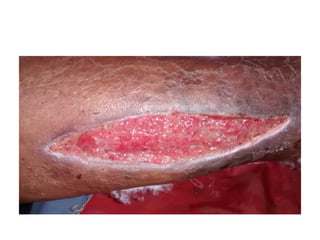
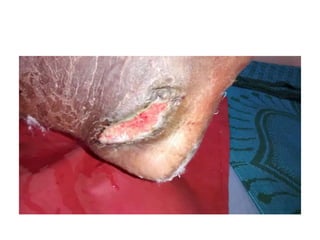
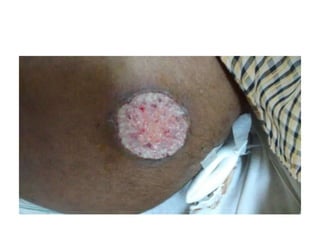
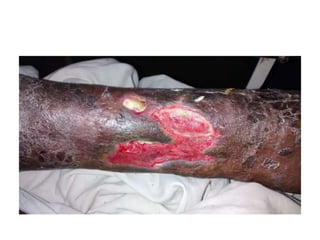
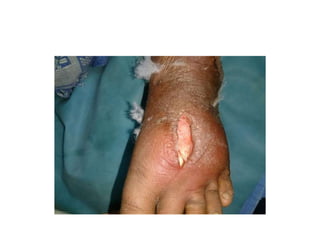
ULCER
DR.SUNIL KUMAR
ASST.PROFESSOR
DEPT.OF GEN.SURGERY
MNR MEDICAL COLLEGE
SANGAREDDY
01-05-2019
Definition
• An ulcer is a break in the continuity of the
covering epithelium, either skin or mucous
membrane due to molecular death.
Parts of an Ulcer
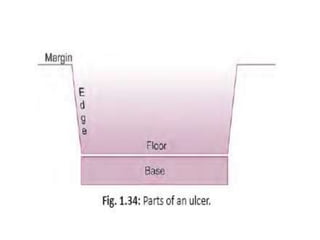
a. Margin: It may be regular or irregular. It may
be rounded or oval.
b. Edge: Edge is the one which connects floor of
the ulcer to the margin.
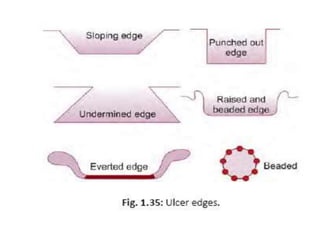
Different edges are:
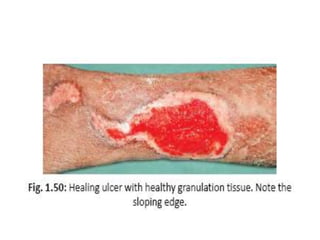
• Sloping edge. It is seen in a healing ulcer.
• Its inner part is red because of red, healthy
granulation tissue.
• Its outer part is white due to scar/fibrous
tissue.
• Its middle part is blue due to epithelial
proliferation.
• Undermined edge is seen in a tuberculous ulcer
• Punched out edge is seen in a gummatous (syphilitic)
ulcer and trophic ulcer.
 It is due to endarteritis.
• Raised and beaded edge (pearly white) is seen in a
rodent ulcer (BCC).
 Beads are due to proliferating active cells.
• Everted edge (rolled out edge): It is seen in a
carcinomatous ulcer due to spill of the proliferating
malignant tissues over the normal skin.
c. Floor:
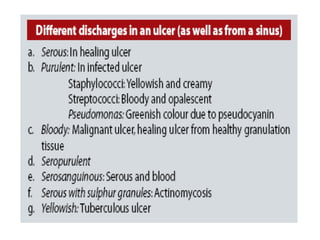
• It is the one which is seen. Floor may contain
discharge, granulation tissue or slough.
d. Base:
Base is the one on which ulcer rests. It may be bone or
soft tissue.
Induration of an Ulcer
• Induration is a clinical palpatory sign which means a
specific type of hardness in the diseased tissue.
• It is obvious in well-differentiated carcinomas.
• It is better felt in squamous cell carcinoma.
• It is also observed in long standing ulcer with
underlying fibrosis
• Brawny induration is a feature of an abscess.
• Induration is felt at edge, base and surrounding area
of an ulcer.
• Induration at surrounding area signifies the extent of
disease (tumour).
• Outermost part of the indurated area is taken as the
point from where clearance of wide excision is
planned.
Classifications
Classification I (Clinical)
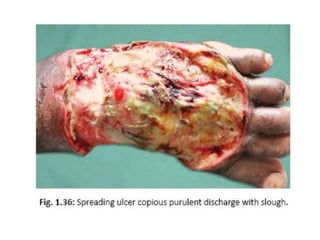
1. Spreading ulcer:
• Here edge is inflamed, irregular and oedematous.
• It is an acute painful ulcer; floor does not contain
healthy granulation tissue (or granulation tissue is
absent) but with profuse purulent discharge and
slough; surrounding area is red and edematous.
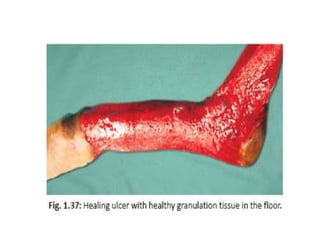
2. Healing ulcer
• Edge is sloping with healthy pink/red healthy
granulation tissue with scanty/minimal serous
discharge in the floor;
• slough is absent;
• regional lymph nodes may or may not be enlarged
but when enlarged always non-tender.
• Surrounding area does not show any signs of
inflammation or induration; base is not indurated.
Three zones are observed in healing ulcer.
• Innermost red zone of healthy granulation
tissue;
• middle bluish zone of growing epithelium;
• outer whitish zone of fibrosis and scar
formation.
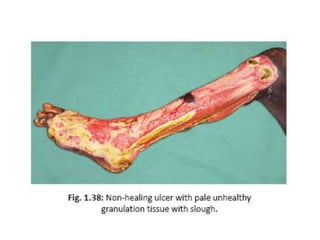
3. Non-healing ulcer
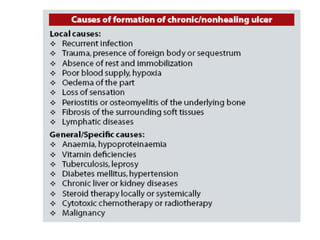
• It may be a chronic ulcer depending on the cause of
the ulcer; here edge will be depending on the
cause—punched out (trophic), undermined
(tuberculous), rolled out (carcinomatous ulcer),
beaded (rodent ulcer);
• floor contains unhealthy granulation tissue and
slough, and serosanguineous/purulent/bloody
discharge;
• Regional draining lymph nodes may be enlarged but
non-tender.
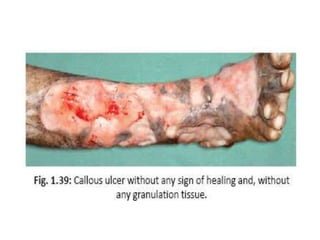
4. Callous (stationary) ulcer
• It is also a chronic non-healing ulcer; floor contains
pale unhealthy, flabby, whitish yellow granulation
tissue and thin scanty serous discharge or often with
copious serosanguinous discharge, with indurated
nontender edge; base is indurated, nontender and
often fixed.
• Ulcer does not show any tendency to heal.
• It lasts for many months to years.
• Tissue destruction is more with absence of or only
minimal regeneration.
• Induration and pigmentation may be seen in the
surrounding area.
• There is no/less discharge.
• Regional lymph nodes may be enlarged; are firm/
hard and nontender.
• It is callousness towards healing; wordcallous
means—insensitive and cruel; and also it means—
hard skinned.
Classification II (Based on Duration)
1. Acute ulcer
duration is less than 2 weeks.
2. Chronic ulcer
duration is more than 2 weeks (long).
Classification III (Pathological)
1. Specific ulcers:
• Tuberculous ulcer.
• Syphilitic ulcer: It is punched out, deep, with “wash-
leather” slough in the floor and with indurated base.
• Actinomycosis.
• Meleney’s ulcer.
2. Malignant ulcers:
• Carcinomatous ulcer
• Rodent ulcer.
• Melanotic ulcer.
3. Non-specific ulcers:
• Traumatic ulcer: It may be mechanical, physical,
chemical— common.
• Arterial ulcer: Atherosclerosis, TAO
• Venous ulcer: Gravitational ulcer, post-phlebitic ulcer.
• Trophic ulcer/Pressure sore.
• Infective ulcers: Pyogenic ulcer.
• Tropical ulcers: It occurs in tropical countries. It is
callous type of ulcer, e.g. Vincent’s ulcer.
• Ulcers due to chilblains and frostbite (cryopathic
ulcer).
• Martorell’s hypertensive ulcer.
• Bazin’s ulcer.
• Diabetic ulcer.
• Ulcers due to leucaemia, polycythemia, jaundice,
collagen diseases, lymphoedema.
• Cortisol ulcers are due to long-time application of
cortisol (steroid) creams to certain skin diseases.
• These ulcers are callous ulcers last for long time and
require excision and skin grafting.
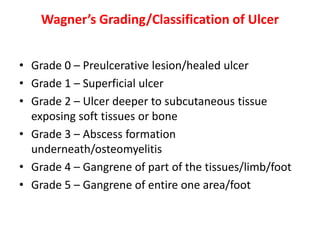
Wagner’s Grading/Classification of Ulcer
• Grade 0 – Preulcerative lesion/healed ulcer
• Grade 1 – Superficial ulcer
• Grade 2 – Ulcer deeper to subcutaneous tissue
exposing soft tissues or bone
• Grade 3 – Abscess formation
underneath/osteomyelitis
• Grade 4 – Gangrene of part of the tissues/limb/foot
• Grade 5 – Gangrene of entire one area/foot
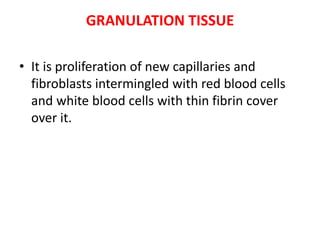
GRANULATION TISSUE
• It is proliferation of new capillaries and
fibroblasts intermingled with red blood cells
and white blood cells with thin fibrin cover
over it.
Unhealthy granulation tissue
• It is pale with purulent discharge.
• Its floor is covered with slough.
• Its edge is inflamed and oedematous.
• It is a spreading ulcer.
• Unhealthy, pale, flat granulation tissue: It is seen in
chronic nonhealing ulcer (callous ulcer).
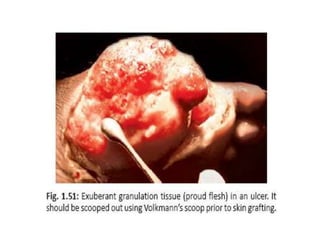
Exuberant granulation tissue (Proud flesh)
• It occurs in a sinus or ulcer wherein granulation
tissue protrudes out of the sinus opening or ulcer
bed like a proliferating mass.
• It is commonly associated with a retained foreign
body in the sinus cavity.
INVESTIGATIONS FOR AN ULCER
Study of discharge:
• Culture and sensitivity, AFB study,
• cytology.
Wedge biopsy:
• Biopsy is taken from the edge because edge
contains multiplying cells.
• Usually two biopsies are taken.
• Biopsy taken from the centre may be inadequate
because of central necrosis
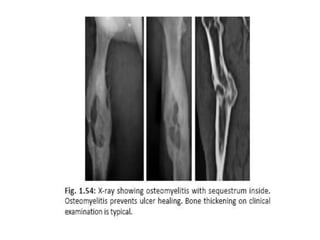
• X-ray of the part to look for
periostitis/osteomyelitis.
• FNAC of the lymph node.
• Chest X-ray, Mantoux test in suspected case of
tuberculous ulcer.
• Haemoglobin, ESR, total WBC count, serum
protein estimation (albumin).
MANAGEMENT OF AN ULCER
• Cause should be found and treated.
• Correction of the anaemia, deficiencies like of
protein and vitamins.
• Proper investigation as needed.
• Transfusion of the blood if required.
• Control the pain and infection.
• Rest, immobilization, elevation, avoidance of
repeated trauma.
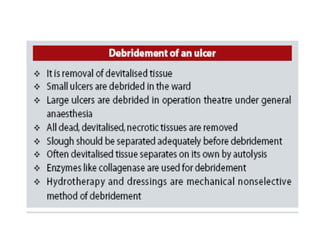
• Care of the ulcer by debridement, ulcer cleaning and
dressing.
• Desloughing is done either mechanically or
chemically. Mechanically it is done using scissor by
excising the slough.
• Hydrogen peroxide which releases nascent oxygen is
used as chemical agent.
• Acriflavine is antiseptic and irritant and so desloughs
the area and promotes granulation tissue formation.
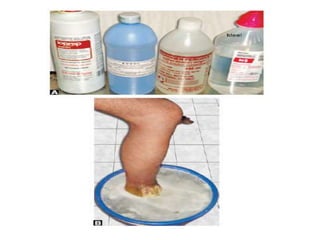
• Eusol (Edinburgh University Solution) which contains
sodium hypochlorite releases nascent chlorine which
forms a water soluble complex with slough to
dissolve it.
• Use of povidone iodine in ulcer cleaning is
controversial (open wound is not suitable; it is mainly
for cleaning the surgical field prior to incision).
• Maggots if present in the wound will cause crawling
sensation and are removed using turpentine
solution.
• Removal of the exuberant granulation tissue is also
required when present.
• Ulcer cleaning and dressing is done daily or twice
daily or once in 2–3 days depending on the type of
ulcer and type of dressing used.
• Normal saline is ideal for ulcer cleaning.
• Various dressings are available.
• Films (opsite/semipermeable polyurethane),
hydrocolloids (duoderm), hydrogels (polyethylene
oxide with water), hydroactives (nonpectin-based
polyurethane matrix), foams.
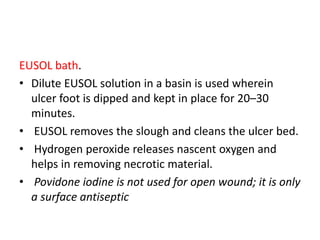
EUSOL bath.
• Dilute EUSOL solution in a basin is used wherein
ulcer foot is dipped and kept in place for 20–30
minutes.
• EUSOL removes the slough and cleans the ulcer bed.
• Hydrogen peroxide releases nascent oxygen and
helps in removing necrotic material.
• Povidone iodine is not used for open wound; it is only
a surface antiseptic
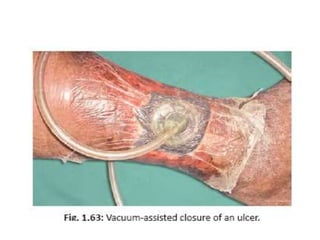
Vacuum assisted closure (VAC) therapy
• It is by creation of negative pressure (25–200 mmHg),
continuous or intermittent over the wound surface; it
causes reduced fluid in the interstitial space, reduces
oedema, increases the cell proliferation and protein
matrix synthesis, promotes formation of healthy
granulation tissue.
• Sterile foam is placed over the ulcer bed covering
widely; tube drain with multiple holes is kept within it
and end of the tube comes out significantly away; foam
is sealed airtight using a sterile adhesive film.
• Tube is connected to suction system.
• Suction is maintained initially continuously
later intermittently.
• Redressing is done only after 4–7 days.
• Therapy using infrared/short wave/ultraviolet
rays to decrease the ulcer size is often used
but their benefits are not proved.
Maggot debridement therapy
• It is used as biotherapy (but not commonly) by
placing cultured live disinfected maggots.
• Maggots are larvae of the green bottle fly, also
known as the green blowfly (Lucilia sericata).
• They act by dissolving and engulfing dead necrotic
tissues; they may reduce the bacterial content in the
wound.
• They can inhibit many bacteria including MRSA
(methicillin resistant bacteria), anaerobic and aerobic
bacteria.
• They secrete proteolytic enzymes to have mechanical
effects; secretion of ammonia alters the pH in the
ulcer bed which inhibits bacterial growth.
• They increase the granulation tissue formation also.
• Once ulcer granulates, defect is closed with
secondary suturing, skin graft or flaps
TRAUMATIC ULCER
• Such ulcer occurs after trauma. It may be
mechanical—dental ulcer along the margin of the
tongue due to tooth injury; physical like by electrical
burn; chemical like by alkali injury.
• Such ulcer is acute, superficial, painful and tender.
• Secondary infection or poor blood supply of the area
make it chronic and deep.
• Footballer’s ulcer is a traumatic ulcer occurring over
the shin of males due to direct knocks on the shin. It
is staphylococcal infection with a chronic and deep
ulcer.
• Traumatic ulcers can occur anywhere in the body due
to trauma
• Trauma causes infection, necrosis, fasciitis, crush
injury, endarteritis of the skin leading into formation
of large/deep nonhealing ulcer.
• Treatment depends on size and extent of ulcer.
• Regular dressing,
• later skin grafting .
TROPHIC ULCER (PRESSURE SORE/DECUBITUS
ULCER)
• Pressure sore is tissue necrosis and ulceration due to
prolonged pressure.
• Blood flow to the skin stops once external pressure
becomes more than 30 mmHg (more than capillary
occlusive pressure) and this causes tissue hypoxia,
necrosis and ulceration.
• It is more prominent between bony prominence and
an external surface.
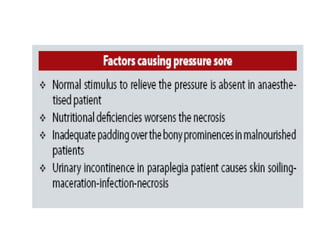
It is due to:
• Impaired nutrition.
• Defective blood supply.
• Neurological deficit.
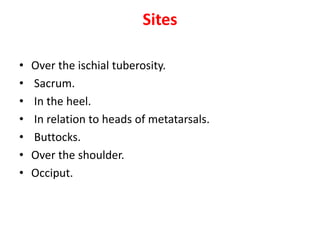
Sites
• Over the ischial tuberosity.
• Sacrum.
• In the heel.
• In relation to heads of metatarsals.
• Buttocks.
• Over the shoulder.
• Occiput.
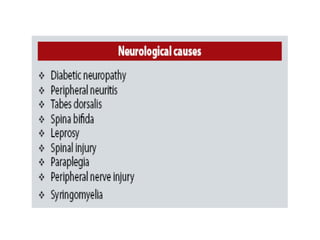
• Due to the presence of neurological deficit, trophic
ulcer is also called as neurogenic ulcer/neuropathic
ulcer.
• Initially it begins as callosity due to repeated trauma
and pressure, under which suppuration occurs and
gives way through a central hole which extends down
into the deeper plane up to the underlying bone as
perforating ulcer (penetrating ulcer).
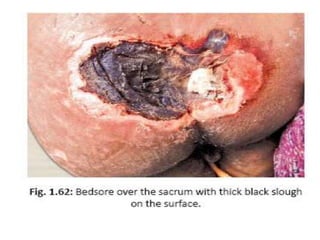
• Bedsores are trophic ulcers.
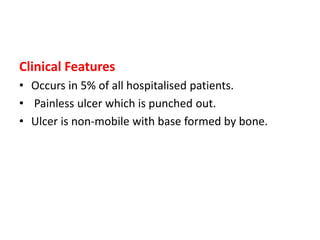
Clinical Features
• Occurs in 5% of all hospitalised patients.
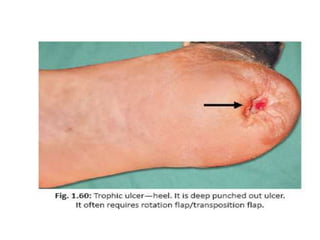
• Painless ulcer which is punched out.
• Ulcer is non-mobile with base formed by bone.
Investigations
• Study of discharge, blood sugar, biopsy from the
edge, X-ray of the part, X-ray spine
Treatment
• Cause should be treated.
• Nutritional supplementation.
• Rest, antibiotics, slough excision, regular dressings.
• Vacuum-assisted closure (VAC): It is the creation of
intermittent negative pressure of minus 125 mmHg
to promote formation of healthy granulation tissue.
• Negative pressure reduces tissue oedema, clears the
interstitial fluid and improves the perfusion,
increases the cell proliferation and so promotes the
healing.
• A perforated drain is kept over the foam dressing
covered over the pressure sore.
• It is sealed with a transparent adhesive sheet.
• Drain is connected to required vacuum apparatus.
• Once ulcer granulates well, flap cover or skin grafting
is done.
• Excision of the ulcer and skin grafting.
• Flaps—local rotation or other flaps (transposition
flaps).
• Cultured muscle interposition.
• Proper care: Change in position once in 2 hours;
lifting the limb upwards for 10 seconds once in 10
minutes; nutrition; use of water bed/air bed/air-fluid
floatation bed and pressure dispersion cushions to
the affected area; urinary and faecal care; hygiene;
psychological counselling.
• Regular skin observation; keeping skin clean and dry
(using regular use of talcum powder); oil massaging
of the skin and soft tissues using clean, absorbent
porous clothing; control and prevention of sepsis
helps in the management.
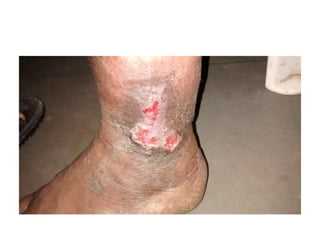
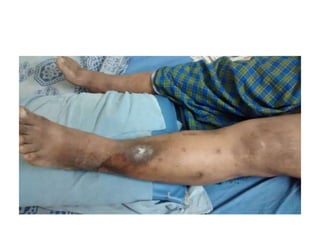
ULCER DUE TO FROSTBITE
• It is due to exposure of a part to wet cold
below the freezing point (cold wind).
• There is arteriolar spasm, denaturation of
proteins and cell destruction.
• It leads to gangrene of the part.
• Ulcers here are always deep.
THANK YOU

Ulcer

  • 1.
  • 2.
    Definition • An ulceris a break in the continuity of the covering epithelium, either skin or mucous membrane due to molecular death. Parts of an Ulcer a. Margin: It may be regular or irregular. It may be rounded or oval. b. Edge: Edge is the one which connects floor of the ulcer to the margin.
  • 3.
    Different edges are: •Sloping edge. It is seen in a healing ulcer. • Its inner part is red because of red, healthy granulation tissue. • Its outer part is white due to scar/fibrous tissue. • Its middle part is blue due to epithelial proliferation.
  • 4.
    • Undermined edgeis seen in a tuberculous ulcer • Punched out edge is seen in a gummatous (syphilitic) ulcer and trophic ulcer.  It is due to endarteritis. • Raised and beaded edge (pearly white) is seen in a rodent ulcer (BCC).  Beads are due to proliferating active cells. • Everted edge (rolled out edge): It is seen in a carcinomatous ulcer due to spill of the proliferating malignant tissues over the normal skin.
  • 5.
    c. Floor: • Itis the one which is seen. Floor may contain discharge, granulation tissue or slough. d. Base: Base is the one on which ulcer rests. It may be bone or soft tissue.
  • 8.
    Induration of anUlcer • Induration is a clinical palpatory sign which means a specific type of hardness in the diseased tissue. • It is obvious in well-differentiated carcinomas. • It is better felt in squamous cell carcinoma. • It is also observed in long standing ulcer with underlying fibrosis • Brawny induration is a feature of an abscess.
  • 9.
    • Induration isfelt at edge, base and surrounding area of an ulcer. • Induration at surrounding area signifies the extent of disease (tumour). • Outermost part of the indurated area is taken as the point from where clearance of wide excision is planned.
  • 10.
    Classifications Classification I (Clinical) 1.Spreading ulcer: • Here edge is inflamed, irregular and oedematous. • It is an acute painful ulcer; floor does not contain healthy granulation tissue (or granulation tissue is absent) but with profuse purulent discharge and slough; surrounding area is red and edematous.
  • 12.
    2. Healing ulcer •Edge is sloping with healthy pink/red healthy granulation tissue with scanty/minimal serous discharge in the floor; • slough is absent; • regional lymph nodes may or may not be enlarged but when enlarged always non-tender. • Surrounding area does not show any signs of inflammation or induration; base is not indurated.
  • 13.
    Three zones areobserved in healing ulcer. • Innermost red zone of healthy granulation tissue; • middle bluish zone of growing epithelium; • outer whitish zone of fibrosis and scar formation.
  • 15.
    3. Non-healing ulcer •It may be a chronic ulcer depending on the cause of the ulcer; here edge will be depending on the cause—punched out (trophic), undermined (tuberculous), rolled out (carcinomatous ulcer), beaded (rodent ulcer); • floor contains unhealthy granulation tissue and slough, and serosanguineous/purulent/bloody discharge; • Regional draining lymph nodes may be enlarged but non-tender.
  • 17.
    4. Callous (stationary)ulcer • It is also a chronic non-healing ulcer; floor contains pale unhealthy, flabby, whitish yellow granulation tissue and thin scanty serous discharge or often with copious serosanguinous discharge, with indurated nontender edge; base is indurated, nontender and often fixed. • Ulcer does not show any tendency to heal. • It lasts for many months to years. • Tissue destruction is more with absence of or only minimal regeneration.
  • 18.
    • Induration andpigmentation may be seen in the surrounding area. • There is no/less discharge. • Regional lymph nodes may be enlarged; are firm/ hard and nontender. • It is callousness towards healing; wordcallous means—insensitive and cruel; and also it means— hard skinned.
  • 20.
    Classification II (Basedon Duration) 1. Acute ulcer duration is less than 2 weeks. 2. Chronic ulcer duration is more than 2 weeks (long).
  • 21.
    Classification III (Pathological) 1.Specific ulcers: • Tuberculous ulcer. • Syphilitic ulcer: It is punched out, deep, with “wash- leather” slough in the floor and with indurated base. • Actinomycosis. • Meleney’s ulcer.
  • 22.
    2. Malignant ulcers: •Carcinomatous ulcer • Rodent ulcer. • Melanotic ulcer. 3. Non-specific ulcers: • Traumatic ulcer: It may be mechanical, physical, chemical— common. • Arterial ulcer: Atherosclerosis, TAO
  • 23.
    • Venous ulcer:Gravitational ulcer, post-phlebitic ulcer. • Trophic ulcer/Pressure sore. • Infective ulcers: Pyogenic ulcer. • Tropical ulcers: It occurs in tropical countries. It is callous type of ulcer, e.g. Vincent’s ulcer. • Ulcers due to chilblains and frostbite (cryopathic ulcer). • Martorell’s hypertensive ulcer.
  • 24.
    • Bazin’s ulcer. •Diabetic ulcer. • Ulcers due to leucaemia, polycythemia, jaundice, collagen diseases, lymphoedema. • Cortisol ulcers are due to long-time application of cortisol (steroid) creams to certain skin diseases. • These ulcers are callous ulcers last for long time and require excision and skin grafting.
  • 25.
    Wagner’s Grading/Classification ofUlcer • Grade 0 – Preulcerative lesion/healed ulcer • Grade 1 – Superficial ulcer • Grade 2 – Ulcer deeper to subcutaneous tissue exposing soft tissues or bone • Grade 3 – Abscess formation underneath/osteomyelitis • Grade 4 – Gangrene of part of the tissues/limb/foot • Grade 5 – Gangrene of entire one area/foot
  • 27.
    GRANULATION TISSUE • Itis proliferation of new capillaries and fibroblasts intermingled with red blood cells and white blood cells with thin fibrin cover over it.
  • 29.
    Unhealthy granulation tissue •It is pale with purulent discharge. • Its floor is covered with slough. • Its edge is inflamed and oedematous. • It is a spreading ulcer. • Unhealthy, pale, flat granulation tissue: It is seen in chronic nonhealing ulcer (callous ulcer).
  • 30.
    Exuberant granulation tissue(Proud flesh) • It occurs in a sinus or ulcer wherein granulation tissue protrudes out of the sinus opening or ulcer bed like a proliferating mass. • It is commonly associated with a retained foreign body in the sinus cavity.
  • 32.
    INVESTIGATIONS FOR ANULCER Study of discharge: • Culture and sensitivity, AFB study, • cytology. Wedge biopsy: • Biopsy is taken from the edge because edge contains multiplying cells. • Usually two biopsies are taken. • Biopsy taken from the centre may be inadequate because of central necrosis
  • 33.
    • X-ray ofthe part to look for periostitis/osteomyelitis. • FNAC of the lymph node. • Chest X-ray, Mantoux test in suspected case of tuberculous ulcer. • Haemoglobin, ESR, total WBC count, serum protein estimation (albumin).
  • 35.
    MANAGEMENT OF ANULCER • Cause should be found and treated. • Correction of the anaemia, deficiencies like of protein and vitamins. • Proper investigation as needed. • Transfusion of the blood if required. • Control the pain and infection. • Rest, immobilization, elevation, avoidance of repeated trauma.
  • 36.
    • Care ofthe ulcer by debridement, ulcer cleaning and dressing. • Desloughing is done either mechanically or chemically. Mechanically it is done using scissor by excising the slough. • Hydrogen peroxide which releases nascent oxygen is used as chemical agent. • Acriflavine is antiseptic and irritant and so desloughs the area and promotes granulation tissue formation.
  • 37.
    • Eusol (EdinburghUniversity Solution) which contains sodium hypochlorite releases nascent chlorine which forms a water soluble complex with slough to dissolve it. • Use of povidone iodine in ulcer cleaning is controversial (open wound is not suitable; it is mainly for cleaning the surgical field prior to incision).
  • 38.
    • Maggots ifpresent in the wound will cause crawling sensation and are removed using turpentine solution. • Removal of the exuberant granulation tissue is also required when present. • Ulcer cleaning and dressing is done daily or twice daily or once in 2–3 days depending on the type of ulcer and type of dressing used.
  • 39.
    • Normal salineis ideal for ulcer cleaning. • Various dressings are available. • Films (opsite/semipermeable polyurethane), hydrocolloids (duoderm), hydrogels (polyethylene oxide with water), hydroactives (nonpectin-based polyurethane matrix), foams.
  • 43.
    EUSOL bath. • DiluteEUSOL solution in a basin is used wherein ulcer foot is dipped and kept in place for 20–30 minutes. • EUSOL removes the slough and cleans the ulcer bed. • Hydrogen peroxide releases nascent oxygen and helps in removing necrotic material. • Povidone iodine is not used for open wound; it is only a surface antiseptic
  • 44.
    Vacuum assisted closure(VAC) therapy • It is by creation of negative pressure (25–200 mmHg), continuous or intermittent over the wound surface; it causes reduced fluid in the interstitial space, reduces oedema, increases the cell proliferation and protein matrix synthesis, promotes formation of healthy granulation tissue. • Sterile foam is placed over the ulcer bed covering widely; tube drain with multiple holes is kept within it and end of the tube comes out significantly away; foam is sealed airtight using a sterile adhesive film.
  • 45.
    • Tube isconnected to suction system. • Suction is maintained initially continuously later intermittently. • Redressing is done only after 4–7 days. • Therapy using infrared/short wave/ultraviolet rays to decrease the ulcer size is often used but their benefits are not proved.
  • 47.
    Maggot debridement therapy •It is used as biotherapy (but not commonly) by placing cultured live disinfected maggots. • Maggots are larvae of the green bottle fly, also known as the green blowfly (Lucilia sericata). • They act by dissolving and engulfing dead necrotic tissues; they may reduce the bacterial content in the wound. • They can inhibit many bacteria including MRSA (methicillin resistant bacteria), anaerobic and aerobic bacteria.
  • 48.
    • They secreteproteolytic enzymes to have mechanical effects; secretion of ammonia alters the pH in the ulcer bed which inhibits bacterial growth. • They increase the granulation tissue formation also. • Once ulcer granulates, defect is closed with secondary suturing, skin graft or flaps
  • 49.
    TRAUMATIC ULCER • Suchulcer occurs after trauma. It may be mechanical—dental ulcer along the margin of the tongue due to tooth injury; physical like by electrical burn; chemical like by alkali injury. • Such ulcer is acute, superficial, painful and tender. • Secondary infection or poor blood supply of the area make it chronic and deep.
  • 50.
    • Footballer’s ulceris a traumatic ulcer occurring over the shin of males due to direct knocks on the shin. It is staphylococcal infection with a chronic and deep ulcer. • Traumatic ulcers can occur anywhere in the body due to trauma
  • 52.
    • Trauma causesinfection, necrosis, fasciitis, crush injury, endarteritis of the skin leading into formation of large/deep nonhealing ulcer. • Treatment depends on size and extent of ulcer. • Regular dressing, • later skin grafting .
  • 53.
    TROPHIC ULCER (PRESSURESORE/DECUBITUS ULCER) • Pressure sore is tissue necrosis and ulceration due to prolonged pressure. • Blood flow to the skin stops once external pressure becomes more than 30 mmHg (more than capillary occlusive pressure) and this causes tissue hypoxia, necrosis and ulceration. • It is more prominent between bony prominence and an external surface.
  • 56.
    It is dueto: • Impaired nutrition. • Defective blood supply. • Neurological deficit.
  • 57.
    Sites • Over theischial tuberosity. • Sacrum. • In the heel. • In relation to heads of metatarsals. • Buttocks. • Over the shoulder. • Occiput.
  • 58.
    • Due tothe presence of neurological deficit, trophic ulcer is also called as neurogenic ulcer/neuropathic ulcer. • Initially it begins as callosity due to repeated trauma and pressure, under which suppuration occurs and gives way through a central hole which extends down into the deeper plane up to the underlying bone as perforating ulcer (penetrating ulcer). • Bedsores are trophic ulcers.
  • 61.
    Clinical Features • Occursin 5% of all hospitalised patients. • Painless ulcer which is punched out. • Ulcer is non-mobile with base formed by bone.
  • 62.
    Investigations • Study ofdischarge, blood sugar, biopsy from the edge, X-ray of the part, X-ray spine
  • 63.
    Treatment • Cause shouldbe treated. • Nutritional supplementation. • Rest, antibiotics, slough excision, regular dressings. • Vacuum-assisted closure (VAC): It is the creation of intermittent negative pressure of minus 125 mmHg to promote formation of healthy granulation tissue.
  • 64.
    • Negative pressurereduces tissue oedema, clears the interstitial fluid and improves the perfusion, increases the cell proliferation and so promotes the healing. • A perforated drain is kept over the foam dressing covered over the pressure sore. • It is sealed with a transparent adhesive sheet.
  • 65.
    • Drain isconnected to required vacuum apparatus. • Once ulcer granulates well, flap cover or skin grafting is done. • Excision of the ulcer and skin grafting. • Flaps—local rotation or other flaps (transposition flaps). • Cultured muscle interposition.
  • 66.
    • Proper care:Change in position once in 2 hours; lifting the limb upwards for 10 seconds once in 10 minutes; nutrition; use of water bed/air bed/air-fluid floatation bed and pressure dispersion cushions to the affected area; urinary and faecal care; hygiene; psychological counselling. • Regular skin observation; keeping skin clean and dry (using regular use of talcum powder); oil massaging of the skin and soft tissues using clean, absorbent porous clothing; control and prevention of sepsis helps in the management.
  • 67.
    ULCER DUE TOFROSTBITE • It is due to exposure of a part to wet cold below the freezing point (cold wind). • There is arteriolar spasm, denaturation of proteins and cell destruction. • It leads to gangrene of the part. • Ulcers here are always deep.
  • 83.