LICHEN PLANUS
SUBODH KR. SHAH
9TH BATCH
INTERN
Introduction:
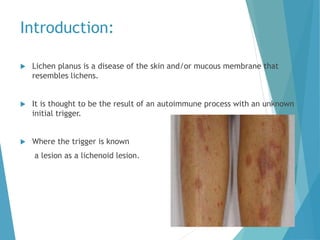
 Lichen planus is a disease of the skin and/or mucous membrane that
resembles lichens.
 It is thought to be the result of an autoimmune process with an unknown
initial trigger.
 Where the trigger is known
a lesion as a lichenoid lesion.
Epidemiology :
 Risk for the condition include:
 exposure to medicines,dyes,and other
chemicals(including
gold,antibiotics,arsenic,diuretics,chloroquine)
 Disease such as hepatitis C
 Race: no racial predispositions.
 Sex: lichen planus effects women more
compared to men (3:2) ratio.
 Age: more than two third of LP patients are
aged 30-60 yrs however it can occur at any
age.
Lichen planus
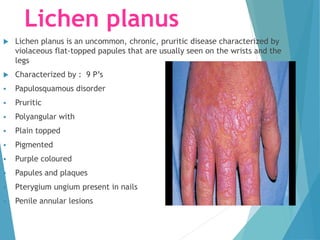
 Lichen planus is an uncommon, chronic, pruritic disease characterized by
violaceous flat-topped papules that are usually seen on the wrists and the
legs
 Characterized by : 9 P’s
 Papulosquamous disorder
 Pruritic
 Polyangular with
 Plain topped
 Pigmented
 Purple coloured
 Papules and plaques
 Pterygium ungium present in nails
 Penile annular lesions
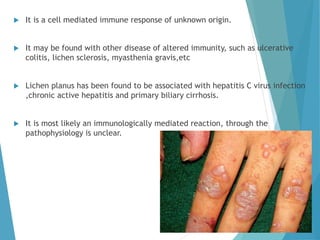
 It is a cell mediated immune response of unknown origin.
 It may be found with other disease of altered immunity, such as ulcerative
colitis, lichen sclerosis, myasthenia gravis,etc
 Lichen planus has been found to be associated with hepatitis C virus infection
,chronic active hepatitis and primary biliary cirrhosis.
 It is most likely an immunologically mediated reaction, through the
pathophysiology is unclear.
Sign and symptoms:
 The following may be noted in the patient history:
 Lesions initially developing on flexural surfaces of the limbs, with a
generalized eruption developing after a week or more and maximal
spreading within 2-16 weeks .
 Pruritus of varying severity, depending on the type of lesion and the
extent of involvement
 Oral lesions that may be asymptomatic, burning, or even painful
 In cutaneous disease, lesions typically resolve within 6 months (>50%) to
18 months (85%); chronic disease is more likely oral lichen planus or with
large, annular, hypertrophic lesions and mucous membrane involvement
 In addition to the widespread cutaneous eruption, lichen planus can
involve the following structures:
a. Mucous membranes
b. Genitalia
c. Nails
d. Scalp
Clinical presentation:
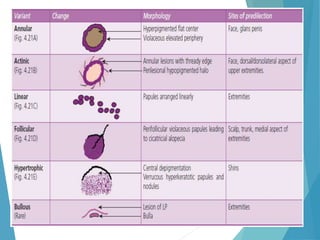
Lichen planus has several variations, as follows:
 Hypertrophic lichen planus
 Atrophic lichen planus
 Erosive/ulcerative lichen planus
 Follicular lichen planus (lichen planopilaris)
 Annular lichen planus
 Linear lichen planus
 Vesicular and bullous lichen planus
 Actinic lichen planus
 Lichen planus pigmentosus
 Lichen planus pemphigoides
CHARACTERSITICS:
 Primary lesion: Flat-topped, violaceous papules and
papulosquamous lesions appear.
On close examination of a papule, preferably after the lesion has
been wet with an alcohol swipe, intersecting small white lines or
papules (Wickham’s striae) can be seen. These confirm the diagnosis.
 Uncommonly, the lesions may assume a ring-shaped configuration
(especially on the penis) or may be hypertrophic (especially
pretibial), atrophic, or bullous.
 On the mucous membranes, the lesions appear as
a whitish, lacy network
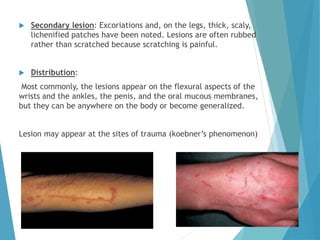
 Secondary lesion: Excoriations and, on the legs, thick, scaly,
lichenified patches have been noted. Lesions are often rubbed
rather than scratched because scratching is painful.
 Distribution:
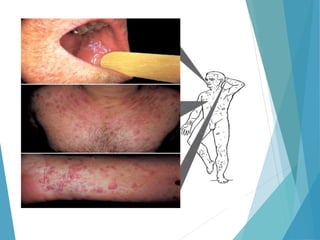
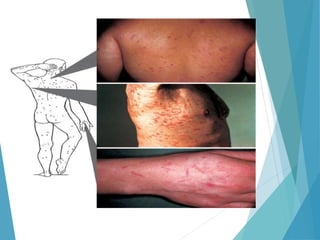
Most commonly, the lesions appear on the flexural aspects of the
wrists and the ankles, the penis, and the oral mucous membranes,
but they can be anywhere on the body or become generalized.
Lesion may appear at the sites of trauma (koebner’s phenomenon)
Clinical Forms:
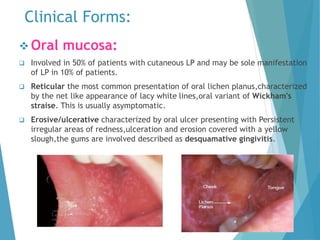
 Oral mucosa:
 Involved in 50% of patients with cutaneous LP and may be sole manifestation
of LP in 10% of patients.
 Reticular the most common presentation of oral lichen planus,characterized
by the net like appearance of lacy white lines,oral variant of Wickham's
straise. This is usually asymptomatic.
 Erosive/ulcerative characterized by oral ulcer presenting with Persistent
irregular areas of redness,ulceration and erosion covered with a yellow
slough,the gums are involved described as desquamative gingivitis.
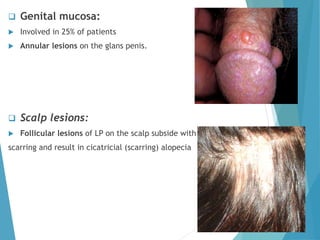
 Genital mucosa:
 Involved in 25% of patients
 Annular lesions on the glans penis.
 Scalp lesions:
 Follicular lesions of LP on the scalp subside with
scarring and result in cicatricial (scarring) alopecia
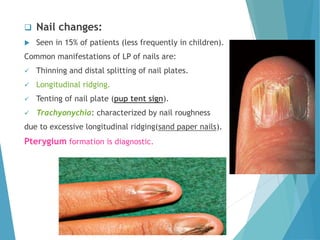
 Nail changes:
 Seen in 15% of patients (less frequently in children).
Common manifestations of LP of nails are:
 Thinning and distal splitting of nail plates.
 Longitudinal ridging.
 Tenting of nail plate (pup tent sign).
 Trachyonychia: characterized by nail roughness
due to excessive longitudinal ridging(sand paper nails).
Pterygium formation is diagnostic.
Diagnosis:
 Direct immunofluorescence study reveals globular
deposits of immunoglobulin M (IgM) and complement
mixed with apoptotic keratinocytes.
 No imaging studies are necessary.
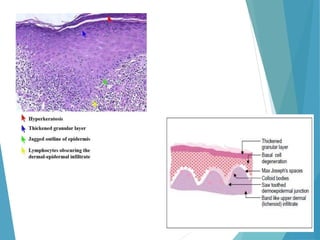
 Histopathologically
Histopathology:
Distinguishing histopathologic features of lichen planus include the
following:
 Hyperkeratotic epidermis with irregular acanthosis and focal thickening
in the granular layer
 Degenerative keratinocytes (colloid or Civatte bodies) in the lower
epidermis; in addition to apoptotic keratinocytes, colloid bodies are
composed of globular deposits of IgM (occasionally immunoglobulin G
[IgG] or immunoglobulin A [IgA]) and complement
 Linear or shaggy deposits of fibrin and fibrinogen in the basement
membrane zone
 In the upper dermis, a bandlike infiltrate of lymphocytic (primarily
helper T) and histiocytic cells with many Langerhans cells
Management:
 Lichen planus is a self-limited disease that usually resolves within 8-12
months.
 Mild cases can be treated with fluorinated topical steroids.
 More severe cases, especially those with scalp, nail, and mucous
membrane involvement, may necessitate more intensive therapy.
Pharmacological management:
 Cutaneous lichen planus:
1. Topical steroids (first-line treatment); systemic steroids;
2. Oral regimens like metronidazole, acitretin, methotrexate,
hydroxychloroquine, griseofulvin, and sulfasalazine and
3. other treatments with unproven efficacy (eg, mycophenolate mofetil)
 Lichen planus of the oral mucosa:
1. Topical steroids;
2. Topical calcineurin inhibitors;
3. Oral or topical retinoids.
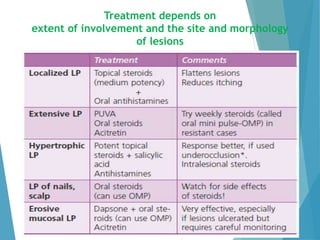
Treatment depends on
extent of involvement and the site and morphology
of lesions
Morbidity:
 In lichen planus, atropy and scarring are seen in hypertrophic lesions
and in lesions on the scalp.
 Cutaneous lichen planus does not carry a risk of skin cancer, but
ulcerative lesions in the mouth, particularly in men, do have a higher
incidence of malignant transformation.
 However, the malignant transformation rate of oral lichen planus is low.
 Vulvar lesion in women may also be associated with squamous cell
carcinoma.
Complication:
 Malignant transformation has been reported in ulcerative oral lichen planus (OLP).
 Cutaneous hypertrophic lichen planus resulting in squamous cell carcinoma (SCC).
 Pruritic and painful vulvar lichen planus has been a precursor to SCC.
 Infection, osteoporosis, adrenal insufficiency, bone marrow suppression, renal
damage, hyperlipidemia, and growth restriction in children may occur due to
medication adverse effects.
 Postinflammatory/residual hyperpigmentation may be a common marker after
lichen planus has subsided.
 Alopecia associated with lichen planus is often permanent.
 Hepatitis C virus infection may be present in 16% of lichen planus patients.
Additionally, a meta-analysis reported that hepatitis C virus seropositivity could
be 6 times higher in oral lichen planus
Lichen planus

Lichen planus

  • 1.
    LICHEN PLANUS SUBODH KR.SHAH 9TH BATCH INTERN
  • 2.
    Introduction:  Lichen planusis a disease of the skin and/or mucous membrane that resembles lichens.  It is thought to be the result of an autoimmune process with an unknown initial trigger.  Where the trigger is known a lesion as a lichenoid lesion.
  • 3.
    Epidemiology :  Riskfor the condition include:  exposure to medicines,dyes,and other chemicals(including gold,antibiotics,arsenic,diuretics,chloroquine)  Disease such as hepatitis C  Race: no racial predispositions.  Sex: lichen planus effects women more compared to men (3:2) ratio.  Age: more than two third of LP patients are aged 30-60 yrs however it can occur at any age.
  • 4.
    Lichen planus  Lichenplanus is an uncommon, chronic, pruritic disease characterized by violaceous flat-topped papules that are usually seen on the wrists and the legs  Characterized by : 9 P’s  Papulosquamous disorder  Pruritic  Polyangular with  Plain topped  Pigmented  Purple coloured  Papules and plaques  Pterygium ungium present in nails  Penile annular lesions
  • 5.
     It isa cell mediated immune response of unknown origin.  It may be found with other disease of altered immunity, such as ulcerative colitis, lichen sclerosis, myasthenia gravis,etc  Lichen planus has been found to be associated with hepatitis C virus infection ,chronic active hepatitis and primary biliary cirrhosis.  It is most likely an immunologically mediated reaction, through the pathophysiology is unclear.
  • 6.
    Sign and symptoms: The following may be noted in the patient history:  Lesions initially developing on flexural surfaces of the limbs, with a generalized eruption developing after a week or more and maximal spreading within 2-16 weeks .  Pruritus of varying severity, depending on the type of lesion and the extent of involvement  Oral lesions that may be asymptomatic, burning, or even painful  In cutaneous disease, lesions typically resolve within 6 months (>50%) to 18 months (85%); chronic disease is more likely oral lichen planus or with large, annular, hypertrophic lesions and mucous membrane involvement
  • 7.
     In additionto the widespread cutaneous eruption, lichen planus can involve the following structures: a. Mucous membranes b. Genitalia c. Nails d. Scalp
  • 8.
    Clinical presentation: Lichen planushas several variations, as follows:  Hypertrophic lichen planus  Atrophic lichen planus  Erosive/ulcerative lichen planus  Follicular lichen planus (lichen planopilaris)  Annular lichen planus  Linear lichen planus  Vesicular and bullous lichen planus  Actinic lichen planus  Lichen planus pigmentosus  Lichen planus pemphigoides
  • 10.
    CHARACTERSITICS:  Primary lesion:Flat-topped, violaceous papules and papulosquamous lesions appear. On close examination of a papule, preferably after the lesion has been wet with an alcohol swipe, intersecting small white lines or papules (Wickham’s striae) can be seen. These confirm the diagnosis.  Uncommonly, the lesions may assume a ring-shaped configuration (especially on the penis) or may be hypertrophic (especially pretibial), atrophic, or bullous.  On the mucous membranes, the lesions appear as a whitish, lacy network
  • 11.
     Secondary lesion:Excoriations and, on the legs, thick, scaly, lichenified patches have been noted. Lesions are often rubbed rather than scratched because scratching is painful.  Distribution: Most commonly, the lesions appear on the flexural aspects of the wrists and the ankles, the penis, and the oral mucous membranes, but they can be anywhere on the body or become generalized. Lesion may appear at the sites of trauma (koebner’s phenomenon)
  • 14.
    Clinical Forms:  Oralmucosa:  Involved in 50% of patients with cutaneous LP and may be sole manifestation of LP in 10% of patients.  Reticular the most common presentation of oral lichen planus,characterized by the net like appearance of lacy white lines,oral variant of Wickham's straise. This is usually asymptomatic.  Erosive/ulcerative characterized by oral ulcer presenting with Persistent irregular areas of redness,ulceration and erosion covered with a yellow slough,the gums are involved described as desquamative gingivitis.
  • 15.
     Genital mucosa: Involved in 25% of patients  Annular lesions on the glans penis.  Scalp lesions:  Follicular lesions of LP on the scalp subside with scarring and result in cicatricial (scarring) alopecia
  • 16.
     Nail changes: Seen in 15% of patients (less frequently in children). Common manifestations of LP of nails are:  Thinning and distal splitting of nail plates.  Longitudinal ridging.  Tenting of nail plate (pup tent sign).  Trachyonychia: characterized by nail roughness due to excessive longitudinal ridging(sand paper nails). Pterygium formation is diagnostic.
  • 17.
    Diagnosis:  Direct immunofluorescencestudy reveals globular deposits of immunoglobulin M (IgM) and complement mixed with apoptotic keratinocytes.  No imaging studies are necessary.  Histopathologically
  • 18.
    Histopathology: Distinguishing histopathologic featuresof lichen planus include the following:  Hyperkeratotic epidermis with irregular acanthosis and focal thickening in the granular layer  Degenerative keratinocytes (colloid or Civatte bodies) in the lower epidermis; in addition to apoptotic keratinocytes, colloid bodies are composed of globular deposits of IgM (occasionally immunoglobulin G [IgG] or immunoglobulin A [IgA]) and complement  Linear or shaggy deposits of fibrin and fibrinogen in the basement membrane zone  In the upper dermis, a bandlike infiltrate of lymphocytic (primarily helper T) and histiocytic cells with many Langerhans cells
  • 20.
    Management:  Lichen planusis a self-limited disease that usually resolves within 8-12 months.  Mild cases can be treated with fluorinated topical steroids.  More severe cases, especially those with scalp, nail, and mucous membrane involvement, may necessitate more intensive therapy.
  • 21.
    Pharmacological management:  Cutaneouslichen planus: 1. Topical steroids (first-line treatment); systemic steroids; 2. Oral regimens like metronidazole, acitretin, methotrexate, hydroxychloroquine, griseofulvin, and sulfasalazine and 3. other treatments with unproven efficacy (eg, mycophenolate mofetil)  Lichen planus of the oral mucosa: 1. Topical steroids; 2. Topical calcineurin inhibitors; 3. Oral or topical retinoids.
  • 22.
    Treatment depends on extentof involvement and the site and morphology of lesions
  • 23.
    Morbidity:  In lichenplanus, atropy and scarring are seen in hypertrophic lesions and in lesions on the scalp.  Cutaneous lichen planus does not carry a risk of skin cancer, but ulcerative lesions in the mouth, particularly in men, do have a higher incidence of malignant transformation.  However, the malignant transformation rate of oral lichen planus is low.  Vulvar lesion in women may also be associated with squamous cell carcinoma.
  • 24.
    Complication:  Malignant transformationhas been reported in ulcerative oral lichen planus (OLP).  Cutaneous hypertrophic lichen planus resulting in squamous cell carcinoma (SCC).  Pruritic and painful vulvar lichen planus has been a precursor to SCC.  Infection, osteoporosis, adrenal insufficiency, bone marrow suppression, renal damage, hyperlipidemia, and growth restriction in children may occur due to medication adverse effects.  Postinflammatory/residual hyperpigmentation may be a common marker after lichen planus has subsided.  Alopecia associated with lichen planus is often permanent.  Hepatitis C virus infection may be present in 16% of lichen planus patients. Additionally, a meta-analysis reported that hepatitis C virus seropositivity could be 6 times higher in oral lichen planus