Peptic Ulcer Disease Carol Lynn Pence  RN, MSN
Anatomy and Physiology of GI Tract
Peptic Ulcers Defined Ulcerated lesion in the mucosa of the stomach or duodenum Types Gastric Duodenal
Peptic Ulcer Disease
Stomach Defense Systems Mucous layer Coats and lines the stomach First line of defense Bicarbonate Neutralizes acid Prostaglandins Hormone-like substances that keep blood vessels dilated for good blood flow Thought to stimulate mucus and bicarbonate production
Risk Factors Lifestyle Smoking Acidic drinks Medications  H. Pylori infection 90% have this bacterium Passed from person to person (fecal-oral route or oral-oral route) Age Duodenal 30-50 Gastric over 60 Gender Duodenal: are increasing in older women Genetic factors More likely if family member has Hx Other factors: stress can worsen but not the cause
Gastric Ulcers Pain occurs 1-2 hours after meals Pain usually does not wake patient Accentuated by ingestion of food Risk for malignancy Deep and penetrating and usually occur on the lesser curvature of the stomach
Gastric and Duodenal Ulcers
Duodenal Ulcers Pain occurs 2-4 hours after meals Pain wakes up patient Pain relieved by food Very little risk for malignancy
General Peptic Ulcer Symptoms Epigastric tenderness Gastric: epigastrium; left of midline Duodenal: mid to right of epigastrium Sharp, burning, aching, gnawing pain Dyspepsia (indigestion) Nausea/vomiting Belching
Complications of Peptic Ulcers Hemorrhage Blood vessels damaged as ulcer erodes into the muscles of stomach or duodenal wall Coffee ground vomitus or occult blood in tarry stools Perforation An ulcer can erode through the entire wall Bacteria and partially digested fool spill into peritoneum=peritonitis Narrowing and obstruction (pyloric) Swelling and scarring can cause obstruction of food leaving stomach=repeated vomiting
Diagnostic Tests Esophagogastrodeuodenoscopy (EGD) Endoscopic procedure Visualizes ulcer crater Ability to take tissue biopsy to R/O cancer and diagnose H. pylori Upper gastrointestinal series (UGI) Barium swallow X-ray that visualizes structures of the upper GI tract Urea Breath Testing Used to detect H.pylori Client drinks a carbon-enriched urea solution Excreted carbon dioxide is then measured
Etiology and Genetic Risk PUD primarily associated with NSAID use and infection with H. Pylori Certain drugs may contribute to cause: Theo-Dur Caffeine – stimulates hydrochloric acid production Corticosterioids – associated with an increased incidence of PUD Genetic factors
Drug Therapy/Primary Goals Provide pain relief Antacids and mucosa protectors Eradicate H. pylori infection Two antibiotics and one acid suppressor Heal ulcer Eradicate infection Protect until ulcer heals Prevent recurrence Decrease high acid stimulating foods in susceptible people Avoid use of potential ulcer causing drugs Stop smoking
Hyposecretory Drugs Proton Pump Inhibitors Suppress acid production Prilosec, Prevacid H2-Receptor Antagonists Block histamine-stimulated gastric secretions Zantac, Pepcid, Axid Antacids Neutralizes acid and prevents formation of pepsin (Maalox, Mylanta) Give 2 hours after meals and at bedtime Prostaglandin Analogs Reduce gastric acid and enhances mucosal resistance to injury Cytotec Mucosal barrier fortifiers Forms a protective coat Carafate/Sucralfate cytoprotective
Surgery Greatly decreased in the last 20-30 years secondary to the discovery of H. pylori Required if ulcer in one of these states Perforated and overflowed into the abdomen Scarred or swelled so that there is obstruction Acute bleeding Non-responsive to medications
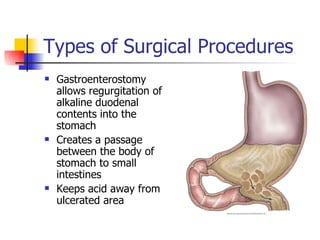
Types of Surgical Procedures Gastroenterostomy allows regurgitation of alkaline duodenal contents into the stomach Creates a passage between the body of stomach to small intestines Keeps acid away from ulcerated area
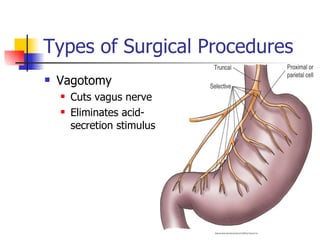
Types of Surgical Procedures Vagotomy Cuts vagus nerve Eliminates acid-secretion stimulus
Surgical Procedure/Pyloroplasty Pyloroplasty Widens the pylorus to guarantee stomach emptying even without vagus nerve stimulation
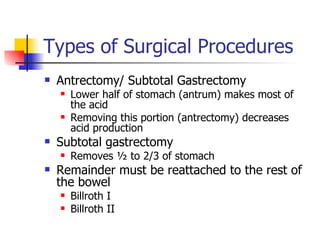
Types of Surgical Procedures Antrectomy/ Subtotal Gastrectomy Lower half of stomach (antrum) makes most of the acid Removing this portion (antrectomy) decreases acid production Subtotal gastrectomy Removes ½ to 2/3 of stomach Remainder must be reattached to the rest of the bowel Billroth I Billroth II
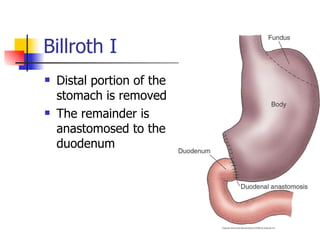
Billroth I Distal portion of the stomach is removed The remainder is anastomosed to the duodenum
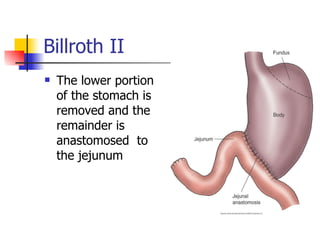
Billroth II The lower portion of the stomach is removed and the remainder is anastomosed  to the jejunum
Postoperative Care NG tube – care and management Monitor for post-operative complications
Post-op Complications Bleeding Occurs at the anastomosed site First 24 hours and post-op days 4-7 Duodenal stump leak Billroth II Severe abdominal pain Bile stained drainage on dressing Gastric retention WILL NEED TO PUT NG TUBE BACK IN Dumping Syndrome (page 1303) Prevalent with sub total gastrectomies Early-30 minutes after meals Vertigo, tachycardia, syncope, sweating, pallor, palpatations Late – 90 min-3 hours after meals Anemia Rapid gastric empyting decreases absorption of iron Malabsorption of fat Decreased acid secretions, decreased pancreatic secretions, increased upper GI mobility
Dumping Syndrome Rapid emptying of food and fluids from the stomach into the jejunum Symptoms Weakness Faintness Palpatations Fullness Discomfort Nausea diarrhea
Minimize Dumping Syndrome Decrease CHO intake Eat slowly Avoid fluids during meals Increase fat Eat small, frequent meals

Peptic ulcer disease

  • 1.
    Peptic Ulcer DiseaseCarol Lynn Pence RN, MSN
  • 2.
  • 3.
    Peptic Ulcers DefinedUlcerated lesion in the mucosa of the stomach or duodenum Types Gastric Duodenal
  • 4.
  • 5.
    Stomach Defense SystemsMucous layer Coats and lines the stomach First line of defense Bicarbonate Neutralizes acid Prostaglandins Hormone-like substances that keep blood vessels dilated for good blood flow Thought to stimulate mucus and bicarbonate production
  • 6.
    Risk Factors LifestyleSmoking Acidic drinks Medications H. Pylori infection 90% have this bacterium Passed from person to person (fecal-oral route or oral-oral route) Age Duodenal 30-50 Gastric over 60 Gender Duodenal: are increasing in older women Genetic factors More likely if family member has Hx Other factors: stress can worsen but not the cause
  • 7.
    Gastric Ulcers Painoccurs 1-2 hours after meals Pain usually does not wake patient Accentuated by ingestion of food Risk for malignancy Deep and penetrating and usually occur on the lesser curvature of the stomach
  • 8.
  • 9.
    Duodenal Ulcers Painoccurs 2-4 hours after meals Pain wakes up patient Pain relieved by food Very little risk for malignancy
  • 10.
    General Peptic UlcerSymptoms Epigastric tenderness Gastric: epigastrium; left of midline Duodenal: mid to right of epigastrium Sharp, burning, aching, gnawing pain Dyspepsia (indigestion) Nausea/vomiting Belching
  • 11.
    Complications of PepticUlcers Hemorrhage Blood vessels damaged as ulcer erodes into the muscles of stomach or duodenal wall Coffee ground vomitus or occult blood in tarry stools Perforation An ulcer can erode through the entire wall Bacteria and partially digested fool spill into peritoneum=peritonitis Narrowing and obstruction (pyloric) Swelling and scarring can cause obstruction of food leaving stomach=repeated vomiting
  • 12.
    Diagnostic Tests Esophagogastrodeuodenoscopy(EGD) Endoscopic procedure Visualizes ulcer crater Ability to take tissue biopsy to R/O cancer and diagnose H. pylori Upper gastrointestinal series (UGI) Barium swallow X-ray that visualizes structures of the upper GI tract Urea Breath Testing Used to detect H.pylori Client drinks a carbon-enriched urea solution Excreted carbon dioxide is then measured
  • 13.
    Etiology and GeneticRisk PUD primarily associated with NSAID use and infection with H. Pylori Certain drugs may contribute to cause: Theo-Dur Caffeine – stimulates hydrochloric acid production Corticosterioids – associated with an increased incidence of PUD Genetic factors
  • 14.
    Drug Therapy/Primary GoalsProvide pain relief Antacids and mucosa protectors Eradicate H. pylori infection Two antibiotics and one acid suppressor Heal ulcer Eradicate infection Protect until ulcer heals Prevent recurrence Decrease high acid stimulating foods in susceptible people Avoid use of potential ulcer causing drugs Stop smoking
  • 15.
    Hyposecretory Drugs ProtonPump Inhibitors Suppress acid production Prilosec, Prevacid H2-Receptor Antagonists Block histamine-stimulated gastric secretions Zantac, Pepcid, Axid Antacids Neutralizes acid and prevents formation of pepsin (Maalox, Mylanta) Give 2 hours after meals and at bedtime Prostaglandin Analogs Reduce gastric acid and enhances mucosal resistance to injury Cytotec Mucosal barrier fortifiers Forms a protective coat Carafate/Sucralfate cytoprotective
  • 16.
    Surgery Greatly decreasedin the last 20-30 years secondary to the discovery of H. pylori Required if ulcer in one of these states Perforated and overflowed into the abdomen Scarred or swelled so that there is obstruction Acute bleeding Non-responsive to medications
  • 17.
    Types of SurgicalProcedures Gastroenterostomy allows regurgitation of alkaline duodenal contents into the stomach Creates a passage between the body of stomach to small intestines Keeps acid away from ulcerated area
  • 18.
    Types of SurgicalProcedures Vagotomy Cuts vagus nerve Eliminates acid-secretion stimulus
  • 19.
    Surgical Procedure/Pyloroplasty PyloroplastyWidens the pylorus to guarantee stomach emptying even without vagus nerve stimulation
  • 20.
    Types of SurgicalProcedures Antrectomy/ Subtotal Gastrectomy Lower half of stomach (antrum) makes most of the acid Removing this portion (antrectomy) decreases acid production Subtotal gastrectomy Removes ½ to 2/3 of stomach Remainder must be reattached to the rest of the bowel Billroth I Billroth II
  • 21.
    Billroth I Distalportion of the stomach is removed The remainder is anastomosed to the duodenum
  • 22.
    Billroth II Thelower portion of the stomach is removed and the remainder is anastomosed to the jejunum
  • 23.
    Postoperative Care NGtube – care and management Monitor for post-operative complications
  • 24.
    Post-op Complications BleedingOccurs at the anastomosed site First 24 hours and post-op days 4-7 Duodenal stump leak Billroth II Severe abdominal pain Bile stained drainage on dressing Gastric retention WILL NEED TO PUT NG TUBE BACK IN Dumping Syndrome (page 1303) Prevalent with sub total gastrectomies Early-30 minutes after meals Vertigo, tachycardia, syncope, sweating, pallor, palpatations Late – 90 min-3 hours after meals Anemia Rapid gastric empyting decreases absorption of iron Malabsorption of fat Decreased acid secretions, decreased pancreatic secretions, increased upper GI mobility
  • 25.
    Dumping Syndrome Rapidemptying of food and fluids from the stomach into the jejunum Symptoms Weakness Faintness Palpatations Fullness Discomfort Nausea diarrhea
  • 26.
    Minimize Dumping SyndromeDecrease CHO intake Eat slowly Avoid fluids during meals Increase fat Eat small, frequent meals

Editor's Notes

  • #4 Peptic ulcer is a mucosal lesion of the stomach or duodenum. The term peptic ulcer is used to describe both gastric and duodenal ulcers. PUD results when gastric mucosal defenses become impaired and no longer protect the epithelium from the effects of acid and pepsin.
  • #8 When a break in the mucosal barrier occurs, hydrochloric acid injures the epithelium. Gastric ulcers may then develop. With a gastric ulcer the pain occurs 1-2 hours after meals and does not usually wake the patient from sleep. Food worsens the pain. There is an increased risk for malignancy and these ulcers are deep and penetrating and usually occur on the lesser curvature of the stomach.
  • #10 Most duodenal ulcers occur in the first portion of the duodenum. With this type of ulcer the pain occurs 2-4 hours after meals, pain wakes up the patient, the pain is relieved with the administration of food and there is very little risk for malignancy.
  • #12 Hemorrhage : With massive bleeding the patient vomits bright red or coffee ground blood. Minimal bleeding from ulcers is manifested by occult blood in a tarry stool (melena). Perforation : Gastric and duodenal ulcers can perforate or bleed. Perforation occurs when the ulcer becomes so deep that the entire thickness of the stomach or duodenum is worn away. The gastroduodenal contents may then empty into the peritoneal cavity. Symptoms of perforation are sudden, sharp pain, the abdomen is tender, rigid, and boardlike. The patient assumes the fetal position, knees to chest. Client can become acutely ill within hours. Peforation is considered a surgical emergency and can be life threatening. If this occurs the physician needs to be notified immediatley.
  • #13 A barium examination of the GI tract can be used to establish a duodenal ulcer. If perforation is suspected the health care provider usually requests an upright abdomen series to demonstrate free air in the peritoneum. Do not use barium where free air is a possibility.
  • #14 I added this slide to the presentation so add this to your notes.
  • #16 Hyposecretory drugs produce a reduction in gastric acid secretions. Your proton pump inhibitors have emerged as the drug class of choice for treating clients with acid-related disorders. These drugs suppress acid production. They include Prilosec and Previcid. Your H2 receptor antagonists block histamine stimulated gastric secretions. Antacids neutralizes acid and prevents formation of pepsin. The prostoglandin analogs reduce gastric acid and enhance mucosal resistance to injury. The drug Carafate acts as a mucosal barrier by forming a protective coating. These drugs are all listed in Chart 59-3 pages 1286-1287.
  • #18 A simple gastroenterostomy permits neutralization of gastric acid by regurgitation of alkaline duodenal contents into the stomach. The surgeon creates a passage between the body of the stomach and the small bowel. Drainage of the gastric contents diverts acid from the ulcerated area and facilitates healing.
  • #19 A vagotomy eliminates the acid-secreting stimulus to gastric cells and decreases the responsiveness of parietal cells.
  • #20 In this procedure the surgeon enlarges the pyloric stricture by incising the pylorus longitudinally and sutures the incision transversely.
  • #24 The postoperative plan of care is similar for all of the gastric operative procedures. These patients will have NG tubes in place and attached to low wall suction. Ensure the patency of these tubes. Irrigation or repositioning of the NG tube is not done after gastric surgery unless specifically ordered by the doctor.
  • #25 Observe for any bleeding, monitor vital signs and post surgery hemoglobin and hematocrit. If gastric retention occurs once ng tube is removed, it will have to be put back in.
  • #26 Dumping Syndrome : is a term that refers to a constellation of vasomotor symptoms after eating, especially following a Billiroth II procedure. This syndrome is believed to be caused because of the rapid emptying of the stomach contents into the small intestine, which shifts fluid into the gut, causing abdominal distention. Early manifestations occur within 30 minutes of eating. Symptoms include vertigo, tachycardia, syncope, pallor, sweating and palpatations. Late dumping syndrome occurs 90 minutes to 3 hours after eating, and is caused by a release of an excessive amount of insulin. The insulin release follows a rapid rise in the blood glucose level that results from the rapid entry of high carbohydrate food into the jejunum. Symptoms include dizziness, light-headedness, palpatations, diaphoresis, and confusion. Dumping syndrome is managed by dietary measures that include decreasing the amount of food taken at one time and eliminating liquids with meals.