Sebaceous Cyst
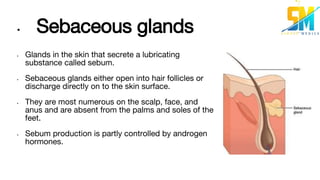
• Sebaceous glands
• Glands in the skin that secrete a lubricating
substance called sebum.
• Sebaceous glands either open into hair follicles or
discharge directly on to the skin surface.
• They are most numerous on the scalp, face, and
anus and are absent from the palms and soles of the
feet.
• Sebum production is partly controlled by androgen
hormones.
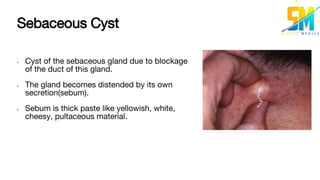
Sebaceous Cyst
• Cyst of the sebaceous gland due to blockage
of the duct of this gland.
• The gland becomes distended by its own
secretion(sebum).
• Sebum is thick paste like yellowish, white,
cheesy, pultaceous material.
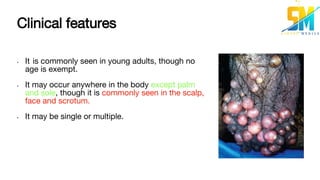
Clinical features
• It is commonly seen in young adults, though no
age is exempt.
• It may occur anywhere in the body except palm
and sole, though it is commonly seen in the scalp,
face and scrotum.
• It may be single or multiple.
Clinical presentation
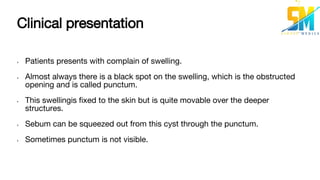
• Patients presents with complain of swelling.
• Almost always there is a black spot on the swelling, which is the obstructed
opening and is called punctum.
• This swellingis fixed to the skin but is quite movable over the deeper
structures.
• Sebum can be squeezed out from this cyst through the punctum.
• Sometimes punctum is not visible.
Examination
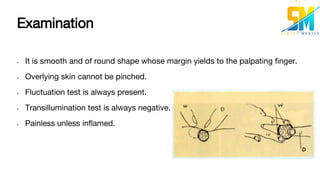
• It is smooth and of round shape whose margin yields to the palpating finger.
• Overlying skin cannot be pinched.
• Fluctuation test is always present.
• Transillumination test is always negative.
• Painless unless inflamed.
Management
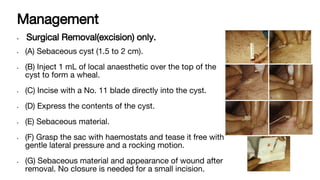
• (A) Sebaceous cyst (1.5 to 2 cm).
• (B) Inject 1 mL of local anaesthetic over the top of the
cyst to form a wheal.
• (C) Incise with a No. 11 blade directly into the cyst.
• (D) Express the contents of the cyst.
• (E) Sebaceous material.
• (F) Grasp the sac with haemostats and tease it free with
gentle lateral pressure and a rocking motion.
• (G) Sebaceous material and appearance of wound after
removal. No closure is needed for a small incision.
• Surgical Removal(excision) only.
Complications
• Infection when the cyst becomes enlarged and painful.
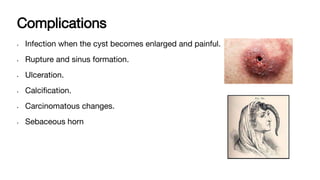
• Rupture and sinus formation.
• Ulceration.
• Calcification.
• Carcinomatous changes.
• Sebaceous horn
sebaceous cyst

sebaceous cyst

  • 1.
  • 2.
    • Sebaceous glands •Glands in the skin that secrete a lubricating substance called sebum. • Sebaceous glands either open into hair follicles or discharge directly on to the skin surface. • They are most numerous on the scalp, face, and anus and are absent from the palms and soles of the feet. • Sebum production is partly controlled by androgen hormones.
  • 3.
    Sebaceous Cyst • Cystof the sebaceous gland due to blockage of the duct of this gland. • The gland becomes distended by its own secretion(sebum). • Sebum is thick paste like yellowish, white, cheesy, pultaceous material.
  • 4.
    Clinical features • Itis commonly seen in young adults, though no age is exempt. • It may occur anywhere in the body except palm and sole, though it is commonly seen in the scalp, face and scrotum. • It may be single or multiple.
  • 5.
    Clinical presentation • Patientspresents with complain of swelling. • Almost always there is a black spot on the swelling, which is the obstructed opening and is called punctum. • This swellingis fixed to the skin but is quite movable over the deeper structures. • Sebum can be squeezed out from this cyst through the punctum. • Sometimes punctum is not visible.
  • 6.
    Examination • It issmooth and of round shape whose margin yields to the palpating finger. • Overlying skin cannot be pinched. • Fluctuation test is always present. • Transillumination test is always negative. • Painless unless inflamed.
  • 7.
    Management • (A) Sebaceouscyst (1.5 to 2 cm). • (B) Inject 1 mL of local anaesthetic over the top of the cyst to form a wheal. • (C) Incise with a No. 11 blade directly into the cyst. • (D) Express the contents of the cyst. • (E) Sebaceous material. • (F) Grasp the sac with haemostats and tease it free with gentle lateral pressure and a rocking motion. • (G) Sebaceous material and appearance of wound after removal. No closure is needed for a small incision. • Surgical Removal(excision) only.
  • 8.
    Complications • Infection whenthe cyst becomes enlarged and painful. • Rupture and sinus formation. • Ulceration. • Calcification. • Carcinomatous changes. • Sebaceous horn