9 Aqueous Solutions
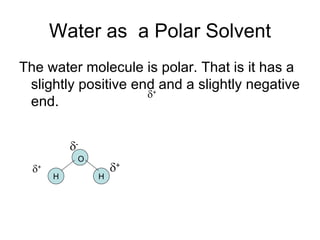
Water as  a Polar Solvent The water molecule is polar. That is it has a slightly positive end and a slightly negative end.  +  + H H  -  + O
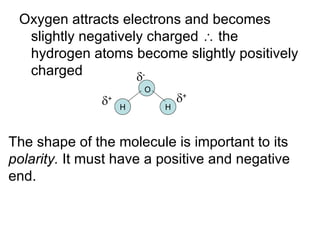
Oxygen attracts electrons and becomes slightly negatively charged    the hydrogen atoms become slightly positively charged The shape of the molecule is important to its  polarity.  It must have a positive and negative end. H H  -  +  + O
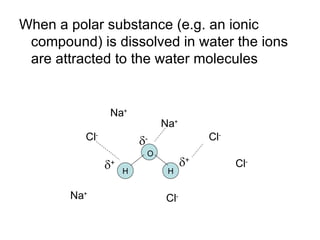
When a polar substance (e.g. an ionic compound) is dissolved in water the ions are attracted to the water molecules Na + Cl - Na + Na + Cl - Cl - Cl - H H  -  +  + O
Water molecules separate, surround and disperse the ions into the liquid.  Some ionic compounds are only slightly (sparingly) soluble in water. e.g. silver chloride. This is because the electrostatic attractions within the compound are greater than the attraction between the ions and the water molecules All ionic compounds will dissolve to a certain extent even though we call them insoluble Solubility of NaCl in water at 20 o C = 365 g/L Solubility of AgCl in water at 20 o C = 0.009 g/L
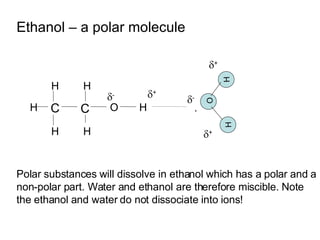
Ethanol – a polar molecule C C H H H H H H O  + Polar substances will dissolve in ethanol which has a polar and a non-polar part. Water and ethanol are therefore miscible. Note the ethanol and water do not dissociate into ions!  -  +  +  - H H - O
Acids Acids are an important group of covalent compounds that dissolve in water. e.g. HCl  H 2 SO 4  HNO 3 These all interact so strongly with water that the molecules dissociate into ions  HCl     H +  +  Cl - In fact we do not get a  lone H +.  The H +.  Is attracted to the water molecule to give H 3 O +
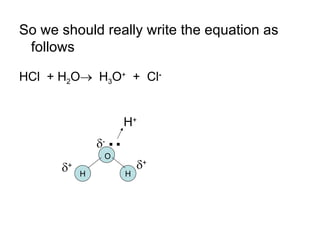
So we should really write the equation as follows HCl  + H 2 O    H 3 O +   +  Cl - H + .. H H  -  +  + O
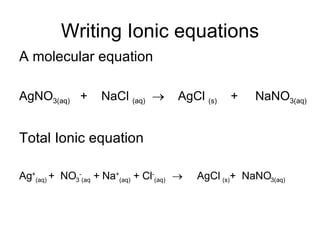
Writing Ionic equations A molecular equation AgNO 3(aq)   +  NaCl  (aq)      AgCl  (s)   +  NaNO 3(aq)‏ Total Ionic equation Ag + (aq)  +  NO 3 - (aq  + Na + (aq)  + Cl - (aq)     AgCl  (s) +  NaNO 3(aq)‏
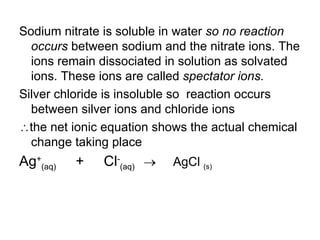
Sodium nitrate is soluble in water  so no reaction occurs  between sodium and the nitrate ions. The ions remain dissociated in solution as solvated ions. These ions are called  spectator ions. Silver chloride is insoluble so  reaction occurs between silver ions and chloride ions  the net ionic equation shows the actual chemical change taking place Ag + (aq)   +  Cl - (aq)     AgCl  (s)
Solubility See page 139 for solubility of compounds in water In order to predict whether a precipitate occurs we need to know the solubility of that compound in water
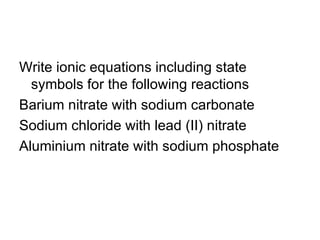
Write ionic equations including state symbols for the following reactions Barium nitrate with sodium carbonate Sodium chloride with lead (II) nitrate Aluminium nitrate with sodium phosphate
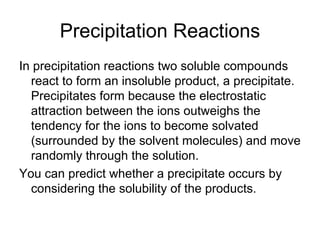
Precipitation Reactions In precipitation reactions two soluble compounds react to form an insoluble product, a precipitate. Precipitates form because the electrostatic attraction between the ions outweighs the tendency for the ions to become solvated (surrounded by the solvent molecules) and move randomly through the solution. You can predict whether a precipitate occurs by considering the solubility of the products.
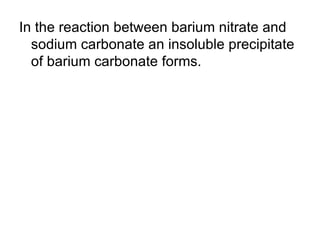
In the reaction between barium nitrate and sodium carbonate an insoluble precipitate of barium carbonate forms.
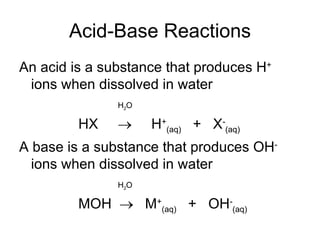
Acid-Base Reactions An acid is a substance that produces H +  ions when dissolved in water H 2 O HX     H + (aq)   +  X - (aq)‏ A base is a substance that produces OH -  ions when dissolved in water H 2 O MOH     M + (aq)   +  OH - (aq)‏
Strength of an acid or base Strong acids or bases dissociate completely into ions when they dissolve in water Weak acids or bases dissociate so little that most of their molecules remain intact Strong acids and bases are therefore electrolytes (conduct a current)‏ Weak acids and bases are very weak electrolytes
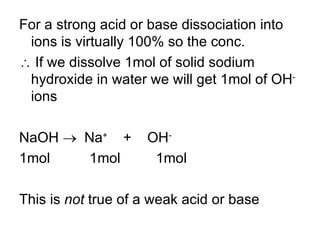
For a strong acid or base dissociation into ions is virtually 100% so the conc.     If we dissolve 1mol of solid sodium hydroxide in water we will get 1mol of OH -  ions  NaOH     Na +   +  OH -   1mol  1mol  1mol This is  not  true of a weak   acid or base
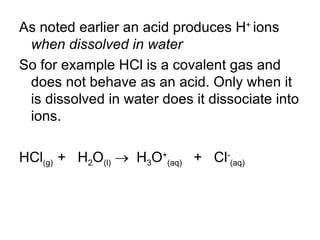
As noted earlier an acid produces H +  ions   when dissolved in water So for example HCl is a covalent gas and does not behave as an acid. Only when it is dissolved in water does it dissociate into ions. HCl (g)  +  H 2 O (l)      H 3 O + (aq)   +  Cl - (aq)‏
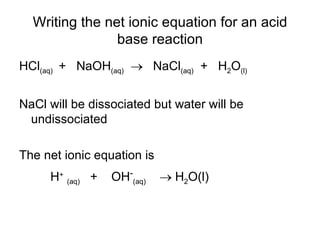
Writing the net ionic equation for an acid base reaction HCl (aq)  +  NaOH (aq)      NaCl (aq)   +  H 2 O (l)‏ NaCl will be dissociated but water will be undissociated The net ionic equation is  H +   (aq)   +  OH - (aq)     H 2 O(l)‏
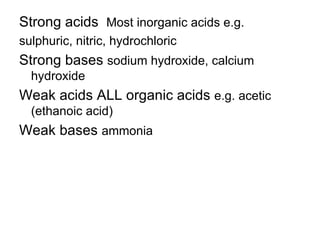
Strong acids  Most inorganic acids e.g.  sulphuric, nitric, hydrochloric Strong bases  sodium hydroxide, calcium hydroxide Weak acids ALL organic acids  e.g. acetic (ethanoic acid)  Weak bases  ammonia
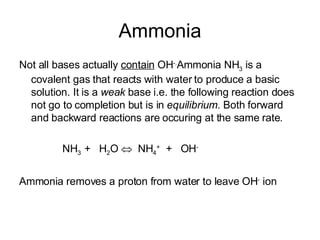
Ammonia Not all bases actually  contain  OH -. Ammonia NH 3  is a covalent gas that reacts with water to produce a basic solution. It is a  weak  base   i.e. the following reaction does not go to completion but is in  equilibrium.  Both forward and backward reactions are occuring at the same rate . NH 3  +  H 2 O     NH 4 +   +  OH - Ammonia removes a proton from water to leave OH -  ion
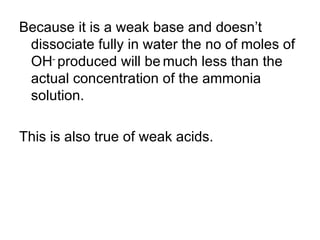
Because it is a weak base and doesn’t dissociate fully in water the no of moles of OH -  produced will be   much less than the actual concentration of the ammonia solution. This is also true of weak acids.
The pH scale pH is the negative log of H +  concentration pH = - log [H + ]  for a 0.1molar solution of HCl (a strong acid)‏ pH = -log 0.1 = 1
What is the pH of a 0.01 mol solution of HCl? -log 0.01 = 2 What is the pH of a 0.1 molar solution of sulphuric acid? H 2 SO 4      2H +  +  SO 4 2-  [H + ] = 2 x 0.1 = 0.2 mol/l And pH = -log 0.2 = 0.7
What is the pH of the following? 0.005 mol/l HNO 3 0.05 mol/l H 3 PO 4 [H + ] = 0.005 mol/L  pH = -log 0.005  pH = 2.3 b) [H + ] = 3 x 0.05 mol/L  pH = -log 0.15  pH = 0.82
Finding pH from [H + ] What is the [H + ] of a solution of HCl with a pH of 3? Antilog -3 = 0.001  [H] = 0.001 What is the [HCl]? From the equation HCl     H +  + Cl -  we can see that the ratio of [H + ] to [HCl] = 1:1 [HCl] = 0.001 mol/L
What is the [H + ] of a solution of H 2 SO 4  with a pH of 2.4? Antilog -2.4 = 0.004 mol/L  [H+] = 0.004 mol/L H 2 SO 4      2H+  +  SO 4 2-    [H 2 SO 4 ] = 0.004/2  = 0.002 mol/L What is the [H 2 SO 4 ]?
Finding pH from [OH - ] pOH = -log[OH - ] and pH +pOH = 14 What is the pH of a 0.1 mol/L solution of sodium hydroxide? pOH = -log 0.1 = 1    pH = 14 – 1 = 13
Find pH of the following solutions 0.001 mol/l potassium hydroxide 0.05 mol/L calcium hydroxide a) pOH = -log 0.001 = 3    pH = 14 -3 = 11 b) [OH - ] = 2 x 0.05    pOH = -log 0.1 = 1  pH = 14 -1 = 13
Calculate the pH of of a solution made by dissolving 1.00g of calcium hydroxide in 500ml of water. RMM Ca(OH) 2  = 40 + (2 x 16) + (2 x 1) = 74 1.00g =  1.00  = 0.0135mol 74  Moles [OH - ] = 2 x 0.0135 = 0.027  Moles per litre = 2 x 0.027 = 0.054 pOH = -log 0.054 = 1.27  pH = 14 – 1.27 = 12.3

9 Aqueous Solutions

  • 1.
  • 2.
    Water as a Polar Solvent The water molecule is polar. That is it has a slightly positive end and a slightly negative end.  +  + H H  -  + O
  • 3.
    Oxygen attracts electronsand becomes slightly negatively charged  the hydrogen atoms become slightly positively charged The shape of the molecule is important to its polarity. It must have a positive and negative end. H H  -  +  + O
  • 4.
    When a polarsubstance (e.g. an ionic compound) is dissolved in water the ions are attracted to the water molecules Na + Cl - Na + Na + Cl - Cl - Cl - H H  -  +  + O
  • 5.
    Water molecules separate,surround and disperse the ions into the liquid. Some ionic compounds are only slightly (sparingly) soluble in water. e.g. silver chloride. This is because the electrostatic attractions within the compound are greater than the attraction between the ions and the water molecules All ionic compounds will dissolve to a certain extent even though we call them insoluble Solubility of NaCl in water at 20 o C = 365 g/L Solubility of AgCl in water at 20 o C = 0.009 g/L
  • 6.
    Ethanol – apolar molecule C C H H H H H H O  + Polar substances will dissolve in ethanol which has a polar and a non-polar part. Water and ethanol are therefore miscible. Note the ethanol and water do not dissociate into ions!  -  +  +  - H H - O
  • 7.
    Acids Acids arean important group of covalent compounds that dissolve in water. e.g. HCl H 2 SO 4 HNO 3 These all interact so strongly with water that the molecules dissociate into ions HCl  H + + Cl - In fact we do not get a lone H +. The H +. Is attracted to the water molecule to give H 3 O +
  • 8.
    So we shouldreally write the equation as follows HCl + H 2 O  H 3 O + + Cl - H + .. H H  -  +  + O
  • 9.
    Writing Ionic equationsA molecular equation AgNO 3(aq) + NaCl (aq)  AgCl (s) + NaNO 3(aq)‏ Total Ionic equation Ag + (aq) + NO 3 - (aq + Na + (aq) + Cl - (aq)  AgCl (s) + NaNO 3(aq)‏
  • 10.
    Sodium nitrate issoluble in water so no reaction occurs between sodium and the nitrate ions. The ions remain dissociated in solution as solvated ions. These ions are called spectator ions. Silver chloride is insoluble so reaction occurs between silver ions and chloride ions  the net ionic equation shows the actual chemical change taking place Ag + (aq) + Cl - (aq)  AgCl (s)
  • 11.
    Solubility See page139 for solubility of compounds in water In order to predict whether a precipitate occurs we need to know the solubility of that compound in water
  • 12.
    Write ionic equationsincluding state symbols for the following reactions Barium nitrate with sodium carbonate Sodium chloride with lead (II) nitrate Aluminium nitrate with sodium phosphate
  • 13.
    Precipitation Reactions Inprecipitation reactions two soluble compounds react to form an insoluble product, a precipitate. Precipitates form because the electrostatic attraction between the ions outweighs the tendency for the ions to become solvated (surrounded by the solvent molecules) and move randomly through the solution. You can predict whether a precipitate occurs by considering the solubility of the products.
  • 14.
    In the reactionbetween barium nitrate and sodium carbonate an insoluble precipitate of barium carbonate forms.
  • 15.
    Acid-Base Reactions Anacid is a substance that produces H + ions when dissolved in water H 2 O HX  H + (aq) + X - (aq)‏ A base is a substance that produces OH - ions when dissolved in water H 2 O MOH  M + (aq) + OH - (aq)‏
  • 16.
    Strength of anacid or base Strong acids or bases dissociate completely into ions when they dissolve in water Weak acids or bases dissociate so little that most of their molecules remain intact Strong acids and bases are therefore electrolytes (conduct a current)‏ Weak acids and bases are very weak electrolytes
  • 17.
    For a strongacid or base dissociation into ions is virtually 100% so the conc.  If we dissolve 1mol of solid sodium hydroxide in water we will get 1mol of OH - ions NaOH  Na + + OH - 1mol 1mol 1mol This is not true of a weak acid or base
  • 18.
    As noted earlieran acid produces H + ions when dissolved in water So for example HCl is a covalent gas and does not behave as an acid. Only when it is dissolved in water does it dissociate into ions. HCl (g) + H 2 O (l)  H 3 O + (aq) + Cl - (aq)‏
  • 19.
    Writing the netionic equation for an acid base reaction HCl (aq) + NaOH (aq)  NaCl (aq) + H 2 O (l)‏ NaCl will be dissociated but water will be undissociated The net ionic equation is H + (aq) + OH - (aq)  H 2 O(l)‏
  • 20.
    Strong acids Most inorganic acids e.g. sulphuric, nitric, hydrochloric Strong bases sodium hydroxide, calcium hydroxide Weak acids ALL organic acids e.g. acetic (ethanoic acid) Weak bases ammonia
  • 21.
    Ammonia Not allbases actually contain OH -. Ammonia NH 3 is a covalent gas that reacts with water to produce a basic solution. It is a weak base i.e. the following reaction does not go to completion but is in equilibrium. Both forward and backward reactions are occuring at the same rate . NH 3 + H 2 O  NH 4 + + OH - Ammonia removes a proton from water to leave OH - ion
  • 22.
    Because it isa weak base and doesn’t dissociate fully in water the no of moles of OH - produced will be much less than the actual concentration of the ammonia solution. This is also true of weak acids.
  • 23.
    The pH scalepH is the negative log of H + concentration pH = - log [H + ]  for a 0.1molar solution of HCl (a strong acid)‏ pH = -log 0.1 = 1
  • 24.
    What is thepH of a 0.01 mol solution of HCl? -log 0.01 = 2 What is the pH of a 0.1 molar solution of sulphuric acid? H 2 SO 4  2H + + SO 4 2-  [H + ] = 2 x 0.1 = 0.2 mol/l And pH = -log 0.2 = 0.7
  • 25.
    What is thepH of the following? 0.005 mol/l HNO 3 0.05 mol/l H 3 PO 4 [H + ] = 0.005 mol/L pH = -log 0.005  pH = 2.3 b) [H + ] = 3 x 0.05 mol/L pH = -log 0.15  pH = 0.82
  • 26.
    Finding pH from[H + ] What is the [H + ] of a solution of HCl with a pH of 3? Antilog -3 = 0.001  [H] = 0.001 What is the [HCl]? From the equation HCl  H + + Cl - we can see that the ratio of [H + ] to [HCl] = 1:1 [HCl] = 0.001 mol/L
  • 27.
    What is the[H + ] of a solution of H 2 SO 4 with a pH of 2.4? Antilog -2.4 = 0.004 mol/L  [H+] = 0.004 mol/L H 2 SO 4  2H+ + SO 4 2-  [H 2 SO 4 ] = 0.004/2 = 0.002 mol/L What is the [H 2 SO 4 ]?
  • 28.
    Finding pH from[OH - ] pOH = -log[OH - ] and pH +pOH = 14 What is the pH of a 0.1 mol/L solution of sodium hydroxide? pOH = -log 0.1 = 1  pH = 14 – 1 = 13
  • 29.
    Find pH ofthe following solutions 0.001 mol/l potassium hydroxide 0.05 mol/L calcium hydroxide a) pOH = -log 0.001 = 3  pH = 14 -3 = 11 b) [OH - ] = 2 x 0.05  pOH = -log 0.1 = 1  pH = 14 -1 = 13
  • 30.
    Calculate the pHof of a solution made by dissolving 1.00g of calcium hydroxide in 500ml of water. RMM Ca(OH) 2 = 40 + (2 x 16) + (2 x 1) = 74 1.00g = 1.00 = 0.0135mol 74 Moles [OH - ] = 2 x 0.0135 = 0.027 Moles per litre = 2 x 0.027 = 0.054 pOH = -log 0.054 = 1.27 pH = 14 – 1.27 = 12.3