Solution &
Solubility
By iTutor.com
T- 1-855-694-8886
Email- info@iTutor.com
Solution
 Solutions are homogeneous mixtures of two or more pure
substances.
 In a solution, the solute is dispersed uniformly throughout the
solvent.
 A homogenous mixture of a solute dissolved in a solvent.
 The solubility (ability to dissolve) of a solute in a solvent is
dependent on the
a. Temperature
 For solid solutes
as temperature increases, solubility increases.
 For gas solutes
 :as temperature increases, solubility decreases.
b. Pressure
 For solid solutes
as pressure increases, solubility remains the same.
 For gas solutes:
as pressure increases, solubility increases
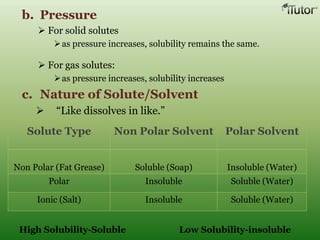
c. Nature of Solute/Solvent
 “Like dissolves in like.”
Solute Type Non Polar Solvent Polar Solvent
Non Polar (Fat Grease) Soluble (Soap) Insoluble (Water)
Polar Insoluble Soluble (Water)
Ionic (Salt) Insoluble Soluble (Water)
High Solubility-Soluble Low Solubility-insoluble
Solubility
 Maximum grams of solute that will dissolve in 100 g of solvent at
a given temperature.
Solubility=
 Varies with temperature
 Based on a saturated solution
Gram of solute
100 g of Water
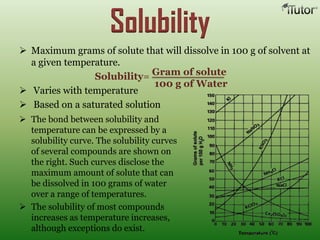
 The bond between solubility and
temperature can be expressed by a
solubility curve. The solubility curves
of several compounds are shown on
the right. Such curves disclose the
maximum amount of solute that can
be dissolved in 100 grams of water
over a range of temperatures.
 The solubility of most compounds
increases as temperature increases,
although exceptions do exist.
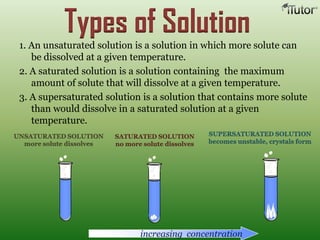
Types of Solution1. An unsaturated solution is a solution in which more solute can
be dissolved at a given temperature.
2. A saturated solution is a solution containing the maximum
amount of solute that will dissolve at a given temperature.
3. A supersaturated solution is a solution that contains more solute
than would dissolve in a saturated solution at a given
temperature.
SATURATED SOLUTION
no more solute dissolves
UNSATURATED SOLUTION
more solute dissolves
SUPERSATURATED SOLUTION
becomes unstable, crystals form
increasing concentration
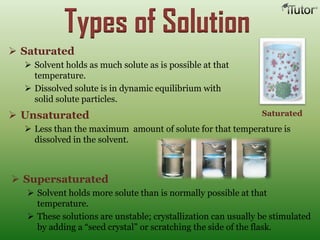
 Saturated
 Solvent holds as much solute as is possible at that
temperature.
 Dissolved solute is in dynamic equilibrium with
solid solute particles.
Types of Solution
 Unsaturated
 Less than the maximum amount of solute for that temperature is
dissolved in the solvent.
Saturated
 Supersaturated
 Solvent holds more solute than is normally possible at that
temperature.
 These solutions are unstable; crystallization can usually be stimulated
by adding a “seed crystal” or scratching the side of the flask.
Solubility Rules
1. Not all ionic compounds are water soluble.
2. There are some general rules for compounds that are water
soluble:
 Group 1 ionic compounds and ammonium (NH4+) are always
water soluble
 Group 17 ionic compounds are water soluble except when paired
with Ag, Pb, and Hg ions
1. A salt is soluble in water if it contains any one of the following
ions:
NH4
+ Li+ Na+ K+ or NO3
-
Examples: Soluble salts
LiCl Na2SO4 KBr Ca(NO3)2
Solubility Rules
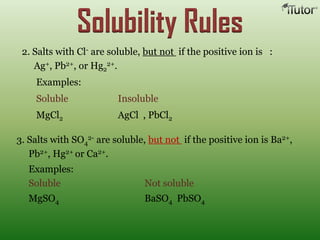
2. Salts with Cl- are soluble, but not if the positive ion is :
Ag+, Pb2+, or Hg2
2+.
Examples:
Soluble Insoluble
MgCl2 AgCl , PbCl2
3. Salts with SO4
2- are soluble, but not if the positive ion is Ba2+,
Pb2+, Hg2+ or Ca2+.
Examples:
Soluble Not soluble
MgSO4 BaSO4 PbSO4
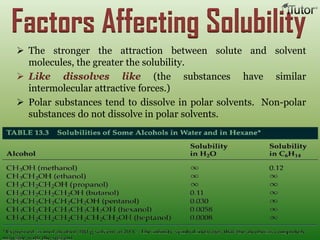
 The stronger the attraction between solute and solvent
molecules, the greater the solubility.
 Like dissolves like (the substances have similar
intermolecular attractive forces.)
 Polar substances tend to dissolve in polar solvents. Non-polar
substances do not dissolve in polar solvents.
Factors Affecting Solubility
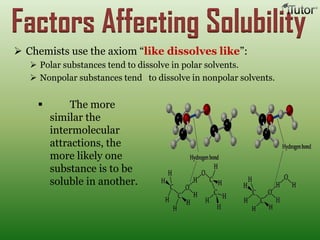
 Chemists use the axiom “like dissolves like”:
 Polar substances tend to dissolve in polar solvents.
 Nonpolar substances tend to dissolve in nonpolar solvents.
Factors Affecting Solubility
 The more
similar the
intermolecular
attractions, the
more likely one
substance is to be
soluble in another.
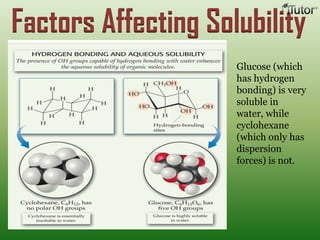
Glucose (which
has hydrogen
bonding) is very
soluble in
water, while
cyclohexane
(which only has
dispersion
forces) is not.
Factors Affecting Solubility
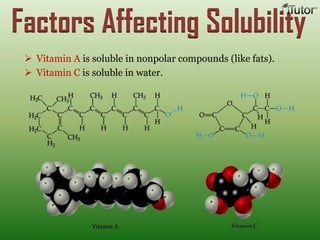
 Vitamin A is soluble in nonpolar compounds (like fats).
 Vitamin C is soluble in water.
Factors Affecting Solubility
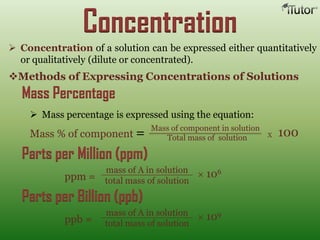
Concentration
 Concentration of a solution can be expressed either quantitatively
or qualitatively (dilute or concentrated).
Methods of Expressing Concentrations of Solutions
Mass Percentage
 Mass percentage is expressed using the equation:
Mass % of component = X
Mass of component in solution
Total mass of solution 100
Parts per Million (ppm)
ppm =
mass of A in solution
total mass of solution
106
Parts per Billion (ppb)
ppb =
mass of A in solution
total mass of solution
109
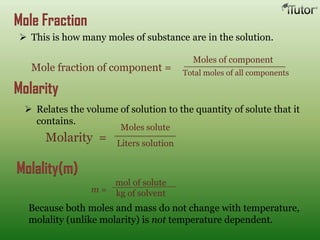
Mole Fraction
 This is how many moles of substance are in the solution.
Mole fraction of component =
Moles of component
Total moles of all components
Molarity
 Relates the volume of solution to the quantity of solute that it
contains.
Molarity =
Moles solute
Liters solution
Molality(m)
mol of solute
kg of solventm =
Because both moles and mass do not change with temperature,
molality (unlike molarity) is not temperature dependent.
Changing Molarity to Molality
If we know the density of the
solution, we can calculate the
molality from the molarity,
and vice versa.
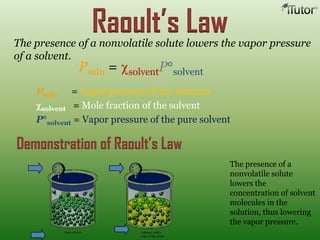
Raoult’s Law
Psoln = Vapor pressure of the solution
solvent = Mole fraction of the solvent
P solvent = Vapor pressure of the pure solvent
The presence of a nonvolatile solute lowers the vapor pressure
of a solvent.
Psoln = solventP solvent
The presence of a
nonvolatile solute
lowers the
concentration of solvent
molecules in the
solution, thus lowering
the vapor pressure.
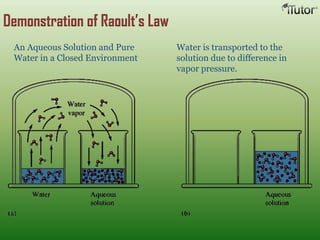
Demonstration of Raoult’s Law
Water is transported to the
solution due to difference in
vapor pressure.
An Aqueous Solution and Pure
Water in a Closed Environment
Demonstration of Raoult’s Law
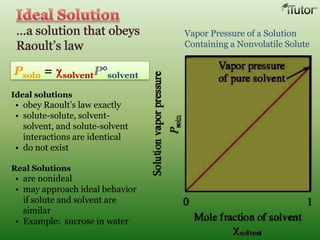
Psoln = solventP solvent
Vapor Pressure of a Solution
Containing a Nonvolatile Solute
Ideal solutions
• obey Raoult’s law exactly
• solute-solute, solvent-
solvent, and solute-solvent
interactions are identical
• do not exist
Real Solutions
• are nonideal
• may approach ideal behavior
if solute and solvent are
similar
• Example: sucrose in water
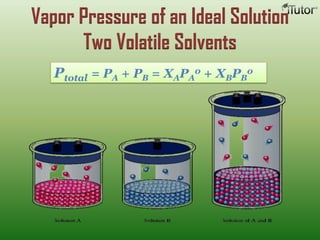
Vapor Pressure of an Ideal Solution
Two Volatile Solvents
Ptotal = PA + PB = XAPA
0 + XBPB
0
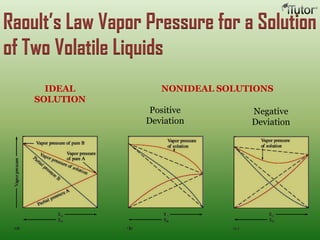
Raoult’s Law Vapor Pressure for a Solution
of Two Volatile Liquids
IDEAL
SOLUTION
NONIDEAL SOLUTIONS
Positive
Deviation
Negative
Deviation
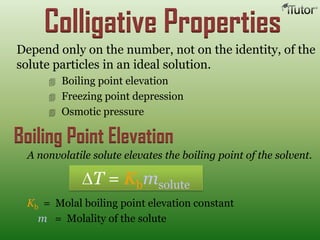
Colligative Properties
Depend only on the number, not on the identity, of the
solute particles in an ideal solution.
 Boiling point elevation
 Freezing point depression
 Osmotic pressure
Boiling Point Elevation
Kb = Molal boiling point elevation constant
m = Molality of the solute
A nonvolatile solute elevates the boiling point of the solvent.
T = Kbmsolute
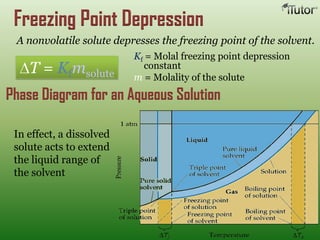
Freezing Point Depression
Kf = Molal freezing point depression
constant
m = Molality of the solute
A nonvolatile solute depresses the freezing point of the solvent.
T = Kfmsolute
Phase Diagram for an Aqueous Solution
In effect, a dissolved
solute acts to extend
the liquid range of
the solvent
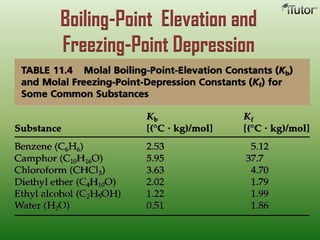
Boiling-Point Elevation and
Freezing-Point Depression
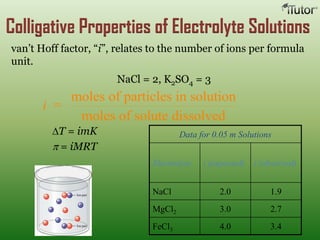
Colligative Properties of Electrolyte Solutions
T = imK
= iMRT
i =
moles of particles in solution
moles of solute dissolved
van’t Hoff factor, “i”, relates to the number of ions per formula
unit.
NaCl = 2, K2SO4 = 3
Data for 0.05 m Solutions
Electrolyte i (expected) i (observed)
NaCl 2.0 1.9
MgCl2 3.0 2.7
FeCl3 4.0 3.4
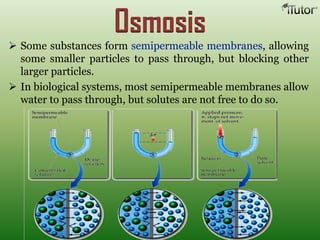
Osmosis
 Some substances form semipermeable membranes, allowing
some smaller particles to pass through, but blocking other
larger particles.
 In biological systems, most semipermeable membranes allow
water to pass through, but solutes are not free to do so.
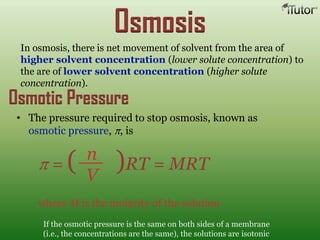
In osmosis, there is net movement of solvent from the area of
higher solvent concentration (lower solute concentration) to
the are of lower solvent concentration (higher solute
concentration).
Osmosis
• The pressure required to stop osmosis, known as
osmotic pressure, , is
where M is the molarity of the solution
If the osmotic pressure is the same on both sides of a membrane
(i.e., the concentrations are the same), the solutions are isotonic
n
V
= ( )RT = MRT
Osmotic Pressure
Colloids Colloids are particles that are large on the molecular scale but still
small enough to remain suspended indefinitely in a solvent system.
(aka colloidal dispersions.)
 They are intermediate between solutions and heterogeneous
mixtures.
 They have the ability to scatter light; known as the Tyndall effect.
Hydrophilic and Hydrophobic Colloids
 The most important colloids are those in which water is the
solvent, or dispersing agent.
 Hydrophilic colloids are water loving and are found in the
human body and help keep molecules suspended in water.
(enzymes, antibodies)
 Hydrophobic colloids are water fearing and must be stabilized
before they can be mixed into water. (droplets of oil.)
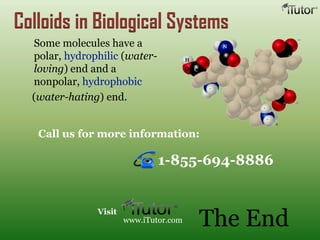
Colloids in Biological Systems
Some molecules have a
polar, hydrophilic (water-
loving) end and a
nonpolar, hydrophobic
(water-hating) end.
Call us for more information:
www.iTutor.com
1-855-694-8886
Visit
The End

Solution & Solubility

  • 1.
    Solution & Solubility By iTutor.com T-1-855-694-8886 Email- info@iTutor.com
  • 2.
    Solution  Solutions arehomogeneous mixtures of two or more pure substances.  In a solution, the solute is dispersed uniformly throughout the solvent.  A homogenous mixture of a solute dissolved in a solvent.  The solubility (ability to dissolve) of a solute in a solvent is dependent on the a. Temperature  For solid solutes as temperature increases, solubility increases.  For gas solutes  :as temperature increases, solubility decreases.
  • 3.
    b. Pressure  Forsolid solutes as pressure increases, solubility remains the same.  For gas solutes: as pressure increases, solubility increases c. Nature of Solute/Solvent  “Like dissolves in like.” Solute Type Non Polar Solvent Polar Solvent Non Polar (Fat Grease) Soluble (Soap) Insoluble (Water) Polar Insoluble Soluble (Water) Ionic (Salt) Insoluble Soluble (Water) High Solubility-Soluble Low Solubility-insoluble
  • 4.
    Solubility  Maximum gramsof solute that will dissolve in 100 g of solvent at a given temperature. Solubility=  Varies with temperature  Based on a saturated solution Gram of solute 100 g of Water  The bond between solubility and temperature can be expressed by a solubility curve. The solubility curves of several compounds are shown on the right. Such curves disclose the maximum amount of solute that can be dissolved in 100 grams of water over a range of temperatures.  The solubility of most compounds increases as temperature increases, although exceptions do exist.
  • 5.
    Types of Solution1.An unsaturated solution is a solution in which more solute can be dissolved at a given temperature. 2. A saturated solution is a solution containing the maximum amount of solute that will dissolve at a given temperature. 3. A supersaturated solution is a solution that contains more solute than would dissolve in a saturated solution at a given temperature. SATURATED SOLUTION no more solute dissolves UNSATURATED SOLUTION more solute dissolves SUPERSATURATED SOLUTION becomes unstable, crystals form increasing concentration
  • 6.
     Saturated  Solventholds as much solute as is possible at that temperature.  Dissolved solute is in dynamic equilibrium with solid solute particles. Types of Solution  Unsaturated  Less than the maximum amount of solute for that temperature is dissolved in the solvent. Saturated  Supersaturated  Solvent holds more solute than is normally possible at that temperature.  These solutions are unstable; crystallization can usually be stimulated by adding a “seed crystal” or scratching the side of the flask.
  • 7.
    Solubility Rules 1. Notall ionic compounds are water soluble. 2. There are some general rules for compounds that are water soluble:  Group 1 ionic compounds and ammonium (NH4+) are always water soluble  Group 17 ionic compounds are water soluble except when paired with Ag, Pb, and Hg ions 1. A salt is soluble in water if it contains any one of the following ions: NH4 + Li+ Na+ K+ or NO3 - Examples: Soluble salts LiCl Na2SO4 KBr Ca(NO3)2
  • 8.
    Solubility Rules 2. Saltswith Cl- are soluble, but not if the positive ion is : Ag+, Pb2+, or Hg2 2+. Examples: Soluble Insoluble MgCl2 AgCl , PbCl2 3. Salts with SO4 2- are soluble, but not if the positive ion is Ba2+, Pb2+, Hg2+ or Ca2+. Examples: Soluble Not soluble MgSO4 BaSO4 PbSO4
  • 9.
     The strongerthe attraction between solute and solvent molecules, the greater the solubility.  Like dissolves like (the substances have similar intermolecular attractive forces.)  Polar substances tend to dissolve in polar solvents. Non-polar substances do not dissolve in polar solvents. Factors Affecting Solubility
  • 10.
     Chemists usethe axiom “like dissolves like”:  Polar substances tend to dissolve in polar solvents.  Nonpolar substances tend to dissolve in nonpolar solvents. Factors Affecting Solubility  The more similar the intermolecular attractions, the more likely one substance is to be soluble in another.
  • 11.
    Glucose (which has hydrogen bonding)is very soluble in water, while cyclohexane (which only has dispersion forces) is not. Factors Affecting Solubility
  • 12.
     Vitamin Ais soluble in nonpolar compounds (like fats).  Vitamin C is soluble in water. Factors Affecting Solubility
  • 13.
    Concentration  Concentration ofa solution can be expressed either quantitatively or qualitatively (dilute or concentrated). Methods of Expressing Concentrations of Solutions Mass Percentage  Mass percentage is expressed using the equation: Mass % of component = X Mass of component in solution Total mass of solution 100 Parts per Million (ppm) ppm = mass of A in solution total mass of solution 106 Parts per Billion (ppb) ppb = mass of A in solution total mass of solution 109
  • 14.
    Mole Fraction  Thisis how many moles of substance are in the solution. Mole fraction of component = Moles of component Total moles of all components Molarity  Relates the volume of solution to the quantity of solute that it contains. Molarity = Moles solute Liters solution Molality(m) mol of solute kg of solventm = Because both moles and mass do not change with temperature, molality (unlike molarity) is not temperature dependent.
  • 15.
    Changing Molarity toMolality If we know the density of the solution, we can calculate the molality from the molarity, and vice versa.
  • 16.
    Raoult’s Law Psoln =Vapor pressure of the solution solvent = Mole fraction of the solvent P solvent = Vapor pressure of the pure solvent The presence of a nonvolatile solute lowers the vapor pressure of a solvent. Psoln = solventP solvent The presence of a nonvolatile solute lowers the concentration of solvent molecules in the solution, thus lowering the vapor pressure. Demonstration of Raoult’s Law
  • 17.
    Water is transportedto the solution due to difference in vapor pressure. An Aqueous Solution and Pure Water in a Closed Environment Demonstration of Raoult’s Law
  • 18.
    Psoln = solventPsolvent Vapor Pressure of a Solution Containing a Nonvolatile Solute Ideal solutions • obey Raoult’s law exactly • solute-solute, solvent- solvent, and solute-solvent interactions are identical • do not exist Real Solutions • are nonideal • may approach ideal behavior if solute and solvent are similar • Example: sucrose in water
  • 19.
    Vapor Pressure ofan Ideal Solution Two Volatile Solvents Ptotal = PA + PB = XAPA 0 + XBPB 0
  • 20.
    Raoult’s Law VaporPressure for a Solution of Two Volatile Liquids IDEAL SOLUTION NONIDEAL SOLUTIONS Positive Deviation Negative Deviation
  • 21.
    Colligative Properties Depend onlyon the number, not on the identity, of the solute particles in an ideal solution.  Boiling point elevation  Freezing point depression  Osmotic pressure Boiling Point Elevation Kb = Molal boiling point elevation constant m = Molality of the solute A nonvolatile solute elevates the boiling point of the solvent. T = Kbmsolute
  • 22.
    Freezing Point Depression Kf= Molal freezing point depression constant m = Molality of the solute A nonvolatile solute depresses the freezing point of the solvent. T = Kfmsolute Phase Diagram for an Aqueous Solution In effect, a dissolved solute acts to extend the liquid range of the solvent
  • 23.
  • 24.
    Colligative Properties ofElectrolyte Solutions T = imK = iMRT i = moles of particles in solution moles of solute dissolved van’t Hoff factor, “i”, relates to the number of ions per formula unit. NaCl = 2, K2SO4 = 3 Data for 0.05 m Solutions Electrolyte i (expected) i (observed) NaCl 2.0 1.9 MgCl2 3.0 2.7 FeCl3 4.0 3.4
  • 25.
    Osmosis  Some substancesform semipermeable membranes, allowing some smaller particles to pass through, but blocking other larger particles.  In biological systems, most semipermeable membranes allow water to pass through, but solutes are not free to do so.
  • 26.
    In osmosis, thereis net movement of solvent from the area of higher solvent concentration (lower solute concentration) to the are of lower solvent concentration (higher solute concentration). Osmosis • The pressure required to stop osmosis, known as osmotic pressure, , is where M is the molarity of the solution If the osmotic pressure is the same on both sides of a membrane (i.e., the concentrations are the same), the solutions are isotonic n V = ( )RT = MRT Osmotic Pressure
  • 27.
    Colloids Colloids areparticles that are large on the molecular scale but still small enough to remain suspended indefinitely in a solvent system. (aka colloidal dispersions.)  They are intermediate between solutions and heterogeneous mixtures.  They have the ability to scatter light; known as the Tyndall effect. Hydrophilic and Hydrophobic Colloids  The most important colloids are those in which water is the solvent, or dispersing agent.  Hydrophilic colloids are water loving and are found in the human body and help keep molecules suspended in water. (enzymes, antibodies)  Hydrophobic colloids are water fearing and must be stabilized before they can be mixed into water. (droplets of oil.)
  • 28.
    Colloids in BiologicalSystems Some molecules have a polar, hydrophilic (water- loving) end and a nonpolar, hydrophobic (water-hating) end. Call us for more information: www.iTutor.com 1-855-694-8886 Visit The End