Equilibria
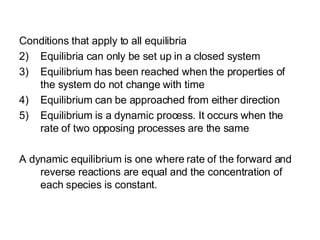
Conditions that apply to all equilibria Equilibria can only be set up in a closed system Equilibrium has been reached when the properties of the system do not change with time Equilibrium can be approached from either direction  Equilibrium is a dynamic process. It occurs when the rate of two opposing processes are the same A dynamic equilibrium is one where rate of the forward and reverse reactions are equal and the concentration of each species is constant.
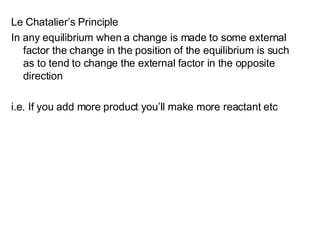
Le Chatalier’s Principle In any equilibrium when a change is made to some external factor the change in the position of the equilibrium is such as to tend to change the external factor in the opposite direction i.e. If you add more product you’ll make more reactant etc
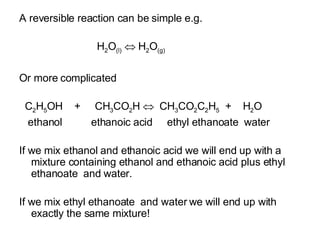
A reversible reaction can be simple e.g. H 2 O (l)     H 2 O (g)‏ Or more complicated C 2 H 5 OH  +  CH 3 CO 2 H     CH 3 CO 2 C 2 H 5   +  H 2 O ethanol  ethanoic acid  ethyl ethanoate  water If we mix ethanol and ethanoic acid we will end up with a mixture containing ethanol and ethanoic acid plus ethyl ethanoate  and water.  If we mix ethyl ethanoate  and water we will end up with exactly the same mixture!
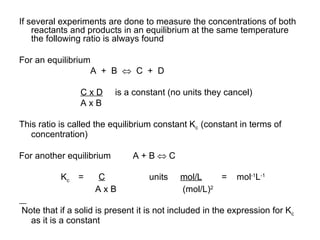
If several experiments are done to measure the concentrations of both reactants and products in an equilibrium at the same temperature the following ratio is always found For an equilibrium  A  +  B     C  +  D C x D   is a constant (no units they cancel)‏ A x B  This ratio is called the equilibrium constant K c  (constant in terms of concentration)‏ For another equilibrium  A + B    C K c  =   C   units  mol/L   =  mol -1 L -1 A x B  (mol/L) 2 Note that if a solid is present it is not included in the expression for K c  as it is a constant
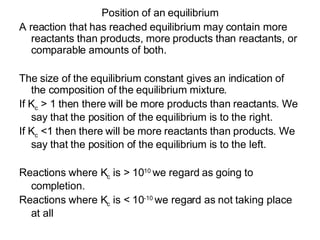
Position of an equilibrium A reaction that has reached equilibrium may contain more reactants than products, more products than reactants, or comparable amounts of both. The size of the equilibrium constant gives an indication of the composition of the equilibrium mixture.  If K c  > 1 then there will be more products than reactants. We say that the position of the equilibrium is to the right. If K c  <1 then there will be more reactants than products. We say that the position of the equilibrium is to the left. Reactions where K c  is > 10 10  we regard as going to completion. Reactions where K c  is < 10 -10  we regard as not taking place at all
A mixture of 1 mol hydrogen and 1 mol iodine are reacted together and reach equilibrium at constant temperature 1.56 mols of HI are present at equilibrium. Find K c H 2   +  I 2      2HI K c  =  [ HI] x [HI]   =  [HI] 2 [H 2 ] x [I 2 ]  [H 2 ][I 2 ]
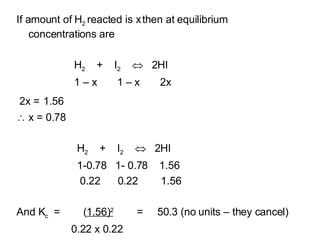
If amount of H 2  reacted is x   then at equilibrium concentrations are H 2   +  I 2      2HI 1 – x  1 – x  2x 2x =   1.56  x = 0.78  H 2   +  I 2      2HI 1-0.78  1- 0.78  1.56 0.22  0.22  1.56 And K c   =  ( 1.56) 2   =  50.3 (no units – they cancel)  0.22 x 0.22
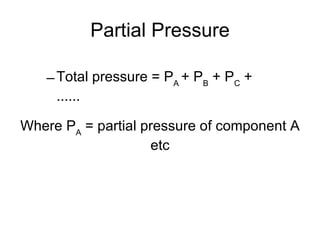
Partial Pressure Where P A  = partial pressure of component A etc Total pressure = P A  + P B  + P C  + ......

7 Equilibria

  • 1.
  • 2.
    Conditions that applyto all equilibria Equilibria can only be set up in a closed system Equilibrium has been reached when the properties of the system do not change with time Equilibrium can be approached from either direction Equilibrium is a dynamic process. It occurs when the rate of two opposing processes are the same A dynamic equilibrium is one where rate of the forward and reverse reactions are equal and the concentration of each species is constant.
  • 3.
    Le Chatalier’s PrincipleIn any equilibrium when a change is made to some external factor the change in the position of the equilibrium is such as to tend to change the external factor in the opposite direction i.e. If you add more product you’ll make more reactant etc
  • 4.
    A reversible reactioncan be simple e.g. H 2 O (l)  H 2 O (g)‏ Or more complicated C 2 H 5 OH + CH 3 CO 2 H  CH 3 CO 2 C 2 H 5 + H 2 O ethanol ethanoic acid ethyl ethanoate water If we mix ethanol and ethanoic acid we will end up with a mixture containing ethanol and ethanoic acid plus ethyl ethanoate and water. If we mix ethyl ethanoate and water we will end up with exactly the same mixture!
  • 5.
    If several experimentsare done to measure the concentrations of both reactants and products in an equilibrium at the same temperature the following ratio is always found For an equilibrium A + B  C + D C x D is a constant (no units they cancel)‏ A x B This ratio is called the equilibrium constant K c (constant in terms of concentration)‏ For another equilibrium A + B  C K c = C units mol/L = mol -1 L -1 A x B (mol/L) 2 Note that if a solid is present it is not included in the expression for K c as it is a constant
  • 6.
    Position of anequilibrium A reaction that has reached equilibrium may contain more reactants than products, more products than reactants, or comparable amounts of both. The size of the equilibrium constant gives an indication of the composition of the equilibrium mixture. If K c > 1 then there will be more products than reactants. We say that the position of the equilibrium is to the right. If K c <1 then there will be more reactants than products. We say that the position of the equilibrium is to the left. Reactions where K c is > 10 10 we regard as going to completion. Reactions where K c is < 10 -10 we regard as not taking place at all
  • 7.
    A mixture of1 mol hydrogen and 1 mol iodine are reacted together and reach equilibrium at constant temperature 1.56 mols of HI are present at equilibrium. Find K c H 2 + I 2  2HI K c = [ HI] x [HI] = [HI] 2 [H 2 ] x [I 2 ] [H 2 ][I 2 ]
  • 8.
    If amount ofH 2 reacted is x then at equilibrium concentrations are H 2 + I 2  2HI 1 – x 1 – x 2x 2x = 1.56 x = 0.78 H 2 + I 2  2HI 1-0.78 1- 0.78 1.56 0.22 0.22 1.56 And K c = ( 1.56) 2 = 50.3 (no units – they cancel) 0.22 x 0.22
  • 9.
    Partial Pressure WhereP A = partial pressure of component A etc Total pressure = P A + P B + P C + ......