Unit 11 Acids and Bases
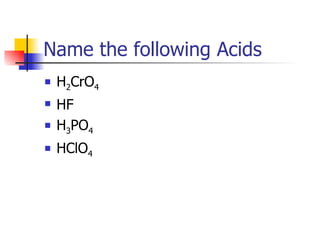
Name the following Acids H 2 CrO 4 HF H 3 PO 4 HClO 4
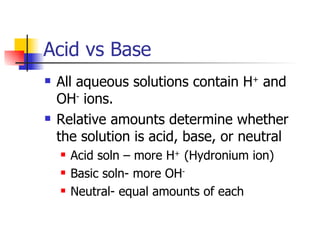
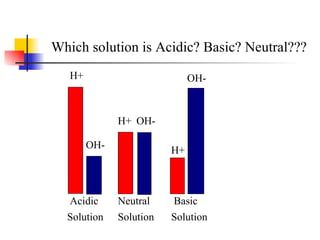
Acid vs Base All aqueous solutions contain H +  and OH -  ions. Relative amounts determine whether the solution is acid, base, or neutral Acid soln – more H +  (Hydronium ion) Basic soln- more OH - Neutral- equal amounts of each
Basic  Acidic Neutral H+ H+ H+ OH- OH- OH- Solution Solution Solution Which solution is Acidic? Basic? Neutral???
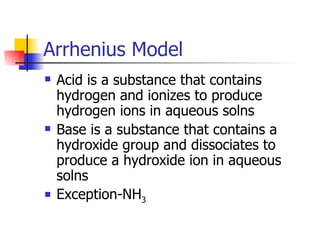
Arrhenius Model Acid is a substance that contains hydrogen and ionizes to produce hydrogen ions in aqueous solns Base is a substance that contains a hydroxide group and dissociates to produce a hydroxide ion in aqueous solns Exception-NH 3
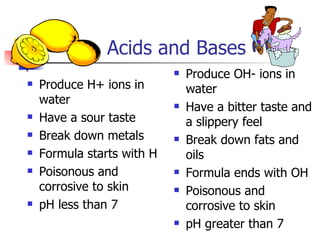
Acids and Bases Produce H+ ions in water Have a sour taste Break down metals Formula starts with H Poisonous and corrosive to skin pH less than 7 Produce OH- ions in water Have a bitter taste and a slippery feel Break down fats and oils Formula ends with OH Poisonous and corrosive to skin pH greater than 7
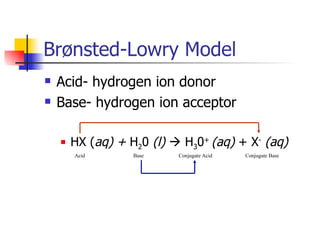
Br ø nsted-Lowry Model Acid- hydrogen ion donor Base- hydrogen ion acceptor HX ( aq) +  H 2 0  (l)     H 3 0 +   (aq)  + X -   (aq) Base Conjugate Acid Acid Conjugate Base
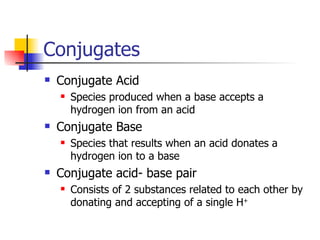
Conjugates Conjugate Acid Species produced when a base accepts a hydrogen ion from an acid Conjugate Base Species that results when an acid donates a hydrogen ion to a base Conjugate acid- base pair Consists of 2 substances related to each other by donating and accepting of a single H +
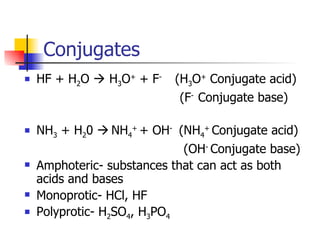
Conjugates HF + H 2 O    H 3 O +  + F -  (H 3 O +  Conjugate acid)   (F -  Conjugate base) NH 3  + H 2 0     NH 4 +   + OH -  (NH 4 +  Conjugate acid)   (OH -  Conjugate base) Amphoteric- substances that can act as both acids and bases Monoprotic- HCl, HF Polyprotic- H 2 SO 4 , H 3 PO 4
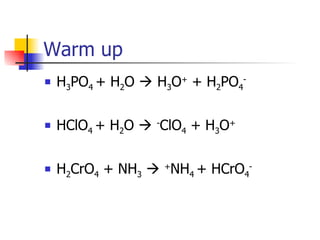
Warm up H 3 PO 4  + H 2 O    H 3 O +  + H 2 PO 4 - HClO 4  + H 2 O     - ClO 4  + H 3 O + H 2 CrO 4  + NH 3      + NH 4  + HCrO 4 -
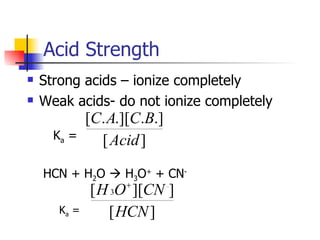
Acid Strength Strong acids – ionize completely Weak acids- do not ionize completely K a  =  HCN + H 2 O    H 3 O +  + CN - K a  =
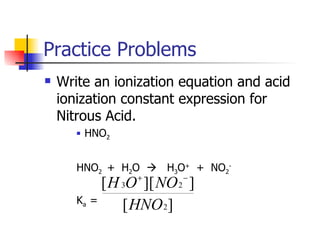
Practice Problems Write an ionization equation and acid ionization constant expression for Nitrous Acid. HNO 2 HNO 2  +  H 2 O     H 3 O +   +  NO 2 - K a  =
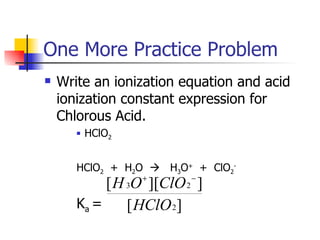
One More Practice Problem Write an ionization equation and acid ionization constant expression for Chlorous Acid. HClO 2 HClO 2   +  H 2 O     H 3 O +   +  ClO 2 - K a  =
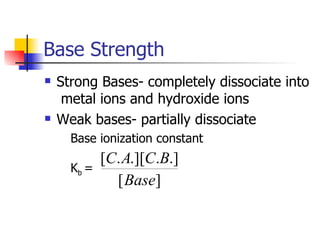
Base Strength Strong Bases- completely dissociate into  metal ions and hydroxide ions Weak bases- partially dissociate Base ionization constant K b  =
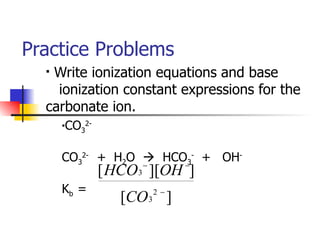
Write ionization equations and base  ionization constant expressions for the carbonate ion. CO 3 2- CO 3 2-  +  H 2 O     HCO 3 -   +  OH - K b  =  Practice Problems
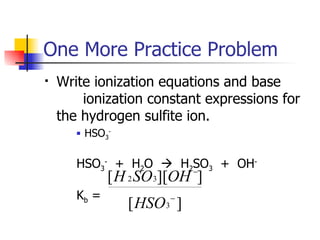
One More Practice Problem Write ionization equations and base  ionization constant expressions for the hydrogen sulfite ion. HSO 3 - HSO 3 -   +  H 2 O     H 2 SO 3   +  OH - K b  =
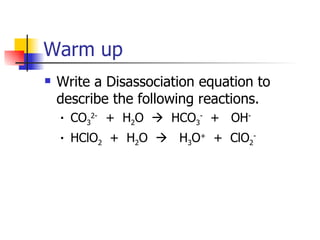
Warm up Write a Disassociation equation to describe the following reactions. CO 3 2-  +  H 2 O     HCO 3 -   +  OH - HClO 2   +  H 2 O     H 3 O +   +  ClO 2 -
pH Measure of H +  ions in soln pH = -log[H + ] Acidic solutions have a pH below 7 Basic solutions have a pH above 7 pH 7 is neutral Change of 1 pH unit represents a tenfold change. (exponential)
pOH Measures concentration of OH -  ion pOH = - log [OH - ] pH + pOH = 14.00
Practice Problems Calculate the pH and pOH of aqueous solutions having the following ion concentrations. [OH - ] = 6.5 x 10 -6 pOH = -log[OH - ] pH = 14.00 – pOH pOH = -log[6.5 x 10 -6 ] pH = 14.00 – 5.19 pOH = -[log 6.5 + log 10 -6 ] pH = 8.81 pOH = -[0.81 + (-6)] pOH =  5.19
One more, one more time! Calculate the pH and pOH of aqueous solutions having the following ion concentrations. [H + ] = 3.6 x 10 -9 pH = -log[H + ] pOH=14.00 – pH pH = -log[3.6 x 10 -9 ] pOH=14.00-8.44 pH = -[log 3.6 + log 10 -9 ] pOH=5.56 pH = -[0.56 + (-9)] pH = 8.44
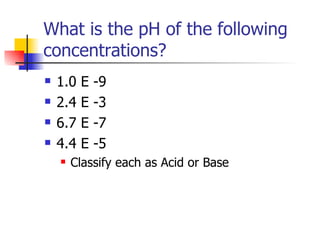
What is the pH of the following concentrations? 1.0 E -9 2.4 E -3 6.7 E -7 4.4 E -5 Classify each as Acid or Base
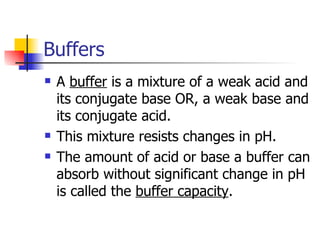
Buffers A  buffer  is a mixture of a weak acid and its conjugate base OR, a weak base and its conjugate acid. This mixture resists changes in pH. The amount of acid or base a buffer can absorb without significant change in pH is called the  buffer capacity .
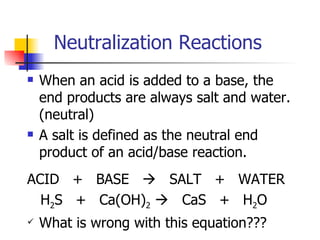
Neutralization Reactions When an acid is added to a base, the end products are always salt and water. (neutral) A salt is defined as the neutral end product of an acid/base reaction. ACID  +  BASE     SALT  +  WATER H 2 S  +  Ca(OH) 2      CaS  +  H 2 O What is wrong with this equation???
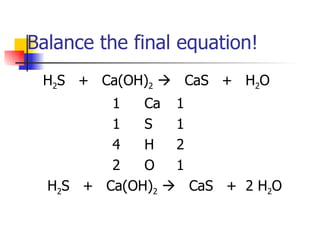
Balance the final equation! H 2 S  +  Ca(OH) 2      CaS  +  H 2 O 1 Ca 1 1 S 1 4 H 2 2 O 1 H 2 S  +  Ca(OH) 2      CaS  +  2 H 2 O
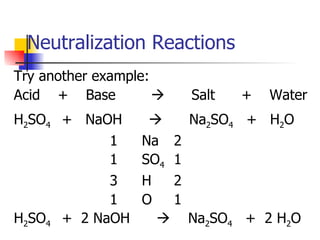
Neutralization Reactions Try another example: Acid  +  Base     Salt  +  Water H 2 SO 4  +  NaOH     Na 2 SO 4   +  H 2 O 1 Na 2 1 SO 4 1 3 H 2 1 O 1 H 2 SO 4  +  2 NaOH     Na 2 SO 4   +  2 H 2 O
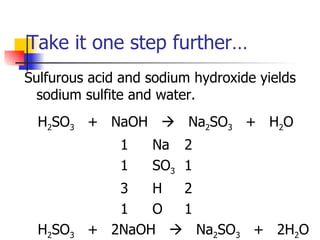
Take it one step further… Sulfurous acid and sodium hydroxide yields sodium sulfite and water. H 2 SO 3   +  NaOH     Na 2 SO 3   +  H 2 O 1 Na 2 1 SO 3 1 3 H 2 1 O 1 H 2 SO 3   +  2NaOH     Na 2 SO 3   +  2H 2 O
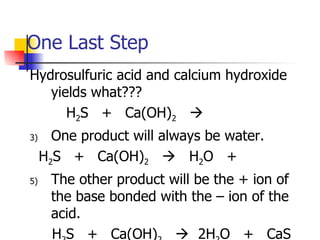
One Last Step Hydrosulfuric acid and calcium hydroxide yields what???   H 2 S  +  Ca(OH) 2      One product will always be water. H 2 S  +  Ca(OH) 2      H 2 O  +  The other product will be the + ion of the base bonded with the – ion of the acid. H 2 S  +  Ca(OH) 2      2H 2 O  +  CaS
pH Indicators A chemical substance that changes color in the presence of an acid and/or a base. 1) pH paper – Dip the paper, match color to scale on vial to determine numeric pH. pH<7 = acid, pH>7 = base, pH = 7 neutral 2)  Litmus – Dip one red and one blue paper. Red stays red, blue turns red     Acid Blue stays blue, red turns blue    Base Red stays red, blue stays blue    Neutral
pH Indicators 3)  Bromthymol Blue – Add a few drops of bromthymol blue to the substance.  If the blue color turns to yellow    Acid If the blue color stays blue     Base 4)  Phenolphthalein – Add a few drops of phenolphthalein to the substance. If the clear liquid turns to pink     Base If the clear liquid remains clear     Acid
Concentration  Strength of an acid or base is determined by the amount of ionization.  Concentration is determined by the amount of water added to the substance.  Molarity  (M) The number of moles of solute dissolved in each liter of solution. Molarity =  moles of solute   liters of solution
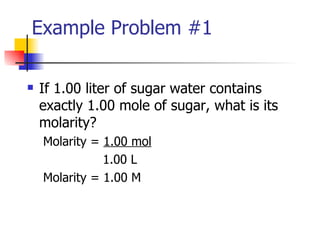
Example Problem #1 If 1.00 liter of sugar water contains exactly 1.00 mole of sugar, what is its molarity? Molarity =  1.00 mol   1.00 L Molarity = 1.00 M
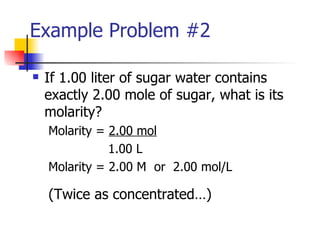
Example Problem #2 If 1.00 liter of sugar water contains exactly 2.00 mole of sugar, what is its molarity? Molarity =  2.00 mol   1.00 L Molarity = 2.00 M  or  2.00 mol/L (Twice as concentrated…)
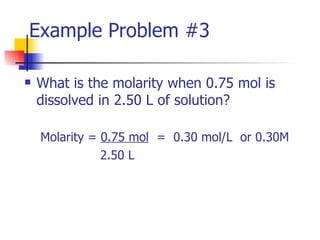
Example Problem #3 What is the molarity when 0.75 mol is dissolved in 2.50 L of solution? Molarity =  0.75 mol   =  0.30 mol/L  or 0.30M   2.50 L
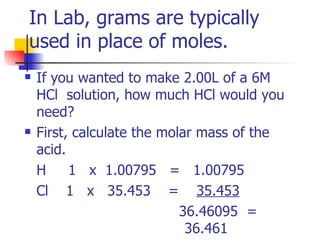
In Lab, grams are typically used in place of moles. If you wanted to make 2.00L of a 6M HCl  solution, how much HCl would you need?  First, calculate the molar mass of the acid. H  1  x  1.00795  =  1.00795 Cl  1  x  35.453  =  35.453   36.46095  =  36.461
If you wanted to make 2.00L of a 6M HCl  solution, how much HCl would you need?  First, calculate the molar mass of the acid.   HCl contains 36.461 g/mol It would take 36.461 g of HCl to make 1 liter of a 1M HCl solution.  How many grams would it take to make 2L of a 1M solution? 2  x  36.461g  =  72.922g
If you wanted to make 2.00L of a 6M HCl  solution, how much HCl would you need?  It takes 72.922g of HCl to make 2 liters of a 1M solution.  How much would it take to make 2 liters of a 6M solution? 6  x  72.922g  =  437.532 g
Try One More Suppose you wanted to make 2 liters of a 0.5 M solution of HCl.  How much HCl would you need? Each mole of HCl is equal to 36.461g For a 0.5 M solution, you would need half that much.  36.461 x 0.5 = 18.2305g. However, you want to make 2 liters, so double that amount.  18.2305  x  2  = 36.461g.

Acid Base Notes (H)

  • 1.
    Unit 11 Acidsand Bases
  • 2.
    Name the followingAcids H 2 CrO 4 HF H 3 PO 4 HClO 4
  • 3.
    Acid vs BaseAll aqueous solutions contain H + and OH - ions. Relative amounts determine whether the solution is acid, base, or neutral Acid soln – more H + (Hydronium ion) Basic soln- more OH - Neutral- equal amounts of each
  • 4.
    Basic AcidicNeutral H+ H+ H+ OH- OH- OH- Solution Solution Solution Which solution is Acidic? Basic? Neutral???
  • 5.
    Arrhenius Model Acidis a substance that contains hydrogen and ionizes to produce hydrogen ions in aqueous solns Base is a substance that contains a hydroxide group and dissociates to produce a hydroxide ion in aqueous solns Exception-NH 3
  • 6.
    Acids and BasesProduce H+ ions in water Have a sour taste Break down metals Formula starts with H Poisonous and corrosive to skin pH less than 7 Produce OH- ions in water Have a bitter taste and a slippery feel Break down fats and oils Formula ends with OH Poisonous and corrosive to skin pH greater than 7
  • 7.
    Br ø nsted-LowryModel Acid- hydrogen ion donor Base- hydrogen ion acceptor HX ( aq) + H 2 0 (l)  H 3 0 + (aq) + X - (aq) Base Conjugate Acid Acid Conjugate Base
  • 8.
    Conjugates Conjugate AcidSpecies produced when a base accepts a hydrogen ion from an acid Conjugate Base Species that results when an acid donates a hydrogen ion to a base Conjugate acid- base pair Consists of 2 substances related to each other by donating and accepting of a single H +
  • 9.
    Conjugates HF +H 2 O  H 3 O + + F - (H 3 O + Conjugate acid) (F - Conjugate base) NH 3 + H 2 0  NH 4 + + OH - (NH 4 + Conjugate acid) (OH - Conjugate base) Amphoteric- substances that can act as both acids and bases Monoprotic- HCl, HF Polyprotic- H 2 SO 4 , H 3 PO 4
  • 10.
    Warm up H3 PO 4 + H 2 O  H 3 O + + H 2 PO 4 - HClO 4 + H 2 O  - ClO 4 + H 3 O + H 2 CrO 4 + NH 3  + NH 4 + HCrO 4 -
  • 11.
    Acid Strength Strongacids – ionize completely Weak acids- do not ionize completely K a = HCN + H 2 O  H 3 O + + CN - K a =
  • 12.
    Practice Problems Writean ionization equation and acid ionization constant expression for Nitrous Acid. HNO 2 HNO 2 + H 2 O  H 3 O + + NO 2 - K a =
  • 13.
    One More PracticeProblem Write an ionization equation and acid ionization constant expression for Chlorous Acid. HClO 2 HClO 2 + H 2 O  H 3 O + + ClO 2 - K a =
  • 14.
    Base Strength StrongBases- completely dissociate into metal ions and hydroxide ions Weak bases- partially dissociate Base ionization constant K b =
  • 15.
    Write ionization equationsand base ionization constant expressions for the carbonate ion. CO 3 2- CO 3 2- + H 2 O  HCO 3 - + OH - K b = Practice Problems
  • 16.
    One More PracticeProblem Write ionization equations and base ionization constant expressions for the hydrogen sulfite ion. HSO 3 - HSO 3 - + H 2 O  H 2 SO 3 + OH - K b =
  • 17.
    Warm up Writea Disassociation equation to describe the following reactions. CO 3 2- + H 2 O  HCO 3 - + OH - HClO 2 + H 2 O  H 3 O + + ClO 2 -
  • 18.
    pH Measure ofH + ions in soln pH = -log[H + ] Acidic solutions have a pH below 7 Basic solutions have a pH above 7 pH 7 is neutral Change of 1 pH unit represents a tenfold change. (exponential)
  • 19.
    pOH Measures concentrationof OH - ion pOH = - log [OH - ] pH + pOH = 14.00
  • 20.
    Practice Problems Calculatethe pH and pOH of aqueous solutions having the following ion concentrations. [OH - ] = 6.5 x 10 -6 pOH = -log[OH - ] pH = 14.00 – pOH pOH = -log[6.5 x 10 -6 ] pH = 14.00 – 5.19 pOH = -[log 6.5 + log 10 -6 ] pH = 8.81 pOH = -[0.81 + (-6)] pOH = 5.19
  • 21.
    One more, onemore time! Calculate the pH and pOH of aqueous solutions having the following ion concentrations. [H + ] = 3.6 x 10 -9 pH = -log[H + ] pOH=14.00 – pH pH = -log[3.6 x 10 -9 ] pOH=14.00-8.44 pH = -[log 3.6 + log 10 -9 ] pOH=5.56 pH = -[0.56 + (-9)] pH = 8.44
  • 22.
    What is thepH of the following concentrations? 1.0 E -9 2.4 E -3 6.7 E -7 4.4 E -5 Classify each as Acid or Base
  • 23.
    Buffers A buffer is a mixture of a weak acid and its conjugate base OR, a weak base and its conjugate acid. This mixture resists changes in pH. The amount of acid or base a buffer can absorb without significant change in pH is called the buffer capacity .
  • 24.
    Neutralization Reactions Whenan acid is added to a base, the end products are always salt and water. (neutral) A salt is defined as the neutral end product of an acid/base reaction. ACID + BASE  SALT + WATER H 2 S + Ca(OH) 2  CaS + H 2 O What is wrong with this equation???
  • 25.
    Balance the finalequation! H 2 S + Ca(OH) 2  CaS + H 2 O 1 Ca 1 1 S 1 4 H 2 2 O 1 H 2 S + Ca(OH) 2  CaS + 2 H 2 O
  • 26.
    Neutralization Reactions Tryanother example: Acid + Base  Salt + Water H 2 SO 4 + NaOH  Na 2 SO 4 + H 2 O 1 Na 2 1 SO 4 1 3 H 2 1 O 1 H 2 SO 4 + 2 NaOH  Na 2 SO 4 + 2 H 2 O
  • 27.
    Take it onestep further… Sulfurous acid and sodium hydroxide yields sodium sulfite and water. H 2 SO 3 + NaOH  Na 2 SO 3 + H 2 O 1 Na 2 1 SO 3 1 3 H 2 1 O 1 H 2 SO 3 + 2NaOH  Na 2 SO 3 + 2H 2 O
  • 28.
    One Last StepHydrosulfuric acid and calcium hydroxide yields what??? H 2 S + Ca(OH) 2  One product will always be water. H 2 S + Ca(OH) 2  H 2 O + The other product will be the + ion of the base bonded with the – ion of the acid. H 2 S + Ca(OH) 2  2H 2 O + CaS
  • 29.
    pH Indicators Achemical substance that changes color in the presence of an acid and/or a base. 1) pH paper – Dip the paper, match color to scale on vial to determine numeric pH. pH<7 = acid, pH>7 = base, pH = 7 neutral 2) Litmus – Dip one red and one blue paper. Red stays red, blue turns red  Acid Blue stays blue, red turns blue  Base Red stays red, blue stays blue  Neutral
  • 30.
    pH Indicators 3) Bromthymol Blue – Add a few drops of bromthymol blue to the substance. If the blue color turns to yellow  Acid If the blue color stays blue  Base 4) Phenolphthalein – Add a few drops of phenolphthalein to the substance. If the clear liquid turns to pink  Base If the clear liquid remains clear  Acid
  • 31.
    Concentration Strengthof an acid or base is determined by the amount of ionization. Concentration is determined by the amount of water added to the substance. Molarity (M) The number of moles of solute dissolved in each liter of solution. Molarity = moles of solute liters of solution
  • 32.
    Example Problem #1If 1.00 liter of sugar water contains exactly 1.00 mole of sugar, what is its molarity? Molarity = 1.00 mol 1.00 L Molarity = 1.00 M
  • 33.
    Example Problem #2If 1.00 liter of sugar water contains exactly 2.00 mole of sugar, what is its molarity? Molarity = 2.00 mol 1.00 L Molarity = 2.00 M or 2.00 mol/L (Twice as concentrated…)
  • 34.
    Example Problem #3What is the molarity when 0.75 mol is dissolved in 2.50 L of solution? Molarity = 0.75 mol = 0.30 mol/L or 0.30M 2.50 L
  • 35.
    In Lab, gramsare typically used in place of moles. If you wanted to make 2.00L of a 6M HCl solution, how much HCl would you need? First, calculate the molar mass of the acid. H 1 x 1.00795 = 1.00795 Cl 1 x 35.453 = 35.453 36.46095 = 36.461
  • 36.
    If you wantedto make 2.00L of a 6M HCl solution, how much HCl would you need? First, calculate the molar mass of the acid. HCl contains 36.461 g/mol It would take 36.461 g of HCl to make 1 liter of a 1M HCl solution. How many grams would it take to make 2L of a 1M solution? 2 x 36.461g = 72.922g
  • 37.
    If you wantedto make 2.00L of a 6M HCl solution, how much HCl would you need? It takes 72.922g of HCl to make 2 liters of a 1M solution. How much would it take to make 2 liters of a 6M solution? 6 x 72.922g = 437.532 g
  • 38.
    Try One MoreSuppose you wanted to make 2 liters of a 0.5 M solution of HCl. How much HCl would you need? Each mole of HCl is equal to 36.461g For a 0.5 M solution, you would need half that much. 36.461 x 0.5 = 18.2305g. However, you want to make 2 liters, so double that amount. 18.2305 x 2 = 36.461g.