3 Enthalpy
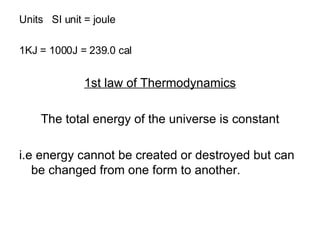
Units  SI unit = joule 1KJ = 1000J = 239.0 cal 1st law of Thermodynamics The total energy of the universe is constant i.e energy cannot be created or destroyed but can be changed from one form to another.
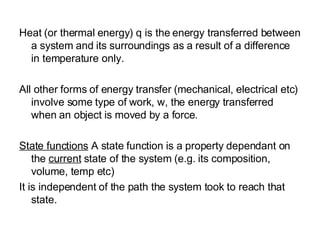
Heat (or thermal energy) q is the energy transferred between a system and its surroundings as a result of a difference in temperature only. All other forms of energy transfer (mechanical, electrical etc) involve some type of work, w, the energy transferred when an object is moved by a force. State functions  A state function is a property dependant on the  current  state of the system (e.g. its composition, volume, temp etc) It is independent of the path the system took to reach that state.
Energy of a system is a  state  function So   E is a constant for any given change but q and w may vary (q and w are not state functions) and   E  = q + w
Energy can be converted from one form to another e.g. from mechanical    heat    electrical    light etc. Energy is  released  when bonds are made Energy is  used  when bonds are broken Chemical reactions involve Bond breaking Bond forming
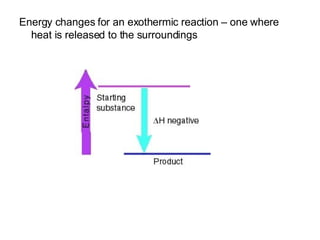
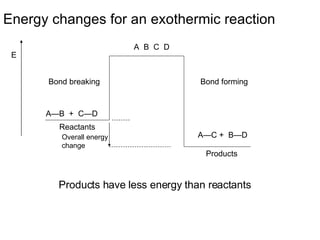
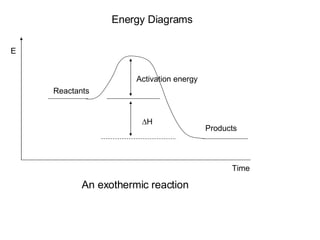
Energy changes for an exothermic reaction – one where heat is released to the surroundings
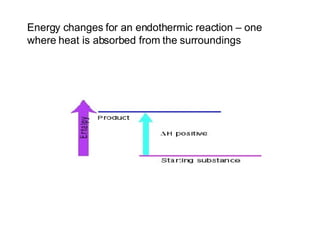
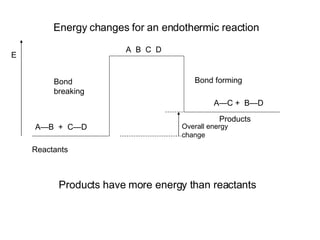
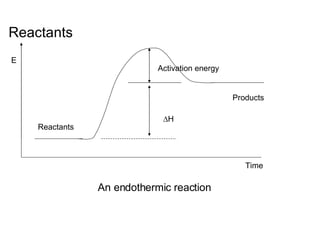
Energy changes for an endothermic reaction – one where heat is absorbed from the surroundings
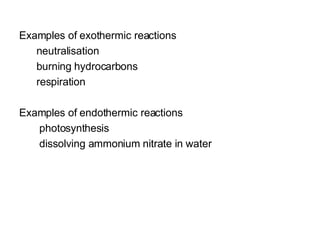
Examples of exothermic reactions neutralisation burning hydrocarbons respiration Examples of endothermic reactions photosynthesis dissolving ammonium nitrate in water
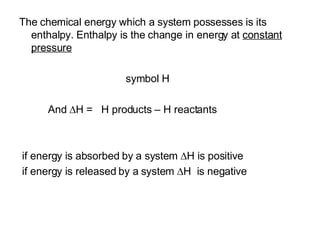
The chemical energy which a system possesses is its enthalpy. Enthalpy is the change in energy at  constant pressure   symbol H And   H =  H products – H reactants if energy is absorbed by a system   H is positive if energy is released by a system   H  is negative
Energy changes for an endothermic reaction A—B  +  C—D  Reactants A—C +  B—D  Products A  B  C  D Bond breaking Bond forming Overall energy change Products have more energy than reactants E
Energy changes for an exothermic reaction A—B  +  C—D  A—C +  B—D  Products Bond forming Bond breaking Overall energy change E A  B  C  D Products have less energy than reactants Reactants
Energy Diagrams E Activation energy  H Reactants Products An exothermic reaction Time
Reactants Activation energy  H Products An endothermic reaction E Reactants Time
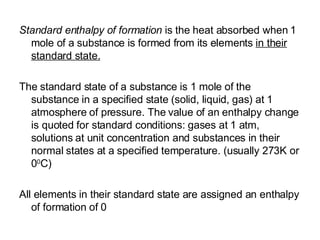
Standard enthalpy of formation  is the heat absorbed when 1 mole of a substance is formed from its elements  in their standard state. The standard state of a substance is 1 mole of the substance in a specified state (solid, liquid, gas) at 1 atmosphere of pressure. The value of an enthalpy change is quoted for standard conditions: gases at 1 atm, solutions at unit concentration and substances in their normal states at a specified temperature. (usually 273K or 0 0 C) All elements in their standard state are assigned an enthalpy of formation of 0
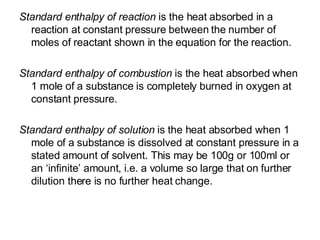
Standard enthalpy of reaction  is the heat absorbed in a reaction at constant pressure between the number of moles of reactant shown in the equation for the reaction. Standard enthalpy of combustion  is the heat absorbed when 1 mole of a substance is completely burned in oxygen at constant pressure. Standard enthalpy of solution  is the heat absorbed when 1 mole of a substance is dissolved at constant pressure in a stated amount of solvent. This may be 100g or 100ml or an ‘infinite’ amount, i.e. a volume so large that on further dilution there is no further heat change.
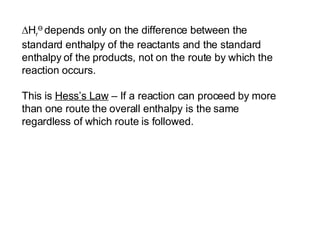
 H r Ө   depends only on the difference between the standard enthalpy of the reactants and the standard enthalpy   of the products, not on the route by which the reaction occurs. This is  Hess’s Law  – If a reaction can proceed by more than one route the overall enthalpy is the same regardless of which route is followed.
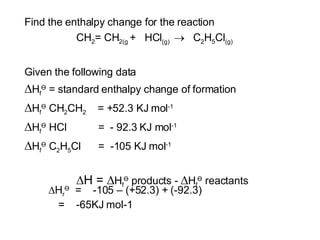
Find the enthalpy change for the reaction CH 2 = CH 2(g  +  HCl (g)     C 2 H 5 Cl (g) Given the following data  H f Ө  = standard enthalpy change of formation  H f Ө  CH 2 CH 2   = +52.3 KJ mol -1  H f Ө  HCl  =  - 92.3 KJ mol -1  H f Ө  C 2 H 5 Cl  =  -105 KJ mol -1  H =   H f Ө  products -   H f Ө  reactants  H r Ө   =  -105 – (+52.3) + (-92.3) =  -65KJ mol-1
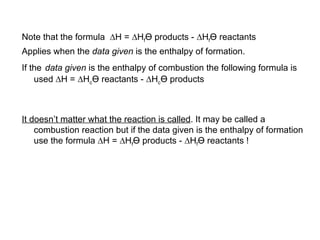
Note that the formula   H =   H f Ө  products -   H f Ө  reactants  Applies when the  data given  is the enthalpy of formation. If the   data given  is the enthalpy of combustion the following formula is used   H =   H c Ө  reactants -   H c Ө  products It doesn’t matter what the reaction is called . It may be called a combustion reaction but if the data given is the enthalpy of formation use the formula   H =   H f Ө  products -   H f Ө  reactants !
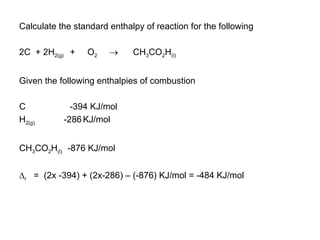
Calculate the standard enthalpy of reaction for the following 2C  + 2H 2(g)  +  O 2      CH 3 CO 2 H (l) Given the following enthalpies of combustion C  -394 KJ/mol H 2(g)  -286   KJ/mol CH 3 CO 2 H (l)  -876 KJ/mol  r   =  (2x -394) + (2x-286) – (-876) KJ/mol = -484 KJ/mol

3 Enthalpy

  • 1.
  • 2.
    Units SIunit = joule 1KJ = 1000J = 239.0 cal 1st law of Thermodynamics The total energy of the universe is constant i.e energy cannot be created or destroyed but can be changed from one form to another.
  • 3.
    Heat (or thermalenergy) q is the energy transferred between a system and its surroundings as a result of a difference in temperature only. All other forms of energy transfer (mechanical, electrical etc) involve some type of work, w, the energy transferred when an object is moved by a force. State functions A state function is a property dependant on the current state of the system (e.g. its composition, volume, temp etc) It is independent of the path the system took to reach that state.
  • 4.
    Energy of asystem is a state function So  E is a constant for any given change but q and w may vary (q and w are not state functions) and  E = q + w
  • 5.
    Energy can beconverted from one form to another e.g. from mechanical  heat  electrical  light etc. Energy is released when bonds are made Energy is used when bonds are broken Chemical reactions involve Bond breaking Bond forming
  • 6.
    Energy changes foran exothermic reaction – one where heat is released to the surroundings
  • 7.
    Energy changes foran endothermic reaction – one where heat is absorbed from the surroundings
  • 8.
    Examples of exothermicreactions neutralisation burning hydrocarbons respiration Examples of endothermic reactions photosynthesis dissolving ammonium nitrate in water
  • 9.
    The chemical energywhich a system possesses is its enthalpy. Enthalpy is the change in energy at constant pressure symbol H And  H = H products – H reactants if energy is absorbed by a system  H is positive if energy is released by a system  H is negative
  • 10.
    Energy changes foran endothermic reaction A—B + C—D Reactants A—C + B—D Products A B C D Bond breaking Bond forming Overall energy change Products have more energy than reactants E
  • 11.
    Energy changes foran exothermic reaction A—B + C—D A—C + B—D Products Bond forming Bond breaking Overall energy change E A B C D Products have less energy than reactants Reactants
  • 12.
    Energy Diagrams EActivation energy  H Reactants Products An exothermic reaction Time
  • 13.
    Reactants Activation energy H Products An endothermic reaction E Reactants Time
  • 14.
    Standard enthalpy offormation is the heat absorbed when 1 mole of a substance is formed from its elements in their standard state. The standard state of a substance is 1 mole of the substance in a specified state (solid, liquid, gas) at 1 atmosphere of pressure. The value of an enthalpy change is quoted for standard conditions: gases at 1 atm, solutions at unit concentration and substances in their normal states at a specified temperature. (usually 273K or 0 0 C) All elements in their standard state are assigned an enthalpy of formation of 0
  • 15.
    Standard enthalpy ofreaction is the heat absorbed in a reaction at constant pressure between the number of moles of reactant shown in the equation for the reaction. Standard enthalpy of combustion is the heat absorbed when 1 mole of a substance is completely burned in oxygen at constant pressure. Standard enthalpy of solution is the heat absorbed when 1 mole of a substance is dissolved at constant pressure in a stated amount of solvent. This may be 100g or 100ml or an ‘infinite’ amount, i.e. a volume so large that on further dilution there is no further heat change.
  • 16.
     H rӨ depends only on the difference between the standard enthalpy of the reactants and the standard enthalpy of the products, not on the route by which the reaction occurs. This is Hess’s Law – If a reaction can proceed by more than one route the overall enthalpy is the same regardless of which route is followed.
  • 17.
    Find the enthalpychange for the reaction CH 2 = CH 2(g + HCl (g)  C 2 H 5 Cl (g) Given the following data  H f Ө = standard enthalpy change of formation  H f Ө CH 2 CH 2 = +52.3 KJ mol -1  H f Ө HCl = - 92.3 KJ mol -1  H f Ө C 2 H 5 Cl = -105 KJ mol -1  H =  H f Ө products -  H f Ө reactants  H r Ө = -105 – (+52.3) + (-92.3) = -65KJ mol-1
  • 18.
    Note that theformula  H =  H f Ө products -  H f Ө reactants Applies when the data given is the enthalpy of formation. If the data given is the enthalpy of combustion the following formula is used  H =  H c Ө reactants -  H c Ө products It doesn’t matter what the reaction is called . It may be called a combustion reaction but if the data given is the enthalpy of formation use the formula  H =  H f Ө products -  H f Ө reactants !
  • 19.
    Calculate the standardenthalpy of reaction for the following 2C + 2H 2(g) + O 2  CH 3 CO 2 H (l) Given the following enthalpies of combustion C -394 KJ/mol H 2(g) -286 KJ/mol CH 3 CO 2 H (l) -876 KJ/mol  r = (2x -394) + (2x-286) – (-876) KJ/mol = -484 KJ/mol