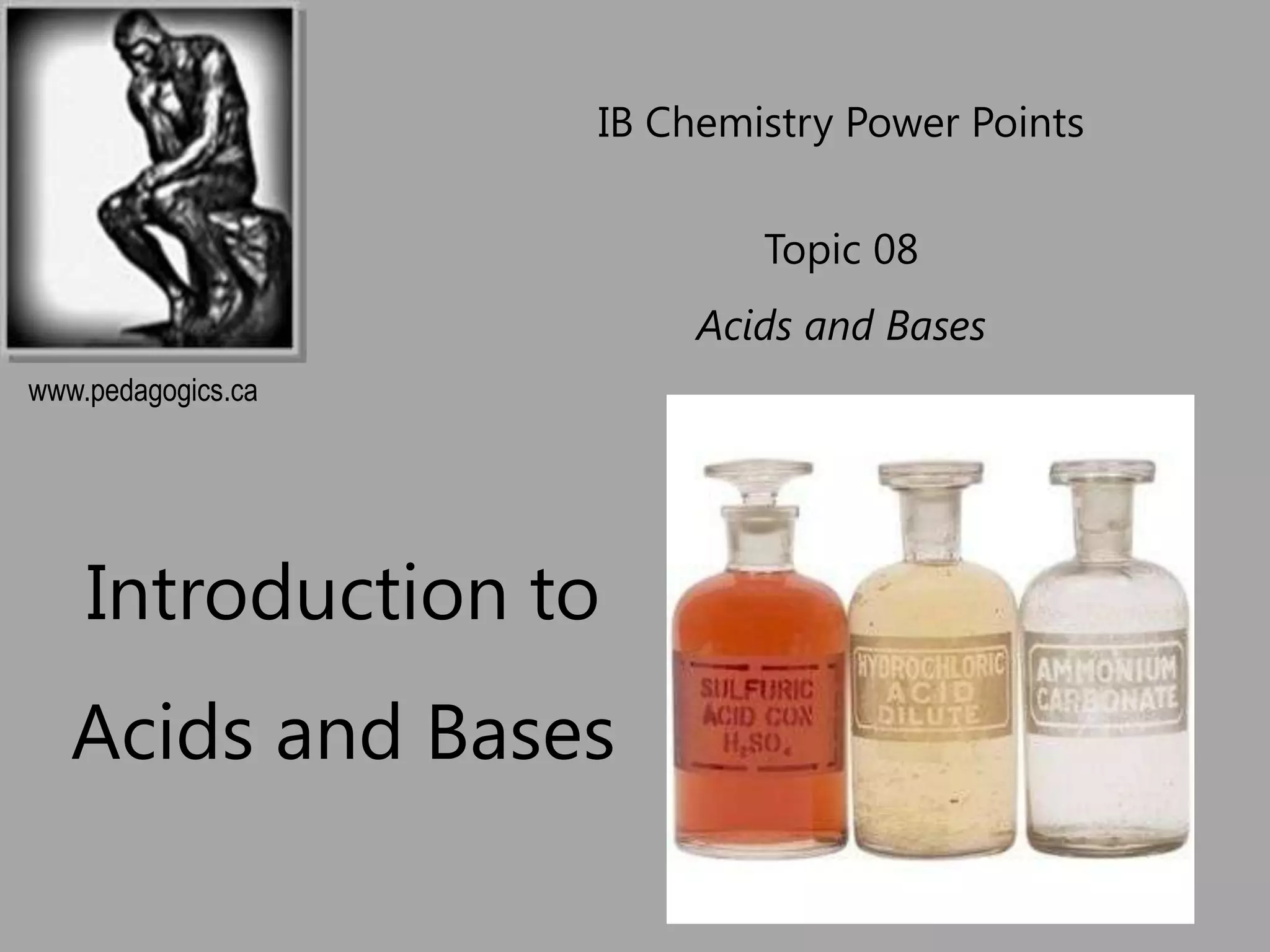
IB Chemistry Power Points

                            Topic 08
                         Acids and Bases
www.pedagogics.ca


    Introduction to
   Acids and Bases
In aqueous solutions, a proportion of the water
molecules dissociate;

   The ions formed are H+ or positively charged
    hydrogen ions and negatively charged hydroxide ions
    (OH-)
            Technically
                                   +                   -
             2 H2O(l)  H3O            (aq)   + OH (aq)


                                          +        −       -14
       Equilibrium Constant     Kw = [H ][OH ] = 1 x 10
 Some chemical compounds contribute additional H+
 to make the solution more acidic. Other compounds
 remove H+ ions.

 A compound that increases [H+] is called an acid

 Examples: HCl, H2SO4, HNO3, CH3COOH
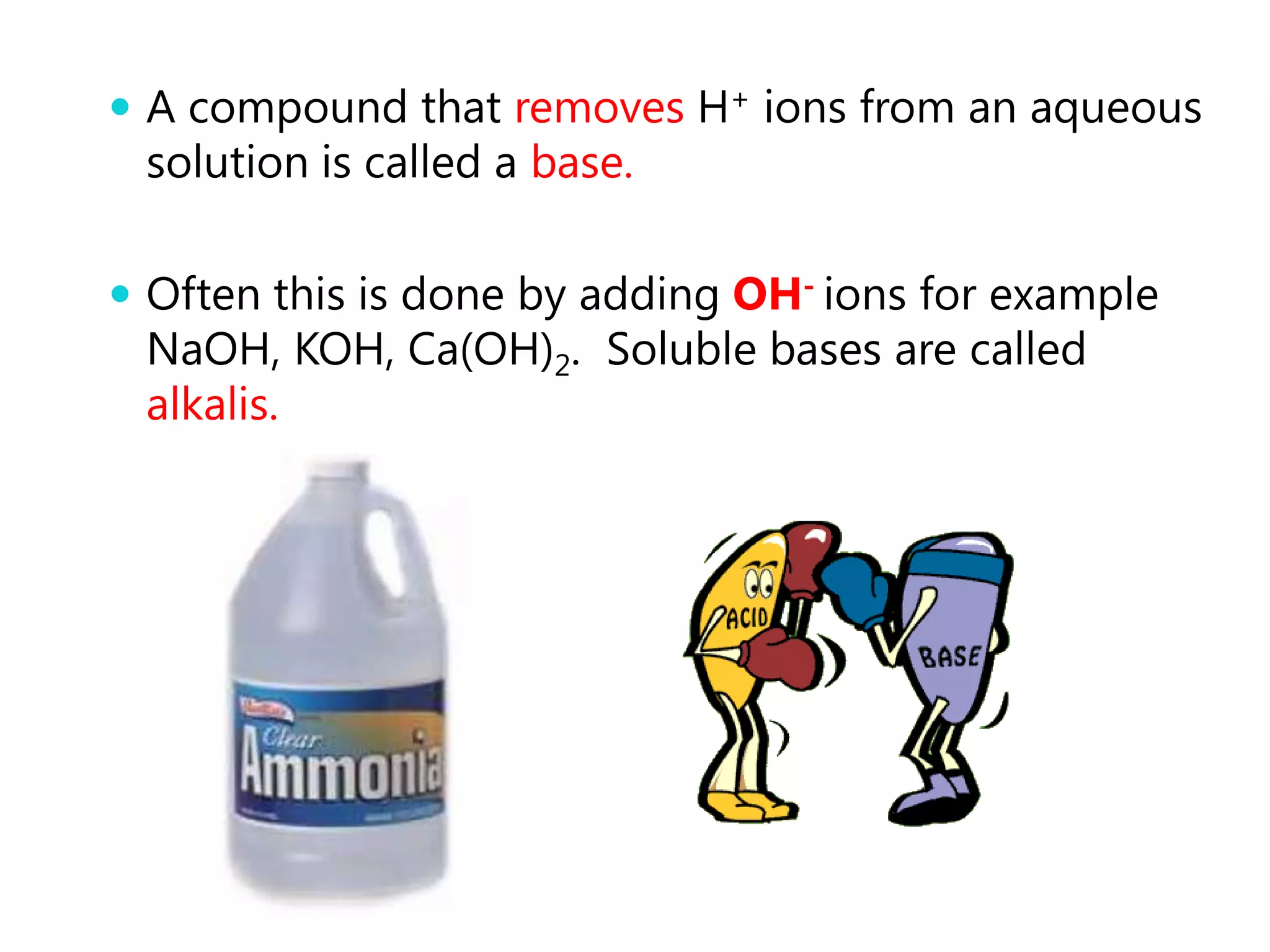
 A compound that removes H+ ions from an aqueous
 solution is called a base.

 Often this is done by adding OH- ions for example
 NaOH, KOH, Ca(OH)2. Soluble bases are called
 alkalis.
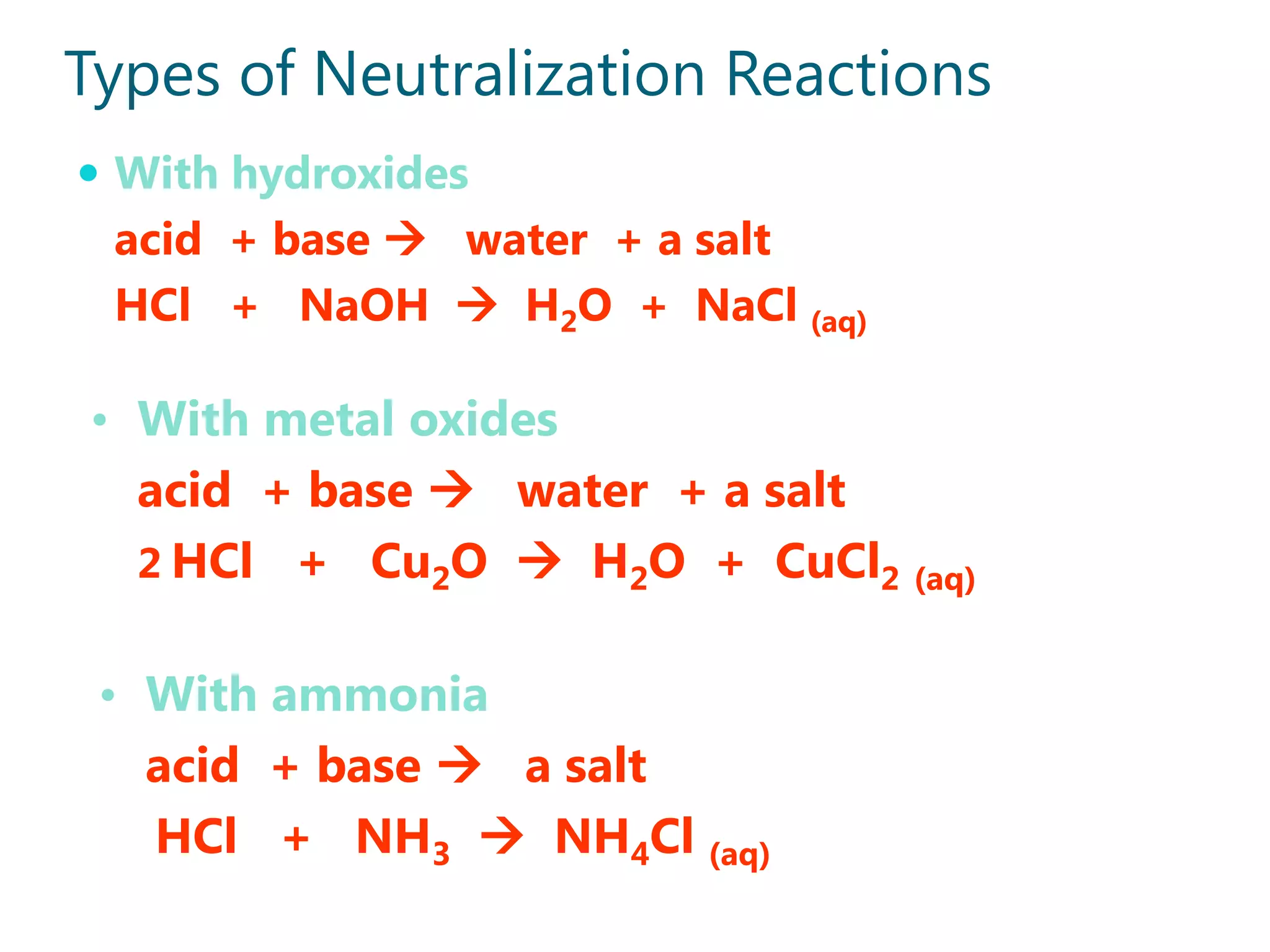
Types of Neutralization Reactions
 With hydroxides
 acid + base  water + a salt
 HCl + NaOH  H2O + NaCl (aq)

• With metal oxides
  acid + base  water + a salt
  2 HCl + Cu2O  H2O + CuCl2 (aq)


 • With ammonia
   acid + base  a salt
   HCl + NH3  NH4Cl (aq)
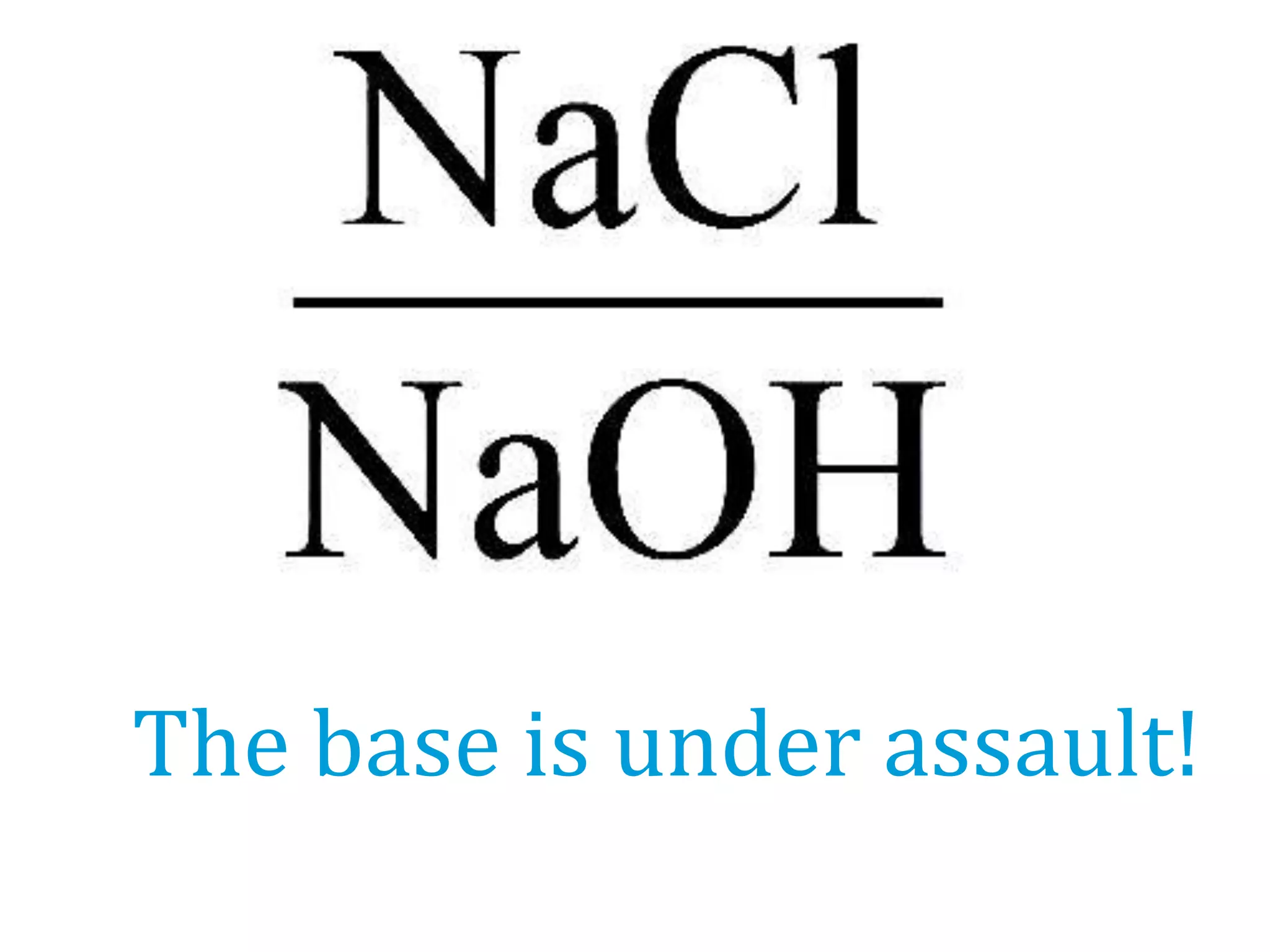
The base is under assault!
Three theories of acids
Arrhenius (most common)
Bronsted-Lowry
Lewis
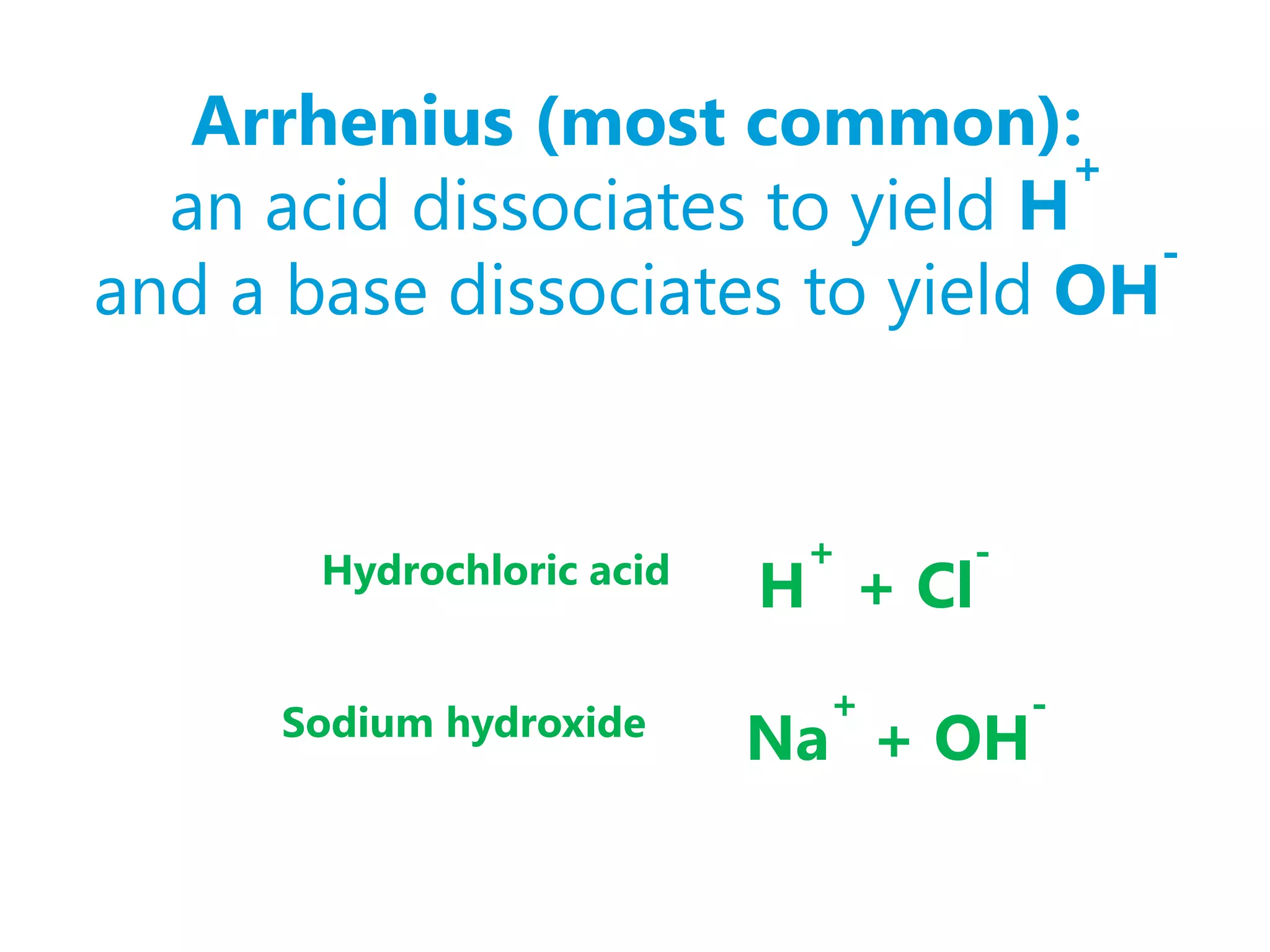
Arrhenius (most common):
                                +
  an acid dissociates to yield H
                                  -
and a base dissociates to yield OH


       Hydrochloric acid    +    -
                           H + Cl

      Sodium hydroxide       +       -
                           Na + OH
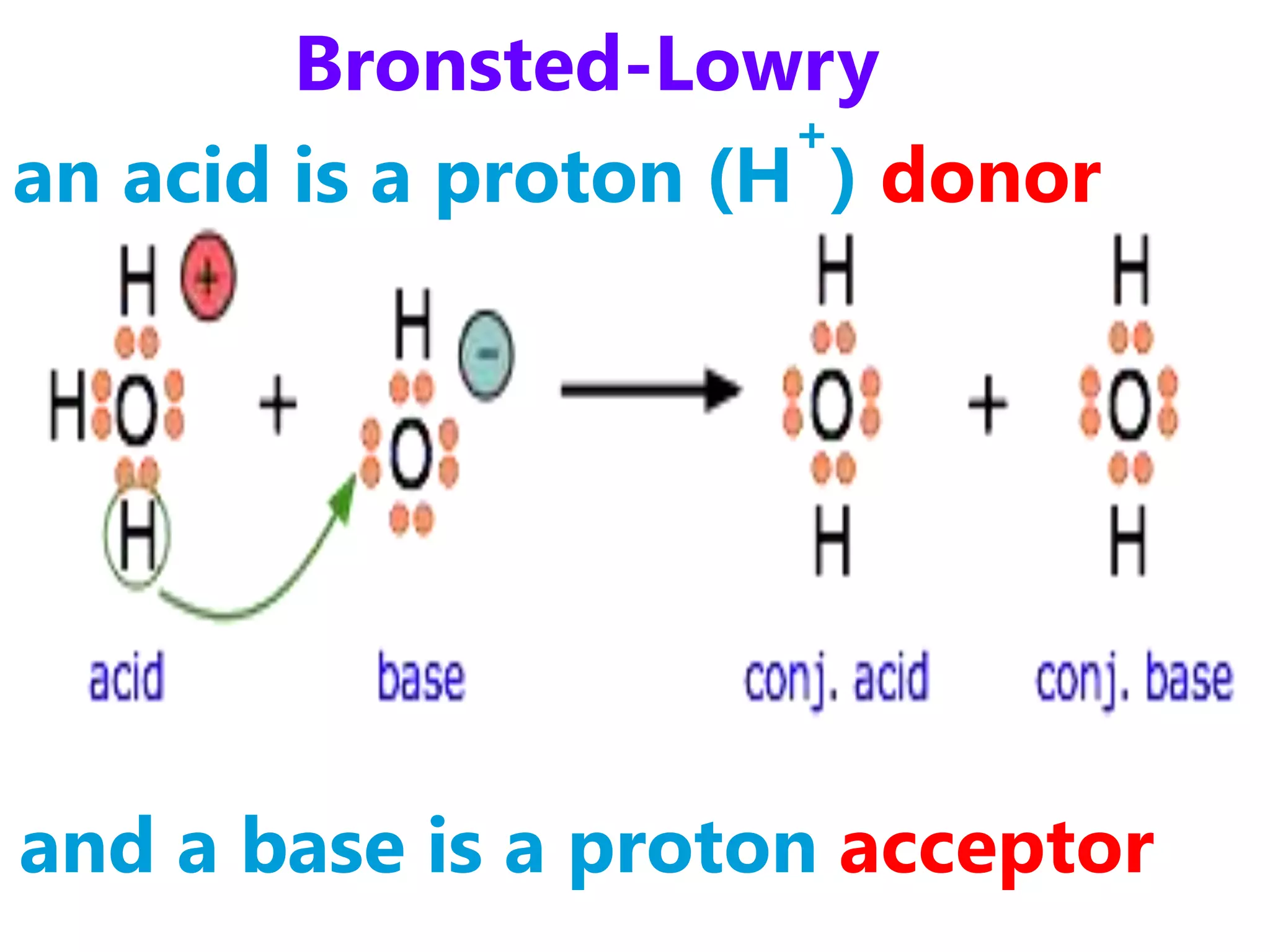
Bronsted-Lowry
                      +
an acid is a proton (H ) donor


and a base is a proton acceptor
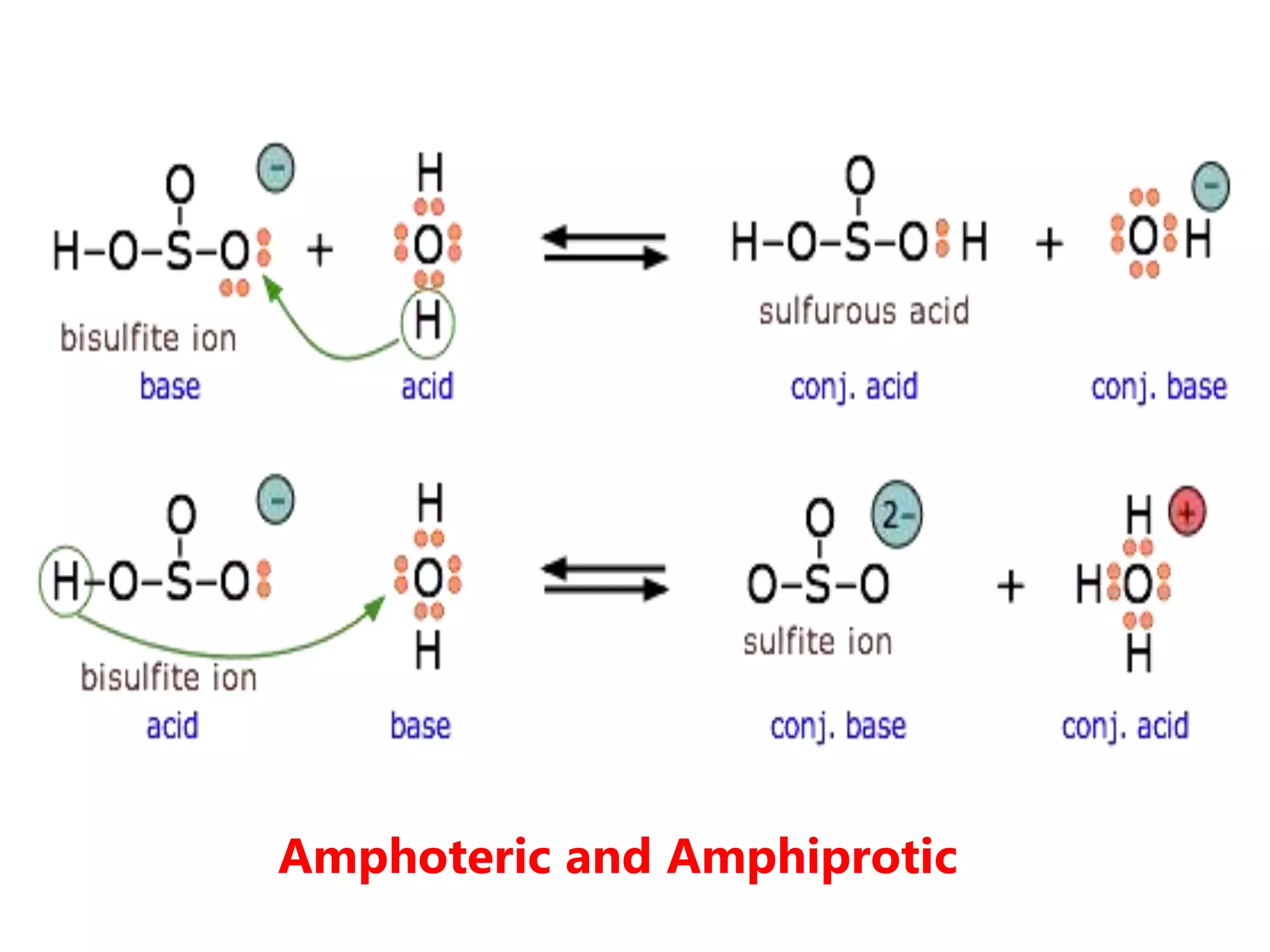
Amphoteric and Amphiprotic
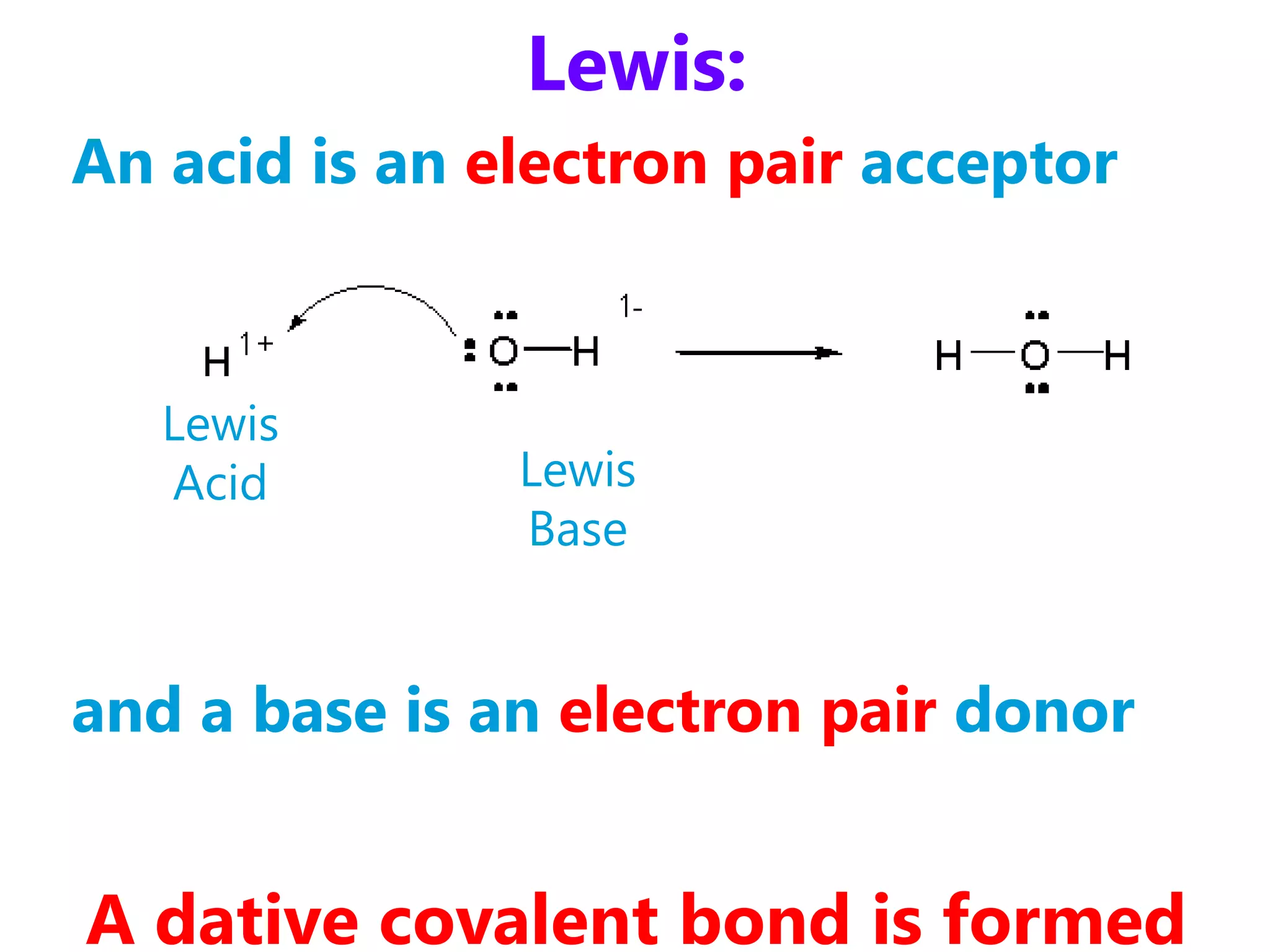
Lewis:
An acid is an electron pair acceptor


   Lewis
   Acid        Lewis
               Base


and a base is an electron pair donor


A dative covalent bond is formed
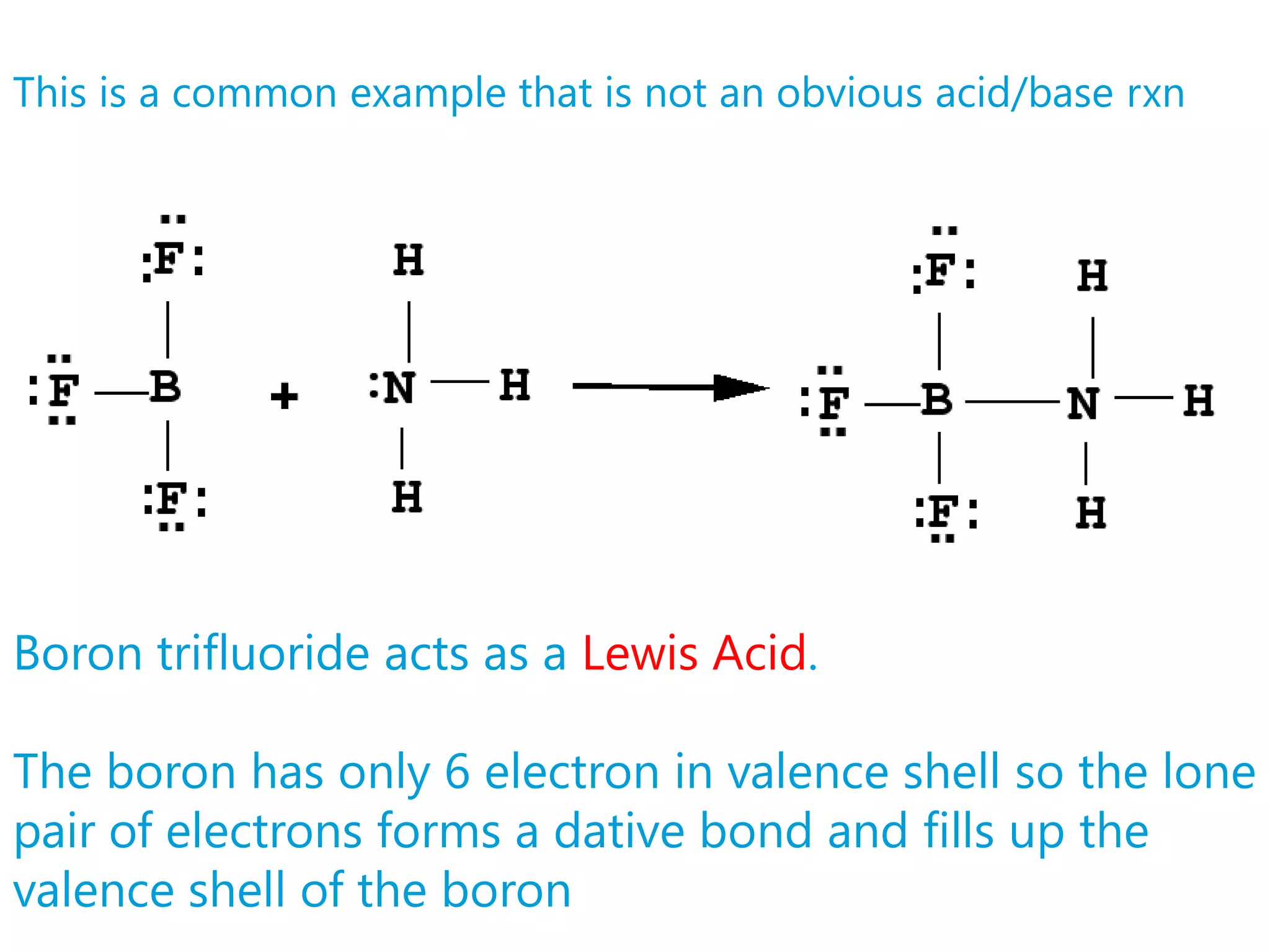
This is a common example that is not an obvious acid/base rxn


Boron trifluoride acts as a Lewis Acid.

The boron has only 6 electron in valence shell so the lone
pair of electrons forms a dative bond and fills up the
valence shell of the boron
Indicators
Acids and bases are substances with
specific physical and chemical
properties.

We can determine if substances are
acidic or basic by testing their reaction
with indicators.
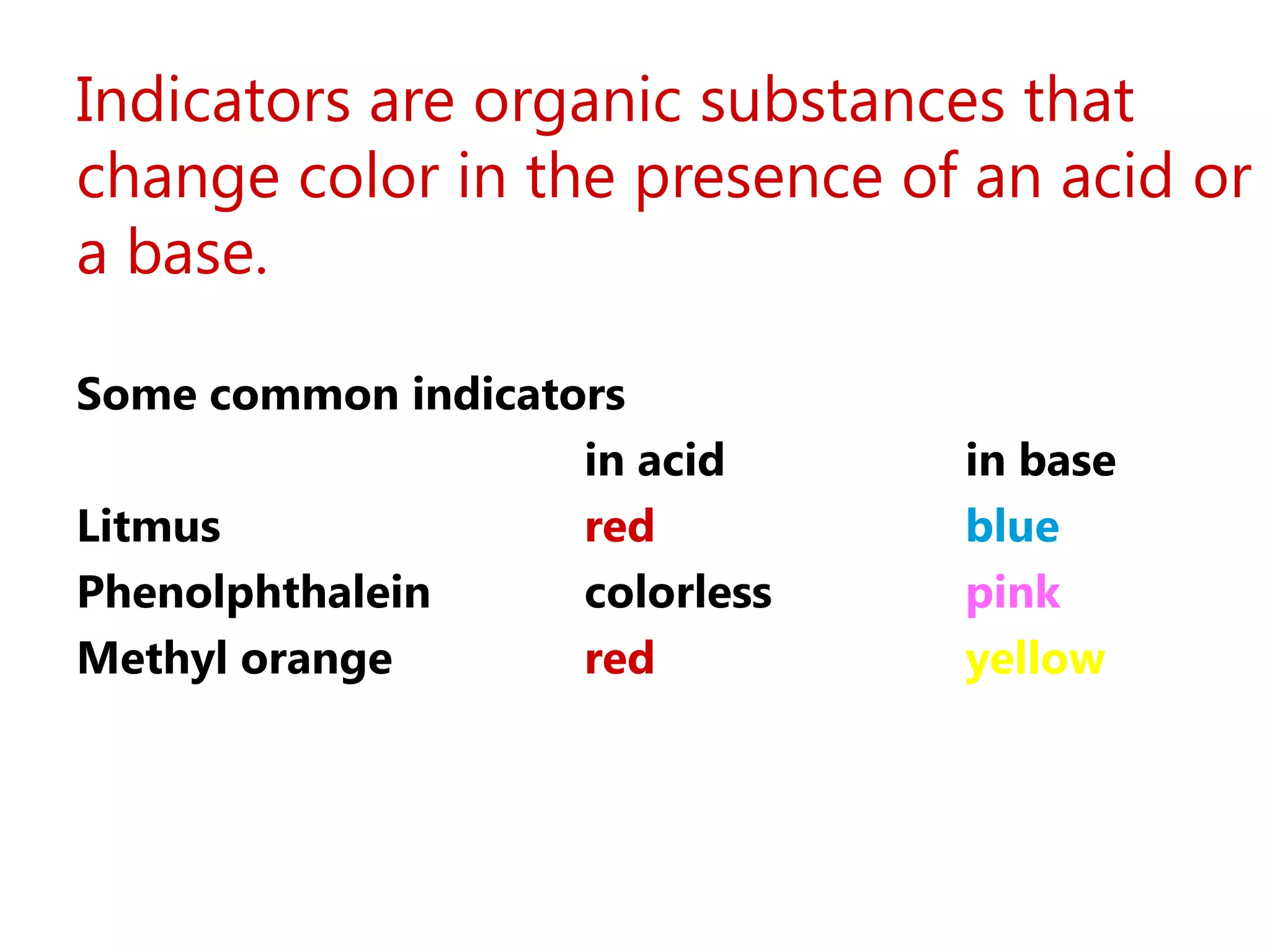
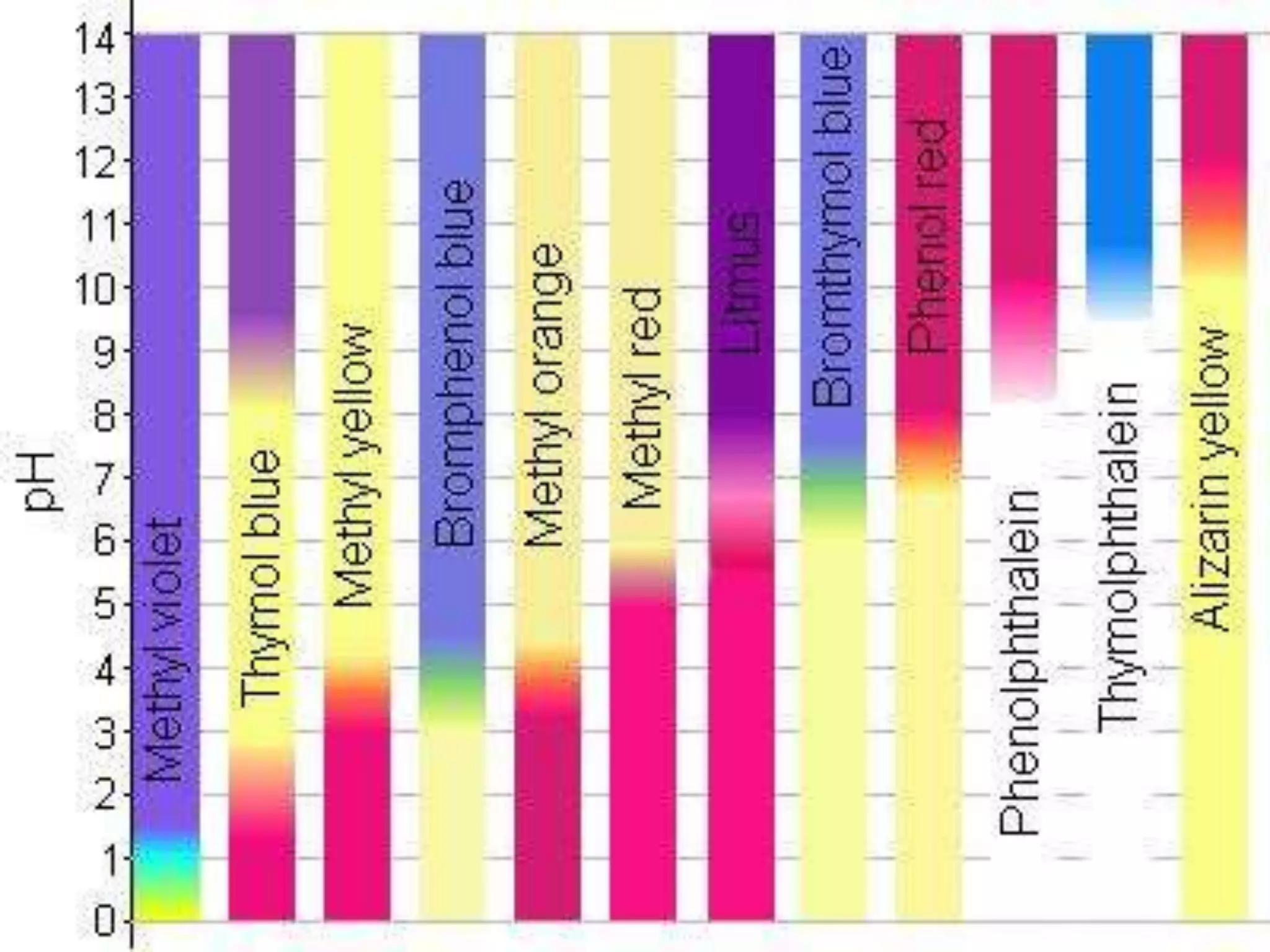
Indicators are organic substances that
change color in the presence of an acid or
a base.

Some common indicators
                    in acid     in base
Litmus              red         blue
Phenolphthalein     colorless   pink
Methyl orange       red         yellow
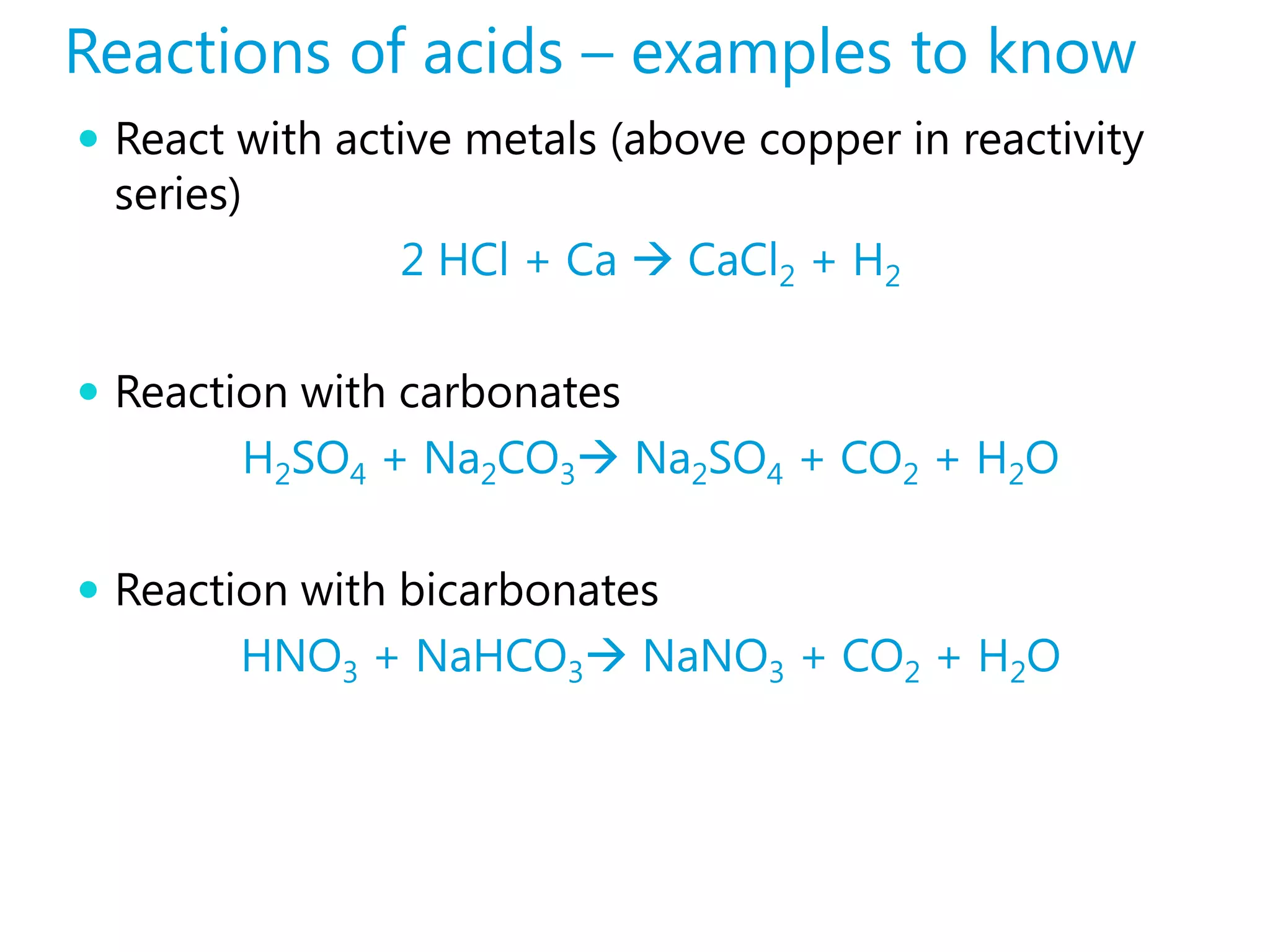
Reactions of acids – examples to know
 React with active metals (above copper in reactivity
 series)
                2 HCl + Ca  CaCl2 + H2

 Reaction with carbonates
        H2SO4 + Na2CO3 Na2SO4 + CO2 + H2O

 Reaction with bicarbonates
        HNO3 + NaHCO3 NaNO3 + CO2 + H2O
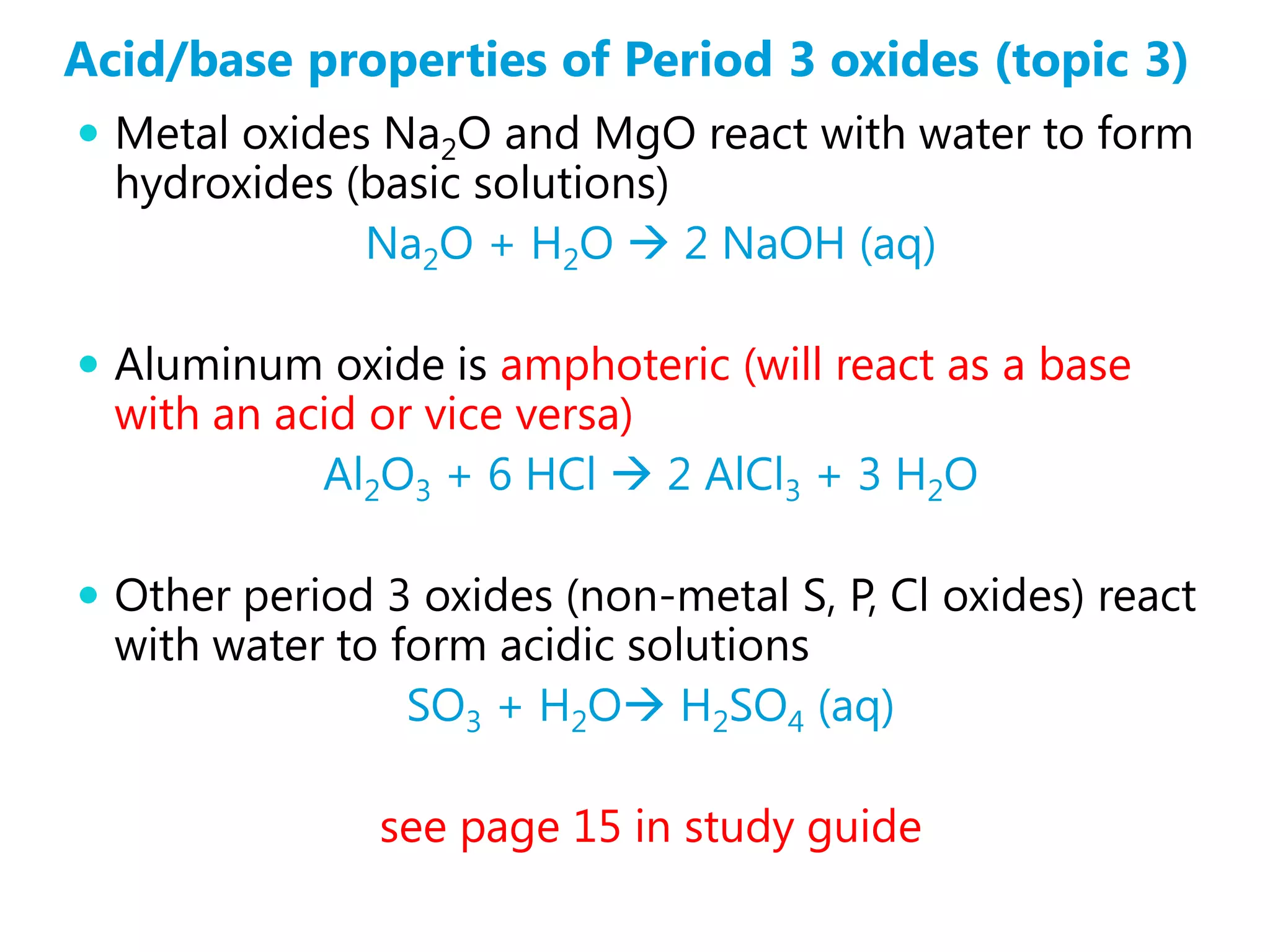
Acid/base properties of Period 3 oxides (topic 3)
 Metal oxides Na2O and MgO react with water to form
  hydroxides (basic solutions)
              Na2O + H2O  2 NaOH (aq)

 Aluminum oxide is amphoteric (will react as a base
  with an acid or vice versa)
            Al2O3 + 6 HCl  2 AlCl3 + 3 H2O

 Other period 3 oxides (non-metal S, P, Cl oxides) react
  with water to form acidic solutions
                 SO3 + H2O H2SO4 (aq)

               see page 15 in study guide
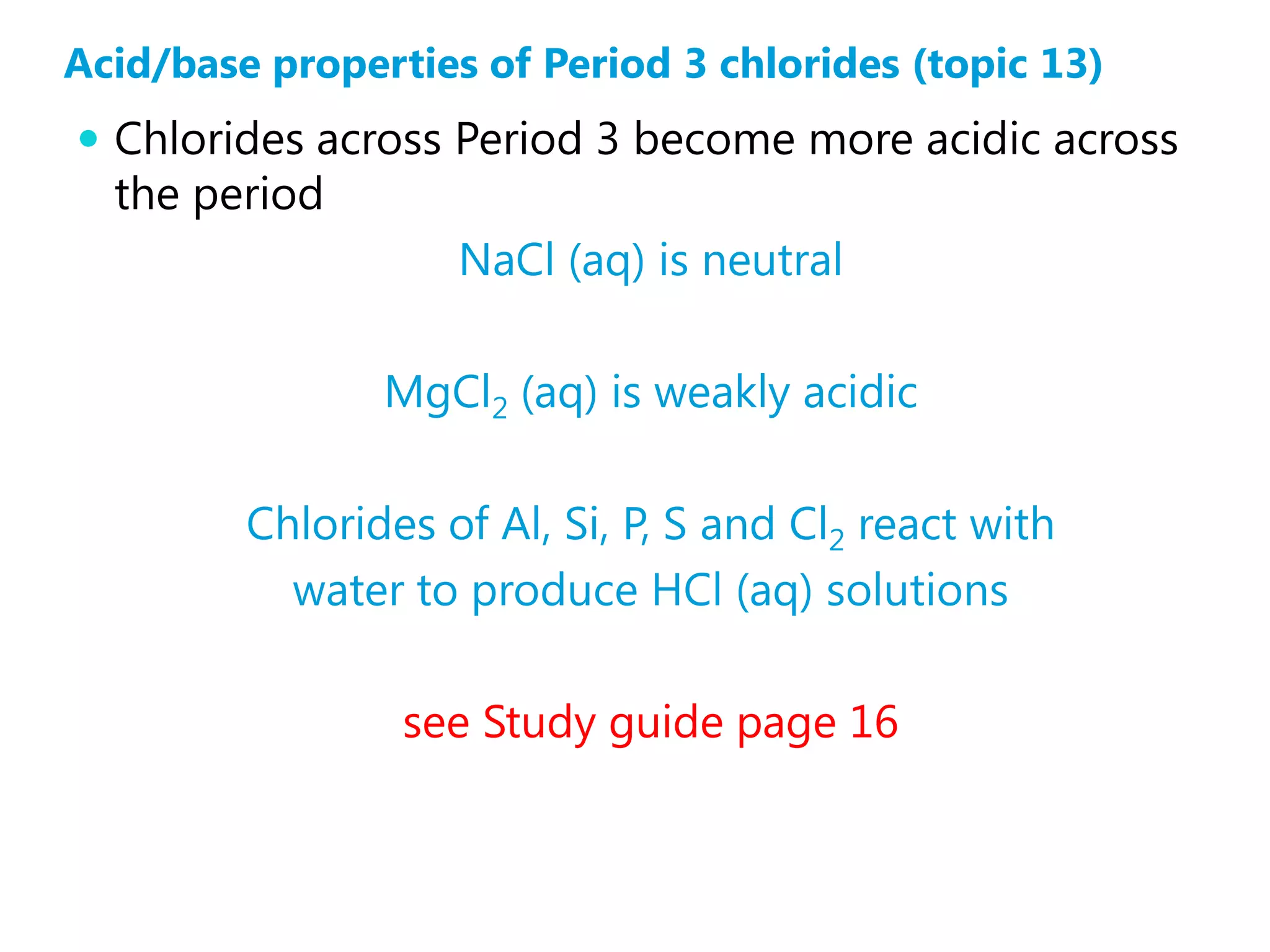
Acid/base properties of Period 3 chlorides (topic 13)
 Chlorides across Period 3 become more acidic across
  the period
                    NaCl (aq) is neutral

                MgCl2 (aq) is weakly acidic

         Chlorides of Al, Si, P, S and Cl2 react with
           water to produce HCl (aq) solutions

                 see Study guide page 16
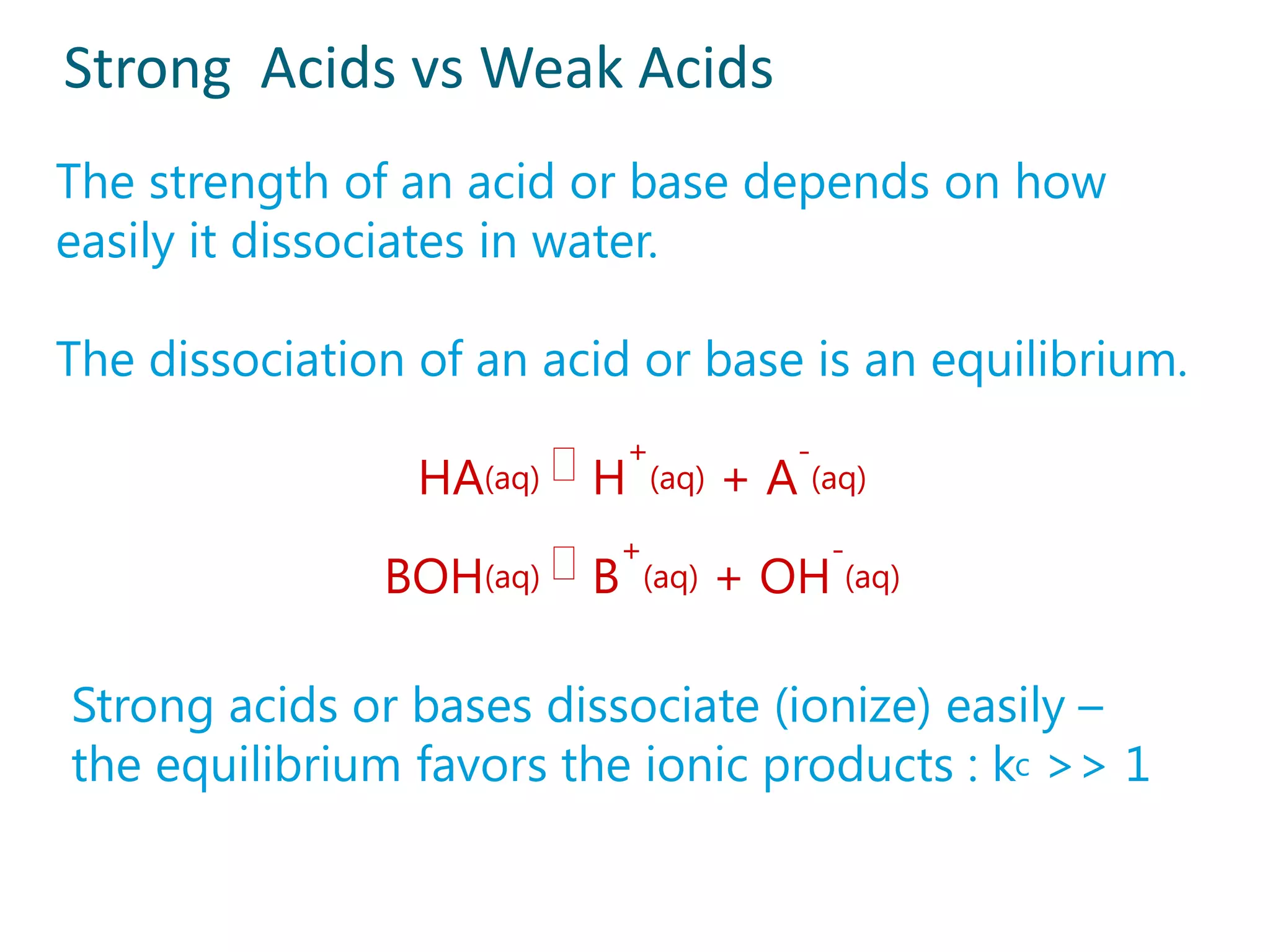
Strong Acids vs Weak Acids
The strength of an acid or base depends on how
easily it dissociates in water.

The dissociation of an acid or base is an equilibrium.

                 HA(aq)  H+(aq) + A-(aq)

               BOH(aq)  B+(aq) + OH-(aq)

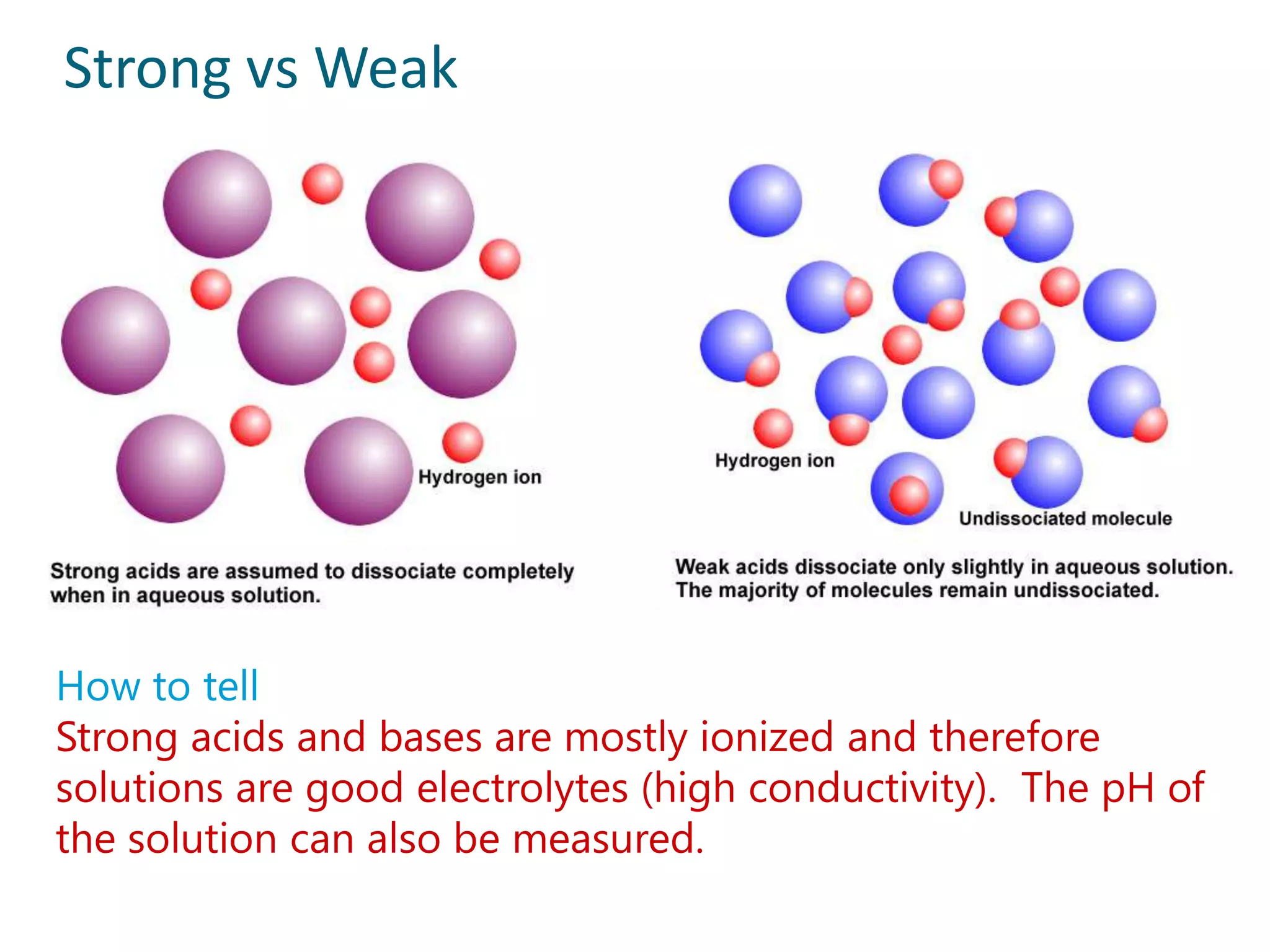
Strong acids or bases dissociate (ionize) easily –
the equilibrium favors the ionic products : kc >> 1
Strong vs Weak


How to tell
Strong acids and bases are mostly ionized and therefore
solutions are good electrolytes (high conductivity). The pH of
the solution can also be measured.
Strong vs Weak
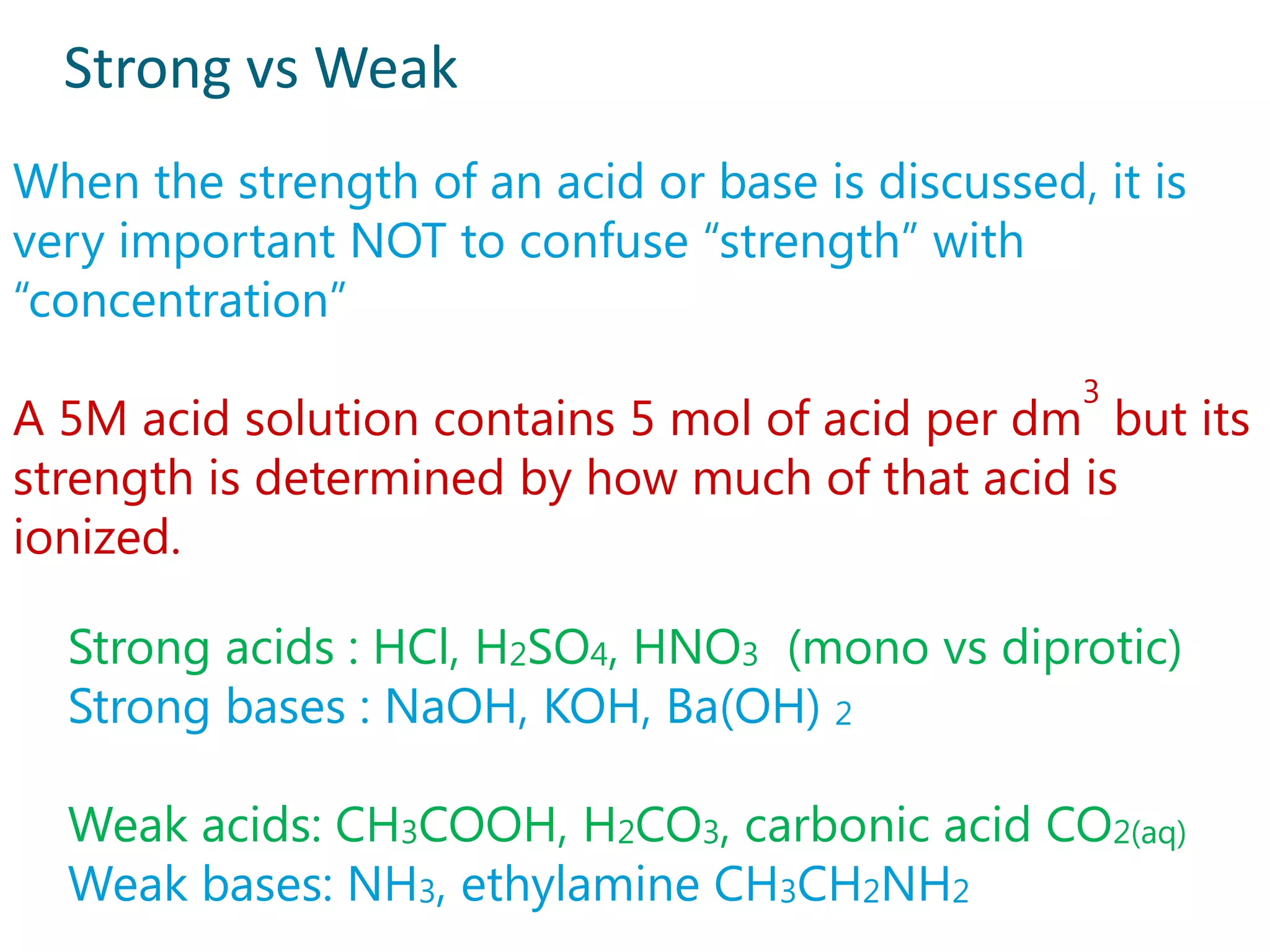
When the strength of an acid or base is discussed, it is
very important NOT to confuse “strength” with
“concentration”
                                                   3
A 5M acid solution contains 5 mol of acid per dm but its
strength is determined by how much of that acid is
ionized.

  Strong acids : HCl, H2SO4, HNO3 (mono vs diprotic)
  Strong bases : NaOH, KOH, Ba(OH) 2

  Weak acids: CH3COOH, H2CO3, carbonic acid CO2(aq)
  Weak bases: NH3, ethylamine CH3CH2NH2
Strong Acid

    example HCl
               +                -
HCl(aq)      H     (aq)   +   Cl (aq)
        [H+ ][Cl- ]
     k=             >> 1
          [HCl]

•    completely dissociated
•    pH of 0.1 M soln = 1
•    strong electrolyte
•    reacts vigorously
•   note simplified “net ionic”
    equation
Weak Acid

  example CH3COOH
                   +                    -
CH3COOH (aq)     H     (aq)   +   CH3COO (aq)

         [H+ ][CH3COO- ]
      k=                 << 1
           [CH3COOH]

     •   partially dissociated
     •   pH of 0.1 M soln = 2.9
     •   weak electrolyte
     •   reacts slowly
What is the pH scale?
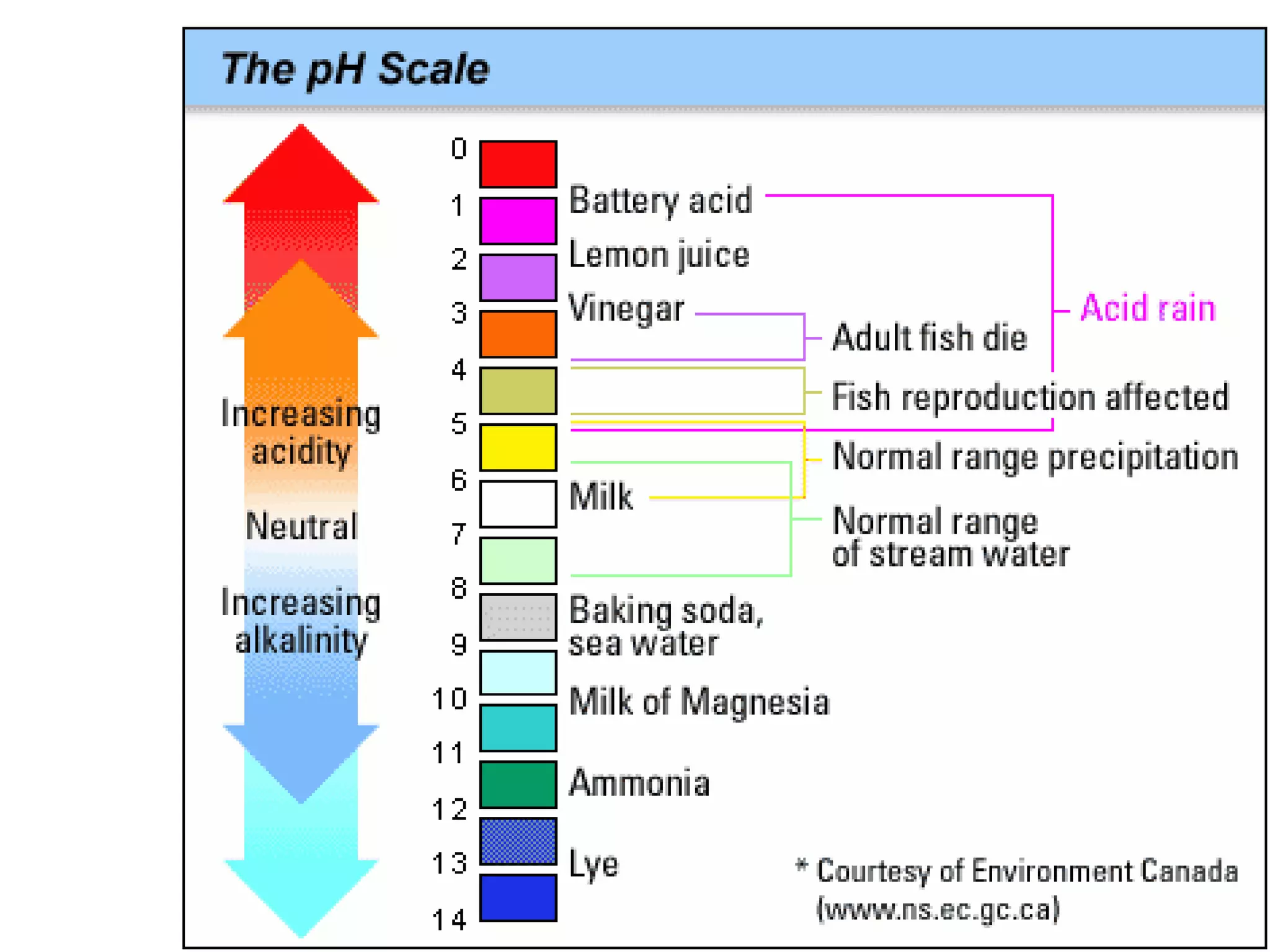
   pH is a measurement of hydrogen ion concentration

   It tells you how acidic or basic (or alkaline) something is

   Ranges from 0 (most acidic) to 14 (most basic)


              pH                 log[ H ]
How does scale work?
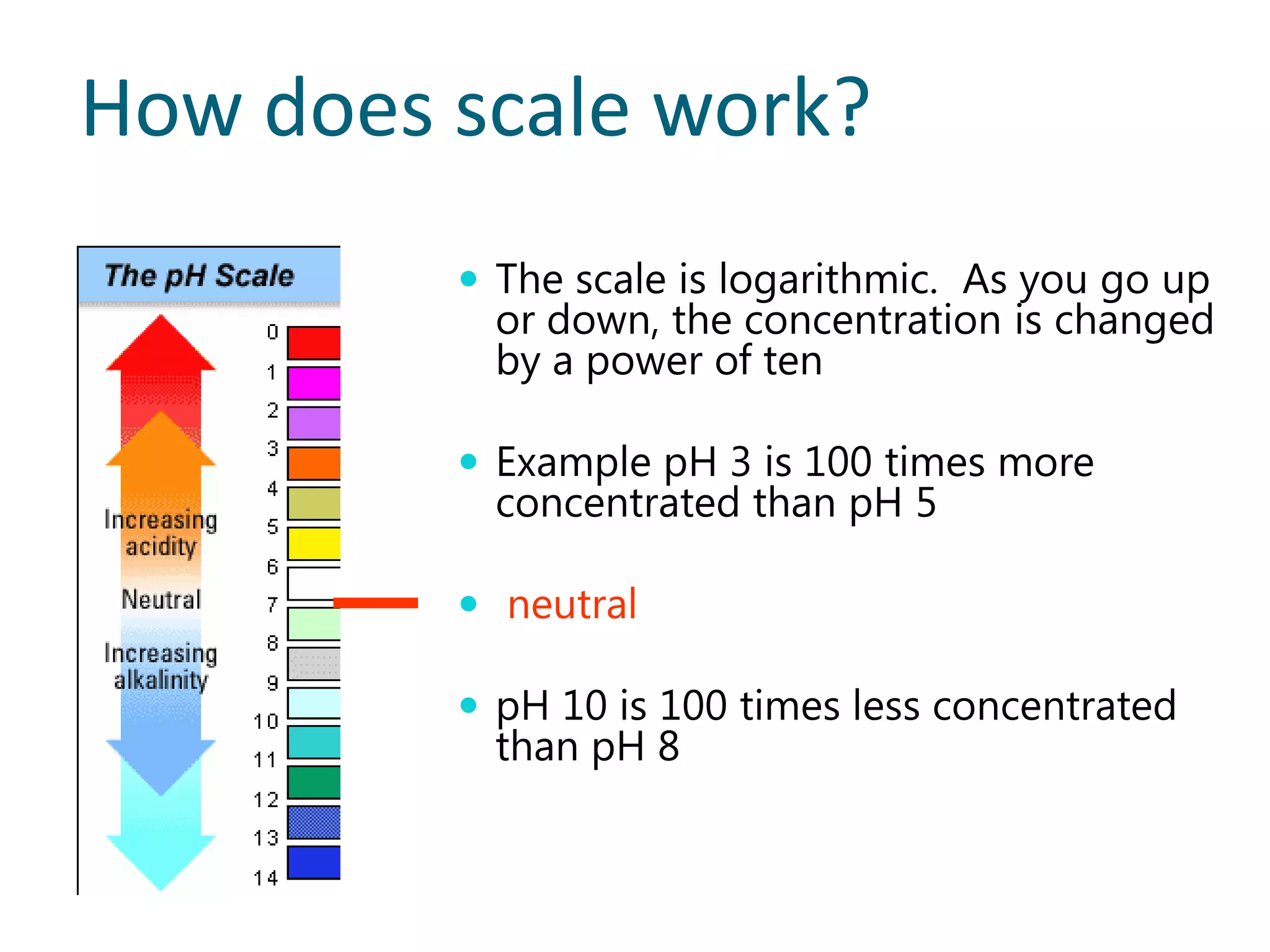
          The scale is logarithmic. As you go up
           or down, the concentration is changed
           by a power of ten

          Example pH 3 is 100 times more
           concentrated than pH 5

          neutral

          pH 10 is 100 times less concentrated
           than pH 8
Topic 08   introduction

Topic 08 introduction

  • 1.
    IB Chemistry PowerPoints Topic 08 Acids and Bases www.pedagogics.ca Introduction to Acids and Bases
  • 2.
    In aqueous solutions,a proportion of the water molecules dissociate;  The ions formed are H+ or positively charged hydrogen ions and negatively charged hydroxide ions (OH-) Technically + - 2 H2O(l)  H3O (aq) + OH (aq) + − -14 Equilibrium Constant Kw = [H ][OH ] = 1 x 10
  • 3.
     Some chemicalcompounds contribute additional H+ to make the solution more acidic. Other compounds remove H+ ions.  A compound that increases [H+] is called an acid  Examples: HCl, H2SO4, HNO3, CH3COOH
  • 4.
     A compoundthat removes H+ ions from an aqueous solution is called a base.  Often this is done by adding OH- ions for example NaOH, KOH, Ca(OH)2. Soluble bases are called alkalis.
  • 5.
    Types of NeutralizationReactions  With hydroxides acid + base  water + a salt HCl + NaOH  H2O + NaCl (aq) • With metal oxides acid + base  water + a salt 2 HCl + Cu2O  H2O + CuCl2 (aq) • With ammonia acid + base  a salt HCl + NH3  NH4Cl (aq)
  • 6.
    The base isunder assault!
  • 7.
    Three theories ofacids Arrhenius (most common) Bronsted-Lowry Lewis
  • 8.
    Arrhenius (most common): + an acid dissociates to yield H - and a base dissociates to yield OH Hydrochloric acid + - H + Cl Sodium hydroxide + - Na + OH
  • 9.
    Bronsted-Lowry + an acid is a proton (H ) donor and a base is a proton acceptor
  • 10.
  • 11.
    Lewis: An acid isan electron pair acceptor Lewis Acid Lewis Base and a base is an electron pair donor A dative covalent bond is formed
  • 12.
    This is acommon example that is not an obvious acid/base rxn Boron trifluoride acts as a Lewis Acid. The boron has only 6 electron in valence shell so the lone pair of electrons forms a dative bond and fills up the valence shell of the boron
  • 13.
    Indicators Acids and basesare substances with specific physical and chemical properties. We can determine if substances are acidic or basic by testing their reaction with indicators.
  • 14.
    Indicators are organicsubstances that change color in the presence of an acid or a base. Some common indicators in acid in base Litmus red blue Phenolphthalein colorless pink Methyl orange red yellow
  • 16.
    Reactions of acids– examples to know  React with active metals (above copper in reactivity series) 2 HCl + Ca  CaCl2 + H2  Reaction with carbonates H2SO4 + Na2CO3 Na2SO4 + CO2 + H2O  Reaction with bicarbonates HNO3 + NaHCO3 NaNO3 + CO2 + H2O
  • 17.
    Acid/base properties ofPeriod 3 oxides (topic 3)  Metal oxides Na2O and MgO react with water to form hydroxides (basic solutions) Na2O + H2O  2 NaOH (aq)  Aluminum oxide is amphoteric (will react as a base with an acid or vice versa) Al2O3 + 6 HCl  2 AlCl3 + 3 H2O  Other period 3 oxides (non-metal S, P, Cl oxides) react with water to form acidic solutions SO3 + H2O H2SO4 (aq) see page 15 in study guide
  • 18.
    Acid/base properties ofPeriod 3 chlorides (topic 13)  Chlorides across Period 3 become more acidic across the period NaCl (aq) is neutral MgCl2 (aq) is weakly acidic Chlorides of Al, Si, P, S and Cl2 react with water to produce HCl (aq) solutions see Study guide page 16
  • 19.
    Strong Acids vsWeak Acids The strength of an acid or base depends on how easily it dissociates in water. The dissociation of an acid or base is an equilibrium. HA(aq)  H+(aq) + A-(aq) BOH(aq)  B+(aq) + OH-(aq) Strong acids or bases dissociate (ionize) easily – the equilibrium favors the ionic products : kc >> 1
  • 20.
    Strong vs Weak Howto tell Strong acids and bases are mostly ionized and therefore solutions are good electrolytes (high conductivity). The pH of the solution can also be measured.
  • 21.
    Strong vs Weak Whenthe strength of an acid or base is discussed, it is very important NOT to confuse “strength” with “concentration” 3 A 5M acid solution contains 5 mol of acid per dm but its strength is determined by how much of that acid is ionized. Strong acids : HCl, H2SO4, HNO3 (mono vs diprotic) Strong bases : NaOH, KOH, Ba(OH) 2 Weak acids: CH3COOH, H2CO3, carbonic acid CO2(aq) Weak bases: NH3, ethylamine CH3CH2NH2
  • 22.
    Strong Acid example HCl + - HCl(aq) H (aq) + Cl (aq) [H+ ][Cl- ] k= >> 1 [HCl] • completely dissociated • pH of 0.1 M soln = 1 • strong electrolyte • reacts vigorously • note simplified “net ionic” equation
  • 23.
    Weak Acid example CH3COOH + - CH3COOH (aq) H (aq) + CH3COO (aq) [H+ ][CH3COO- ] k= << 1 [CH3COOH] • partially dissociated • pH of 0.1 M soln = 2.9 • weak electrolyte • reacts slowly
  • 24.
    What is thepH scale?  pH is a measurement of hydrogen ion concentration  It tells you how acidic or basic (or alkaline) something is  Ranges from 0 (most acidic) to 14 (most basic) pH log[ H ]
  • 25.
    How does scalework?  The scale is logarithmic. As you go up or down, the concentration is changed by a power of ten  Example pH 3 is 100 times more concentrated than pH 5  neutral  pH 10 is 100 times less concentrated than pH 8