z
Ionic equilibrium
Presentedby:FreyaCardozo
1
z
Electrolyte
 The substances which give rise to ions when dissolved in water are electrolytes.
 The non electrolytes are those which do not ionize and exist as molecules in
aqueous solutions.
 Electrolytes can be classified as
1. Strong electrolyte : The electrolytes Ionizing completely or almost completely
are strong electrolytes. For example : strong acids, strong bases and salts.Eg.HCl
2. Weak electrolytes :The electrolytes which dissociate to a smaller extent in
aqueous solution are weak electrolytes. Weak acids and weak bases belong to
this class. Eg. CH3COOH
Presentedby:FreyaCardozo
2
z
Representation
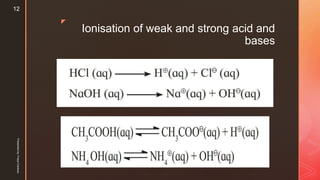
We represent strong electrolytes using 
Since weak electrolytes do not completely ionize we represent it by double
headed arrow showing equilibrium
Presentedby:FreyaCardozo
3
z
Degree of dissociation (∝)
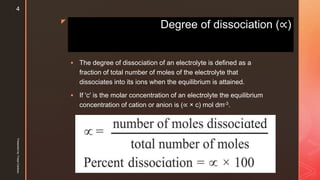
 The degree of dissociation of an electrolyte is defined as a
fraction of total number of moles of the electrolyte that
dissociates into its ions when the equilibrium is attained.
 If 'c' is the molar concentration of an electrolyte the equilibrium
concentration of cation or anion is (∝ × c) mol dm-3.
Presentedby:FreyaCardozo
4
z
Acid base theories

 Arrehnius theory
 Bronsted-Lowry theory.
 Lewis theory
Presentedby:FreyaCardozo
5
z
Arrhenius theory
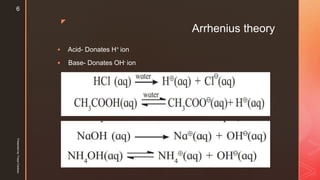
 Acid- Donates H+ ion
 Base- Donates OH- ion
Presentedby:FreyaCardozo
6
z
Drawback
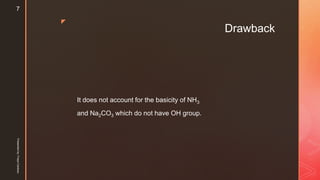
It does not account for the basicity of NH3
and Na2CO3 which do not have OH group.
Presentedby:FreyaCardozo
7
z
Bronsted-Lowry theory -proton transfer
theory.
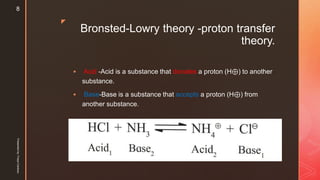
 Acid -Acid is a substance that donates a proton (H⊕) to another
substance.
 Base-Base is a substance that accepts a proton (H⊕) from
another substance.
Presentedby:FreyaCardozo
8
z
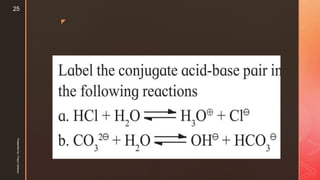
Conjugate acid- bases
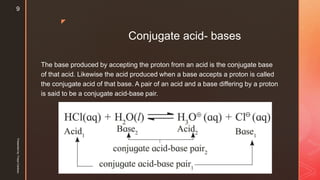
The base produced by accepting the proton from an acid is the conjugate base
of that acid. Likewise the acid produced when a base accepts a proton is called
the conjugate acid of that base. A pair of an acid and a base differing by a proton
is said to be a conjugate acid-base pair.
Presentedby:FreyaCardozo
9
z
Lewis – electron pair Theory
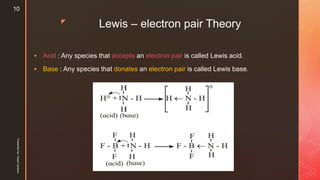
 Acid : Any species that accepts an electron pair is called Lewis acid.
 Base : Any species that donates an electron pair is called Lewis base.
Presentedby:FreyaCardozo
10
z
Amphoteric nature of water
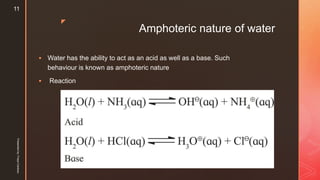
 Water has the ability to act as an acid as well as a base. Such
behaviour is known as amphoteric nature
 Reaction
Presentedby:FreyaCardozo
11
z
Ionisation of weak and strong acid and
bases
Presentedby:FreyaCardozo
12
z
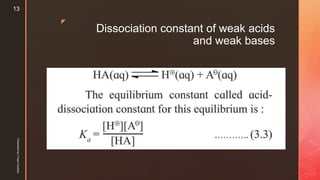
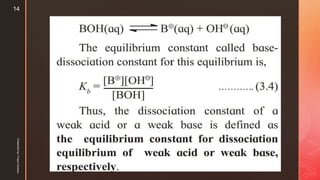
Dissociation constant of weak acids
and weak bases
Presentedby:FreyaCardozo
13
z
Presentedby:FreyaCardozo
14
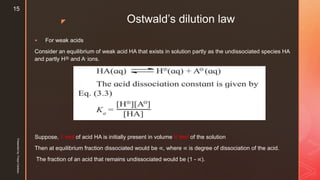
z Ostwald’s dilution law
 For weak acids
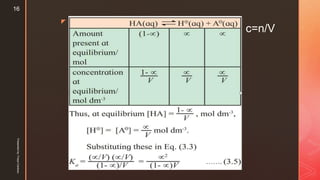
Consider an equilibrium of weak acid HA that exists in solution partly as the undissociated species HA
and partly H⊕ and A- ions.
Suppose, 1 mol of acid HA is initially present in volume V dm3 of the solution
Then at equilibrium fraction dissociated would be ∝, where ∝ is degree of dissociation of the acid.
The fraction of an acid that remains undissociated would be (1 - ∝).
Presentedby:FreyaCardozo
15
z
c=n/V
Presentedby:FreyaCardozo
16
z
Presentedby:FreyaCardozo
17
z
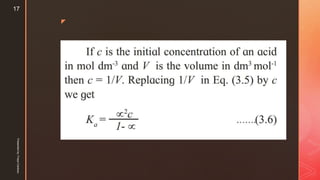
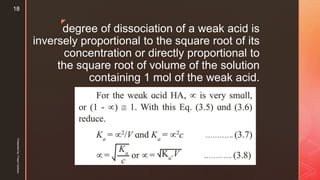
degree of dissociation of a weak acid is
inversely proportional to the square root of its
concentration or directly proportional to
the square root of volume of the solution
containing 1 mol of the weak acid.
Presentedby:FreyaCardozo
18
z
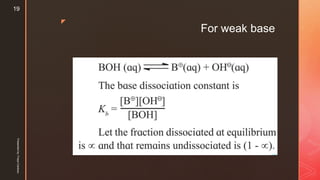
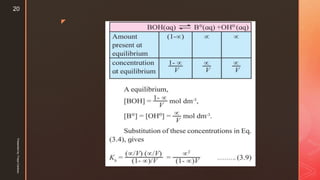
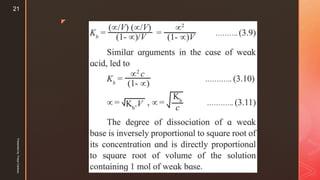
For weak base
Presentedby:FreyaCardozo
19
z
Presentedby:FreyaCardozo
20
z
Presentedby:FreyaCardozo
21
z
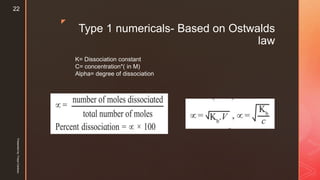
Type 1 numericals- Based on Ostwalds
law

K= Dissociation constant
C= concentration*( in M)
Alpha= degree of dissociation
Presentedby:FreyaCardozo
22
z
Solve
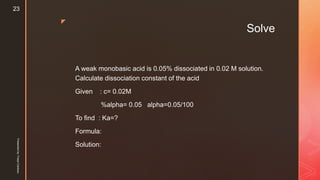
A weak monobasic acid is 0.05% dissociated in 0.02 M solution.
Calculate dissociation constant of the acid
Given : c= 0.02M
%alpha= 0.05 alpha=0.05/100
To find : Ka=?
Formula:
Solution:
Presentedby:FreyaCardozo
23
z
Solve
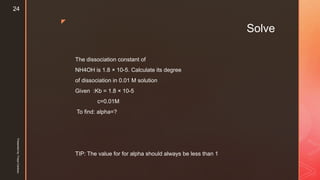
The dissociation constant of
NH4OH is 1.8 × 10⁻⁵. Calculate its degree
of dissociation in 0.01 M solution
Given :Kb = 1.8 × 10⁻⁵
c=0.01M
To find: alpha=?
TIP: The value for for alpha should always be less than 1
Presentedby:FreyaCardozo
24
z
Presentedby:FreyaCardozo
25
z
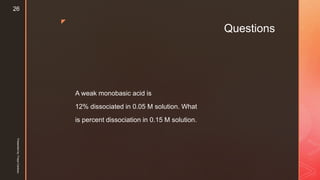
Questions
A weak monobasic acid is
12% dissociated in 0.05 M solution. What
is percent dissociation in 0.15 M solution.
Presentedby:FreyaCardozo
26
z
Calculate [H3O⊕] in 0.1 mol dm3 solution of acetic acid.
Given : Ka [CH3COOH] = 1.8 × 10⁻⁵
Presentedby:FreyaCardozo
27
z
Concept of pH and
pOH
Presentedby:FreyaCardozo
28
z
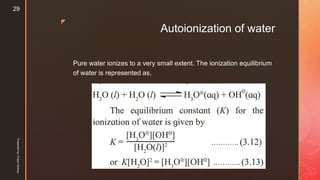
Autoionization of water
Pure water ionizes to a very small extent. The ionization equilibrium
of water is represented as,
Presentedby:FreyaCardozo
29
z
A majority of H2O molecules are undissociated, consequently concentration of water
[H2O] can be treated as constant
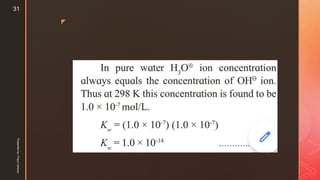
Kw = KK' is called ionic product of water. The product of molar concentrations of
hydronium (or hydrogen) ions and hydroxyl ions at equilibrium in pure water at the
given temperature is called ionic product of water.
Presentedby:FreyaCardozo
30
z
Presentedby:FreyaCardozo
31
z
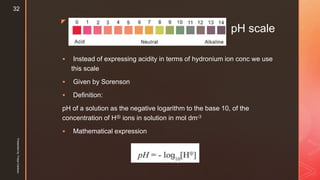
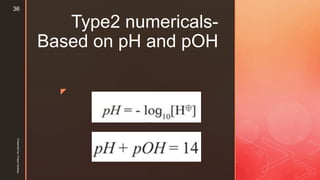
pH scale
 Instead of expressing acidity in terms of hydronium ion conc we use
this scale
 Given by Sorenson
 Definition:
pH of a solution as the negative logarithm to the base 10, of the
concentration of H⊕ ions in solution in mol dm-3
 Mathematical expression
Presentedby:FreyaCardozo
32
z
 pOH of a solution can be defined as the negative logarithm to the
base 10, of the molar concentration of OH ions in solution.
Thus, pOH = -log10[OH- ]
Presentedby:FreyaCardozo
33
z
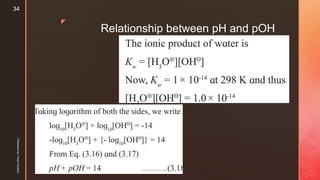
Relationship between pH and pOH
Presentedby:FreyaCardozo
34
z
Types of solutions based on pH
Neutral solutions
For pure water or any aqueous neutral solution at 298 K
[H3O⊕] = [OH -] = 1.0 × 10⁻⁷ M
Hence, pH = -log10[H⊕] = -log10[1 × 10⁻⁷] = 7
Acidic solutions
In acidic solution, there is
Excess of H3O⊕ ions, or [H3O⊕] > [OH ] Hence, [H3O⊕] > 1 × 10⁻⁷ and pH < 7
Basic solutions
In basic solution, the excess of OH ions are present that is [H3O⊕] < [OH ] or
[H3O⊕] < 1.0 × 10⁻⁷ with pH > 7.
Presentedby:FreyaCardozo
35
z
Type2 numericals-
Based on pH and pOH
Presentedby:FreyaCardozo
36
z
Questions
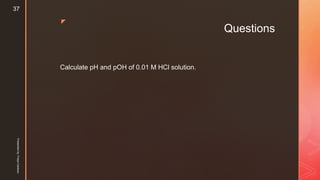
Calculate pH and pOH of 0.01 M HCl solution.
Presentedby:FreyaCardozo
37
z
pH of a solution is 3.12.
Calculate the concentration of H3O⊕ ion.
pH= -log[H+]
-3.12= log[H+]
-3-0.12+1-1= log[H+]
-4+0.88= log[H+]
-4.88= log[H+]
[H+]=7.586 x 10⁻⁴
Presentedby:FreyaCardozo
38
z
A weak monobasic acid is
0.04 % dissociated in 0.025M solution.
What is pH of the solution ?
Given : alpha= 0.04/100
c=0.025M
To find: pH=?
[H+]= alpha x c= 0.0004x 0.025= 10-5
pH=5
Presentedby:FreyaCardozo
39
z
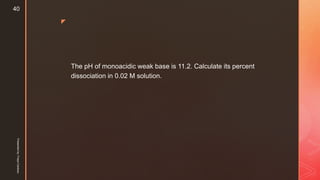
The pH of monoacidic weak base is 11.2. Calculate its percent
dissociation in 0.02 M solution.
Presentedby:FreyaCardozo
40
z
Mcq
 The pH of 10-8 M of HCl is
1. 8
2. 7
3. less than 7
4. greater than 7
 For pH > 7 the hydronium
ion concentration would be
1. 10-7
2. < 10-7 M
3. > 10-7 M
4. ≥ 10-7 M
Presentedby:FreyaCardozo
41
z
Concept of Hydrolysis
Presentedby:FreyaCardozo
42
z
Hydrolysis of water
 When a salt is dissociated in water, it dissociates completely into its constituent
ions.
 The solvent water dissociates slightly as,
Pure water is neutral and [H3O⊕] = [OH -].
 If the ions of the salt do not interact with water, the hydronium and hydroxyl ion
concentrations remain equal and the solution is neutral
Presentedby:FreyaCardozo
43
z
 But when anions or cations of the salt dissociate and interact with the
ions of water either the hydronium ions or hydroxyl ions concentration
increases , making the solution acidic or basic
 Such a reaction between the ions of salt and the ions of water is called
hydrolysis of salt.
 Hydrolysis of salt is defined as the reaction in which cations or anions
or both ions of a salt react with ions of water to produce acidity or
alkalinity (or sometimes even neutrality).
Presentedby:FreyaCardozo
44
z
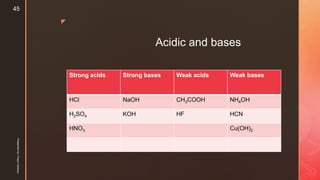
Acidic and bases
Strong acids Strong bases Weak acids Weak bases
HCl NaOH CH3COOH NH4OH
H2SO4 KOH HF HCN
HNO3 Cu(OH)2
Presentedby:FreyaCardozo
45
z
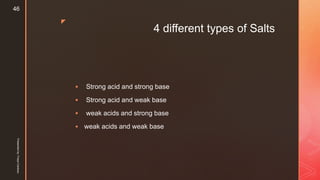
4 different types of Salts
 Strong acid and strong base
 Strong acid and weak base
 weak acids and strong base
 weak acids and weak base
Presentedby:FreyaCardozo
46
z
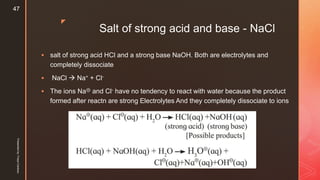
Salt of strong acid and base - NaCl
 salt of strong acid HCl and a strong base NaOH. Both are electrolytes and
completely dissociate
 NaCl  Na+ + Cl-
 The ions Na⊕ and Cl- have no tendency to react with water because the product
formed after reactn are strong Electrolytes And they completely dissociate to ions
Presentedby:FreyaCardozo
47
z
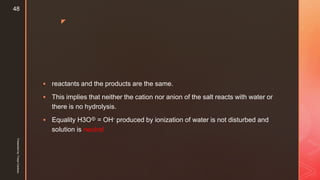
 reactants and the products are the same.
 This implies that neither the cation nor anion of the salt reacts with water or
there is no hydrolysis.
 Equality H3O⊕ = OH- produced by ionization of water is not disturbed and
solution is neutral
Presentedby:FreyaCardozo
48
z
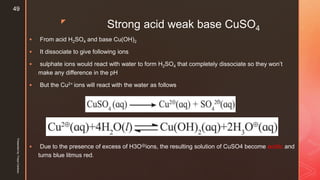
Strong acid weak base CuSO4
 From acid H2SO4 and base Cu(OH)2
 It dissociate to give following ions
 sulphate ions would react with water to form H2SO4 that completely dissociate so they won’t
make any difference in the pH
 But the Cu2+ ions will react with the water as follows
 Due to the presence of excess of H3O⊕ions, the resulting solution of CuSO4 become acidic and
turns blue litmus red.
Presentedby:FreyaCardozo
49
z
 Give reason why To get clear solution of CuSO4, the addition of H2SO4
would be required.
1. Formation of sparingly soluble Cu(OH)2by hydrolysis makes the aqueous
solution of CuSO4 turbid.
2. If H2SO4, that is H3O⊕ ions are added, the hydrolytic equilibrium shifts to
the left.
3. A turbidity of Cu(OH)2dissolves to give a clear solution. To get clear solution
of CuSO4, the addition of H2SO4 would be required.
Presentedby:FreyaCardozo
50
z
Question
Why an aqueous solution of NH4Cl is acidic while that of HCOOK basic ?
Presentedby:FreyaCardozo
51
z
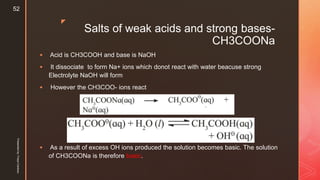
Salts of weak acids and strong bases-
CH3COONa
 Acid is CH3COOH and base is NaOH
 It dissociate to form Na+ ions which donot react with water beacuse strong
Electrolyte NaOH will form
 However the CH3COO- ions react
 As a result of excess OH ions produced the solution becomes basic. The solution
of CH3COONa is therefore basic.
Presentedby:FreyaCardozo
52
z
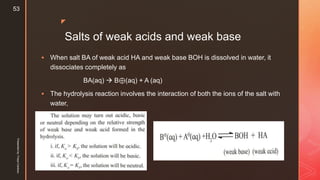
Salts of weak acids and weak base
 When salt BA of weak acid HA and weak base BOH is dissolved in water, it
dissociates completely as
BA(aq)  B⊕(aq) + A (aq)
 The hydrolysis reaction involves the interaction of both the ions of the salt with
water,
Presentedby:FreyaCardozo
53
z
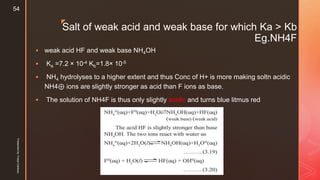
Salt of weak acid and weak base for which Ka > Kb
Eg.NH4F
 weak acid HF and weak base NH4OH
 Ka =7.2 × 10⁻⁴ Kb=1.8× 10⁻⁵
 NH4 hydrolyses to a higher extent and thus Conc of H+ is more making soltn acidic
NH4⊕ ions are slightly stronger as acid than F ions as base.
 The solution of NH4F is thus only slightly acidic and turns blue litmus red
Presentedby:FreyaCardozo
54
z
Salt of weak acid and weak base for which
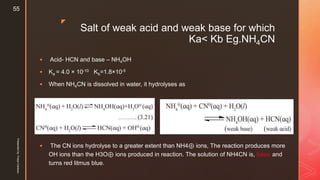
Ka< Kb Eg.NH4CN
 Acid- HCN and base – NH4OH
 Ka = 4.0 × 10⁻¹⁰ Kb=1.8×10⁻⁵
 When NH4CN is dissolved in water, it hydrolyses as
 The CN ions hydrolyse to a greater extent than NH4⊕ ions, The reaction produces more
OH ions than the H3O⊕ ions produced in reaction. The solution of NH4CN is, basic and
turns red litmus blue.
Presentedby:FreyaCardozo
55
z
Salt of weak acid and weak base for
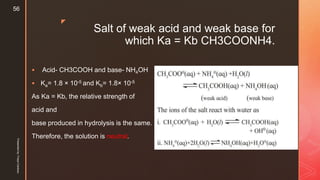
which Ka = Kb CH3COONH4.
 Acid- CH3COOH and base- NH4OH
 Ka= 1.8 × 10⁻⁵ and Kb= 1.8× 10⁻⁵
As Ka = Kb, the relative strength of
acid and
base produced in hydrolysis is the same.
Therefore, the solution is neutral.
Presentedby:FreyaCardozo
56
z
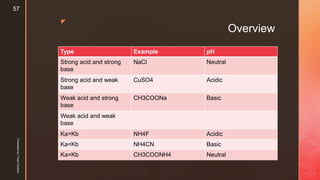
Overview
Type Example pH
Strong acid and strong
base
NaCl Neutral
Strong acid and weak
base
CuSO4 Acidic
Weak acid and strong
base
CH3COONa Basic
Weak acid and weak
base
Ka>Kb NH4F Acidic
Ka<Kb NH4CN Basic
Ka=Kb CH3COONH4 Neutral
Presentedby:FreyaCardozo
57
z
Buffers
Presentedby:FreyaCardozo
58
z
What are buffers
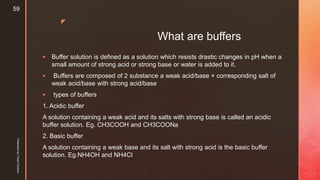
 Buffer solution is defined as a solution which resists drastic changes in pH when a
small amount of strong acid or strong base or water is added to it.
 Buffers are composed of 2 substance a weak acid/base + corresponding salt of
weak acid/base with strong acid/base
 types of buffers
1. Acidic buffer
A solution containing a weak acid and its salts with strong base is called an acidic
buffer solution. Eg. CH3COOH and CH3COONa
2. Basic buffer
A solution containing a weak base and its salt with strong acid is the basic buffer
solution. Eg.NH4OH and NH4Cl
Presentedby:FreyaCardozo
59
z
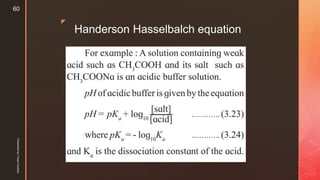
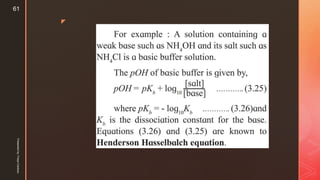
Handerson Hasselbalch equation
Presentedby:FreyaCardozo
60
z
Presentedby:FreyaCardozo
61
z
Buffer action*:Sodium acetate acetic
acid buffer
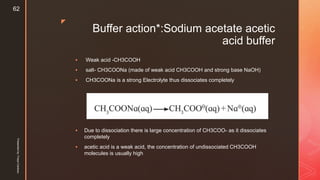
 Weak acid -CH3COOH
 salt- CH3COONa (made of weak acid CH3COOH and strong base NaOH)
 CH3COONa is a strong Electrolyte thus dissociates completely
 Due to dissociation there is large concentration of CH3COO- as it dissociates
completely
 acetic acid is a weak acid, the concentration of undissociated CH3COOH
molecules is usually high
Presentedby:FreyaCardozo
62
z
 If a small amount of strong acid is added to this solution the added H⊕ ions will be
consumed by the conjugate base CH3COO- present in large concentration.
 if small amount of base is added, the added OH ions will be neutralized by the large
concentration of acetic acid
 The acid or base added thus can not change the [H⊕] or [OH ] concentrations and, pH
of the buffer remains unchanged.
Presentedby:FreyaCardozo
63
z
Properties of buffer
The pH of a buffer solution does not change appereciably
i. by addition of small amount of either strong acid or strong base,
ii. on dilution ( because the Conc terms in the H.H eqn do not
involve water)
iii. When it is kept for long time.
Presentedby:FreyaCardozo
64
z
Application
 In biochemical system:
pH of blood in our body is maintained at 7.36 - 7.42 due to (HCO3 + H2CO3) buffer. A mere
change of 0.2 pH units can cause death.
 Agriculture
Soil contains carbonates, phosphate etc that buffer soil pH .choice of fertilizers depends
upon pH of soil.
 Industry
Buffers play an important role in paper, dye, ink, paint and drug industries.
 Medicine
Penicillin preparations are stabilized by addition of sodium citrate as buffer. When citric acid
is added to milk of magnesia (Mg(OH)2), magnesium citrate is formed, which is a buffer.
Presentedby:FreyaCardozo
65
z
 In qualitative analysis
a pH of 8 to 10 is required for precipitation of cations IIIA group. It
is maintained with the use of (NH4OH + NH4Cl) buffer.
Presentedby:FreyaCardozo
66
z
Type 3 numericals
Based on Henderson-Hasselbach equation
 Ka/Kb Dissociation constant for acid / base
 pKa= -logKa
 [salt] concentration of salt
 [acid]/[base]: Tip- To know if it is salt or acid see which has H+
Presentedby:FreyaCardozo
67
z
Type 3 Numericals
Calculate the pH of buffer solution containing 0.05 mol NaF per litre
and 0.015 mol HF per litre. [Ka = 7.2 × 10⁻⁴for HF]
Presentedby:FreyaCardozo
68
z
Calculate the pH of buffer solution composed of 0.1 M weak base BOH
and 0.2 M of its salt BA. [Kb = 1.8× 10⁻⁵ for the weak base]
Presentedby:FreyaCardozo
69
z
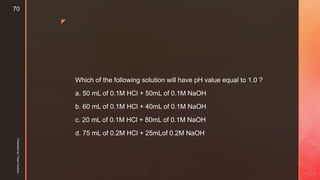
Which of the following solution will have pH value equal to 1.0 ?
a. 50 mL of 0.1M HCl + 50mL of 0.1M NaOH
b. 60 mL of 0.1M HCl + 40mL of 0.1M NaOH
c. 20 mL of 0.1M HCl + 80mL of 0.1M NaOH
d. 75 mL of 0.2M HCl + 25mLof 0.2M NaOH
Presentedby:FreyaCardozo
70
z
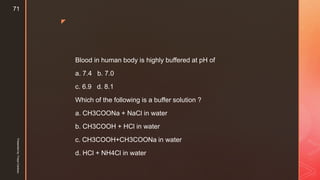
Blood in human body is highly buffered at pH of
a. 7.4 b. 7.0
c. 6.9 d. 8.1
Which of the following is a buffer solution ?
a. CH3COONa + NaCl in water
b. CH3COOH + HCl in water
c. CH3COOH+CH3COONa in water
d. HCl + NH4Cl in water
Presentedby:FreyaCardozo
71
z
Solubility
product
Presentedby:FreyaCardozo
72
z
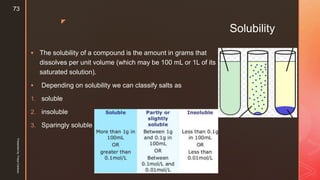
Solubility
 The solubility of a compound is the amount in grams that
dissolves per unit volume (which may be 100 mL or 1L of its
saturated solution).
 Depending on solubility we can classify salts as
1. soluble
2. insoluble
3. Sparingly soluble
Presentedby:FreyaCardozo
73
z
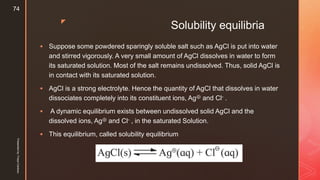
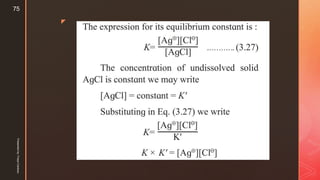
Solubility equilibria
 Suppose some powdered sparingly soluble salt such as AgCl is put into water
and stirred vigorously. A very small amount of AgCl dissolves in water to form
its saturated solution. Most of the salt remains undissolved. Thus, solid AgCl is
in contact with its saturated solution.
 AgCl is a strong electrolyte. Hence the quantity of AgCl that dissolves in water
dissociates completely into its constituent ions, Ag⊕ and Cl- .
 A dynamic equilibrium exists between undissolved solid AgCl and the
dissolved ions, Ag⊕ and Cl- , in the saturated Solution.
 This equilibrium, called solubility equilibrium
Presentedby:FreyaCardozo
74
z
Presentedby:FreyaCardozo
75
z
Presentedby:FreyaCardozo
76
z
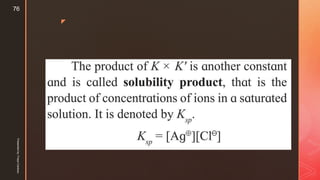
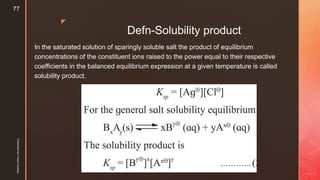
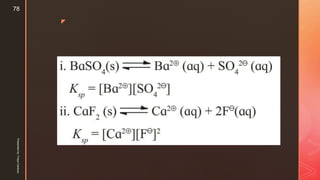
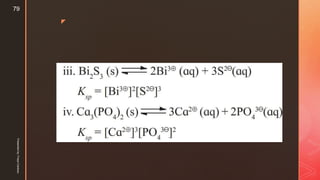
Defn-Solubility product
In the saturated solution of sparingly soluble salt the product of equilibrium
concentrations of the constituent ions raised to the power equal to their respective
coefficients in the balanced equilibrium expression at a given temperature is called
solubility product.
Presentedby:FreyaCardozo
77
z
Presentedby:FreyaCardozo
78
z
Presentedby:FreyaCardozo
79
z
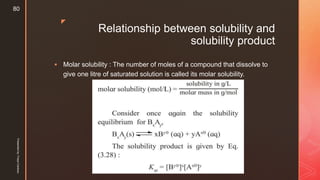
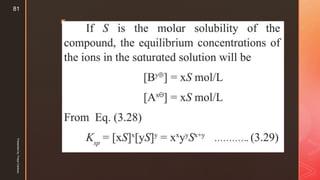
Relationship between solubility and
solubility product
 Molar solubility : The number of moles of a compound that dissolve to
give one litre of saturated solution is called its molar solubility.
Presentedby:FreyaCardozo
80
z
Presentedby:FreyaCardozo
81
z
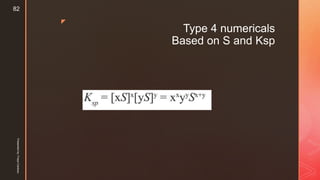
Type 4 numericals
Based on S and Ksp
Presentedby:FreyaCardozo
82
z
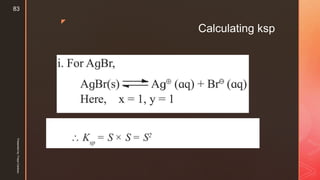
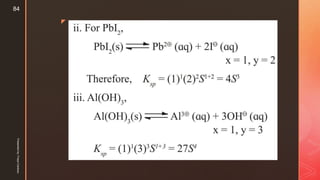
Calculating ksp
Presentedby:FreyaCardozo
83
z
Presentedby:FreyaCardozo
84
z
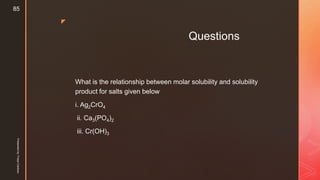
Questions
What is the relationship between molar solubility and solubility
product for salts given below
i. Ag2CrO4
ii. Ca3(PO4)2
iii. Cr(OH)3
Presentedby:FreyaCardozo
85
z
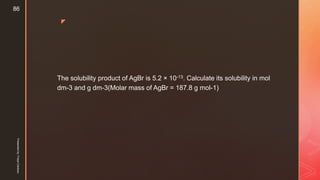
The solubility product of AgBr is 5.2 × 10⁻¹³. Calculate its solubility in mol
dm-3 and g dm-3(Molar mass of AgBr = 187.8 g mol-1)
Presentedby:FreyaCardozo
86
z
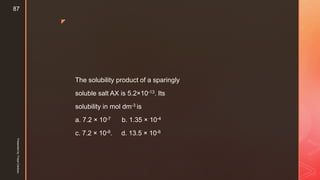
The solubility product of a sparingly
soluble salt AX is 5.2×10⁻¹³. Its
solubility in mol dm-3 is
a. 7.2 × 10⁻⁷ b. 1.35 × 10⁻⁴
c. 7.2 × 10⁻⁸. d. 13.5 × 10⁻⁸
Presentedby:FreyaCardozo
87
z
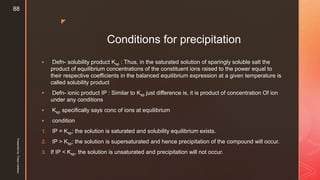
Conditions for precipitation
 Defn- solubility product Ksp : Thus, in the saturated solution of sparingly soluble salt the
product of equilibrium concentrations of the constituent ions raised to the power equal to
their respective coefficients in the balanced equilibrium expression at a given temperature is
called solubility product
 Defn- ionic product IP : Similar to Ksp just difference is, it is product of concentration Of ion
under any conditions
 Ksp specifically says conc of ions at equilibrium
 condition
1. IP = Ksp; the solution is saturated and solubility equilibrium exists.
2. IP > Ksp; the solution is supersaturated and hence precipitation of the compound will occur.
3. If IP < Ksp, the solution is unsaturated and precipitation will not occur.
Presentedby:FreyaCardozo
88
z
Type 5 numericals
Based on I.P and Ksp
Precipitation will occur or no?
 If I.P>Ksp then precipitation will occur
 I.P product of concentration of ions at any time whereas Ksp is at
equilibrium
Presentedby:FreyaCardozo
89
z
A solution is prepared by mixing equal volumes of 0.1M MgCl2 and 0.3M
Na2C2O4 at 293 K. Would MgC2O4 precipitate out ? Ksp of MgC2O4 at 293
K is 8.56 × 10⁻⁵.
Presentedby:FreyaCardozo
90
z
If 20.0 cm3 of 0.050 M Ba(NO3)2 are mixed with 20.0 cm3
of 0.020 M NaF, will BaF2 precipitate ? Ksp of BaF2 is 1.7 × 10⁻⁶ at
298 K.
Presentedby:FreyaCardozo
91
z
Common ion
effect
Presentedby:FreyaCardozo
92
z
Common ion effect
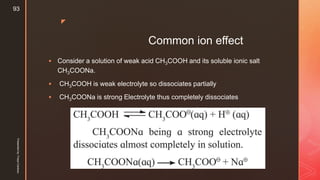
 Consider a solution of weak acid CH3COOH and its soluble ionic salt
CH3COONa.
 CH3COOH is weak electrolyte so dissociates partially
 CH3COONa is strong Electrolyte thus completely dissociates
Presentedby:FreyaCardozo
93
z
 Both the acid and the salt produce CH3COO- ions in solution.
 CH3COONa Dissociates completely. Therefore it provides high
concentration of CH3COO- ions.
 According to Le-Chatelier principle, the addition of CH3COO- from
CH3COONa to the solution of CH3COOH, shifts equilibrium of dissociation
of CH3COOH to left.
 Thus reverse reaction is favoured in which CH3COO- combines with H⊕ to
form unionised CH3COOH.
 Hence dissociation of CH3COOH is supressed due to presence of
CH3COONa containing a common CH3COO- ion.
Presentedby:FreyaCardozo
94
z
Defn – common ion effect
The common ion effect states that the ionisation of a weak electrolyte is
suppressed in presence of a strong electrolyte containing an ion common to
the weak electrolyte.
Presentedby:FreyaCardozo
95
z
Solubility and common ion effect
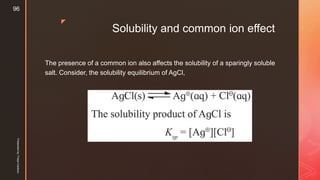
The presence of a common ion also affects the solubility of a sparingly soluble
salt. Consider, the solubility equilibrium of AgCl,
Presentedby:FreyaCardozo
96
z
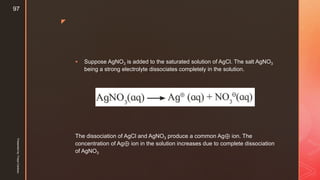
 Suppose AgNO3 is added to the saturated solution of AgCl. The salt AgNO3
being a strong electrolyte dissociates completely in the solution.
The dissociation of AgCl and AgNO3 produce a common Ag⊕ ion. The
concentration of Ag⊕ ion in the solution increases due to complete dissociation
of AgNO3
Presentedby:FreyaCardozo
97
z
 According to to Le-chatelier's principle the addition of Ag⊕ ions
from AgNO3 to the solution of AgCl shifts the solubility
equilibrium of AgCl from right to left.
 Thus AgCl precipitates
 Therefore presence of common ion decrease solubility Of
sparingly soluble salt
 Ksp remains the same
Presentedby:FreyaCardozo
98
z
Questions
 Why cations are Lewis acids ?
 Why is KCl solution neutral to litmus?
 The dissociation of H2S is suppressed in the presence of HCl.
Name the phenomenon.
 Acetic acid is 5% ionised in its decimolar solution. Calculate the
dissociation constant of acid
Presentedby:FreyaCardozo
99

Ionic equilibrium chapter 3(12th HSC Maharashtra state board)

  • 1.
  • 2.
    z Electrolyte  The substanceswhich give rise to ions when dissolved in water are electrolytes.  The non electrolytes are those which do not ionize and exist as molecules in aqueous solutions.  Electrolytes can be classified as 1. Strong electrolyte : The electrolytes Ionizing completely or almost completely are strong electrolytes. For example : strong acids, strong bases and salts.Eg.HCl 2. Weak electrolytes :The electrolytes which dissociate to a smaller extent in aqueous solution are weak electrolytes. Weak acids and weak bases belong to this class. Eg. CH3COOH Presentedby:FreyaCardozo 2
  • 3.
    z Representation We represent strongelectrolytes using  Since weak electrolytes do not completely ionize we represent it by double headed arrow showing equilibrium Presentedby:FreyaCardozo 3
  • 4.
    z Degree of dissociation(∝)  The degree of dissociation of an electrolyte is defined as a fraction of total number of moles of the electrolyte that dissociates into its ions when the equilibrium is attained.  If 'c' is the molar concentration of an electrolyte the equilibrium concentration of cation or anion is (∝ × c) mol dm-3. Presentedby:FreyaCardozo 4
  • 5.
    z Acid base theories  Arrehnius theory  Bronsted-Lowry theory.  Lewis theory Presentedby:FreyaCardozo 5
  • 6.
    z Arrhenius theory  Acid-Donates H+ ion  Base- Donates OH- ion Presentedby:FreyaCardozo 6
  • 7.
    z Drawback It does notaccount for the basicity of NH3 and Na2CO3 which do not have OH group. Presentedby:FreyaCardozo 7
  • 8.
    z Bronsted-Lowry theory -protontransfer theory.  Acid -Acid is a substance that donates a proton (H⊕) to another substance.  Base-Base is a substance that accepts a proton (H⊕) from another substance. Presentedby:FreyaCardozo 8
  • 9.
    z Conjugate acid- bases Thebase produced by accepting the proton from an acid is the conjugate base of that acid. Likewise the acid produced when a base accepts a proton is called the conjugate acid of that base. A pair of an acid and a base differing by a proton is said to be a conjugate acid-base pair. Presentedby:FreyaCardozo 9
  • 10.
    z Lewis – electronpair Theory  Acid : Any species that accepts an electron pair is called Lewis acid.  Base : Any species that donates an electron pair is called Lewis base. Presentedby:FreyaCardozo 10
  • 11.
    z Amphoteric nature ofwater  Water has the ability to act as an acid as well as a base. Such behaviour is known as amphoteric nature  Reaction Presentedby:FreyaCardozo 11
  • 12.
    z Ionisation of weakand strong acid and bases Presentedby:FreyaCardozo 12
  • 13.
    z Dissociation constant ofweak acids and weak bases Presentedby:FreyaCardozo 13
  • 14.
  • 15.
    z Ostwald’s dilutionlaw  For weak acids Consider an equilibrium of weak acid HA that exists in solution partly as the undissociated species HA and partly H⊕ and A- ions. Suppose, 1 mol of acid HA is initially present in volume V dm3 of the solution Then at equilibrium fraction dissociated would be ∝, where ∝ is degree of dissociation of the acid. The fraction of an acid that remains undissociated would be (1 - ∝). Presentedby:FreyaCardozo 15
  • 16.
  • 17.
  • 18.
    z degree of dissociationof a weak acid is inversely proportional to the square root of its concentration or directly proportional to the square root of volume of the solution containing 1 mol of the weak acid. Presentedby:FreyaCardozo 18
  • 19.
  • 20.
  • 21.
  • 22.
    z Type 1 numericals-Based on Ostwalds law  K= Dissociation constant C= concentration*( in M) Alpha= degree of dissociation Presentedby:FreyaCardozo 22
  • 23.
    z Solve A weak monobasicacid is 0.05% dissociated in 0.02 M solution. Calculate dissociation constant of the acid Given : c= 0.02M %alpha= 0.05 alpha=0.05/100 To find : Ka=? Formula: Solution: Presentedby:FreyaCardozo 23
  • 24.
    z Solve The dissociation constantof NH4OH is 1.8 × 10⁻⁵. Calculate its degree of dissociation in 0.01 M solution Given :Kb = 1.8 × 10⁻⁵ c=0.01M To find: alpha=? TIP: The value for for alpha should always be less than 1 Presentedby:FreyaCardozo 24
  • 25.
  • 26.
    z Questions A weak monobasicacid is 12% dissociated in 0.05 M solution. What is percent dissociation in 0.15 M solution. Presentedby:FreyaCardozo 26
  • 27.
    z Calculate [H3O⊕] in0.1 mol dm3 solution of acetic acid. Given : Ka [CH3COOH] = 1.8 × 10⁻⁵ Presentedby:FreyaCardozo 27
  • 28.
    z Concept of pHand pOH Presentedby:FreyaCardozo 28
  • 29.
    z Autoionization of water Purewater ionizes to a very small extent. The ionization equilibrium of water is represented as, Presentedby:FreyaCardozo 29
  • 30.
    z A majority ofH2O molecules are undissociated, consequently concentration of water [H2O] can be treated as constant Kw = KK' is called ionic product of water. The product of molar concentrations of hydronium (or hydrogen) ions and hydroxyl ions at equilibrium in pure water at the given temperature is called ionic product of water. Presentedby:FreyaCardozo 30
  • 31.
  • 32.
    z pH scale  Insteadof expressing acidity in terms of hydronium ion conc we use this scale  Given by Sorenson  Definition: pH of a solution as the negative logarithm to the base 10, of the concentration of H⊕ ions in solution in mol dm-3  Mathematical expression Presentedby:FreyaCardozo 32
  • 33.
    z  pOH ofa solution can be defined as the negative logarithm to the base 10, of the molar concentration of OH ions in solution. Thus, pOH = -log10[OH- ] Presentedby:FreyaCardozo 33
  • 34.
    z Relationship between pHand pOH Presentedby:FreyaCardozo 34
  • 35.
    z Types of solutionsbased on pH Neutral solutions For pure water or any aqueous neutral solution at 298 K [H3O⊕] = [OH -] = 1.0 × 10⁻⁷ M Hence, pH = -log10[H⊕] = -log10[1 × 10⁻⁷] = 7 Acidic solutions In acidic solution, there is Excess of H3O⊕ ions, or [H3O⊕] > [OH ] Hence, [H3O⊕] > 1 × 10⁻⁷ and pH < 7 Basic solutions In basic solution, the excess of OH ions are present that is [H3O⊕] < [OH ] or [H3O⊕] < 1.0 × 10⁻⁷ with pH > 7. Presentedby:FreyaCardozo 35
  • 36.
    z Type2 numericals- Based onpH and pOH Presentedby:FreyaCardozo 36
  • 37.
    z Questions Calculate pH andpOH of 0.01 M HCl solution. Presentedby:FreyaCardozo 37
  • 38.
    z pH of asolution is 3.12. Calculate the concentration of H3O⊕ ion. pH= -log[H+] -3.12= log[H+] -3-0.12+1-1= log[H+] -4+0.88= log[H+] -4.88= log[H+] [H+]=7.586 x 10⁻⁴ Presentedby:FreyaCardozo 38
  • 39.
    z A weak monobasicacid is 0.04 % dissociated in 0.025M solution. What is pH of the solution ? Given : alpha= 0.04/100 c=0.025M To find: pH=? [H+]= alpha x c= 0.0004x 0.025= 10-5 pH=5 Presentedby:FreyaCardozo 39
  • 40.
    z The pH ofmonoacidic weak base is 11.2. Calculate its percent dissociation in 0.02 M solution. Presentedby:FreyaCardozo 40
  • 41.
    z Mcq  The pHof 10-8 M of HCl is 1. 8 2. 7 3. less than 7 4. greater than 7  For pH > 7 the hydronium ion concentration would be 1. 10-7 2. < 10-7 M 3. > 10-7 M 4. ≥ 10-7 M Presentedby:FreyaCardozo 41
  • 42.
  • 43.
    z Hydrolysis of water When a salt is dissociated in water, it dissociates completely into its constituent ions.  The solvent water dissociates slightly as, Pure water is neutral and [H3O⊕] = [OH -].  If the ions of the salt do not interact with water, the hydronium and hydroxyl ion concentrations remain equal and the solution is neutral Presentedby:FreyaCardozo 43
  • 44.
    z  But whenanions or cations of the salt dissociate and interact with the ions of water either the hydronium ions or hydroxyl ions concentration increases , making the solution acidic or basic  Such a reaction between the ions of salt and the ions of water is called hydrolysis of salt.  Hydrolysis of salt is defined as the reaction in which cations or anions or both ions of a salt react with ions of water to produce acidity or alkalinity (or sometimes even neutrality). Presentedby:FreyaCardozo 44
  • 45.
    z Acidic and bases Strongacids Strong bases Weak acids Weak bases HCl NaOH CH3COOH NH4OH H2SO4 KOH HF HCN HNO3 Cu(OH)2 Presentedby:FreyaCardozo 45
  • 46.
    z 4 different typesof Salts  Strong acid and strong base  Strong acid and weak base  weak acids and strong base  weak acids and weak base Presentedby:FreyaCardozo 46
  • 47.
    z Salt of strongacid and base - NaCl  salt of strong acid HCl and a strong base NaOH. Both are electrolytes and completely dissociate  NaCl  Na+ + Cl-  The ions Na⊕ and Cl- have no tendency to react with water because the product formed after reactn are strong Electrolytes And they completely dissociate to ions Presentedby:FreyaCardozo 47
  • 48.
    z  reactants andthe products are the same.  This implies that neither the cation nor anion of the salt reacts with water or there is no hydrolysis.  Equality H3O⊕ = OH- produced by ionization of water is not disturbed and solution is neutral Presentedby:FreyaCardozo 48
  • 49.
    z Strong acid weakbase CuSO4  From acid H2SO4 and base Cu(OH)2  It dissociate to give following ions  sulphate ions would react with water to form H2SO4 that completely dissociate so they won’t make any difference in the pH  But the Cu2+ ions will react with the water as follows  Due to the presence of excess of H3O⊕ions, the resulting solution of CuSO4 become acidic and turns blue litmus red. Presentedby:FreyaCardozo 49
  • 50.
    z  Give reasonwhy To get clear solution of CuSO4, the addition of H2SO4 would be required. 1. Formation of sparingly soluble Cu(OH)2by hydrolysis makes the aqueous solution of CuSO4 turbid. 2. If H2SO4, that is H3O⊕ ions are added, the hydrolytic equilibrium shifts to the left. 3. A turbidity of Cu(OH)2dissolves to give a clear solution. To get clear solution of CuSO4, the addition of H2SO4 would be required. Presentedby:FreyaCardozo 50
  • 51.
    z Question Why an aqueoussolution of NH4Cl is acidic while that of HCOOK basic ? Presentedby:FreyaCardozo 51
  • 52.
    z Salts of weakacids and strong bases- CH3COONa  Acid is CH3COOH and base is NaOH  It dissociate to form Na+ ions which donot react with water beacuse strong Electrolyte NaOH will form  However the CH3COO- ions react  As a result of excess OH ions produced the solution becomes basic. The solution of CH3COONa is therefore basic. Presentedby:FreyaCardozo 52
  • 53.
    z Salts of weakacids and weak base  When salt BA of weak acid HA and weak base BOH is dissolved in water, it dissociates completely as BA(aq)  B⊕(aq) + A (aq)  The hydrolysis reaction involves the interaction of both the ions of the salt with water, Presentedby:FreyaCardozo 53
  • 54.
    z Salt of weakacid and weak base for which Ka > Kb Eg.NH4F  weak acid HF and weak base NH4OH  Ka =7.2 × 10⁻⁴ Kb=1.8× 10⁻⁵  NH4 hydrolyses to a higher extent and thus Conc of H+ is more making soltn acidic NH4⊕ ions are slightly stronger as acid than F ions as base.  The solution of NH4F is thus only slightly acidic and turns blue litmus red Presentedby:FreyaCardozo 54
  • 55.
    z Salt of weakacid and weak base for which Ka< Kb Eg.NH4CN  Acid- HCN and base – NH4OH  Ka = 4.0 × 10⁻¹⁰ Kb=1.8×10⁻⁵  When NH4CN is dissolved in water, it hydrolyses as  The CN ions hydrolyse to a greater extent than NH4⊕ ions, The reaction produces more OH ions than the H3O⊕ ions produced in reaction. The solution of NH4CN is, basic and turns red litmus blue. Presentedby:FreyaCardozo 55
  • 56.
    z Salt of weakacid and weak base for which Ka = Kb CH3COONH4.  Acid- CH3COOH and base- NH4OH  Ka= 1.8 × 10⁻⁵ and Kb= 1.8× 10⁻⁵ As Ka = Kb, the relative strength of acid and base produced in hydrolysis is the same. Therefore, the solution is neutral. Presentedby:FreyaCardozo 56
  • 57.
    z Overview Type Example pH Strongacid and strong base NaCl Neutral Strong acid and weak base CuSO4 Acidic Weak acid and strong base CH3COONa Basic Weak acid and weak base Ka>Kb NH4F Acidic Ka<Kb NH4CN Basic Ka=Kb CH3COONH4 Neutral Presentedby:FreyaCardozo 57
  • 58.
  • 59.
    z What are buffers Buffer solution is defined as a solution which resists drastic changes in pH when a small amount of strong acid or strong base or water is added to it.  Buffers are composed of 2 substance a weak acid/base + corresponding salt of weak acid/base with strong acid/base  types of buffers 1. Acidic buffer A solution containing a weak acid and its salts with strong base is called an acidic buffer solution. Eg. CH3COOH and CH3COONa 2. Basic buffer A solution containing a weak base and its salt with strong acid is the basic buffer solution. Eg.NH4OH and NH4Cl Presentedby:FreyaCardozo 59
  • 60.
  • 61.
  • 62.
    z Buffer action*:Sodium acetateacetic acid buffer  Weak acid -CH3COOH  salt- CH3COONa (made of weak acid CH3COOH and strong base NaOH)  CH3COONa is a strong Electrolyte thus dissociates completely  Due to dissociation there is large concentration of CH3COO- as it dissociates completely  acetic acid is a weak acid, the concentration of undissociated CH3COOH molecules is usually high Presentedby:FreyaCardozo 62
  • 63.
    z  If asmall amount of strong acid is added to this solution the added H⊕ ions will be consumed by the conjugate base CH3COO- present in large concentration.  if small amount of base is added, the added OH ions will be neutralized by the large concentration of acetic acid  The acid or base added thus can not change the [H⊕] or [OH ] concentrations and, pH of the buffer remains unchanged. Presentedby:FreyaCardozo 63
  • 64.
    z Properties of buffer ThepH of a buffer solution does not change appereciably i. by addition of small amount of either strong acid or strong base, ii. on dilution ( because the Conc terms in the H.H eqn do not involve water) iii. When it is kept for long time. Presentedby:FreyaCardozo 64
  • 65.
    z Application  In biochemicalsystem: pH of blood in our body is maintained at 7.36 - 7.42 due to (HCO3 + H2CO3) buffer. A mere change of 0.2 pH units can cause death.  Agriculture Soil contains carbonates, phosphate etc that buffer soil pH .choice of fertilizers depends upon pH of soil.  Industry Buffers play an important role in paper, dye, ink, paint and drug industries.  Medicine Penicillin preparations are stabilized by addition of sodium citrate as buffer. When citric acid is added to milk of magnesia (Mg(OH)2), magnesium citrate is formed, which is a buffer. Presentedby:FreyaCardozo 65
  • 66.
    z  In qualitativeanalysis a pH of 8 to 10 is required for precipitation of cations IIIA group. It is maintained with the use of (NH4OH + NH4Cl) buffer. Presentedby:FreyaCardozo 66
  • 67.
    z Type 3 numericals Basedon Henderson-Hasselbach equation  Ka/Kb Dissociation constant for acid / base  pKa= -logKa  [salt] concentration of salt  [acid]/[base]: Tip- To know if it is salt or acid see which has H+ Presentedby:FreyaCardozo 67
  • 68.
    z Type 3 Numericals Calculatethe pH of buffer solution containing 0.05 mol NaF per litre and 0.015 mol HF per litre. [Ka = 7.2 × 10⁻⁴for HF] Presentedby:FreyaCardozo 68
  • 69.
    z Calculate the pHof buffer solution composed of 0.1 M weak base BOH and 0.2 M of its salt BA. [Kb = 1.8× 10⁻⁵ for the weak base] Presentedby:FreyaCardozo 69
  • 70.
    z Which of thefollowing solution will have pH value equal to 1.0 ? a. 50 mL of 0.1M HCl + 50mL of 0.1M NaOH b. 60 mL of 0.1M HCl + 40mL of 0.1M NaOH c. 20 mL of 0.1M HCl + 80mL of 0.1M NaOH d. 75 mL of 0.2M HCl + 25mLof 0.2M NaOH Presentedby:FreyaCardozo 70
  • 71.
    z Blood in humanbody is highly buffered at pH of a. 7.4 b. 7.0 c. 6.9 d. 8.1 Which of the following is a buffer solution ? a. CH3COONa + NaCl in water b. CH3COOH + HCl in water c. CH3COOH+CH3COONa in water d. HCl + NH4Cl in water Presentedby:FreyaCardozo 71
  • 72.
  • 73.
    z Solubility  The solubilityof a compound is the amount in grams that dissolves per unit volume (which may be 100 mL or 1L of its saturated solution).  Depending on solubility we can classify salts as 1. soluble 2. insoluble 3. Sparingly soluble Presentedby:FreyaCardozo 73
  • 74.
    z Solubility equilibria  Supposesome powdered sparingly soluble salt such as AgCl is put into water and stirred vigorously. A very small amount of AgCl dissolves in water to form its saturated solution. Most of the salt remains undissolved. Thus, solid AgCl is in contact with its saturated solution.  AgCl is a strong electrolyte. Hence the quantity of AgCl that dissolves in water dissociates completely into its constituent ions, Ag⊕ and Cl- .  A dynamic equilibrium exists between undissolved solid AgCl and the dissolved ions, Ag⊕ and Cl- , in the saturated Solution.  This equilibrium, called solubility equilibrium Presentedby:FreyaCardozo 74
  • 75.
  • 76.
  • 77.
    z Defn-Solubility product In thesaturated solution of sparingly soluble salt the product of equilibrium concentrations of the constituent ions raised to the power equal to their respective coefficients in the balanced equilibrium expression at a given temperature is called solubility product. Presentedby:FreyaCardozo 77
  • 78.
  • 79.
  • 80.
    z Relationship between solubilityand solubility product  Molar solubility : The number of moles of a compound that dissolve to give one litre of saturated solution is called its molar solubility. Presentedby:FreyaCardozo 80
  • 81.
  • 82.
    z Type 4 numericals Basedon S and Ksp Presentedby:FreyaCardozo 82
  • 83.
  • 84.
  • 85.
    z Questions What is therelationship between molar solubility and solubility product for salts given below i. Ag2CrO4 ii. Ca3(PO4)2 iii. Cr(OH)3 Presentedby:FreyaCardozo 85
  • 86.
    z The solubility productof AgBr is 5.2 × 10⁻¹³. Calculate its solubility in mol dm-3 and g dm-3(Molar mass of AgBr = 187.8 g mol-1) Presentedby:FreyaCardozo 86
  • 87.
    z The solubility productof a sparingly soluble salt AX is 5.2×10⁻¹³. Its solubility in mol dm-3 is a. 7.2 × 10⁻⁷ b. 1.35 × 10⁻⁴ c. 7.2 × 10⁻⁸. d. 13.5 × 10⁻⁸ Presentedby:FreyaCardozo 87
  • 88.
    z Conditions for precipitation Defn- solubility product Ksp : Thus, in the saturated solution of sparingly soluble salt the product of equilibrium concentrations of the constituent ions raised to the power equal to their respective coefficients in the balanced equilibrium expression at a given temperature is called solubility product  Defn- ionic product IP : Similar to Ksp just difference is, it is product of concentration Of ion under any conditions  Ksp specifically says conc of ions at equilibrium  condition 1. IP = Ksp; the solution is saturated and solubility equilibrium exists. 2. IP > Ksp; the solution is supersaturated and hence precipitation of the compound will occur. 3. If IP < Ksp, the solution is unsaturated and precipitation will not occur. Presentedby:FreyaCardozo 88
  • 89.
    z Type 5 numericals Basedon I.P and Ksp Precipitation will occur or no?  If I.P>Ksp then precipitation will occur  I.P product of concentration of ions at any time whereas Ksp is at equilibrium Presentedby:FreyaCardozo 89
  • 90.
    z A solution isprepared by mixing equal volumes of 0.1M MgCl2 and 0.3M Na2C2O4 at 293 K. Would MgC2O4 precipitate out ? Ksp of MgC2O4 at 293 K is 8.56 × 10⁻⁵. Presentedby:FreyaCardozo 90
  • 91.
    z If 20.0 cm3of 0.050 M Ba(NO3)2 are mixed with 20.0 cm3 of 0.020 M NaF, will BaF2 precipitate ? Ksp of BaF2 is 1.7 × 10⁻⁶ at 298 K. Presentedby:FreyaCardozo 91
  • 92.
  • 93.
    z Common ion effect Consider a solution of weak acid CH3COOH and its soluble ionic salt CH3COONa.  CH3COOH is weak electrolyte so dissociates partially  CH3COONa is strong Electrolyte thus completely dissociates Presentedby:FreyaCardozo 93
  • 94.
    z  Both theacid and the salt produce CH3COO- ions in solution.  CH3COONa Dissociates completely. Therefore it provides high concentration of CH3COO- ions.  According to Le-Chatelier principle, the addition of CH3COO- from CH3COONa to the solution of CH3COOH, shifts equilibrium of dissociation of CH3COOH to left.  Thus reverse reaction is favoured in which CH3COO- combines with H⊕ to form unionised CH3COOH.  Hence dissociation of CH3COOH is supressed due to presence of CH3COONa containing a common CH3COO- ion. Presentedby:FreyaCardozo 94
  • 95.
    z Defn – commonion effect The common ion effect states that the ionisation of a weak electrolyte is suppressed in presence of a strong electrolyte containing an ion common to the weak electrolyte. Presentedby:FreyaCardozo 95
  • 96.
    z Solubility and commonion effect The presence of a common ion also affects the solubility of a sparingly soluble salt. Consider, the solubility equilibrium of AgCl, Presentedby:FreyaCardozo 96
  • 97.
    z  Suppose AgNO3is added to the saturated solution of AgCl. The salt AgNO3 being a strong electrolyte dissociates completely in the solution. The dissociation of AgCl and AgNO3 produce a common Ag⊕ ion. The concentration of Ag⊕ ion in the solution increases due to complete dissociation of AgNO3 Presentedby:FreyaCardozo 97
  • 98.
    z  According toto Le-chatelier's principle the addition of Ag⊕ ions from AgNO3 to the solution of AgCl shifts the solubility equilibrium of AgCl from right to left.  Thus AgCl precipitates  Therefore presence of common ion decrease solubility Of sparingly soluble salt  Ksp remains the same Presentedby:FreyaCardozo 98
  • 99.
    z Questions  Why cationsare Lewis acids ?  Why is KCl solution neutral to litmus?  The dissociation of H2S is suppressed in the presence of HCl. Name the phenomenon.  Acetic acid is 5% ionised in its decimolar solution. Calculate the dissociation constant of acid Presentedby:FreyaCardozo 99

Editor's Notes