8 More on the Mole! Empirical Formula, Stoichiometry and Calculations
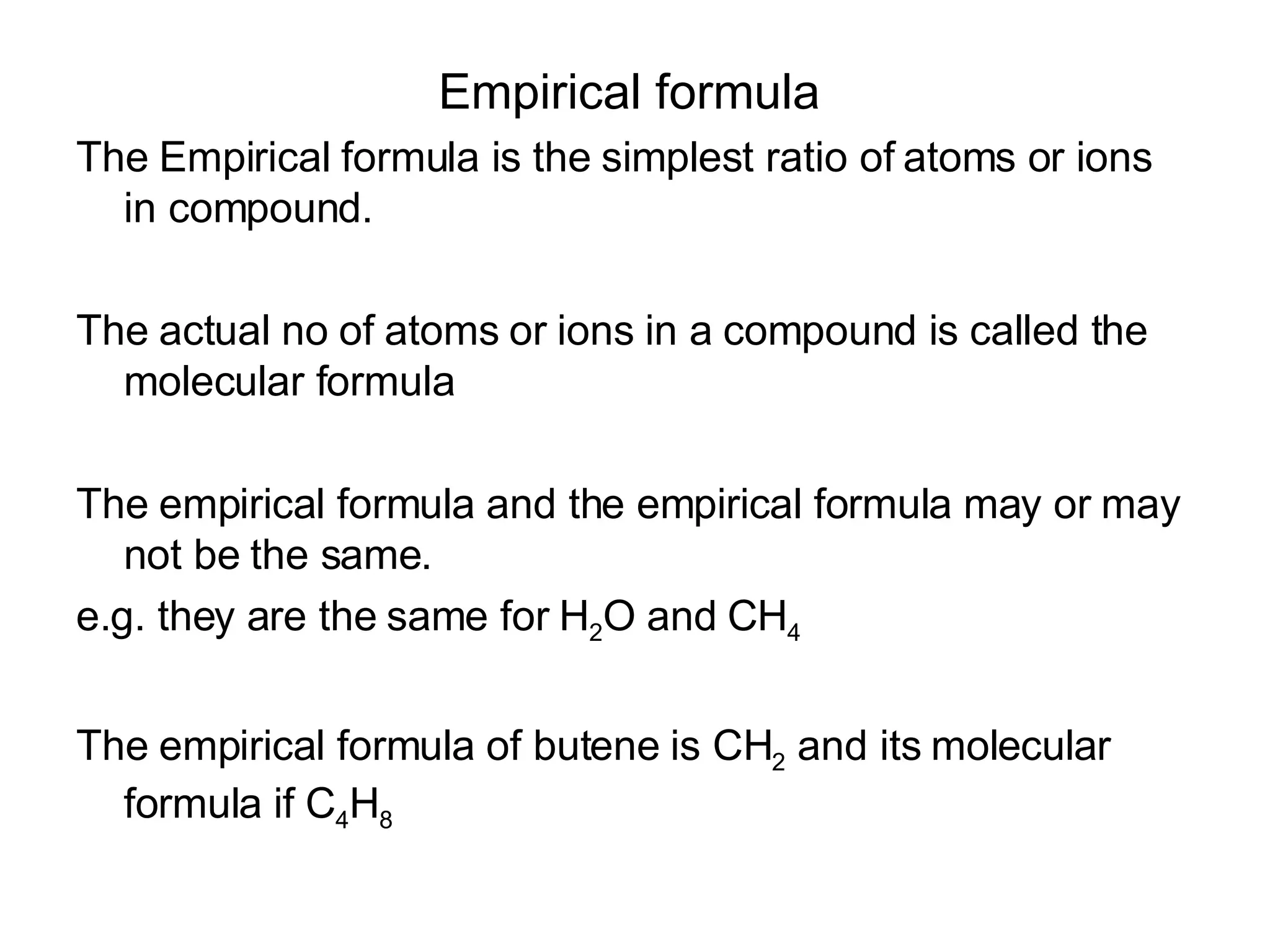
Empirical formula   The Empirical formula is the simplest ratio of atoms or ions in compound. The actual no of atoms or ions in a compound is called the molecular formula The empirical formula and the empirical formula may or may not be the same.  e.g. they are the same for H 2 O and CH 4   The empirical formula of butene is CH 2  and its molecular formula if C 4 H 8
Calculating the Empirical Formula A compound contains 63.6% N and 36.4% O Step 1 convert the % to mass 100g of the compound will contain 63.6g N and 36.4g O Step 2 Covert the mass to moles 63.6g N = 63.6/14 =  4.5 mols  36.4g O = 36.4/16 = 2.275 mols Step 3 Find the ratio of the atoms by dividing through by the smallest no 4.5   =  2     ratio is 2 N to 1 O and formula is N 2 O 2.275
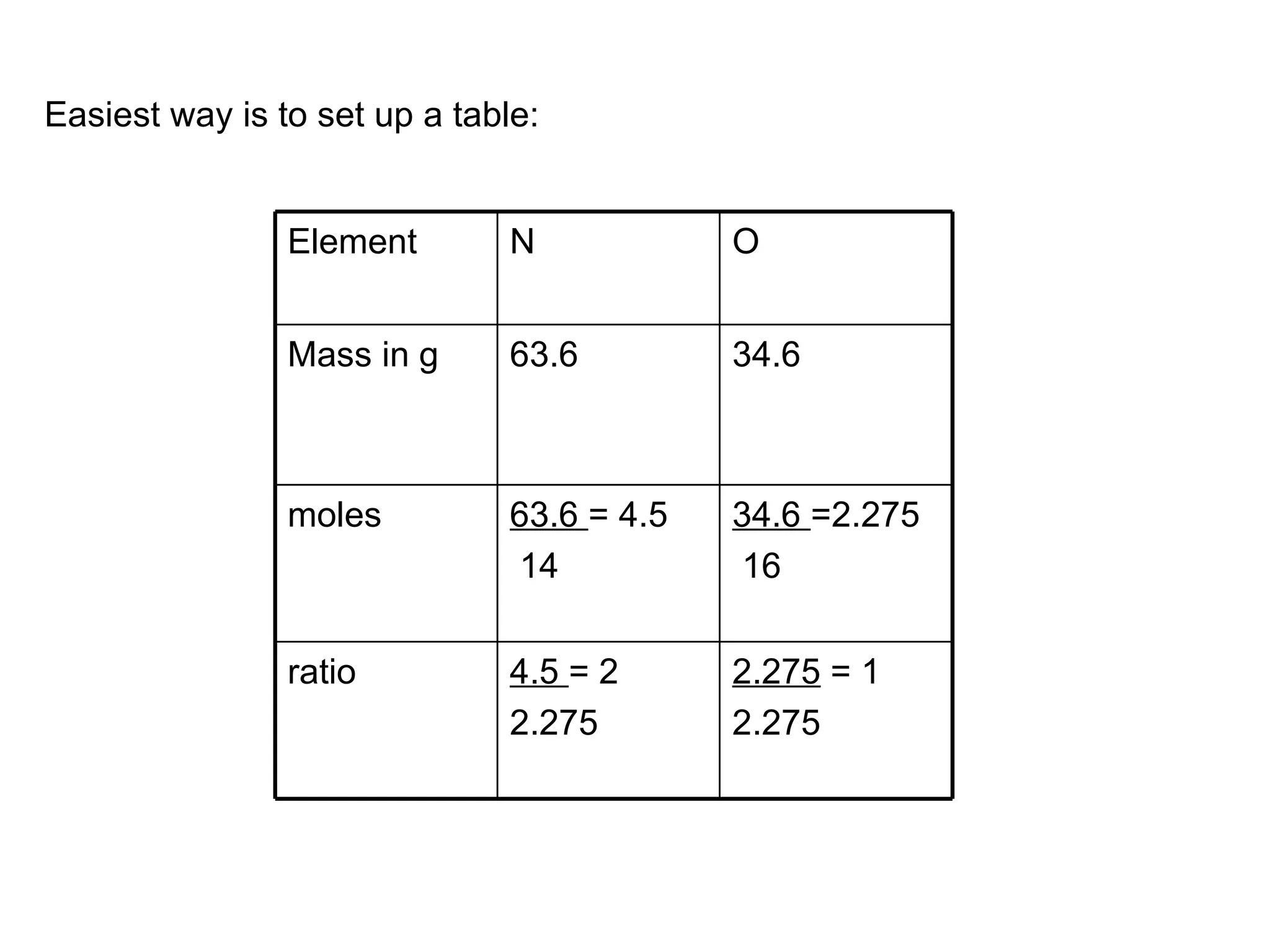
Easiest way is to set up a table: 2.275  = 1 2.275 4.5  = 2 2.275 ratio 34.6  =2.275 16 63.6  = 4.5 14 moles 34.6 63.6 Mass in g O N Element
Find the empirical formula of the following compounds from their composition by mass. Pb = 92.8% O = 7.2% K = 41.0% S = 33.7% O = 25.3% 4.5  = 1 4.5 4.5  = 1 4.5 ratio Formula  PbO 7.2 =0.45 16 92.8 = 0.45 207 moles 7.2 92.8 Mass in g O Pb Element
3 2 2 ratio 1.05  = 1 1.05 33.7  = 1.05 32 33.7 S 1.6  = 1.5 1.05 1.05  = 1 1.05 ratio K 2 S 2 O 3 Formula 25.3 = 1.6 16 41.1 = 1.05 39 moles 25.3 41.1 Mass in g O K Element
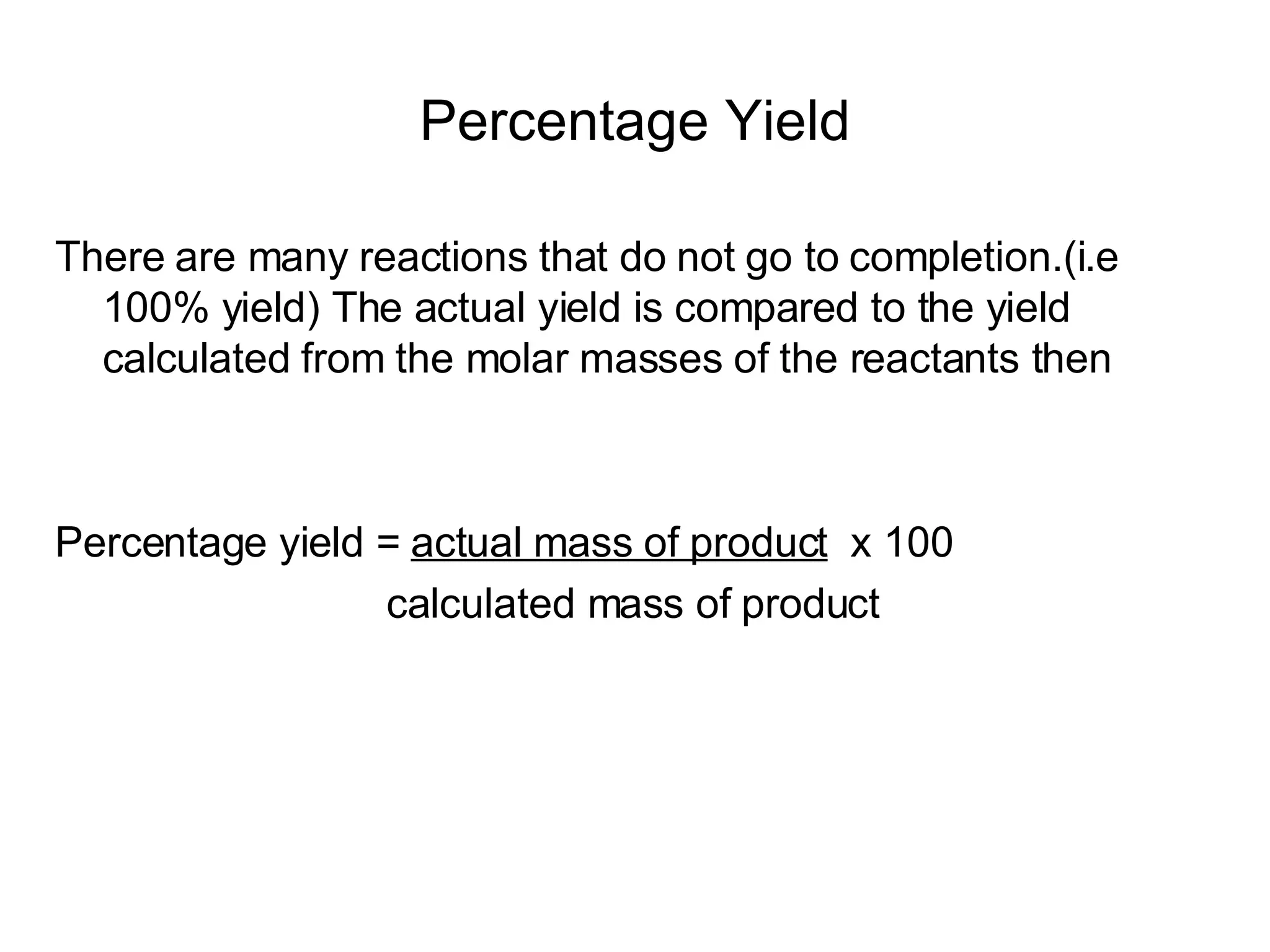
Percentage Yield There are many reactions that do not go to completion.(i.e 100% yield) The actual yield is compared to the yield calculated from the molar masses of the reactants then Percentage yield =  actual mass of product   x 100 calculated mass of product
36g of ethyl ethanoate are obtained from 23g of ethanol using the following equation. What is the % yield? C 2 H 5 OH (l)   +  CH 3 CO 2 H (l)    CH 3 CO 2 C 2 H 5(l)  +  H 2 O ethanol  ethanoic acid  ethyl ethanoate 1mol =46g  1mol  1mol =88g  1mol 23g ethanol =  23  = 0.5mol  46 0.5 mol ethyl ethanoate can be produced  0.5mol ethyl ethanoate = 88 x 0.5g = 44g  maximum yield = 44g Actual yield = 36g   % yield =  36  x 100 = 81.8% 44
Limiting Reagent In a reaction when masses of all the reactants are given it is necessary to find which reactant is  in excess  and will not be completely used up in the reaction, and which one is the  limiting  reagent. The limiting reagent will be completely used up in the reaction and can therefore be used to determine the amount of product formed.
5.00g of iron and 5.00g of sulphur   are   heated together to form iron(II)sulphide. Which reagent is present in excess and what mass of product is formed? Fe (s)   +  S (s)      FeS (s) 1 mole Fe + 1 mole S forms 1 mole FeS  56g Fe + 32 g S form 88g FeS 5.00g Fe =  5  mol = 0.0893mol 56  and 5.00g S =  5   mol = 0.156mol 32  Fe is the limiting reagent and 0.0893 moles of FeS are formed = 0.0893 x 88g = 7.86g
2Al (s)   +  Cr 2 O 3(s)      2Cr (s)   +  Al 2 O 3(s) Calculate the percentage yield when 180g of chromium are obtained from a reaction between 100g aluminium and 400g of chromium(III) oxide Method: 1) calculate the no of moles of Al used 2) Calculate the no of moles of Cr 2 O 3  used 3) Decide which is the limiting reagent 4) Calculate the max no of moles of chromium obtainable 5) Calculate the percentage yield
No of moles Al =  100   =  3.70 27 2) No of moles Cr 2 O 3   =  400   = 2.63 152 3) We need 2 moles Al for every mole Cr 2 O 3 3.70 moles Al need  3.7   moles Cr 2 O 3  = 1.85 moles  2 We have >1.85 moles of Cr 2 O 3    Al is the limiting reagent (Cr 2 O 3  is in excess) 4) 3.70 moles Al will produce 3.7 moles Cr   3.70 x 52 = 192.4 g  Cr could be produced 5) % yield =  180   =  93.6% 192.4

8 More On The Mole!

  • 1.
    8 More onthe Mole! Empirical Formula, Stoichiometry and Calculations
  • 2.
    Empirical formula The Empirical formula is the simplest ratio of atoms or ions in compound. The actual no of atoms or ions in a compound is called the molecular formula The empirical formula and the empirical formula may or may not be the same. e.g. they are the same for H 2 O and CH 4 The empirical formula of butene is CH 2 and its molecular formula if C 4 H 8
  • 3.
    Calculating the EmpiricalFormula A compound contains 63.6% N and 36.4% O Step 1 convert the % to mass 100g of the compound will contain 63.6g N and 36.4g O Step 2 Covert the mass to moles 63.6g N = 63.6/14 = 4.5 mols 36.4g O = 36.4/16 = 2.275 mols Step 3 Find the ratio of the atoms by dividing through by the smallest no 4.5 = 2  ratio is 2 N to 1 O and formula is N 2 O 2.275
  • 4.
    Easiest way isto set up a table: 2.275 = 1 2.275 4.5 = 2 2.275 ratio 34.6 =2.275 16 63.6 = 4.5 14 moles 34.6 63.6 Mass in g O N Element
  • 5.
    Find the empiricalformula of the following compounds from their composition by mass. Pb = 92.8% O = 7.2% K = 41.0% S = 33.7% O = 25.3% 4.5 = 1 4.5 4.5 = 1 4.5 ratio Formula PbO 7.2 =0.45 16 92.8 = 0.45 207 moles 7.2 92.8 Mass in g O Pb Element
  • 6.
    3 2 2ratio 1.05 = 1 1.05 33.7 = 1.05 32 33.7 S 1.6 = 1.5 1.05 1.05 = 1 1.05 ratio K 2 S 2 O 3 Formula 25.3 = 1.6 16 41.1 = 1.05 39 moles 25.3 41.1 Mass in g O K Element
  • 7.
    Percentage Yield Thereare many reactions that do not go to completion.(i.e 100% yield) The actual yield is compared to the yield calculated from the molar masses of the reactants then Percentage yield = actual mass of product x 100 calculated mass of product
  • 8.
    36g of ethylethanoate are obtained from 23g of ethanol using the following equation. What is the % yield? C 2 H 5 OH (l) + CH 3 CO 2 H (l)  CH 3 CO 2 C 2 H 5(l) + H 2 O ethanol ethanoic acid ethyl ethanoate 1mol =46g 1mol 1mol =88g 1mol 23g ethanol = 23 = 0.5mol 46 0.5 mol ethyl ethanoate can be produced 0.5mol ethyl ethanoate = 88 x 0.5g = 44g  maximum yield = 44g Actual yield = 36g  % yield = 36 x 100 = 81.8% 44
  • 9.
    Limiting Reagent Ina reaction when masses of all the reactants are given it is necessary to find which reactant is in excess and will not be completely used up in the reaction, and which one is the limiting reagent. The limiting reagent will be completely used up in the reaction and can therefore be used to determine the amount of product formed.
  • 10.
    5.00g of ironand 5.00g of sulphur are heated together to form iron(II)sulphide. Which reagent is present in excess and what mass of product is formed? Fe (s) + S (s)  FeS (s) 1 mole Fe + 1 mole S forms 1 mole FeS  56g Fe + 32 g S form 88g FeS 5.00g Fe = 5 mol = 0.0893mol 56 and 5.00g S = 5 mol = 0.156mol 32  Fe is the limiting reagent and 0.0893 moles of FeS are formed = 0.0893 x 88g = 7.86g
  • 11.
    2Al (s) + Cr 2 O 3(s)  2Cr (s) + Al 2 O 3(s) Calculate the percentage yield when 180g of chromium are obtained from a reaction between 100g aluminium and 400g of chromium(III) oxide Method: 1) calculate the no of moles of Al used 2) Calculate the no of moles of Cr 2 O 3 used 3) Decide which is the limiting reagent 4) Calculate the max no of moles of chromium obtainable 5) Calculate the percentage yield
  • 12.
    No of molesAl = 100 = 3.70 27 2) No of moles Cr 2 O 3 = 400 = 2.63 152 3) We need 2 moles Al for every mole Cr 2 O 3 3.70 moles Al need 3.7 moles Cr 2 O 3 = 1.85 moles 2 We have >1.85 moles of Cr 2 O 3  Al is the limiting reagent (Cr 2 O 3 is in excess) 4) 3.70 moles Al will produce 3.7 moles Cr  3.70 x 52 = 192.4 g Cr could be produced 5) % yield = 180 = 93.6% 192.4