CHAPTER 10 & 15
Organic Chemistry

Chem 104 Spring

K. Dunlap
Organic Chemistry
the study of the compounds of carbon.
•Organic compounds are made up of carbon
and only a few other elements.
•chief among these are hydrogen, oxygen, and
nitrogen
•also present are sulfur, phosphorus, and
halogens (fluorine, chlorine, bromine, or
iodine)
Why is organic chemistry a separate
discipline within chemistry?
1) Historical: scientists at one time believed
that a “vital force” present in living organisms
was necessary to produce an organic
compound.
•The experiment of Wö
hler in 1828 was the first in
a series of experiments that led to the demise of
the vital force theory.
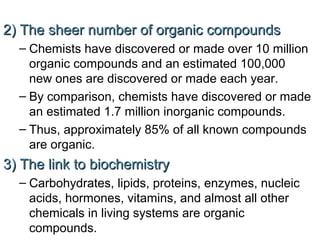
2) The sheer number of organic compounds
– Chemists have discovered or made over 10 million
organic compounds and an estimated 100,000
new ones are discovered or made each year.
– By comparison, chemists have discovered or made
an estimated 1.7 million inorganic compounds.
– Thus, approximately 85% of all known compounds
are organic.

3) The link to biochemistry
– Carbohydrates, lipids, proteins, enzymes, nucleic
acids, hormones, vitamins, and almost all other
chemicals in living systems are organic
compounds.
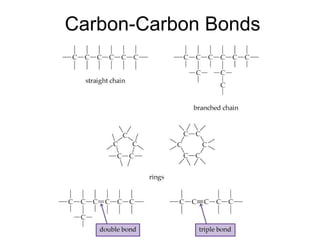
Carbon-Carbon Bonds
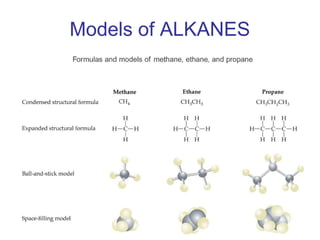
Models of ALKANES
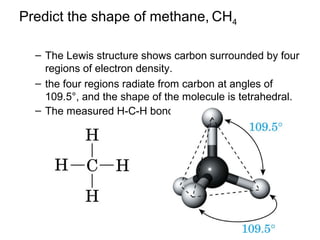
Predict the shape of methane, CH4
– The Lewis structure shows carbon surrounded by four
regions of electron density.
– the four regions radiate from carbon at angles of
109.5°, and the shape of the molecule is tetrahedral.
– The measured H-C-H bond angles are 109.5°.
MOLECULAR
GEOMETRY
Valence-Shell Electron-Pair Repulsion
(VSEPR) Model
– valence electrons of an atom may be involved in forming bonds
or may be unshared.
– each combination creates a negatively charged region of
electrons around the nucleus.
– because like charges repel each other, the various regions of
electron density around an atom spread so that each is as far
away from the others as possible.
Electron Pair Geometries
See Active Figure 8.5
Predict the shape of methane, CH4
– The Lewis structure shows carbon surrounded by four regions of electron
density.
– According to the VSEPR model, the four regions radiate from carbon at angles of
109.5°, and the shape of the molecule is tetrahedral.
– The measured H-C-H bond angles are 109.5°.
Predict the shape of ammonia, NH3
– nitrogen is surrounded by four regions of electron density (3 with single
pairs of electrons, and 1 with an unshared pair of electrons).
– According to the VSEPR model, the four regions radiate from nitrogen
at angles of 109.5°, and the shape of the molecule is pyramidal.
– The measured H-N-H bond angles are 107.3°
Predict the shape of water, H2O
– The Lewis structure shows oxygen with four regions of electron density
(2 regions with single pairs of e-, and 2 with unshared pairs of e-.
– According to the VSEPR model, the four regions radiate from oxygen at
angles of 109.5°, and the shape of the molecule is bent.
– The measured H-O-H bond angle is 104.5°.
Predict the shape of formaldehyde, CH2O
– The Lewis structure shows carbon surrounded by 3 regions of electron
density; 2 with single pairs of e- and one with 2 pairs of e- forming the
double bond to oxygen.
– According to the VSEPR model, the three regions radiate from carbon
at angles of 120°, and the shape of the molecule is planar (trigonal
planar).
– The measured H-C-H bond angle is 116.5°.
Predict the shape of ethylene, C2H4
– The Lewis structure shows carbon surrounded by 3 regions of e- density;
2 with single pairs of e- and 1 with two pairs of electrons forming the
double bond to the other carbon.
– According to the VSEPR model, the three regions radiate from carbon
at angles of 120°, and the shape of the molecule is planar (trigonal
planar).
– The measured H-C-H bond angle is 117.2°.
Predict the shape of acetylene, C2H2
– The Lewis structure shows carbon surrounded by 2 regions of electron
density; one region with a single pair of e-, and the other one with three
pairs of e- forming the triple bond to carbon.
– According to the VSEPR model, the two regions radiate from carbon at
an angle of 180°, and the shape of the molecule is linear.
– The measured H-C-C bond angle is 180°.
Bond Properties
• What is the effect of bonding and
structure on molecular properties?

Free rotation
around C–C single
bond

No rotation around
C=C double bond
Bond Order

Double bond
= 2nd order

Single bond = 1st order

Acrylonitrile
Triple
bond 3rd
Bond Length
• Bond length is the distance between
the nuclei of two bonded atoms.
Bond Length
Bond length depends
on bond order.

Bond distances measured in
Angstrom units where 1 A =
10-2 pm.
10-2 pm.
Bond Strength

• —measured by the energy required to
break a bond. See Table 8.9.
BOND
enthalpy (kJ/mol)
H—H
C—C
C=C
C≡C
N≡N

Bond dissociation
436
346
602
835
945

The GREATER the number of bonds (bond order) the
HIGHER the bond strength and the SHORTER the bond.
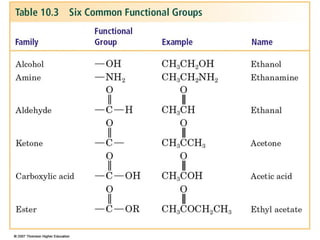
What are Functional Groups?
• an atom or group of atoms within a molecule that shows a
characteristic set of predictable physical and chemical
properties.
• Functional groups are important because:
1) They undergo the same types of chemical reactions no
matter in which molecule they are found.
2) To a large measure they determine the chemical and
physical properties of a molecule.
3) They are the units by which we divide organic compounds
into families.
4) They provide the basis on which we derive names for
organic compounds.
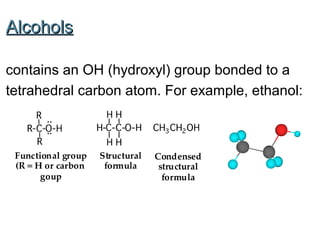
Alcohols
contains an OH (hydroxyl) group bonded to a
tetrahedral carbon atom. For example, ethanol:
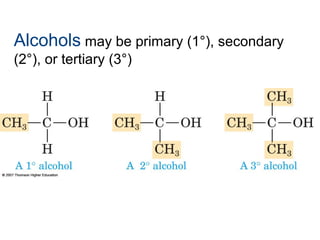
Alcohols may be primary (1°), secondary
(2°), or tertiary (3°)
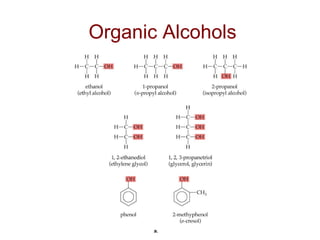
Organic Alcohols
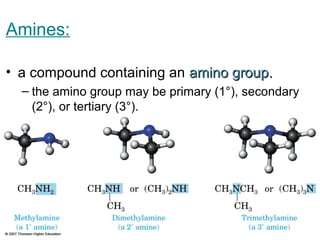
Amines:
• a compound containing an amino group.
– the amino group may be primary (1°), secondary
(2°), or tertiary (3°).
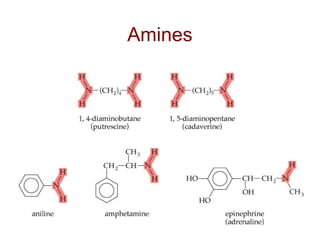
Amines
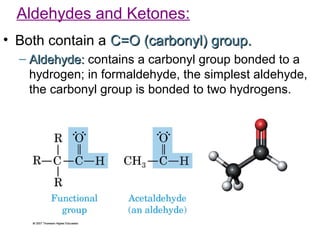
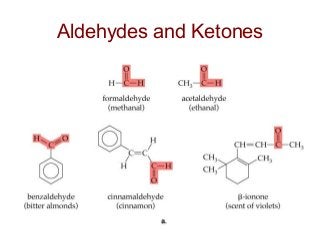
Aldehydes and Ketones:
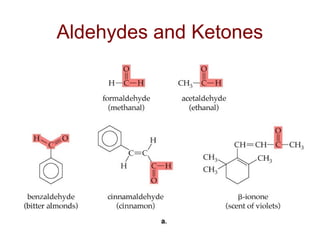
• Both contain a C=O (carbonyl) group.
– Aldehyde: contains a carbonyl group bonded to a
hydrogen; in formaldehyde, the simplest aldehyde,
the carbonyl group is bonded to two hydrogens.
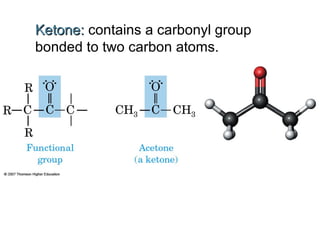
Ketone: contains a carbonyl group
bonded to two carbon atoms.
Aldehydes and Ketones
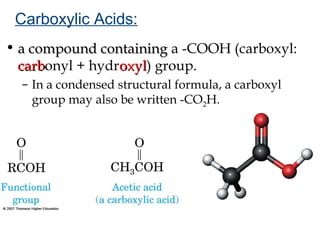
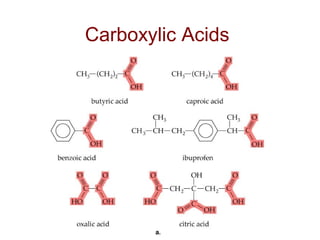
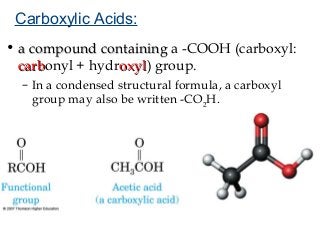
Carboxylic Acids:
• a compound containing a -COOH (carboxyl:
carbonyl + hydroxyl) group.
carb
oxyl
– In a condensed structural formula, a carboxyl
group may also be written -CO2H.
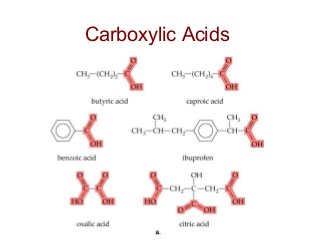
Carboxylic Acids
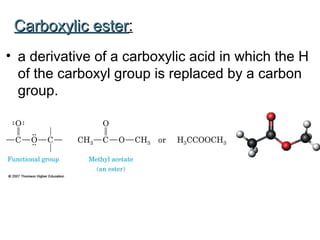
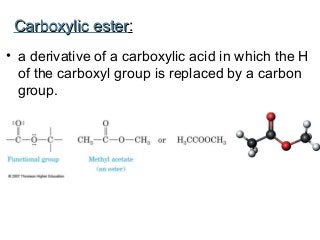
Carboxylic ester:
ester
• a derivative of a carboxylic acid in which the H
of the carboxyl group is replaced by a carbon
group.
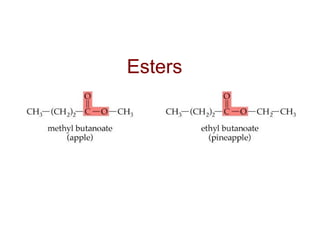
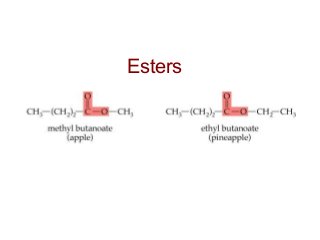
Esters
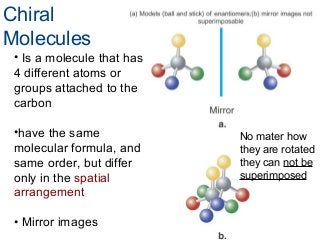
Chiral
Molecules
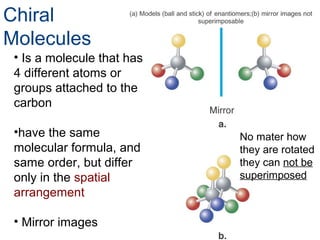
• Is a molecule that has
4 different atoms or
groups attached to the
carbon
•have the same
molecular formula, and
same order, but differ
only in the spatial
arrangement
• Mirror images

No mater how
they are rotated
they can not be
superimposed
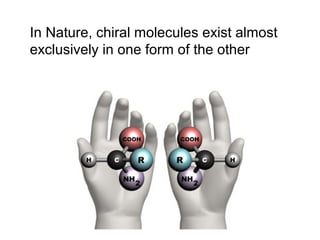
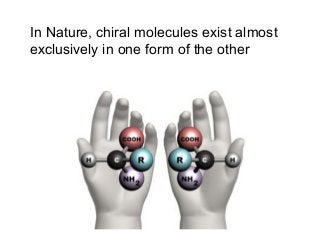
In Nature, chiral molecules exist almost
exclusively in one form of the other
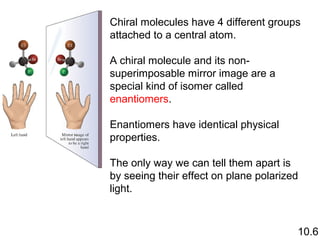
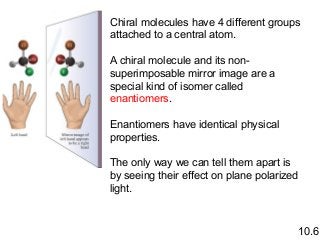
Chiral molecules have 4 different groups
attached to a central atom.
A chiral molecule and its nonsuperimposable mirror image are a
special kind of isomer called
enantiomers.
Enantiomers have identical physical
properties.
The only way we can tell them apart is
by seeing their effect on plane polarized
light.

10.6
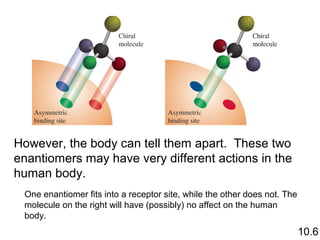
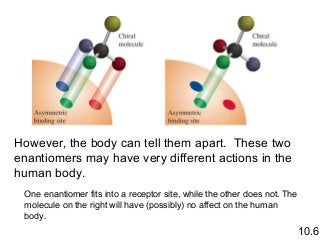
However, the body can tell them apart. These two
enantiomers may have very different actions in the
human body.
One enantiomer fits into a receptor site, while the other does not. The
molecule on the right will have (possibly) no affect on the human
body.

10.6
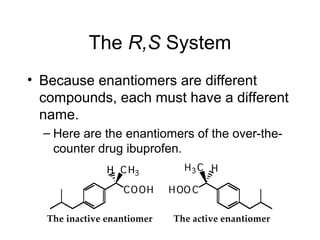
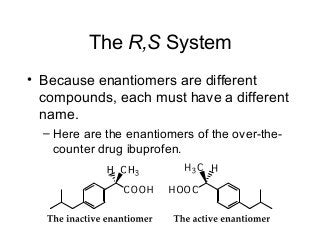
The R,S System
• Because enantiomers are different
compounds, each must have a different
name.
– Here are the enantiomers of the over-thecounter drug ibuprofen.
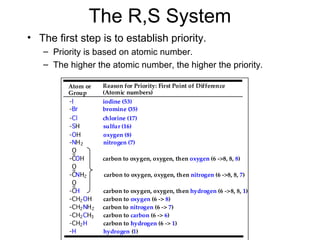
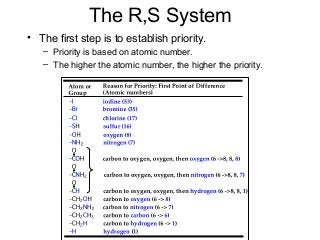
The R,S System
• The first step is to establish priority.
– Priority is based on atomic number.
– The higher the atomic number, the higher the priority.
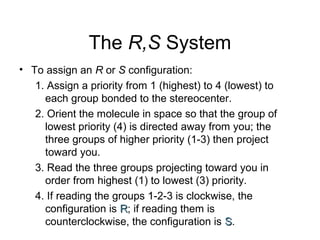
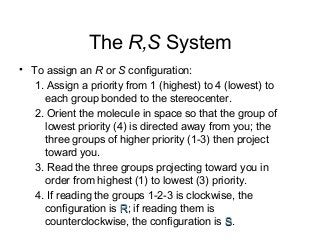
The R,S System
• To assign an R or S configuration:
1. Assign a priority from 1 (highest) to 4 (lowest) to
each group bonded to the stereocenter.
2. Orient the molecule in space so that the group of
lowest priority (4) is directed away from you; the
three groups of higher priority (1-3) then project
toward you.
3. Read the three groups projecting toward you in
order from highest (1) to lowest (3) priority.
4. If reading the groups 1-2-3 is clockwise, the
configuration is R; if reading them is
counterclockwise, the configuration is S.
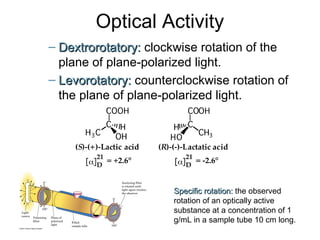
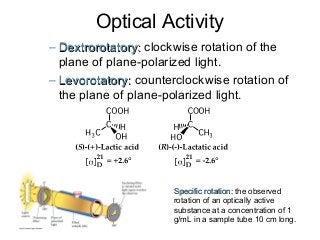
Optical Activity
– Dextrorotatory: clockwise rotation of the
plane of plane-polarized light.
– Levorotatory: counterclockwise rotation of
the plane of plane-polarized light.

Specific rotation: the observed
rotation of an optically active
substance at a concentration of 1
g/mL in a sample tube 10 cm long.
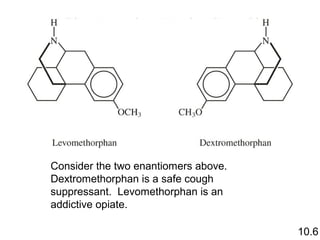
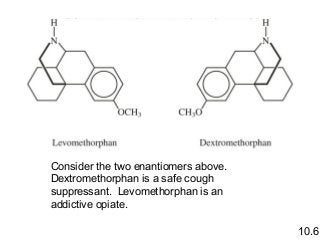
Consider the two enantiomers above.
Dextromethorphan is a safe cough
suppressant. Levomethorphan is an
addictive opiate.
10.6

Organic chemistry

  • 1.
    CHAPTER 10 &15 Organic Chemistry Chem 104 Spring K. Dunlap
  • 2.
    Organic Chemistry the studyof the compounds of carbon. •Organic compounds are made up of carbon and only a few other elements. •chief among these are hydrogen, oxygen, and nitrogen •also present are sulfur, phosphorus, and halogens (fluorine, chlorine, bromine, or iodine)
  • 3.
    Why is organicchemistry a separate discipline within chemistry? 1) Historical: scientists at one time believed that a “vital force” present in living organisms was necessary to produce an organic compound. •The experiment of Wö hler in 1828 was the first in a series of experiments that led to the demise of the vital force theory.
  • 4.
    2) The sheernumber of organic compounds – Chemists have discovered or made over 10 million organic compounds and an estimated 100,000 new ones are discovered or made each year. – By comparison, chemists have discovered or made an estimated 1.7 million inorganic compounds. – Thus, approximately 85% of all known compounds are organic. 3) The link to biochemistry – Carbohydrates, lipids, proteins, enzymes, nucleic acids, hormones, vitamins, and almost all other chemicals in living systems are organic compounds.
  • 6.
  • 7.
  • 8.
    Predict the shapeof methane, CH4 – The Lewis structure shows carbon surrounded by four regions of electron density. – the four regions radiate from carbon at angles of 109.5°, and the shape of the molecule is tetrahedral. – The measured H-C-H bond angles are 109.5°.
  • 9.
  • 10.
    Valence-Shell Electron-Pair Repulsion (VSEPR)Model – valence electrons of an atom may be involved in forming bonds or may be unshared. – each combination creates a negatively charged region of electrons around the nucleus. – because like charges repel each other, the various regions of electron density around an atom spread so that each is as far away from the others as possible.
  • 11.
  • 13.
    Predict the shapeof methane, CH4 – The Lewis structure shows carbon surrounded by four regions of electron density. – According to the VSEPR model, the four regions radiate from carbon at angles of 109.5°, and the shape of the molecule is tetrahedral. – The measured H-C-H bond angles are 109.5°.
  • 14.
    Predict the shapeof ammonia, NH3 – nitrogen is surrounded by four regions of electron density (3 with single pairs of electrons, and 1 with an unshared pair of electrons). – According to the VSEPR model, the four regions radiate from nitrogen at angles of 109.5°, and the shape of the molecule is pyramidal. – The measured H-N-H bond angles are 107.3°
  • 15.
    Predict the shapeof water, H2O – The Lewis structure shows oxygen with four regions of electron density (2 regions with single pairs of e-, and 2 with unshared pairs of e-. – According to the VSEPR model, the four regions radiate from oxygen at angles of 109.5°, and the shape of the molecule is bent. – The measured H-O-H bond angle is 104.5°.
  • 16.
    Predict the shapeof formaldehyde, CH2O – The Lewis structure shows carbon surrounded by 3 regions of electron density; 2 with single pairs of e- and one with 2 pairs of e- forming the double bond to oxygen. – According to the VSEPR model, the three regions radiate from carbon at angles of 120°, and the shape of the molecule is planar (trigonal planar). – The measured H-C-H bond angle is 116.5°.
  • 17.
    Predict the shapeof ethylene, C2H4 – The Lewis structure shows carbon surrounded by 3 regions of e- density; 2 with single pairs of e- and 1 with two pairs of electrons forming the double bond to the other carbon. – According to the VSEPR model, the three regions radiate from carbon at angles of 120°, and the shape of the molecule is planar (trigonal planar). – The measured H-C-H bond angle is 117.2°.
  • 18.
    Predict the shapeof acetylene, C2H2 – The Lewis structure shows carbon surrounded by 2 regions of electron density; one region with a single pair of e-, and the other one with three pairs of e- forming the triple bond to carbon. – According to the VSEPR model, the two regions radiate from carbon at an angle of 180°, and the shape of the molecule is linear. – The measured H-C-C bond angle is 180°.
  • 19.
    Bond Properties • Whatis the effect of bonding and structure on molecular properties? Free rotation around C–C single bond No rotation around C=C double bond
  • 20.
    Bond Order Double bond =2nd order Single bond = 1st order Acrylonitrile Triple bond 3rd
  • 21.
    Bond Length • Bondlength is the distance between the nuclei of two bonded atoms.
  • 22.
    Bond Length Bond lengthdepends on bond order. Bond distances measured in Bond distances measured in Angstrom units where 1 A = Angstrom units where 1 A = 10-2 pm. 10-2 pm.
  • 23.
    Bond Strength • —measuredby the energy required to break a bond. See Table 8.9. BOND enthalpy (kJ/mol) H—H C—C C=C C≡C N≡N Bond dissociation 436 346 602 835 945 The GREATER the number of bonds (bond order) the HIGHER the bond strength and the SHORTER the bond.
  • 24.
    What are FunctionalGroups? • an atom or group of atoms within a molecule that shows a characteristic set of predictable physical and chemical properties. • Functional groups are important because: 1) They undergo the same types of chemical reactions no matter in which molecule they are found. 2) To a large measure they determine the chemical and physical properties of a molecule. 3) They are the units by which we divide organic compounds into families. 4) They provide the basis on which we derive names for organic compounds.
  • 26.
    Alcohols contains an OH(hydroxyl) group bonded to a tetrahedral carbon atom. For example, ethanol:
  • 27.
    Alcohols may beprimary (1°), secondary (2°), or tertiary (3°)
  • 28.
  • 29.
    Amines: • a compoundcontaining an amino group. – the amino group may be primary (1°), secondary (2°), or tertiary (3°).
  • 30.
  • 31.
    Aldehydes and Ketones: •Both contain a C=O (carbonyl) group. – Aldehyde: contains a carbonyl group bonded to a hydrogen; in formaldehyde, the simplest aldehyde, the carbonyl group is bonded to two hydrogens.
  • 32.
    Ketone: contains acarbonyl group bonded to two carbon atoms.
  • 33.
  • 34.
    Carboxylic Acids: • acompound containing a -COOH (carboxyl: carbonyl + hydroxyl) group. carb oxyl – In a condensed structural formula, a carboxyl group may also be written -CO2H.
  • 35.
  • 36.
    Carboxylic ester: ester • aderivative of a carboxylic acid in which the H of the carboxyl group is replaced by a carbon group.
  • 37.
  • 39.
    Chiral Molecules • Is amolecule that has 4 different atoms or groups attached to the carbon •have the same molecular formula, and same order, but differ only in the spatial arrangement • Mirror images No mater how they are rotated they can not be superimposed
  • 40.
    In Nature, chiralmolecules exist almost exclusively in one form of the other
  • 41.
    Chiral molecules have4 different groups attached to a central atom. A chiral molecule and its nonsuperimposable mirror image are a special kind of isomer called enantiomers. Enantiomers have identical physical properties. The only way we can tell them apart is by seeing their effect on plane polarized light. 10.6
  • 42.
    However, the bodycan tell them apart. These two enantiomers may have very different actions in the human body. One enantiomer fits into a receptor site, while the other does not. The molecule on the right will have (possibly) no affect on the human body. 10.6
  • 43.
    The R,S System •Because enantiomers are different compounds, each must have a different name. – Here are the enantiomers of the over-thecounter drug ibuprofen.
  • 44.
    The R,S System •The first step is to establish priority. – Priority is based on atomic number. – The higher the atomic number, the higher the priority.
  • 45.
    The R,S System •To assign an R or S configuration: 1. Assign a priority from 1 (highest) to 4 (lowest) to each group bonded to the stereocenter. 2. Orient the molecule in space so that the group of lowest priority (4) is directed away from you; the three groups of higher priority (1-3) then project toward you. 3. Read the three groups projecting toward you in order from highest (1) to lowest (3) priority. 4. If reading the groups 1-2-3 is clockwise, the configuration is R; if reading them is counterclockwise, the configuration is S.
  • 46.
    Optical Activity – Dextrorotatory:clockwise rotation of the plane of plane-polarized light. – Levorotatory: counterclockwise rotation of the plane of plane-polarized light. Specific rotation: the observed rotation of an optically active substance at a concentration of 1 g/mL in a sample tube 10 cm long.
  • 47.
    Consider the twoenantiomers above. Dextromethorphan is a safe cough suppressant. Levomethorphan is an addictive opiate. 10.6