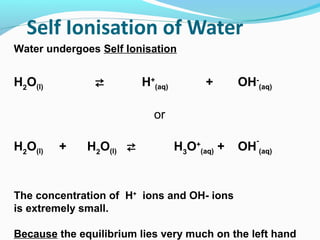
Water undergoes Self Ionisation

⇄

H2O(l)

H+(aq)

+

OH-(aq)

or
H2O(l)

+

H2O(l) ⇄

H3O

+
(aq)

+

-

OH (aq)

The concentration of H+ ions and OH- ions
is extremely small.
Because the equilibrium lies very much on the left hand
H2O(l)

⇄

H+(aq) +
Kc

OH-(aq)

=

In the above expression, the value of [H2O] may be taken as having a
constant value because the degree of ionisation is so small.
Kc

=

Kc [H2O] = [H+] [OH-]
Both Kc and [H2O] are constant values so

Kw = Kc [H2O] = [H+] [OH-]
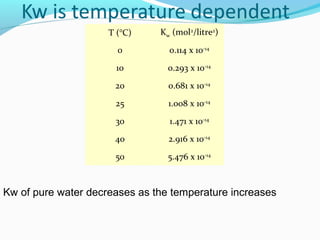
T (°C)

Kw (mol2/litre2)

0

0.114 x 10⁻¹⁴

10

0.293 x 10⁻¹⁴

20

0.681 x 10⁻¹⁴

25

1.008 x 10⁻¹⁴

30

1.471 x 10⁻¹⁴

40

2.916 x 10⁻¹⁴

50

5.476 x 10⁻¹⁴

Kw of pure water decreases as the temperature increases
Acid–Base Concentrations in Solutions
concentration (moles/L)

10-1
OH-

H+

10-7
H+

OH-

OH-

H+

10-14

[H+] > [OH-]

[H+] = [OH-]

acidic
solution

neutral
solution

[H+] < [OH-]
basic
solution
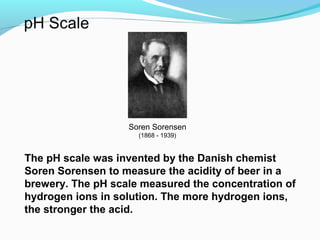
Soren Sorensen
(1868 - 1939)

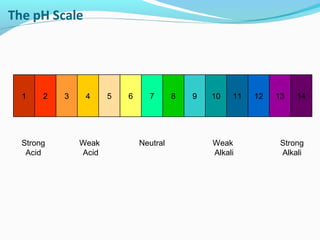
The pH scale was invented by the Danish chemist
Soren Sorensen to measure the acidity of beer in a
brewery. The pH scale measured the concentration of
hydrogen ions in solution. The more hydrogen ions,
the stronger the acid.
1

2

Strong
Acid

3

4

Weak
Acid

5

6

7

Neutral

8

9

10

11

Weak
Alkali

12

13

14

Strong
Alkali
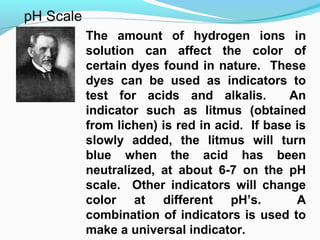
The amount of hydrogen ions in
solution can affect the color of
certain dyes found in nature. These
dyes can be used as indicators to
test for acids and alkalis.
An
indicator such as litmus (obtained
from lichen) is red in acid. If base is
slowly added, the litmus will turn
blue when the acid has been
neutralized, at about 6-7 on the pH
scale. Other indicators will change
color at different pH’s.
A
combination of indicators is used to
make a universal indicator.
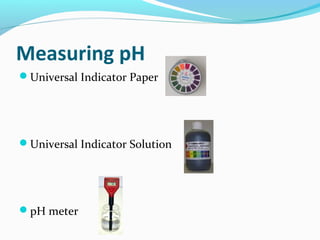
Measuring pH
Universal Indicator Paper

Universal Indicator Solution

pH meter
Measuring pH
 pH can be measured in several ways
 Usually it is measured with a coloured acid-base

indicator or a pH meter
 Coloured indicators are a crude measure of pH, but are
useful in certain applications
 pH meters are more accurate, but they must be
calibrated prior to use
 Calibration means setting to a standard
 A pH meter is calibrated with a solution of known pH
often called a buffer
 “Buffer” indicates that the pH is stable
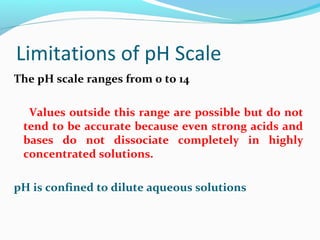
Limitations of pH Scale
The pH scale ranges from 0 to 14
Values outside this range are possible but do not
tend to be accurate because even strong acids and
bases do not dissociate completely in highly
concentrated solutions.
pH is confined to dilute aqueous solutions
At 250C

Kw = 1 x 10-14 mol2/litre2
[H+ ] x [OH- ] = 1 x 10-14 mol2/litre2
This equilibrium constant is very important because it
applies to all aqueous solutions - acids, bases, salts,
and non-electrolytes - not just to pure water.
For H2O(l) ⇄

H+(aq) + OH-(aq)

→

[H+ ] =

[H+ ] x [OH- ] = 1 x 10-14

[OH- ]
= [1 x 10⁻⁷ ] x [1 x 10⁻⁷ ]

[H+ ] of water is at 250C is 1 x 10⁻⁷ mol/litre
Replacing [H+ ] with pH to indicate acidity of solutions
pH 7 replaces [H+ ] of 1 x 10⁻⁷ mol/litre
where

pH =

- Log10 [H+ ]
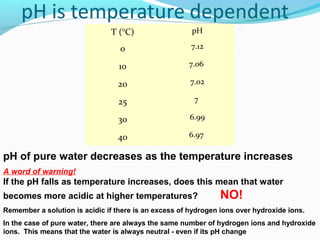
T (°C)

pH

0

7.12

10

7.06

20

7.02

25

7

30

6.99

40

6.97

pH of pure water decreases as the temperature increases
A word of warning!

If the pH falls as temperature increases, does this mean that water
becomes more acidic at higher temperatures?

NO!

Remember a solution is acidic if there is an excess of hydrogen ions over hydroxide ions.
In the case of pure water, there are always the same number of hydrogen ions and hydroxide
ions. This means that the water is always neutral - even if its pH change
Acid – Base Concentrations and pH
concentration (moles/L)

10-1

pH = 11

pH = 3

OH-

H+

pH = 7
10-7
H+

OH-

OH-

H+

10-14

[H3O+] > [OH-]
acidic
solution

[H3O+] = [OH-]
neutral
solution

[H3O+] < [OH-]

basic
solution
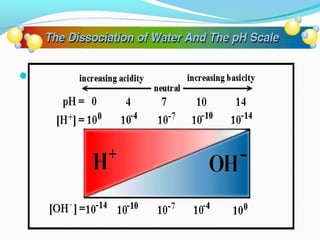
pH describes both [H+ ] and [OH- ]

0

Acidic [H+ ] = 100

[OH- ] =10-14

pH
Neutral

[H+ ] = 10-7

[OH- ] =10-7

pH
Basic

[H+ ] = 10-14

pH

= 14

= 0

= 7

[OH- ] = 100

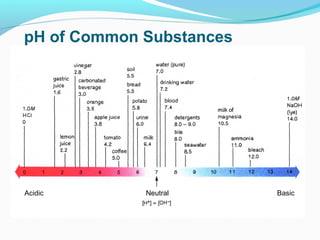
pH of Common Substances

Acidic

Neutral

Basic
More acidic

More basic

pH

NaOH, 0.1 M
Household bleach
Household ammonia
Lime water
Milk of magnesia
Borax
Baking soda
Egg white, seawater
Human blood, tears
Milk
Saliva
Rain
Black coffee
Banana
Tomatoes
Wine
Cola, vinegar
Lemon juice
Gastric juice

14
13
12
11
10
9
8
7
6
5
4
3
2
1
0

[H+]

[OH-]

pOH

1 x 10-14
1 x 10-13
1 x 10-12
1 x 10-11
1 x 10⁻¹⁰
1 x 10⁻⁹
1 x 10⁻⁸
1 x 10⁻⁷
1 x 10⁻⁶
1 x 10⁻⁵
1 x 10⁻⁴
1 x 10⁻³
1 x 10⁻²
1 x 10⁻¹
1 x 100

1 x 10-0
1 x 10⁻¹
1 x 10⁻²
1 x 10⁻³
1 x 10⁻⁴
1 x 10⁻⁵
1 x 10⁻⁶
1 x 10⁻⁷
1 x 10⁻⁸
1 x 10⁻⁹
1 x 10⁻¹⁰
1 x 10-11
1 x 10-12
1 x 10-13
1 x 10-14

0
1
2
3
4
5
6
7
8
9
10
11
12
13
14
Calculations and practice
• You will need to memorize the following:

[H+] = 10–pH
[OH–] = 10–pOH
pH = – log10[H+]
pOH = – log10[OH–]
pH + pOH = 14
pH Calculations
pH

pH = -log10[H+]

[H+]

[H+] = 10-pH

pH + pOH = 14

pOH

[H+] [OH-] = 1 x10-14

pOH = -log10[OH-]
[OH-] = 10-pOH

[OH-]
pH for Strong Acids
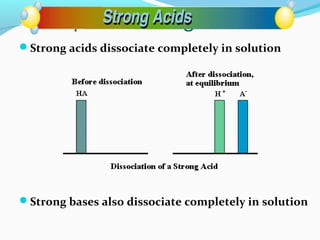
Strong acids dissociate completely in solution

Strong bases also dissociate completely in solution
pH Exercises
a) pH of 0.02M HCl
pH = – log10 [H+]
= – log10 [0.020]
= 1.6989
= 1.70
b) pH of 0.0050M NaOH
pOH = – log10 [OH–]
= – log10 [0.0050]
= 2.3
pH
= 14 – pOH
= 14 – 2.3
=11.7

c) pH of solution where [H +]
is 7.2x10⁻⁸M
pH
= – log10 [H+]
= – log10 [7.2x10⁻⁸]
= 7.14
(slightly basic)
monoprotic
e.g. HCl, HNO3

HA(aq)
0.3 M

H1+(aq) + A1-(aq)
0.3 M
0.3 M

pH = ?
pH = - log10 [H+]
pH = - log10[0.3M]
pH =

diprotic
e.g. H2SO4

H2A(aq)
0.3 M

2 H1+(aq) + A2-(aq)
0.6 M
0.3 M

0.48

pH = - log10[H+]
pH = - log10[0.6M]
pH =

0.78
A sample of orange juice has a hydrogen-ion
concentration of 2.9 x 10⁻⁴M. What is the pH?
pH = -log10 [H+ ]
pH = -log10 (2.9x10⁻⁴ )
pH = 3.54
Given: pH = 4.6

determine the [hydrogen ion]

pH = - log10 [H+]

choose proper equation

4.6 = - log10 [H+]

substitute pH value in equation

- 4.6 =
2nd

log

log10[H+]

multiply both sides by -1

- 4.6 =

antilog [H+]

take antilog of both sides

[H+] = 2.51x10⁻⁵ M
10x
antilog

You can check your answer by working backwards.
pH = - log10[H+]
pH = - log10[2.51x10⁻⁵ M]
pH = 4.6
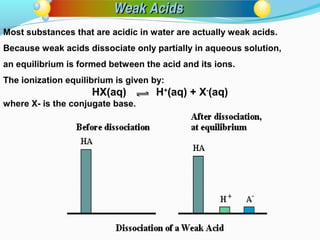
Most substances that are acidic in water are actually weak acids.
Because weak acids dissociate only partially in aqueous solution,
an equilibrium is formed between the acid and its ions.
The ionization equilibrium is given by:

HX(aq)
where X- is the conjugate base.

H+(aq) + X-(aq)
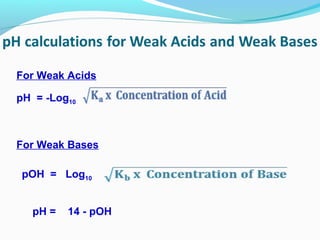
For Weak Acids
pH = -Log10

For Weak Bases
pOH = Log10
pH =

14 - pOH
pH of solutions of weak concentrations
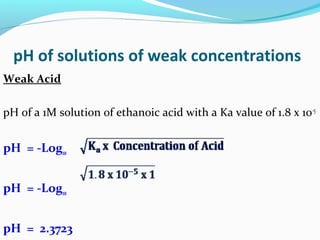
Weak Acid
pH of a 1M solution of ethanoic acid with a Ka value of 1.8 x 10⁻⁵

pH = -Log10
pH = -Log10
pH = 2.3723
pH of solutions of weak concentrations
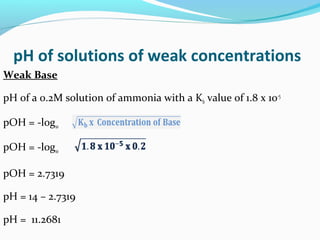
Weak Base
pH of a 0.2M solution of ammonia with a Kb value of 1.8 x 10⁻⁵
pOH = -log10
pOH = -log10
pOH = 2.7319
pH = 14 – 2.7319
pH = 11.2681
Theory of Acid Base Indicators
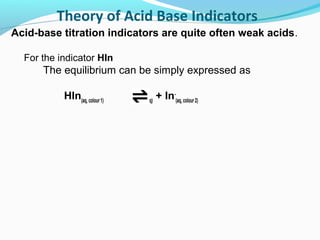
Acid-base titration indicators are quite often weak acids.
For the indicator HIn

The equilibrium can be simply expressed as
HIn(aq, colour 1)

H+(aq) + In-(aq, colour 2)
Theory of Acid Base Indicators
Applying Le Chatelier's equilibrium principle:
Addition of acid
•

favours the formation of more HIn (colour 1)

HIn(aq)

H+(aq) + In-(aq)

because an increase on the right of [H+]
causes a shift to left
increasing [HIn] (colour 1)
to minimise 'enforced' rise in [H+].
Theory of Acid Base Indicators
Applying Le Chatelier's equilibrium principle:
Addition of base
•

favours the formation of more In- (colour 2)

HIn(aq)

H+(aq) + In-(aq)

The increase in [OH-] causes a shift to right
because the reaction
H+(aq) + OH-(aq) ==> H2O(l)

Reducing the [H+] on the right
so more HIn ionises to replace the [H+]
and so increasing In- (colour 2)
to minimise 'enforced' rise in [OH-]
Theory of Acid Base Indicators
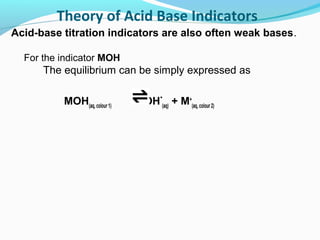
Acid-base titration indicators are also often weak bases.
For the indicator MOH

The equilibrium can be simply expressed as
MOH(aq, colour 1)

OH-(aq) + M+(aq, colour 2)
Theory of Acid Base Indicators
Applying Le Chatelier's equilibrium principle:
Addition of base
•

favours the formation of more MOH (colour 1)

MOH(aq)

M+(aq) + OH-(aq)

because an increase on the right of [OH-]
causes a shift to left
increasing [MOH] (colour 1)

-

to minimise 'enforced' rise in [OH ].
Theory of Acid Base Indicators
Applying Le Chatelier's equilibrium principle:
Addition of acid
•

favours the formation of more M+ (colour 2)

MOH(aq)

M+(aq) + OH-(aq)

The increase in [H+] causes a shift to right
because the reaction
H+(aq) + OH-(aq) ==> H2O(l)

Reducing the [OH-] on the right
so more MOH ionises to replace the [OH-]
and so increasing M+ (colour 2)
+
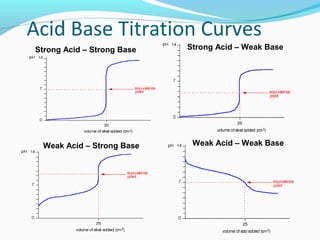
Acid Base Titration Curves
Strong Acid – Strong Base

Weak Acid – Strong Base

Strong Acid – Weak Base

Weak Acid – Weak Base
Choice of Indicator for Titration
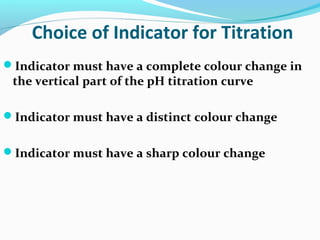
Indicator must have a complete colour change in

the vertical part of the pH titration curve

Indicator must have a distinct colour change
Indicator must have a sharp colour change
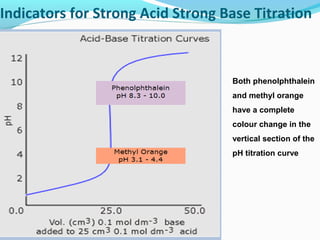
Indicators for Strong Acid Strong Base Titration

Both phenolphthalein
and methyl orange
have a complete
colour change in the
vertical section of the
pH titration curve
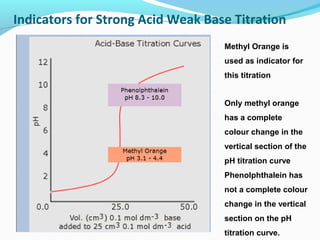
Indicators for Strong Acid Weak Base Titration
Methyl Orange is
used as indicator for
this titration
Only methyl orange
has a complete
colour change in the
vertical section of the
pH titration curve
Phenolphthalein has
not a complete colour
change in the vertical
section on the pH
titration curve.
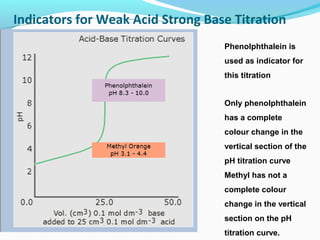
Indicators for Weak Acid Strong Base Titration
Phenolphthalein is
used as indicator for
this titration
Only phenolphthalein
has a complete
colour change in the
vertical section of the
pH titration curve
Methyl has not a
complete colour
change in the vertical
section on the pH
titration curve.
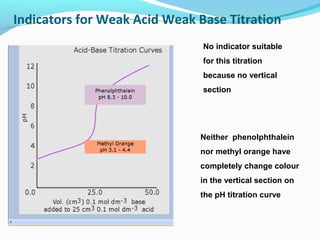
Indicators for Weak Acid Weak Base Titration
No indicator suitable
for this titration
because no vertical
section

Neither phenolphthalein
nor methyl orange have
completely change colour
in the vertical section on
the pH titration curve
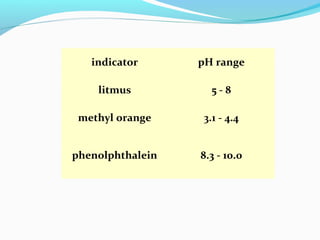
indicator

pH range

litmus

5-8

methyl orange

3.1 - 4.4

phenolphthalein

8.3 - 10.0
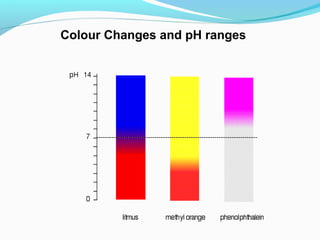
Colour Changes and pH ranges
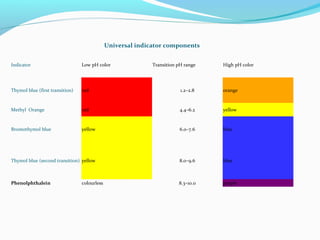
Universal indicator components
Indicator

Low pH color

Thymol blue (first transition)

red

1.2–2.8

orange

Methyl Orange

red

4.4–6.2

yellow

Bromothymol blue

yellow

6.0–7.6

blue

Thymol blue (second transition) yellow

8.0–9.6

blue

Phenolphthalein

8.3–10.0

purple

colourless

Transition pH range

High pH color

Ph scale

  • 1.
    Water undergoes SelfIonisation ⇄ H2O(l) H+(aq) + OH-(aq) or H2O(l) + H2O(l) ⇄ H3O + (aq) + - OH (aq) The concentration of H+ ions and OH- ions is extremely small. Because the equilibrium lies very much on the left hand
  • 2.
    H2O(l) ⇄ H+(aq) + Kc OH-(aq) = In theabove expression, the value of [H2O] may be taken as having a constant value because the degree of ionisation is so small. Kc = Kc [H2O] = [H+] [OH-] Both Kc and [H2O] are constant values so Kw = Kc [H2O] = [H+] [OH-]
  • 3.
    T (°C) Kw (mol2/litre2) 0 0.114x 10⁻¹⁴ 10 0.293 x 10⁻¹⁴ 20 0.681 x 10⁻¹⁴ 25 1.008 x 10⁻¹⁴ 30 1.471 x 10⁻¹⁴ 40 2.916 x 10⁻¹⁴ 50 5.476 x 10⁻¹⁴ Kw of pure water decreases as the temperature increases
  • 4.
  • 5.
    Acid–Base Concentrations inSolutions concentration (moles/L) 10-1 OH- H+ 10-7 H+ OH- OH- H+ 10-14 [H+] > [OH-] [H+] = [OH-] acidic solution neutral solution [H+] < [OH-] basic solution
  • 6.
    Soren Sorensen (1868 -1939) The pH scale was invented by the Danish chemist Soren Sorensen to measure the acidity of beer in a brewery. The pH scale measured the concentration of hydrogen ions in solution. The more hydrogen ions, the stronger the acid.
  • 7.
  • 8.
    The amount ofhydrogen ions in solution can affect the color of certain dyes found in nature. These dyes can be used as indicators to test for acids and alkalis. An indicator such as litmus (obtained from lichen) is red in acid. If base is slowly added, the litmus will turn blue when the acid has been neutralized, at about 6-7 on the pH scale. Other indicators will change color at different pH’s. A combination of indicators is used to make a universal indicator.
  • 9.
    Measuring pH Universal IndicatorPaper Universal Indicator Solution pH meter
  • 10.
    Measuring pH  pHcan be measured in several ways  Usually it is measured with a coloured acid-base indicator or a pH meter  Coloured indicators are a crude measure of pH, but are useful in certain applications  pH meters are more accurate, but they must be calibrated prior to use  Calibration means setting to a standard  A pH meter is calibrated with a solution of known pH often called a buffer  “Buffer” indicates that the pH is stable
  • 11.
    Limitations of pHScale The pH scale ranges from 0 to 14 Values outside this range are possible but do not tend to be accurate because even strong acids and bases do not dissociate completely in highly concentrated solutions. pH is confined to dilute aqueous solutions
  • 12.
    At 250C Kw =1 x 10-14 mol2/litre2 [H+ ] x [OH- ] = 1 x 10-14 mol2/litre2 This equilibrium constant is very important because it applies to all aqueous solutions - acids, bases, salts, and non-electrolytes - not just to pure water.
  • 13.
    For H2O(l) ⇄ H+(aq)+ OH-(aq) → [H+ ] = [H+ ] x [OH- ] = 1 x 10-14 [OH- ] = [1 x 10⁻⁷ ] x [1 x 10⁻⁷ ] [H+ ] of water is at 250C is 1 x 10⁻⁷ mol/litre Replacing [H+ ] with pH to indicate acidity of solutions pH 7 replaces [H+ ] of 1 x 10⁻⁷ mol/litre where pH = - Log10 [H+ ]
  • 14.
    T (°C) pH 0 7.12 10 7.06 20 7.02 25 7 30 6.99 40 6.97 pH ofpure water decreases as the temperature increases A word of warning! If the pH falls as temperature increases, does this mean that water becomes more acidic at higher temperatures? NO! Remember a solution is acidic if there is an excess of hydrogen ions over hydroxide ions. In the case of pure water, there are always the same number of hydrogen ions and hydroxide ions. This means that the water is always neutral - even if its pH change
  • 15.
    Acid – BaseConcentrations and pH concentration (moles/L) 10-1 pH = 11 pH = 3 OH- H+ pH = 7 10-7 H+ OH- OH- H+ 10-14 [H3O+] > [OH-] acidic solution [H3O+] = [OH-] neutral solution [H3O+] < [OH-] basic solution
  • 16.
    pH describes both[H+ ] and [OH- ] 0 Acidic [H+ ] = 100 [OH- ] =10-14 pH Neutral [H+ ] = 10-7 [OH- ] =10-7 pH Basic [H+ ] = 10-14 pH = 14 = 0 = 7 [OH- ] = 100
  • 17.
  • 18.
    pH of CommonSubstances Acidic Neutral Basic
  • 19.
    More acidic More basic pH NaOH,0.1 M Household bleach Household ammonia Lime water Milk of magnesia Borax Baking soda Egg white, seawater Human blood, tears Milk Saliva Rain Black coffee Banana Tomatoes Wine Cola, vinegar Lemon juice Gastric juice 14 13 12 11 10 9 8 7 6 5 4 3 2 1 0 [H+] [OH-] pOH 1 x 10-14 1 x 10-13 1 x 10-12 1 x 10-11 1 x 10⁻¹⁰ 1 x 10⁻⁹ 1 x 10⁻⁸ 1 x 10⁻⁷ 1 x 10⁻⁶ 1 x 10⁻⁵ 1 x 10⁻⁴ 1 x 10⁻³ 1 x 10⁻² 1 x 10⁻¹ 1 x 100 1 x 10-0 1 x 10⁻¹ 1 x 10⁻² 1 x 10⁻³ 1 x 10⁻⁴ 1 x 10⁻⁵ 1 x 10⁻⁶ 1 x 10⁻⁷ 1 x 10⁻⁸ 1 x 10⁻⁹ 1 x 10⁻¹⁰ 1 x 10-11 1 x 10-12 1 x 10-13 1 x 10-14 0 1 2 3 4 5 6 7 8 9 10 11 12 13 14
  • 20.
    Calculations and practice •You will need to memorize the following: [H+] = 10–pH [OH–] = 10–pOH pH = – log10[H+] pOH = – log10[OH–] pH + pOH = 14
  • 21.
    pH Calculations pH pH =-log10[H+] [H+] [H+] = 10-pH pH + pOH = 14 pOH [H+] [OH-] = 1 x10-14 pOH = -log10[OH-] [OH-] = 10-pOH [OH-]
  • 22.
    pH for StrongAcids Strong acids dissociate completely in solution Strong bases also dissociate completely in solution
  • 23.
    pH Exercises a) pHof 0.02M HCl pH = – log10 [H+] = – log10 [0.020] = 1.6989 = 1.70 b) pH of 0.0050M NaOH pOH = – log10 [OH–] = – log10 [0.0050] = 2.3 pH = 14 – pOH = 14 – 2.3 =11.7 c) pH of solution where [H +] is 7.2x10⁻⁸M pH = – log10 [H+] = – log10 [7.2x10⁻⁸] = 7.14 (slightly basic)
  • 24.
    monoprotic e.g. HCl, HNO3 HA(aq) 0.3M H1+(aq) + A1-(aq) 0.3 M 0.3 M pH = ? pH = - log10 [H+] pH = - log10[0.3M] pH = diprotic e.g. H2SO4 H2A(aq) 0.3 M 2 H1+(aq) + A2-(aq) 0.6 M 0.3 M 0.48 pH = - log10[H+] pH = - log10[0.6M] pH = 0.78
  • 25.
    A sample oforange juice has a hydrogen-ion concentration of 2.9 x 10⁻⁴M. What is the pH? pH = -log10 [H+ ] pH = -log10 (2.9x10⁻⁴ ) pH = 3.54
  • 26.
    Given: pH =4.6 determine the [hydrogen ion] pH = - log10 [H+] choose proper equation 4.6 = - log10 [H+] substitute pH value in equation - 4.6 = 2nd log log10[H+] multiply both sides by -1 - 4.6 = antilog [H+] take antilog of both sides [H+] = 2.51x10⁻⁵ M 10x antilog You can check your answer by working backwards. pH = - log10[H+] pH = - log10[2.51x10⁻⁵ M] pH = 4.6
  • 27.
    Most substances thatare acidic in water are actually weak acids. Because weak acids dissociate only partially in aqueous solution, an equilibrium is formed between the acid and its ions. The ionization equilibrium is given by: HX(aq) where X- is the conjugate base. H+(aq) + X-(aq)
  • 28.
    For Weak Acids pH= -Log10 For Weak Bases pOH = Log10 pH = 14 - pOH
  • 29.
    pH of solutionsof weak concentrations Weak Acid pH of a 1M solution of ethanoic acid with a Ka value of 1.8 x 10⁻⁵ pH = -Log10 pH = -Log10 pH = 2.3723
  • 30.
    pH of solutionsof weak concentrations Weak Base pH of a 0.2M solution of ammonia with a Kb value of 1.8 x 10⁻⁵ pOH = -log10 pOH = -log10 pOH = 2.7319 pH = 14 – 2.7319 pH = 11.2681
  • 31.
    Theory of AcidBase Indicators Acid-base titration indicators are quite often weak acids. For the indicator HIn The equilibrium can be simply expressed as HIn(aq, colour 1) H+(aq) + In-(aq, colour 2)
  • 32.
    Theory of AcidBase Indicators Applying Le Chatelier's equilibrium principle: Addition of acid • favours the formation of more HIn (colour 1) HIn(aq) H+(aq) + In-(aq) because an increase on the right of [H+] causes a shift to left increasing [HIn] (colour 1) to minimise 'enforced' rise in [H+].
  • 33.
    Theory of AcidBase Indicators Applying Le Chatelier's equilibrium principle: Addition of base • favours the formation of more In- (colour 2) HIn(aq) H+(aq) + In-(aq) The increase in [OH-] causes a shift to right because the reaction H+(aq) + OH-(aq) ==> H2O(l) Reducing the [H+] on the right so more HIn ionises to replace the [H+] and so increasing In- (colour 2) to minimise 'enforced' rise in [OH-]
  • 34.
    Theory of AcidBase Indicators Acid-base titration indicators are also often weak bases. For the indicator MOH The equilibrium can be simply expressed as MOH(aq, colour 1) OH-(aq) + M+(aq, colour 2)
  • 35.
    Theory of AcidBase Indicators Applying Le Chatelier's equilibrium principle: Addition of base • favours the formation of more MOH (colour 1) MOH(aq) M+(aq) + OH-(aq) because an increase on the right of [OH-] causes a shift to left increasing [MOH] (colour 1) - to minimise 'enforced' rise in [OH ].
  • 36.
    Theory of AcidBase Indicators Applying Le Chatelier's equilibrium principle: Addition of acid • favours the formation of more M+ (colour 2) MOH(aq) M+(aq) + OH-(aq) The increase in [H+] causes a shift to right because the reaction H+(aq) + OH-(aq) ==> H2O(l) Reducing the [OH-] on the right so more MOH ionises to replace the [OH-] and so increasing M+ (colour 2) +
  • 37.
    Acid Base TitrationCurves Strong Acid – Strong Base Weak Acid – Strong Base Strong Acid – Weak Base Weak Acid – Weak Base
  • 38.
    Choice of Indicatorfor Titration Indicator must have a complete colour change in the vertical part of the pH titration curve Indicator must have a distinct colour change Indicator must have a sharp colour change
  • 39.
    Indicators for StrongAcid Strong Base Titration Both phenolphthalein and methyl orange have a complete colour change in the vertical section of the pH titration curve
  • 40.
    Indicators for StrongAcid Weak Base Titration Methyl Orange is used as indicator for this titration Only methyl orange has a complete colour change in the vertical section of the pH titration curve Phenolphthalein has not a complete colour change in the vertical section on the pH titration curve.
  • 41.
    Indicators for WeakAcid Strong Base Titration Phenolphthalein is used as indicator for this titration Only phenolphthalein has a complete colour change in the vertical section of the pH titration curve Methyl has not a complete colour change in the vertical section on the pH titration curve.
  • 42.
    Indicators for WeakAcid Weak Base Titration No indicator suitable for this titration because no vertical section Neither phenolphthalein nor methyl orange have completely change colour in the vertical section on the pH titration curve
  • 43.
    indicator pH range litmus 5-8 methyl orange 3.1- 4.4 phenolphthalein 8.3 - 10.0
  • 44.
  • 45.
    Universal indicator components Indicator LowpH color Thymol blue (first transition) red 1.2–2.8 orange Methyl Orange red 4.4–6.2 yellow Bromothymol blue yellow 6.0–7.6 blue Thymol blue (second transition) yellow 8.0–9.6 blue Phenolphthalein 8.3–10.0 purple colourless Transition pH range High pH color

Editor's Notes

  • #7 The pH scale was invented by the Danish chemist Soren Sorensen for a brewery to measure the acidity of beer.