Organic ChemistryRevision Notes
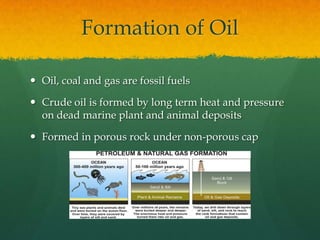
Formation of OilOil, coal and gas are fossil fuelsCrude oil is formed by long term heat and pressure on dead marine plant and animal depositsFormed in porous rock under non-porous cap
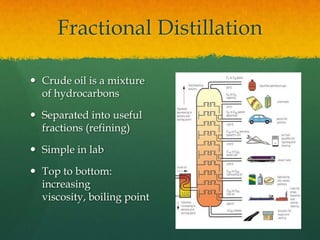
Fractional DistillationCrude oil is a mixture of hydrocarbonsSeparated into useful fractions (refining)Simple in labTop to bottom: increasing viscosity, boiling point
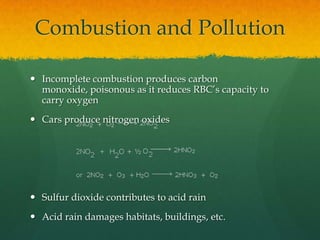
Combustion and PollutionIncomplete combustion produces carbon monoxide, poisonous as it reduces RBC’s capacity to carry oxygenCars produce nitrogen oxidesSulfur dioxide contributes to acid rainAcid rain damages habitats, buildings, etc.
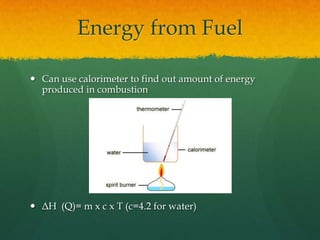
Energy from FuelCan use calorimeter to find out amount of energy produced in combustionΔH  (Q)= m x c x T (c=4.2 for water)
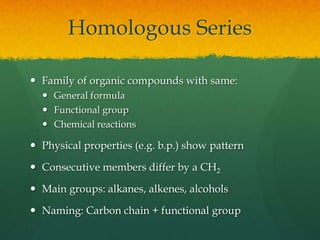
Homologous SeriesFamily of organic compounds with same:General formulaFunctional groupChemical reactionsPhysical properties (e.g. b.p.) show patternConsecutive members differ by a CH2Main groups: alkanes, alkenes, alcoholsNaming: Carbon chain + functional group
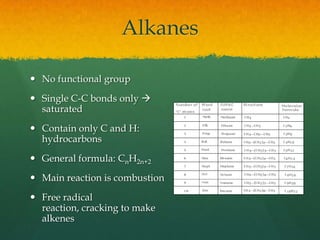
AlkanesNo functional groupSingle C-C bonds only  saturatedContain only C and H: hydrocarbonsGeneral formula: CnH2n+2Main reaction is combustionFree radical reaction, cracking to make alkenes
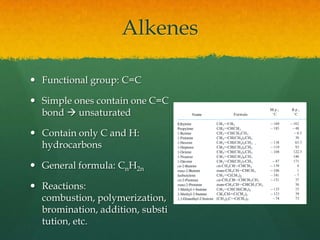
AlkenesFunctional group: C=CSimple ones contain one C=C bond  unsaturatedContain only C and H: hydrocarbonsGeneral formula: CnH2nReactions: combustion, polymerization, bromination, addition, substitution, etc.
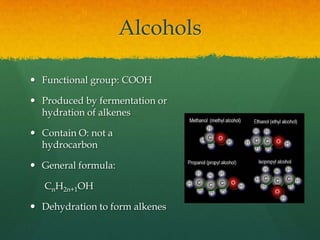
AlcoholsFunctional group: COOHProduced by fermentation or hydration of alkenesContain O: not a hydrocarbonGeneral formula:      CnH2n+1OHDehydration to form alkenes
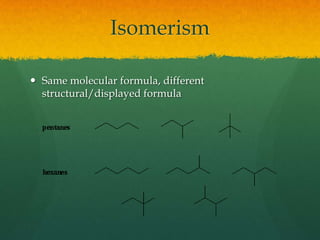
IsomerismSame molecular formula, different structural/displayed formula
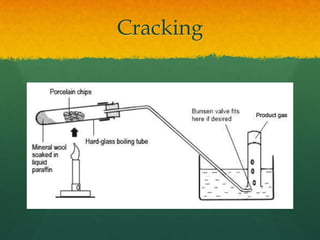
Cracking
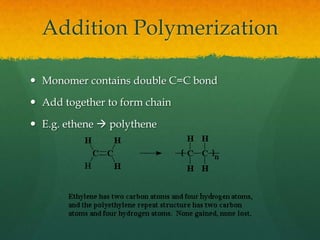
Addition PolymerizationMonomer contains double C=C bondAdd together to form chainE.g. ethene polythene
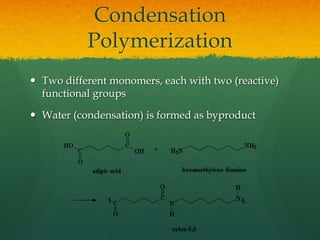
Condensation PolymerizationTwo different monomers, each with two (reactive) functional groupsWater (condensation) is formed as byproduct

Unit 6 Organic Chemistry