Reaction kinetics
Factors which affect the rate of a chemical reaction 1 Concentration of reactants 2 Pressure 3 Temperature 4 Physical state of reactants 5 catalysts
Decomposition of hydrogen peroxide Rate = gradient =  conc   example units are mol s -1   time Now we find gradient at various concentrations and plot rate vs concentration [H 2 O 2} ] Time
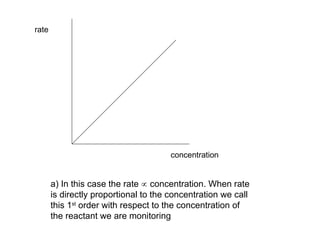
rate concentration a) In this case the rate    concentration. When rate is directly proportional to the concentration we call this 1 st  order with respect to the concentration of the reactant we are monitoring
rate concentration b) In this case the rate is independent of the concentration.  We call this zero order with respect to the reactant we are monitoring
rate concentration c) We call this one 2 nd  order with respect to the reactant we are monitoring
For a) where the rate is proportional to the conc  rate    [H 2 O 2 ]  or rate = k [H 2 O 2 ] where k is called the rate constant and the above equation is called the rate equation We could write this as rate = k [H 2 O 2 ] 1  but the superscript is always assumed to be 1 if no other number is present. This is the number that is referred to in the expression 1 st  order
Lets suppose we now have a reaction involving 2 reactants A  +  B    products Rate will depend on both [A] and [B]  The rate equation is  rate = k[A] x   [B] y x and y are called the order with respect to A and B X and y may be 0,1,2 (very rarely 3)
If the order is 0 the the rate does not depend on the concentration of that reactant e.g for the reaction between A and B previously.  If order w.r.t A = 1 and order w.r.t B = 0 The rate equation will be  Rate =k [A] 1 [B] 0  any number to the power of 0 = 1 Rate equation becomes  Rate = k [A]
The overall order of a reaction is the sum of all the superscripts So for the reaction with a rate equation as follows Rate = k[A] 1 ][B] 2 The overall order is 3 It is important to remember that no information about the order or the rate of a reaction can be found from an equation.  All  the kinetic data must be found by experiment
Definitions The  order of reaction  is the number of concentration terms in the experimentally determined rate equation. The  rate of a reaction  is proportional to the concentration and the rate constant is the proportionality constant. In order to find the order w.r.t. individual reactants a series of experiments must be performed. e.g. for the reaction A  +  B     P We need to  Keep A the same and change B Keep B the same and change A
2.4 x 10 -2 6 x 10 -3 4 x 10 -3 1.2 x 10 -2 6 x 10 -3 2 x 10 -3 3 x 10 -3  3 x 10 -3 2 x 10 -3 Initial rate mol/L/h Initial conc B mol/l Initial conc A mol/l
Lets look at A first. When B is kept the same and A is doubled the rate doubles.  rate    [A] 1 i.e. order w.r.t A = 1 When A kept the same and B doubled The rate increases x 4 (i.e 2 2 )    Rate    [B] 2 i.e. order w.r.t B = 2 Overall order = 3
our rate equation then is  rate = k [A][B] 2 As k is a constant   it will be the same for any of the 3 experiments so we can use any experiment and put in the values of [A] [B] and initial rate to find k. k =  rate    k =  3.0 x 10 -3 [A][B] 2  (2 x 10 -3 )(3.0 x 10 -3 ) 2 = 1.67 x 10 5 What are the units? mol/L/h   =  mol -2 L 2  h -1 (mol/L) 3
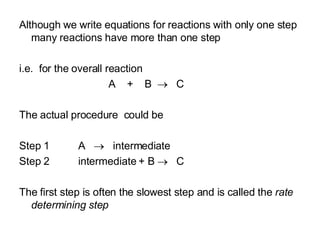
Although we write equations for reactions with only one step many reactions have more than one step  i.e.  for the overall reaction  A  +  B     C The actual procedure  could be  Step 1  A     intermediate Step 2  intermediate + B     C The first step is often the slowest step and is called the  rate determining step
In any reaction the  slowest  step (usually the first step) is the  rate determining step  (r.d.s) The  order  of reaction is the number of molecules or atoms taking part in the r.d.s So in the previous example the order w.r.t. A would be 1 and the overall order would also be 1. the rate depends on the first step so [B] has no effect on the rate.
For  reaction with the following rate equation Rate = k[A][B] Order w.r.t A = 1 Order w.r.t B = 1 1 molecule A and 1 molecule B take part in the r.d.s For a reaction with the following rate equation Rate = k[A] 2 B] 0 This would be a 2 step reaction Step 1  A  +  A     X Step 2  X  +  B    products

9 Reaction Kinetics

  • 1.
  • 2.
    Factors which affectthe rate of a chemical reaction 1 Concentration of reactants 2 Pressure 3 Temperature 4 Physical state of reactants 5 catalysts
  • 3.
    Decomposition of hydrogenperoxide Rate = gradient = conc example units are mol s -1 time Now we find gradient at various concentrations and plot rate vs concentration [H 2 O 2} ] Time
  • 4.
    rate concentration a)In this case the rate  concentration. When rate is directly proportional to the concentration we call this 1 st order with respect to the concentration of the reactant we are monitoring
  • 5.
    rate concentration b)In this case the rate is independent of the concentration. We call this zero order with respect to the reactant we are monitoring
  • 6.
    rate concentration c)We call this one 2 nd order with respect to the reactant we are monitoring
  • 7.
    For a) wherethe rate is proportional to the conc rate  [H 2 O 2 ] or rate = k [H 2 O 2 ] where k is called the rate constant and the above equation is called the rate equation We could write this as rate = k [H 2 O 2 ] 1 but the superscript is always assumed to be 1 if no other number is present. This is the number that is referred to in the expression 1 st order
  • 8.
    Lets suppose wenow have a reaction involving 2 reactants A + B  products Rate will depend on both [A] and [B] The rate equation is rate = k[A] x [B] y x and y are called the order with respect to A and B X and y may be 0,1,2 (very rarely 3)
  • 9.
    If the orderis 0 the the rate does not depend on the concentration of that reactant e.g for the reaction between A and B previously. If order w.r.t A = 1 and order w.r.t B = 0 The rate equation will be Rate =k [A] 1 [B] 0 any number to the power of 0 = 1 Rate equation becomes Rate = k [A]
  • 10.
    The overall orderof a reaction is the sum of all the superscripts So for the reaction with a rate equation as follows Rate = k[A] 1 ][B] 2 The overall order is 3 It is important to remember that no information about the order or the rate of a reaction can be found from an equation. All the kinetic data must be found by experiment
  • 11.
    Definitions The order of reaction is the number of concentration terms in the experimentally determined rate equation. The rate of a reaction is proportional to the concentration and the rate constant is the proportionality constant. In order to find the order w.r.t. individual reactants a series of experiments must be performed. e.g. for the reaction A + B  P We need to Keep A the same and change B Keep B the same and change A
  • 12.
    2.4 x 10⁻² 6 x 10 -3 4 x 10 -3 1.2 x 10 -2 6 x 10 -3 2 x 10 -3 3 x 10 -3 3 x 10 -3 2 x 10 -3 Initial rate mol/L/h Initial conc B mol/l Initial conc A mol/l
  • 13.
    Lets look atA first. When B is kept the same and A is doubled the rate doubles.  rate  [A] 1 i.e. order w.r.t A = 1 When A kept the same and B doubled The rate increases x 4 (i.e 2 2 )  Rate  [B] 2 i.e. order w.r.t B = 2 Overall order = 3
  • 14.
    our rate equationthen is rate = k [A][B] 2 As k is a constant it will be the same for any of the 3 experiments so we can use any experiment and put in the values of [A] [B] and initial rate to find k. k = rate  k = 3.0 x 10 -3 [A][B] 2 (2 x 10 -3 )(3.0 x 10 -3 ) 2 = 1.67 x 10 5 What are the units? mol/L/h = mol -2 L 2 h -1 (mol/L) 3
  • 15.
    Although we writeequations for reactions with only one step many reactions have more than one step i.e. for the overall reaction A + B  C The actual procedure could be Step 1 A  intermediate Step 2 intermediate + B  C The first step is often the slowest step and is called the rate determining step
  • 16.
    In any reactionthe slowest step (usually the first step) is the rate determining step (r.d.s) The order of reaction is the number of molecules or atoms taking part in the r.d.s So in the previous example the order w.r.t. A would be 1 and the overall order would also be 1. the rate depends on the first step so [B] has no effect on the rate.
  • 17.
    For reactionwith the following rate equation Rate = k[A][B] Order w.r.t A = 1 Order w.r.t B = 1 1 molecule A and 1 molecule B take part in the r.d.s For a reaction with the following rate equation Rate = k[A] 2 B] 0 This would be a 2 step reaction Step 1 A + A  X Step 2 X + B  products