INTRODUCTIONINTRODUCTION
Acids
Is a substance that produce hydrogen ions when
dissolved in water
All acids contains hydrogen. But not all substances
with hydrogen contains acida (water)
The hydorgen ions produced are responsible for the
properties of an acid
Some common acids
Man-made:
Hydrochloric Acid (HCl)
Sulphuric Acid (H2SO4)
Nitric Acid (HNO3)
Natural Acids:
Ethanoic acids (Found in vinegar)
Properties
Acids have a sour taste
Acids dissolve in water to form solutions wich
conduce electricity.
Acids turn blue litmus paper red
pH value < 7
Chemical properties
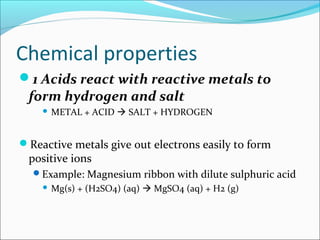
1 Acids react with reactive metals to
form hydrogen and salt
 METAL + ACID  SALT + HYDROGEN
Reactive metals give out electrons easily to form
positive ions
Example: Magnesium ribbon with dilute sulphuric acid
 Mg(s) + (H2SO4) (aq)  MgSO4 (aq) + H2 (g)
Chemical properties
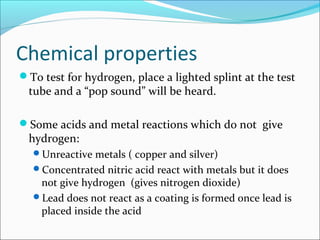
To test for hydrogen, place a lighted splint at the test
tube and a “pop sound” will be heard.
Some acids and metal reactions which do not give
hydrogen:
Unreactive metals ( copper and silver)
Concentrated nitric acid react with metals but it does
not give hydrogen (gives nitrogen dioxide)
Lead does not react as a coating is formed once lead is
placed inside the acid
Chemical properties
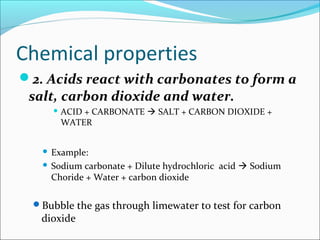
2. Acids react with carbonates to form a
salt, carbon dioxide and water.
 ACID + CARBONATE  SALT + CARBON DIOXIDE +
WATER
 Example:
 Sodium carbonate + Dilute hydrochloric acid  Sodium
Choride + Water + carbon dioxide
Bubble the gas through limewater to test for carbon
dioxide
Chemical properties
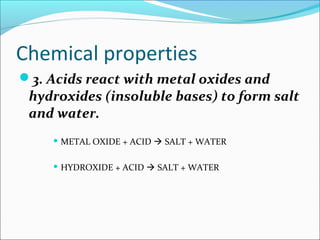
3. Acids react with metal oxides and
hydroxides (insoluble bases) to form salt
and water.
 METAL OXIDE + ACID  SALT + WATER
 HYDROXIDE + ACID  SALT + WATER
The role of Water in Acidity
Acids only react when placed on water. This is
because water can break apart the acid into hydrogen
ions and salt.
Therefore, and acid dissociate in water to produce
hydrogen ions wich are responsible for the cidic
properties.
Acids only shor they properties when dissolved in
water
The role of Water in Acidity
The hydrogen ions produced are not hydrogen gas.
They react with metals like magnessium to produce
hydrogen gas and magnessium ions
A few drops of water are enough to allow an acid to
dissociate
Uses of Acids
Sulphuric acid:
 Detergents
 Car batteries
Ethanoic acid:
 Vinegar to preserve food
 Adhesives (glue)
Hidrochloric Acid:
 Cleaning metals
 Leather processing
Base
A base is any metal oxide or hydroxide
A base is a substance that reacts with an acid to give
salt and water only
 ACID + BASE  SALT + WATER
 Similar to:
 ACID + METAL OXIDE / HYDROXIDE  SALT + WATER
Ionic equation for this is always standard:

OH- + H+  H2O (l)
Some common bases
Sodium Oxide
Zinc Oxide
Copper (II) Oxide
Magnessium Hydroxide
Aluminum Hydroxide
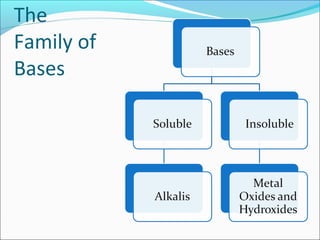
The
Family of
Bases
Alkalis
DEFINITION: An alkali is a base that is soluble in
water.
Some examples include:
Sodium Hydroxide
Potassium Hydroxide
Calcium Hydroxide
Barium Hydroxide
Aqueous Ammonia
Properties of Alkalis
Alkalis have a bitter taste and soapy feel.
Alkalis turn red litmus paper blue.
pH value > 7.
Chemical Properties of Alkalis
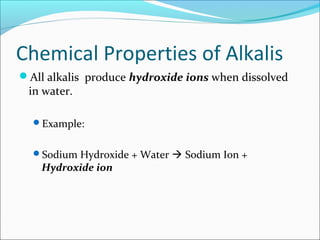
All alkalis produce hydroxide ions when dissolved
in water.
Example:
Sodium Hydroxide + Water  Sodium Ion +
Hydroxide ion
Chemical Properties of Alkalis
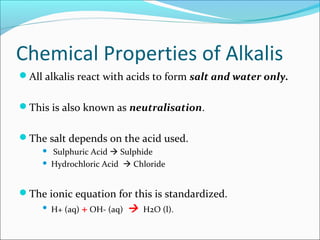
All alkalis react with acids to form salt and water only.
This is also known as neutralisation.
The salt depends on the acid used.
 Sulphuric Acid  Sulphide
 Hydrochloric Acid  Chloride
The ionic equation for this is standardized.
 H+ (aq) + OH- (aq)  H2O (l).
Chemical Properties of Alkalis
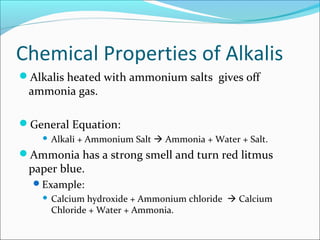
Alkalis heated with ammonium salts gives off
ammonia gas.
General Equation:
 Alkali + Ammonium Salt  Ammonia + Water + Salt.
Ammonia has a strong smell and turn red litmus
paper blue.
Example:
 Calcium hydroxide + Ammonium chloride  Calcium
Chloride + Water + Ammonia.
Chemical Properties of Alkalis
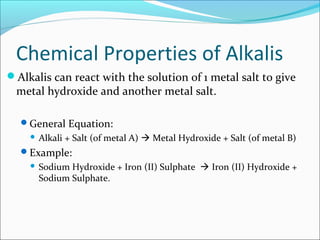
Alkalis can react with the solution of 1 metal salt to give
metal hydroxide and another metal salt.
General Equation:
 Alkali + Salt (of metal A)  Metal Hydroxide + Salt (of metal B)
Example:
 Sodium Hydroxide + Iron (II) Sulphate  Iron (II) Hydroxide +
Sodium Sulphate.
Uses of Alkalis
Ammonia Solution:
Window cleaning solutions
Calcium Oxide:
To make iron, concrete, cement
Magnesium Hydroxide:
Toothpaste to neutralise acid o teeth
In antacids to relieve indigestion.
Sodium Hydroxide:
In making soaps and detergents.
•Concentration tells us how much of aConcentration tells us how much of a
substance is dissolved insubstance is dissolved in 11 dmdm33
of a solution.of a solution.
•It can be changed by either adding moreIt can be changed by either adding more
solute or more solventsolute or more solvent
•Strength refers to how easily an acid orStrength refers to how easily an acid or
alkalialkali dissociatesdissociates when dissolved in water.when dissolved in water.
•A strong acid like hydrochloric acidA strong acid like hydrochloric acid
dissociates easily in water (almost 100% ofdissociates easily in water (almost 100% of
the acid dissociates)the acid dissociates)
•A weak acid like ethanoic acid does notA weak acid like ethanoic acid does not
fully dissociate when dissolved in water.fully dissociate when dissolved in water.
• The strength of an acid cannot be changed.The strength of an acid cannot be changed.
• No matter how concentrated ethanoic acidNo matter how concentrated ethanoic acid
is, it is still a weak acid.is, it is still a weak acid.
• The strength of an acid of an alkali can beThe strength of an acid of an alkali can be
shown using the pH scale.shown using the pH scale.

Acids and bases

  • 1.
  • 2.
    Acids Is a substancethat produce hydrogen ions when dissolved in water All acids contains hydrogen. But not all substances with hydrogen contains acida (water) The hydorgen ions produced are responsible for the properties of an acid
  • 3.
    Some common acids Man-made: HydrochloricAcid (HCl) Sulphuric Acid (H2SO4) Nitric Acid (HNO3) Natural Acids: Ethanoic acids (Found in vinegar)
  • 4.
    Properties Acids have asour taste Acids dissolve in water to form solutions wich conduce electricity. Acids turn blue litmus paper red pH value < 7
  • 5.
    Chemical properties 1 Acidsreact with reactive metals to form hydrogen and salt  METAL + ACID  SALT + HYDROGEN Reactive metals give out electrons easily to form positive ions Example: Magnesium ribbon with dilute sulphuric acid  Mg(s) + (H2SO4) (aq)  MgSO4 (aq) + H2 (g)
  • 6.
    Chemical properties To testfor hydrogen, place a lighted splint at the test tube and a “pop sound” will be heard. Some acids and metal reactions which do not give hydrogen: Unreactive metals ( copper and silver) Concentrated nitric acid react with metals but it does not give hydrogen (gives nitrogen dioxide) Lead does not react as a coating is formed once lead is placed inside the acid
  • 7.
    Chemical properties 2. Acidsreact with carbonates to form a salt, carbon dioxide and water.  ACID + CARBONATE  SALT + CARBON DIOXIDE + WATER  Example:  Sodium carbonate + Dilute hydrochloric acid  Sodium Choride + Water + carbon dioxide Bubble the gas through limewater to test for carbon dioxide
  • 8.
    Chemical properties 3. Acidsreact with metal oxides and hydroxides (insoluble bases) to form salt and water.  METAL OXIDE + ACID  SALT + WATER  HYDROXIDE + ACID  SALT + WATER
  • 9.
    The role ofWater in Acidity Acids only react when placed on water. This is because water can break apart the acid into hydrogen ions and salt. Therefore, and acid dissociate in water to produce hydrogen ions wich are responsible for the cidic properties. Acids only shor they properties when dissolved in water
  • 10.
    The role ofWater in Acidity The hydrogen ions produced are not hydrogen gas. They react with metals like magnessium to produce hydrogen gas and magnessium ions A few drops of water are enough to allow an acid to dissociate
  • 11.
    Uses of Acids Sulphuricacid:  Detergents  Car batteries Ethanoic acid:  Vinegar to preserve food  Adhesives (glue) Hidrochloric Acid:  Cleaning metals  Leather processing
  • 13.
    Base A base isany metal oxide or hydroxide A base is a substance that reacts with an acid to give salt and water only  ACID + BASE  SALT + WATER  Similar to:  ACID + METAL OXIDE / HYDROXIDE  SALT + WATER Ionic equation for this is always standard:  OH- + H+  H2O (l)
  • 14.
    Some common bases SodiumOxide Zinc Oxide Copper (II) Oxide Magnessium Hydroxide Aluminum Hydroxide
  • 15.
  • 16.
    Alkalis DEFINITION: An alkaliis a base that is soluble in water. Some examples include: Sodium Hydroxide Potassium Hydroxide Calcium Hydroxide Barium Hydroxide Aqueous Ammonia
  • 17.
    Properties of Alkalis Alkalishave a bitter taste and soapy feel. Alkalis turn red litmus paper blue. pH value > 7.
  • 18.
    Chemical Properties ofAlkalis All alkalis produce hydroxide ions when dissolved in water. Example: Sodium Hydroxide + Water  Sodium Ion + Hydroxide ion
  • 19.
    Chemical Properties ofAlkalis All alkalis react with acids to form salt and water only. This is also known as neutralisation. The salt depends on the acid used.  Sulphuric Acid  Sulphide  Hydrochloric Acid  Chloride The ionic equation for this is standardized.  H+ (aq) + OH- (aq)  H2O (l).
  • 20.
    Chemical Properties ofAlkalis Alkalis heated with ammonium salts gives off ammonia gas. General Equation:  Alkali + Ammonium Salt  Ammonia + Water + Salt. Ammonia has a strong smell and turn red litmus paper blue. Example:  Calcium hydroxide + Ammonium chloride  Calcium Chloride + Water + Ammonia.
  • 21.
    Chemical Properties ofAlkalis Alkalis can react with the solution of 1 metal salt to give metal hydroxide and another metal salt. General Equation:  Alkali + Salt (of metal A)  Metal Hydroxide + Salt (of metal B) Example:  Sodium Hydroxide + Iron (II) Sulphate  Iron (II) Hydroxide + Sodium Sulphate.
  • 22.
    Uses of Alkalis AmmoniaSolution: Window cleaning solutions Calcium Oxide: To make iron, concrete, cement Magnesium Hydroxide: Toothpaste to neutralise acid o teeth In antacids to relieve indigestion. Sodium Hydroxide: In making soaps and detergents.
  • 23.
    •Concentration tells ushow much of aConcentration tells us how much of a substance is dissolved insubstance is dissolved in 11 dmdm33 of a solution.of a solution. •It can be changed by either adding moreIt can be changed by either adding more solute or more solventsolute or more solvent
  • 24.
    •Strength refers tohow easily an acid orStrength refers to how easily an acid or alkalialkali dissociatesdissociates when dissolved in water.when dissolved in water. •A strong acid like hydrochloric acidA strong acid like hydrochloric acid dissociates easily in water (almost 100% ofdissociates easily in water (almost 100% of the acid dissociates)the acid dissociates) •A weak acid like ethanoic acid does notA weak acid like ethanoic acid does not fully dissociate when dissolved in water.fully dissociate when dissolved in water.
  • 25.
    • The strengthof an acid cannot be changed.The strength of an acid cannot be changed. • No matter how concentrated ethanoic acidNo matter how concentrated ethanoic acid is, it is still a weak acid.is, it is still a weak acid. • The strength of an acid of an alkali can beThe strength of an acid of an alkali can be shown using the pH scale.shown using the pH scale.