Oxidation
Number
IVY M. ANTONIO
BEED 1-3 DAY
Oxidation Number
 also called Oxidation State, the total number of
electrons that an atom either gains or loses in order
to form a chemical bond with another atom.
are used to keep track of how many electrons are
lost or gained by each atom.
Each atom that participates in an oxidation-
reduction reaction is assigned an oxidation number
that reflects its ability to acquire, donate, or share
electrons.
The increase in oxidation state of an
atom, through a chemical reaction, is
known as an oxidation; a decrease in
oxidation state is known as a reduction.
Such reactions involve the formal
transfer of electrons: a net gain in
electrons being a reduction, and a net
loss of electrons being an oxidation. For
pure elements, the oxidation state is
zero.
These oxidation numbers are
assigned using the following rules:
1. The convention is that the cation is written
first in a formula, followed by the anion.
For example, in NaH, the H is H-; in HCl, the H is
H+.
2. The oxidation number of a free element is
always 0.
The atoms in He and N2, for example, have
oxidation numbers of 0.
3. The oxidation number of a monatomic
ion equals the charge of the ion.
For example, the oxidation number of Na+ is
+1; the oxidation number of N3- is -3.
4. The usual oxidation number of hydrogen
is +1.
The oxidation number of hydrogen is -1 in
compounds containing elements that are less
electronegative than hydrogen, as in CaH2.
5. The oxidation number of oxygen in
compounds is usually -2.Exceptions include
OF2, since F is more electronegative than O, and
BaO2, due to the structure of the peroxide ion,
which is [O-O]2-.
6. The oxidation number of a Group IA
element in a compound is +1.
7. The oxidation number of a Group IIA
element in a compound is +2.
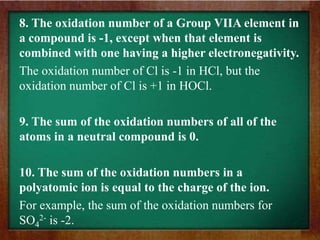
8. The oxidation number of a Group VIIA element in
a compound is -1, except when that element is
combined with one having a higher electronegativity.
The oxidation number of Cl is -1 in HCl, but the
oxidation number of Cl is +1 in HOCl.
9. The sum of the oxidation numbers of all of the
atoms in a neutral compound is 0.
10. The sum of the oxidation numbers in a
polyatomic ion is equal to the charge of the ion.
For example, the sum of the oxidation numbers for
SO4
2- is -2.
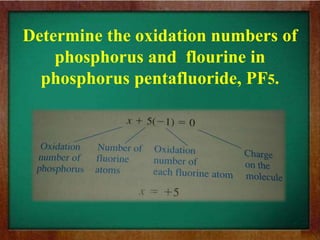
Determine the oxidation numbers of
phosphorus and flourine in
phosphorus pentafluoride, PF5.
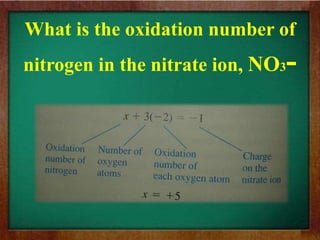
What is the oxidation number of
nitrogen in the nitrate ion, NO3-
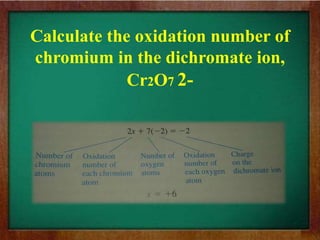
Calculate the oxidation number of
chromium in the dichromate ion,
Cr2O7 2-
THANK YOU
  

oxidation numbers

  • 1.
  • 2.
    Oxidation Number  alsocalled Oxidation State, the total number of electrons that an atom either gains or loses in order to form a chemical bond with another atom. are used to keep track of how many electrons are lost or gained by each atom. Each atom that participates in an oxidation- reduction reaction is assigned an oxidation number that reflects its ability to acquire, donate, or share electrons.
  • 3.
    The increase inoxidation state of an atom, through a chemical reaction, is known as an oxidation; a decrease in oxidation state is known as a reduction. Such reactions involve the formal transfer of electrons: a net gain in electrons being a reduction, and a net loss of electrons being an oxidation. For pure elements, the oxidation state is zero.
  • 4.
    These oxidation numbersare assigned using the following rules: 1. The convention is that the cation is written first in a formula, followed by the anion. For example, in NaH, the H is H-; in HCl, the H is H+. 2. The oxidation number of a free element is always 0. The atoms in He and N2, for example, have oxidation numbers of 0.
  • 5.
    3. The oxidationnumber of a monatomic ion equals the charge of the ion. For example, the oxidation number of Na+ is +1; the oxidation number of N3- is -3. 4. The usual oxidation number of hydrogen is +1. The oxidation number of hydrogen is -1 in compounds containing elements that are less electronegative than hydrogen, as in CaH2.
  • 6.
    5. The oxidationnumber of oxygen in compounds is usually -2.Exceptions include OF2, since F is more electronegative than O, and BaO2, due to the structure of the peroxide ion, which is [O-O]2-. 6. The oxidation number of a Group IA element in a compound is +1. 7. The oxidation number of a Group IIA element in a compound is +2.
  • 7.
    8. The oxidationnumber of a Group VIIA element in a compound is -1, except when that element is combined with one having a higher electronegativity. The oxidation number of Cl is -1 in HCl, but the oxidation number of Cl is +1 in HOCl. 9. The sum of the oxidation numbers of all of the atoms in a neutral compound is 0. 10. The sum of the oxidation numbers in a polyatomic ion is equal to the charge of the ion. For example, the sum of the oxidation numbers for SO4 2- is -2.
  • 8.
    Determine the oxidationnumbers of phosphorus and flourine in phosphorus pentafluoride, PF5.
  • 9.
    What is theoxidation number of nitrogen in the nitrate ion, NO3-
  • 10.
    Calculate the oxidationnumber of chromium in the dichromate ion, Cr2O7 2-
  • 11.