Projection
It is the process of converting a 3D object into a 2D object. It is also defined as mapping or
transformation of the object in projection plane or view plane. The view plane is displayed surface.
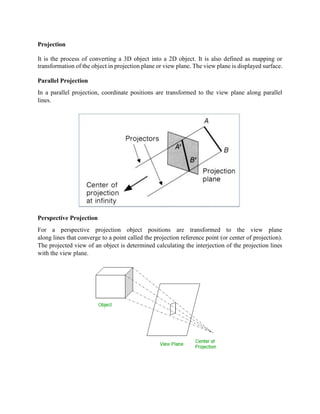
Parallel Projection
In a parallel projection, coordinate positions are transformed to the view plane along parallel
lines.
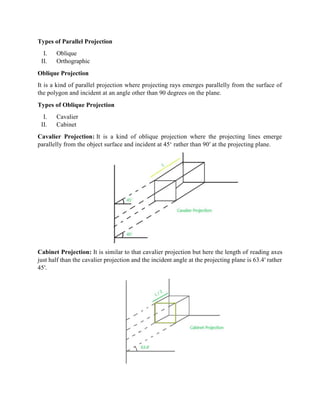
Perspective Projection
For a perspective projection object positions are transformed to the view plane
along lines that converge to a point called the projection reference point (or center of projection).
The projected view of an object is determined calculating the interjection of the projection lines
with the view plane.
Types of Parallel Projection
I. Oblique
II. Orthographic
Oblique Projection
It is a kind of parallel projection where projecting rays emerges parallelly from the surface of
the polygon and incident at an angle other than 90 degrees on the plane.
Types of Oblique Projection
I. Cavalier
II. Cabinet
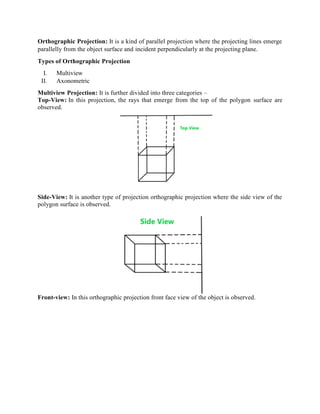
Cavalier Projection: It is a kind of oblique projection where the projecting lines emerge
parallelly from the object surface and incident at 45‘ rather than 90′ at the projecting plane.
Cabinet Projection: It is similar to that cavalier projection but here the length of reading axes
just half than the cavalier projection and the incident angle at the projecting plane is 63.4′ rather
45′.
Orthographic Projection: It is a kind of parallel projection where the projecting lines emerge
parallelly from the object surface and incident perpendicularly at the projecting plane.
Types of Orthographic Projection
I. Multiview
II. Axonometric
Multiview Projection: It is further divided into three categories –
Top-View: In this projection, the rays that emerge from the top of the polygon surface are
observed.
Side-View: It is another type of projection orthographic projection where the side view of the
polygon surface is observed.
Front-view: In this orthographic projection front face view of the object is observed.
Axonometric Projection: Axonometric projection is an orthographic projection, where the
projection lines are perpendicular to the plane of projection, and the object is rotated around one
or more of its axes to show multiple sides.
Types of Axonometric Projection
I. Isometric: All projectors make equal angles generally angle is of 30°.
II. Diametric: In these two projectors have equal angles. With respect to two principle
axis.
III. Trimetric: The direction of projection makes unequal angle with their principle axis.

Projection

  • 1.
    Projection It is theprocess of converting a 3D object into a 2D object. It is also defined as mapping or transformation of the object in projection plane or view plane. The view plane is displayed surface. Parallel Projection In a parallel projection, coordinate positions are transformed to the view plane along parallel lines. Perspective Projection For a perspective projection object positions are transformed to the view plane along lines that converge to a point called the projection reference point (or center of projection). The projected view of an object is determined calculating the interjection of the projection lines with the view plane.
  • 2.
    Types of ParallelProjection I. Oblique II. Orthographic Oblique Projection It is a kind of parallel projection where projecting rays emerges parallelly from the surface of the polygon and incident at an angle other than 90 degrees on the plane. Types of Oblique Projection I. Cavalier II. Cabinet Cavalier Projection: It is a kind of oblique projection where the projecting lines emerge parallelly from the object surface and incident at 45‘ rather than 90′ at the projecting plane. Cabinet Projection: It is similar to that cavalier projection but here the length of reading axes just half than the cavalier projection and the incident angle at the projecting plane is 63.4′ rather 45′.
  • 3.
    Orthographic Projection: Itis a kind of parallel projection where the projecting lines emerge parallelly from the object surface and incident perpendicularly at the projecting plane. Types of Orthographic Projection I. Multiview II. Axonometric Multiview Projection: It is further divided into three categories – Top-View: In this projection, the rays that emerge from the top of the polygon surface are observed. Side-View: It is another type of projection orthographic projection where the side view of the polygon surface is observed. Front-view: In this orthographic projection front face view of the object is observed.
  • 4.
    Axonometric Projection: Axonometricprojection is an orthographic projection, where the projection lines are perpendicular to the plane of projection, and the object is rotated around one or more of its axes to show multiple sides. Types of Axonometric Projection I. Isometric: All projectors make equal angles generally angle is of 30°. II. Diametric: In these two projectors have equal angles. With respect to two principle axis. III. Trimetric: The direction of projection makes unequal angle with their principle axis.