Viewing in 3D
Projections Display device (a screen) is 2D… How do we map 3D objects to 2D space? 2D to 2D is straight forward… 2D window to world.. and a viewport on the 2D surface. Clip what won't be shown in the 2D window, and map the remainder to the viewport. 3D to 2D is more complicated… Solution : Transform 3D objects on to a 2D plane using  projections
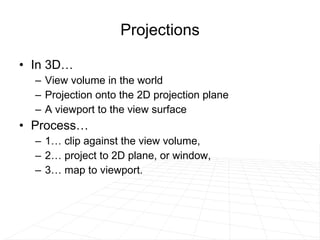
Projections In 3D… View volume in the world Projection onto the 2D projection plane A viewport to the view surface  Process… 1… clip against the view volume,  2… project to 2D plane, or window, 3… map to viewport.
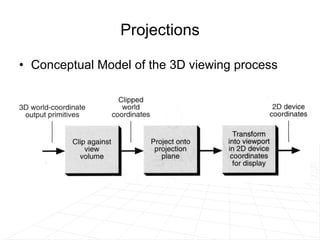
Projections Conceptual Model of the 3D viewing process
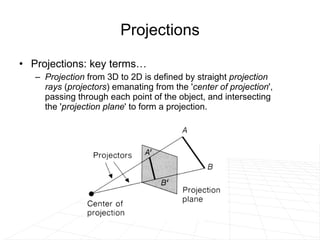
Projections Projections: key terms… Projection  from 3D to 2D is defined by straight  projection rays  ( projectors ) emanating from the ' center of projection ', passing through each point of the object, and intersecting the ' projection   plane ' to form a projection.
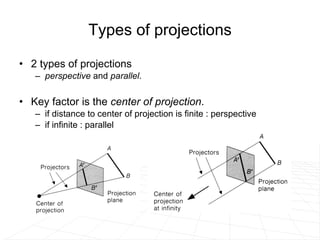
Types of projections 2 types of projections  perspective  and  parallel .  Key factor is the  center of projection .  if distance to center of projection is finite : perspective if infinite : parallel
Perspective v Parallel Perspective:  visual effect is similar to human visual system...  has 'perspective foreshortening' size of object varies inversely with distance from the center of projection.  angles only remain intact for faces parallel to projection plane. Parallel: less realistic view because of no foreshortening however, parallel lines remain parallel.  angles only remain intact for faces parallel to projection plane.
Perspective Projections Any parallel lines  not  parallel to the projection plane, converge at a vanishing point.  There are an infinite number of these, 1 for each of the infinite amount of directions line can be oriented. If a set of lines are parallel to one of the three principle axes, the vanishing point is called an  axis vanishing point .  There are at most 3 such points, corresponding to the number of axes cut by the projection plane.
Perspective Projections Example:  if z projection plane cuts the z axis: normal to it, so only z has a principle vanishing point, as x and y are parallel and have none.  Can categorise perspective projections by the number of principle vanishing points, and the number of axes the projection plane cuts.
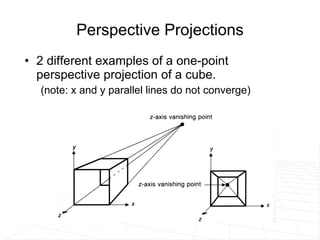
Perspective Projections 2 different examples of a one-point perspective projection of a cube. (note: x and y parallel lines do not converge)
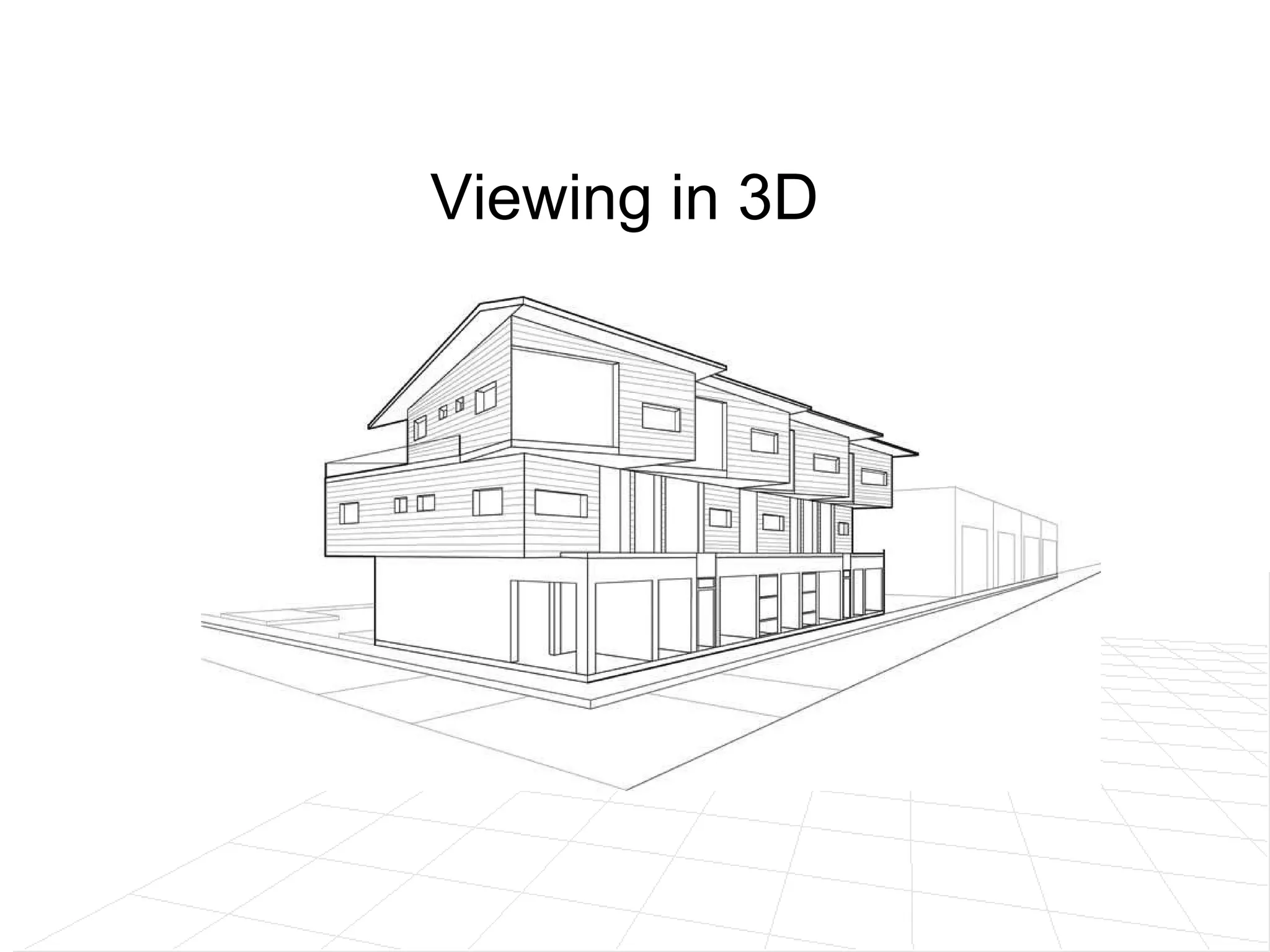
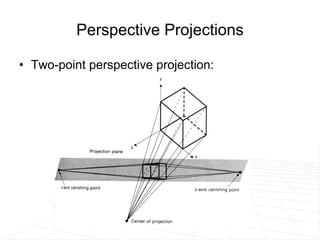
Perspective Projections Two-point perspective projection: This is often used in architectural, engineering and industrial design drawings.  Three-point is used less frequently as it adds little extra realism to that offered by two-point perspective projection.
Perspective Projections Two-point perspective projection:
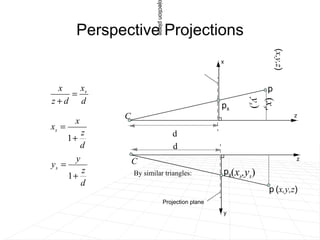
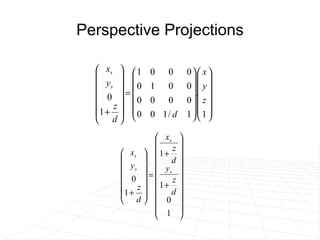
Perspective Projections p ( x,y,z ) z y Projection plane p s ( x s ,y s ) C d By similar triangles: p ( x,y,z ) z x Projection plane p s ( x s ,y s ) C d
Perspective Projections
Parallel Projections 2 principle types:  orthographic  and  oblique .  Orthographic :  direction of projection = normal to the projection plane. Oblique :  direction of projection != normal to the projection plane.
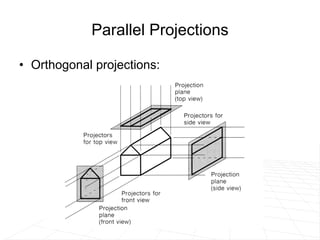
Parallel Projections Orthographic (or orthogonal) projections:  front elevation, top-elevation and side-elevation.  all have projection plane perpendicular to a principle axes.  Useful because angle and distance measurements can be made... However, As only one face of an object is shown, it can be hard to create a mental image of the object, even when several view are available.
Parallel Projections Orthogonal projections:
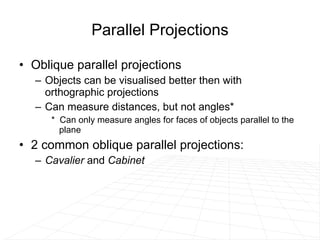
Parallel Projections Oblique parallel projections Objects can be visualised better then with orthographic projections Can measure distances, but not angles* *  Can only measure angles for faces of objects parallel to the plane 2 common oblique parallel projections:  Cavalier  and  Cabinet
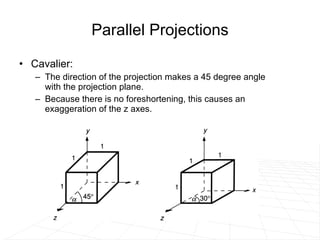
Parallel Projections Cavalier: The direction of the projection makes a 45 degree angle with the projection plane.  Because there is no foreshortening, this causes an exaggeration of the z axes.
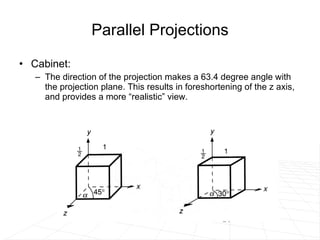
Parallel Projections Cabinet: The direction of the projection makes a 63.4 degree angle with the projection plane. This results in foreshortening of the z axis, and provides a more “realistic” view.
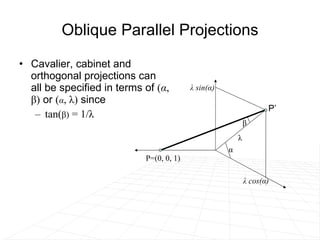
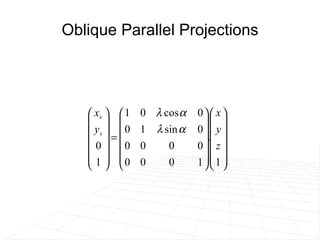
Oblique Parallel Projections Cavalier, cabinet and  orthogonal projections can all be specified in terms of  ( α ,  β )   or  ( α ,  λ )  since  tan( β)  = 1/ λ α β P=(0, 0, 1) P’ λ  cos( α ) λ  sin( α ) λ
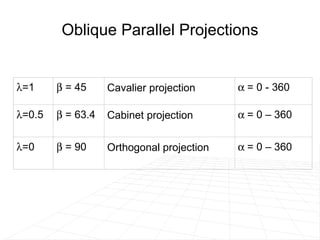
Oblique Parallel Projections  =1    = 45 Cavalier projection  = 0 - 360  =0.5    = 63.4 Cabinet projection  = 0 – 360  =0    = 90 Orthogonal projection  = 0 – 360
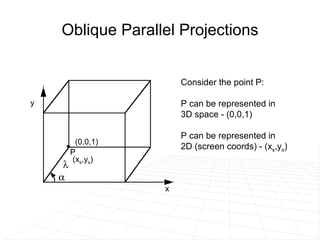
Oblique Parallel Projections x y   (x s ,y s ) (0,0,1) P Consider the point P: P can be represented in 3D space - (0,0,1) P can be represented in 2D (screen coords) - (x s ,y s )
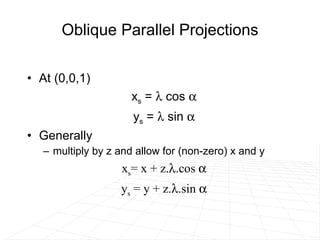
Oblique Parallel Projections At (0,0,1) x s  =    cos   y s  =    sin   Generally  multiply by z and allow for (non-zero) x and y x s = x + z.  .cos   y s  = y + z.  .sin  
Oblique Parallel Projections

View in 3_d_asper_syllabus

  • 1.
  • 2.
    Projections Display device(a screen) is 2D… How do we map 3D objects to 2D space? 2D to 2D is straight forward… 2D window to world.. and a viewport on the 2D surface. Clip what won't be shown in the 2D window, and map the remainder to the viewport. 3D to 2D is more complicated… Solution : Transform 3D objects on to a 2D plane using projections
  • 3.
    Projections In 3D…View volume in the world Projection onto the 2D projection plane A viewport to the view surface Process… 1… clip against the view volume, 2… project to 2D plane, or window, 3… map to viewport.
  • 4.
    Projections Conceptual Modelof the 3D viewing process
  • 5.
    Projections Projections: keyterms… Projection from 3D to 2D is defined by straight projection rays ( projectors ) emanating from the ' center of projection ', passing through each point of the object, and intersecting the ' projection plane ' to form a projection.
  • 6.
    Types of projections2 types of projections perspective and parallel . Key factor is the center of projection . if distance to center of projection is finite : perspective if infinite : parallel
  • 7.
    Perspective v ParallelPerspective: visual effect is similar to human visual system... has 'perspective foreshortening' size of object varies inversely with distance from the center of projection. angles only remain intact for faces parallel to projection plane. Parallel: less realistic view because of no foreshortening however, parallel lines remain parallel. angles only remain intact for faces parallel to projection plane.
  • 8.
    Perspective Projections Anyparallel lines not parallel to the projection plane, converge at a vanishing point. There are an infinite number of these, 1 for each of the infinite amount of directions line can be oriented. If a set of lines are parallel to one of the three principle axes, the vanishing point is called an axis vanishing point . There are at most 3 such points, corresponding to the number of axes cut by the projection plane.
  • 9.
    Perspective Projections Example: if z projection plane cuts the z axis: normal to it, so only z has a principle vanishing point, as x and y are parallel and have none. Can categorise perspective projections by the number of principle vanishing points, and the number of axes the projection plane cuts.
  • 10.
    Perspective Projections 2different examples of a one-point perspective projection of a cube. (note: x and y parallel lines do not converge)
  • 11.
    Perspective Projections Two-pointperspective projection: This is often used in architectural, engineering and industrial design drawings. Three-point is used less frequently as it adds little extra realism to that offered by two-point perspective projection.
  • 12.
    Perspective Projections Two-pointperspective projection:
  • 13.
    Perspective Projections p( x,y,z ) z y Projection plane p s ( x s ,y s ) C d By similar triangles: p ( x,y,z ) z x Projection plane p s ( x s ,y s ) C d
  • 14.
  • 15.
    Parallel Projections 2principle types: orthographic and oblique . Orthographic : direction of projection = normal to the projection plane. Oblique : direction of projection != normal to the projection plane.
  • 16.
    Parallel Projections Orthographic(or orthogonal) projections: front elevation, top-elevation and side-elevation. all have projection plane perpendicular to a principle axes. Useful because angle and distance measurements can be made... However, As only one face of an object is shown, it can be hard to create a mental image of the object, even when several view are available.
  • 17.
  • 18.
    Parallel Projections Obliqueparallel projections Objects can be visualised better then with orthographic projections Can measure distances, but not angles* * Can only measure angles for faces of objects parallel to the plane 2 common oblique parallel projections: Cavalier and Cabinet
  • 19.
    Parallel Projections Cavalier:The direction of the projection makes a 45 degree angle with the projection plane. Because there is no foreshortening, this causes an exaggeration of the z axes.
  • 20.
    Parallel Projections Cabinet:The direction of the projection makes a 63.4 degree angle with the projection plane. This results in foreshortening of the z axis, and provides a more “realistic” view.
  • 21.
    Oblique Parallel ProjectionsCavalier, cabinet and orthogonal projections can all be specified in terms of ( α , β ) or ( α , λ ) since tan( β) = 1/ λ α β P=(0, 0, 1) P’ λ cos( α ) λ sin( α ) λ
  • 22.
    Oblique Parallel Projections =1  = 45 Cavalier projection  = 0 - 360  =0.5  = 63.4 Cabinet projection  = 0 – 360  =0  = 90 Orthogonal projection  = 0 – 360
  • 23.
    Oblique Parallel Projectionsx y   (x s ,y s ) (0,0,1) P Consider the point P: P can be represented in 3D space - (0,0,1) P can be represented in 2D (screen coords) - (x s ,y s )
  • 24.
    Oblique Parallel ProjectionsAt (0,0,1) x s =  cos  y s =  sin  Generally multiply by z and allow for (non-zero) x and y x s = x + z.  .cos  y s = y + z.  .sin 
  • 25.