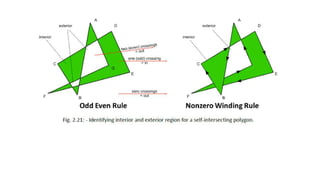
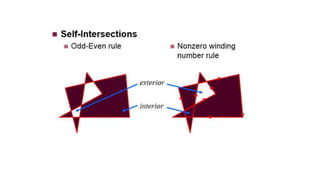
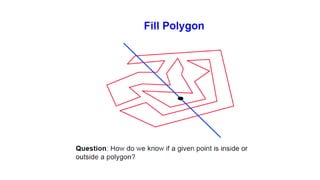
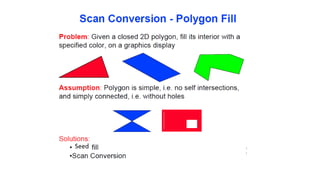
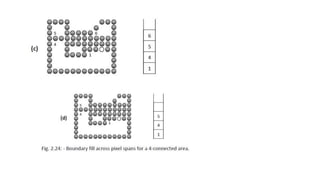
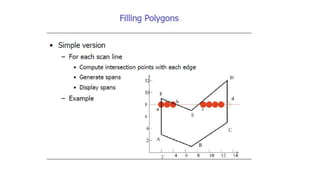
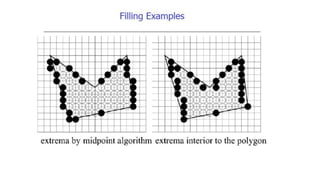
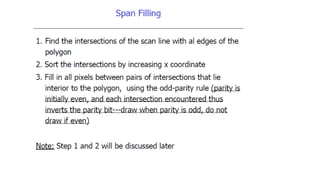
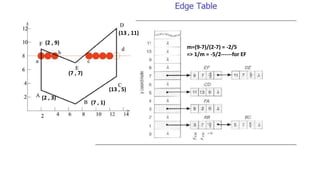
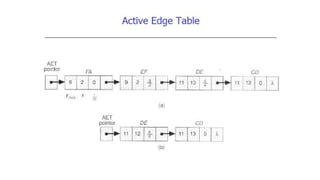
The document discusses different methods for filling polygons in computer graphics, including seed fill algorithms, scanline algorithms, and the nonzero winding number rule. It provides examples of code to implement a scanline polygon filling algorithm, which works by calculating the slopes of each polygon edge, determining the x-coordinate intersections of each scanline with the polygon edges, and drawing filled regions between the intersections from left to right.




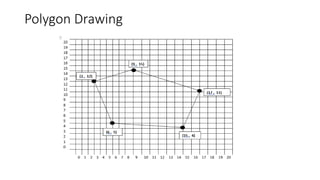
![• int Point[10]; OR int Point[ ]={3,12,9,15,17,11,15,4,6,5};
• Point[0]=3
• Point[1]=12
• Point[2]=9
• Point[3]=15
• Point[4]=17
• Point[5]=11
• Point[6]=15
• Point[7]=4
• Point[8]=6
• Point[9]=5
drawpoly(5, Point)
OR
line (3, 12, 9, 15)
line (9, 15, 17, 11)
line (17, 11 15, 4)
line (15, 4, 6, 5)
line (6, 5, 3, 12)](https://image.slidesharecdn.com/ca301cgfilledareaprimitives-new-221031130014-ccbf8eb5/85/CA301_CG_Filled-Area-Primitives-New-pptx-6-320.jpg)
![• int a[20][2]
• printf("nntEnter the no. of edges of polygon : ");
• scanf("%d",&n);
• printf("nntEnter the cordinates of polygon :nnn ");
• for(i=0;i<n;i++)
• {
• printf("tX%d Y%d : ",i,i);
• scanf("%d %d",&a[i][0],&a[i][1]);
• }
• a[n][0]=a[0][0];
• a[n][1]=a[0][1];
• /*- draw polygon -*/
• for(i=0;i<n;i++)
• {
• line(a[i][0],a[i][1],a[i+1][0],a[i+1][1]);
• }](https://image.slidesharecdn.com/ca301cgfilledareaprimitives-new-221031130014-ccbf8eb5/85/CA301_CG_Filled-Area-Primitives-New-pptx-7-320.jpg)

















![• #include <stdio.h>
• #include <conio.h>
• #include <graphics.h>
• main()
• {
• int n,i,j,k,gd,gm,dy,dx;
• int x,y,temp;
• int a[20][2],xi[20];
• float slope[20];
• clrscr();
• printf("nntEnter the no. of edges of polygon : ");
• scanf("%d",&n);
• printf("nntEnter the cordinates of polygon :nnn ");
• for(i=0;i<n;i++)
• {
• printf("tX%d Y%d : ",i,i);
• scanf("%d %d",&a[i][0],&a[i][1]);
• }
• a[n][0]=a[0][0];
• a[n][1]=a[0][1];
• detectgraph(&gd,&gm);
• initgraph(&gd,&gm,"c:tcbgi");
• /*- draw polygon -*/
• for(i=0;i<n;i++)
• {
• line(a[i][0],a[i][1],a[i+1][0],a[i+1][1]);
• }
• getch();](https://image.slidesharecdn.com/ca301cgfilledareaprimitives-new-221031130014-ccbf8eb5/85/CA301_CG_Filled-Area-Primitives-New-pptx-31-320.jpg)
![• for(i=0;i<n;i++)
• {
• dy=a[i+1][1]-a[i][1];
• dx=a[i+1][0]-a[i][0];
• if(dy==0) slope[i]=1.0;
• if(dx==0) slope[i]=0.0;
• if((dy!=0)&&(dx!=0)) /*- calculate inverse slope -*/
• {
• slope[i]=(float) dx/dy;
• }
• }
• for(y=0;y< 480;y++)
• {
• k=0;
• for(i=0;i<n;i++)
• {
• if( ((a[i][1]<=y)&&(a[i+1][1]>y))||
• ((a[i][1]>y)&&(a[i+1][1]<=y)))
• {
• xi[k]=(int)(a[i][0]+slope[i]*(y-a[i][1]));
• k++;
• }
• }
• for(j=0;j<k-1;j++) /*- Arrange x-intersections in order -*/
• for(i=0;i<k-1;i++)
• {
• if(xi[i]>xi[i+1])
• {
• temp=xi[i];
• xi[i]=xi[i+1];
• xi[i+1]=temp;
• }
• }](https://image.slidesharecdn.com/ca301cgfilledareaprimitives-new-221031130014-ccbf8eb5/85/CA301_CG_Filled-Area-Primitives-New-pptx-32-320.jpg)
![• setcolor(35);
• for(i=0;i<k;i+=2)
• {
• line(xi[i],y,xi[i+1]+1,y);
• getch();
• }
• }
• }](https://image.slidesharecdn.com/ca301cgfilledareaprimitives-new-221031130014-ccbf8eb5/85/CA301_CG_Filled-Area-Primitives-New-pptx-33-320.jpg)