Computer Graphics
Clipping
• Sutherland-Hodgman Algorithm (Area Clipping or Polygon Clipping)
• Weiler-Atherton Polygon Clipping (Solution of Sutherland-Hodgman
Algorithm )
• Cohen Sutherland Algorithm (Line Clipping)
2
Area Clipping (polygons)
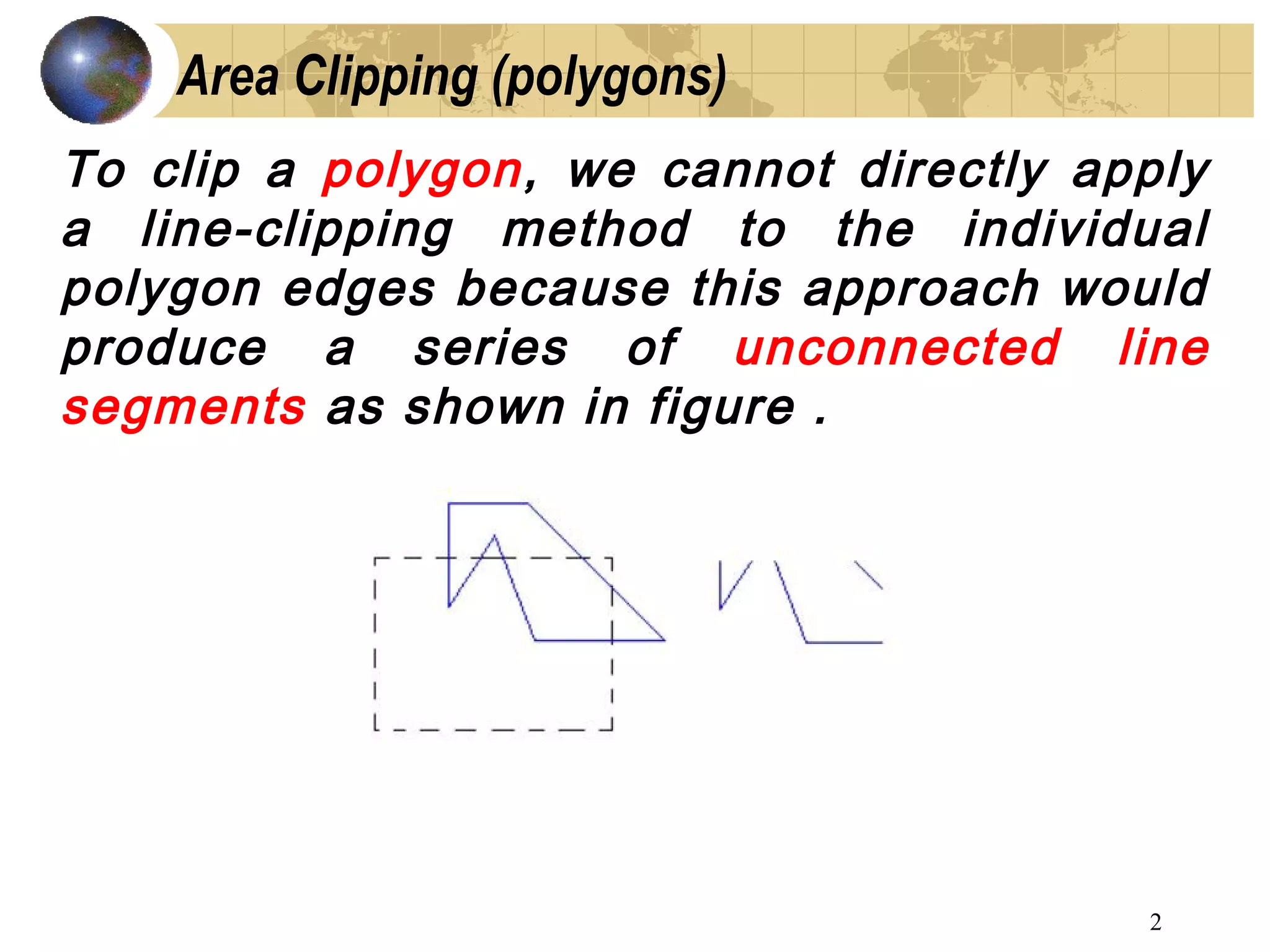
To clip a polygon, we cannot directly apply
a line-clipping method to the individual
polygon edges because this approach would
produce a series of unconnected line
segments as shown in figure .
3
Area Clipping (polygons)
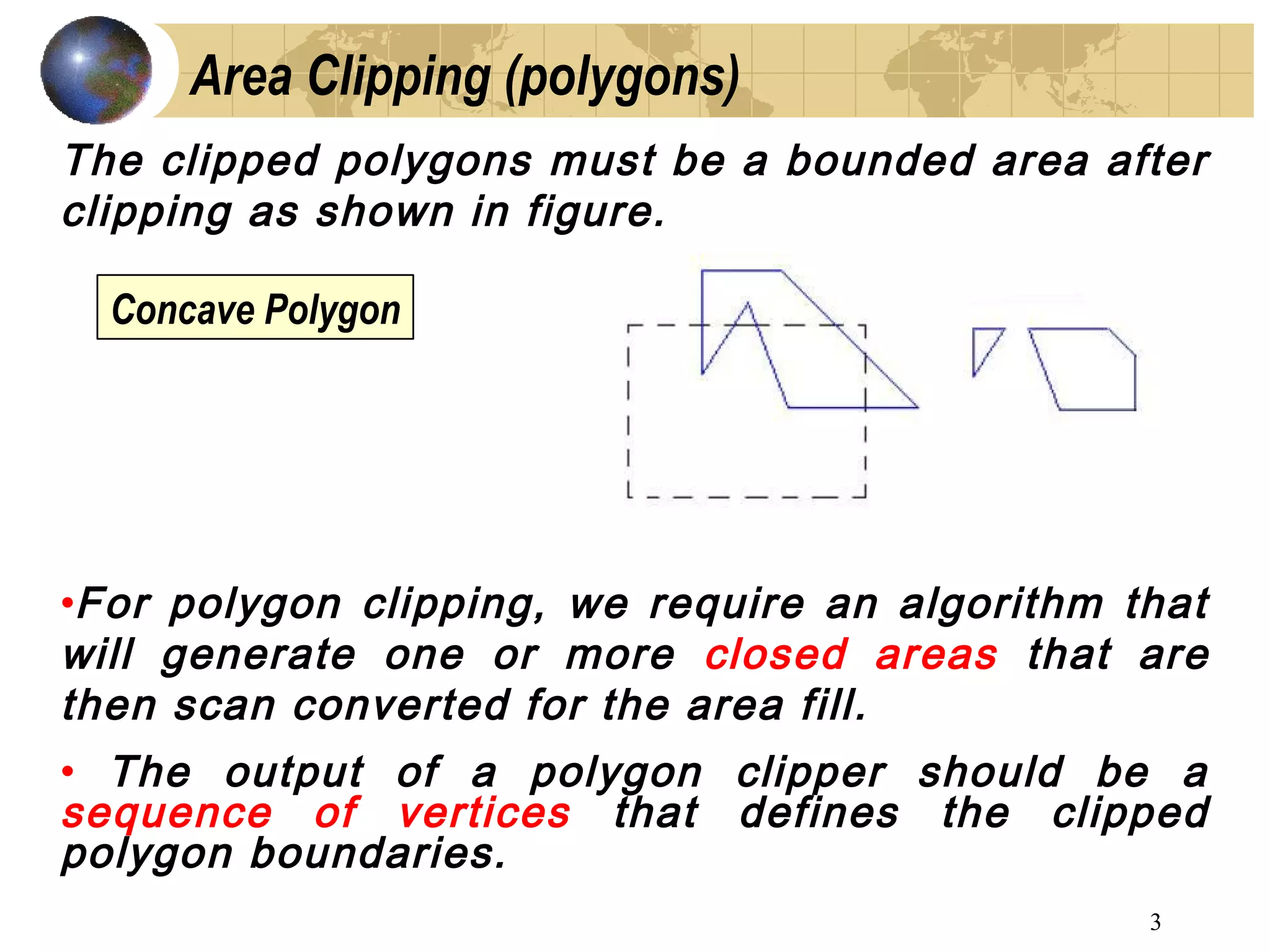
The clipped polygons must be a bounded area after
clipping as shown in figure.
•For polygon clipping, we require an algorithm that
will generate one or more closed areas that are
then scan converted for the area fill.
• The output of a polygon clipper should be a
sequence of vertices that defines the clipped
polygon boundaries.
Concave Polygon
4
Sutherland-Hodgman Polygon Clipping
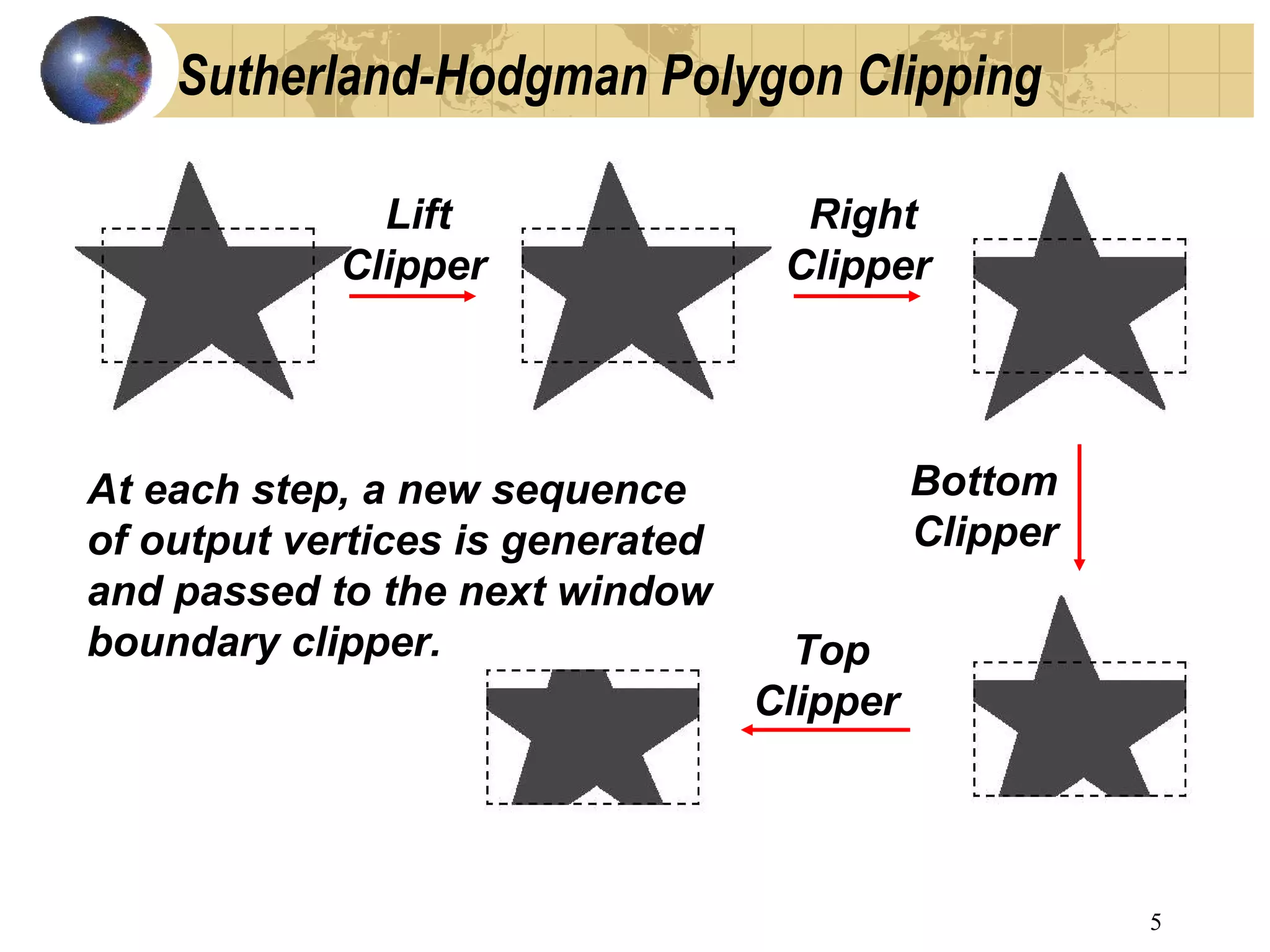
•Clip a polygon by processing the polygon boundary
against each window edge. (Left, Top, Bottom, Right).
• Apply four cases to process all polygon edges to
produce sequence of vertices. This sequence of
vertices will make a bounded area.
• Beginning with the initial set of polygon vertices, we
could first clip the polygon against the left rectangle
boundary to produce a new sequence of vertices.
• The new set of vertices could be successively passed
to a right boundary clipper, a bottom boundary clipper,
and a top boundary clipper.
5
Sutherland-Hodgman Polygon Clipping
Lift
Clipper
Right
Clipper
Bottom
Clipper
Top
Clipper
At each step, a new sequence
of output vertices is generated
and passed to the next window
boundary clipper.
6
Sutherland-Hodgman Polygon Clipping
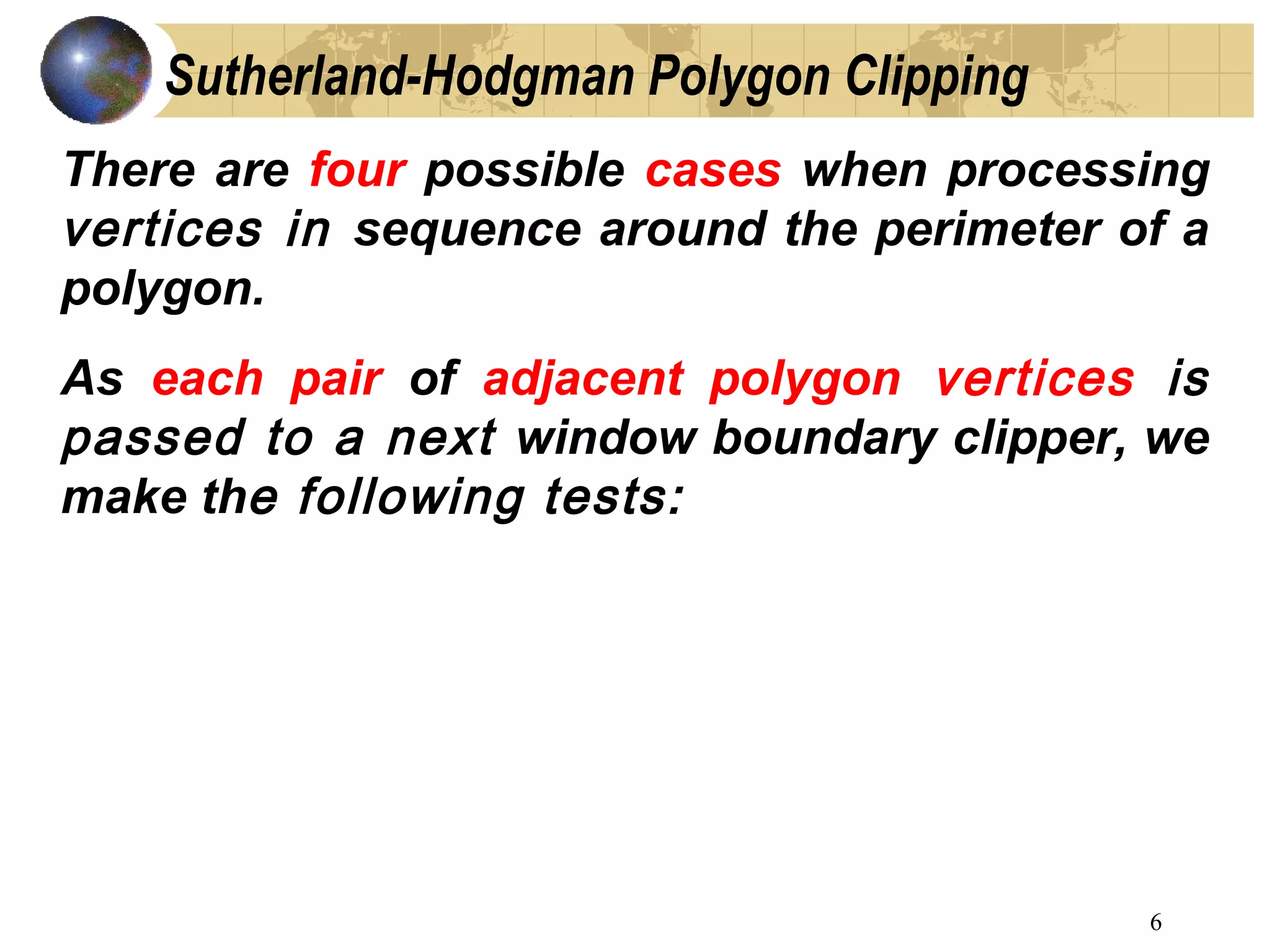
There are four possible cases when processing
vertices in sequence around the perimeter of a
polygon.
As each pair of adjacent polygon vertices is
passed to a next window boundary clipper, we
make the following tests:
7
Sutherland-Hodgman Polygon Clipping
1. If the first vertex is outside the window
boundary and the second vertex is inside
Then , both the intersection point of the
polygon edge with the window boundary
and the second vertex are added to the
output vertex list.
8
Sutherland-Hodgman Polygon Clipping
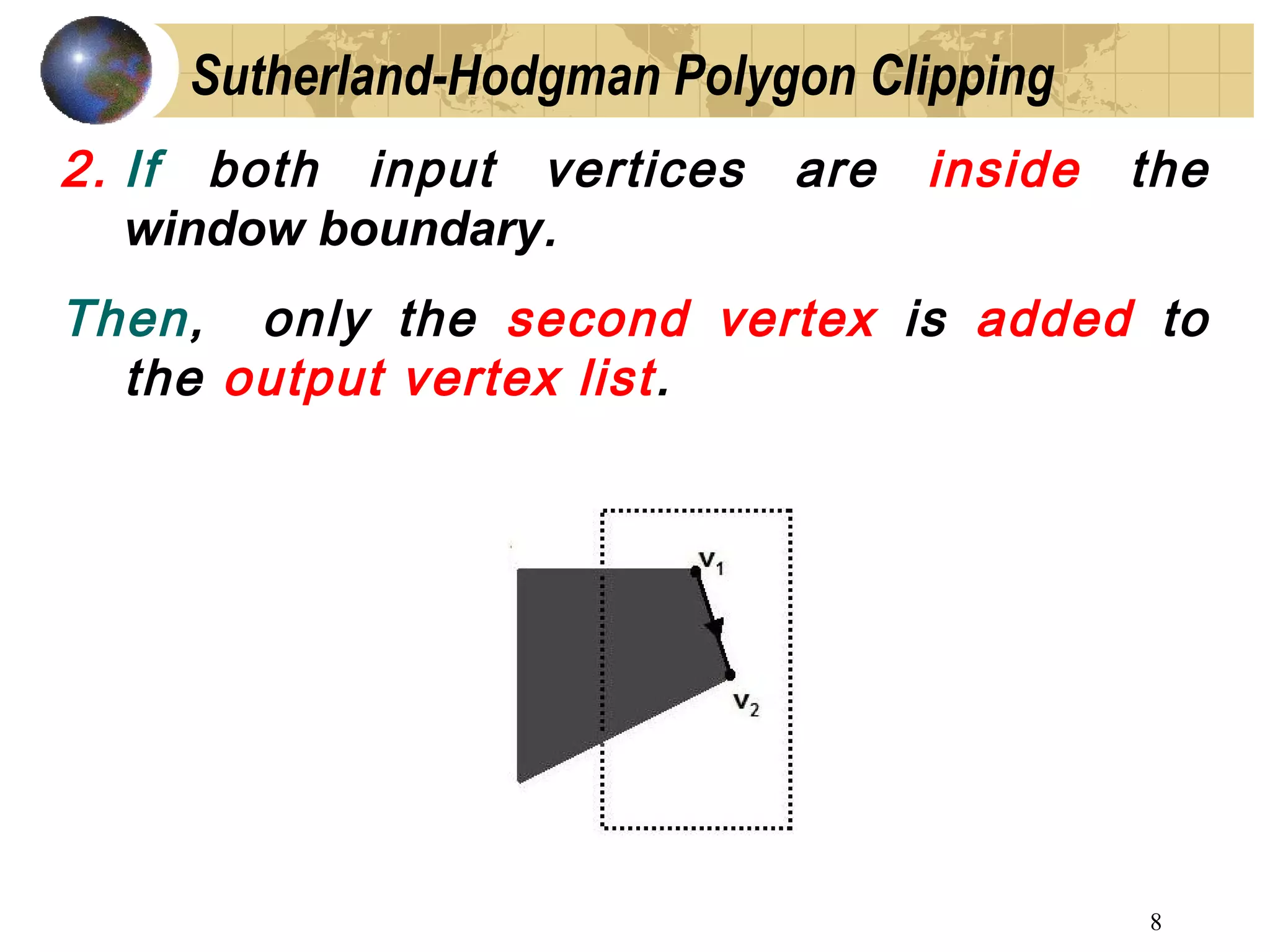
2. If both input vertices are inside the
window boundary.
Then, only the second vertex is added to
the output vertex list.
9
Sutherland-Hodgman Polygon Clipping
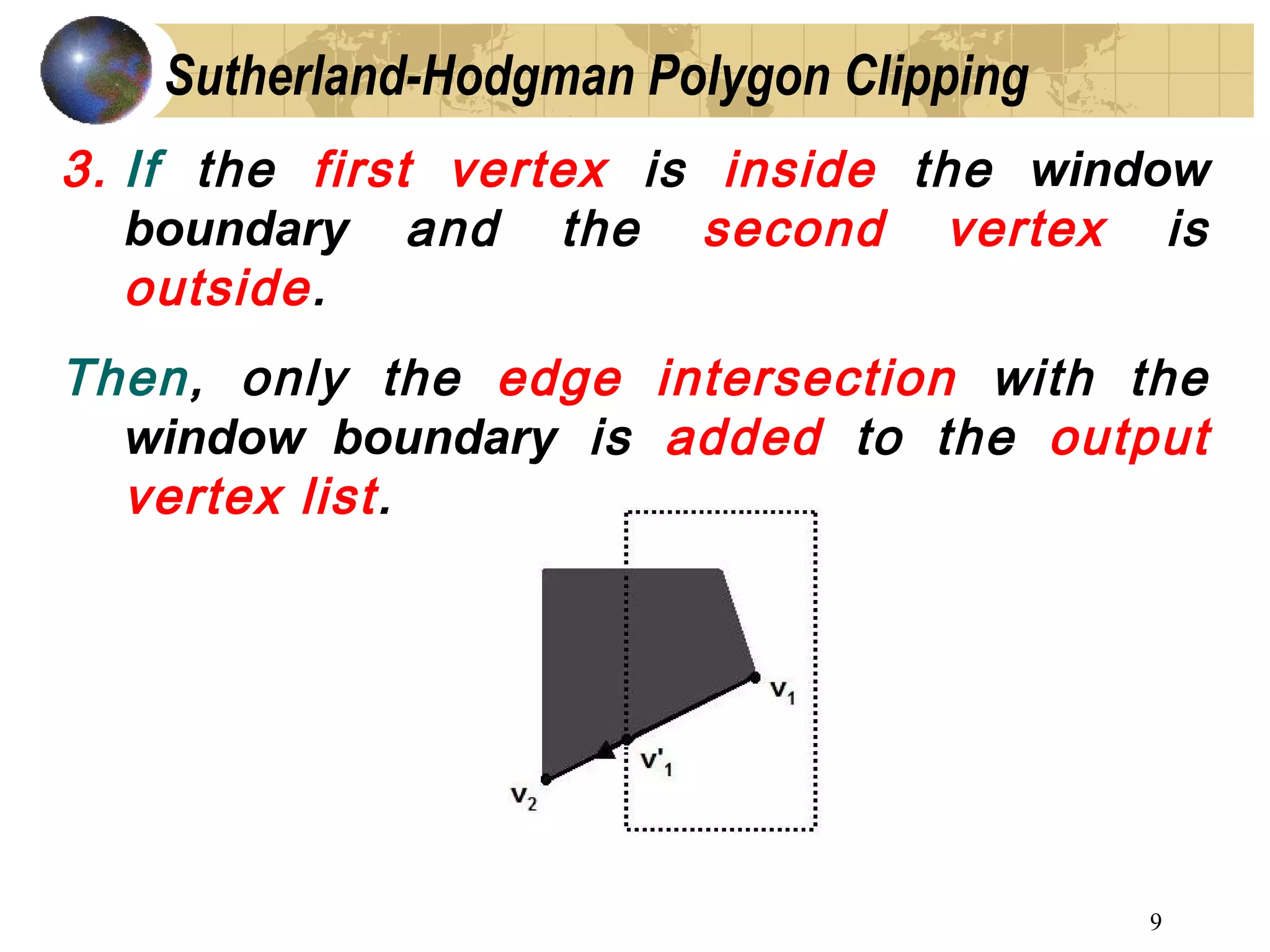
3. If the first vertex is inside the window
boundary and the second vertex is
outside.
Then, only the edge intersection with the
window boundary is added to the output
vertex list.
10
Sutherland-Hodgman Polygon Clipping
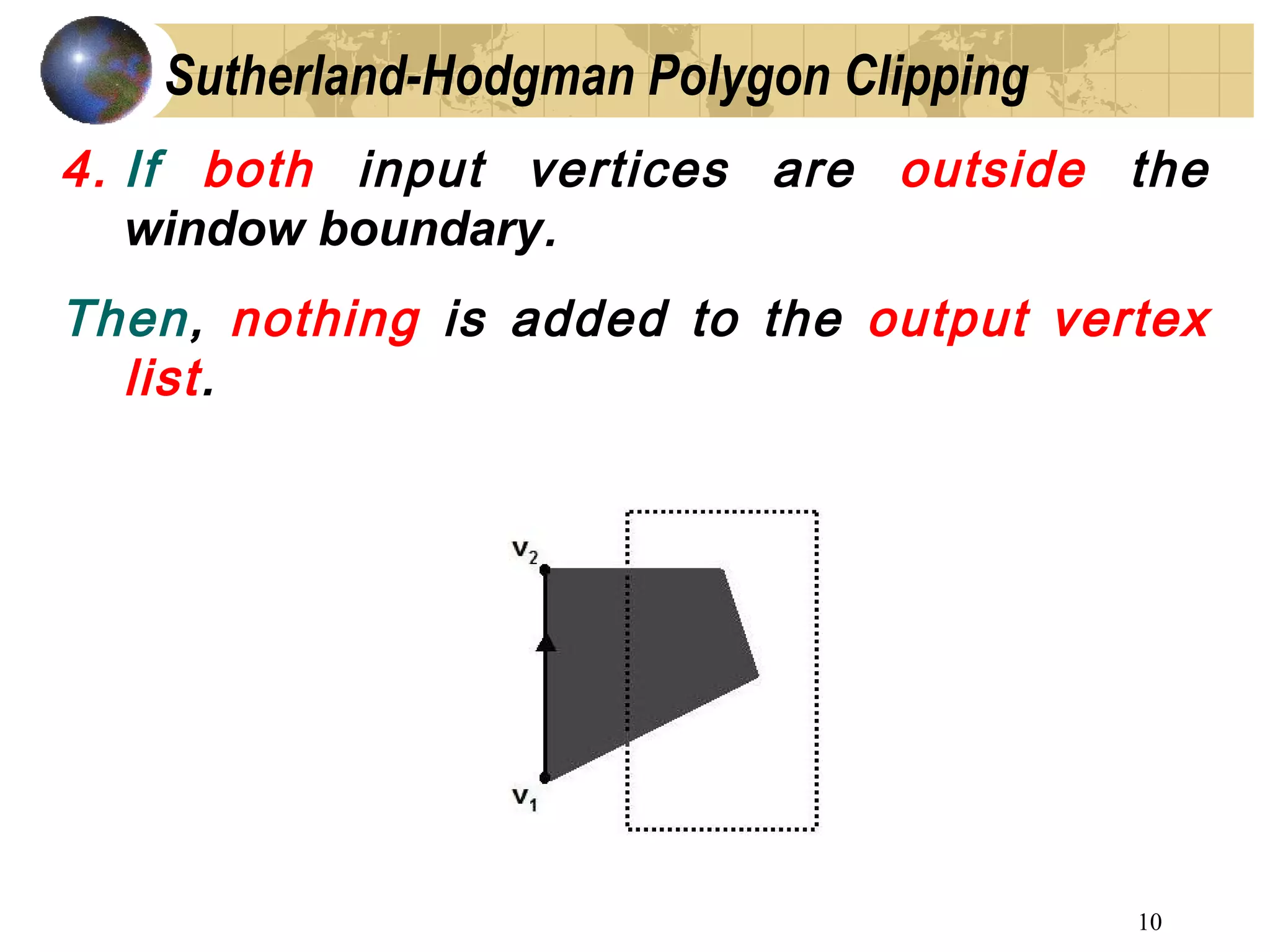
4. If both input vertices are outside the
window boundary.
Then, nothing is added to the output vertex
list.
11
Sutherland-Hodgman Polygon Clipping (Example)
We illustrate this algorithm by processing the area in
figure against the left window boundary.
Vertices 1 and 2 are outside of the
boundary.
Vertex 3, which is inside, 1' and
vertex 3 are saved.
Vertex 4 and 5 are inside, and they
also saved.
Vertex 6 is outside, 5' is saved.
Using the five saved points, we
would repeat the process for the
next window boundary.
12
Sutherland-Hodgman Polygon Clipping
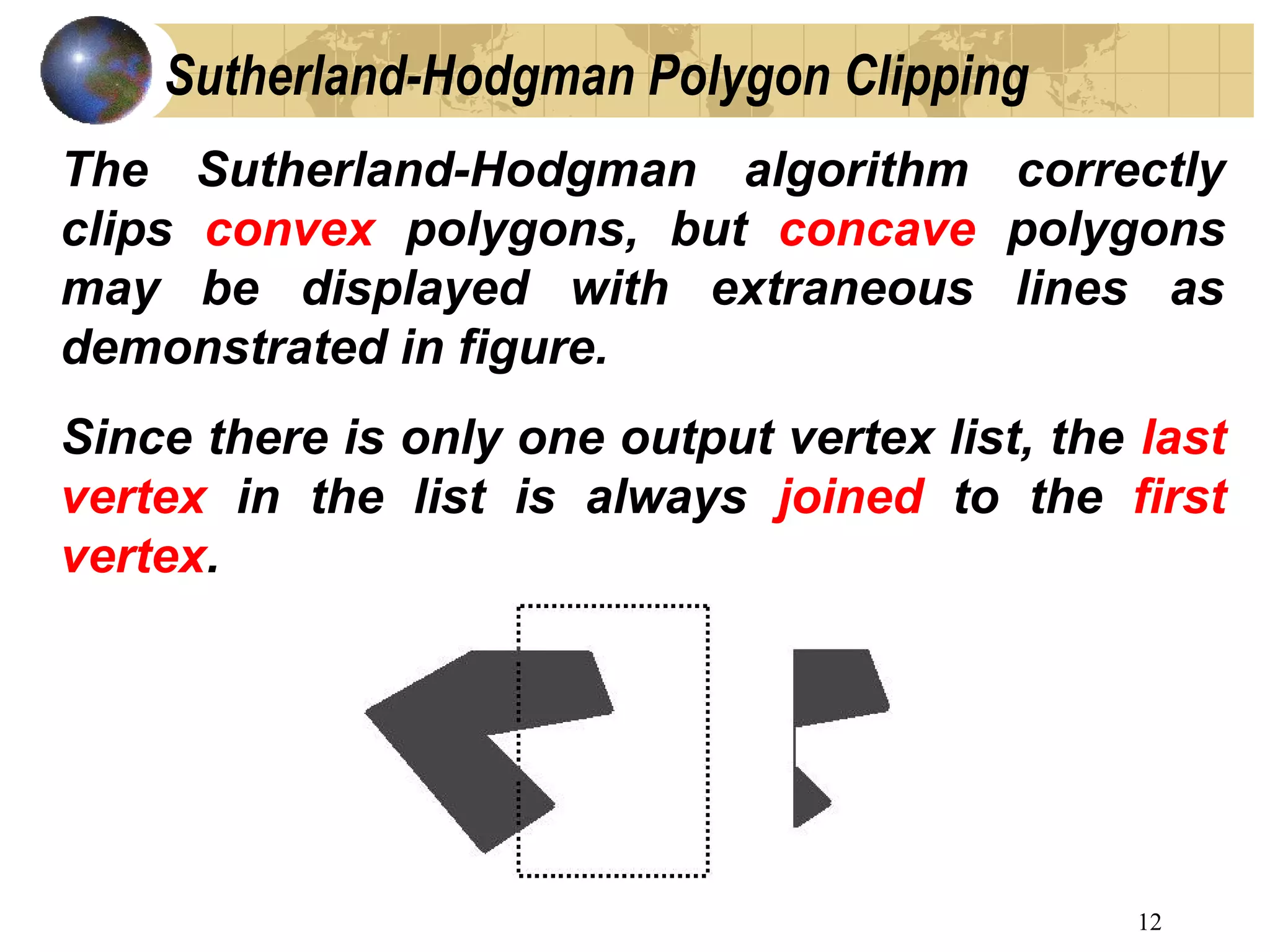
The Sutherland-Hodgman algorithm correctly
clips convex polygons, but concave polygons
may be displayed with extraneous lines as
demonstrated in figure.
Since there is only one output vertex list, the last
vertex in the list is always joined to the first
vertex.
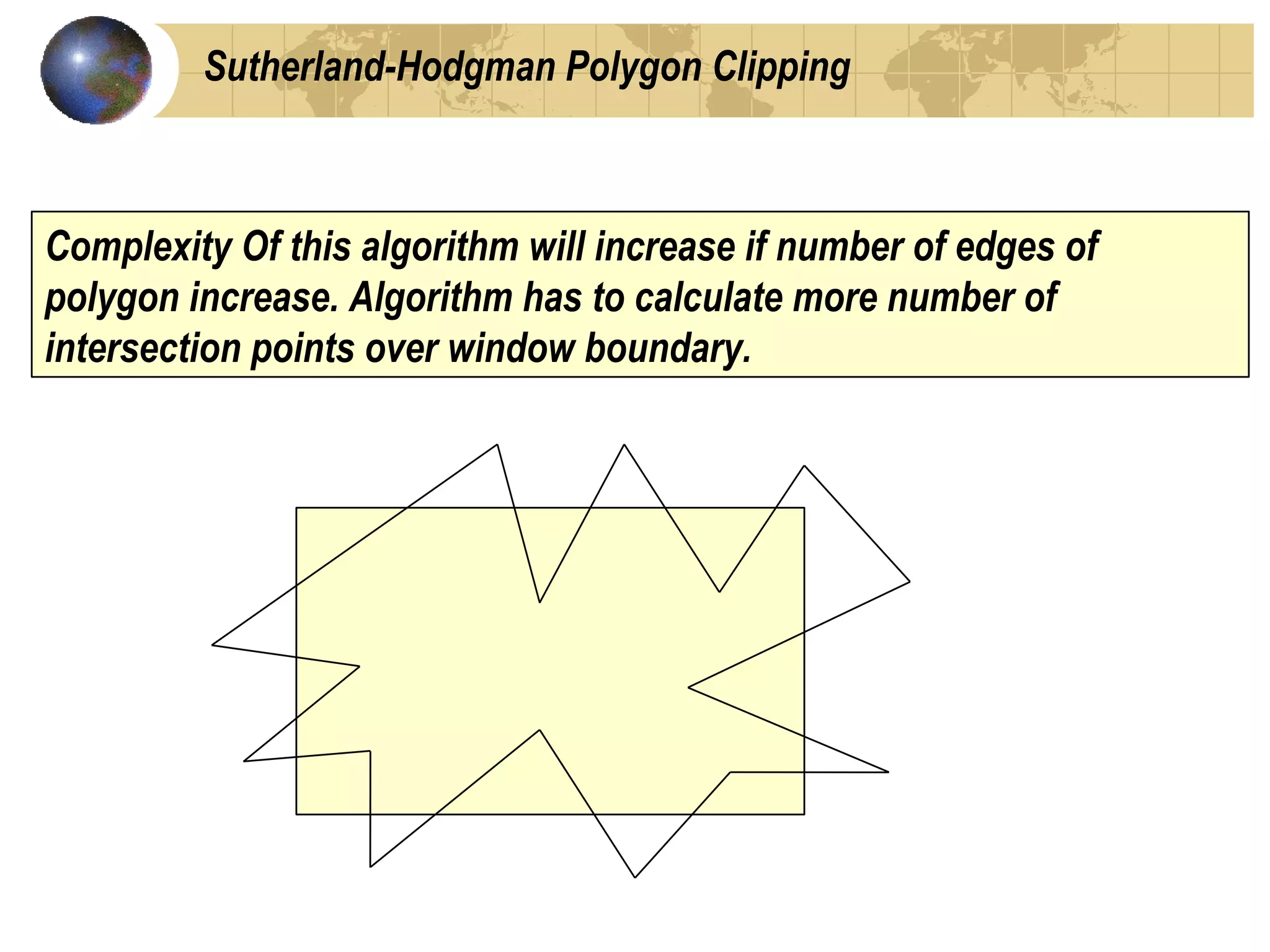
Sutherland-Hodgman Polygon Clipping
Complexity Of this algorithm will increase if number of edges of
polygon increase. Algorithm has to calculate more number of
intersection points over window boundary.
14
Weiler-Atherton Polygon Clipping
This algorithm was developed clip a fill area that is either
a convex polygon or a concave polygon.
The basic idea of this algorithm is that instead of
proceeding around the polygon edges as vertices are
processed, we will follow the window boundaries.
The path we follow depends on:
• polygon-processing direction (clockwise or
counterclockwise)
• The pair of polygon vertices
outside-to-inside or an inside-to-outside.
15
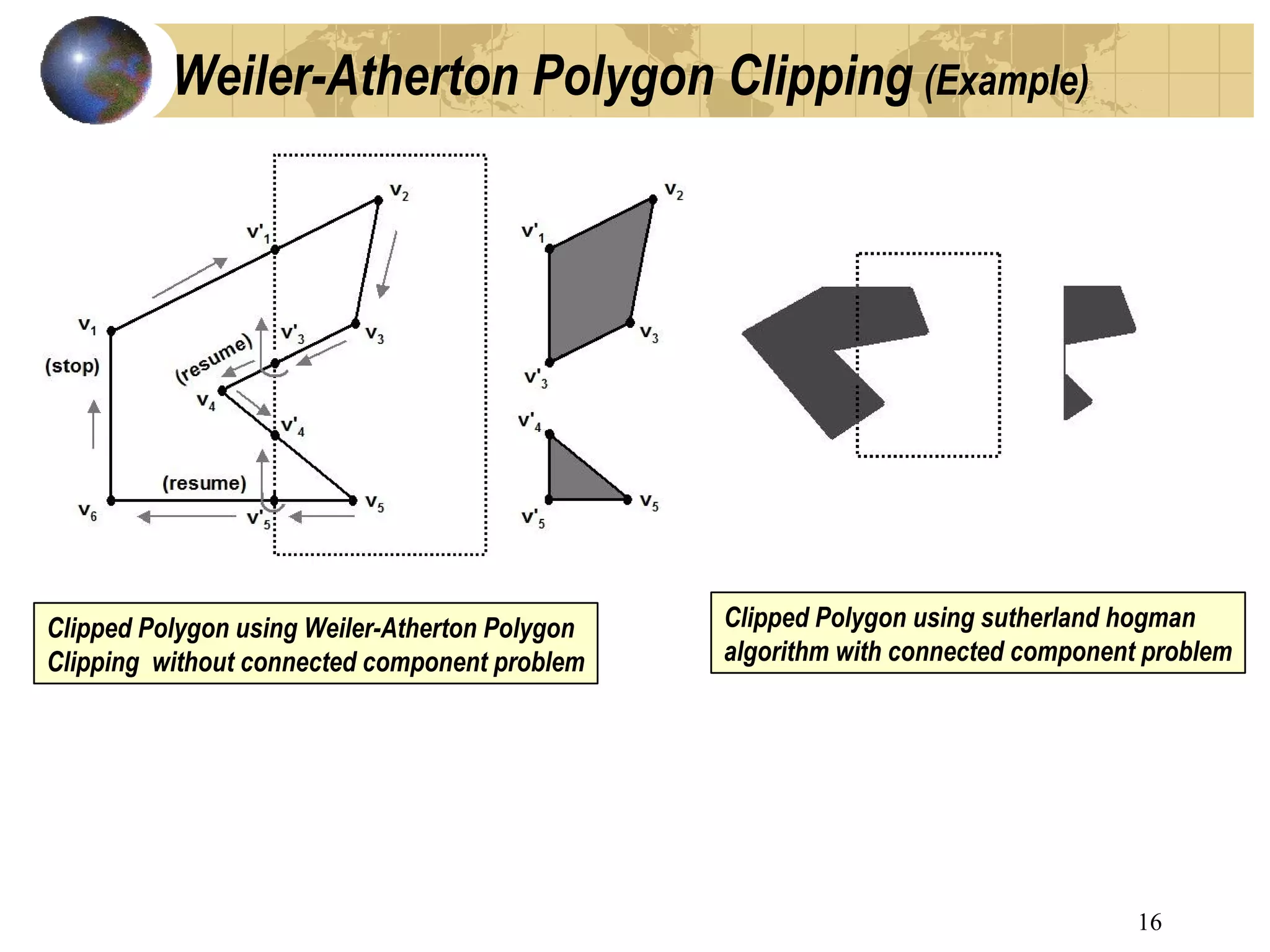
Weiler-Atherton Polygon Clipping
For clockwise processing of polygon vertices, we
use the following rules:
• For an outside-to-inside pair of vertices, follow
polygon boundaries.
• For an inside-to-outside pair of vertices, follow
window boundaries in a clockwise direction.
16
Weiler-Atherton Polygon Clipping (Example)
Clipped Polygon using sutherland hogman
algorithm with connected component problem
Clipped Polygon using Weiler-Atherton Polygon
Clipping without connected component problem
Thank You

Polygon clipping

  • 1.
    Computer Graphics Clipping • Sutherland-HodgmanAlgorithm (Area Clipping or Polygon Clipping) • Weiler-Atherton Polygon Clipping (Solution of Sutherland-Hodgman Algorithm ) • Cohen Sutherland Algorithm (Line Clipping)
  • 2.
    2 Area Clipping (polygons) Toclip a polygon, we cannot directly apply a line-clipping method to the individual polygon edges because this approach would produce a series of unconnected line segments as shown in figure .
  • 3.
    3 Area Clipping (polygons) Theclipped polygons must be a bounded area after clipping as shown in figure. •For polygon clipping, we require an algorithm that will generate one or more closed areas that are then scan converted for the area fill. • The output of a polygon clipper should be a sequence of vertices that defines the clipped polygon boundaries. Concave Polygon
  • 4.
    4 Sutherland-Hodgman Polygon Clipping •Clipa polygon by processing the polygon boundary against each window edge. (Left, Top, Bottom, Right). • Apply four cases to process all polygon edges to produce sequence of vertices. This sequence of vertices will make a bounded area. • Beginning with the initial set of polygon vertices, we could first clip the polygon against the left rectangle boundary to produce a new sequence of vertices. • The new set of vertices could be successively passed to a right boundary clipper, a bottom boundary clipper, and a top boundary clipper.
  • 5.
    5 Sutherland-Hodgman Polygon Clipping Lift Clipper Right Clipper Bottom Clipper Top Clipper Ateach step, a new sequence of output vertices is generated and passed to the next window boundary clipper.
  • 6.
    6 Sutherland-Hodgman Polygon Clipping Thereare four possible cases when processing vertices in sequence around the perimeter of a polygon. As each pair of adjacent polygon vertices is passed to a next window boundary clipper, we make the following tests:
  • 7.
    7 Sutherland-Hodgman Polygon Clipping 1.If the first vertex is outside the window boundary and the second vertex is inside Then , both the intersection point of the polygon edge with the window boundary and the second vertex are added to the output vertex list.
  • 8.
    8 Sutherland-Hodgman Polygon Clipping 2.If both input vertices are inside the window boundary. Then, only the second vertex is added to the output vertex list.
  • 9.
    9 Sutherland-Hodgman Polygon Clipping 3.If the first vertex is inside the window boundary and the second vertex is outside. Then, only the edge intersection with the window boundary is added to the output vertex list.
  • 10.
    10 Sutherland-Hodgman Polygon Clipping 4.If both input vertices are outside the window boundary. Then, nothing is added to the output vertex list.
  • 11.
    11 Sutherland-Hodgman Polygon Clipping(Example) We illustrate this algorithm by processing the area in figure against the left window boundary. Vertices 1 and 2 are outside of the boundary. Vertex 3, which is inside, 1' and vertex 3 are saved. Vertex 4 and 5 are inside, and they also saved. Vertex 6 is outside, 5' is saved. Using the five saved points, we would repeat the process for the next window boundary.
  • 12.
    12 Sutherland-Hodgman Polygon Clipping TheSutherland-Hodgman algorithm correctly clips convex polygons, but concave polygons may be displayed with extraneous lines as demonstrated in figure. Since there is only one output vertex list, the last vertex in the list is always joined to the first vertex.
  • 13.
    Sutherland-Hodgman Polygon Clipping ComplexityOf this algorithm will increase if number of edges of polygon increase. Algorithm has to calculate more number of intersection points over window boundary.
  • 14.
    14 Weiler-Atherton Polygon Clipping Thisalgorithm was developed clip a fill area that is either a convex polygon or a concave polygon. The basic idea of this algorithm is that instead of proceeding around the polygon edges as vertices are processed, we will follow the window boundaries. The path we follow depends on: • polygon-processing direction (clockwise or counterclockwise) • The pair of polygon vertices outside-to-inside or an inside-to-outside.
  • 15.
    15 Weiler-Atherton Polygon Clipping Forclockwise processing of polygon vertices, we use the following rules: • For an outside-to-inside pair of vertices, follow polygon boundaries. • For an inside-to-outside pair of vertices, follow window boundaries in a clockwise direction.
  • 16.
    16 Weiler-Atherton Polygon Clipping(Example) Clipped Polygon using sutherland hogman algorithm with connected component problem Clipped Polygon using Weiler-Atherton Polygon Clipping without connected component problem
  • 18.