1.5 Infinite Limits
and 3.5 Limits at Infinity
AP Calculus I
Ms. Hernandez
(print in grayscale or black/white)
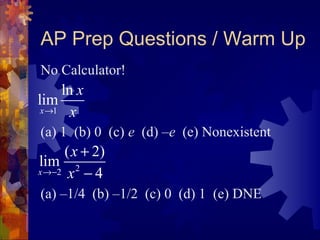
AP Prep Questions / Warm Up
No Calculator!
(a) 1 (b) 0 (c) e (d) –e (e) Nonexistent
(a) –1/4 (b) –1/2 (c) 0 (d) 1 (e) DNE
1
ln
lim
x
x
x→
22
( 2)
lim
4x
x
x→−
+
−
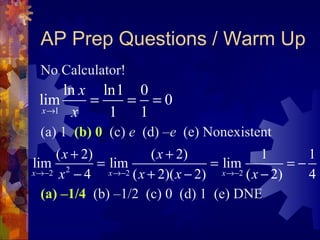
AP Prep Questions / Warm Up
No Calculator!
(a) 1 (b) 0 (c) e (d) –e (e) Nonexistent
(a) –1/4 (b) –1/2 (c) 0 (d) 1 (e) DNE
1
ln ln1 0
lim 0
1 1x
x
x→
= = =
22 2 2
( 2) ( 2) 1 1
lim lim lim
4 ( 2)( 2) ( 2) 4x x x
x x
x x x x→− →− →−
+ +
= = = −
− + − −
1.5 Infinite Limits
 Vertical asymptotes at x=c will give you
infinite limits
 Take the limit at x=c and the behavior of
the graph at x=c is a vertical asymptote
then the limit is infinity
 Really the limit does not exist, and that
it fails to exist is b/c of the unbounded
behavior (and we call it infinity)
Determining Infinite Limits from a
Graph
 Example 1 pg 81
 Can you get different infinite limits from
the left or right of a graph?
 How do you find the vertical asymptote?
Finding Vertical Asymptotes
 Ex 2 pg 82
 Denominator = 0 at x = c AND the
numerator is NOT zero
 Thus, we have vertical asymptote at x = c
 What happens when both num and den
are BOTH Zero?!?!
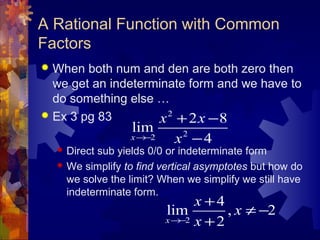
A Rational Function with Common
Factors
 When both num and den are both zero then
we get an indeterminate form and we have to
do something else …
 Ex 3 pg 83
 Direct sub yields 0/0 or indeterminate form
 We simplify to find vertical asymptotes but how do
we solve the limit? When we simplify we still have
indeterminate form.
2
22
2 8
lim
4x
x x
x→−
+ −
−
2
4
lim , 2
2x
x
x
x→−
+
≠ −
+
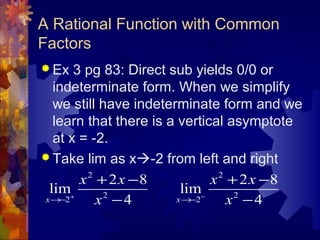
A Rational Function with Common
Factors
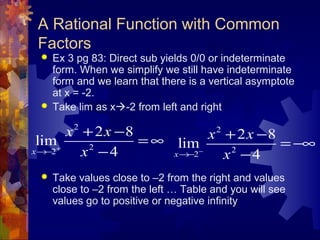
 Ex 3 pg 83: Direct sub yields 0/0 or
indeterminate form. When we simplify
we still have indeterminate form and we
learn that there is a vertical asymptote
at x = -2.
 Take lim as x-2 from left and right
2
2
2
2 8
lim
4x
x x
x+
→−
+ −
−
2
2
2
2 8
lim
4x
x x
x−
→−
+ −
−
A Rational Function with Common
Factors
 Ex 3 pg 83: Direct sub yields 0/0 or indeterminate
form. When we simplify we still have indeterminate
form and we learn that there is a vertical asymptote
at x = -2.
 Take lim as x-2 from left and right
 Take values close to –2 from the right and values
close to –2 from the left … Table and you will see
values go to positive or negative infinity
2
2
2
2 8
lim
4x
x x
x+
→−
+ −
= ∞
−
2
2
2
2 8
lim
4x
x x
x−
→−
+ −
= −∞
−
Determining Infinite Limits
 Ex 4 pg 83
 Denominator = 0 when x = 1 AND the
numerator is NOT zero
 Thus, we have vertical asymptote at x=1
 But is the limit +infinity or –infinity?
 Let x = small values close to c
 Use your calculator to make sure – but
they are not always your best friend!
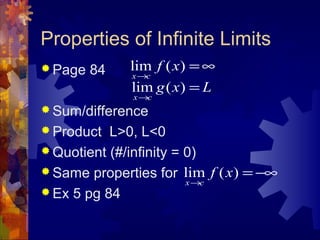
Properties of Infinite Limits
 Page 84
 Sum/difference
 Product L>0, L<0
 Quotient (#/infinity = 0)
 Same properties for
 Ex 5 pg 84
lim ( )
x c
f x
→
= ∞
lim ( )
x c
g x L
→
=
lim ( )
x c
f x
→
= −∞
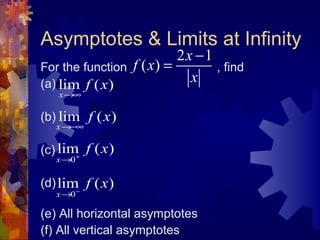
Asymptotes & Limits at Infinity
For the function , find
(a)
(b)
(c)
(d)
(e) All horizontal asymptotes
(f) All vertical asymptotes
2 1
( )
x
f x
x
−
=
lim ( )
x
f x
→∞
lim ( )
x
f x
→−∞
0
lim ( )
x
f x+
→
0
lim ( )
x
f x−
→
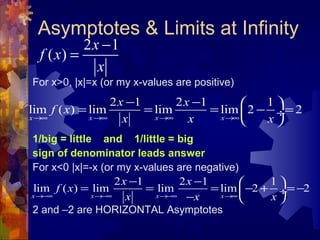
Asymptotes & Limits at Infinity
For x>0, |x|=x (or my x-values are positive)
1/big = little and 1/little = big
sign of denominator leads answer
For x<0 |x|=-x (or my x-values are negative)
2 and –2 are HORIZONTAL Asymptotes
2 1
( )
x
f x
x
−
=
2 1 2 1 1
lim ( ) lim lim lim 2 2
x x x x
x x
f x
x x x→∞ →∞ →∞ →∞
− −  
= = = − = ÷
 
2 1 2 1 1
lim ( ) lim lim lim 2 2
x x x x
x x
f x
x x x→−∞ →−∞ →−∞ →∞
− −  
= = = − + = − ÷
−  
Asymptotes & Limits at Infinity
2 1
( )
x
f x
x
−
=
0 0 0 0
2 1 2 1 1
lim ( ) lim lim lim 2
x x x x
x x
f x
x x x+ + + +
→ → → →
− −  
= = = − ÷
 
2 1 2 1 1
lim ( ) lim lim lim 2 2
x x x x
x x
f x
x x x→−∞ →−∞ →−∞ →∞
− −  
= = = − + = − ÷
−  
1 1
2 2 2 lim DNE
x little
   
− = − = −∞ = −∞ ∴ ÷  ÷
+   
1 1
2 2 2 lim DNE
x little
   
− + = − + = − +−∞ = −∞ ∴ ÷  ÷
−   
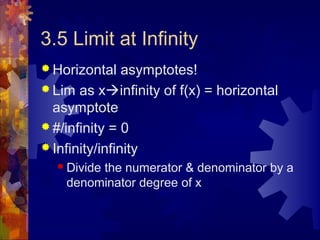
3.5 Limit at Infinity
 Horizontal asymptotes!
 Lim as xinfinity of f(x) = horizontal
asymptote
 #/infinity = 0
 Infinity/infinity
 Divide the numerator & denominator by a
denominator degree of x
Some examples
 Ex 2-3 on pages #194-195
 What’s the graph look like on Ex 3.c
 Called oblique asymptotes (not in cal 1)
 KNOW Guidelines on page 195
2 horizontal asymptotes
 Ex 4 pg 196
 Is the method for solving lim of f(x) with
2 horizontal asymptotes any different
than if the f(x) only had 1 horizontal
asymptotes?
Trig f(x)
 Ex 5 pg 197
 What is the difference in the behaviors
of the two trig f(x) in this example?
 Oscillating toward no value vs
oscillating toward a value
Word Problems !!!!!
 Taking information from a word problem
and apply properties of limits at infinity
to solve
 Ex 6 pg 197
A word on infinite limits at infinity
 Take a lim of f(x)  infinity and
sometimes the answer is infinity
 Ex 7 on page 198
 Uses property of f(x)
 Ex 8 on page 198
 Uses LONG division of polynomials-Yuck!

1541 infinite limits

  • 1.
    1.5 Infinite Limits and3.5 Limits at Infinity AP Calculus I Ms. Hernandez (print in grayscale or black/white)
  • 2.
    AP Prep Questions/ Warm Up No Calculator! (a) 1 (b) 0 (c) e (d) –e (e) Nonexistent (a) –1/4 (b) –1/2 (c) 0 (d) 1 (e) DNE 1 ln lim x x x→ 22 ( 2) lim 4x x x→− + −
  • 3.
    AP Prep Questions/ Warm Up No Calculator! (a) 1 (b) 0 (c) e (d) –e (e) Nonexistent (a) –1/4 (b) –1/2 (c) 0 (d) 1 (e) DNE 1 ln ln1 0 lim 0 1 1x x x→ = = = 22 2 2 ( 2) ( 2) 1 1 lim lim lim 4 ( 2)( 2) ( 2) 4x x x x x x x x x→− →− →− + + = = = − − + − −
  • 4.
    1.5 Infinite Limits Vertical asymptotes at x=c will give you infinite limits  Take the limit at x=c and the behavior of the graph at x=c is a vertical asymptote then the limit is infinity  Really the limit does not exist, and that it fails to exist is b/c of the unbounded behavior (and we call it infinity)
  • 5.
    Determining Infinite Limitsfrom a Graph  Example 1 pg 81  Can you get different infinite limits from the left or right of a graph?  How do you find the vertical asymptote?
  • 6.
    Finding Vertical Asymptotes Ex 2 pg 82  Denominator = 0 at x = c AND the numerator is NOT zero  Thus, we have vertical asymptote at x = c  What happens when both num and den are BOTH Zero?!?!
  • 7.
    A Rational Functionwith Common Factors  When both num and den are both zero then we get an indeterminate form and we have to do something else …  Ex 3 pg 83  Direct sub yields 0/0 or indeterminate form  We simplify to find vertical asymptotes but how do we solve the limit? When we simplify we still have indeterminate form. 2 22 2 8 lim 4x x x x→− + − − 2 4 lim , 2 2x x x x→− + ≠ − +
  • 8.
    A Rational Functionwith Common Factors  Ex 3 pg 83: Direct sub yields 0/0 or indeterminate form. When we simplify we still have indeterminate form and we learn that there is a vertical asymptote at x = -2.  Take lim as x-2 from left and right 2 2 2 2 8 lim 4x x x x+ →− + − − 2 2 2 2 8 lim 4x x x x− →− + − −
  • 9.
    A Rational Functionwith Common Factors  Ex 3 pg 83: Direct sub yields 0/0 or indeterminate form. When we simplify we still have indeterminate form and we learn that there is a vertical asymptote at x = -2.  Take lim as x-2 from left and right  Take values close to –2 from the right and values close to –2 from the left … Table and you will see values go to positive or negative infinity 2 2 2 2 8 lim 4x x x x+ →− + − = ∞ − 2 2 2 2 8 lim 4x x x x− →− + − = −∞ −
  • 10.
    Determining Infinite Limits Ex 4 pg 83  Denominator = 0 when x = 1 AND the numerator is NOT zero  Thus, we have vertical asymptote at x=1  But is the limit +infinity or –infinity?  Let x = small values close to c  Use your calculator to make sure – but they are not always your best friend!
  • 11.
    Properties of InfiniteLimits  Page 84  Sum/difference  Product L>0, L<0  Quotient (#/infinity = 0)  Same properties for  Ex 5 pg 84 lim ( ) x c f x → = ∞ lim ( ) x c g x L → = lim ( ) x c f x → = −∞
  • 12.
    Asymptotes & Limitsat Infinity For the function , find (a) (b) (c) (d) (e) All horizontal asymptotes (f) All vertical asymptotes 2 1 ( ) x f x x − = lim ( ) x f x →∞ lim ( ) x f x →−∞ 0 lim ( ) x f x+ → 0 lim ( ) x f x− →
  • 13.
    Asymptotes & Limitsat Infinity For x>0, |x|=x (or my x-values are positive) 1/big = little and 1/little = big sign of denominator leads answer For x<0 |x|=-x (or my x-values are negative) 2 and –2 are HORIZONTAL Asymptotes 2 1 ( ) x f x x − = 2 1 2 1 1 lim ( ) lim lim lim 2 2 x x x x x x f x x x x→∞ →∞ →∞ →∞ − −   = = = − = ÷   2 1 2 1 1 lim ( ) lim lim lim 2 2 x x x x x x f x x x x→−∞ →−∞ →−∞ →∞ − −   = = = − + = − ÷ −  
  • 14.
    Asymptotes & Limitsat Infinity 2 1 ( ) x f x x − = 0 0 0 0 2 1 2 1 1 lim ( ) lim lim lim 2 x x x x x x f x x x x+ + + + → → → → − −   = = = − ÷   2 1 2 1 1 lim ( ) lim lim lim 2 2 x x x x x x f x x x x→−∞ →−∞ →−∞ →∞ − −   = = = − + = − ÷ −   1 1 2 2 2 lim DNE x little     − = − = −∞ = −∞ ∴ ÷  ÷ +    1 1 2 2 2 lim DNE x little     − + = − + = − +−∞ = −∞ ∴ ÷  ÷ −   
  • 15.
    3.5 Limit atInfinity  Horizontal asymptotes!  Lim as xinfinity of f(x) = horizontal asymptote  #/infinity = 0  Infinity/infinity  Divide the numerator & denominator by a denominator degree of x
  • 16.
    Some examples  Ex2-3 on pages #194-195  What’s the graph look like on Ex 3.c  Called oblique asymptotes (not in cal 1)  KNOW Guidelines on page 195
  • 17.
    2 horizontal asymptotes Ex 4 pg 196  Is the method for solving lim of f(x) with 2 horizontal asymptotes any different than if the f(x) only had 1 horizontal asymptotes?
  • 18.
    Trig f(x)  Ex5 pg 197  What is the difference in the behaviors of the two trig f(x) in this example?  Oscillating toward no value vs oscillating toward a value
  • 19.
    Word Problems !!!!! Taking information from a word problem and apply properties of limits at infinity to solve  Ex 6 pg 197
  • 20.
    A word oninfinite limits at infinity  Take a lim of f(x)  infinity and sometimes the answer is infinity  Ex 7 on page 198  Uses property of f(x)  Ex 8 on page 198  Uses LONG division of polynomials-Yuck!