Chapter 12
Limits & An Introduction To Calculus

         12.1 Limit of a Function


Proverbs 24:29. "Do not say, 'I will do to him just
as he has done to me; I will render to the man
according to his work.'"
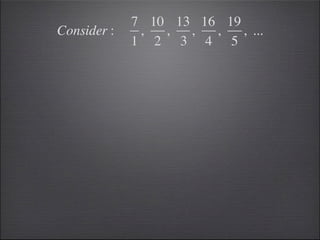
7 10 13 16 19
Consider :    ,  ,  ,  ,   , ...
             1 2 3 4 5
7 10 13 16 19
Consider :    ,  ,  ,  ,   , ...
             1 2 3 4 5
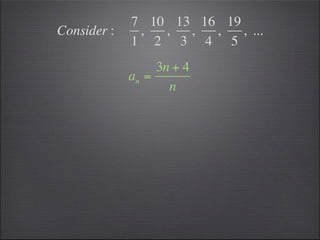
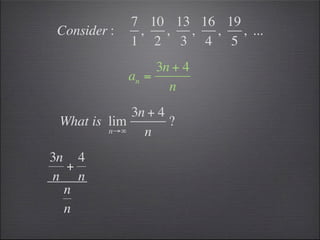
                  3n + 4
             an =
                    n
7 10 13 16 19
Consider :    ,  ,  ,  ,   , ...
             1 2 3 4 5
                  3n + 4
             an =
                    n
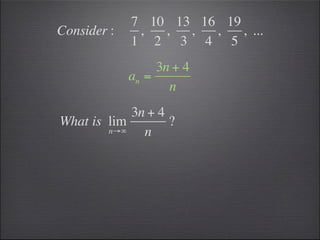
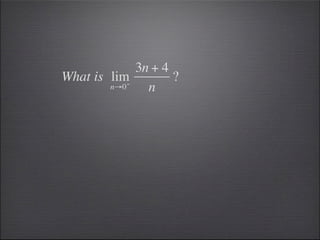
            3n + 4
What is lim        ?
        n→∞   n
7 10 13 16 19
Consider :    ,  ,  ,  ,   , ...
             1 2 3 4 5
                  3n + 4
             an =
                    n
             3n + 4
 What is lim        ?
         n→∞   n
3n 4
  +
n n
  n
  n
7 10 13 16 19
Consider :    ,  ,  ,  ,   , ...
             1 2 3 4 5
                  3n + 4
             an =
                    n
             3n + 4
 What is lim        ?
         n→∞   n
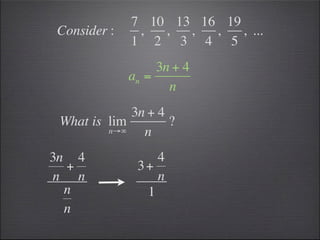
3n 4             4
  +           3+
n n              n
  n            1
  n
7 10 13 16 19
Consider :    ,  ,  ,  ,   , ...
             1 2 3 4 5
                  3n + 4
             an =
                    n
             3n + 4
 What is lim        ?
         n→∞   n
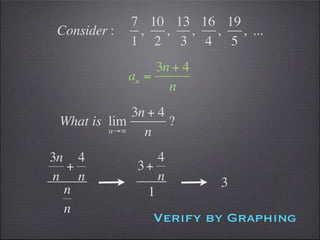
3n 4             4
  +           3+
n n              n         3
  n            1
  n
                 Verify by Graphing
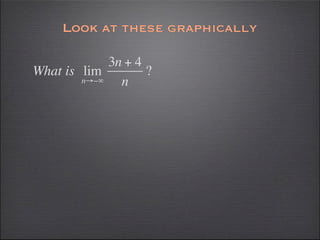
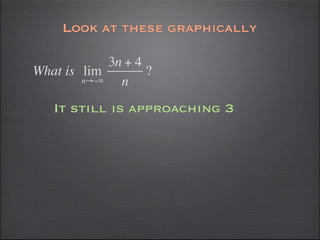
Look at these graphically

             3n + 4
What is lim         ?
        n→−∞   n
Look at these graphically

             3n + 4
What is lim         ?
        n→−∞   n
   It still is approaching 3
Look at these graphically

             3n + 4
What is lim         ?
        n→−∞   n
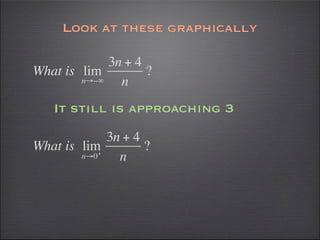
   It still is approaching 3
             3n + 4
What is lim+        ?
        n→0    n
Look at these graphically

               3n + 4
  What is lim         ?
          n→−∞   n
     It still is approaching 3
               3n + 4
  What is lim+        ?
          n→0    n

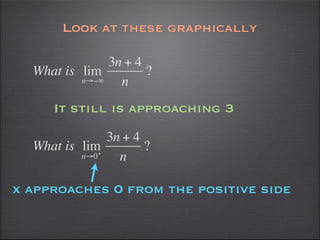
x approaches 0 from the positive side
Look at these graphically

               3n + 4
  What is lim         ?
          n→−∞   n
     It still is approaching 3
               3n + 4
  What is lim+        ?
          n→0    n

x approaches 0 from the positive side
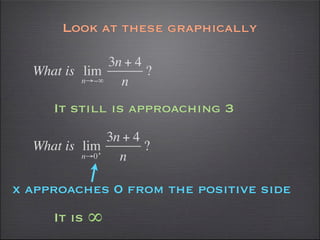
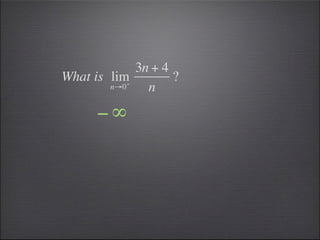
     It is ∞
3n + 4
What is lim−        ?
        n→0    n
3n + 4
What is lim−        ?
        n→0    n

      −∞
2
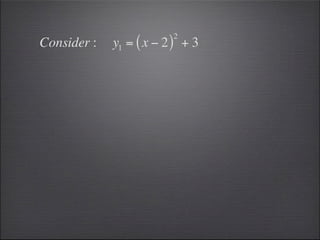
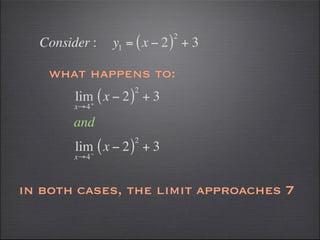
Consider :   y1 = ( x − 2 ) + 3
2
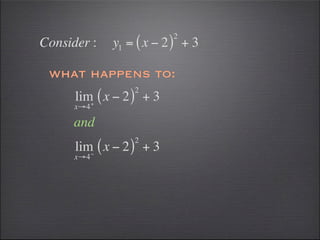
Consider :    y1 = ( x − 2 ) + 3

 what happens to:
                  2
      lim+ ( x − 2 ) + 3
      x→4

      and
                  2
      lim− ( x − 2 ) + 3
      x→4
2
  Consider :    y1 = ( x − 2 ) + 3

    what happens to:
                    2
        lim+ ( x − 2 ) + 3
        x→4

        and
                    2
        lim− ( x − 2 ) + 3
        x→4


in both cases, the limit approaches 7
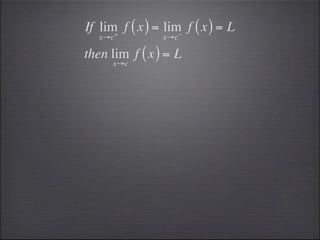
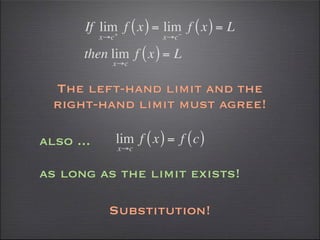
If lim f ( x ) = lim f ( x ) = L
      +             −
   x→c          x→c

then lim f ( x ) = L
     x→c
If lim f ( x ) = lim f ( x ) = L
          +             −
       x→c          x→c

    then lim f ( x ) = L
         x→c


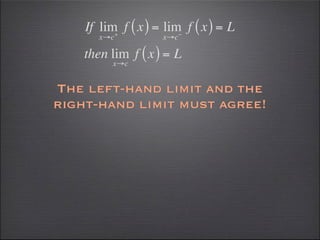
The left-hand limit and the
right-hand limit must agree!
If lim f ( x ) = lim f ( x ) = L
             +             −
           x→c              x→c

       then lim f ( x ) = L
             x→c


  The left-hand limit and the
  right-hand limit must agree!

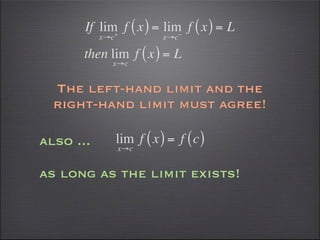
also ...         lim f ( x ) = f ( c )
                 x→c


as long as the limit exists!
If lim f ( x ) = lim f ( x ) = L
             +             −
           x→c              x→c

       then lim f ( x ) = L
             x→c


  The left-hand limit and the
  right-hand limit must agree!

also ...         lim f ( x ) = f ( c )
                 x→c


as long as the limit exists!

            Substitution!
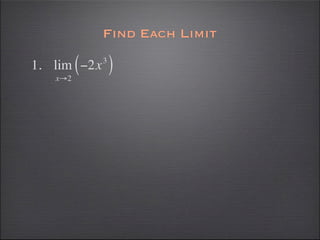
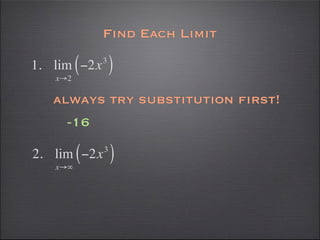
Find Each Limit

1. lim ( −2x   3
                   )
    x→2
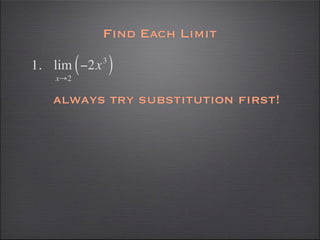
Find Each Limit

1. lim ( −2x   3
                   )
    x→2

   always try substitution first!
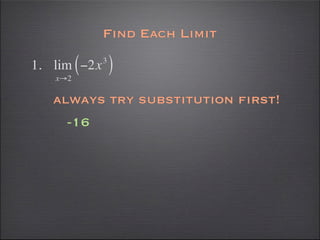
Find Each Limit

1. lim ( −2x   3
                   )
    x→2

   always try substitution first!
      -16
Find Each Limit

1. lim ( −2x   3
                   )
    x→2

   always try substitution first!
      -16

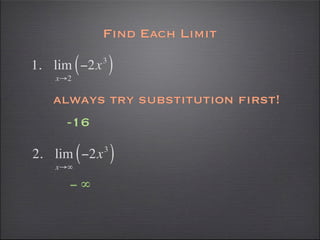
2. lim ( −2x   3
                   )
    x→∞
Find Each Limit

1. lim ( −2x   3
                   )
    x→2

   always try substitution first!
      -16

2. lim ( −2x   3
                   )
    x→∞

      −∞
2
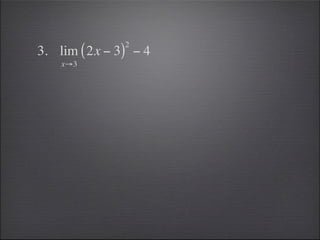
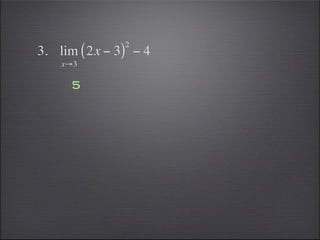
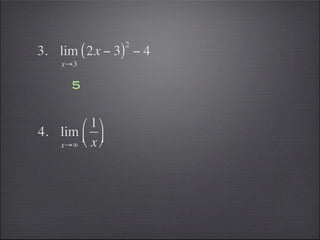
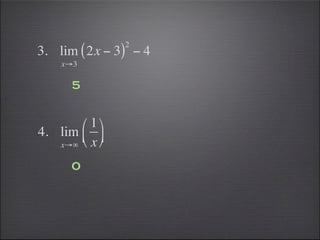
3. lim ( 2x − 3) − 4
    x→3
2
3. lim ( 2x − 3) − 4
    x→3

      5
2
3. lim ( 2x − 3) − 4
    x→3

       5

       ⎛ 1 ⎞
4. lim ⎜ ⎟
   x→∞ ⎝ x ⎠
2
3. lim ( 2x − 3) − 4
    x→3

       5

       ⎛ 1 ⎞
4. lim ⎜ ⎟
   x→∞ ⎝ x ⎠

       0
5. lim [ x ]
    x→2
5. lim [ x ]   Greatest Integer
    x→2           Function
5. lim [ x ]   Greatest Integer
    x→2           Function
5. lim [ x ]             Greatest Integer
    x→2                     Function

     lim
      x→2 +
              [ x] = 2
5. lim [ x ]             Greatest Integer
    x→2                     Function

     lim
      x→2 +
              [ x] = 2
     lim
      x→2 −
              [ x] = 1
5. lim [ x ]             Greatest Integer
     x→2                     Function

      lim
       x→2 +
               [ x] = 2
      lim
       x→2 −
               [ x] = 1

Because the left-hand and right-hand
limits do not agree, this limit does
not exist.
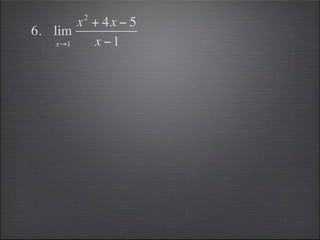
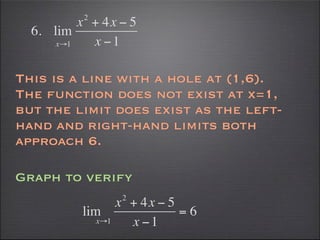
2
        x + 4x − 5
6. lim
    x→1   x −1
2
          x + 4x − 5
  6. lim
      x→1   x −1

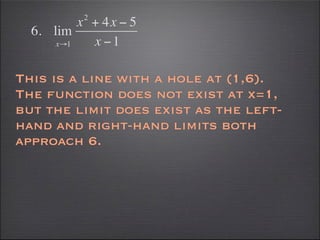
This is a line with a hole at (1,6).
The function does not exist at x=1,
but the limit does exist as the left-
hand and right-hand limits both
approach 6.
2
          x + 4x − 5
  6. lim
      x→1   x −1

This is a line with a hole at (1,6).
The function does not exist at x=1,
but the limit does exist as the left-
hand and right-hand limits both
approach 6.

Graph to verify
                      2
                     x + 4x − 5
          lim                   =6
               x→1     x −1
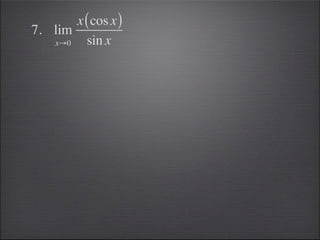
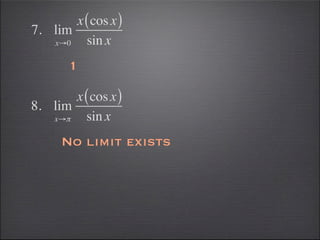
x ( cos x )
7. lim
   x→0   sin x
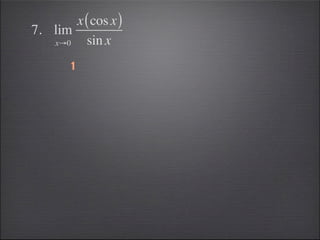
x ( cos x )
7. lim
   x→0   sin x
       1
x ( cos x )
7. lim
   x→0   sin x
       1

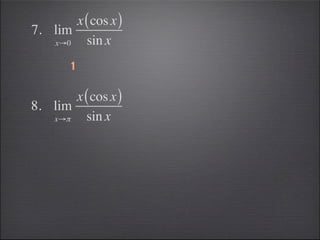
       x ( cos x )
8. lim
   x→π   sin x
x ( cos x )
7. lim
   x→0   sin x
       1

       x ( cos x )
8. lim
   x→π   sin x
     No limit exists
HW #7
We are what we repeatedly do.
Excellence, therefore, is not an act but a habit.
                          Aristotle

1201 ch 12 day 1

  • 1.
    Chapter 12 Limits &An Introduction To Calculus 12.1 Limit of a Function Proverbs 24:29. "Do not say, 'I will do to him just as he has done to me; I will render to the man according to his work.'"
  • 2.
    7 10 1316 19 Consider : , , , , , ... 1 2 3 4 5
  • 3.
    7 10 1316 19 Consider : , , , , , ... 1 2 3 4 5 3n + 4 an = n
  • 4.
    7 10 1316 19 Consider : , , , , , ... 1 2 3 4 5 3n + 4 an = n 3n + 4 What is lim ? n→∞ n
  • 5.
    7 10 1316 19 Consider : , , , , , ... 1 2 3 4 5 3n + 4 an = n 3n + 4 What is lim ? n→∞ n 3n 4 + n n n n
  • 6.
    7 10 1316 19 Consider : , , , , , ... 1 2 3 4 5 3n + 4 an = n 3n + 4 What is lim ? n→∞ n 3n 4 4 + 3+ n n n n 1 n
  • 7.
    7 10 1316 19 Consider : , , , , , ... 1 2 3 4 5 3n + 4 an = n 3n + 4 What is lim ? n→∞ n 3n 4 4 + 3+ n n n 3 n 1 n Verify by Graphing
  • 8.
    Look at thesegraphically 3n + 4 What is lim ? n→−∞ n
  • 9.
    Look at thesegraphically 3n + 4 What is lim ? n→−∞ n It still is approaching 3
  • 10.
    Look at thesegraphically 3n + 4 What is lim ? n→−∞ n It still is approaching 3 3n + 4 What is lim+ ? n→0 n
  • 11.
    Look at thesegraphically 3n + 4 What is lim ? n→−∞ n It still is approaching 3 3n + 4 What is lim+ ? n→0 n x approaches 0 from the positive side
  • 12.
    Look at thesegraphically 3n + 4 What is lim ? n→−∞ n It still is approaching 3 3n + 4 What is lim+ ? n→0 n x approaches 0 from the positive side It is ∞
  • 13.
    3n + 4 Whatis lim− ? n→0 n
  • 14.
    3n + 4 Whatis lim− ? n→0 n −∞
  • 15.
    2 Consider : y1 = ( x − 2 ) + 3
  • 16.
    2 Consider : y1 = ( x − 2 ) + 3 what happens to: 2 lim+ ( x − 2 ) + 3 x→4 and 2 lim− ( x − 2 ) + 3 x→4
  • 17.
    2 Consider: y1 = ( x − 2 ) + 3 what happens to: 2 lim+ ( x − 2 ) + 3 x→4 and 2 lim− ( x − 2 ) + 3 x→4 in both cases, the limit approaches 7
  • 18.
    If lim f( x ) = lim f ( x ) = L + − x→c x→c then lim f ( x ) = L x→c
  • 19.
    If lim f( x ) = lim f ( x ) = L + − x→c x→c then lim f ( x ) = L x→c The left-hand limit and the right-hand limit must agree!
  • 20.
    If lim f( x ) = lim f ( x ) = L + − x→c x→c then lim f ( x ) = L x→c The left-hand limit and the right-hand limit must agree! also ... lim f ( x ) = f ( c ) x→c as long as the limit exists!
  • 21.
    If lim f( x ) = lim f ( x ) = L + − x→c x→c then lim f ( x ) = L x→c The left-hand limit and the right-hand limit must agree! also ... lim f ( x ) = f ( c ) x→c as long as the limit exists! Substitution!
  • 22.
    Find Each Limit 1.lim ( −2x 3 ) x→2
  • 23.
    Find Each Limit 1.lim ( −2x 3 ) x→2 always try substitution first!
  • 24.
    Find Each Limit 1.lim ( −2x 3 ) x→2 always try substitution first! -16
  • 25.
    Find Each Limit 1.lim ( −2x 3 ) x→2 always try substitution first! -16 2. lim ( −2x 3 ) x→∞
  • 26.
    Find Each Limit 1.lim ( −2x 3 ) x→2 always try substitution first! -16 2. lim ( −2x 3 ) x→∞ −∞
  • 27.
    2 3. lim (2x − 3) − 4 x→3
  • 28.
    2 3. lim (2x − 3) − 4 x→3 5
  • 29.
    2 3. lim (2x − 3) − 4 x→3 5 ⎛ 1 ⎞ 4. lim ⎜ ⎟ x→∞ ⎝ x ⎠
  • 30.
    2 3. lim (2x − 3) − 4 x→3 5 ⎛ 1 ⎞ 4. lim ⎜ ⎟ x→∞ ⎝ x ⎠ 0
  • 31.
    5. lim [x ] x→2
  • 32.
    5. lim [x ] Greatest Integer x→2 Function
  • 33.
    5. lim [x ] Greatest Integer x→2 Function
  • 34.
    5. lim [x ] Greatest Integer x→2 Function lim x→2 + [ x] = 2
  • 35.
    5. lim [x ] Greatest Integer x→2 Function lim x→2 + [ x] = 2 lim x→2 − [ x] = 1
  • 36.
    5. lim [x ] Greatest Integer x→2 Function lim x→2 + [ x] = 2 lim x→2 − [ x] = 1 Because the left-hand and right-hand limits do not agree, this limit does not exist.
  • 37.
    2 x + 4x − 5 6. lim x→1 x −1
  • 38.
    2 x + 4x − 5 6. lim x→1 x −1 This is a line with a hole at (1,6). The function does not exist at x=1, but the limit does exist as the left- hand and right-hand limits both approach 6.
  • 39.
    2 x + 4x − 5 6. lim x→1 x −1 This is a line with a hole at (1,6). The function does not exist at x=1, but the limit does exist as the left- hand and right-hand limits both approach 6. Graph to verify 2 x + 4x − 5 lim =6 x→1 x −1
  • 40.
    x ( cosx ) 7. lim x→0 sin x
  • 41.
    x ( cosx ) 7. lim x→0 sin x 1
  • 42.
    x ( cosx ) 7. lim x→0 sin x 1 x ( cos x ) 8. lim x→π sin x
  • 43.
    x ( cosx ) 7. lim x→0 sin x 1 x ( cos x ) 8. lim x→π sin x No limit exists
  • 44.
    HW #7 We arewhat we repeatedly do. Excellence, therefore, is not an act but a habit. Aristotle