



Vidhyadeep Institute
Of
Management & Technology
Anita (Kim)
Enrollment no :
 1-130940107011
 2-130940107012
 3-130940107013
 4-130940107014
 5-130940107017
 6-130940107018
 7-130940107019
 8-130940107020
Guided By : Bharuchi Suhel
Mohadikar Vaishali

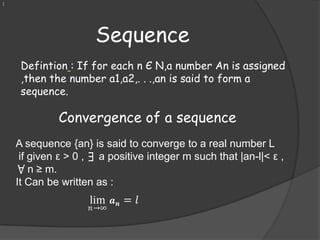
Sequence
Defintion : If for each n Є N,a number An is assigned
,then the number a1,a2,. . .,an is said to form a
sequence.

Convergence of a sequence
A sequence {an} is said to converge to a real number L
if given ε > 0 , ∃ a positive integer m such that |an-l|< ε ,
∀ n ≥ m.
It Can be written as :

lim 𝒂 𝒏 = 𝑙
𝑛→∞
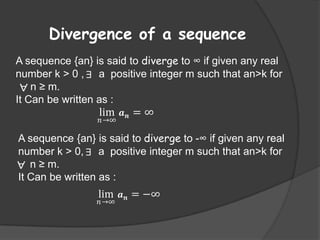
Divergence of a sequence
A sequence {an} is said to diverge to ∞ if given any real
number k > 0 , ∃ a positive integer m such that an>k for
∀ n ≥ m.
It Can be written as :

lim 𝒂 𝒏 = ∞
𝑛→∞

A sequence {an} is said to diverge to -∞ if given any real
number k > 0, ∃ a positive integer m such that an>k for
∀ n ≥ m.
It Can be written as :

lim 𝒂 𝒏 = −∞
𝑛→∞
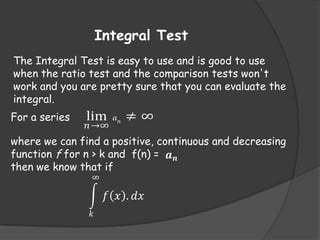
Integral Test
The Integral Test is easy to use and is good to use
when the ratio test and the comparison tests won't
work and you are pretty sure that you can evaluate the
integral.
For a series

lim

𝑛 →∞

𝑎𝑛

≠∞

where we can find a positive, continuous and decreasing
function f for n > k and f(n) = 𝒂 𝒏
then we know that if
∞

𝑓 𝑥 . 𝑑𝑥
𝑘
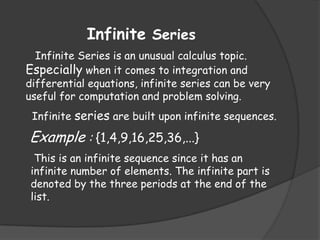
Infinite Series
Infinite Series is an unusual calculus topic.
Especially when it comes to integration and
differential equations, infinite series can be very
useful for computation and problem solving.
Infinite series are built upon infinite sequences.

Example : {1,4,9,16,25,36,...}
This is an infinite sequence since it has an
infinite number of elements. The infinite part is
denoted by the three periods at the end of the
list.
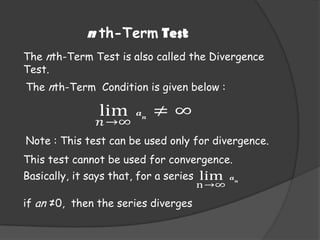
n th-Term Test
The nth-Term Test is also called the Divergence
Test.
The nth-Term Condition is given below :

lim

𝑛 →∞

𝒂

𝒏

≠∞

Note : This test can be used only for divergence.
This test cannot be used for convergence.
Basically, it says that, for a series
if an ≠0, then the series diverges

lim

n→∞

𝒂

𝒏
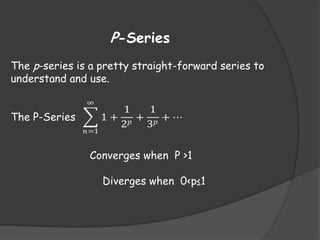
P-Series
The p-series is a pretty straight-forward series to
understand and use.
∞

The P-Series
𝑛=1

1
1
1+ 𝑝 + 𝑝 +⋯
2
3

Converges when P >1
Diverges when 0<p≤1
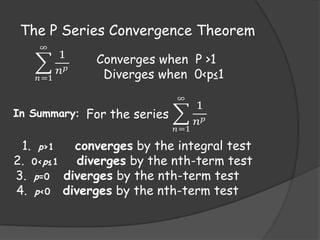
The P Series Convergence Theorem
∞

𝑛 =1

1
𝑛𝑝

Converges when P >1
Diverges when 0<p≤1
∞

In Summary: For the series
𝑛 =1

1
𝑛𝑝

1. p>1
converges by the integral test
2. 0<p≤1 diverges by the nth-term test
3. p=0 diverges by the nth-term test
4. p<0 diverges by the nth-term test
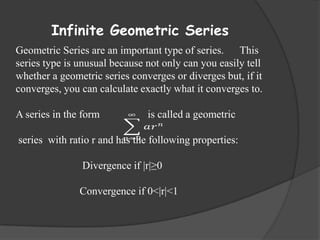
Infinite Geometric Series
Geometric Series are an important type of series. This
series type is unusual because not only can you easily tell
whether a geometric series converges or diverges but, if it
converges, you can calculate exactly what it converges to.
A series in the form

∞

is called a geometric
𝑎𝑟

𝑛

𝑛
series with ratio r and has=0 following properties:
the

Divergence if |r|≥0
Convergence if 0<|r|<1
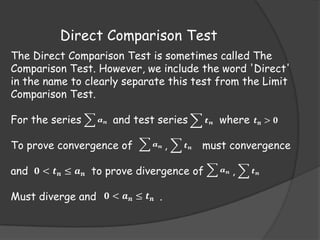
Direct Comparison Test
The Direct Comparison Test is sometimes called The
Comparison Test. However, we include the word 'Direct'
in the name to clearly separate this test from the Limit
Comparison Test.
For the series

𝒂𝒏

and test series

To prove convergence of

𝒂𝒏

,

𝒕𝒏

𝒕

where 𝒕 𝒏 > 𝟎

must convergence

and 𝟎 < 𝒕 𝒏 ≤ 𝒂 𝒏 to prove divergence of
Must diverge and 𝟎 < 𝒂 𝒏 ≤ 𝒕 𝒏 .

𝒏

𝒂𝒏

,

𝒕𝒏
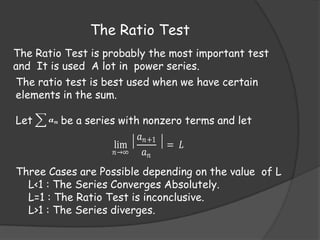
The Ratio Test
The Ratio Test is probably the most important test
and It is used A lot in power series.
The ratio test is best used when we have certain
elements in the sum.

Let

𝒂𝒏

be a series with nonzero terms and let
𝑎 𝑛+1
lim ⃒
⃒= 𝐿
𝑛→∞
𝑎𝑛

Three Cases are Possible depending on the value of L
L<1 : The Series Converges Absolutely.
L=1 : The Ratio Test is inconclusive.
L>1 : The Series diverges.
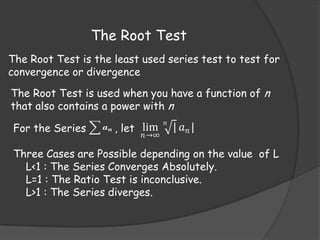
The Root Test
The Root Test is the least used series test to test for
convergence or divergence

The Root Test is used when you have a function of n
that also contains a power with n
For the Series

𝒂𝒏

, let lim

𝑛→∞

𝑛

| 𝑎 𝑛|

Three Cases are Possible depending on the value of L
L<1 : The Series Converges Absolutely.
L=1 : The Ratio Test is inconclusive.
L>1 : The Series diverges.
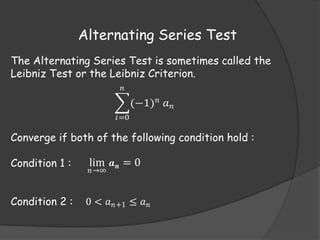
Alternating Series Test
The Alternating Series Test is sometimes called the
Leibniz Test or the Leibniz Criterion.
𝑛

(−1) 𝑛 𝑎 𝑛
𝑖=0

Converge if both of the following condition hold :
Condition 1 :

lim 𝒂 𝒏 = 0

Condition 2 :

0 < 𝑎 𝑛+1 ≤ 𝑎 𝑛

𝑛→∞
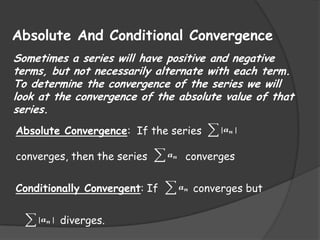
Absolute And Conditional Convergence
Sometimes a series will have positive and negative
terms, but not necessarily alternate with each term.
To determine the convergence of the series we will
look at the convergence of the absolute value of that
series.
Absolute Convergence: If the series
converges, then the series

Conditionally Convergent: If
|𝒂 𝒏 |

diverges.

𝒂𝒏

|𝒂 𝒏 |

converges
𝒂𝒏

converges but
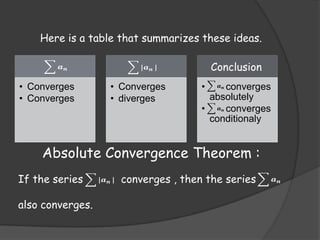
Here is a table that summarizes these ideas.
𝒂𝒏

• Converges
• Converges

Conclusion

|𝒂 𝒏 |

• Converges
• diverges

•

𝒂𝒏

converges
absolutely
• 𝒂 𝒏 converges
conditionaly

Absolute Convergence Theorem :
If the series

also converges.

|𝒂 𝒏 |

converges , then the series

𝒂𝒏
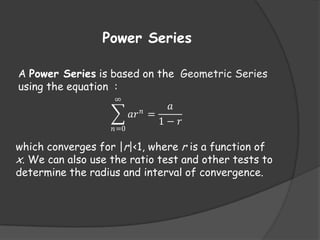
Power Series
A Power Series is based on the Geometric Series
using the equation :
∞

𝑎
𝑎𝑟 =
1− 𝑟
𝑛

𝑛=0

which converges for |r|<1, where r is a function of
x. We can also use the ratio test and other tests to
determine the radius and interval of convergence.
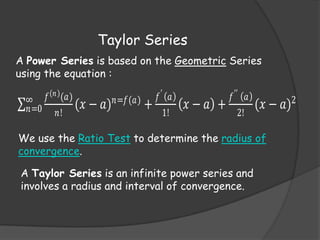
Taylor Series
A Power Series is based on the Geometric Series
using the equation :
𝑛
∞ 𝑓 (𝑎)
𝑛=0 𝑛! (𝑥 −

𝑎) 𝑛=𝑓(𝑎) +

𝑓′ 𝑎
1!

𝑥− 𝑎 +

𝑓 ′′ 𝑎
2!

(𝑥 − 𝑎)2

We use the Ratio Test to determine the radius of
convergence.
A Taylor Series is an infinite power series and
involves a radius and interval of convergence.
Thank You

Infinite Series Presentation by Jatin Dhola

  • 1.
  • 2.
    Enrollment no : 1-130940107011  2-130940107012  3-130940107013  4-130940107014  5-130940107017  6-130940107018  7-130940107019  8-130940107020 Guided By : Bharuchi Suhel Mohadikar Vaishali 
  • 4.
    Sequence Defintion : Iffor each n Є N,a number An is assigned ,then the number a1,a2,. . .,an is said to form a sequence. Convergence of a sequence A sequence {an} is said to converge to a real number L if given ε > 0 , ∃ a positive integer m such that |an-l|< ε , ∀ n ≥ m. It Can be written as : lim 𝒂 𝒏 = 𝑙 𝑛→∞
  • 5.
    Divergence of asequence A sequence {an} is said to diverge to ∞ if given any real number k > 0 , ∃ a positive integer m such that an>k for ∀ n ≥ m. It Can be written as : lim 𝒂 𝒏 = ∞ 𝑛→∞ A sequence {an} is said to diverge to -∞ if given any real number k > 0, ∃ a positive integer m such that an>k for ∀ n ≥ m. It Can be written as : lim 𝒂 𝒏 = −∞ 𝑛→∞
  • 6.
    Integral Test The IntegralTest is easy to use and is good to use when the ratio test and the comparison tests won't work and you are pretty sure that you can evaluate the integral. For a series lim 𝑛 →∞ 𝑎𝑛 ≠∞ where we can find a positive, continuous and decreasing function f for n > k and f(n) = 𝒂 𝒏 then we know that if ∞ 𝑓 𝑥 . 𝑑𝑥 𝑘
  • 7.
    Infinite Series Infinite Seriesis an unusual calculus topic. Especially when it comes to integration and differential equations, infinite series can be very useful for computation and problem solving. Infinite series are built upon infinite sequences. Example : {1,4,9,16,25,36,...} This is an infinite sequence since it has an infinite number of elements. The infinite part is denoted by the three periods at the end of the list.
  • 8.
    n th-Term Test Thenth-Term Test is also called the Divergence Test. The nth-Term Condition is given below : lim 𝑛 →∞ 𝒂 𝒏 ≠∞ Note : This test can be used only for divergence. This test cannot be used for convergence. Basically, it says that, for a series if an ≠0, then the series diverges lim n→∞ 𝒂 𝒏
  • 9.
    P-Series The p-series isa pretty straight-forward series to understand and use. ∞ The P-Series 𝑛=1 1 1 1+ 𝑝 + 𝑝 +⋯ 2 3 Converges when P >1 Diverges when 0<p≤1
  • 10.
    The P SeriesConvergence Theorem ∞ 𝑛 =1 1 𝑛𝑝 Converges when P >1 Diverges when 0<p≤1 ∞ In Summary: For the series 𝑛 =1 1 𝑛𝑝 1. p>1 converges by the integral test 2. 0<p≤1 diverges by the nth-term test 3. p=0 diverges by the nth-term test 4. p<0 diverges by the nth-term test
  • 11.
    Infinite Geometric Series GeometricSeries are an important type of series. This series type is unusual because not only can you easily tell whether a geometric series converges or diverges but, if it converges, you can calculate exactly what it converges to. A series in the form ∞ is called a geometric 𝑎𝑟 𝑛 𝑛 series with ratio r and has=0 following properties: the Divergence if |r|≥0 Convergence if 0<|r|<1
  • 12.
    Direct Comparison Test TheDirect Comparison Test is sometimes called The Comparison Test. However, we include the word 'Direct' in the name to clearly separate this test from the Limit Comparison Test. For the series 𝒂𝒏 and test series To prove convergence of 𝒂𝒏 , 𝒕𝒏 𝒕 where 𝒕 𝒏 > 𝟎 must convergence and 𝟎 < 𝒕 𝒏 ≤ 𝒂 𝒏 to prove divergence of Must diverge and 𝟎 < 𝒂 𝒏 ≤ 𝒕 𝒏 . 𝒏 𝒂𝒏 , 𝒕𝒏
  • 13.
    The Ratio Test TheRatio Test is probably the most important test and It is used A lot in power series. The ratio test is best used when we have certain elements in the sum. Let 𝒂𝒏 be a series with nonzero terms and let 𝑎 𝑛+1 lim ⃒ ⃒= 𝐿 𝑛→∞ 𝑎𝑛 Three Cases are Possible depending on the value of L L<1 : The Series Converges Absolutely. L=1 : The Ratio Test is inconclusive. L>1 : The Series diverges.
  • 14.
    The Root Test TheRoot Test is the least used series test to test for convergence or divergence The Root Test is used when you have a function of n that also contains a power with n For the Series 𝒂𝒏 , let lim 𝑛→∞ 𝑛 | 𝑎 𝑛| Three Cases are Possible depending on the value of L L<1 : The Series Converges Absolutely. L=1 : The Ratio Test is inconclusive. L>1 : The Series diverges.
  • 15.
    Alternating Series Test TheAlternating Series Test is sometimes called the Leibniz Test or the Leibniz Criterion. 𝑛 (−1) 𝑛 𝑎 𝑛 𝑖=0 Converge if both of the following condition hold : Condition 1 : lim 𝒂 𝒏 = 0 Condition 2 : 0 < 𝑎 𝑛+1 ≤ 𝑎 𝑛 𝑛→∞
  • 16.
    Absolute And ConditionalConvergence Sometimes a series will have positive and negative terms, but not necessarily alternate with each term. To determine the convergence of the series we will look at the convergence of the absolute value of that series. Absolute Convergence: If the series converges, then the series Conditionally Convergent: If |𝒂 𝒏 | diverges. 𝒂𝒏 |𝒂 𝒏 | converges 𝒂𝒏 converges but
  • 17.
    Here is atable that summarizes these ideas. 𝒂𝒏 • Converges • Converges Conclusion |𝒂 𝒏 | • Converges • diverges • 𝒂𝒏 converges absolutely • 𝒂 𝒏 converges conditionaly Absolute Convergence Theorem : If the series also converges. |𝒂 𝒏 | converges , then the series 𝒂𝒏
  • 18.
    Power Series A PowerSeries is based on the Geometric Series using the equation : ∞ 𝑎 𝑎𝑟 = 1− 𝑟 𝑛 𝑛=0 which converges for |r|<1, where r is a function of x. We can also use the ratio test and other tests to determine the radius and interval of convergence.
  • 19.
    Taylor Series A PowerSeries is based on the Geometric Series using the equation : 𝑛 ∞ 𝑓 (𝑎) 𝑛=0 𝑛! (𝑥 − 𝑎) 𝑛=𝑓(𝑎) + 𝑓′ 𝑎 1! 𝑥− 𝑎 + 𝑓 ′′ 𝑎 2! (𝑥 − 𝑎)2 We use the Ratio Test to determine the radius of convergence. A Taylor Series is an infinite power series and involves a radius and interval of convergence.
  • 20.