GRADE 8 - 12
ALL MAJOR SUBJECTS IN
ENGLISH & AFRIKAANS
WWW.THEANSWER.CO.ZA
Stand a chance to
WIN
an Apple iPad!
www.theanswer.co.za/win
Terms & Conditions apply
11
CAPS
Mathematics
3-in-1
Anne
Eadie,
et
al.
11
GRADE
CAPS
Mathematics
CLASS TEXT & STUDY GUIDE
Anne Eadie & Gretel Lampe
3-in-1
Grade 11 Mathematics 3-in-1 CAPS
CLASS TEXT & STUDY GUIDE
The Answer Series Grade 11 Maths 3-in-1 study guide walks you step-by-step through the CAPS curriculum. It helps you to
revise essential concepts from previous grades, which you will master before taking on new work with confidence.
Key features:
•	
Comprehensive, explanatory notes and worked examples for each topic
•	
Graded exercises to promote logic and develop technique
•	
Detailed solutions for all exercises
•	
An exam with fully explained solutions (paper 1 and paper 2) for thorough consolidation and final exam preparation.
This study guide is guaranteed to develop a solid grounding for every learner preparing for their Grade 11 and 12 Maths
examinations, a sure way to open doors for the future!
E-book
available
2013 publication | ISBN: 978-1-920558-27-7 041121 | TAS
THIS CLASS TEXT  STUDY GUIDE INCLUDES
Comprehensive Notes
1
2 Exercises
3 Full Solutions
(available in a separate booklet)
GRADE
11
CAPS
3-in-1
Mathematics
Anne Eadie  Gretel Lampe
10 additional, challenging
practice exam papers  answers
GRADE 11
MATHS P  A
Also available
Plus bonus Exam Papers and Memos
Copyright © The Answer Series: Photocopying of this material is illegal
The Sure Route to Success in Matric Maths
The Exam
The Curriculum (CAPS): Overview of Topics
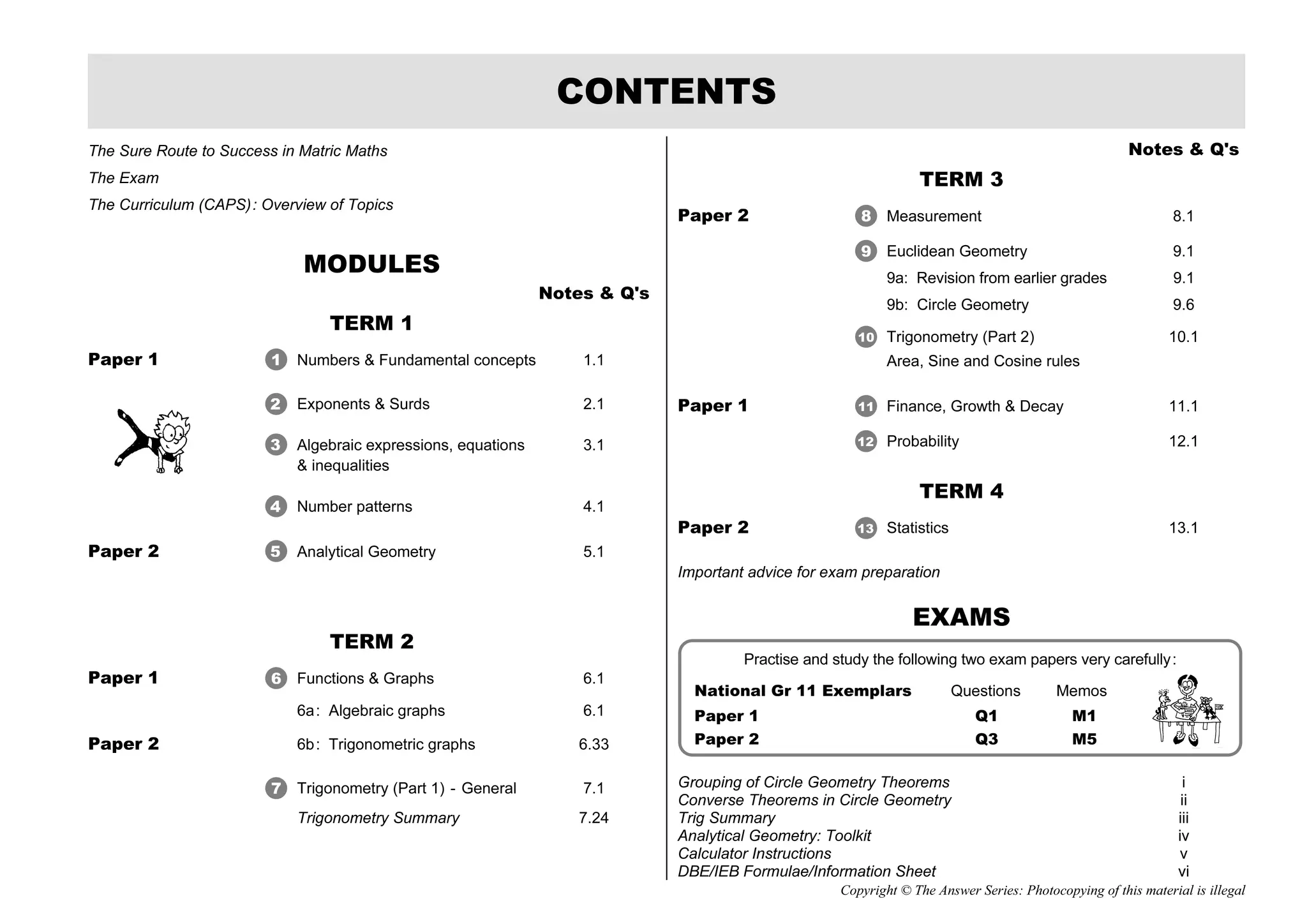
MODULES
Notes  Q's
TERM 1
Paper 1 Numbers  Fundamental concepts 1.1
Exponents  Surds 2.1
Algebraic expressions, equations 3.1
 inequalities
Number patterns 4.1
Paper 2 Analytical Geometry 5.1
TERM 2
Paper 1 Functions  Graphs 6.1
6a: Algebraic graphs 6.1
Paper 2 6b: Trigonometric graphs 6.33
Trigonometry (Part 1) - General 7.1
Trigonometry Summary 7.24
Notes  Q's
TERM 3
Paper 2 Measurement 8.1
Euclidean Geometry 9.1
9a: Revision from earlier grades 9.1
9b: Circle Geometry 9.6
Trigonometry (Part 2) 10.1
Area, Sine and Cosine rules
Paper 1 Finance, Growth  Decay 11.1
Probability 12.1
TERM 4
Paper 2 Statistics 13.1
Important advice for exam preparation
EXAMS
Grouping of Circle Geometry Theorems i
Converse Theorems in Circle Geometry ii
Trig Summary iii
Analytical Geometry: Toolkit iv
Calculator Instructions v
DBE/IEB Formulae/Information Sheet vi
CONTENTS
Practise and study the following two exam papers very carefully:
National Gr 11 Exemplars Questions Memos
Paper 1 Q1 M1
Paper 2 Q3 M5
1
2
3
4
5
6
7
9
8
10
11
12
13
Copyright © The Answer Series: Photocopying of this material is illegal 1.6
NUMBERS

FUNDAMENTAL
CONCEPTS
1
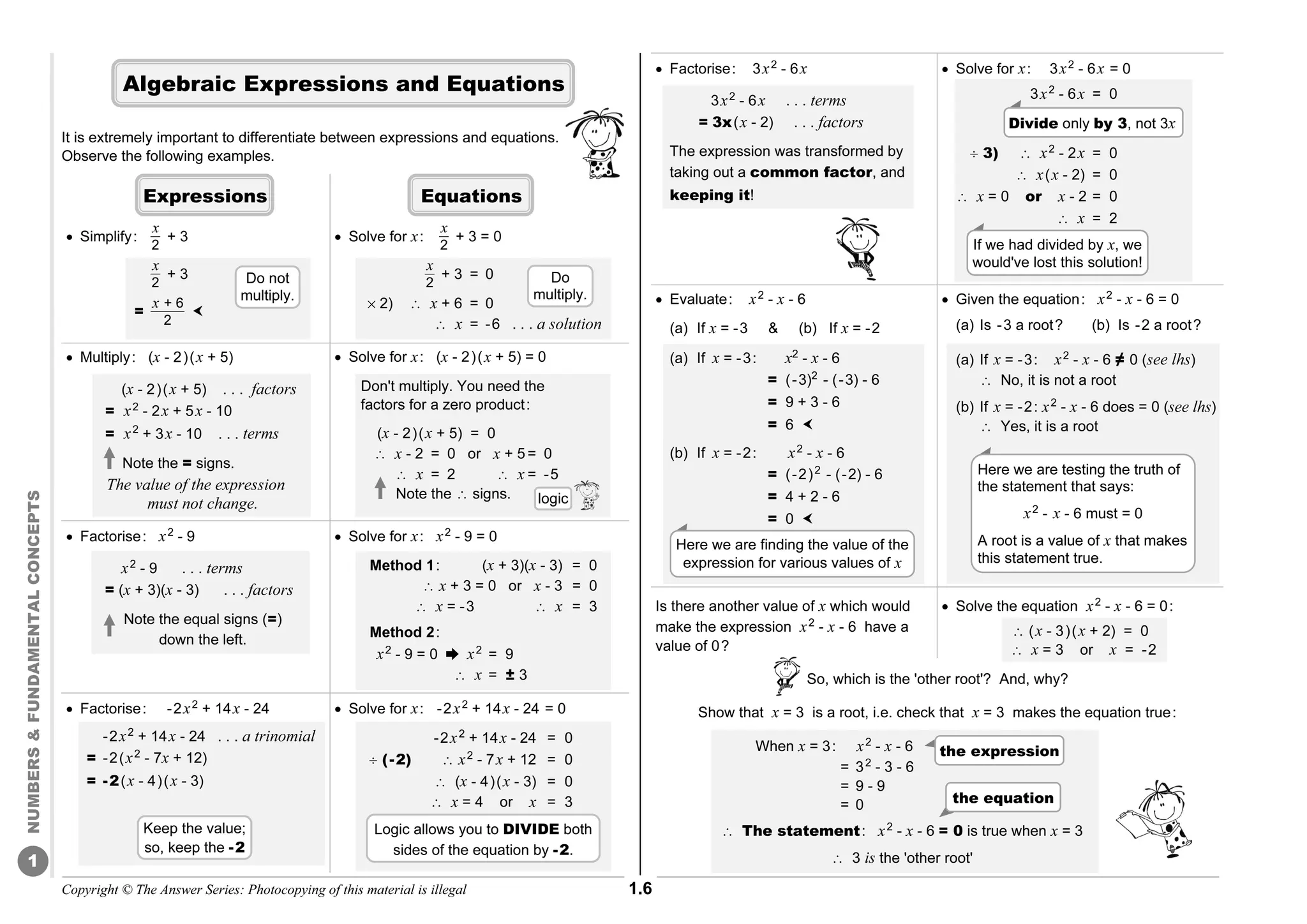
It is extremely important to differentiate between expressions and equations.
Observe the following examples.
 Simplify:
2
x
+ 3
2
x
+ 3
=
+ 6
2
x

 Solve for x:
2
x
+ 3 = 0
2
x
+ 3 = 0
% 2) â x + 6 = 0
â x = -6 . . . a solution
 Multiply: (x - 2)(x + 5)
(x - 2)(x + 5) . . . factors
= x2
- 2x + 5x - 10
= x2
+ 3x - 10 . . . terms
Note the = signs.
The value of the expression
must not change.
 Solve for x: (x - 2)(x + 5) = 0
Don't multiply. You need the
factors for a zero product:
(x - 2)(x + 5) = 0
â x - 2 = 0 or x + 5 = 0
â x = 2 â x = -5
Note the â signs.
 Factorise: x2
- 9
x2
- 9 . . . terms
= (x + 3)(x - 3) . . . factors
Note the equal signs (=)
down the left.
 Solve for x: x2
- 9 = 0
Method 1: (x + 3)(x - 3) = 0
â x + 3 = 0 or x - 3 = 0
â x = -3 â x = 3
Method 2:
x2
- 9 = 0 ² x2
= 9
â x = ± 3
 Factorise: -2x2
+ 14x - 24
-2x2
+ 14x - 24 . . . a trinomial
= -2(x2
- 7x + 12)
= -2(x - 4)(x - 3)
 Solve for x: -2x2
+ 14x - 24 = 0
-2x2
+ 14x - 24 = 0
+ (-2) â x2
- 7x + 12 = 0
â (x - 4)(x - 3) = 0
â x = 4 or x = 3
 Factorise: 3x2
- 6x
3x2
- 6x . . . terms
= 3x(x - 2) . . . factors
The expression was transformed by
taking out a common factor, and
keeping it!
 Solve for x: 3x2
- 6x = 0
3x2
- 6x = 0
+ 3) â x2
- 2x = 0
â x(x - 2) = 0
â x = 0 or x - 2 = 0
â x = 2
 Evaluate: x2
- x - 6
(a) If x = -3  (b) If x = -2
(a) If x = -3: x2
- x - 6
= (-3)2
- (-3) - 6
= 9 + 3 - 6
= 6 
(b) If x = -2: x2
- x - 6
= (-2)2
- (-2) - 6
= 4 + 2 - 6
= 0 
 Given the equation: x2
- x - 6 = 0
(a) Is -3 a root? (b) Is -2 a root?
(a) If x = -3: x2
- x - 6 ≠ 0 (see lhs)
â No, it is not a root
(b) If x = -2: x2
- x - 6 does = 0 (see lhs)
â Yes, it is a root
Is there another value of x which would
make the expression x2
- x - 6 have a
value of 0?
 Solve the equation x2
- x - 6 = 0:
â (x - 3)(x + 2) = 0
â x = 3 or x = -2
Show that x = 3 is a root, i.e. check that x = 3 makes the equation true:
When x = 3: x2
- x - 6
= 32
- 3 - 6
= 9 - 9
= 0
â The statement: x2
- x - 6 = 0 is true when x = 3
â 3 is the 'other root'
Do not
multiply.
Do
multiply.
logic
Keep the value;
so, keep the -2
Logic allows you to DIVIDE both
sides of the equation by -2.
Here we are finding the value of the
expression for various values of x
Here we are testing the truth of
the statement that says:
x2
- x - 6 must = 0
A root is a value of x that makes
this statement true.
Divide only by 3, not 3x
the expression
So, which is the 'other root'? And, why?
the equation
Algebraic Expressions and Equations
Expressions Equations
If we had divided by x, we
would've lost this solution!
3.8 Copyright © The Answer Series: Photocopying of this material is illegal
3
ALGEBRAIC
EXPRESSIONS,
EQUATIONS

INEQUALITIES
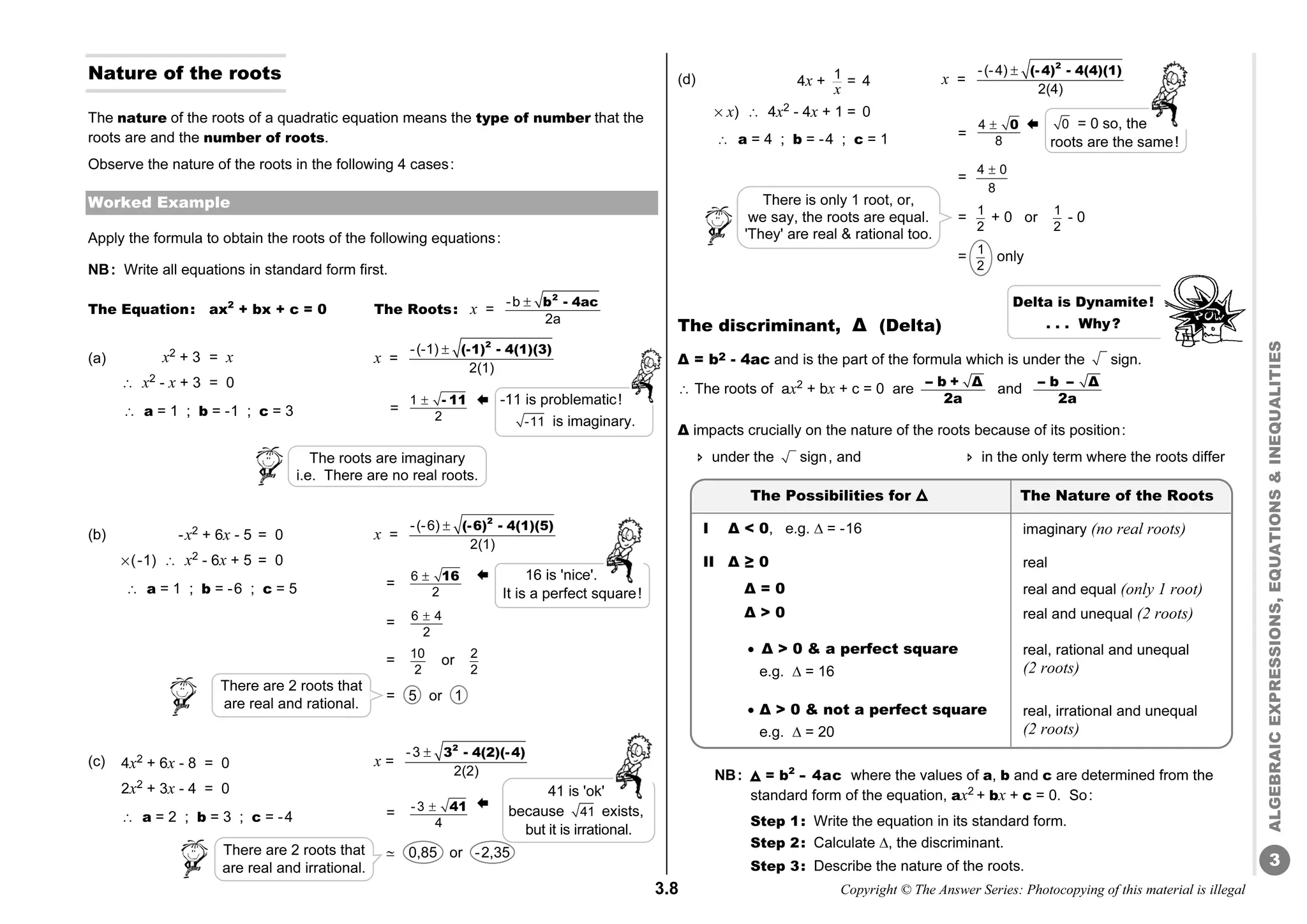
Nature of the roots
The nature of the roots of a quadratic equation means the type of number that the
roots are and the number of roots.
Observe the nature of the roots in the following 4 cases:
Worked Example
Apply the formula to obtain the roots of the following equations:
NB: Write all equations in standard form first.
The Equation: ax2
+ bx + c = 0 The Roots: x =
-b
2a
 2
b 4ac
-
(a) x2
+ 3 = x x =
-(-1)
2(1)
 2
(-1) 4(1)(3)
-
â x2
- x + 3 = 0 =
(b) x =
-(-6)
2(1)
 2
(-6) 4(1)(5)
-
=
= 6 4
2

= 10
2
or 2
2
= 5 or 1
(c) x =
-3
2(2)
 2
3 4(2)(-4)
-
=
j 0,85 or -2,35
(d) x =
-(-4)
2(4)
 2
(-4) 4(4)(1)
-
=
=
4 0
8

= 1
2
+ 0 or 1
2
- 0
= 1
2
only
The discriminant, Δ (Delta)
Δ = b2 - 4ac and is the part of the formula which is under the sign.
â The roots of ax2
+ bx + c = 0 are -- b + Δ
2a
and -- b -- Δ
2a
Δ impacts crucially on the nature of the roots because of its position:
 under the sign, and  in the only term where the roots differ
NB: = b2
-
- 4ac where the values of a, b and c are determined from the
standard form of the equation, ax2
+ bx + c = 0. So:
Step 1: Write the equation in its standard form.
Step 2: Calculate , the discriminant.
Step 3: Describe the nature of the roots.
4x + 1
x
= 4
% x) â 4x2
- 4x + 1 = 0
 a = 4 ; b = -4 ; c = 1
0 = 0 so, the
roots are the same!
4
8
 0 
x2
+ 3 = x
â x2
- x + 3 = 0
â a = 1 ; b = -1 ; c = 3
-x2
+ 6x - 5 = 0
%(-1) â x2
- 6x + 5 = 0
â a = 1 ; b = -6 ; c = 5
4x2
+ 6x - 8 = 0
2x2
+ 3x - 4 = 0
â a = 2 ; b = 3 ; c = -4
-11 is problematic!
-11 is imaginary.
1
2
 - 11 


6
2
16

-3
4
 41
There are 2 roots that
are real and irrational.
41 is 'ok'
because 41 exists,
but it is irrational.
16 is 'nice'.
It is a perfect square!
There are 2 roots that
are real and rational.
The roots are imaginary
i.e. There are no real roots.
Delta is Dynamite!
. . . Why?
There is only 1 root, or,
we say, the roots are equal.
'They' are real  rational too.
imaginary (no real roots)
real
real and equal (only 1 root)
real and unequal (2 roots)
real, rational and unequal
(2 roots)
real, irrational and unequal
(2 roots)
The Possibilities for The Nature of the Roots
I Δ  0, e.g.  = -16
II Δ ≥ 0
Δ = 0
Δ  0
 Δ  0  a perfect square
e.g.  = 16
 Δ  0  not a perfect square
e.g.  = 20
3.10 Copyright © The Answer Series: Photocopying of this material is illegal
3
ALGEBRAIC
EXPRESSIONS,
EQUATIONS

INEQUALITIES
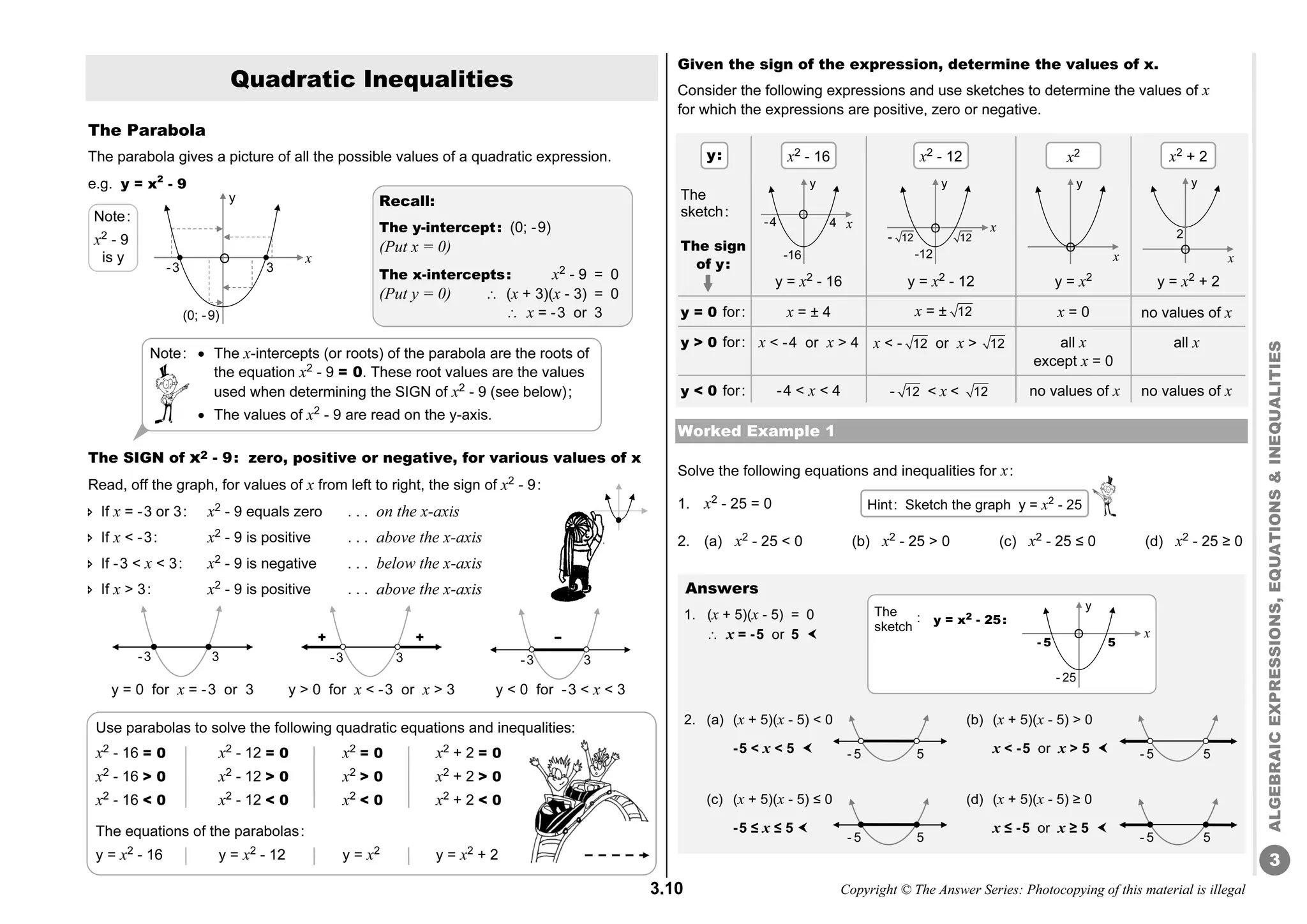
Quadratic Inequalities
The Parabola
The parabola gives a picture of all the possible values of a quadratic expression.
e.g. y = x2
- 9
The SIGN of x2 - 9: zero, positive or negative, for various values of x
Read, off the graph, for values of x from left to right, the sign of x2
- 9:
 If x = -3 or 3: x2
- 9 equals zero . . . on the x-axis
 If x  -3: x2
- 9 is positive . . . above the x-axis
 If -3  x  3: x2
- 9 is negative . . . below the x-axis
 If x  3: x2
- 9 is positive . . . above the x-axis
y = 0 for x = -3 or 3 y  0 for x  -3 or x  3 y  0 for -3  x  3
Given the sign of the expression, determine the values of x.
Consider the following expressions and use sketches to determine the values of x
for which the expressions are positive, zero or negative.

Worked Example 1
Solve the following equations and inequalities for x:
1. x2
- 25 = 0
2. (a) x2
- 25  0 (b) x2
- 25  0 (c) x2
- 25 ≤ 0 (d) x2
- 25 ≥ 0
Recall:
The y-intercept: (0; -9)
(Put x = 0)
The x-intercepts: x2
- 9 = 0
(Put y = 0) â (x + 3)(x - 3) = 0
â x = -3 or 3
Note:
x2
- 9
is y
3
-3 3
-3
+ +
3
-3
--
Hint: Sketch the graph y = x2
- 25
y = x2
- 16
x2 x2
+ 2
x2
- 12
x2
- 16
y = x2
+ 2
y = x2
y = x2
- 12
The
sketch:
y = 0 for: x = ± 4 x = ± 12 x = 0 no values of x
y  0 for: x  -4 or x  4 x  - 12 or x  12 all x
except x = 0
all x
y  0 for: -4  x  4 - 12  x  12 no values of x no values of x
The sign
of y:
y:
4
-4 x
y
-16
O
x
y
O
12
- 12
x
y
-12
O
O
x
y
2
Answers
1. (x + 5)(x - 5) = 0
â x = -5 or 5 
2. (a) (x + 5)(x - 5)  0 (b) (x + 5)(x - 5)  0
-5  x  5  x  -5 or x  5 
(c) (x + 5)(x - 5) ≤ 0 (d) (x + 5)(x - 5) ≥ 0
-5 ≤ x ≤ 5  x ≤ -5 or x ≥ 5 
5
- 5
5
- 5
5
- 5
5
- 5
y = x2
- 25:
The
sketch
:
5
- 5
- 25
O
y
x
x
3
y
-3
O
(0; -9)
Note:  The x-intercepts (or roots) of the parabola are the roots of
the equation x2
- 9 = 0. These root values are the values
used when determining the SIGN of x2
- 9 (see below);
 The values of x2
- 9 are read on the y-axis.
Use parabolas to solve the following quadratic equations and inequalities:
x2
- 16 = 0 x2
- 12 = 0 x2
= 0 x2
+ 2 = 0
x2
- 16  0 x2
- 12  0 x2
 0 x2
+ 2  0
x2
- 16  0 x2
- 12  0 x2
 0 x2
+ 2  0
The equations of the parabolas:
y = x2
- 16 y = x2
- 12 y = x2
y = x2
+ 2
Copyright © The Answer Series: Photocopying of this material is illegal 5.13
ANALYTICAL
GEOMETRY
5
Distance PQ . . .
1
Gradient PQ . . .
2 Midpoint of PQ . . .
3
Q(x2 ; y2)
P(x1 ; y1)
R
y2
y1
x1 x2
x2 - x1
y2 - y1

x
y
O
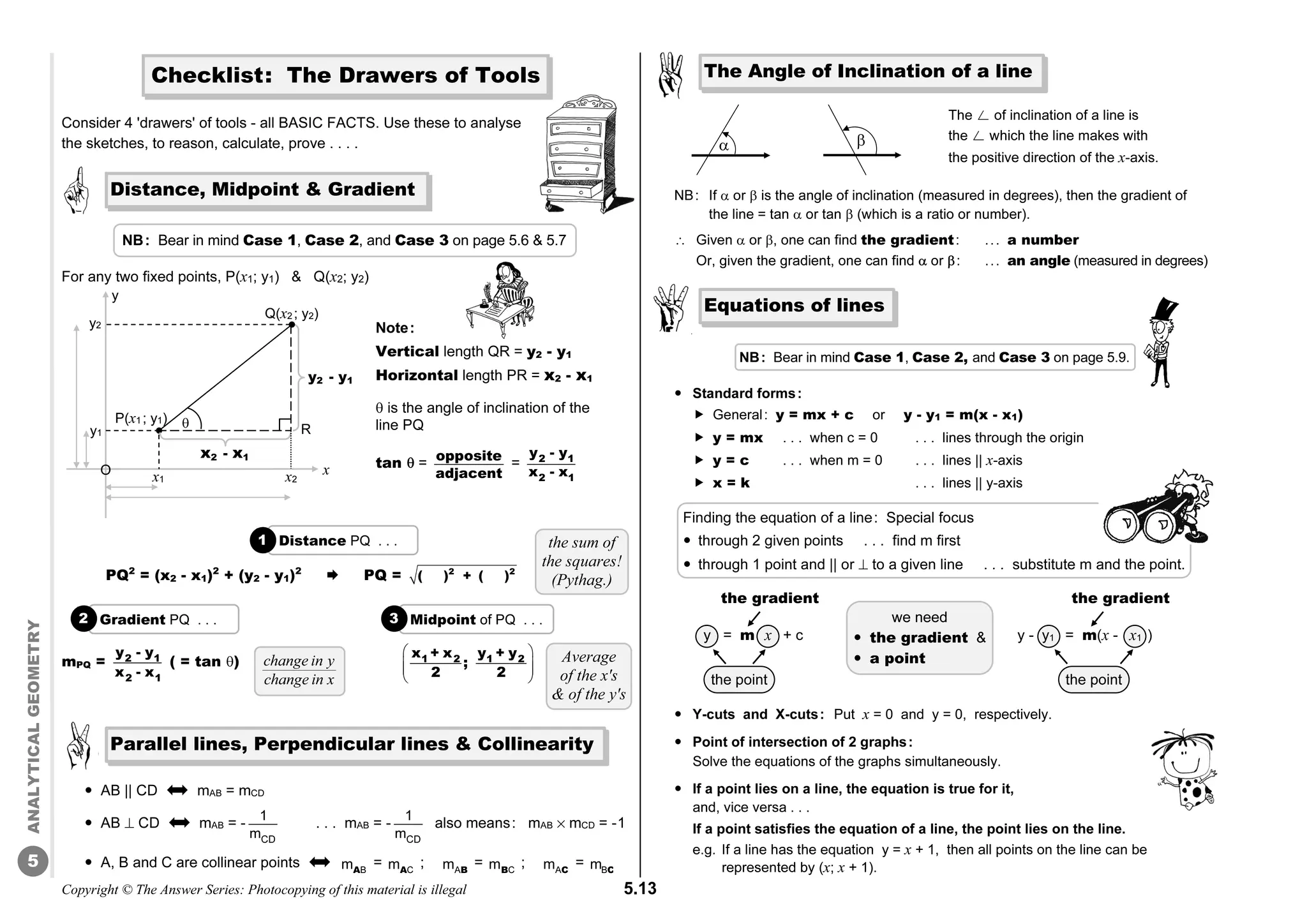
Consider 4 'drawers' of tools - all BASIC FACTS. Use these to analyse
the sketches, to reason, calculate, prove . . . .
For any two fixed points, P(x1; y1)  Q(x2; y2)
Note:
Vertical length QR = y2 - y1
Horizontal length PR = x2 - x1
 is the angle of inclination of the
line PQ
tan  =
opposite
adjacent
= 2 1
2 1
y - y
x - x
PQ2
= (x2 - x1)2
+ (y2 - y1)2
 PQ = 2 2
( ) + ( )
 
 
 
 
1 2 1 2
x + x y + y
;
2 2
 AB || CD 
 mAB = mCD
 AB  CD 
 mAB = -
CD
1
m
. . . mAB = -
CD
1
m
also means: mAB % mCD = -1
 A, B and C are collinear points 
 B
mA
= C
mA
; A
m B
= C
mB
; A
m C
= B
m C
The ø of inclination of a line is
the ø which the line makes with
the positive direction of the x-axis.
NB: If  or  is the angle of inclination (measured in degrees), then the gradient of
the line = tan  or tan  (which is a ratio or number).
 Given  or , one can find the gradient: ... a number
Or, given the gradient, one can find  or : ... an angle (measured in degrees)
 Standard forms:
 General: y = mx + c or y - y1 = m(x - x1)
 y = mx . . . when c = 0 . . . lines through the origin
 y = c . . . when m = 0 . . . lines || x-axis
 x = k . . . lines || y-axis
 Y-cuts and X-cuts: Put x = 0 and y = 0, respectively.
 Point of intersection of 2 graphs:
Solve the equations of the graphs simultaneously.
 If a point lies on a line, the equation is true for it,
and, vice versa . . .
If a point satisfies the equation of a line, the point lies on the line.
e.g. If a line has the equation y = x + 1, then all points on the line can be
represented by (x; x + 1).
NB: Bear in mind Case 1, Case 2, and Case 3 on page 5.6  5.7
mPQ = 2 1
2 1
y - y
x - x
( = tan )
 
the sum of
the squares!
(Pythag.)
Average
of the x's
 of the y's
change in y
change in x
Finding the equation of a line: Special focus
 through 2 given points . . . find m first
 through 1 point and || or  to a given line . . . substitute m and the point.
Checklist: The Drawers of Tools
Distance, Midpoint  Gradient
Parallel lines, Perpendicular lines  Collinearity
The Angle of Inclination of a line
Equations of lines
we need
 the gradient 
 a point
the gradient
the point
y = m x + c
the gradient
the point
y - y1 = m(x - x1 )
NB: Bear in mind Case 1, Case 2, and Case 3 on page 5.9.
5.14 Copyright © The Answer Series: Photocopying of this material is illegal
5
ANALYTICAL
GEOMETRY:
EX
5.3
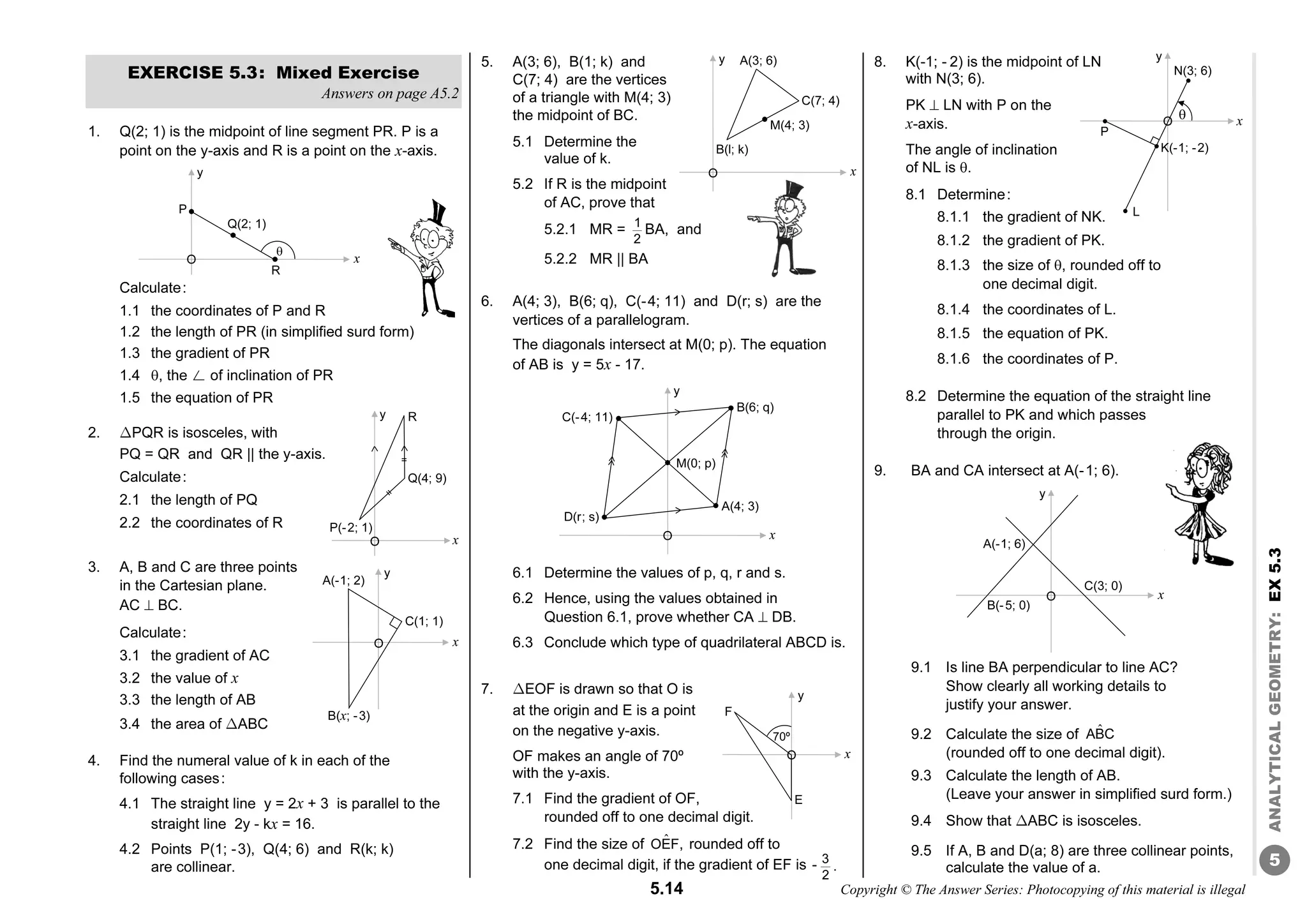
EXERCISE 5.3: Mixed Exercise
Answers on page A5.2
1. Q(2; 1) is the midpoint of line segment PR. P is a
point on the y-axis and R is a point on the x-axis.
Calculate:
1.1 the coordinates of P and R
1.2 the length of PR (in simplified surd form)
1.3 the gradient of PR
1.4 , the ø of inclination of PR
1.5 the equation of PR
2. ΔPQR is isosceles, with
PQ = QR and QR || the y-axis.
Calculate:
2.1 the length of PQ
2.2 the coordinates of R
3. A, B and C are three points
in the Cartesian plane.
AC  BC.
Calculate:
3.1 the gradient of AC
3.2 the value of x
3.3 the length of AB
3.4 the area of ΔABC
4. Find the numeral value of k in each of the
following cases:
4.1 The straight line y = 2x + 3 is parallel to the
straight line 2y - kx = 16.
4.2 Points P(1; -3), Q(4; 6) and R(k; k)
are collinear.
5. A(3; 6), B(1; k) and
C(7; 4) are the vertices
of a triangle with M(4; 3)
the midpoint of BC.
5.1 Determine the
value of k.
5.2 If R is the midpoint
of AC, prove that
5.2.1 MR = 1
2
BA, and
5.2.2 MR || BA
6. A(4; 3), B(6; q), C(-4; 11) and D(r; s) are the
vertices of a parallelogram.
The diagonals intersect at M(0; p). The equation
of AB is y = 5x - 17.
6.1 Determine the values of p, q, r and s.
6.2 Hence, using the values obtained in
Question 6.1, prove whether CA  DB.
6.3 Conclude which type of quadrilateral ABCD is.
7. ΔEOF is drawn so that O is
at the origin and E is a point
on the negative y-axis.
OF makes an angle of 70º
with the y-axis.
7.1 Find the gradient of OF,
rounded off to one decimal digit.
7.2 Find the size of ˆ
OEF, rounded off to
one decimal digit, if the gradient of EF is -
8. K(-1; - 2) is the midpoint of LN
with N(3; 6).
PK  LN with P on the
x-axis.
The angle of inclination
of NL is .
8.1 Determine:
8.1.1 the gradient of NK.
8.1.2 the gradient of PK.
8.1.3 the size of , rounded off to
one decimal digit.
8.1.4 the coordinates of L.
8.1.5 the equation of PK.
8.1.6 the coordinates of P.
8.2 Determine the equation of the straight line
parallel to PK and which passes
through the origin.
9. BA and CA intersect at A(-1; 6).
9.1 Is line BA perpendicular to line AC?
Show clearly all working details to
justify your answer.
9.2 Calculate the size of ˆ
ABC
(rounded off to one decimal digit).
9.3 Calculate the length of AB.
(Leave your answer in simplified surd form.)
9.4 Show that ΔABC is isosceles.
9.5 If A, B and D(a; 8) are three collinear points,
calculate the value of a.
B(6; q)
x
y
A(4; 3)
O
D(r; s)
C(-4; 11)
M(0; p)
P
x
y
Q(2; 1)
R

O
B(l; k)
x
y A(3; 6)
O
M(4; 3)
C(7; 4)
3
2
.
F
x
y
70º
O
E
x
y
C(3; 0)
A(-1; 6)
B(-5; 0)
O
P(-2; 1)
x
y
Q(4; 9)
R
O
C(1; 1)
x
y
A(-1; 2)
B(x; -3)
O
 x
y
N(3; 6)
K(-1; -2)
P
L
O
6.7 Copyright © The Answer Series: Photocopying of this material is illegal
6
FUNCTIONS

GRAPHS
Axis of symmetry: x = --
b
2a
Axis of symmetry: x =
A + B
2
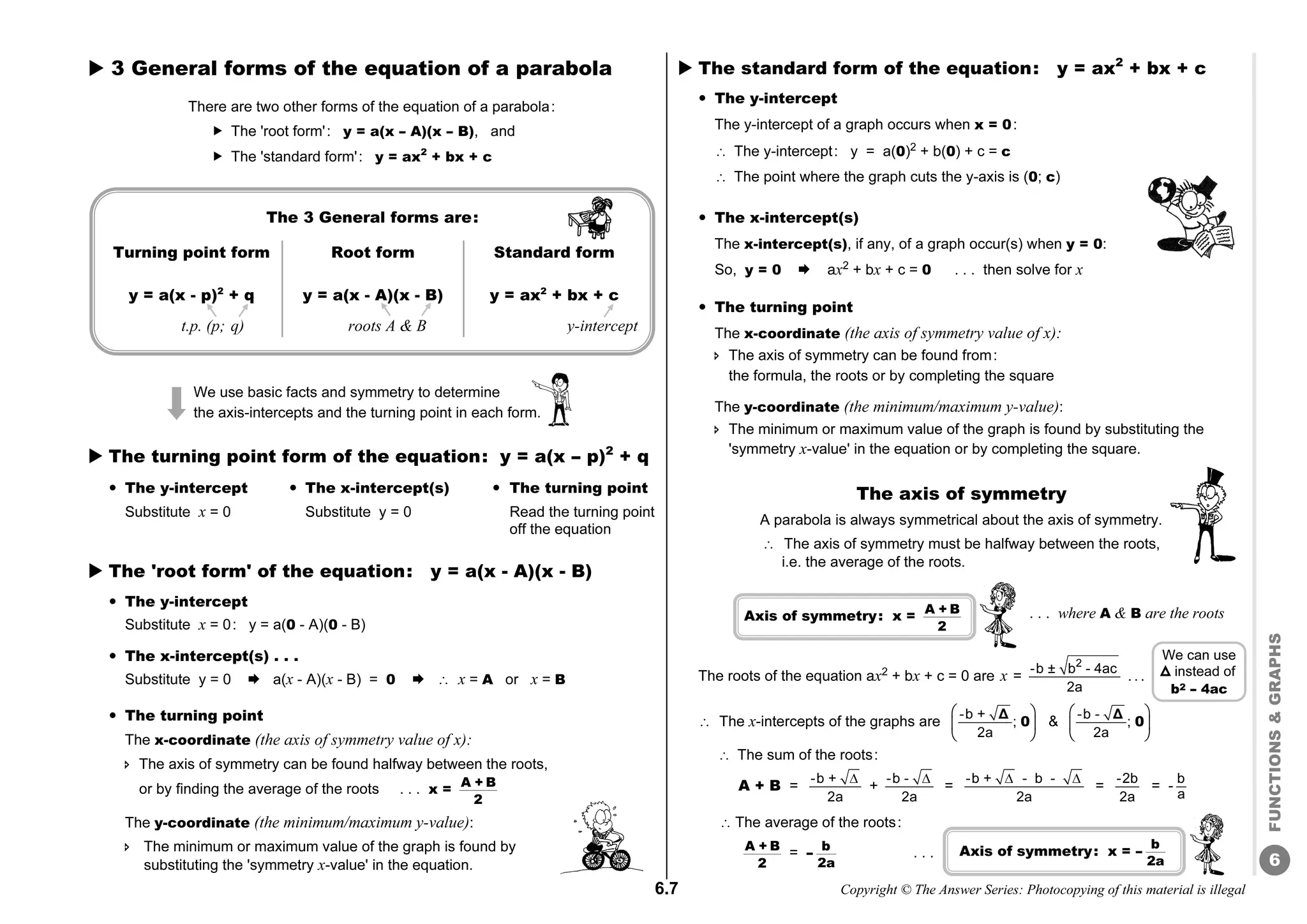
 3 General forms of the equation of a parabola
There are two other forms of the equation of a parabola:
 The 'root form': y = a(x -- A)(x -- B), and
 The 'standard form': y = ax2
+ bx + c
We use basic facts and symmetry to determine
the axis-intercepts and the turning point in each form.
 The turning point form of the equation: y = a(x -- p)2
+ q
 The y-intercept  The x-intercept(s)  The turning point
Substitute x = 0 Substitute y = 0 Read the turning point
off the equation
 The 'root form' of the equation: y = a(x - A)(x - B)
 The y-intercept
Substitute x = 0: y = a(0 - A)(0 - B)
 The x-intercept(s) . . .
Substitute y = 0  a(x - A)(x - B) = 0   x = A or x = B
 The turning point
The x-coordinate (the axis of symmetry value of x):
 The axis of symmetry can be found halfway between the roots,
or by finding the average of the roots . . . x =
A + B
2
The y-coordinate (the minimum/maximum y-value):
 The minimum or maximum value of the graph is found by
substituting the 'symmetry x-value' in the equation.
 The standard form of the equation: y = ax2
+ bx + c
 The y-intercept
The y-intercept of a graph occurs when x = 0:
 The y-intercept: y = a(0)2
+ b(0) + c = c
 The point where the graph cuts the y-axis is (0; c)
 The x-intercept(s)
The x-intercept(s), if any, of a graph occur(s) when y = 0:
So, y = 0  ax2
+ bx + c = 0 . . . then solve for x
 The turning point
The x-coordinate (the axis of symmetry value of x):
 The axis of symmetry can be found from:
the formula, the roots or by completing the square
The y-coordinate (the minimum/maximum y-value):
 The minimum or maximum value of the graph is found by substituting the
'symmetry x-value' in the equation or by completing the square.
The axis of symmetry
. . . where A  B are the roots
The roots of the equation ax2
+ bx + c = 0 are x =
2
-b ± b - 4ac
2a
. . .
 The x-intercepts of the graphs are
-b +
;
2a
 
 
 
0
Δ

-b -
;
2a
 
 
 
0
Δ
 The sum of the roots:
A + B =
-b +
2a

+
-b -
2a

=
-b + - b -
2a
 
=
-2b
2a
= -
b
a
 The average of the roots:
A + B
2
= --
b
2a
. . .
We can use
instead of
b2 -- 4ac
A parabola is always symmetrical about the axis of symmetry.
 The axis of symmetry must be halfway between the roots,
i.e. the average of the roots.
The 3 General forms are:
Turning point form
y = a(x - p)2
+ q
t.p. (p; q)
Root form
y = a(x - A)(x - B)
roots A  B
Standard form
y = ax2
+ bx + c
y-intercept
6.33 Copyright © The Answer Series: Photocopying of this material is illegal
6
FUNCTIONS

GRAPHS
Note: The coordinates of the turning points
 The coordinates of the axis-intercepts.
TRIGONOMETRIC GRAPHS
Point-by-point Plotting
Essential for point-by-point plotting of the basic graphs for ∈[0º; 360º]:
 Know the critical values of the ratios
 Know the signs of the ratios in the 4 quadrants
'The wheels' combine the critical values and the signs of the ratios.
Use the wheels to plot the 'critical points' before drawing the waves.
 Decide where to start: Start at the beginning of the wave.
 Choose the scale for each graph: All the critical values are on the wheels.
 Extend the domain to: ∈[-360º; 360º]
Use the wheels to write down the critical values of negative angles
by going clockwise:
Plot points for all 3 basic graphs
 y = sin θ:
 y = cos θ:
 y = tan θ:
x
y
O
Without
the use
of a
calculator.
Consider each wave
as being divided
into 4 quarters
Features of the graphs:
For both y = sin   y = cos :
 The amplitude = 1 unit
 The range: -1 ≤ y ≤ 1
 The maximum value = 1
 The minimum value = -1
 The period = 360º
y = tan θ:
 The range: y∈R  The period = 180º
 The asymptotes: x = -270º ; x = -90º ; x = 90º ; x = 270º
y = sin θ:

y
O
1
-1
(0º; 0) (360º;0)
(180º;0)
(90º; 1)
(270º; -1)
y = cos θ:

y
O
(0º;1)
-1
(90º;0) (270º;0)
(360º; 1)
(180º; -1)

y
360º
(180º; 0)
1
-1
(45º; 1) (225º; 1)
(0º;0)
(135º; -1) (315º; -1)
O
x = 90º x = 270º
I II III IV I II III IV

y
(-90º; -1)
(-360º;0) (-180º;0)
1
-1
(0º; 0) (360º;0)
(180º;0)
(90º; 1)
(270º; -1)
(-270º; 1)
O
(-360º;1)
-1
(-270º;0) (-90º;0)
(-180º; -1)

y
O
(0º;1)
(90º;0) (270º;0)
(360º; 1)
(180º; -1)
I II III IV I II III IV
(-180º;0)
(-315º; 1) (-135º; 1)
(-225º; -1) (-45º; -1)

y
(360º; 0)
(180º; 0)
1
-1
(45º; 1) (225º; 1)
(135º; -1) (315º; -1)
O
(-360º;0)
x = -270º x = -90º x = 90º x = 270º
I II III IV I II III IV
e.g.
cos(-180º) = -1
sin(-270º) = 1 tan(-135º) = 1
O
0 0
-1
-
- 270º
1
O
-1 1
0
-
-180º
0
0 0


-1
O
-
-135º
-1
1
1
cos θ:
-1 1
0
0
0 0
1
--1
sin θ: tan θ:
0 0
-1 1
-1
1
+
-
-

+-
-

6b
7.15 Copyright © The Answer Series: Photocopying of this material is illegal
7
TRIGONOMETRY
(Part
1)
-
General
These 3 angles are co-terminal, i.e. they have the same terminal arm, OY.
The sine of all 3 angles is 1, their cosine is 0 and their tan is undefined.
30º  -330º 150º  -210º 210º  -150º 330º  -30º
Trigonometry Unlimited: All Angles!
Considering all possible angles, including negative angles
In considering the domain [0º; 360º], we have considered all 4 quadrants, but only
angles rotating anticlockwise, and only 1 revolution.
Rotating anticlockwise or clockwise, through any number of revolutions covers
the same 4 quadrants with the same results!
General forms: (θ ± 360º) ; (-θ)
 Rotating through revolutions, anticlockwise and clockwise
e.g. (1) Compare: 30º ; 390º and -330º
These are 3 different ø
s
, but they are 'co-terminal', i.e. their end arms coincide.
â They have the same trig ratios:
sin 30º = sin 390º = sin(-330º) = 1
2
(2) Compare: 330º ; 690º ; -30º ; -390º
Standard positions:
These angles are co-terminal.
â They have the same trig ratios.
sin 330º = sin 690º = sin(-30º) = sin(-390º) = - 1
2
(3) Compare: 90º ; 450º ; -270º
450º = 90º + 360º
-270º = 90º -
- 360º
We conclude the following reduction formulae for θ ± 360º:
 Rotating clockwise
If θ is then -θ is
 Compare 30º ; 150º ; 210º ; 330º
to: -30º ; -150º ; -210º ; -330º
 The following pairs of angles are co-terminal.
â They have the same trigonometric ratios.
I: sin(-330º) II: sin(-210º) III: sin(-150º) IV: sin(-30º)
= sin 30º = sin 150º = sin 210º = sin 330º
= 1
2
= 1
2
= - 1
2
= - 1
2
 30º
x
y
O
P
 390º = 30º + 360º
x
y
O
P
 -330º = 30º - 360º
x
y
O
P
x
y
O
θ anticlockwise
rotation
x
y
O
-θ
clockwise
rotation
x
y
O
30º
-30º
x
y
O
150º
-150º
30º
30º
x
y
O
150º
-210º
P
II
x
y
O
210º
-150º
III
P
x
y
O
330º
IV
-30º
P
-330º
x
y
O
P
I
30º
x
y
O
330º
-330º
30º
30º
y
O
210º
-210º
30º
30º
x
x
y
O
450º
-270º
So: sin (-330º) = + sin 30º sin (-150º) = - sin 30º
sin (-210º) = + sin 30º sin (-30º) = - sin 30º
sin( + 360º) = sin  cos( + 360º) = cos  tan( + 360º) = tan 
sin( - 360º) = sin  cos( - 360º) = cos  tan( - 360º) = tan 
 -30º ;
-390º
y
O x
 330º ;
690º
y
O x
The reduction formulae for -θ:
sin(-) = -
-sin  tan(-) = -
-tan 
Compare to:
sin(360º - ) = -
-sin  tan(360º - ) = -
-tan 
cos(360º - ) = +cos 
cos(-) = +cos 
Consider  acute
Copyright © The Answer Series: Photocopying of this material is illegal 7.24
TRIG
SUMMARY
7
y
x
y
(x; y)
x
r
O

II  180º -- 
 180º + 
 360º -- 
150º
210º
330º
120º
240º
300º
135º
225º
315º
45º family
60º family
III
IV
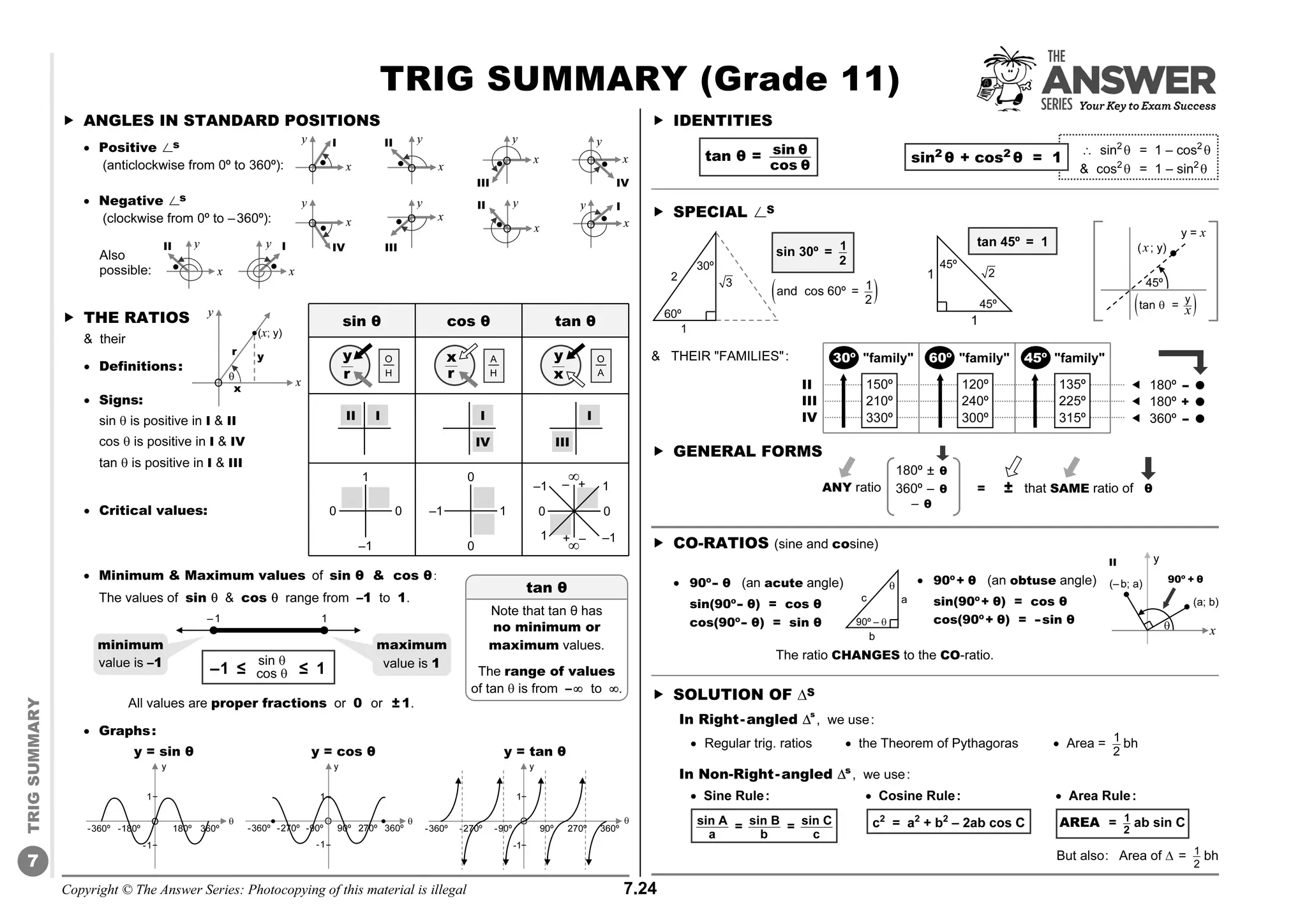
TRIG SUMMARY (Grade 11)
 ANGLES IN STANDARD POSITIONS
 Positive øs
(anticlockwise from 0º to 360º):
 Negative øs
(clockwise from 0º to –360º):
 Minimum  Maximum values of sin θ  cos θ:
The values of sin   cos  range from –1 to 1.
All values are proper fractions or 0 or ±1.
 Graphs:
y = sin θ y = cos θ y = tan θ
 IDENTITIES
 SPECIAL øS
 THEIR FAMILIES:
 GENERAL FORMS
 CO-RATIOS (sine and cosine)
 SOLUTION OF S
In Right-angled 
s
, we use:
 Regular trig. ratios  the Theorem of Pythagoras  Area = 1
2
bh
In Non-Right-angled s
, we use:
 Sine Rule:  Cosine Rule:  Area Rule:
minimum
value is –1
maximum
value is 1
–1 1
 THE RATIOS
 their
 Definitions:
 Signs:
sin  is positive in I  II
cos  is positive in I  IV
tan  is positive in I  III
 Critical values:
sin θ cos θ tan θ
O
H
y
r
A
H
x
r
O
A
y
x
I
IV
I
III
II I
+ –
0
1
–1
0
1
0
0
–1

1
0 0
–1
1 –1

– +
Also
possible:
II
x
y I
x
y
tan θ
Note that tan θ has
no minimum or
maximum values.
The range of values
of tan  is from – to .
–1 ≤ ≤ 1
sin 
cos 
III
x
y
O
I
x
y
O
IV
x
y
O
II
x
y
O
O
II
x
y
O
IV
x
y
O
I
x
y
O
III
x
y
tan θ = sin θ
cos θ
â sin2
 = 1 – cos2

 cos2
 = 1 – sin2

sin2
θ + cos2
θ = 1
c2
= a2
+ b2
– 2ab cos C
But also: Area of  = 1
2
bh
sin A
a
= sin B
b
= sin C
c
AREA = 1
2
ab sin C
sin 30º = 1
2
 
1
and cos 60º =
2
30º
60º
2
1
3
tan 45º = 1
2
1
1
45º
45º
(x; y)
 
y
tan = x

45º
y = x
 90º-- θ (an acute angle)
sin(90º-- θ) = cos θ
cos(90º-- θ) = sin θ
 90º+ θ (an obtuse angle)
sin(90º+ θ) = cos θ
cos(90º+ θ) = --sin θ

90º – 
a
b
c
The ratio CHANGES to the CO-ratio.
90º + θ

(–b; a)
y
x
(a; b)
II
30º family
ANY ratio = ± that SAME ratio of θ
180º ± θ
360º – θ
– θ
O
y
-90º
-270º 360º
90º 270º
-360º

1
-1
-360º

y
-180º 360º
180º
O
1
-1
O
-360º -270º -90º

y
90º 270º 360º
1
-1
9.10 Copyright © The Answer Series: Photocopying of this material is illegal
9
CIRCLE
GEOMETRY
To ensure that you grasp the meaning of the word 'subtend':
 Take each of the figures:
 Place your index fingers on A  B;
 move along the radii to meet at O and back; then,
 move to meet at P on the circumference and back.
 Turn your book upside down and sideways.
You need to recognise different views of these situations.
 Take note of whether the angles are acute, obtuse, right, straight or reflex.
 Redraw figures 1 to 4 leaving out the chord AB completely and observe
the arc subtending the central and inscribed angles in each case.
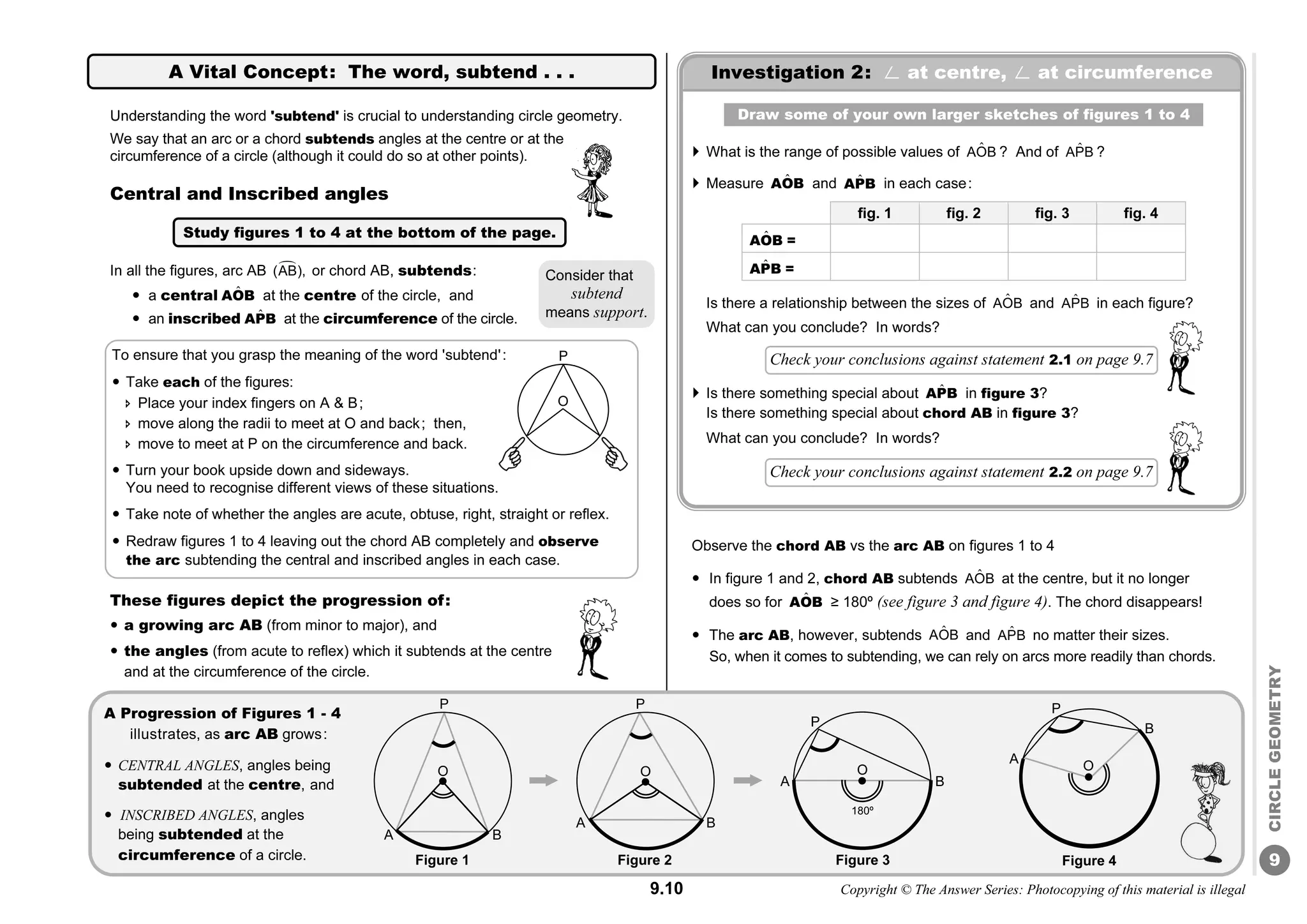
Understanding the word 'subtend' is crucial to understanding circle geometry.
We say that an arc or a chord subtends angles at the centre or at the
circumference of a circle (although it could do so at other points).
Central and Inscribed angles
In all the figures, arc AB 
(AB), or chord AB, subtends:
 a central ˆ
AOB at the centre of the circle, and
 an inscribed ˆ
APB at the circumference of the circle.
These figures depict the progression of:
 a growing arc AB (from minor to major), and
 the angles (from acute to reflex) which it subtends at the centre
and at the circumference of the circle.
Observe the chord AB vs the arc AB on figures 1 to 4
 In figure 1 and 2, chord AB subtends ˆ
AOB at the centre, but it no longer
does so for ˆ
AOB ≥ 180º (see figure 3 and figure 4). The chord disappears!
 The arc AB, however, subtends ˆ
AOB and ˆ
APB no matter their sizes.
So, when it comes to subtending, we can rely on arcs more readily than chords.
Consider that
subtend
means support.
A Vital Concept: The word, subtend . . .
Study figures 1 to 4 at the bottom of the page.
Investigation 2: ø at centre, ø at circumference
Draw some of your own larger sketches of figures 1 to 4
 What is the range of possible values of ˆ
AOB ? And of ˆ
APB ?
 Measure ˆ
AOB and ˆ
APB in each case:
fig. 1 fig. 2 fig. 3 fig. 4
ˆ
AOB =
ˆ
APB =
Is there a relationship between the sizes of ˆ
AOB and ˆ
APB in each figure?
What can you conclude? In words?
 Is there something special about ˆ
APB in figure 3?
Is there something special about chord AB in figure 3?
What can you conclude? In words?
Check your conclusions against statement 2.2 on page 9.7
Check your conclusions against statement 2.1 on page 9.7
P
O
A Progression of Figures 1 - 4
illustrates, as arc AB grows:
 CENTRAL ANGLES, angles being
subtended at the centre, and
 INSCRIBED ANGLES, angles
being subtended at the
circumference of a circle. Figure 2
P
A B
O
Figure 1
P
A B
O
Figure 3
P
A B
O
180º
Figure 4
P
A
B
O
9.24 Copyright © The Answer Series: Photocopying of this material is illegal
9
CIRCLE
GEOMETRY
:
EX
9.6
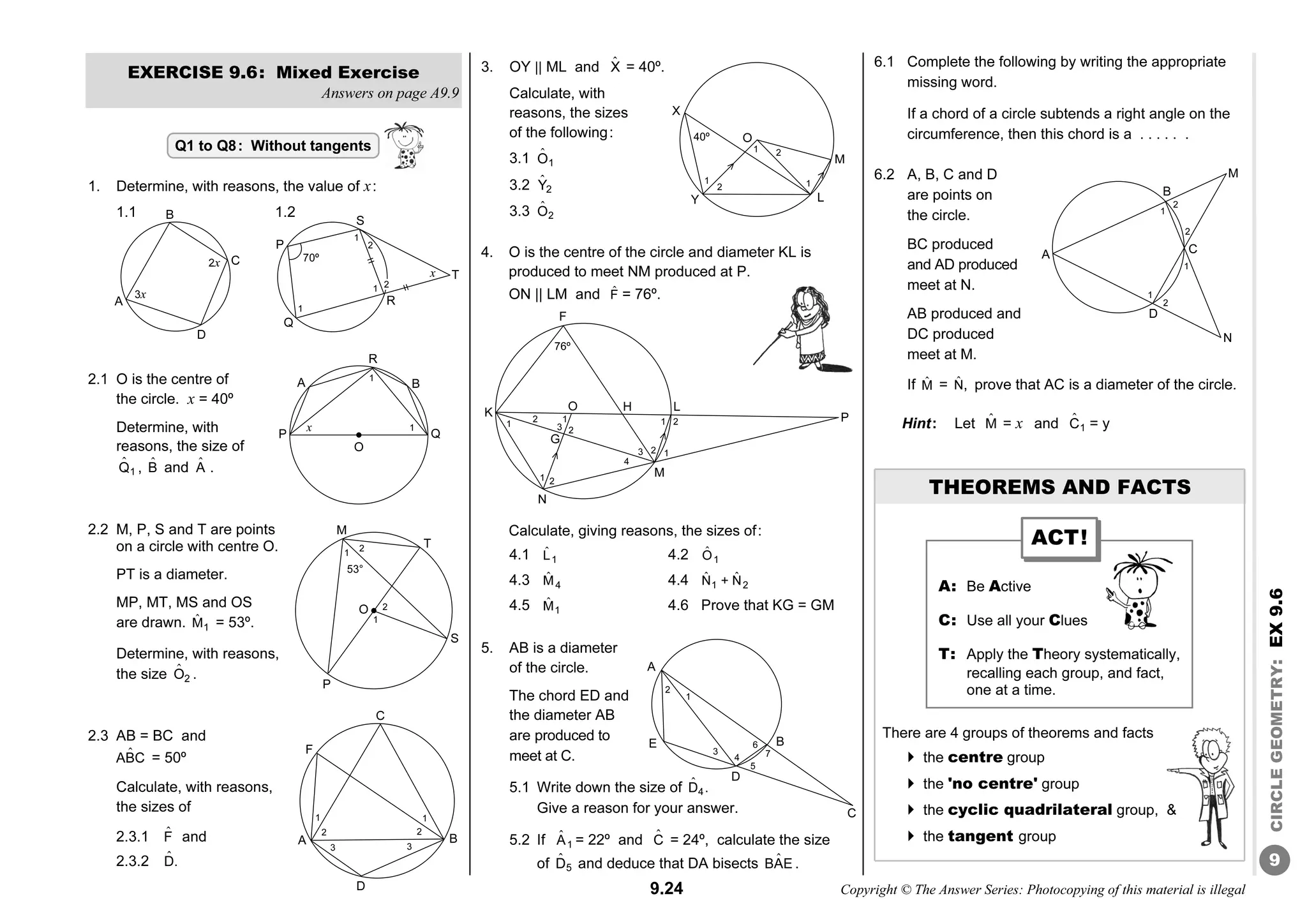
EXERCISE 9.6: Mixed Exercise
Answers on page A9.9
1. Determine, with reasons, the value of x:
1.1 1.2
2.1 O is the centre of
the circle. x = 40º
Determine, with
reasons, the size of
ˆ
1
Q , B̂ and  .
2.2 M, P, S and T are points
on a circle with centre O.
PT is a diameter.
MP, MT, MS and OS
are drawn. ˆ
1
M = 53º.
Determine, with reasons,
the size ˆ
2
O .
2.3 AB = BC and
ˆ
ABC = 50º
Calculate, with reasons,
the sizes of
2.3.1 F̂ and
2.3.2 D̂.
3. OY || ML and X̂ = 40º.
Calculate, with
reasons, the sizes
of the following:
3.1 ˆ
1
O
3.2 ˆ
2
Y
3.3 ˆ
2
O
4. O is the centre of the circle and diameter KL is
produced to meet NM produced at P.
ON || LM and F̂ = 76º.
Calculate, giving reasons, the sizes of:
4.1 ˆ
1
L 4.2 ˆ
1
O
4.3 ˆ
4
M 4.4 ˆ ˆ
1 2
N + N
4.5 ˆ
1
M 4.6 Prove that KG = GM
5. AB is a diameter
of the circle.
The chord ED and
the diameter AB
are produced to
meet at C.
5.1 Write down the size of ˆ
4
D .
Give a reason for your answer.
5.2 If ˆ
1
A = 22º and Ĉ = 24º, calculate the size
of ˆ
5
D and deduce that DA bisects ˆ
BAE .
6.1 Complete the following by writing the appropriate
missing word.
If a chord of a circle subtends a right angle on the
circumference, then this chord is a . . . . . .
6.2 A, B, C and D
are points on
the circle.
BC produced
and AD produced
meet at N.
AB produced and
DC produced
meet at M.
If M̂ = N̂, prove that AC is a diameter of the circle.
Hint: Let M̂ = x and ˆ
1
C = y
THEOREMS AND FACTS
There are 4 groups of theorems and facts
 the centre group
 the 'no centre' group
 the cyclic quadrilateral group, 
 the tangent group
Q1 to Q8: Without tangents
B
A
D
C
3x
2x
A
D
B
M
2
1
2
C
2
1
1
N
D
C
B
1
A
F
2 2
1
3
3
A: Be Active
C: Use all your Clues
T: Apply the Theory systematically,
recalling each group, and fact,
one at a time.
ACT!
A
D
B
E
2
1
6
C
5
7
3
4
F
K
N
L
P
M
H
O
76º
2
1
1
3
G
1
1
1
2
2
2
2
3
4
A B
P Q
1
x
R
O
1
P
M
S
1
O
T
2
2
1
53°
S
P
Q
R
T
x
1
1
2
2
1
70º
40º
X
O
2
1
1
2
M
L
Y
1
Copyright © The Answer Series: Photocopying of this material is illegal 10.1
TRIGONOMETRY
(Part
2)
-
area,
sine
and
cosine
rules
10
TRIGONOMETRY (Part 2) –
area, sine and cosine rules
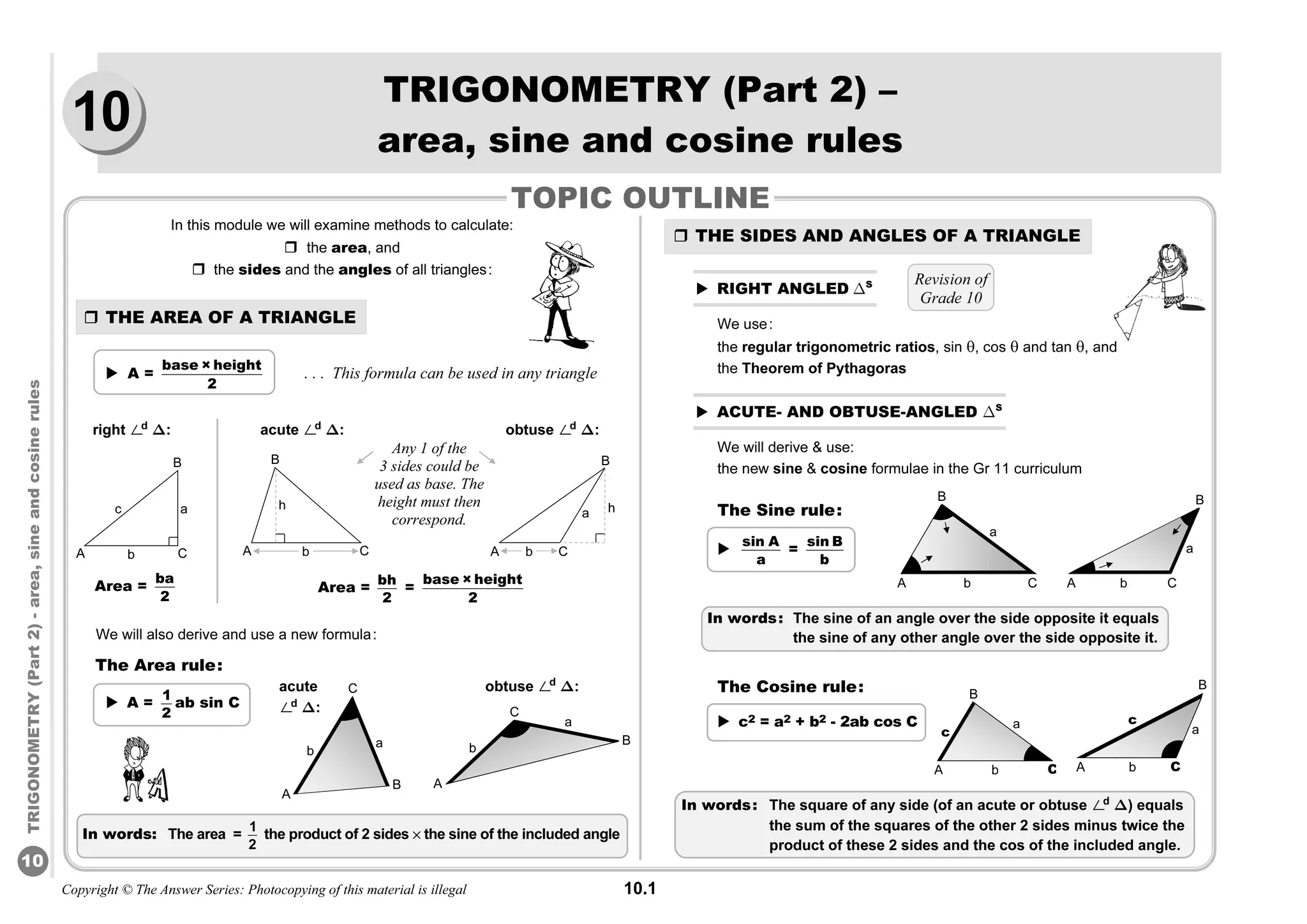
In this module we will examine methods to calculate:
 the area, and
 the sides and the angles of all triangles:
 THE AREA OF A TRIANGLE
 A =
base × height
2
. . . This formula can be used in any triangle
We will also derive and use a new formula:
The Area rule:
 THE SIDES AND ANGLES OF A TRIANGLE
 RIGHT ANGLED ΔS
We use:
the regular trigonometric ratios, sin , cos  and tan , and
the Theorem of Pythagoras
 ACUTE- AND OBTUSE-ANGLED ΔS
We will derive  use:
the new sine  cosine formulae in the Gr 11 curriculum
The Sine rule:

sin A
a
=
sin B
b
The Cosine rule:
 c2 = a2 + b2 - 2ab cos C
In words: The sine of an angle over the side opposite it equals
the sine of any other angle over the side opposite it.
In words: The square of any side (of an acute or obtuse ø
d
Δ) equals
the sum of the squares of the other 2 sides minus twice the
product of these 2 sides and the cos of the included angle.
In words: The area =
1
2
the product of 2 sides % the sine of the included angle
Revision of
Grade 10
TOPIC OUTLINE
right ø
d
Δ:
B
A C
c a
b
Area =
ba
2
Area =
bh
2
=
base × height
2
acute ø
d
Δ: obtuse ø
d
Δ:
Any 1 of the
3 sides could be
used as base. The
height must then
correspond.
B
A C
a
b
h
B
C
A
h
b
C
A b
a
B
A C
b
B
a
c
b
a
C
B
A
C
b
A
B
a
c
acute
ø
d
Δ:
B
A
C
a
b
obtuse ø
d
Δ:
B
A
b
a
C
 A =
1
2
ab sin C
10
12.11 Copyright © The Answer Series: Photocopying of this material is illegal
PROBABILITY
12
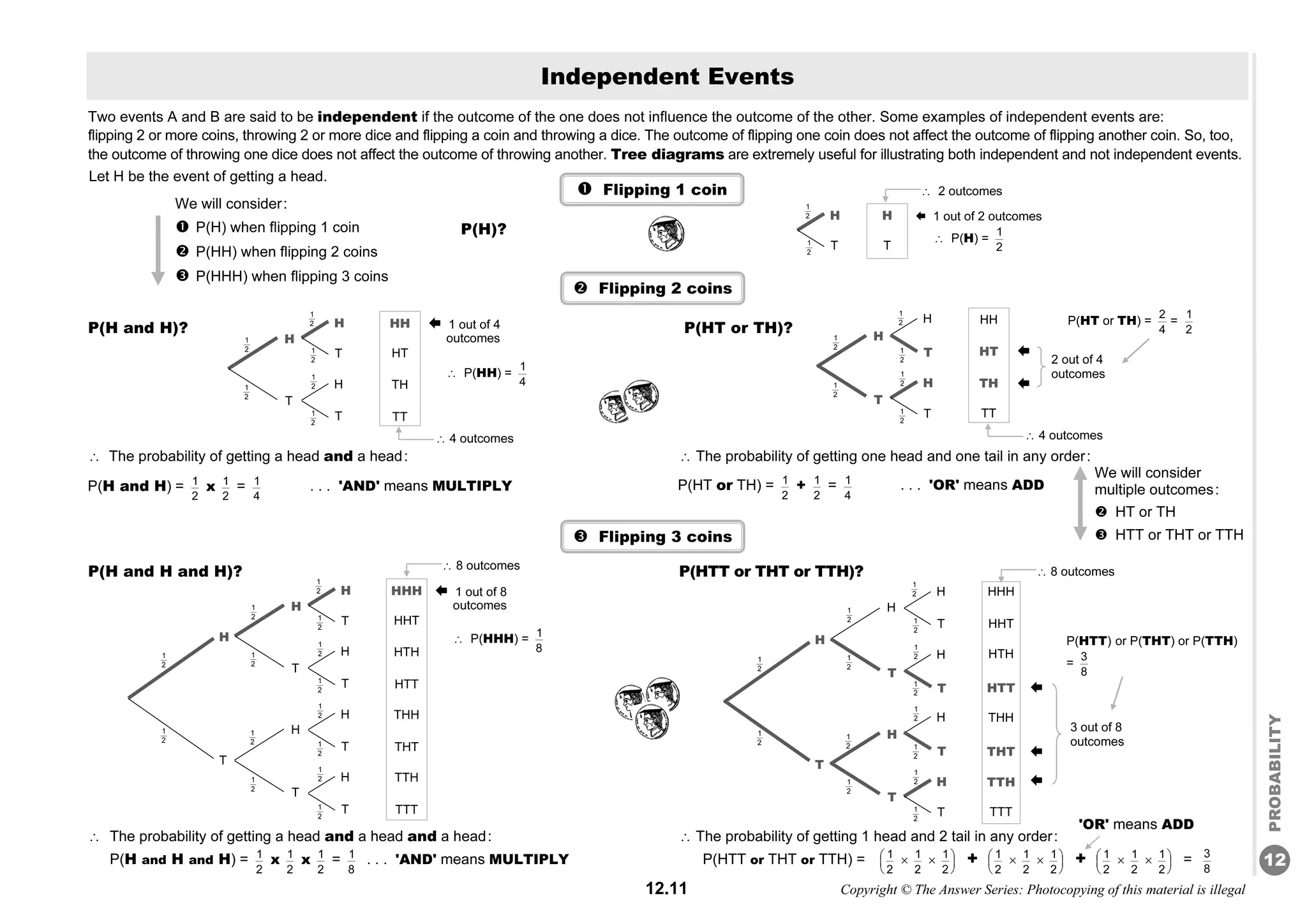
Two events A and B are said to be independent if the outcome of the one does not influence the outcome of the other. Some examples of independent events are:
flipping 2 or more coins, throwing 2 or more dice and flipping a coin and throwing a dice. The outcome of flipping one coin does not affect the outcome of flipping another coin. So, too,
the outcome of throwing one dice does not affect the outcome of throwing another. Tree diagrams are extremely useful for illustrating both independent and not independent events.
P(H and H)? P(HT or TH)?
 The probability of getting a head and a head:  The probability of getting one head and one tail in any order:
P(H and H and H)? P(HTT or THT or TTH)?
 The probability of getting a head and a head and a head:  The probability of getting 1 head and 2 tail in any order:
P(H and H and H) = 1
2
x 1
2
x 1
2
= 1
8
. . . 'AND' means MULTIPLY P(HTT or THT or TTH) = 1
2



 1
2
 1
2



+ 1
2



 1
2
 1
2



+ 1
2



 1
2
 1
2



= 3
8
Independent Events
 Flipping 1 coin
H
T
H
T
1
2
1
2  1 out of 2 outcomes
 P(H) =
1
2
 2 outcomes
P(H)?
 Flipping 3 coins
'OR' means ADD
 8 outcomes
1
2
1
2
1
2
HHH
HHT
HTH
HTT
THH
THT
TTH
TTT
H
T
H
T
H
T
H
T
H
T
H
T
H
T
1
2
1
2
1
2
1
2
1
2
1
2
1
2
1
2
1
2
1
2
1
2
P(HTT) or P(THT) or P(TTH)
=
3
8


3 out of 8
outcomes
1
2
1
2
1
2
HHH
HHT
HTH
HTT
THH
THT
TTH
TTT
H
T
H
T
H
T
H
T
H
T
H
T
H
T
1
2
1
2
1
2
1
2
1
2
1
2
1
2
1
2
1
2
1
2
1
2
 1 out of 8
outcomes
 P(HHH) = 1
8
 8 outcomes
 Flipping 2 coins
 4 outcomes
1
2
HH
HT
TH
TT
H
T
H
T
H
T
1
2
1
2
1
2
1
2
1
2
 1 out of 4
outcomes
 P(HH) =
1
4
P(H and H) = 1
2
x 1
2
= 1
4
P(HT or TH) = 1
2
+ 1
2
= 1
4
. . . 'AND' means MULTIPLY . . . 'OR' means ADD
 4 outcomes
1
2
HH
HT
TH
TT
H
T
H
T
H
T
1
2
1
2
1
2
1
2
1
2


2 out of 4
outcomes
P(HT or TH) =
2
4
=
1
2
We will consider:
 P(H) when flipping 1 coin
 P(HH) when flipping 2 coins
 P(HHH) when flipping 3 coins
Let H be the event of getting a head.
We will consider
multiple outcomes:
 HT or TH
 HTT or THT or TTH
Copyright © The Answer Series: Photocopying of this material is illegal Q6
EXAM
PAPERS:
PAPER
2
 MEASUREMENT [6]
QUESTION 8
A solid metallic hemisphere has a
radius of 3 cm. It is made of metal A.
To reduce its weight a conical hole is
drilled into the hemisphere (as shown in
the diagram) and it is completely filled with a lighter
metal B. The conical hole has a radius of 1,5 cm and a
depth of
8
9
cm.
Calculate the ratio of the volume of metal A to the
volume of metal B. [6]
 EUCLIDEAN GEOMETRY [40]
QUESTION 9
9.1 Complete the statement so that it is valid:
The line drawn from the centre of the circle
perpendicular to the chord . . . (1)
9.2 In the diagram, O is the
centre of the circle.
The diameter DE is
perpendicular to the
chord PQ at C.
DE = 20 cm and CE = 2 cm.
Calculate the length of the following with reasons:
9.2.1 OC 9.2.2 PQ (2)(4) [7]
QUESTION 10
10.1 In the diagram, O is the
centre of the circle and
A, B and D are points on
the circle.
Use Euclidean geometry methods to prove the
theorem which states that ˆ
AOB = ˆ
2ADB. (5)
10.2 In the diagram, M is the centre of the circle.
A, B, C, K and T lie on the circle.
AT produced and CK produced meet in N.
Also NA = NC and B̂ = 38º.
10.2.1 Calculate, with reasons, the size of the
following angles:
(a) ˆ
KMA (b) ˆ
2
T (2)(2)
(c) Ĉ (d) ˆ
4
K (2)(2)
10.2.2 Show that NK = NT. (2)
10.2.3 Prove that AMKN is a cyclic
quadrilateral. (3) [18]
QUESTION 11
11.1 Complete the following statement so that it
is valid:
The angle between a chord and a tangent
at the point of contact is . . . (1)
11.2 In the diagram, EA is a tangent to circle ABCD
at A.
AC is a tangent to circle CDFG at C.
CE and AG intersect at D.
If ˆ
1
A = x and ˆ
1
E = y, prove the following with
reasons:
11.2.1 BCG || AE (5)
11.2.2 AE is a tangent to circle FED (5)
11.2.3 AB = AC (4) [15]
TOTAL: 150
B
1
A
C
D
E
F
G
1
1
1
1
1
2
2
2
2
2
2
3 3
3
4
x
5
y
P
E
C
O
D
Q
D
O
A
B
N
T
38º
1
1 2
2
3
4
B
C M
A
K
M9 Copyright © The Answer Series: Photocopying of this material is illegal
EXAM
MEMOS:
PAPER
2
 MEASUREMENT [6]
8. Volume of metal B (the cone)
=
1
3
r2
.h
=
1
3
(1,5)2
.
8
9
=
2
3

Volume of the hemisphere = 1
2
3
4
r
3
 
 
 

=
2
3

. 33
= 18
â Volume of metal A = 18 - 2
3
 = 17
1
3

â The ratio:
Volume of metal A : Volume of metal B
= 17 1
3
 :
2
3

% 3) = 52 : 2
 2) = 26 : 1 
 EUCLIDEAN GEOMETRY [40]
9.1 . . . bisects the chord 
9.2.1 OE = OD = 1
2
(20) = 10 cm
â OC = 8 cm  . . . CE = 2 cm
9.2.2 In OPC:
PC2
= OP2
- OC2
. . . Pythagoras
= 102
- 82
= 36
â PC = 6 cm
â PQ = 12 cm  . . . line from centre  to chord
10.1 Construction: Join DO and
produce it to C
Proof:
Let ˆ
1
D = x
then  = x . . .
â ˆ
1
O = 2x
. . . ext. ø of DAO
Similarly, ˆ
2
O = 2y
â ˆ
AOB = 2x + 2y
= 2(x + y)
= 2 ˆ
ADB 
10.2
10.2.1 (a) ˆ
KMA = 2(38º) . . .
= 76º 
(b) ˆ
2
T = 38º  . . . ext. ø of cyclic quad. BKTA
(c) Ĉ = 38º  . . .
(d) ˆ
NAC = 38º . . . øs
opposite = sides
â ˆ
4
K = 38º  . . . ext. ø of c.q. CKTA
10.2.2 In NKT: ˆ
4
K = ˆ
2
T . . . both = 38º in 10.2.1
â NK = NT  . . . sides opp = øs
10.2.3 ˆ
KMA = 2(38º) . . . see 10.2.1(a)
 N̂ = 180º - 2(38º) . . . sum of øs
of NKT
(see 10.2.2)
â ˆ
KMA + N̂ = 180º
â AMKN is a cyclic quadrilateral 
. . . opposite øs
of quad upplementary
or conv. opp øs
of cyclic quad
11.1 . . . equal to the angle subtended by the chord
in the alternate segment. 
11.2
11.2.1 ˆ
1
A = x . . . given
â ˆ
2
C = x . . . tan chord theorem
â ˆ
2
G = x . . . tan chord theorem
â ˆ
1
A = ˆ
2
G
â BCG || AE  . . . alternate øs
=
11.2.2 ˆ
1
E = ˆ
3
C = y . . . alternate øs
; BG || AE
â ˆ
1
F = y . . . exterior ø of cyclic quad
â ˆ
1
E = ˆ
1
F
â AE is a tangent to ?FED 
. . . converse tan-chord theorem
11.2.3 ˆ
1
C = ˆ
CAE . . . alternate øs
; BCG || AE
= B̂ . . . tan chord theorem
â ˆ
1
C = B̂
â AB = AC  . . . sides opposite = øs
radii
= 1
2
diameter
ø at centre =
2 % ø at circumference
øs
in same segment
or, ext. ø of c.q. CKTA
r = 3 cm
r = 1 1
2
cm
h = 8
9
cm
P
E
C
O
D
Q
D
1
A
B
1 2
2
y
y
x
x
C
O
øs
opp
= radii
B
1 A
C
D
E
F
G
1
1
1
1
1
2
2
2
2
2
2
3 3
3
4
x
5
y
N
T
38º
1
1 2
2
3
4
B
C M
A
K
iv Copyright © The Answer Series: Photocopying of this material is illegal
ANALYTICAL
GEOMETRY
TOOLKIT
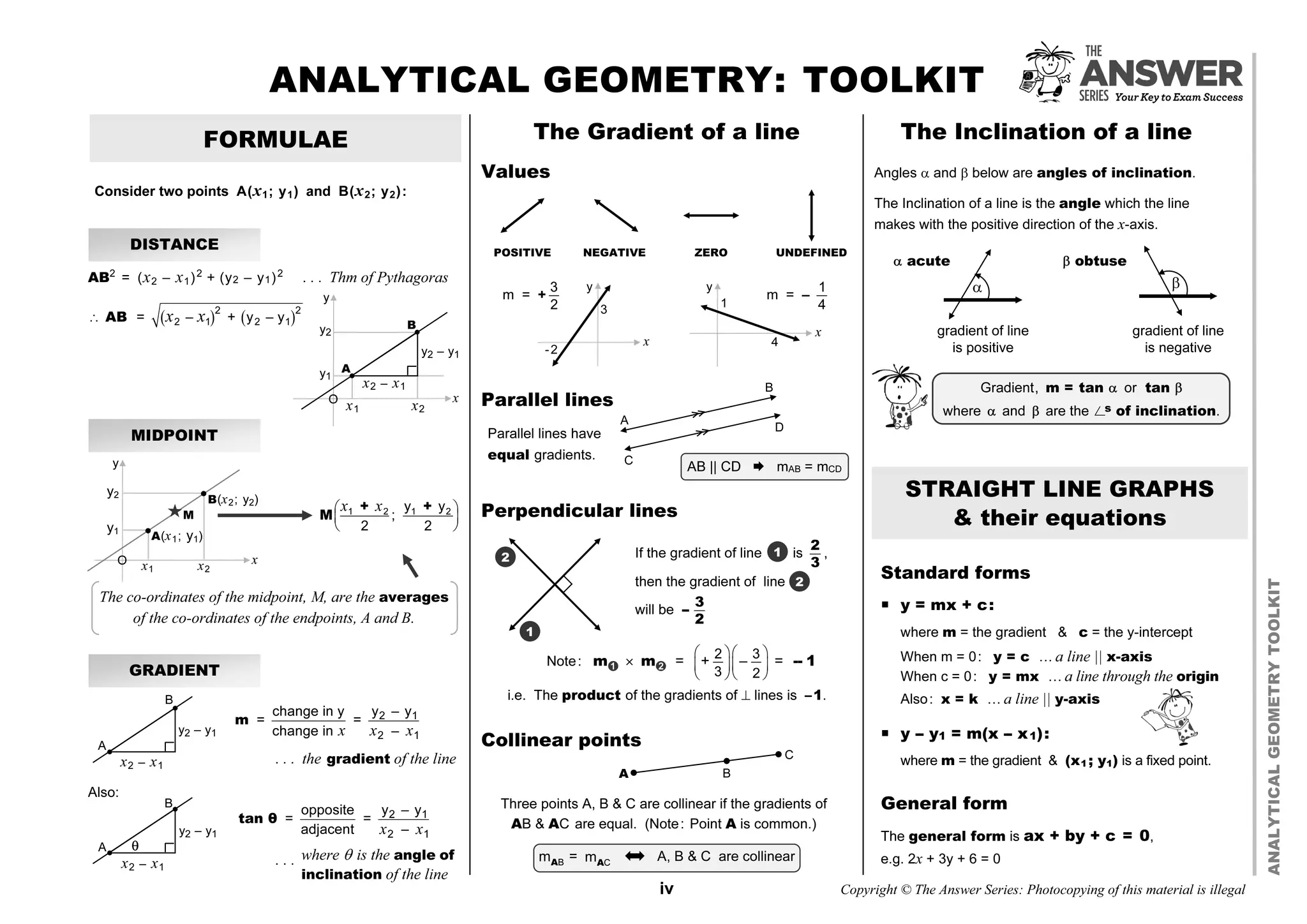
ANALYTICAL GEOMETRY: TOOLKIT
FORMULAE
Consider two points A(x1; y1) and B(x2; y2):
AB2
= (x2 – x1)2
+ (y2 – y1)2
. . . Thm of Pythagoras
â AB =    
x x 2 2
2 1 2 1
– + y – y
m =
x
change in y
change in
=
x x
2 1
2 1
y – y
–
. . . the gradient of the line
Also:
tan θ =
opposite
adjacent
=
x x
2 1
2 1
y – y
–
. . .
The Gradient of a line
Values
m = +
3
2
m = –
1
4
Parallel lines
Parallel lines have
equal gradients.
Perpendicular lines
If the gradient of line is
2
3
,
then the gradient of line
will be --
3
2
Note:
2 3
3 2
= + – =
  
  
  
m m -- 1
– —

i.e. The product of the gradients of  lines is –1.
Collinear points
Three points A, B  C are collinear if the gradients of
AB  AC are equal. (Note: Point A is common.)
The Inclination of a line
Angles  and  below are angles of inclination.
The Inclination of a line is the angle which the line
makes with the positive direction of the x-axis.
STRAIGHT LINE GRAPHS
 their equations
Standard forms
 y = mx + c:
where m = the gradient  c = the y-intercept
When m = 0: y = c ... a line || x-axis
When c = 0: y = mx ... a line through the origin
Also: x = k ... a line || y-axis
 y -- y1 = m(x -- x1):
where m = the gradient  (x1 ; y1) is a fixed point.
General form
The general form is ax + by + c = 0,
e.g. 2x + 3y + 6 = 0
UNDEFINED
ZERO
POSITIVE NEGATIVE
AB || CD  mAB = mCD
Gradient, m = tan  or tan 
where  and  are the øs of inclination.
B
C
A
= 
 A, B  C are collinear
B
mA C
mA
A
B
D
C
DISTANCE
MIDPOINT
GRADIENT
The co-ordinates of the midpoint, M, are the averages
of the co-ordinates of the endpoints, A and B.
where  is the angle of
inclination of the line
x2 – x1
A
B
y2 – y1
1
2
x x
 
 
 
1 2 1 2
y y
;
2 2
+ +
M
x2 – x1
A
B
y2 – y1

1
2
y
x
A(x1; y1)
B(x2; y2)
M
O x1
y2
y1
x2
y
x
x2 – x1
A
B
y2 – y1
x1 x2
y2
y1
O
y
3
x
-2
y
x
1
4
 acute  obtuse
gradient of line
is positive
gradient of line
is negative


11
GRADE
CAPS
3-in-1
Mathematics
ANSWERS TO MODULE EXERCISES
Anne Eadie  Gretel Lampe
Copyright © The Answer Series: Photocopying of this material is illegal
MODULES
TERM 1
Paper 1
Revision:
Numbers  Fundamental concepts A1.1
 Types of numbers
 Algebraic expressions,
fractions and equations
 Non-standard number patterns
Exponents  Surds A2.1
Algebraic expressions, equations A3.1
 inequalities
Number patterns A4.1
Paper 2
Analytical Geometry A5.1
TERM 2
Paper 1
Functions  Graphs A6.1
6a: Algebraic graphs
6b: Trigonometric graphs
Trigonometry (Part 1) - General A7.1
Trigonometry Summary
TERM 3
Paper 2
Measurement A8.1
Euclidean Geometry: ?'s A9.1
9a: Revision from earlier grades
9b: Circle Geometry
Trigonometry (Part 2) A10.1
- area, sine and cosine rules
Paper 1
Finance, Growth  Decay A11.1
Probability A12.1
TERM 4
Paper 2
Statistics A13.1
CONTENTS
Paper 2
Exams and Memos
are in the Study Guide.
1
2
3
4
5
6
7
9
8
10
11
12
13
Copyright © The Answer Series: Photocopying of this material is illegal A3.4
ALGEBRAIC
EXPRESSIONS,
EQUATIONS

INEQUALITIES:
EX
3.5
3
9. 3 - x  2x2
â -2x2
- x + 3  0
% (-1) â 2x2
+ x - 3  0
â (2x + 3)(x - 1)  0
â x  - 3
2
or x  1 
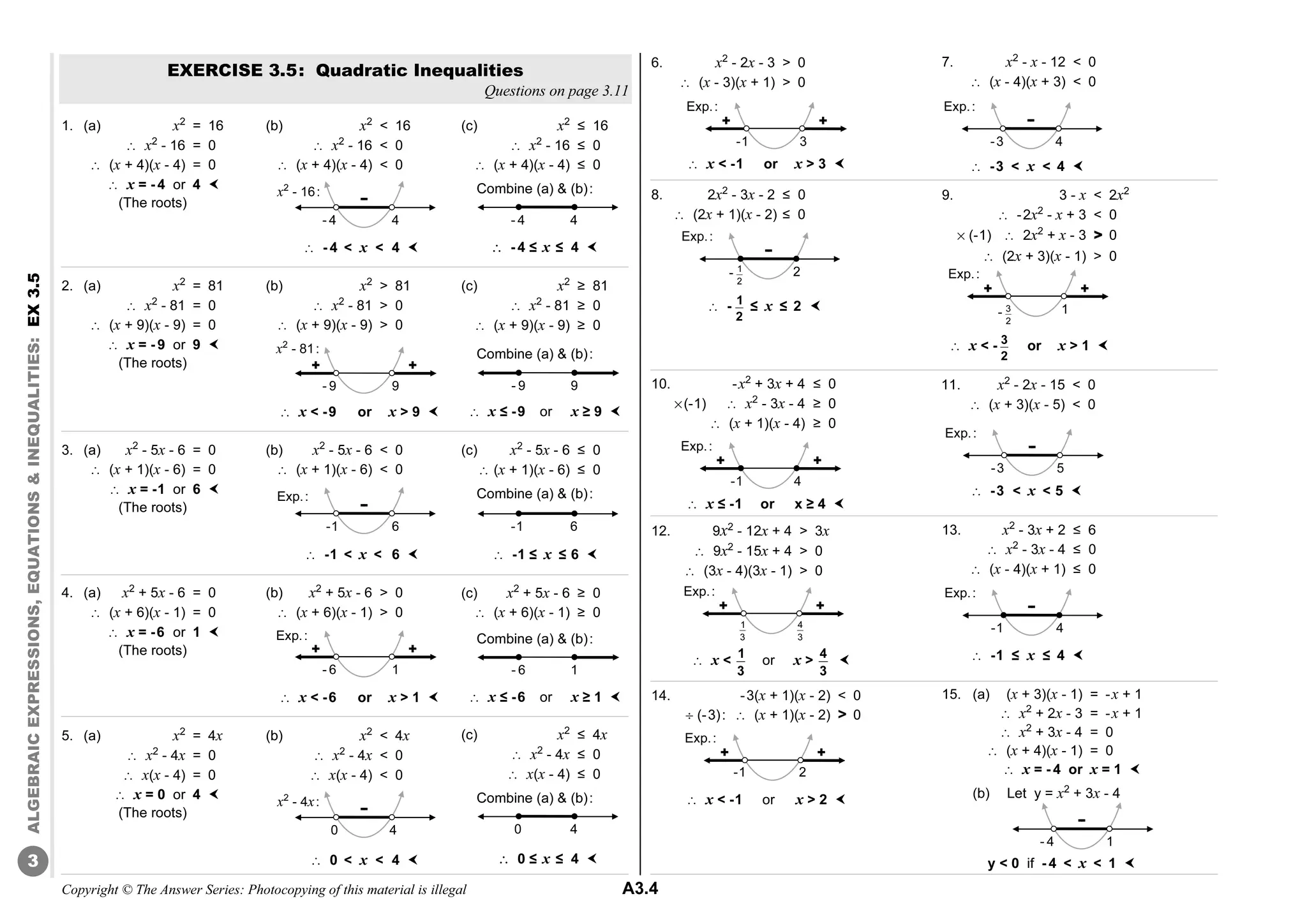
EXERCISE 3.5: Quadratic Inequalities
Questions on page 3.11
1. (a) x2
= 16 (b) x2
 16
â x2
- 16 = 0 â x2
- 16  0
â (x + 4)(x - 4) = 0 â (x + 4)(x - 4)  0
â x = - 4 or 4 
(The roots)
â - 4  x  4 
2. (a) x2
= 81 (b) x2
 81
â x2
- 81 = 0 â x2
- 81  0
â (x + 9)(x - 9) = 0 â (x + 9)(x - 9)  0
â x = - 9 or 9 
(The roots)
â x  -9 or x  9 
3. (a) x2
- 5x - 6 = 0 (b) x2
- 5x - 6  0
â (x + 1)(x - 6) = 0 â (x + 1)(x - 6)  0
â x = -1 or 6 
(The roots)
â -1  x  6 
4. (a) x2
+ 5x - 6 = 0 (b) x2
+ 5x - 6  0
â (x + 6)(x - 1) = 0 â (x + 6)(x - 1)  0
â x = -6 or 1 
(The roots)
â x  -6 or x  1 
5. (a) x2
= 4x (b) x2
 4x
â x2
- 4x = 0 â x2
- 4x  0
â x(x - 4) = 0 â x(x - 4)  0
â x = 0 or 4 
(The roots)
â 0  x  4 
6. x2
- 2x - 3  0
â (x - 3)(x + 1)  0
â x  -1 or x  3 
8. 2x2
- 3x - 2 ≤ 0
â (2x + 1)(x - 2) ≤ 0
â - 1
2
≤ x ≤ 2 
10. -x2
+ 3x + 4 ≤ 0
%(-1) â x2
- 3x - 4 ≥ 0
â (x + 1)(x - 4) ≥ 0
â x ≤ -1 or x ≥ 4 
12. 9x2
- 12x + 4  3x
â 9x2
- 15x + 4  0
â (3x - 4)(3x - 1)  0
â x 
1
3
or x 
4
3

14. -3(x + 1)(x - 2)  0
 (-3): â (x + 1)(x - 2)  0
â x  -1 or x  2 
--
4
- 4
x2
- 16:
--
6
-1
Exp.:
+
1
- 6
Exp.:
+
+
9
- 9
x2
- 81:
+
--
4
0
x2
- 4x:
+
3
-1
Exp.:
+
--
2
- 1
2
Exp.:
7. x2
- x - 12  0
â (x - 4)(x + 3)  0
â -3  x  4 
--
4
-3
Exp.:
+
4
3
1
3
Exp.:
+
+
4
-1
Exp.:
+
(c) x2
≤ 16
â x2
- 16 ≤ 0
â (x + 4)(x - 4) ≤ 0
Combine (a)  (b):
â - 4 ≤ x ≤ 4 
4
- 4
(c) x2
- 5x - 6 ≤ 0
â (x + 1)(x - 6) ≤ 0
Combine (a)  (b):
â -1 ≤ x ≤ 6 
6
-1
(c) x2
+ 5x - 6 ≥ 0
â (x + 6)(x - 1) ≥ 0
Combine (a)  (b):
â x ≤ -6 or x ≥ 1 
1
- 6
(c) x2
≥ 81
â x2
- 81 ≥ 0
â (x + 9)(x - 9) ≥ 0
Combine (a)  (b):
â x ≤ -9 or x ≥ 9 
9
- 9
+
2
-1
Exp.:
+
15. (a) (x + 3)(x - 1) = -x + 1
â x2
+ 2x - 3 = -x + 1
â x2
+ 3x - 4 = 0
â (x + 4)(x - 1) = 0
â x = - 4 or x = 1 
(b) Let y = x2
+ 3x - 4
13. x2
- 3x + 2 ≤ 6
â x2
- 3x - 4 ≤ 0
â (x - 4)(x + 1) ≤ 0
â -1 ≤ x ≤ 4 
--
4
-1
Exp.:
--
1
- 4
y  0 if - 4  x  1 
11. x2
- 2x - 15  0
â (x + 3)(x - 5)  0
â -3  x  5 
--
5
-3
Exp.:
+
1
- 3
2
Exp.:
+
(c) x2
≤ 4x
â x2
- 4x ≤ 0
â x(x - 4) ≤ 0
Combine (a)  (b):
â 0 ≤ x ≤ 4 
4
0
Copyright © The Answer Series: Photocopying of this material is illegal A5.3
ANALYTICAL
GEOMETRY:
EX
5.3
5
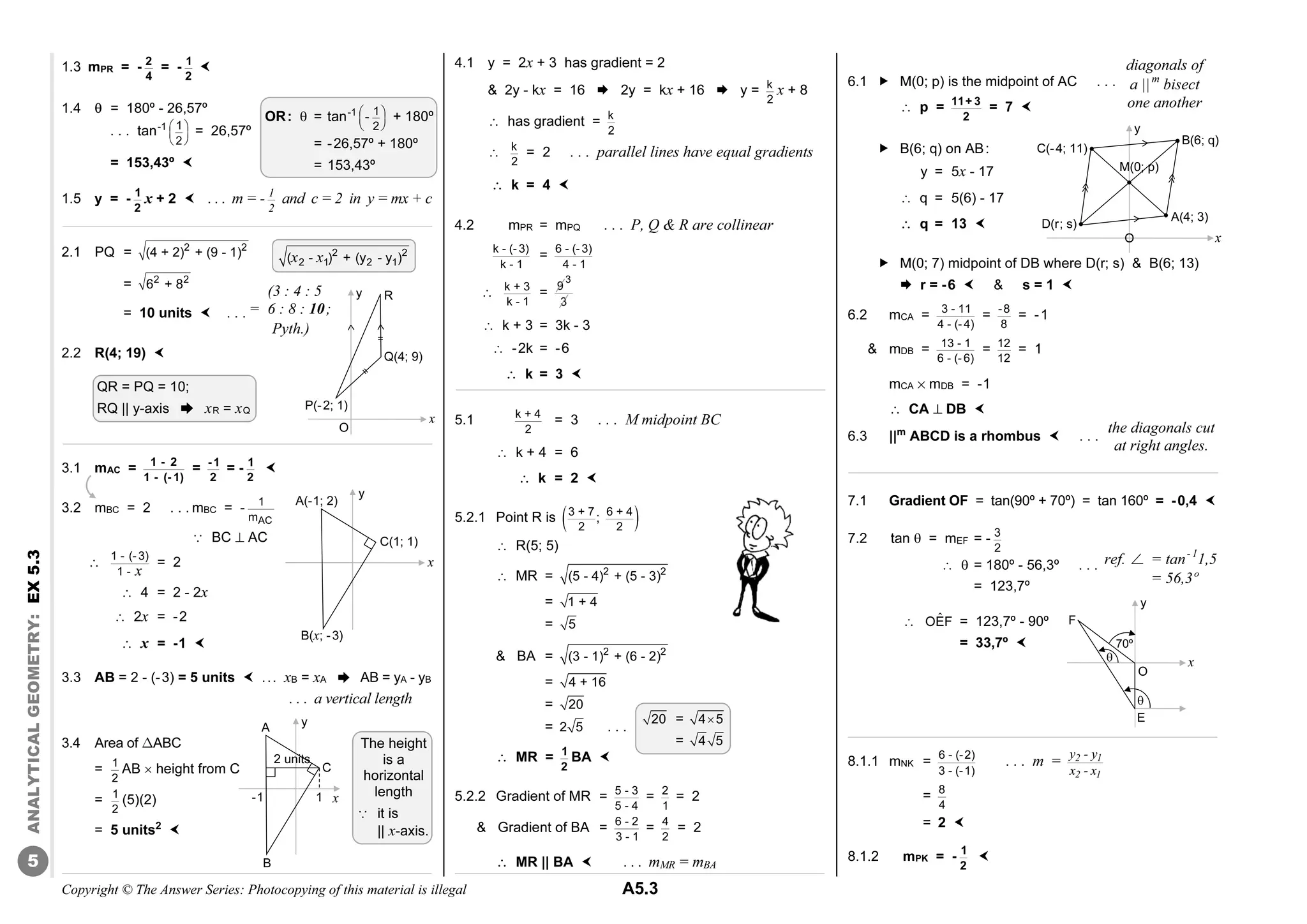
1.3 mPR = - 2
4
= - 1
2

1.4  = 180º - 26,57º
. . . tan-1  
 
 
1
2
= 26,57º
= 153,43º 
1.5 y = - 1
2
x + 2  . . . m = - 1
2
and c = 2 in y = mx + c
2.1 PQ = 2 2
(4 + 2) + (9 - 1)
= 2 2
6 + 8
= 10 units  . . .
2.2 R(4; 19) 
3.1 mAC = 1 - 2
1 - (- 1)
= -1
2
= - 1
2

3.2 mBC = 2 . . . mBC = -
AC
1
m

ä BC  AC

1 - (- 3)
1 - x
= 2
 4 = 2 - 2x
 2x = -2
 x = -1 
3.3 AB = 2 - (-3) = 5 units  ... xB = xA ² AB = yA - yB
. . . a vertical length
3.4 Area of ΔABC
= 1
2
AB  height from C
= 1
2
(5)(2)
= 5 units2

4.1 y = 2x + 3 has gradient = 2
 2y - kx = 16  2y = kx + 16  y = k
2
x + 8
 has gradient = k
2
 k
2
= 2 . . . parallel lines have equal gradients
 k = 4 
4.2 mPR = mPQ . . . P, Q  R are collinear
k - (- 3)
k - 1
=
6 - (- 3)
4 - 1
 k + 3
k - 1
= 9
3
3
 k + 3 = 3k - 3
 -2k = -6
 k = 3 
5.1 k + 4
2
= 3 . . . M midpoint BC
 k + 4 = 6
 k = 2 
5.2.1 Point R is  
3 + 7 6 + 4
2 2
;
 R(5; 5)
 MR = 2 2
(5 - 4) + (5 - 3)
= 1 + 4
= 5
 BA = 2 2
(3 - 1) + (6 - 2)
= 4 + 16
= 20
= 2 5 . . .
 MR = 1
2
BA 
5.2.2 Gradient of MR = 5 - 3
5 - 4
= 2
1
= 2
 Gradient of BA = 6 - 2
3 - 1
= 4
2
= 2
 MR || BA  . . . mMR = mBA
6.1  M(0; p) is the midpoint of AC . . .
 p = 11+ 3
2
= 7 
 B(6; q) on AB:
y = 5x - 17
 q = 5(6) - 17
 q = 13 
 M(0; 7) midpoint of DB where D(r; s)  B(6; 13)
 r = -6   s = 1 
6.2 mCA = 3 - 11
4 - (- 4)
= -8
8
= -1
 mDB = 13 - 1
6 - (- 6)
= 12
12
= 1
mCA % mDB = -1
 CA  DB 
6.3 ||m
ABCD is a rhombus  . . .
7.1 Gradient OF = tan(90º + 70º) = tan 160º = -0,4 
7.2 tan  = mEF = - 3
2
  = 180º - 56,3º . . .
= 123,7º
 ˆ
OEF = 123,7º - 90º
= 33,7º 
8.1.1 mNK =
6 - (-2)
3 - (-1)
. . . m = 2 1
2 1
y - y
x - x
= 8
4
= 2 
8.1.2 mPK = - 1
2

OR:  = tan-1  
 
 
1
2
- + 180º
= -26,57º + 180º
= 153,43º
The height
is a
horizontal
length
ä it is
|| x-axis.
diagonals of
a ||m
bisect
one another
the diagonals cut
at right angles.
ref. ø = tan-1
1,5
= 56,3º
20 = 
4 5
= 4 5
B(6; q)
x
y
A(4; 3)
D(r; s)
C(-4; 11)
M(0; p)
O
x
y
2 units
-1 1
A
C
B
F
x
y
70º
O
E


x x 2 2
2 1 2 1
( - ) + (y - y )
QR = PQ = 10;
RQ || y-axis ² xR = xQ
(3 : 4 : 5
= 6 : 8 : 10;
Pyth.)
P(-2; 1)
x
y
Q(4; 9)
R
O
C(1; 1)
x
y
A(-1; 2)
B(x; -3)
Copyright © The Answer Series: Photocopying of this material is illegal A6.1
FUNCTIONS

GRAPHS:
EX
6.1
6
EXERCISE 6.1: Parabolas
Questions on page 6.13
1.1 (a) (-3; -5) (b) y = x2
+ 6x + 4 (c) (0; 4)
1.2 (a) (1; 4) (b) y = -x2
+ 2x + 3 (c) (0; 3)
1.3 (a) (-2; 1) (b) y = 2x2
+ 8x + 9 (c) (0; 9)
2.1 (a) y = x2
+ 8x + 10 . . . std form
 y = x2
+ 8x + 42
+ 10 -- 16
 y = (x + 4)2
- 6 . . . t.pt. form
(b) 4 units left and 6 units down
(c) turning point: (- 4; -6)
(d) y-int: (0; 10) . . .
2.2 (a) y = x2
- 6x + 11
 y = x2
- 6x + 32
+ 11 -- 9
 y = (x - 3)2
+ 2
(b) 3 units right and 2 units up
(c) turning point: (3; 2)
(d) y-intercept: (0; 11) . . . see the standard form
2.3 (a) y = -x2
+ 4x + 5
 y = -(x2
- 4x - 5)
 y = -(x2
- 4x + 22
- 5 - 4)
 y = -[(x - 2)2
- 9]
 y = -(x - 2)2
+ 9
(b) 2 units right and 9 units up
(c) turning point: (2; 9)
(d) y-intercept: (0; 5) . . . see the standard form
3.1 (a) y = x2
- 7x + 12 3.2 (a) y = -(x2
- 7x + 12)
 y = (x - 3)(x - 4)   y = -(x - 3)(x - 4) 
(b) x = 3 and x = 4  (b) x = 3  x = 4 
(c) x = 3 1
2
 (c) x = 3 1
2

3.3 (a) y = (x - 1)2
- 4 (b) x = -1 and x = 3 
 y = x2
- 2x - 3 (c) x =
-1 + 3
2
= 1 
 y = (x + 1)(x - 3) 
4. (a) y = (x - 3)2
- 1 
(b) y = (x + 2)2
+ 5 
5.1 (a) (b)
(c) (d)
(e) (f)
(g) (h)
(i) (j)
5.2.1 (a) 3 units down
(b) 3 units left
(d) 5 units right and 2 units down
(f) 2 units left and 4 units up
5.2.2 (c) 4 units down
(e) 2 units right and 1 unit up
6.1
(a) y = ax2
+ 3 (b) y = ax2
+ 4
(3; 6): 6 = a(3)2
+ 3 (-4; 0): 0 = a(-4)2
+ 4
 3 = 9a  -4 = 16a
 a =
1
3
 a = -
1
4
 Eqn: y =
1
3
x2
+ 3   Eqn: y = -
1
4
x2
+ 4 
(c) y = ax2
. . . c = 0
(-3; 4): 4 = a(-3)2
 4 = 9a
 a =
4
9
 Eqn: y =
4
9
x2

(d) t.p.: (2; 0) (e) t.p.: (1; 2)
 y = a(x - 2)2
 y = a(x - 1)2
+ 2
(0; 2):  2 = a(-2)2
(0; 5):  5 = a(-1)2
+ 2
 a =
1
2
 a = 3
 Eqn: y =
1
2
(x - 2)2
  Eqn: y = 3(x - 1)2
+ 2 
(f) Symmetry x = 2  Maximum y = 9
 y = a(x - 2)2
+ 9
(-1; 0):  0 = a(-1 - 2)2
+ 9
 9a = -9
 a = -1
 Eqn: y = -(x - 2)2
+ 9 
The y-intercept
Either
 read it from the
standard form
or
 substitute x = 0
in the t.p. form
see the
std form
y
x
O
(0; 3)
y
x
O
(-2; -1)
-5
y
x
O
(-5; 2)
27
y
x
O
(0; -5)
(-1; -2)
(a) ¡ (c): Use y = ax2 + q
These graphs are symmetrical about the y-axis.
(d) ¡ (f): Use y = a(x - p)2 + q
These graphs are not symmetrical about the y-axis.
x-ints:
(x - 2)2
= 4
 x - 2 = 2
 x = 2 2
= 0 or 4
y
x
(4; 0)
(2; -4)
(0; 0)
O
x-ints:
-(2x - 1)2
+ 9 = 0
(2x - 1)2
= 9
2x - 1 = 3
2x = 1  3
x = 1 3
2

 x = -1 or 2
y
x
(2; 0)
(0; 8)
O
(-1; 0)
 
1
2
; 9
x-ints:
3(x - 1)2
- 12 = 0
3(x - 1)2
= 12
(x - 1)2
= 4
x - 1 = 2
x = 1  2
 x = -1 or 3
x-int: x = 3 ... the 'zero
value' of x
for ( )2
= 0
y
x
O
(0; 9)
3
x-ints:
-x2
+ 4 = 0
x2
= 4
x = 2
y
x
O
(-2; 0) (2; 0)
(0; 4)
y
x
O
(0; 9)
 
3
2
- ; 0
x-int: x = - 3
2
... the
'zero value'
of x for
( )2
= 0
Note:
a = 1, given
y
x
(1; -12)
(0; -9)
O
(-1; 0) (3; 0)
Copyright © The Answer Series: Photocopying of this material is illegal A7.3
TRIGONOMETRY
(Part
1)
-
General:
EX
7.3
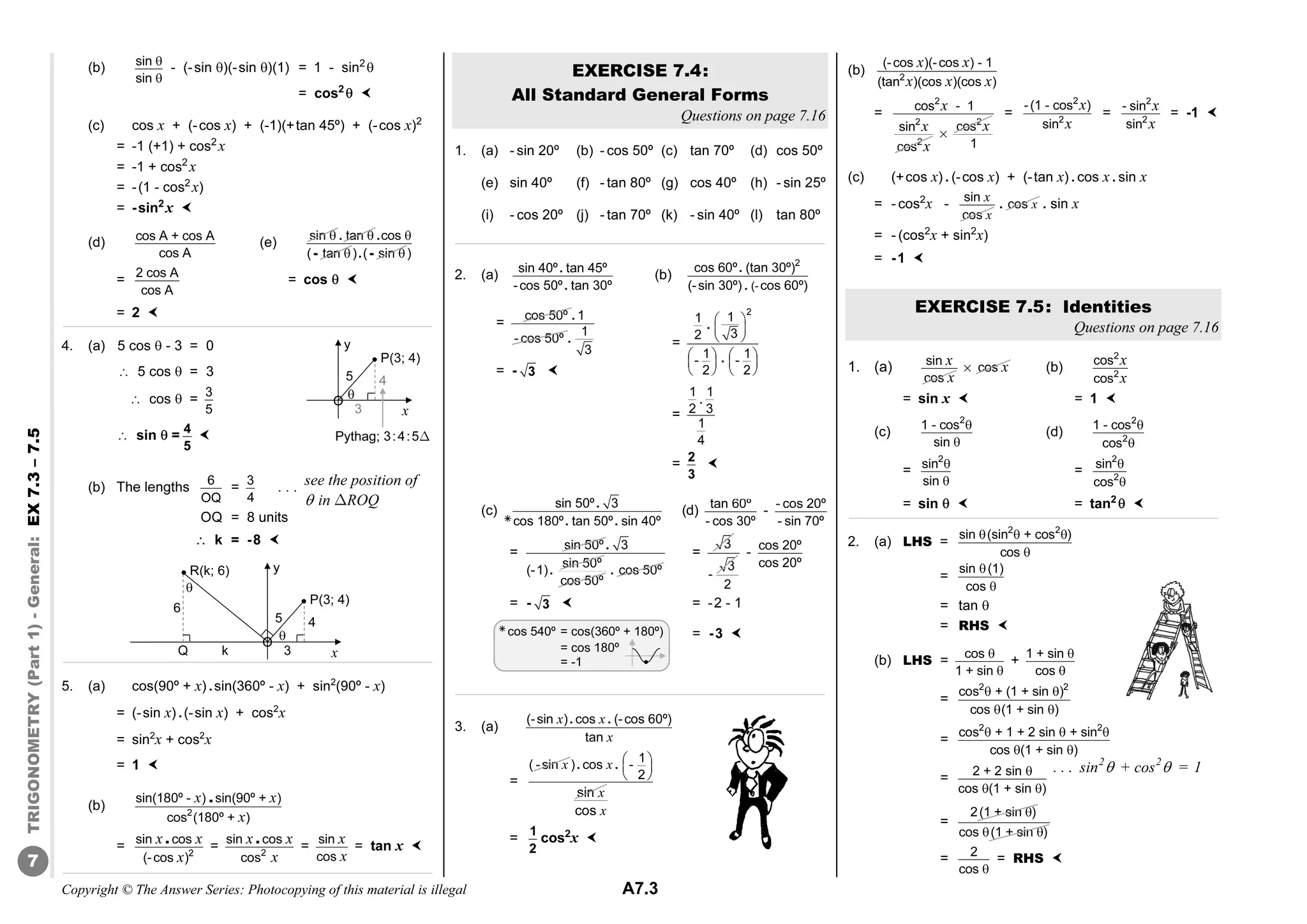
–
7.5
7
(b) sin
sin


- (-sin )(-sin )(1) = 1 - sin2

= cos2
 
(c) cos x + (-cos x) + (-1)(+tan 45º) + (-cos x)2
= -1 (+1) + cos2
x
= -1 + cos2
x
= -(1 - cos2
x)
= -sin2
x 
(d) cos A + cos A
cos A
(e)
sin  tan 
. cos
( tan


.
- ) ( sin 
. - )
= 2 cos A
cos A
= cos  
= 2 
4. (a) 5 cos  - 3 = 0
â 5 cos  = 3
â cos  = 3
5
â sin  = 4
5

(b) The lengths
6
OQ
= 3
4
. . .
OQ = 8 units
 k = -8 
5. (a) cos(90º + x) .sin(360º - x) + sin2
(90º - x)
= (-sin x) .(-sin x) + cos2
x
= sin2
x + cos2
x
= 1 
(b)
x x
x
.
2
sin(180º - ) sin(90º + )
cos (180º + )
=
x x
x
.
2
sin cos
(-cos )
=
x x
x
.
2
sin cos
cos
=
x
x
sin
cos
= tan x 
EXERCISE 7.4:
All Standard General Forms
Questions on page 7.16
1. (a) - sin 20º (b) - cos 50º (c) tan 70º (d) cos 50º
(e) sin 40º (f) - tan 80º (g) cos 40º (h) - sin 25º
(i) - cos 20º (j) - tan 70º (k) - sin 40º (l) tan 80º
2. (a)
.
.
sin 40º tan 45º
-cos 50º tan 30º
(b)
2
(-
cos 60º (tan 30º)
(-sin 30º) cos 60º)
.
.
(c)
.
. .
sin 50º 3
cos 180º tan 50º sin 40º
(d)
=
sin 50º .
.
3
sin 50º
(-1)
cos 50º
. cos 50º
=
3
3
-
2
-
cos 20º
cos 20º
= - 3  = -2 - 1
= -3 
3. (a)
. .
x x
x
(-sin ) cos (-cos 60º)
tan
=
x
( -sin . .
x
x
 
 
 
1
) cos -
2
sin
x
cos
=
1
2
cos2
x 
(b)
x x
x x x
2
(-cos )(-cos ) - 1
(tan )(cos )(cos )
=
2
2
2
cos - 1
sin
cos
x
x
x
2
cos x
%
1
=
2
2
-(1 - cos )
sin
x
x
=
2
2
- sin
sin
x
x
= -1 
(c) (+cos x) . (-cos x) + (-tan x) . cos x . sin x
= - cos2
x -
x
x
sin
cos
. x
cos . sin x
= - (cos2
x + sin2
x)
= -1 
EXERCISE 7.5: Identities
Questions on page 7.16
1. (a) sin
cos
x
x
cos x
% (b)
2
2
cos
cos
x
x
= sin x  = 1 
(c)
2
1 - cos
sin


(d)
2
2
1 - cos
cos


=
2
sin
sin


=
2
2
sin
cos


= sin   = tan2
 
2. (a) LHS =
2 2
sin (sin + cos )
cos
  

=
sin (1)
cos


= tan 
= RHS 
(b) LHS = cos
1 + sin


+ 1 + sin
cos


=
 
 
2 2
cos + (1 + sin )
cos (1 + sin )
=
  
 
2 2
cos + 1 + 2 sin + sin
cos (1 + sin )
=

 
2 + 2 sin
cos (1 + sin )
=
2(1 + sin )

cos (1 + sin )
 
= 2
cos 
= RHS 
y
x
O
5 4
3
P(3; 4)

Pythag; 3:4:5Δ

 cos 540º = cos(360º + 180º)
= cos 180º
= -1
tan 60º
- cos 30º
-
- cos 20º
- sin 70º
see the position of
 in ΔROQ
y
x
O
5 4
3
P(3; 4)
k
6
R(k; 6)
Q


. . . sin2
 + cos2
 = 1
=
 
 
 
   
   
   
2
1
1
3
2
1 1
- -
2 2
.
.
=
.
1 1
2 3
1
4
= 2
3

=
cos 50º . 1
- cos 50º .
1
3
= - 3
Copyright © The Answer Series: Photocopying of this material is illegal A9.7
CIRCLE
GEOMETRY:
EX
9.4
–
9.5
9
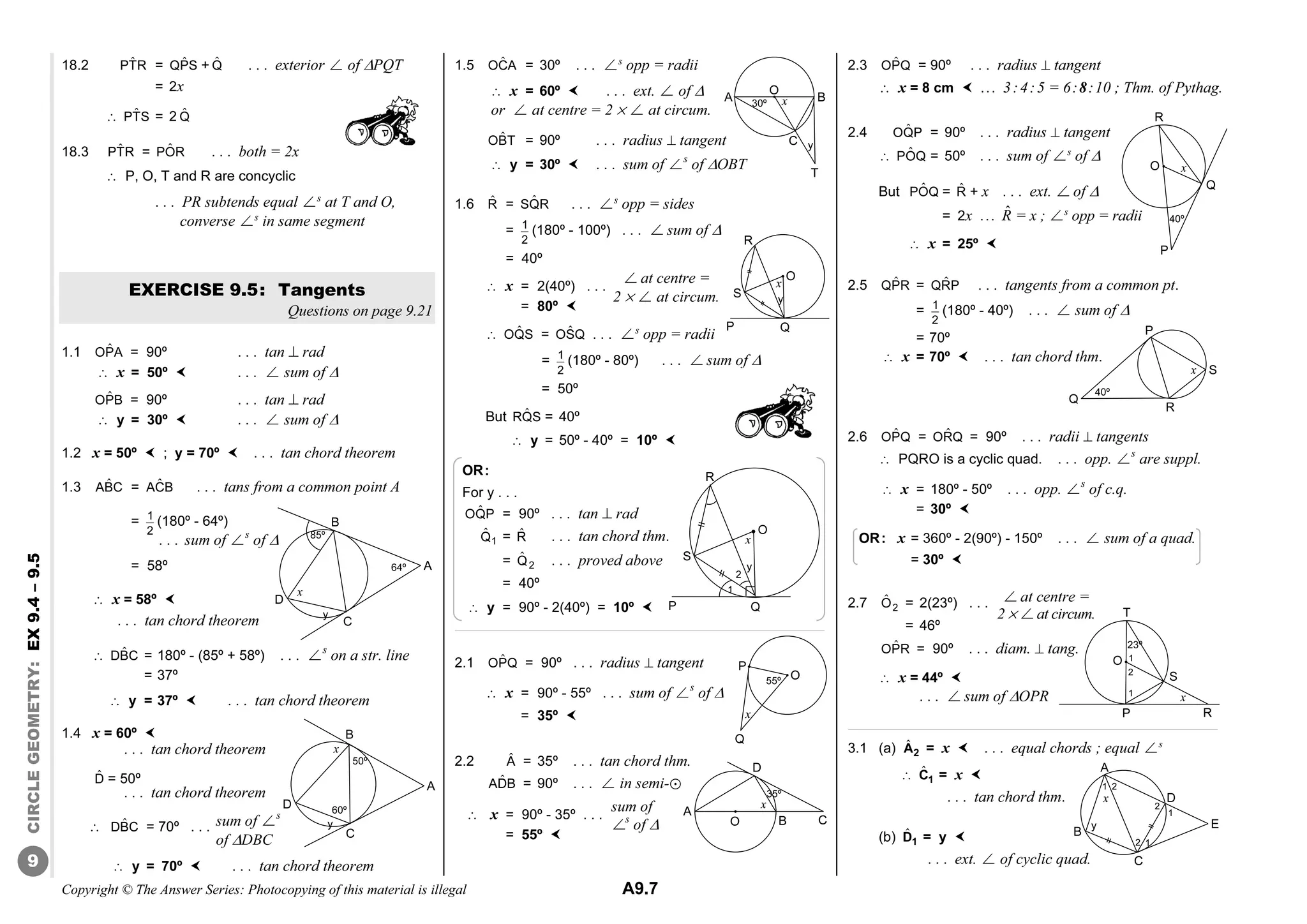
18.2 ˆ
PTR = ˆ
QPS + Q̂ . . . exterior ø of PQT
= 2x
â ˆ
PTS = 2 Q̂
18.3 ˆ
PTR = ˆ
POR . . . both = 2x
â P, O, T and R are concyclic
. . . PR subtends equal øs
at T and O,
converse øs
in same segment
EXERCISE 9.5: Tangents
Questions on page 9.21
1.1 ˆ
OPA = 90º . . . tan  rad
â x = 50º  . . . ø sum of 
ˆ
OPB = 90º . . . tan  rad
â y = 30º  . . . ø sum of 
1.2 x = 50º  ; y = 70º  . . . tan chord theorem
1.3 ˆ
ABC = ˆ
ACB . . . tans from a common point A
= 1
2
(180º - 64º)
= 58º
â x = 58º 
. . . tan chord theorem
â ˆ
DBC = 180º - (85º + 58º) . . . øs
on a str. line
= 37º
â y = 37º  . . . tan chord theorem
1.4 x = 60º 
D̂ = 50º
â ˆ
DBC = 70º . . .
â y = 70º  . . . tan chord theorem
1.5 ˆ
OCA = 30º . . . øs
opp = radii
â x = 60º  . . . ext. ø of 
or ø at centre = 2 % ø at circum.
ˆ
OBT = 90º . . . radius  tangent
â y = 30º  . . . sum of øs
of OBT
1.6 R̂ = ˆ
SQR . . . øs
opp = sides
= 1
2
(180º - 100º) . . . ø sum of 
= 40º
â x = 2(40º) . . .
= 80º 
â ˆ
OQS = ˆ
OSQ . . . øs
opp = radii
= 1
2
(180º - 80º) . . . ø sum of 
= 50º
But ˆ
RQS = 40º
â y = 50º - 40º = 10º 
OR:
For y . . .
ˆ
OQP = 90º . . . tan  rad
ˆ
1
Q = R̂ . . . tan chord thm.
= ˆ
2
Q . . . proved above
= 40º
â y = 90º - 2(40º) = 10º 
2.1 ˆ
OPQ = 90º . . . radius  tangent
â x = 90º - 55º . . . sum of øs
of 
= 35º 
2.2 Â = 35º . . . tan chord thm.
ˆ
ADB = 90º . . . ø in semi-?
â x = 90º - 35º . . .
= 55º 
2.3 ˆ
OPQ = 90º . . . radius  tangent
â x = 8 cm  ... 3:4:5 = 6:8:10 ; Thm. of Pythag.
2.4 ˆ
OQP = 90º . . . radius  tangent
â ˆ
POQ = 50º . . . sum of øs
of 
But ˆ
POQ = R̂ + x . . . ext. øof 
= 2x ... R̂ = x ; øs
opp = radii
â x = 25º 
2.5 ˆ
QPR = ˆ
QRP . . . tangents from a common pt.
= 1
2
(180º - 40º) . . . ø sum of 
= 70º
â x = 70º  . . . tan chord thm.
2.6 ˆ
OPQ = ˆ
ORQ = 90º . . . radii  tangents
â PQRO is a cyclic quad. . . . opp. øs
are suppl.
â x = 180º - 50º . . . opp. øs
of c.q.
= 30º 
OR: x = 360º - 2(90º) - 150º . . . ø sum of a quad.
= 30º 
2.7 ˆ
2
O = 2(23º) . . .
= 46º
ˆ
OPR = 90º . . . diam.  tang.
â x = 44º 
. . . ø sum of OPR
3.1 (a) ˆ
2
A = x  . . . equal chords ; equal øs
â ˆ
1
C = x 
. . . tan chord thm.
(b) ˆ
1
D = y 
. . . ext. ø of cyclic quad.
O
x
y
B
C
T
A 30º
øat centre =
2 % øat circum.
x
y
D
A
C
E
1
2
1
B
1
2
2
. . . sum of øs
of 
sum of øs
of DBC
. . . tan chord theorem
R
S
P Q
O
x
y
sum of
øs
of  O
x
D
A
C
B
35º
Q
40º
O x
P
R
P
S
x
40º
Q
R
S
T
P R
1
2
1
O
23º
x
B
C
A
D
85º
64º
x
y
50º
60º
x
y
B
C
A
D
55º
x
O
Q
P
R
S
P Q
O
x
y
2
1
øat centre =
2 % ø at circum.
Copyright © The Answer Series: Photocopying of this material is illegal A10.9
TRIGONOMETRY
(Part
2)
-
area,
sine
and
cosine
rules:
EX
10.6
10

12.6 The area of quadrilateral KPNQ
= the area of KPN + the area of KQN
= 1
2
PN.KN.sin 52º + 1
2
QN.KN.sin 46º
. . . where QN = KN = 200 m  PN = 118 m
= 9 298,526... + 14 386,796...
j 23 685,32 m2

13.1 ˆ
MPN = 180º - (52º + 32º) . . . ø sum of MPN
= 96º 
13.2 In MPN:
sin 32º
MP
= 160
sin 96º
â MP =
160 sin 32º
sin 96º
j 85 m 
13.3 In PMT:
85
PT
= sin 52º
â PT = 85 sin 52º
j 67 m 
14.1 c2
= a2
+ b2
- 2ab cos C
14.2.1 In KLM:
15
KM
= cos 35º
â 15
cos 35º
= KM
â KM j 18,3 m 
14.2.2 In KMN: ˆ
KMN = 140º . . . ø sum of 
 KN2
= 18,32
+ 102
- 2(18,3)(10) cos 140º
= 715,26...
â KN j 26,7 m 
14.2.3 In KMN:
10
sin θ
= sin 140º
26,7
â sin  = 10 sin 140º
26,7
= 0,2407...
â  j 13,9º 
Note:  is acute ä already ˆ
KMN is obtuse.
15.1
sin A sin B sin C
= =
a b c

15.2
15.2.1 ˆ
DEF = y . . . corresponding øs
; AF || BC
â ˆ
ADB = y - x . . . exterior ø of DAE
 ˆ
DAB = 90º + x
In DAB:
BD
sin(90º + )
x
=
h
sin(y - )
x
. . .
â BD =
x
x
h sin (90º + )
sin(y - )
â BD =
x
x
h cos
sin(y - )

15.2.2 BD = 8 cos 31º
sin (61º - 31º)
â BD =
8 cos 31º
sin 30º
â BD = 13,71. . . m
In DBC:
CD
BD
= sin y
â CD = BD sin 61º
 CD = 12 m 
16.
16.1 Exterior ø of  = sum of the two int. opp. øs

16.2 In MTN:
sin x
MT
=
k
sin(y - )
x
â MT = k sin
sin(y - )
x
x
. . . 
16.3 In right ød
MST:
MT
MS
= sin y
â MS = MT sin y . . . 
 in : â MS =
k sin sin y
sin(y - )
x
x
.

17.1 In TQR: ˆ
TRQ =  - 

TR
x
= cos( - )
 x = TR cos( - )
 TR =
 
x
cos( - )

17.2 P̂ = 90º -   . . . ø sum of 
17.3 In PTR: TR
sin(90º - )

=
2
sin 
â TR =
2 cos
sin



17.4 â
cos( - )
x
 
=
2 cos
sin


. . . both = TR
â x =
2 cos .cos( - )
sin
  


17.5 x =
2 cos 50º.cos(50º - 30º)
sin 30º
j 2,4 metres 
1
Q
2
K
P
1
N
1
1
2
2
2
36º
67º
52º
46º
200 m


T
P
52º
M
85 m
N
K
35º
M
5º
L

10
15
It is important to place the
required side in the TOP LEFT position.
Note: MT is the LINK between the 2 s
:
rt ød
MST and non-rt ød
MTN
formula
in 15.1
B
A
D
C
x
y
y
y - x
h
F
E
N
T
S
y
M
x
y - x
k
Place  in the
TOP LEFT
position.
R
P
x
1
T
Q
2


N
160 m
P
96º
M
32º
52º
For Questions 16 and 17:
Be sure to read the
'Advice for 2D problems'
on page 10.13.

Gr-11-Maths-3-in-1-extract.pdf.study.com

  • 1.
    GRADE 8 -12 ALL MAJOR SUBJECTS IN ENGLISH & AFRIKAANS WWW.THEANSWER.CO.ZA Stand a chance to WIN an Apple iPad! www.theanswer.co.za/win Terms & Conditions apply 11 CAPS Mathematics 3-in-1 Anne Eadie, et al. 11 GRADE CAPS Mathematics CLASS TEXT & STUDY GUIDE Anne Eadie & Gretel Lampe 3-in-1
  • 2.
    Grade 11 Mathematics3-in-1 CAPS CLASS TEXT & STUDY GUIDE The Answer Series Grade 11 Maths 3-in-1 study guide walks you step-by-step through the CAPS curriculum. It helps you to revise essential concepts from previous grades, which you will master before taking on new work with confidence. Key features: • Comprehensive, explanatory notes and worked examples for each topic • Graded exercises to promote logic and develop technique • Detailed solutions for all exercises • An exam with fully explained solutions (paper 1 and paper 2) for thorough consolidation and final exam preparation. This study guide is guaranteed to develop a solid grounding for every learner preparing for their Grade 11 and 12 Maths examinations, a sure way to open doors for the future!
  • 3.
    E-book available 2013 publication |ISBN: 978-1-920558-27-7 041121 | TAS THIS CLASS TEXT STUDY GUIDE INCLUDES Comprehensive Notes 1 2 Exercises 3 Full Solutions (available in a separate booklet) GRADE 11 CAPS 3-in-1 Mathematics Anne Eadie Gretel Lampe 10 additional, challenging practice exam papers answers GRADE 11 MATHS P A Also available Plus bonus Exam Papers and Memos
  • 4.
    Copyright © TheAnswer Series: Photocopying of this material is illegal The Sure Route to Success in Matric Maths The Exam The Curriculum (CAPS): Overview of Topics MODULES Notes Q's TERM 1 Paper 1 Numbers Fundamental concepts 1.1 Exponents Surds 2.1 Algebraic expressions, equations 3.1 inequalities Number patterns 4.1 Paper 2 Analytical Geometry 5.1 TERM 2 Paper 1 Functions Graphs 6.1 6a: Algebraic graphs 6.1 Paper 2 6b: Trigonometric graphs 6.33 Trigonometry (Part 1) - General 7.1 Trigonometry Summary 7.24 Notes Q's TERM 3 Paper 2 Measurement 8.1 Euclidean Geometry 9.1 9a: Revision from earlier grades 9.1 9b: Circle Geometry 9.6 Trigonometry (Part 2) 10.1 Area, Sine and Cosine rules Paper 1 Finance, Growth Decay 11.1 Probability 12.1 TERM 4 Paper 2 Statistics 13.1 Important advice for exam preparation EXAMS Grouping of Circle Geometry Theorems i Converse Theorems in Circle Geometry ii Trig Summary iii Analytical Geometry: Toolkit iv Calculator Instructions v DBE/IEB Formulae/Information Sheet vi CONTENTS Practise and study the following two exam papers very carefully: National Gr 11 Exemplars Questions Memos Paper 1 Q1 M1 Paper 2 Q3 M5 1 2 3 4 5 6 7 9 8 10 11 12 13
  • 5.
    Copyright © TheAnswer Series: Photocopying of this material is illegal 1.6 NUMBERS FUNDAMENTAL CONCEPTS 1 It is extremely important to differentiate between expressions and equations. Observe the following examples.  Simplify: 2 x + 3 2 x + 3 = + 6 2 x  Solve for x: 2 x + 3 = 0 2 x + 3 = 0 % 2) â x + 6 = 0 â x = -6 . . . a solution  Multiply: (x - 2)(x + 5) (x - 2)(x + 5) . . . factors = x2 - 2x + 5x - 10 = x2 + 3x - 10 . . . terms Note the = signs. The value of the expression must not change.  Solve for x: (x - 2)(x + 5) = 0 Don't multiply. You need the factors for a zero product: (x - 2)(x + 5) = 0 â x - 2 = 0 or x + 5 = 0 â x = 2 â x = -5 Note the â signs.  Factorise: x2 - 9 x2 - 9 . . . terms = (x + 3)(x - 3) . . . factors Note the equal signs (=) down the left.  Solve for x: x2 - 9 = 0 Method 1: (x + 3)(x - 3) = 0 â x + 3 = 0 or x - 3 = 0 â x = -3 â x = 3 Method 2: x2 - 9 = 0 ² x2 = 9 â x = ± 3  Factorise: -2x2 + 14x - 24 -2x2 + 14x - 24 . . . a trinomial = -2(x2 - 7x + 12) = -2(x - 4)(x - 3)  Solve for x: -2x2 + 14x - 24 = 0 -2x2 + 14x - 24 = 0 + (-2) â x2 - 7x + 12 = 0 â (x - 4)(x - 3) = 0 â x = 4 or x = 3  Factorise: 3x2 - 6x 3x2 - 6x . . . terms = 3x(x - 2) . . . factors The expression was transformed by taking out a common factor, and keeping it!  Solve for x: 3x2 - 6x = 0 3x2 - 6x = 0 + 3) â x2 - 2x = 0 â x(x - 2) = 0 â x = 0 or x - 2 = 0 â x = 2  Evaluate: x2 - x - 6 (a) If x = -3 (b) If x = -2 (a) If x = -3: x2 - x - 6 = (-3)2 - (-3) - 6 = 9 + 3 - 6 = 6 (b) If x = -2: x2 - x - 6 = (-2)2 - (-2) - 6 = 4 + 2 - 6 = 0  Given the equation: x2 - x - 6 = 0 (a) Is -3 a root? (b) Is -2 a root? (a) If x = -3: x2 - x - 6 ≠ 0 (see lhs) â No, it is not a root (b) If x = -2: x2 - x - 6 does = 0 (see lhs) â Yes, it is a root Is there another value of x which would make the expression x2 - x - 6 have a value of 0?  Solve the equation x2 - x - 6 = 0: â (x - 3)(x + 2) = 0 â x = 3 or x = -2 Show that x = 3 is a root, i.e. check that x = 3 makes the equation true: When x = 3: x2 - x - 6 = 32 - 3 - 6 = 9 - 9 = 0 â The statement: x2 - x - 6 = 0 is true when x = 3 â 3 is the 'other root' Do not multiply. Do multiply. logic Keep the value; so, keep the -2 Logic allows you to DIVIDE both sides of the equation by -2. Here we are finding the value of the expression for various values of x Here we are testing the truth of the statement that says: x2 - x - 6 must = 0 A root is a value of x that makes this statement true. Divide only by 3, not 3x the expression So, which is the 'other root'? And, why? the equation Algebraic Expressions and Equations Expressions Equations If we had divided by x, we would've lost this solution!
  • 6.
    3.8 Copyright ©The Answer Series: Photocopying of this material is illegal 3 ALGEBRAIC EXPRESSIONS, EQUATIONS INEQUALITIES Nature of the roots The nature of the roots of a quadratic equation means the type of number that the roots are and the number of roots. Observe the nature of the roots in the following 4 cases: Worked Example Apply the formula to obtain the roots of the following equations: NB: Write all equations in standard form first. The Equation: ax2 + bx + c = 0 The Roots: x = -b 2a  2 b 4ac - (a) x2 + 3 = x x = -(-1) 2(1)  2 (-1) 4(1)(3) - â x2 - x + 3 = 0 = (b) x = -(-6) 2(1)  2 (-6) 4(1)(5) - = = 6 4 2  = 10 2 or 2 2 = 5 or 1 (c) x = -3 2(2)  2 3 4(2)(-4) - = j 0,85 or -2,35 (d) x = -(-4) 2(4)  2 (-4) 4(4)(1) - = = 4 0 8  = 1 2 + 0 or 1 2 - 0 = 1 2 only The discriminant, Δ (Delta) Δ = b2 - 4ac and is the part of the formula which is under the sign. â The roots of ax2 + bx + c = 0 are -- b + Δ 2a and -- b -- Δ 2a Δ impacts crucially on the nature of the roots because of its position: under the sign, and in the only term where the roots differ NB: = b2 - - 4ac where the values of a, b and c are determined from the standard form of the equation, ax2 + bx + c = 0. So: Step 1: Write the equation in its standard form. Step 2: Calculate , the discriminant. Step 3: Describe the nature of the roots. 4x + 1 x = 4 % x) â 4x2 - 4x + 1 = 0  a = 4 ; b = -4 ; c = 1 0 = 0 so, the roots are the same! 4 8  0 x2 + 3 = x â x2 - x + 3 = 0 â a = 1 ; b = -1 ; c = 3 -x2 + 6x - 5 = 0 %(-1) â x2 - 6x + 5 = 0 â a = 1 ; b = -6 ; c = 5 4x2 + 6x - 8 = 0 2x2 + 3x - 4 = 0 â a = 2 ; b = 3 ; c = -4 -11 is problematic! -11 is imaginary. 1 2  - 11  6 2 16 -3 4  41 There are 2 roots that are real and irrational. 41 is 'ok' because 41 exists, but it is irrational. 16 is 'nice'. It is a perfect square! There are 2 roots that are real and rational. The roots are imaginary i.e. There are no real roots. Delta is Dynamite! . . . Why? There is only 1 root, or, we say, the roots are equal. 'They' are real rational too. imaginary (no real roots) real real and equal (only 1 root) real and unequal (2 roots) real, rational and unequal (2 roots) real, irrational and unequal (2 roots) The Possibilities for The Nature of the Roots I Δ 0, e.g.  = -16 II Δ ≥ 0 Δ = 0 Δ 0  Δ 0 a perfect square e.g.  = 16  Δ 0 not a perfect square e.g.  = 20
  • 7.
    3.10 Copyright ©The Answer Series: Photocopying of this material is illegal 3 ALGEBRAIC EXPRESSIONS, EQUATIONS INEQUALITIES Quadratic Inequalities The Parabola The parabola gives a picture of all the possible values of a quadratic expression. e.g. y = x2 - 9 The SIGN of x2 - 9: zero, positive or negative, for various values of x Read, off the graph, for values of x from left to right, the sign of x2 - 9: If x = -3 or 3: x2 - 9 equals zero . . . on the x-axis If x -3: x2 - 9 is positive . . . above the x-axis If -3 x 3: x2 - 9 is negative . . . below the x-axis If x 3: x2 - 9 is positive . . . above the x-axis y = 0 for x = -3 or 3 y 0 for x -3 or x 3 y 0 for -3 x 3 Given the sign of the expression, determine the values of x. Consider the following expressions and use sketches to determine the values of x for which the expressions are positive, zero or negative. Worked Example 1 Solve the following equations and inequalities for x: 1. x2 - 25 = 0 2. (a) x2 - 25 0 (b) x2 - 25 0 (c) x2 - 25 ≤ 0 (d) x2 - 25 ≥ 0 Recall: The y-intercept: (0; -9) (Put x = 0) The x-intercepts: x2 - 9 = 0 (Put y = 0) â (x + 3)(x - 3) = 0 â x = -3 or 3 Note: x2 - 9 is y 3 -3 3 -3 + + 3 -3 -- Hint: Sketch the graph y = x2 - 25 y = x2 - 16 x2 x2 + 2 x2 - 12 x2 - 16 y = x2 + 2 y = x2 y = x2 - 12 The sketch: y = 0 for: x = ± 4 x = ± 12 x = 0 no values of x y 0 for: x -4 or x 4 x - 12 or x 12 all x except x = 0 all x y 0 for: -4 x 4 - 12 x 12 no values of x no values of x The sign of y: y: 4 -4 x y -16 O x y O 12 - 12 x y -12 O O x y 2 Answers 1. (x + 5)(x - 5) = 0 â x = -5 or 5 2. (a) (x + 5)(x - 5) 0 (b) (x + 5)(x - 5) 0 -5 x 5 x -5 or x 5 (c) (x + 5)(x - 5) ≤ 0 (d) (x + 5)(x - 5) ≥ 0 -5 ≤ x ≤ 5 x ≤ -5 or x ≥ 5 5 - 5 5 - 5 5 - 5 5 - 5 y = x2 - 25: The sketch : 5 - 5 - 25 O y x x 3 y -3 O (0; -9) Note:  The x-intercepts (or roots) of the parabola are the roots of the equation x2 - 9 = 0. These root values are the values used when determining the SIGN of x2 - 9 (see below);  The values of x2 - 9 are read on the y-axis. Use parabolas to solve the following quadratic equations and inequalities: x2 - 16 = 0 x2 - 12 = 0 x2 = 0 x2 + 2 = 0 x2 - 16 0 x2 - 12 0 x2 0 x2 + 2 0 x2 - 16 0 x2 - 12 0 x2 0 x2 + 2 0 The equations of the parabolas: y = x2 - 16 y = x2 - 12 y = x2 y = x2 + 2
  • 8.
    Copyright © TheAnswer Series: Photocopying of this material is illegal 5.13 ANALYTICAL GEOMETRY 5 Distance PQ . . . 1 Gradient PQ . . . 2 Midpoint of PQ . . . 3 Q(x2 ; y2) P(x1 ; y1) R y2 y1 x1 x2 x2 - x1 y2 - y1  x y O Consider 4 'drawers' of tools - all BASIC FACTS. Use these to analyse the sketches, to reason, calculate, prove . . . . For any two fixed points, P(x1; y1) Q(x2; y2) Note: Vertical length QR = y2 - y1 Horizontal length PR = x2 - x1  is the angle of inclination of the line PQ tan  = opposite adjacent = 2 1 2 1 y - y x - x PQ2 = (x2 - x1)2 + (y2 - y1)2 PQ = 2 2 ( ) + ( )         1 2 1 2 x + x y + y ; 2 2 AB || CD mAB = mCD AB  CD mAB = - CD 1 m . . . mAB = - CD 1 m also means: mAB % mCD = -1 A, B and C are collinear points B mA = C mA ; A m B = C mB ; A m C = B m C The ø of inclination of a line is the ø which the line makes with the positive direction of the x-axis. NB: If  or  is the angle of inclination (measured in degrees), then the gradient of the line = tan  or tan  (which is a ratio or number).  Given  or , one can find the gradient: ... a number Or, given the gradient, one can find  or : ... an angle (measured in degrees) Standard forms: General: y = mx + c or y - y1 = m(x - x1) y = mx . . . when c = 0 . . . lines through the origin y = c . . . when m = 0 . . . lines || x-axis x = k . . . lines || y-axis Y-cuts and X-cuts: Put x = 0 and y = 0, respectively. Point of intersection of 2 graphs: Solve the equations of the graphs simultaneously. If a point lies on a line, the equation is true for it, and, vice versa . . . If a point satisfies the equation of a line, the point lies on the line. e.g. If a line has the equation y = x + 1, then all points on the line can be represented by (x; x + 1). NB: Bear in mind Case 1, Case 2, and Case 3 on page 5.6 5.7 mPQ = 2 1 2 1 y - y x - x ( = tan )   the sum of the squares! (Pythag.) Average of the x's of the y's change in y change in x Finding the equation of a line: Special focus through 2 given points . . . find m first through 1 point and || or  to a given line . . . substitute m and the point. Checklist: The Drawers of Tools Distance, Midpoint Gradient Parallel lines, Perpendicular lines Collinearity The Angle of Inclination of a line Equations of lines we need the gradient a point the gradient the point y = m x + c the gradient the point y - y1 = m(x - x1 ) NB: Bear in mind Case 1, Case 2, and Case 3 on page 5.9.
  • 9.
    5.14 Copyright ©The Answer Series: Photocopying of this material is illegal 5 ANALYTICAL GEOMETRY: EX 5.3 EXERCISE 5.3: Mixed Exercise Answers on page A5.2 1. Q(2; 1) is the midpoint of line segment PR. P is a point on the y-axis and R is a point on the x-axis. Calculate: 1.1 the coordinates of P and R 1.2 the length of PR (in simplified surd form) 1.3 the gradient of PR 1.4 , the ø of inclination of PR 1.5 the equation of PR 2. ΔPQR is isosceles, with PQ = QR and QR || the y-axis. Calculate: 2.1 the length of PQ 2.2 the coordinates of R 3. A, B and C are three points in the Cartesian plane. AC  BC. Calculate: 3.1 the gradient of AC 3.2 the value of x 3.3 the length of AB 3.4 the area of ΔABC 4. Find the numeral value of k in each of the following cases: 4.1 The straight line y = 2x + 3 is parallel to the straight line 2y - kx = 16. 4.2 Points P(1; -3), Q(4; 6) and R(k; k) are collinear. 5. A(3; 6), B(1; k) and C(7; 4) are the vertices of a triangle with M(4; 3) the midpoint of BC. 5.1 Determine the value of k. 5.2 If R is the midpoint of AC, prove that 5.2.1 MR = 1 2 BA, and 5.2.2 MR || BA 6. A(4; 3), B(6; q), C(-4; 11) and D(r; s) are the vertices of a parallelogram. The diagonals intersect at M(0; p). The equation of AB is y = 5x - 17. 6.1 Determine the values of p, q, r and s. 6.2 Hence, using the values obtained in Question 6.1, prove whether CA  DB. 6.3 Conclude which type of quadrilateral ABCD is. 7. ΔEOF is drawn so that O is at the origin and E is a point on the negative y-axis. OF makes an angle of 70º with the y-axis. 7.1 Find the gradient of OF, rounded off to one decimal digit. 7.2 Find the size of ˆ OEF, rounded off to one decimal digit, if the gradient of EF is - 8. K(-1; - 2) is the midpoint of LN with N(3; 6). PK  LN with P on the x-axis. The angle of inclination of NL is . 8.1 Determine: 8.1.1 the gradient of NK. 8.1.2 the gradient of PK. 8.1.3 the size of , rounded off to one decimal digit. 8.1.4 the coordinates of L. 8.1.5 the equation of PK. 8.1.6 the coordinates of P. 8.2 Determine the equation of the straight line parallel to PK and which passes through the origin. 9. BA and CA intersect at A(-1; 6). 9.1 Is line BA perpendicular to line AC? Show clearly all working details to justify your answer. 9.2 Calculate the size of ˆ ABC (rounded off to one decimal digit). 9.3 Calculate the length of AB. (Leave your answer in simplified surd form.) 9.4 Show that ΔABC is isosceles. 9.5 If A, B and D(a; 8) are three collinear points, calculate the value of a. B(6; q) x y A(4; 3) O D(r; s) C(-4; 11) M(0; p) P x y Q(2; 1) R  O B(l; k) x y A(3; 6) O M(4; 3) C(7; 4) 3 2 . F x y 70º O E x y C(3; 0) A(-1; 6) B(-5; 0) O P(-2; 1) x y Q(4; 9) R O C(1; 1) x y A(-1; 2) B(x; -3) O  x y N(3; 6) K(-1; -2) P L O
  • 10.
    6.7 Copyright ©The Answer Series: Photocopying of this material is illegal 6 FUNCTIONS GRAPHS Axis of symmetry: x = -- b 2a Axis of symmetry: x = A + B 2 3 General forms of the equation of a parabola There are two other forms of the equation of a parabola: The 'root form': y = a(x -- A)(x -- B), and The 'standard form': y = ax2 + bx + c We use basic facts and symmetry to determine the axis-intercepts and the turning point in each form. The turning point form of the equation: y = a(x -- p)2 + q The y-intercept The x-intercept(s) The turning point Substitute x = 0 Substitute y = 0 Read the turning point off the equation The 'root form' of the equation: y = a(x - A)(x - B) The y-intercept Substitute x = 0: y = a(0 - A)(0 - B) The x-intercept(s) . . . Substitute y = 0 a(x - A)(x - B) = 0  x = A or x = B The turning point The x-coordinate (the axis of symmetry value of x): The axis of symmetry can be found halfway between the roots, or by finding the average of the roots . . . x = A + B 2 The y-coordinate (the minimum/maximum y-value): The minimum or maximum value of the graph is found by substituting the 'symmetry x-value' in the equation. The standard form of the equation: y = ax2 + bx + c The y-intercept The y-intercept of a graph occurs when x = 0:  The y-intercept: y = a(0)2 + b(0) + c = c  The point where the graph cuts the y-axis is (0; c) The x-intercept(s) The x-intercept(s), if any, of a graph occur(s) when y = 0: So, y = 0 ax2 + bx + c = 0 . . . then solve for x The turning point The x-coordinate (the axis of symmetry value of x): The axis of symmetry can be found from: the formula, the roots or by completing the square The y-coordinate (the minimum/maximum y-value): The minimum or maximum value of the graph is found by substituting the 'symmetry x-value' in the equation or by completing the square. The axis of symmetry . . . where A B are the roots The roots of the equation ax2 + bx + c = 0 are x = 2 -b ± b - 4ac 2a . . .  The x-intercepts of the graphs are -b + ; 2a       0 Δ -b - ; 2a       0 Δ  The sum of the roots: A + B = -b + 2a  + -b - 2a  = -b + - b - 2a   = -2b 2a = - b a  The average of the roots: A + B 2 = -- b 2a . . . We can use instead of b2 -- 4ac A parabola is always symmetrical about the axis of symmetry.  The axis of symmetry must be halfway between the roots, i.e. the average of the roots. The 3 General forms are: Turning point form y = a(x - p)2 + q t.p. (p; q) Root form y = a(x - A)(x - B) roots A B Standard form y = ax2 + bx + c y-intercept
  • 11.
    6.33 Copyright ©The Answer Series: Photocopying of this material is illegal 6 FUNCTIONS GRAPHS Note: The coordinates of the turning points The coordinates of the axis-intercepts. TRIGONOMETRIC GRAPHS Point-by-point Plotting Essential for point-by-point plotting of the basic graphs for ∈[0º; 360º]: Know the critical values of the ratios Know the signs of the ratios in the 4 quadrants 'The wheels' combine the critical values and the signs of the ratios. Use the wheels to plot the 'critical points' before drawing the waves. Decide where to start: Start at the beginning of the wave. Choose the scale for each graph: All the critical values are on the wheels. Extend the domain to: ∈[-360º; 360º] Use the wheels to write down the critical values of negative angles by going clockwise: Plot points for all 3 basic graphs y = sin θ: y = cos θ: y = tan θ: x y O Without the use of a calculator. Consider each wave as being divided into 4 quarters Features of the graphs: For both y = sin  y = cos : The amplitude = 1 unit The range: -1 ≤ y ≤ 1 The maximum value = 1 The minimum value = -1 The period = 360º y = tan θ: The range: y∈R The period = 180º The asymptotes: x = -270º ; x = -90º ; x = 90º ; x = 270º y = sin θ:  y O 1 -1 (0º; 0) (360º;0) (180º;0) (90º; 1) (270º; -1) y = cos θ:  y O (0º;1) -1 (90º;0) (270º;0) (360º; 1) (180º; -1)  y 360º (180º; 0) 1 -1 (45º; 1) (225º; 1) (0º;0) (135º; -1) (315º; -1) O x = 90º x = 270º I II III IV I II III IV  y (-90º; -1) (-360º;0) (-180º;0) 1 -1 (0º; 0) (360º;0) (180º;0) (90º; 1) (270º; -1) (-270º; 1) O (-360º;1) -1 (-270º;0) (-90º;0) (-180º; -1)  y O (0º;1) (90º;0) (270º;0) (360º; 1) (180º; -1) I II III IV I II III IV (-180º;0) (-315º; 1) (-135º; 1) (-225º; -1) (-45º; -1)  y (360º; 0) (180º; 0) 1 -1 (45º; 1) (225º; 1) (135º; -1) (315º; -1) O (-360º;0) x = -270º x = -90º x = 90º x = 270º I II III IV I II III IV e.g. cos(-180º) = -1 sin(-270º) = 1 tan(-135º) = 1 O 0 0 -1 - - 270º 1 O -1 1 0 - -180º 0 0 0   -1 O - -135º -1 1 1 cos θ: -1 1 0 0 0 0 1 --1 sin θ: tan θ: 0 0 -1 1 -1 1 + - -  +- -  6b
  • 12.
    7.15 Copyright ©The Answer Series: Photocopying of this material is illegal 7 TRIGONOMETRY (Part 1) - General These 3 angles are co-terminal, i.e. they have the same terminal arm, OY. The sine of all 3 angles is 1, their cosine is 0 and their tan is undefined. 30º -330º 150º -210º 210º -150º 330º -30º Trigonometry Unlimited: All Angles! Considering all possible angles, including negative angles In considering the domain [0º; 360º], we have considered all 4 quadrants, but only angles rotating anticlockwise, and only 1 revolution. Rotating anticlockwise or clockwise, through any number of revolutions covers the same 4 quadrants with the same results! General forms: (θ ± 360º) ; (-θ) Rotating through revolutions, anticlockwise and clockwise e.g. (1) Compare: 30º ; 390º and -330º These are 3 different ø s , but they are 'co-terminal', i.e. their end arms coincide. â They have the same trig ratios: sin 30º = sin 390º = sin(-330º) = 1 2 (2) Compare: 330º ; 690º ; -30º ; -390º Standard positions: These angles are co-terminal. â They have the same trig ratios. sin 330º = sin 690º = sin(-30º) = sin(-390º) = - 1 2 (3) Compare: 90º ; 450º ; -270º 450º = 90º + 360º -270º = 90º - - 360º We conclude the following reduction formulae for θ ± 360º: Rotating clockwise If θ is then -θ is Compare 30º ; 150º ; 210º ; 330º to: -30º ; -150º ; -210º ; -330º The following pairs of angles are co-terminal. â They have the same trigonometric ratios. I: sin(-330º) II: sin(-210º) III: sin(-150º) IV: sin(-30º) = sin 30º = sin 150º = sin 210º = sin 330º = 1 2 = 1 2 = - 1 2 = - 1 2 30º x y O P 390º = 30º + 360º x y O P -330º = 30º - 360º x y O P x y O θ anticlockwise rotation x y O -θ clockwise rotation x y O 30º -30º x y O 150º -150º 30º 30º x y O 150º -210º P II x y O 210º -150º III P x y O 330º IV -30º P -330º x y O P I 30º x y O 330º -330º 30º 30º y O 210º -210º 30º 30º x x y O 450º -270º So: sin (-330º) = + sin 30º sin (-150º) = - sin 30º sin (-210º) = + sin 30º sin (-30º) = - sin 30º sin( + 360º) = sin  cos( + 360º) = cos  tan( + 360º) = tan  sin( - 360º) = sin  cos( - 360º) = cos  tan( - 360º) = tan  -30º ; -390º y O x 330º ; 690º y O x The reduction formulae for -θ: sin(-) = - -sin  tan(-) = - -tan  Compare to: sin(360º - ) = - -sin  tan(360º - ) = - -tan  cos(360º - ) = +cos  cos(-) = +cos  Consider  acute
  • 13.
    Copyright © TheAnswer Series: Photocopying of this material is illegal 7.24 TRIG SUMMARY 7 y x y (x; y) x r O  II 180º -- 180º + 360º -- 150º 210º 330º 120º 240º 300º 135º 225º 315º 45º family 60º family III IV TRIG SUMMARY (Grade 11) ANGLES IN STANDARD POSITIONS  Positive øs (anticlockwise from 0º to 360º):  Negative øs (clockwise from 0º to –360º):  Minimum Maximum values of sin θ cos θ: The values of sin  cos  range from –1 to 1. All values are proper fractions or 0 or ±1.  Graphs: y = sin θ y = cos θ y = tan θ IDENTITIES SPECIAL øS THEIR FAMILIES: GENERAL FORMS CO-RATIOS (sine and cosine) SOLUTION OF S In Right-angled  s , we use:  Regular trig. ratios  the Theorem of Pythagoras  Area = 1 2 bh In Non-Right-angled s , we use:  Sine Rule:  Cosine Rule:  Area Rule: minimum value is –1 maximum value is 1 –1 1 THE RATIOS their  Definitions:  Signs: sin  is positive in I II cos  is positive in I IV tan  is positive in I III  Critical values: sin θ cos θ tan θ O H y r A H x r O A y x I IV I III II I + – 0 1 –1 0 1 0 0 –1  1 0 0 –1 1 –1  – + Also possible: II x y I x y tan θ Note that tan θ has no minimum or maximum values. The range of values of tan  is from – to . –1 ≤ ≤ 1 sin  cos  III x y O I x y O IV x y O II x y O O II x y O IV x y O I x y O III x y tan θ = sin θ cos θ â sin2  = 1 – cos2  cos2  = 1 – sin2  sin2 θ + cos2 θ = 1 c2 = a2 + b2 – 2ab cos C But also: Area of  = 1 2 bh sin A a = sin B b = sin C c AREA = 1 2 ab sin C sin 30º = 1 2   1 and cos 60º = 2 30º 60º 2 1 3 tan 45º = 1 2 1 1 45º 45º (x; y)   y tan = x  45º y = x  90º-- θ (an acute angle) sin(90º-- θ) = cos θ cos(90º-- θ) = sin θ  90º+ θ (an obtuse angle) sin(90º+ θ) = cos θ cos(90º+ θ) = --sin θ  90º –  a b c The ratio CHANGES to the CO-ratio. 90º + θ  (–b; a) y x (a; b) II 30º family ANY ratio = ± that SAME ratio of θ 180º ± θ 360º – θ – θ O y -90º -270º 360º 90º 270º -360º  1 -1 -360º  y -180º 360º 180º O 1 -1 O -360º -270º -90º  y 90º 270º 360º 1 -1
  • 14.
    9.10 Copyright ©The Answer Series: Photocopying of this material is illegal 9 CIRCLE GEOMETRY To ensure that you grasp the meaning of the word 'subtend': Take each of the figures: Place your index fingers on A B; move along the radii to meet at O and back; then, move to meet at P on the circumference and back. Turn your book upside down and sideways. You need to recognise different views of these situations. Take note of whether the angles are acute, obtuse, right, straight or reflex. Redraw figures 1 to 4 leaving out the chord AB completely and observe the arc subtending the central and inscribed angles in each case. Understanding the word 'subtend' is crucial to understanding circle geometry. We say that an arc or a chord subtends angles at the centre or at the circumference of a circle (although it could do so at other points). Central and Inscribed angles In all the figures, arc AB (AB), or chord AB, subtends: a central ˆ AOB at the centre of the circle, and an inscribed ˆ APB at the circumference of the circle. These figures depict the progression of: a growing arc AB (from minor to major), and the angles (from acute to reflex) which it subtends at the centre and at the circumference of the circle. Observe the chord AB vs the arc AB on figures 1 to 4 In figure 1 and 2, chord AB subtends ˆ AOB at the centre, but it no longer does so for ˆ AOB ≥ 180º (see figure 3 and figure 4). The chord disappears! The arc AB, however, subtends ˆ AOB and ˆ APB no matter their sizes. So, when it comes to subtending, we can rely on arcs more readily than chords. Consider that subtend means support. A Vital Concept: The word, subtend . . . Study figures 1 to 4 at the bottom of the page. Investigation 2: ø at centre, ø at circumference Draw some of your own larger sketches of figures 1 to 4 What is the range of possible values of ˆ AOB ? And of ˆ APB ? Measure ˆ AOB and ˆ APB in each case: fig. 1 fig. 2 fig. 3 fig. 4 ˆ AOB = ˆ APB = Is there a relationship between the sizes of ˆ AOB and ˆ APB in each figure? What can you conclude? In words? Is there something special about ˆ APB in figure 3? Is there something special about chord AB in figure 3? What can you conclude? In words? Check your conclusions against statement 2.2 on page 9.7 Check your conclusions against statement 2.1 on page 9.7 P O A Progression of Figures 1 - 4 illustrates, as arc AB grows: CENTRAL ANGLES, angles being subtended at the centre, and INSCRIBED ANGLES, angles being subtended at the circumference of a circle. Figure 2 P A B O Figure 1 P A B O Figure 3 P A B O 180º Figure 4 P A B O
  • 15.
    9.24 Copyright ©The Answer Series: Photocopying of this material is illegal 9 CIRCLE GEOMETRY : EX 9.6 EXERCISE 9.6: Mixed Exercise Answers on page A9.9 1. Determine, with reasons, the value of x: 1.1 1.2 2.1 O is the centre of the circle. x = 40º Determine, with reasons, the size of ˆ 1 Q , B̂ and  . 2.2 M, P, S and T are points on a circle with centre O. PT is a diameter. MP, MT, MS and OS are drawn. ˆ 1 M = 53º. Determine, with reasons, the size ˆ 2 O . 2.3 AB = BC and ˆ ABC = 50º Calculate, with reasons, the sizes of 2.3.1 F̂ and 2.3.2 D̂. 3. OY || ML and X̂ = 40º. Calculate, with reasons, the sizes of the following: 3.1 ˆ 1 O 3.2 ˆ 2 Y 3.3 ˆ 2 O 4. O is the centre of the circle and diameter KL is produced to meet NM produced at P. ON || LM and F̂ = 76º. Calculate, giving reasons, the sizes of: 4.1 ˆ 1 L 4.2 ˆ 1 O 4.3 ˆ 4 M 4.4 ˆ ˆ 1 2 N + N 4.5 ˆ 1 M 4.6 Prove that KG = GM 5. AB is a diameter of the circle. The chord ED and the diameter AB are produced to meet at C. 5.1 Write down the size of ˆ 4 D . Give a reason for your answer. 5.2 If ˆ 1 A = 22º and Ĉ = 24º, calculate the size of ˆ 5 D and deduce that DA bisects ˆ BAE . 6.1 Complete the following by writing the appropriate missing word. If a chord of a circle subtends a right angle on the circumference, then this chord is a . . . . . . 6.2 A, B, C and D are points on the circle. BC produced and AD produced meet at N. AB produced and DC produced meet at M. If M̂ = N̂, prove that AC is a diameter of the circle. Hint: Let M̂ = x and ˆ 1 C = y THEOREMS AND FACTS There are 4 groups of theorems and facts the centre group the 'no centre' group the cyclic quadrilateral group, the tangent group Q1 to Q8: Without tangents B A D C 3x 2x A D B M 2 1 2 C 2 1 1 N D C B 1 A F 2 2 1 3 3 A: Be Active C: Use all your Clues T: Apply the Theory systematically, recalling each group, and fact, one at a time. ACT! A D B E 2 1 6 C 5 7 3 4 F K N L P M H O 76º 2 1 1 3 G 1 1 1 2 2 2 2 3 4 A B P Q 1 x R O 1 P M S 1 O T 2 2 1 53° S P Q R T x 1 1 2 2 1 70º 40º X O 2 1 1 2 M L Y 1
  • 16.
    Copyright © TheAnswer Series: Photocopying of this material is illegal 10.1 TRIGONOMETRY (Part 2) - area, sine and cosine rules 10 TRIGONOMETRY (Part 2) – area, sine and cosine rules In this module we will examine methods to calculate:  the area, and  the sides and the angles of all triangles:  THE AREA OF A TRIANGLE A = base × height 2 . . . This formula can be used in any triangle We will also derive and use a new formula: The Area rule:  THE SIDES AND ANGLES OF A TRIANGLE RIGHT ANGLED ΔS We use: the regular trigonometric ratios, sin , cos  and tan , and the Theorem of Pythagoras ACUTE- AND OBTUSE-ANGLED ΔS We will derive use: the new sine cosine formulae in the Gr 11 curriculum The Sine rule: sin A a = sin B b The Cosine rule: c2 = a2 + b2 - 2ab cos C In words: The sine of an angle over the side opposite it equals the sine of any other angle over the side opposite it. In words: The square of any side (of an acute or obtuse ø d Δ) equals the sum of the squares of the other 2 sides minus twice the product of these 2 sides and the cos of the included angle. In words: The area = 1 2 the product of 2 sides % the sine of the included angle Revision of Grade 10 TOPIC OUTLINE right ø d Δ: B A C c a b Area = ba 2 Area = bh 2 = base × height 2 acute ø d Δ: obtuse ø d Δ: Any 1 of the 3 sides could be used as base. The height must then correspond. B A C a b h B C A h b C A b a B A C b B a c b a C B A C b A B a c acute ø d Δ: B A C a b obtuse ø d Δ: B A b a C A = 1 2 ab sin C 10
  • 17.
    12.11 Copyright ©The Answer Series: Photocopying of this material is illegal PROBABILITY 12 Two events A and B are said to be independent if the outcome of the one does not influence the outcome of the other. Some examples of independent events are: flipping 2 or more coins, throwing 2 or more dice and flipping a coin and throwing a dice. The outcome of flipping one coin does not affect the outcome of flipping another coin. So, too, the outcome of throwing one dice does not affect the outcome of throwing another. Tree diagrams are extremely useful for illustrating both independent and not independent events. P(H and H)? P(HT or TH)?  The probability of getting a head and a head:  The probability of getting one head and one tail in any order: P(H and H and H)? P(HTT or THT or TTH)?  The probability of getting a head and a head and a head:  The probability of getting 1 head and 2 tail in any order: P(H and H and H) = 1 2 x 1 2 x 1 2 = 1 8 . . . 'AND' means MULTIPLY P(HTT or THT or TTH) = 1 2     1 2  1 2    + 1 2     1 2  1 2    + 1 2     1 2  1 2    = 3 8 Independent Events  Flipping 1 coin H T H T 1 2 1 2 1 out of 2 outcomes  P(H) = 1 2  2 outcomes P(H)?  Flipping 3 coins 'OR' means ADD  8 outcomes 1 2 1 2 1 2 HHH HHT HTH HTT THH THT TTH TTT H T H T H T H T H T H T H T 1 2 1 2 1 2 1 2 1 2 1 2 1 2 1 2 1 2 1 2 1 2 P(HTT) or P(THT) or P(TTH) = 3 8 3 out of 8 outcomes 1 2 1 2 1 2 HHH HHT HTH HTT THH THT TTH TTT H T H T H T H T H T H T H T 1 2 1 2 1 2 1 2 1 2 1 2 1 2 1 2 1 2 1 2 1 2 1 out of 8 outcomes  P(HHH) = 1 8  8 outcomes  Flipping 2 coins  4 outcomes 1 2 HH HT TH TT H T H T H T 1 2 1 2 1 2 1 2 1 2 1 out of 4 outcomes  P(HH) = 1 4 P(H and H) = 1 2 x 1 2 = 1 4 P(HT or TH) = 1 2 + 1 2 = 1 4 . . . 'AND' means MULTIPLY . . . 'OR' means ADD  4 outcomes 1 2 HH HT TH TT H T H T H T 1 2 1 2 1 2 1 2 1 2 2 out of 4 outcomes P(HT or TH) = 2 4 = 1 2 We will consider:  P(H) when flipping 1 coin  P(HH) when flipping 2 coins  P(HHH) when flipping 3 coins Let H be the event of getting a head. We will consider multiple outcomes:  HT or TH  HTT or THT or TTH
  • 18.
    Copyright © TheAnswer Series: Photocopying of this material is illegal Q6 EXAM PAPERS: PAPER 2 MEASUREMENT [6] QUESTION 8 A solid metallic hemisphere has a radius of 3 cm. It is made of metal A. To reduce its weight a conical hole is drilled into the hemisphere (as shown in the diagram) and it is completely filled with a lighter metal B. The conical hole has a radius of 1,5 cm and a depth of 8 9 cm. Calculate the ratio of the volume of metal A to the volume of metal B. [6] EUCLIDEAN GEOMETRY [40] QUESTION 9 9.1 Complete the statement so that it is valid: The line drawn from the centre of the circle perpendicular to the chord . . . (1) 9.2 In the diagram, O is the centre of the circle. The diameter DE is perpendicular to the chord PQ at C. DE = 20 cm and CE = 2 cm. Calculate the length of the following with reasons: 9.2.1 OC 9.2.2 PQ (2)(4) [7] QUESTION 10 10.1 In the diagram, O is the centre of the circle and A, B and D are points on the circle. Use Euclidean geometry methods to prove the theorem which states that ˆ AOB = ˆ 2ADB. (5) 10.2 In the diagram, M is the centre of the circle. A, B, C, K and T lie on the circle. AT produced and CK produced meet in N. Also NA = NC and B̂ = 38º. 10.2.1 Calculate, with reasons, the size of the following angles: (a) ˆ KMA (b) ˆ 2 T (2)(2) (c) Ĉ (d) ˆ 4 K (2)(2) 10.2.2 Show that NK = NT. (2) 10.2.3 Prove that AMKN is a cyclic quadrilateral. (3) [18] QUESTION 11 11.1 Complete the following statement so that it is valid: The angle between a chord and a tangent at the point of contact is . . . (1) 11.2 In the diagram, EA is a tangent to circle ABCD at A. AC is a tangent to circle CDFG at C. CE and AG intersect at D. If ˆ 1 A = x and ˆ 1 E = y, prove the following with reasons: 11.2.1 BCG || AE (5) 11.2.2 AE is a tangent to circle FED (5) 11.2.3 AB = AC (4) [15] TOTAL: 150 B 1 A C D E F G 1 1 1 1 1 2 2 2 2 2 2 3 3 3 4 x 5 y P E C O D Q D O A B N T 38º 1 1 2 2 3 4 B C M A K
  • 19.
    M9 Copyright ©The Answer Series: Photocopying of this material is illegal EXAM MEMOS: PAPER 2 MEASUREMENT [6] 8. Volume of metal B (the cone) = 1 3 r2 .h = 1 3 (1,5)2 . 8 9 = 2 3  Volume of the hemisphere = 1 2 3 4 r 3        = 2 3  . 33 = 18 â Volume of metal A = 18 - 2 3  = 17 1 3  â The ratio: Volume of metal A : Volume of metal B = 17 1 3  : 2 3  % 3) = 52 : 2  2) = 26 : 1 EUCLIDEAN GEOMETRY [40] 9.1 . . . bisects the chord 9.2.1 OE = OD = 1 2 (20) = 10 cm â OC = 8 cm . . . CE = 2 cm 9.2.2 In OPC: PC2 = OP2 - OC2 . . . Pythagoras = 102 - 82 = 36 â PC = 6 cm â PQ = 12 cm . . . line from centre  to chord 10.1 Construction: Join DO and produce it to C Proof: Let ˆ 1 D = x then  = x . . . â ˆ 1 O = 2x . . . ext. ø of DAO Similarly, ˆ 2 O = 2y â ˆ AOB = 2x + 2y = 2(x + y) = 2 ˆ ADB 10.2 10.2.1 (a) ˆ KMA = 2(38º) . . . = 76º (b) ˆ 2 T = 38º . . . ext. ø of cyclic quad. BKTA (c) Ĉ = 38º . . . (d) ˆ NAC = 38º . . . øs opposite = sides â ˆ 4 K = 38º . . . ext. ø of c.q. CKTA 10.2.2 In NKT: ˆ 4 K = ˆ 2 T . . . both = 38º in 10.2.1 â NK = NT . . . sides opp = øs 10.2.3 ˆ KMA = 2(38º) . . . see 10.2.1(a) N̂ = 180º - 2(38º) . . . sum of øs of NKT (see 10.2.2) â ˆ KMA + N̂ = 180º â AMKN is a cyclic quadrilateral . . . opposite øs of quad upplementary or conv. opp øs of cyclic quad 11.1 . . . equal to the angle subtended by the chord in the alternate segment. 11.2 11.2.1 ˆ 1 A = x . . . given â ˆ 2 C = x . . . tan chord theorem â ˆ 2 G = x . . . tan chord theorem â ˆ 1 A = ˆ 2 G â BCG || AE . . . alternate øs = 11.2.2 ˆ 1 E = ˆ 3 C = y . . . alternate øs ; BG || AE â ˆ 1 F = y . . . exterior ø of cyclic quad â ˆ 1 E = ˆ 1 F â AE is a tangent to ?FED . . . converse tan-chord theorem 11.2.3 ˆ 1 C = ˆ CAE . . . alternate øs ; BCG || AE = B̂ . . . tan chord theorem â ˆ 1 C = B̂ â AB = AC . . . sides opposite = øs radii = 1 2 diameter ø at centre = 2 % ø at circumference øs in same segment or, ext. ø of c.q. CKTA r = 3 cm r = 1 1 2 cm h = 8 9 cm P E C O D Q D 1 A B 1 2 2 y y x x C O øs opp = radii B 1 A C D E F G 1 1 1 1 1 2 2 2 2 2 2 3 3 3 4 x 5 y N T 38º 1 1 2 2 3 4 B C M A K
  • 20.
    iv Copyright ©The Answer Series: Photocopying of this material is illegal ANALYTICAL GEOMETRY TOOLKIT ANALYTICAL GEOMETRY: TOOLKIT FORMULAE Consider two points A(x1; y1) and B(x2; y2): AB2 = (x2 – x1)2 + (y2 – y1)2 . . . Thm of Pythagoras â AB =     x x 2 2 2 1 2 1 – + y – y m = x change in y change in = x x 2 1 2 1 y – y – . . . the gradient of the line Also: tan θ = opposite adjacent = x x 2 1 2 1 y – y – . . . The Gradient of a line Values m = + 3 2 m = – 1 4 Parallel lines Parallel lines have equal gradients. Perpendicular lines If the gradient of line is 2 3 , then the gradient of line will be -- 3 2 Note: 2 3 3 2 = + – =          m m -- 1 – —  i.e. The product of the gradients of  lines is –1. Collinear points Three points A, B C are collinear if the gradients of AB AC are equal. (Note: Point A is common.) The Inclination of a line Angles  and  below are angles of inclination. The Inclination of a line is the angle which the line makes with the positive direction of the x-axis. STRAIGHT LINE GRAPHS their equations Standard forms y = mx + c: where m = the gradient c = the y-intercept When m = 0: y = c ... a line || x-axis When c = 0: y = mx ... a line through the origin Also: x = k ... a line || y-axis y -- y1 = m(x -- x1): where m = the gradient (x1 ; y1) is a fixed point. General form The general form is ax + by + c = 0, e.g. 2x + 3y + 6 = 0 UNDEFINED ZERO POSITIVE NEGATIVE AB || CD mAB = mCD Gradient, m = tan  or tan  where  and  are the øs of inclination. B C A = A, B C are collinear B mA C mA A B D C DISTANCE MIDPOINT GRADIENT The co-ordinates of the midpoint, M, are the averages of the co-ordinates of the endpoints, A and B. where  is the angle of inclination of the line x2 – x1 A B y2 – y1 1 2 x x       1 2 1 2 y y ; 2 2 + + M x2 – x1 A B y2 – y1  1 2 y x A(x1; y1) B(x2; y2) M O x1 y2 y1 x2 y x x2 – x1 A B y2 – y1 x1 x2 y2 y1 O y 3 x -2 y x 1 4  acute  obtuse gradient of line is positive gradient of line is negative  
  • 21.
    11 GRADE CAPS 3-in-1 Mathematics ANSWERS TO MODULEEXERCISES Anne Eadie Gretel Lampe
  • 22.
    Copyright © TheAnswer Series: Photocopying of this material is illegal MODULES TERM 1 Paper 1 Revision: Numbers Fundamental concepts A1.1 Types of numbers Algebraic expressions, fractions and equations Non-standard number patterns Exponents Surds A2.1 Algebraic expressions, equations A3.1 inequalities Number patterns A4.1 Paper 2 Analytical Geometry A5.1 TERM 2 Paper 1 Functions Graphs A6.1 6a: Algebraic graphs 6b: Trigonometric graphs Trigonometry (Part 1) - General A7.1 Trigonometry Summary TERM 3 Paper 2 Measurement A8.1 Euclidean Geometry: ?'s A9.1 9a: Revision from earlier grades 9b: Circle Geometry Trigonometry (Part 2) A10.1 - area, sine and cosine rules Paper 1 Finance, Growth Decay A11.1 Probability A12.1 TERM 4 Paper 2 Statistics A13.1 CONTENTS Paper 2 Exams and Memos are in the Study Guide. 1 2 3 4 5 6 7 9 8 10 11 12 13
  • 23.
    Copyright © TheAnswer Series: Photocopying of this material is illegal A3.4 ALGEBRAIC EXPRESSIONS, EQUATIONS INEQUALITIES: EX 3.5 3 9. 3 - x 2x2 â -2x2 - x + 3 0 % (-1) â 2x2 + x - 3 0 â (2x + 3)(x - 1) 0 â x - 3 2 or x 1 EXERCISE 3.5: Quadratic Inequalities Questions on page 3.11 1. (a) x2 = 16 (b) x2 16 â x2 - 16 = 0 â x2 - 16 0 â (x + 4)(x - 4) = 0 â (x + 4)(x - 4) 0 â x = - 4 or 4 (The roots) â - 4 x 4 2. (a) x2 = 81 (b) x2 81 â x2 - 81 = 0 â x2 - 81 0 â (x + 9)(x - 9) = 0 â (x + 9)(x - 9) 0 â x = - 9 or 9 (The roots) â x -9 or x 9 3. (a) x2 - 5x - 6 = 0 (b) x2 - 5x - 6 0 â (x + 1)(x - 6) = 0 â (x + 1)(x - 6) 0 â x = -1 or 6 (The roots) â -1 x 6 4. (a) x2 + 5x - 6 = 0 (b) x2 + 5x - 6 0 â (x + 6)(x - 1) = 0 â (x + 6)(x - 1) 0 â x = -6 or 1 (The roots) â x -6 or x 1 5. (a) x2 = 4x (b) x2 4x â x2 - 4x = 0 â x2 - 4x 0 â x(x - 4) = 0 â x(x - 4) 0 â x = 0 or 4 (The roots) â 0 x 4 6. x2 - 2x - 3 0 â (x - 3)(x + 1) 0 â x -1 or x 3 8. 2x2 - 3x - 2 ≤ 0 â (2x + 1)(x - 2) ≤ 0 â - 1 2 ≤ x ≤ 2 10. -x2 + 3x + 4 ≤ 0 %(-1) â x2 - 3x - 4 ≥ 0 â (x + 1)(x - 4) ≥ 0 â x ≤ -1 or x ≥ 4 12. 9x2 - 12x + 4 3x â 9x2 - 15x + 4 0 â (3x - 4)(3x - 1) 0 â x 1 3 or x 4 3 14. -3(x + 1)(x - 2) 0  (-3): â (x + 1)(x - 2) 0 â x -1 or x 2 -- 4 - 4 x2 - 16: -- 6 -1 Exp.: + 1 - 6 Exp.: + + 9 - 9 x2 - 81: + -- 4 0 x2 - 4x: + 3 -1 Exp.: + -- 2 - 1 2 Exp.: 7. x2 - x - 12 0 â (x - 4)(x + 3) 0 â -3 x 4 -- 4 -3 Exp.: + 4 3 1 3 Exp.: + + 4 -1 Exp.: + (c) x2 ≤ 16 â x2 - 16 ≤ 0 â (x + 4)(x - 4) ≤ 0 Combine (a) (b): â - 4 ≤ x ≤ 4 4 - 4 (c) x2 - 5x - 6 ≤ 0 â (x + 1)(x - 6) ≤ 0 Combine (a) (b): â -1 ≤ x ≤ 6 6 -1 (c) x2 + 5x - 6 ≥ 0 â (x + 6)(x - 1) ≥ 0 Combine (a) (b): â x ≤ -6 or x ≥ 1 1 - 6 (c) x2 ≥ 81 â x2 - 81 ≥ 0 â (x + 9)(x - 9) ≥ 0 Combine (a) (b): â x ≤ -9 or x ≥ 9 9 - 9 + 2 -1 Exp.: + 15. (a) (x + 3)(x - 1) = -x + 1 â x2 + 2x - 3 = -x + 1 â x2 + 3x - 4 = 0 â (x + 4)(x - 1) = 0 â x = - 4 or x = 1 (b) Let y = x2 + 3x - 4 13. x2 - 3x + 2 ≤ 6 â x2 - 3x - 4 ≤ 0 â (x - 4)(x + 1) ≤ 0 â -1 ≤ x ≤ 4 -- 4 -1 Exp.: -- 1 - 4 y 0 if - 4 x 1 11. x2 - 2x - 15 0 â (x + 3)(x - 5) 0 â -3 x 5 -- 5 -3 Exp.: + 1 - 3 2 Exp.: + (c) x2 ≤ 4x â x2 - 4x ≤ 0 â x(x - 4) ≤ 0 Combine (a) (b): â 0 ≤ x ≤ 4 4 0
  • 24.
    Copyright © TheAnswer Series: Photocopying of this material is illegal A5.3 ANALYTICAL GEOMETRY: EX 5.3 5 1.3 mPR = - 2 4 = - 1 2 1.4  = 180º - 26,57º . . . tan-1       1 2 = 26,57º = 153,43º 1.5 y = - 1 2 x + 2 . . . m = - 1 2 and c = 2 in y = mx + c 2.1 PQ = 2 2 (4 + 2) + (9 - 1) = 2 2 6 + 8 = 10 units . . . 2.2 R(4; 19) 3.1 mAC = 1 - 2 1 - (- 1) = -1 2 = - 1 2 3.2 mBC = 2 . . . mBC = - AC 1 m  ä BC  AC  1 - (- 3) 1 - x = 2  4 = 2 - 2x  2x = -2  x = -1 3.3 AB = 2 - (-3) = 5 units ... xB = xA ² AB = yA - yB . . . a vertical length 3.4 Area of ΔABC = 1 2 AB  height from C = 1 2 (5)(2) = 5 units2 4.1 y = 2x + 3 has gradient = 2 2y - kx = 16 2y = kx + 16 y = k 2 x + 8  has gradient = k 2  k 2 = 2 . . . parallel lines have equal gradients  k = 4 4.2 mPR = mPQ . . . P, Q R are collinear k - (- 3) k - 1 = 6 - (- 3) 4 - 1  k + 3 k - 1 = 9 3 3  k + 3 = 3k - 3  -2k = -6  k = 3 5.1 k + 4 2 = 3 . . . M midpoint BC  k + 4 = 6  k = 2 5.2.1 Point R is   3 + 7 6 + 4 2 2 ;  R(5; 5)  MR = 2 2 (5 - 4) + (5 - 3) = 1 + 4 = 5 BA = 2 2 (3 - 1) + (6 - 2) = 4 + 16 = 20 = 2 5 . . .  MR = 1 2 BA 5.2.2 Gradient of MR = 5 - 3 5 - 4 = 2 1 = 2 Gradient of BA = 6 - 2 3 - 1 = 4 2 = 2  MR || BA . . . mMR = mBA 6.1 M(0; p) is the midpoint of AC . . .  p = 11+ 3 2 = 7 B(6; q) on AB: y = 5x - 17  q = 5(6) - 17  q = 13 M(0; 7) midpoint of DB where D(r; s) B(6; 13) r = -6 s = 1 6.2 mCA = 3 - 11 4 - (- 4) = -8 8 = -1 mDB = 13 - 1 6 - (- 6) = 12 12 = 1 mCA % mDB = -1  CA  DB 6.3 ||m ABCD is a rhombus . . . 7.1 Gradient OF = tan(90º + 70º) = tan 160º = -0,4 7.2 tan  = mEF = - 3 2   = 180º - 56,3º . . . = 123,7º  ˆ OEF = 123,7º - 90º = 33,7º 8.1.1 mNK = 6 - (-2) 3 - (-1) . . . m = 2 1 2 1 y - y x - x = 8 4 = 2 8.1.2 mPK = - 1 2 OR:  = tan-1       1 2 - + 180º = -26,57º + 180º = 153,43º The height is a horizontal length ä it is || x-axis. diagonals of a ||m bisect one another the diagonals cut at right angles. ref. ø = tan-1 1,5 = 56,3º 20 =  4 5 = 4 5 B(6; q) x y A(4; 3) D(r; s) C(-4; 11) M(0; p) O x y 2 units -1 1 A C B F x y 70º O E   x x 2 2 2 1 2 1 ( - ) + (y - y ) QR = PQ = 10; RQ || y-axis ² xR = xQ (3 : 4 : 5 = 6 : 8 : 10; Pyth.) P(-2; 1) x y Q(4; 9) R O C(1; 1) x y A(-1; 2) B(x; -3)
  • 25.
    Copyright © TheAnswer Series: Photocopying of this material is illegal A6.1 FUNCTIONS GRAPHS: EX 6.1 6 EXERCISE 6.1: Parabolas Questions on page 6.13 1.1 (a) (-3; -5) (b) y = x2 + 6x + 4 (c) (0; 4) 1.2 (a) (1; 4) (b) y = -x2 + 2x + 3 (c) (0; 3) 1.3 (a) (-2; 1) (b) y = 2x2 + 8x + 9 (c) (0; 9) 2.1 (a) y = x2 + 8x + 10 . . . std form  y = x2 + 8x + 42 + 10 -- 16  y = (x + 4)2 - 6 . . . t.pt. form (b) 4 units left and 6 units down (c) turning point: (- 4; -6) (d) y-int: (0; 10) . . . 2.2 (a) y = x2 - 6x + 11  y = x2 - 6x + 32 + 11 -- 9  y = (x - 3)2 + 2 (b) 3 units right and 2 units up (c) turning point: (3; 2) (d) y-intercept: (0; 11) . . . see the standard form 2.3 (a) y = -x2 + 4x + 5  y = -(x2 - 4x - 5)  y = -(x2 - 4x + 22 - 5 - 4)  y = -[(x - 2)2 - 9]  y = -(x - 2)2 + 9 (b) 2 units right and 9 units up (c) turning point: (2; 9) (d) y-intercept: (0; 5) . . . see the standard form 3.1 (a) y = x2 - 7x + 12 3.2 (a) y = -(x2 - 7x + 12)  y = (x - 3)(x - 4)  y = -(x - 3)(x - 4) (b) x = 3 and x = 4 (b) x = 3 x = 4 (c) x = 3 1 2 (c) x = 3 1 2 3.3 (a) y = (x - 1)2 - 4 (b) x = -1 and x = 3  y = x2 - 2x - 3 (c) x = -1 + 3 2 = 1  y = (x + 1)(x - 3) 4. (a) y = (x - 3)2 - 1 (b) y = (x + 2)2 + 5 5.1 (a) (b) (c) (d) (e) (f) (g) (h) (i) (j) 5.2.1 (a) 3 units down (b) 3 units left (d) 5 units right and 2 units down (f) 2 units left and 4 units up 5.2.2 (c) 4 units down (e) 2 units right and 1 unit up 6.1 (a) y = ax2 + 3 (b) y = ax2 + 4 (3; 6): 6 = a(3)2 + 3 (-4; 0): 0 = a(-4)2 + 4  3 = 9a  -4 = 16a  a = 1 3  a = - 1 4  Eqn: y = 1 3 x2 + 3  Eqn: y = - 1 4 x2 + 4 (c) y = ax2 . . . c = 0 (-3; 4): 4 = a(-3)2  4 = 9a  a = 4 9  Eqn: y = 4 9 x2 (d) t.p.: (2; 0) (e) t.p.: (1; 2)  y = a(x - 2)2  y = a(x - 1)2 + 2 (0; 2):  2 = a(-2)2 (0; 5):  5 = a(-1)2 + 2  a = 1 2  a = 3  Eqn: y = 1 2 (x - 2)2  Eqn: y = 3(x - 1)2 + 2 (f) Symmetry x = 2 Maximum y = 9  y = a(x - 2)2 + 9 (-1; 0):  0 = a(-1 - 2)2 + 9  9a = -9  a = -1  Eqn: y = -(x - 2)2 + 9 The y-intercept Either read it from the standard form or substitute x = 0 in the t.p. form see the std form y x O (0; 3) y x O (-2; -1) -5 y x O (-5; 2) 27 y x O (0; -5) (-1; -2) (a) ¡ (c): Use y = ax2 + q These graphs are symmetrical about the y-axis. (d) ¡ (f): Use y = a(x - p)2 + q These graphs are not symmetrical about the y-axis. x-ints: (x - 2)2 = 4  x - 2 = 2  x = 2 2 = 0 or 4 y x (4; 0) (2; -4) (0; 0) O x-ints: -(2x - 1)2 + 9 = 0 (2x - 1)2 = 9 2x - 1 = 3 2x = 1  3 x = 1 3 2   x = -1 or 2 y x (2; 0) (0; 8) O (-1; 0)   1 2 ; 9 x-ints: 3(x - 1)2 - 12 = 0 3(x - 1)2 = 12 (x - 1)2 = 4 x - 1 = 2 x = 1  2  x = -1 or 3 x-int: x = 3 ... the 'zero value' of x for ( )2 = 0 y x O (0; 9) 3 x-ints: -x2 + 4 = 0 x2 = 4 x = 2 y x O (-2; 0) (2; 0) (0; 4) y x O (0; 9)   3 2 - ; 0 x-int: x = - 3 2 ... the 'zero value' of x for ( )2 = 0 Note: a = 1, given y x (1; -12) (0; -9) O (-1; 0) (3; 0)
  • 26.
    Copyright © TheAnswer Series: Photocopying of this material is illegal A7.3 TRIGONOMETRY (Part 1) - General: EX 7.3 – 7.5 7 (b) sin sin   - (-sin )(-sin )(1) = 1 - sin2  = cos2  (c) cos x + (-cos x) + (-1)(+tan 45º) + (-cos x)2 = -1 (+1) + cos2 x = -1 + cos2 x = -(1 - cos2 x) = -sin2 x (d) cos A + cos A cos A (e) sin  tan  . cos ( tan   . - ) ( sin  . - ) = 2 cos A cos A = cos  = 2 4. (a) 5 cos  - 3 = 0 â 5 cos  = 3 â cos  = 3 5 â sin  = 4 5 (b) The lengths 6 OQ = 3 4 . . . OQ = 8 units  k = -8 5. (a) cos(90º + x) .sin(360º - x) + sin2 (90º - x) = (-sin x) .(-sin x) + cos2 x = sin2 x + cos2 x = 1 (b) x x x . 2 sin(180º - ) sin(90º + ) cos (180º + ) = x x x . 2 sin cos (-cos ) = x x x . 2 sin cos cos = x x sin cos = tan x EXERCISE 7.4: All Standard General Forms Questions on page 7.16 1. (a) - sin 20º (b) - cos 50º (c) tan 70º (d) cos 50º (e) sin 40º (f) - tan 80º (g) cos 40º (h) - sin 25º (i) - cos 20º (j) - tan 70º (k) - sin 40º (l) tan 80º 2. (a) . . sin 40º tan 45º -cos 50º tan 30º (b) 2 (- cos 60º (tan 30º) (-sin 30º) cos 60º) . . (c) . . . sin 50º 3 cos 180º tan 50º sin 40º (d) = sin 50º . . 3 sin 50º (-1) cos 50º . cos 50º = 3 3 - 2 - cos 20º cos 20º = - 3 = -2 - 1 = -3 3. (a) . . x x x (-sin ) cos (-cos 60º) tan = x ( -sin . . x x       1 ) cos - 2 sin x cos = 1 2 cos2 x (b) x x x x x 2 (-cos )(-cos ) - 1 (tan )(cos )(cos ) = 2 2 2 cos - 1 sin cos x x x 2 cos x % 1 = 2 2 -(1 - cos ) sin x x = 2 2 - sin sin x x = -1 (c) (+cos x) . (-cos x) + (-tan x) . cos x . sin x = - cos2 x - x x sin cos . x cos . sin x = - (cos2 x + sin2 x) = -1 EXERCISE 7.5: Identities Questions on page 7.16 1. (a) sin cos x x cos x % (b) 2 2 cos cos x x = sin x = 1 (c) 2 1 - cos sin   (d) 2 2 1 - cos cos   = 2 sin sin   = 2 2 sin cos   = sin  = tan2  2. (a) LHS = 2 2 sin (sin + cos ) cos     = sin (1) cos   = tan  = RHS (b) LHS = cos 1 + sin   + 1 + sin cos   =     2 2 cos + (1 + sin ) cos (1 + sin ) =      2 2 cos + 1 + 2 sin + sin cos (1 + sin ) =    2 + 2 sin cos (1 + sin ) = 2(1 + sin )  cos (1 + sin )   = 2 cos  = RHS y x O 5 4 3 P(3; 4)  Pythag; 3:4:5Δ cos 540º = cos(360º + 180º) = cos 180º = -1 tan 60º - cos 30º - - cos 20º - sin 70º see the position of  in ΔROQ y x O 5 4 3 P(3; 4) k 6 R(k; 6) Q   . . . sin2  + cos2  = 1 =                   2 1 1 3 2 1 1 - - 2 2 . . = . 1 1 2 3 1 4 = 2 3 = cos 50º . 1 - cos 50º . 1 3 = - 3
  • 27.
    Copyright © TheAnswer Series: Photocopying of this material is illegal A9.7 CIRCLE GEOMETRY: EX 9.4 – 9.5 9 18.2 ˆ PTR = ˆ QPS + Q̂ . . . exterior ø of PQT = 2x â ˆ PTS = 2 Q̂ 18.3 ˆ PTR = ˆ POR . . . both = 2x â P, O, T and R are concyclic . . . PR subtends equal øs at T and O, converse øs in same segment EXERCISE 9.5: Tangents Questions on page 9.21 1.1 ˆ OPA = 90º . . . tan  rad â x = 50º . . . ø sum of  ˆ OPB = 90º . . . tan  rad â y = 30º . . . ø sum of  1.2 x = 50º ; y = 70º . . . tan chord theorem 1.3 ˆ ABC = ˆ ACB . . . tans from a common point A = 1 2 (180º - 64º) = 58º â x = 58º . . . tan chord theorem â ˆ DBC = 180º - (85º + 58º) . . . øs on a str. line = 37º â y = 37º . . . tan chord theorem 1.4 x = 60º D̂ = 50º â ˆ DBC = 70º . . . â y = 70º . . . tan chord theorem 1.5 ˆ OCA = 30º . . . øs opp = radii â x = 60º . . . ext. ø of  or ø at centre = 2 % ø at circum. ˆ OBT = 90º . . . radius  tangent â y = 30º . . . sum of øs of OBT 1.6 R̂ = ˆ SQR . . . øs opp = sides = 1 2 (180º - 100º) . . . ø sum of  = 40º â x = 2(40º) . . . = 80º â ˆ OQS = ˆ OSQ . . . øs opp = radii = 1 2 (180º - 80º) . . . ø sum of  = 50º But ˆ RQS = 40º â y = 50º - 40º = 10º OR: For y . . . ˆ OQP = 90º . . . tan  rad ˆ 1 Q = R̂ . . . tan chord thm. = ˆ 2 Q . . . proved above = 40º â y = 90º - 2(40º) = 10º 2.1 ˆ OPQ = 90º . . . radius  tangent â x = 90º - 55º . . . sum of øs of  = 35º 2.2 Â = 35º . . . tan chord thm. ˆ ADB = 90º . . . ø in semi-? â x = 90º - 35º . . . = 55º 2.3 ˆ OPQ = 90º . . . radius  tangent â x = 8 cm ... 3:4:5 = 6:8:10 ; Thm. of Pythag. 2.4 ˆ OQP = 90º . . . radius  tangent â ˆ POQ = 50º . . . sum of øs of  But ˆ POQ = R̂ + x . . . ext. øof  = 2x ... R̂ = x ; øs opp = radii â x = 25º 2.5 ˆ QPR = ˆ QRP . . . tangents from a common pt. = 1 2 (180º - 40º) . . . ø sum of  = 70º â x = 70º . . . tan chord thm. 2.6 ˆ OPQ = ˆ ORQ = 90º . . . radii  tangents â PQRO is a cyclic quad. . . . opp. øs are suppl. â x = 180º - 50º . . . opp. øs of c.q. = 30º OR: x = 360º - 2(90º) - 150º . . . ø sum of a quad. = 30º 2.7 ˆ 2 O = 2(23º) . . . = 46º ˆ OPR = 90º . . . diam.  tang. â x = 44º . . . ø sum of OPR 3.1 (a) ˆ 2 A = x . . . equal chords ; equal øs â ˆ 1 C = x . . . tan chord thm. (b) ˆ 1 D = y . . . ext. ø of cyclic quad. O x y B C T A 30º øat centre = 2 % øat circum. x y D A C E 1 2 1 B 1 2 2 . . . sum of øs of  sum of øs of DBC . . . tan chord theorem . . . tan chord theorem R S P Q O x y sum of øs of  O x D A C B 35º Q 40º O x P R P S x 40º Q R S T P R 1 2 1 O 23º x B C A D 85º 64º x y 50º 60º x y B C A D 55º x O Q P R S P Q O x y 2 1 øat centre = 2 % ø at circum.
  • 28.
    Copyright © TheAnswer Series: Photocopying of this material is illegal A10.9 TRIGONOMETRY (Part 2) - area, sine and cosine rules: EX 10.6 10 12.6 The area of quadrilateral KPNQ = the area of KPN + the area of KQN = 1 2 PN.KN.sin 52º + 1 2 QN.KN.sin 46º . . . where QN = KN = 200 m PN = 118 m = 9 298,526... + 14 386,796... j 23 685,32 m2 13.1 ˆ MPN = 180º - (52º + 32º) . . . ø sum of MPN = 96º 13.2 In MPN: sin 32º MP = 160 sin 96º â MP = 160 sin 32º sin 96º j 85 m 13.3 In PMT: 85 PT = sin 52º â PT = 85 sin 52º j 67 m 14.1 c2 = a2 + b2 - 2ab cos C 14.2.1 In KLM: 15 KM = cos 35º â 15 cos 35º = KM â KM j 18,3 m 14.2.2 In KMN: ˆ KMN = 140º . . . ø sum of  KN2 = 18,32 + 102 - 2(18,3)(10) cos 140º = 715,26... â KN j 26,7 m 14.2.3 In KMN: 10 sin θ = sin 140º 26,7 â sin  = 10 sin 140º 26,7 = 0,2407... â  j 13,9º Note:  is acute ä already ˆ KMN is obtuse. 15.1 sin A sin B sin C = = a b c 15.2 15.2.1 ˆ DEF = y . . . corresponding øs ; AF || BC â ˆ ADB = y - x . . . exterior ø of DAE ˆ DAB = 90º + x In DAB: BD sin(90º + ) x = h sin(y - ) x . . . â BD = x x h sin (90º + ) sin(y - ) â BD = x x h cos sin(y - ) 15.2.2 BD = 8 cos 31º sin (61º - 31º) â BD = 8 cos 31º sin 30º â BD = 13,71. . . m In DBC: CD BD = sin y â CD = BD sin 61º  CD = 12 m 16. 16.1 Exterior ø of  = sum of the two int. opp. øs 16.2 In MTN: sin x MT = k sin(y - ) x â MT = k sin sin(y - ) x x . . .  16.3 In right ød MST: MT MS = sin y â MS = MT sin y . . .   in : â MS = k sin sin y sin(y - ) x x . 17.1 In TQR: ˆ TRQ =  -  TR x = cos( - )  x = TR cos( - )  TR =   x cos( - ) 17.2 P̂ = 90º -  . . . ø sum of  17.3 In PTR: TR sin(90º - )  = 2 sin  â TR = 2 cos sin   17.4 â cos( - ) x   = 2 cos sin   . . . both = TR â x = 2 cos .cos( - ) sin     17.5 x = 2 cos 50º.cos(50º - 30º) sin 30º j 2,4 metres 1 Q 2 K P 1 N 1 1 2 2 2 36º 67º 52º 46º 200 m T P 52º M 85 m N K 35º M 5º L  10 15 It is important to place the required side in the TOP LEFT position. Note: MT is the LINK between the 2 s : rt ød MST and non-rt ød MTN formula in 15.1 B A D C x y y y - x h F E N T S y M x y - x k Place  in the TOP LEFT position. R P x 1 T Q 2   N 160 m P 96º M 32º 52º For Questions 16 and 17: Be sure to read the 'Advice for 2D problems' on page 10.13.