helpdesk@construction-productivity.co.uk
htt://www.construction-productivity.co.uk
ON SITE
PRODUCTIVITY-
WRITE SYSTEM
On-Site Construction Productivity Using
the WRITE System
 Existing construction productivity
measurement techniques are not
capable of providing the real-time
productivity data to project managers
and engineers for analyses and
sharing the data among participants
involved in construction operations.
On-Site Construction Productivity Using
the WRITE System
 On-site productivity problems cannot be taken
just in time.
 To address these shortfalls, the Wireless Real-
time Productivity Measurement (WRITE)
System was developed.
 it can measure the on-site construction
productivity in real time.
 In addition, an on-site construction productivity
improvement model using the WRITE System
and the benchmark data was developed.
WRITE System
Objective Approach-
 The real-time productivity data measured by
the WRITE System was compared to the
benchmark productivity data.
 The results of the comparison provided the
necessary information for:
 project management team to determine if
immediate actions should be taken
WRITE System
 Secondly, it provides an advanced
technology for managers to determine on-site


construction productivity in real time.
 Improving on-site could be taken just in time
if needed.
 These advancements enhance the
contractors’ capability of managing
construction projects.
WRITE System
 Productivity data have been widely used as
performance indicators:
 to evaluate construction operations throughout
the entire phase of construction.
 Construction companies must continuously
track productivity in order to measure their
performance.
1. Maintain profitability
2. Prepare future biddings
WRITE System
 Measuring productivity on site has been an
important task in the construction industry.
 In the past many On-site productivity
measurement techniques have been developed.
They include:
 questionnaires
 stopwatch studies
 photography
 time-lapse videos
 video-taping
WRITE System
 In recent years, real-time
monitoring systems have become
key methods to reduce the gap
between:
1. Actual
2. planned production rates
In an effective way.
On-Site Construction Productivity Using
the WRITE System
 A real-time video system was
developed by Everett and
Slocum.
 For monitor lifting activities of
crane in attempts to improve both
productivity and safety of crane
operations.
WRITE System
Since 2000,
 wireless technologies, such as:
 global positioning system (GPS)
 radio frequency identification (RFID)
system, were utilized
 Have been adopted in construction In
order to track the current status of the
resources and activities.
On-Site Construction Productivity Using
the WRITE System
 A GPS technology was used to
automatically measure earthmoving
performance.
 It is by identifying the locations of
equipment at regular time intervals,
 Converting the information into project
productivity (Navon and Shpatnitsky
2005).
WRITE System
 A web-based camera was used to
monitor interior construction operations.
 This web-based network technology
produced an opportunity to avoid using a
wired network connection.
 In a congested construction jobsite not a
good idea (Kang and Choi 2005).
On-Site Construction Productivity Using
the WRITE System
 Existing on-site construction productivity
measurement methods have some
common limitations.
 They are unable to provide the real-time
productivity data for analyses, and
sharing the data among participants.
WRITE System
DEVELOPMENT OF WRITE SYTEM
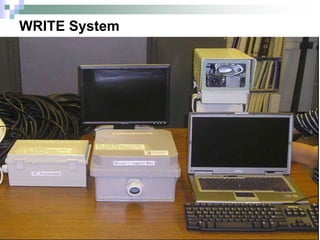
 The developed WRITE system
includes:
 A video camera;
 a digital camera;
 a data processor;
WRITE System
 an AC transformer;
 two antennas;
 A laptop computer as shown in Fig 1.
 The preliminary test results indicated that
the developed system can measure the
on-site construction productivity accurately
(Kim 2008)
WRITE System
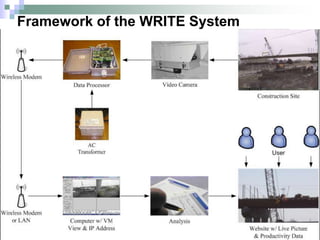
Framework of the WRITE System
Development of the Productivity
Improvement Model
 After building the WRITE System;
 a model for the on-site construction
productivity improvement was developed.
In this model:
 the first task is to collect pictorial data in the
construction site using the WRITE System.
Development of the Productivity
Improvement Model
The second task is:
 to determine the real-time productivity data
which is the ratio of working and
nonworking time.
The third task is:
 to compare the real-time productivity data
with the productivity benchmark data.
WRITE System
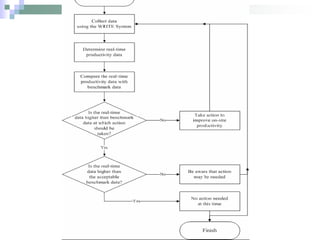
During the comparison,
 Management team MUST answer two
questions, and then make productivity
improvement decisions accordingly.
The first question
 whether the real-time productivity data is
higher than the benchmark data at which
action should be taken.
WRITE System
If the answer for this question is no,
 management needs to take action
immediately to improve the on-site
productivity.
If it is yes,
 management goes to the next stage to
compare the real-time data with the
acceptable benchmark data.
WRITE System
 If the real-time data is > than the acceptable
benchmark data,
 No action is needed.
 Otherwise, management needs to be aware that
action may be needed in the near future.
 It follows with a close monitoring at the construction
site.
 The developed model can be utilized for the entire
period of construction or for the segments of
construction.
WRITE System
Work Breakdown Structure (WBS)
 The work breakdown structure (WBS) has
been widely used to manage the project.
 WBS is defined as “a deliverable-oriented
grouping of project elements”.
 which organizes and defines the hierarchical
structure of the entire project (Jung and Woo
2004).
WRITE System
 It is often used in the complex construction
projects.
 To identify project information.
 Improve the efficiency of control
processes.
WRITE System
 A WBS shows the relationship of all
project activities.
 It is at important and decisive levels.
 WBS makes each activity more
manageable and measurable.
 The number of levels depends on the
size and complexity of the projects (U.S.
Department of Energy 1997).
On-Site Construction Productivity Using
the WRITE System
 The bridge reconstruction project used in
the field experiments was broken down
into four levels. They are:
 including Level 1 (project)
 Level 2 (work zone)
 Level 3 (activity)
 and Level 4 (operation)
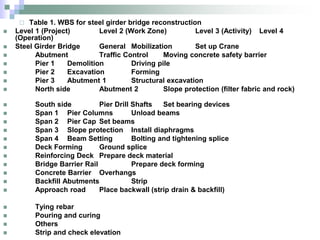
 Examples of the levels of steel girder
bridge WBSs are shown in Table 1.
 Table 1. WBS for steel girder bridge reconstruction
 Level 1 (Project) Level 2 (Work Zone) Level 3 (Activity) Level 4
(Operation)
 Steel Girder Bridge General Mobilization Set up Crane
 Abutment Traffic Control Moving concrete safety barrier
 Pier 1 Demolition Driving pile
 Pier 2 Excavation Forming
 Pier 3 Abutment 1 Structural excavation
 North side Abutment 2 Slope protection (filter fabric and rock)
 South side Pier Drill Shafts Set bearing devices
 Span 1 Pier Columns Unload beams
 Span 2 Pier Cap Set beams
 Span 3 Slope protection Install diaphragms
 Span 4 Beam Setting Bolting and tightening splice
 Deck Forming Ground splice
 Reinforcing Deck Prepare deck material
 Bridge Barrier Rail Prepare deck forming
 Concrete Barrier Overhangs
 Backfill Abutments Strip
 Approach road Place backwall (strip drain & backfill)
 Tying rebar
 Pouring and curing
 Others
 Strip and check elevation
WRITE System
Determining Productivity Benchmark Data
 Benchmarking has been used as a tool to
improve productivity since the early 1980s.
 The Construction Industry Institute (CII) has
established construction productivity metrics
and a reporting format for construction
productivity benchmarking and improvement
(Han et al. 2005).
WRITE System
 Actual working time of construction
workers is at 56% in nuclear plant
construction projects (Hewage and
Ruwanpura 2006).
 Christian and Hachey (1995)
studied concrete-placement
operations. Their finding showed
that:
WRITE System
 There are 61% working time and
39% nonworking time.
 According to the previous
research projects, the ratio of
working time and nonworking time
ranges approximately from 50:50
to 60:40.
WRITE System
 There is no consensus on the
acceptance ratio of working time verse
nonworking time in the construction
industry.
 because construction projects have
different natures such as different
types of projects, activities, and
operations.
WRITE System
 Productive and non-productive
time for five bridge operations
were identified as:
 deck forming
 tying rebar
 installing finisher
WRITE System
 backfilling
 and placing approach road footing.
 A total of 66 hours of video tapes were
recorded using the WRITE System to
determine the productivity rates for the
five bridge operations.
On-Site Construction Productivity Using
the WRITE System
 These videos were all taken zoomed-in to
clearly identify:
 the productive time;
 nonworking;
 time for each operation.
 The ratio of productive and non-productive
time was: 86% and 14% on average as
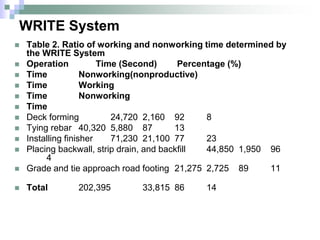
shown in Table 2.
WRITE System
 Table 2. Ratio of working and nonworking time determined by
the WRITE System
 Operation Time (Second) Percentage (%)
 Time Nonworking(nonproductive)
 Time Working
 Time Nonworking
 Time
 Deck forming 24,720 2,160 92 8
 Tying rebar 40,320 5,880 87 13
 Installing finisher 71,230 21,100 77 23
 Placing backwall, strip drain, and backfill 44,850 1,950 96
4
 Grade and tie approach road footing 21,275 2,725 89 11
 Total 202,395 33,815 86 14
WRITE System
 The benchmark data were based on
professional intuitions about rates of
working time and nonworking time for
each of the five bridge construction
operations.
WRITE System
 Table 3. List of survey construction
professionals
 Name Company Construction Specialty
Position
 Ken Johnson BRB contractors, Inc. Bridge
Project Manager
 Mike Laird BRB contractors, Inc. Bridge and
Plant Project Manager
 Ray Rinne A.M. Cohron & Son, Inc.
 Bridge Superintendent
 Christopher J. Rech A.M. Cohron & Son, Inc.
Bridge Project Manager
WRITE System
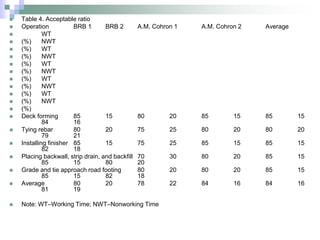
 Table 4 shows acceptable ratios provided
by four survey participants.
 The overall average ratio for working time
(WT) was 81%
 and overall average ratio for nonworking
time (NWT) was 19%.
 Tying rebar had the highest nonworking
ratio of 21%,
 while deck forming had the lowest rate of
16%. T
On-Site Construction Productivity Using
the WRITE System
 According to the survey participants, they
can accept the working time ratio of at least
79% for these bridge operations.
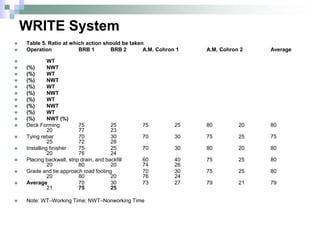
 Table 5 presents ratios at which action
should be taken by project managers to
improve on-site construction productivity.
WRITE System
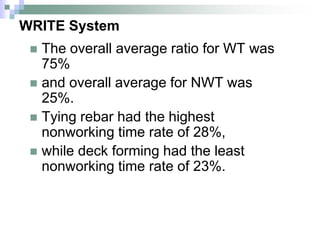
 The overall average ratio for WT was
75%
 and overall average for NWT was
25%.
 Tying rebar had the highest
nonworking time rate of 28%,
 while deck forming had the least
nonworking time rate of 23%.
 Table 4. Acceptable ratio
 Operation BRB 1 BRB 2 A.M. Cohron 1 A.M. Cohron 2 Average
 WT
 (%) NWT
 (%) WT
 (%) NWT
 (%) WT
 (%) NWT
 (%) WT
 (%) NWT
 (%) WT
 (%) NWT
 (%)
 Deck forming 85 15 80 20 85 15 85 15
84 16
 Tying rebar 80 20 75 25 80 20 80 20
79 21
 Installing finisher 85 15 75 25 85 15 85 15
82 18
 Placing backwall, strip drain, and backfill 70 30 80 20 85 15
85 15 80 20
 Grade and tie approach road footing 80 20 80 20 85 15
85 15 82 18
 Average 80 20 78 22 84 16 84 16
81 19
 Note: WT–Working Time; NWT–Nonworking Time
WRITE System
 Table 5. Ratio at which action should be taken
 Operation BRB 1 BRB 2 A.M. Cohron 1 A.M. Cohron 2 Average
 WT
 (%) NWT
 (%) WT
 (%) NWT
 (%) WT
 (%) NWT
 (%) WT
 (%) NWT
 (%) WT
 (%) NWT (%)
 Deck Forming 75 25 75 25 80 20 80
20 77 23
 Tying rebar 70 30 70 30 75 25 75
25 72 28
 Installing finisher 75 25 70 30 80 20 80
20 76 24
 Placing backwall, strip drain, and backfill 60 40 75 25 80
20 80 20 74 26
 Grade and tie approach road footing 70 30 75 25 80
20 80 20 76 24
 Average 70 30 73 27 79 21 79
21 75 25
 Note: WT–Working Time; NWT–Nonworking Time
WRITE System
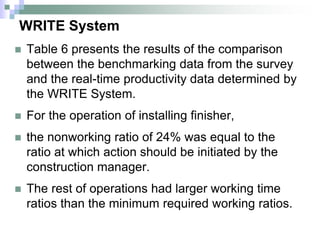
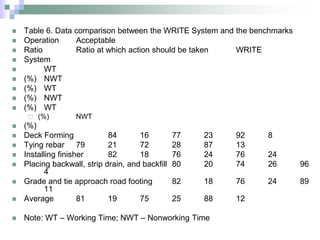
 Table 6 presents the results of the comparison
between the benchmarking data from the survey
and the real-time productivity data determined by
the WRITE System.
 For the operation of installing finisher,
 the nonworking ratio of 24% was equal to the
ratio at which action should be initiated by the
construction manager.
 The rest of operations had larger working time
ratios than the minimum required working ratios.
 Table 6. Data comparison between the WRITE System and the benchmarks
 Operation Acceptable
 Ratio Ratio at which action should be taken WRITE
 System
 WT
 (%) NWT
 (%) WT
 (%) NWT
 (%) WT
 (%) NWT
 (%)
 Deck Forming 84 16 77 23 92 8
 Tying rebar 79 21 72 28 87 13
 Installing finisher 82 18 76 24 76 24
 Placing backwall, strip drain, and backfill 80 20 74 26 96
4
 Grade and tie approach road footing 82 18 76 24 89
11
 Average 81 19 75 25 88 12
 Note: WT – Working Time; NWT – Nonworking Time
WRITE System
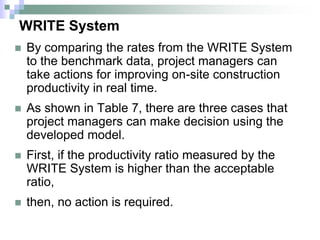
 By comparing the rates from the WRITE System
to the benchmark data, project managers can
take actions for improving on-site construction
productivity in real time.
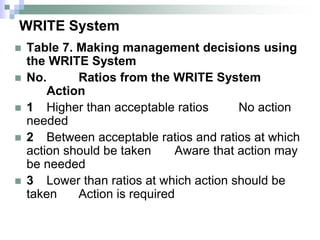
 As shown in Table 7, there are three cases that
project managers can make decision using the
developed model.
 First, if the productivity ratio measured by the
WRITE System is higher than the acceptable
ratio,
 then, no action is required.
WRITE System
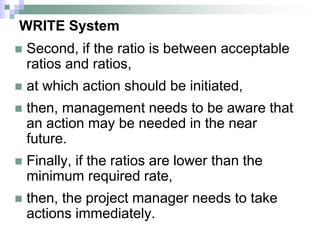
 Second, if the ratio is between acceptable
ratios and ratios,
 at which action should be initiated,
 then, management needs to be aware that
an action may be needed in the near
future.
 Finally, if the ratios are lower than the
minimum required rate,
 then, the project manager needs to take
actions immediately.
WRITE System
 Table 7. Making management decisions using
the WRITE System
 No. Ratios from the WRITE System
Action
 1 Higher than acceptable ratios No action
needed
 2 Between acceptable ratios and ratios at which
action should be taken Aware that action may
be needed
 3 Lower than ratios at which action should be
taken Action is required

022 b construction productivity-write

  • 1.
  • 2.
    On-Site Construction ProductivityUsing the WRITE System  Existing construction productivity measurement techniques are not capable of providing the real-time productivity data to project managers and engineers for analyses and sharing the data among participants involved in construction operations.
  • 3.
    On-Site Construction ProductivityUsing the WRITE System  On-site productivity problems cannot be taken just in time.  To address these shortfalls, the Wireless Real- time Productivity Measurement (WRITE) System was developed.  it can measure the on-site construction productivity in real time.  In addition, an on-site construction productivity improvement model using the WRITE System and the benchmark data was developed.
  • 4.
    WRITE System Objective Approach- The real-time productivity data measured by the WRITE System was compared to the benchmark productivity data.  The results of the comparison provided the necessary information for:  project management team to determine if immediate actions should be taken
  • 5.
    WRITE System  Secondly,it provides an advanced technology for managers to determine on-site construction productivity in real time.  Improving on-site could be taken just in time if needed.  These advancements enhance the contractors’ capability of managing construction projects.
  • 6.
    WRITE System  Productivitydata have been widely used as performance indicators:  to evaluate construction operations throughout the entire phase of construction.  Construction companies must continuously track productivity in order to measure their performance. 1. Maintain profitability 2. Prepare future biddings
  • 7.
    WRITE System  Measuringproductivity on site has been an important task in the construction industry.  In the past many On-site productivity measurement techniques have been developed. They include:  questionnaires  stopwatch studies  photography  time-lapse videos  video-taping
  • 8.
    WRITE System  Inrecent years, real-time monitoring systems have become key methods to reduce the gap between: 1. Actual 2. planned production rates In an effective way.
  • 9.
    On-Site Construction ProductivityUsing the WRITE System  A real-time video system was developed by Everett and Slocum.  For monitor lifting activities of crane in attempts to improve both productivity and safety of crane operations.
  • 10.
    WRITE System Since 2000, wireless technologies, such as:  global positioning system (GPS)  radio frequency identification (RFID) system, were utilized  Have been adopted in construction In order to track the current status of the resources and activities.
  • 11.
    On-Site Construction ProductivityUsing the WRITE System  A GPS technology was used to automatically measure earthmoving performance.  It is by identifying the locations of equipment at regular time intervals,  Converting the information into project productivity (Navon and Shpatnitsky 2005).
  • 12.
    WRITE System  Aweb-based camera was used to monitor interior construction operations.  This web-based network technology produced an opportunity to avoid using a wired network connection.  In a congested construction jobsite not a good idea (Kang and Choi 2005).
  • 13.
    On-Site Construction ProductivityUsing the WRITE System  Existing on-site construction productivity measurement methods have some common limitations.  They are unable to provide the real-time productivity data for analyses, and sharing the data among participants.
  • 14.
    WRITE System DEVELOPMENT OFWRITE SYTEM  The developed WRITE system includes:  A video camera;  a digital camera;  a data processor;
  • 15.
    WRITE System  anAC transformer;  two antennas;  A laptop computer as shown in Fig 1.  The preliminary test results indicated that the developed system can measure the on-site construction productivity accurately (Kim 2008)
  • 16.
  • 17.
    Framework of theWRITE System
  • 18.
    Development of theProductivity Improvement Model  After building the WRITE System;  a model for the on-site construction productivity improvement was developed. In this model:  the first task is to collect pictorial data in the construction site using the WRITE System.
  • 19.
    Development of theProductivity Improvement Model The second task is:  to determine the real-time productivity data which is the ratio of working and nonworking time. The third task is:  to compare the real-time productivity data with the productivity benchmark data.
  • 20.
    WRITE System During thecomparison,  Management team MUST answer two questions, and then make productivity improvement decisions accordingly. The first question  whether the real-time productivity data is higher than the benchmark data at which action should be taken.
  • 21.
    WRITE System If theanswer for this question is no,  management needs to take action immediately to improve the on-site productivity. If it is yes,  management goes to the next stage to compare the real-time data with the acceptable benchmark data.
  • 22.
    WRITE System  Ifthe real-time data is > than the acceptable benchmark data,  No action is needed.  Otherwise, management needs to be aware that action may be needed in the near future.  It follows with a close monitoring at the construction site.  The developed model can be utilized for the entire period of construction or for the segments of construction.
  • 24.
    WRITE System Work BreakdownStructure (WBS)  The work breakdown structure (WBS) has been widely used to manage the project.  WBS is defined as “a deliverable-oriented grouping of project elements”.  which organizes and defines the hierarchical structure of the entire project (Jung and Woo 2004).
  • 25.
    WRITE System  Itis often used in the complex construction projects.  To identify project information.  Improve the efficiency of control processes.
  • 26.
    WRITE System  AWBS shows the relationship of all project activities.  It is at important and decisive levels.  WBS makes each activity more manageable and measurable.  The number of levels depends on the size and complexity of the projects (U.S. Department of Energy 1997).
  • 27.
    On-Site Construction ProductivityUsing the WRITE System  The bridge reconstruction project used in the field experiments was broken down into four levels. They are:  including Level 1 (project)  Level 2 (work zone)  Level 3 (activity)  and Level 4 (operation)  Examples of the levels of steel girder bridge WBSs are shown in Table 1.
  • 28.
     Table 1.WBS for steel girder bridge reconstruction  Level 1 (Project) Level 2 (Work Zone) Level 3 (Activity) Level 4 (Operation)  Steel Girder Bridge General Mobilization Set up Crane  Abutment Traffic Control Moving concrete safety barrier  Pier 1 Demolition Driving pile  Pier 2 Excavation Forming  Pier 3 Abutment 1 Structural excavation  North side Abutment 2 Slope protection (filter fabric and rock)  South side Pier Drill Shafts Set bearing devices  Span 1 Pier Columns Unload beams  Span 2 Pier Cap Set beams  Span 3 Slope protection Install diaphragms  Span 4 Beam Setting Bolting and tightening splice  Deck Forming Ground splice  Reinforcing Deck Prepare deck material  Bridge Barrier Rail Prepare deck forming  Concrete Barrier Overhangs  Backfill Abutments Strip  Approach road Place backwall (strip drain & backfill)  Tying rebar  Pouring and curing  Others  Strip and check elevation
  • 29.
    WRITE System Determining ProductivityBenchmark Data  Benchmarking has been used as a tool to improve productivity since the early 1980s.  The Construction Industry Institute (CII) has established construction productivity metrics and a reporting format for construction productivity benchmarking and improvement (Han et al. 2005).
  • 30.
    WRITE System  Actualworking time of construction workers is at 56% in nuclear plant construction projects (Hewage and Ruwanpura 2006).  Christian and Hachey (1995) studied concrete-placement operations. Their finding showed that:
  • 31.
    WRITE System  Thereare 61% working time and 39% nonworking time.  According to the previous research projects, the ratio of working time and nonworking time ranges approximately from 50:50 to 60:40.
  • 32.
    WRITE System  Thereis no consensus on the acceptance ratio of working time verse nonworking time in the construction industry.  because construction projects have different natures such as different types of projects, activities, and operations.
  • 33.
    WRITE System  Productiveand non-productive time for five bridge operations were identified as:  deck forming  tying rebar  installing finisher
  • 34.
    WRITE System  backfilling and placing approach road footing.  A total of 66 hours of video tapes were recorded using the WRITE System to determine the productivity rates for the five bridge operations.
  • 35.
    On-Site Construction ProductivityUsing the WRITE System  These videos were all taken zoomed-in to clearly identify:  the productive time;  nonworking;  time for each operation.  The ratio of productive and non-productive time was: 86% and 14% on average as shown in Table 2.
  • 36.
    WRITE System  Table2. Ratio of working and nonworking time determined by the WRITE System  Operation Time (Second) Percentage (%)  Time Nonworking(nonproductive)  Time Working  Time Nonworking  Time  Deck forming 24,720 2,160 92 8  Tying rebar 40,320 5,880 87 13  Installing finisher 71,230 21,100 77 23  Placing backwall, strip drain, and backfill 44,850 1,950 96 4  Grade and tie approach road footing 21,275 2,725 89 11  Total 202,395 33,815 86 14
  • 37.
    WRITE System  Thebenchmark data were based on professional intuitions about rates of working time and nonworking time for each of the five bridge construction operations.
  • 38.
    WRITE System  Table3. List of survey construction professionals  Name Company Construction Specialty Position  Ken Johnson BRB contractors, Inc. Bridge Project Manager  Mike Laird BRB contractors, Inc. Bridge and Plant Project Manager  Ray Rinne A.M. Cohron & Son, Inc.  Bridge Superintendent  Christopher J. Rech A.M. Cohron & Son, Inc. Bridge Project Manager
  • 39.
    WRITE System  Table4 shows acceptable ratios provided by four survey participants.  The overall average ratio for working time (WT) was 81%  and overall average ratio for nonworking time (NWT) was 19%.  Tying rebar had the highest nonworking ratio of 21%,  while deck forming had the lowest rate of 16%. T
  • 40.
    On-Site Construction ProductivityUsing the WRITE System  According to the survey participants, they can accept the working time ratio of at least 79% for these bridge operations.  Table 5 presents ratios at which action should be taken by project managers to improve on-site construction productivity.
  • 41.
    WRITE System  Theoverall average ratio for WT was 75%  and overall average for NWT was 25%.  Tying rebar had the highest nonworking time rate of 28%,  while deck forming had the least nonworking time rate of 23%.
  • 42.
     Table 4.Acceptable ratio  Operation BRB 1 BRB 2 A.M. Cohron 1 A.M. Cohron 2 Average  WT  (%) NWT  (%) WT  (%) NWT  (%) WT  (%) NWT  (%) WT  (%) NWT  (%) WT  (%) NWT  (%)  Deck forming 85 15 80 20 85 15 85 15 84 16  Tying rebar 80 20 75 25 80 20 80 20 79 21  Installing finisher 85 15 75 25 85 15 85 15 82 18  Placing backwall, strip drain, and backfill 70 30 80 20 85 15 85 15 80 20  Grade and tie approach road footing 80 20 80 20 85 15 85 15 82 18  Average 80 20 78 22 84 16 84 16 81 19  Note: WT–Working Time; NWT–Nonworking Time
  • 43.
    WRITE System  Table5. Ratio at which action should be taken  Operation BRB 1 BRB 2 A.M. Cohron 1 A.M. Cohron 2 Average  WT  (%) NWT  (%) WT  (%) NWT  (%) WT  (%) NWT  (%) WT  (%) NWT  (%) WT  (%) NWT (%)  Deck Forming 75 25 75 25 80 20 80 20 77 23  Tying rebar 70 30 70 30 75 25 75 25 72 28  Installing finisher 75 25 70 30 80 20 80 20 76 24  Placing backwall, strip drain, and backfill 60 40 75 25 80 20 80 20 74 26  Grade and tie approach road footing 70 30 75 25 80 20 80 20 76 24  Average 70 30 73 27 79 21 79 21 75 25  Note: WT–Working Time; NWT–Nonworking Time
  • 44.
    WRITE System  Table6 presents the results of the comparison between the benchmarking data from the survey and the real-time productivity data determined by the WRITE System.  For the operation of installing finisher,  the nonworking ratio of 24% was equal to the ratio at which action should be initiated by the construction manager.  The rest of operations had larger working time ratios than the minimum required working ratios.
  • 45.
     Table 6.Data comparison between the WRITE System and the benchmarks  Operation Acceptable  Ratio Ratio at which action should be taken WRITE  System  WT  (%) NWT  (%) WT  (%) NWT  (%) WT  (%) NWT  (%)  Deck Forming 84 16 77 23 92 8  Tying rebar 79 21 72 28 87 13  Installing finisher 82 18 76 24 76 24  Placing backwall, strip drain, and backfill 80 20 74 26 96 4  Grade and tie approach road footing 82 18 76 24 89 11  Average 81 19 75 25 88 12  Note: WT – Working Time; NWT – Nonworking Time
  • 46.
    WRITE System  Bycomparing the rates from the WRITE System to the benchmark data, project managers can take actions for improving on-site construction productivity in real time.  As shown in Table 7, there are three cases that project managers can make decision using the developed model.  First, if the productivity ratio measured by the WRITE System is higher than the acceptable ratio,  then, no action is required.
  • 47.
    WRITE System  Second,if the ratio is between acceptable ratios and ratios,  at which action should be initiated,  then, management needs to be aware that an action may be needed in the near future.  Finally, if the ratios are lower than the minimum required rate,  then, the project manager needs to take actions immediately.
  • 48.
    WRITE System  Table7. Making management decisions using the WRITE System  No. Ratios from the WRITE System Action  1 Higher than acceptable ratios No action needed  2 Between acceptable ratios and ratios at which action should be taken Aware that action may be needed  3 Lower than ratios at which action should be taken Action is required