MANAGEMENT FOR
FAST TRACKING
CONSTRUCTION
helpdesk@construction-productivity.co.uk
htt://www.construction-productivity.
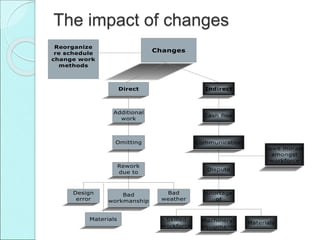
The impact of changes
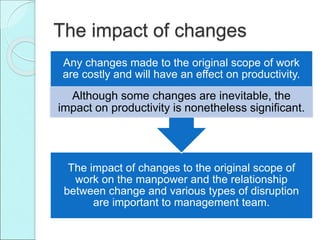
The impact of changes to the original scope of
work on the manpower and the relationship
between change and various types of disruption
are important to management team.
Any changes made to the original scope of work
are costly and will have an effect on productivity.
Although some changes are inevitable, the
impact on productivity is nonetheless significant.
The impact of changes
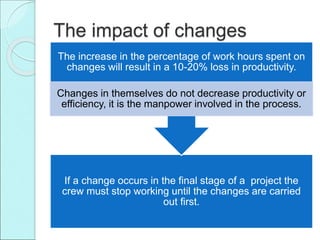
If a change occurs in the final stage of a project the
crew must stop working until the changes are carried
out first.
The increase in the percentage of work hours spent on
changes will result in a 10-20% loss in productivity.
Changes in themselves do not decrease productivity or
efficiency, it is the manpower involved in the process.
The impact of changes
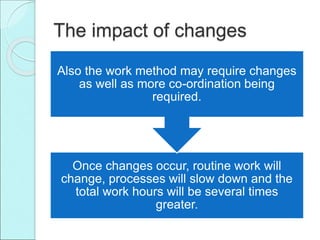
Once changes occur, routine work will
change, processes will slow down and the
total work hours will be several times
greater.
Also the work method may require changes
as well as more co-ordination being
required.
The impact of changes
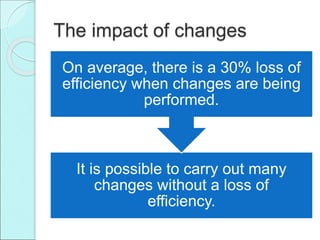
It is possible to carry out many
changes without a loss of
efficiency.
On average, there is a 30% loss of
efficiency when changes are being
performed.
The impact of changes
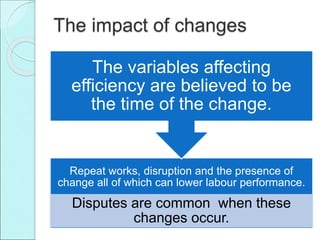
Repeat works, disruption and the presence of
change all of which can lower labour performance.
Disputes are common when these
changes occur.
The variables affecting
efficiency are believed to be
the time of the change.
The impact of changes
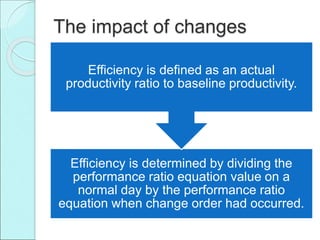
Efficiency is determined by dividing the
performance ratio equation value on a
normal day by the performance ratio
equation when change order had occurred.
Efficiency is defined as an actual
productivity ratio to baseline productivity.
The impact of changes
Fast-tracked-Impact of
changes
Fast-tracked-
Impact of
changes
• Any changes to original plan will
delay project completion time.
Fast-tracked-
Impact of
changes
• If a project is fast-tracked without
proper planning, those changes
can cause the disruption of the
construction process.
Fast-tracked-Impact of changes
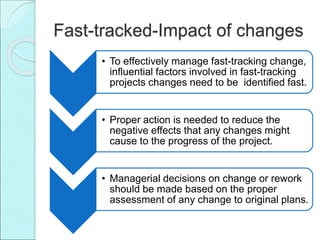
• To effectively manage fast-tracking change,
influential factors involved in fast-tracking
projects changes need to be identified fast.
• Proper action is needed to reduce the
negative effects that any changes might
cause to the progress of the project.
• Managerial decisions on change or rework
should be made based on the proper
assessment of any change to original plans.
Fast-tracked-Impact of changes
Fast-tracked-
Impact of
changes
• Shortening project completion
time has been one of the most
critical factors for productivity
improvement in many industries.
Fast-tracked-
Impact of
changes
• To ensure a faster product
development is possible by
reducing product cycle time
through concurrent development.
Fast-tracked-Impact of changes
Fast-
tracked
• The increasing preference of project owners
and managers to fast-track construction proves
the popularity of concurrent development in
construction.
Fast-
tracked
• Concurrent construction also has greater
potential to impact the project development
process than the traditional methods.
Fast-
tracked
• Potential problems is considered to be
increased level of uncertainty
Fast-tracked-Impact of changes
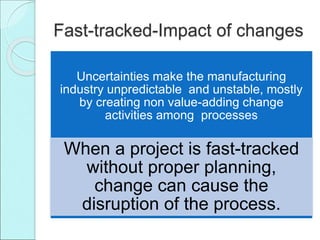
Uncertainties make the manufacturing
industry unpredictable and unstable, mostly
by creating non value-adding change
activities among processes
When a project is fast-tracked
without proper planning,
change can cause the
disruption of the process.
Types of Changes for fast-
tracked
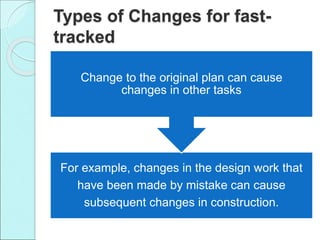
For example, changes in the design work that
have been made by mistake can cause
subsequent changes in construction.
Change to the original plan can cause
changes in other tasks
Fast-tracked-Impact of changes
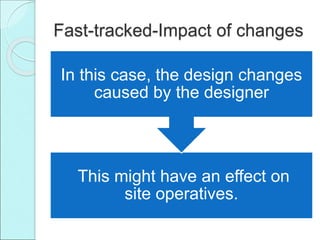
This might have an effect on
site operatives.
In this case, the design changes
caused by the designer
Fast-tracked-Impact of changes
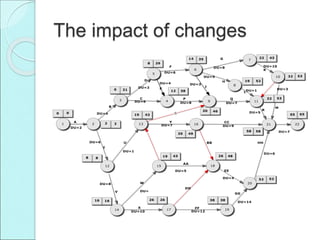
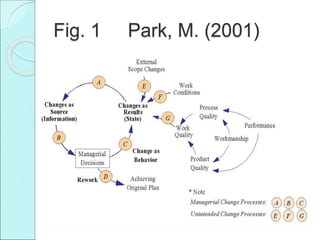
As illustrated in Figure 1, once changes occur
during an operation (A and B), changes result
in either subsequent changes (C) or rework
(D), depending on managerial decisions.
The arrows labelled E, F, and G in Figure 1
illustrate the unintended change process.
Fig. 1 Park, M. (2001)

029 fast-tracking projects

  • 1.
  • 2.
    The impact ofchanges The impact of changes to the original scope of work on the manpower and the relationship between change and various types of disruption are important to management team. Any changes made to the original scope of work are costly and will have an effect on productivity. Although some changes are inevitable, the impact on productivity is nonetheless significant.
  • 3.
    The impact ofchanges If a change occurs in the final stage of a project the crew must stop working until the changes are carried out first. The increase in the percentage of work hours spent on changes will result in a 10-20% loss in productivity. Changes in themselves do not decrease productivity or efficiency, it is the manpower involved in the process.
  • 4.
    The impact ofchanges Once changes occur, routine work will change, processes will slow down and the total work hours will be several times greater. Also the work method may require changes as well as more co-ordination being required.
  • 5.
    The impact ofchanges It is possible to carry out many changes without a loss of efficiency. On average, there is a 30% loss of efficiency when changes are being performed.
  • 6.
    The impact ofchanges Repeat works, disruption and the presence of change all of which can lower labour performance. Disputes are common when these changes occur. The variables affecting efficiency are believed to be the time of the change.
  • 7.
    The impact ofchanges Efficiency is determined by dividing the performance ratio equation value on a normal day by the performance ratio equation when change order had occurred. Efficiency is defined as an actual productivity ratio to baseline productivity.
  • 8.
  • 9.
  • 10.
  • 11.
  • 12.
  • 13.
    Fast-tracked-Impact of changes Fast-tracked- Impact of changes •Any changes to original plan will delay project completion time. Fast-tracked- Impact of changes • If a project is fast-tracked without proper planning, those changes can cause the disruption of the construction process.
  • 14.
    Fast-tracked-Impact of changes •To effectively manage fast-tracking change, influential factors involved in fast-tracking projects changes need to be identified fast. • Proper action is needed to reduce the negative effects that any changes might cause to the progress of the project. • Managerial decisions on change or rework should be made based on the proper assessment of any change to original plans.
  • 15.
    Fast-tracked-Impact of changes Fast-tracked- Impactof changes • Shortening project completion time has been one of the most critical factors for productivity improvement in many industries. Fast-tracked- Impact of changes • To ensure a faster product development is possible by reducing product cycle time through concurrent development.
  • 16.
    Fast-tracked-Impact of changes Fast- tracked •The increasing preference of project owners and managers to fast-track construction proves the popularity of concurrent development in construction. Fast- tracked • Concurrent construction also has greater potential to impact the project development process than the traditional methods. Fast- tracked • Potential problems is considered to be increased level of uncertainty
  • 17.
    Fast-tracked-Impact of changes Uncertaintiesmake the manufacturing industry unpredictable and unstable, mostly by creating non value-adding change activities among processes When a project is fast-tracked without proper planning, change can cause the disruption of the process.
  • 18.
    Types of Changesfor fast- tracked For example, changes in the design work that have been made by mistake can cause subsequent changes in construction. Change to the original plan can cause changes in other tasks
  • 19.
    Fast-tracked-Impact of changes Thismight have an effect on site operatives. In this case, the design changes caused by the designer
  • 20.
    Fast-tracked-Impact of changes Asillustrated in Figure 1, once changes occur during an operation (A and B), changes result in either subsequent changes (C) or rework (D), depending on managerial decisions. The arrows labelled E, F, and G in Figure 1 illustrate the unintended change process.
  • 21.
    Fig. 1 Park,M. (2001)