Limits 2.5 Involving Infinity
2 
Infinite Limits
3 
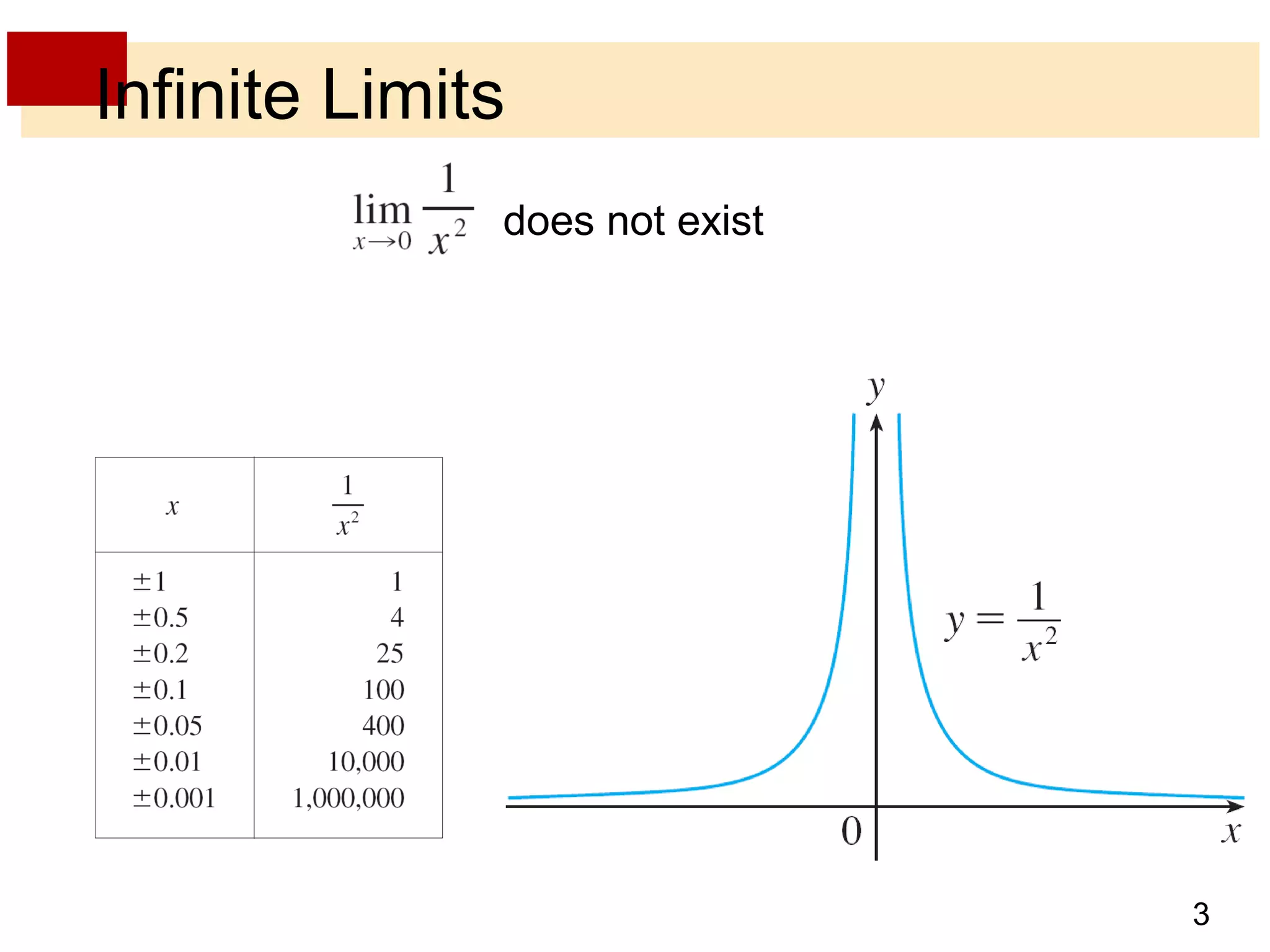
Infinite Limits 
does not exist
4 
Infinite Limits 
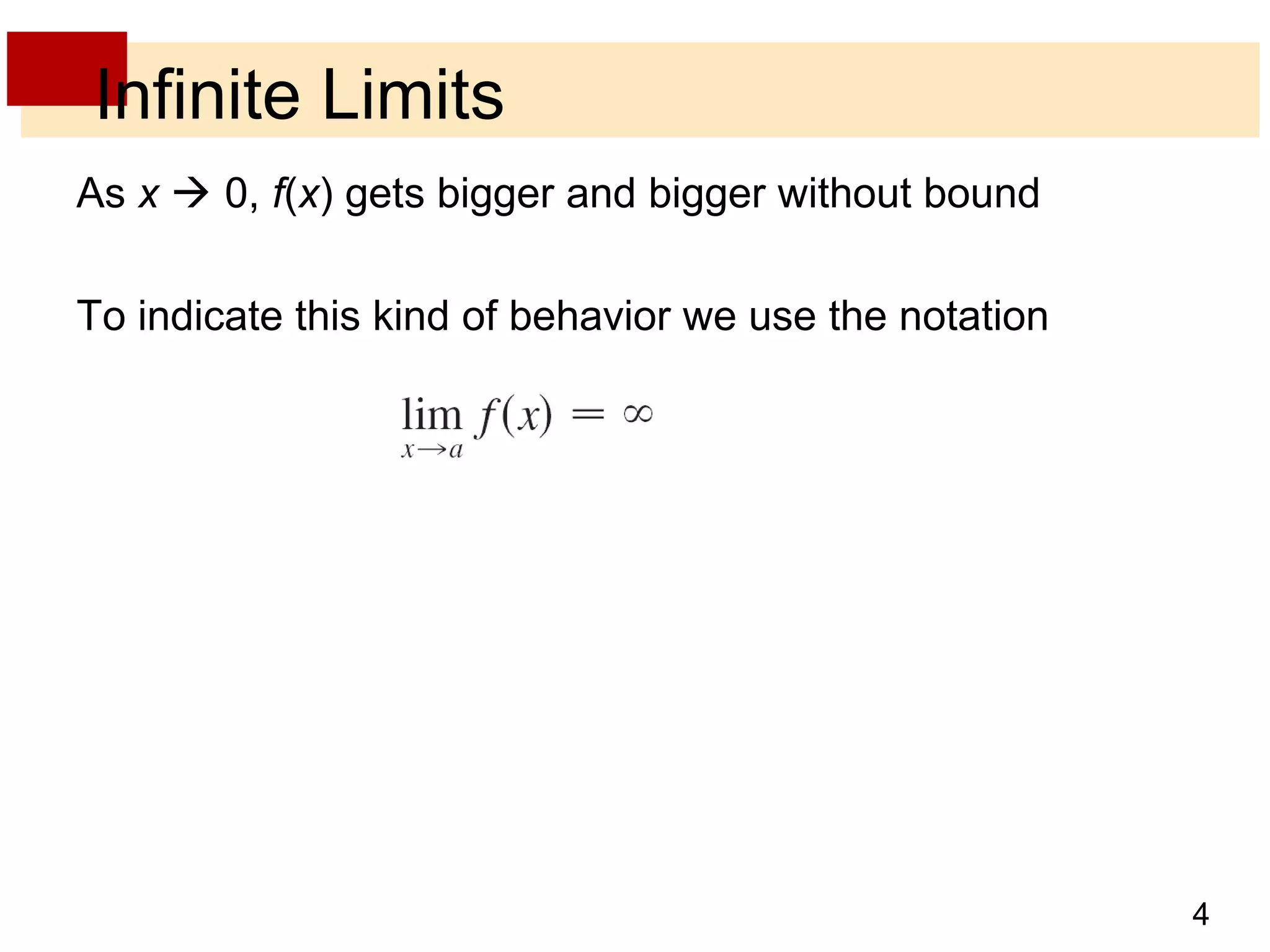
As x  0, f(x) gets bigger and bigger without bound 
To indicate this kind of behavior we use the notation
5 
Infinite Limits 
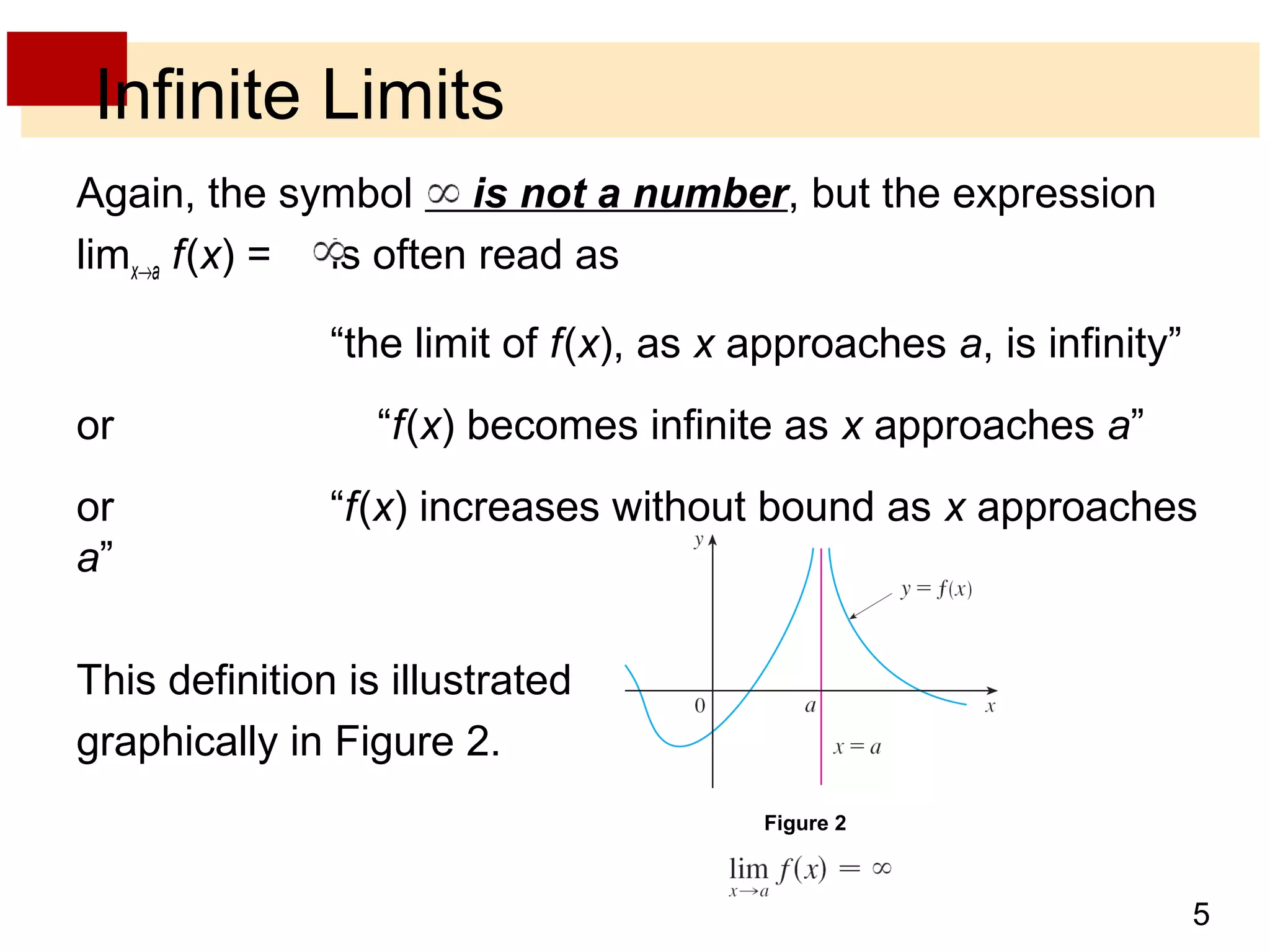
Again, the symbol is not a number, but the expression 
limx®a f (x) = is often read as 
“the limit of f (x), as x approaches a, is infinity” 
or “f (x) becomes infinite as x approaches a” 
or “f (x) increases without bound as x approaches 
a” 
This definition is illustrated 
graphically in Figure 2. 
Figure 2
6 
Infinite Limits 
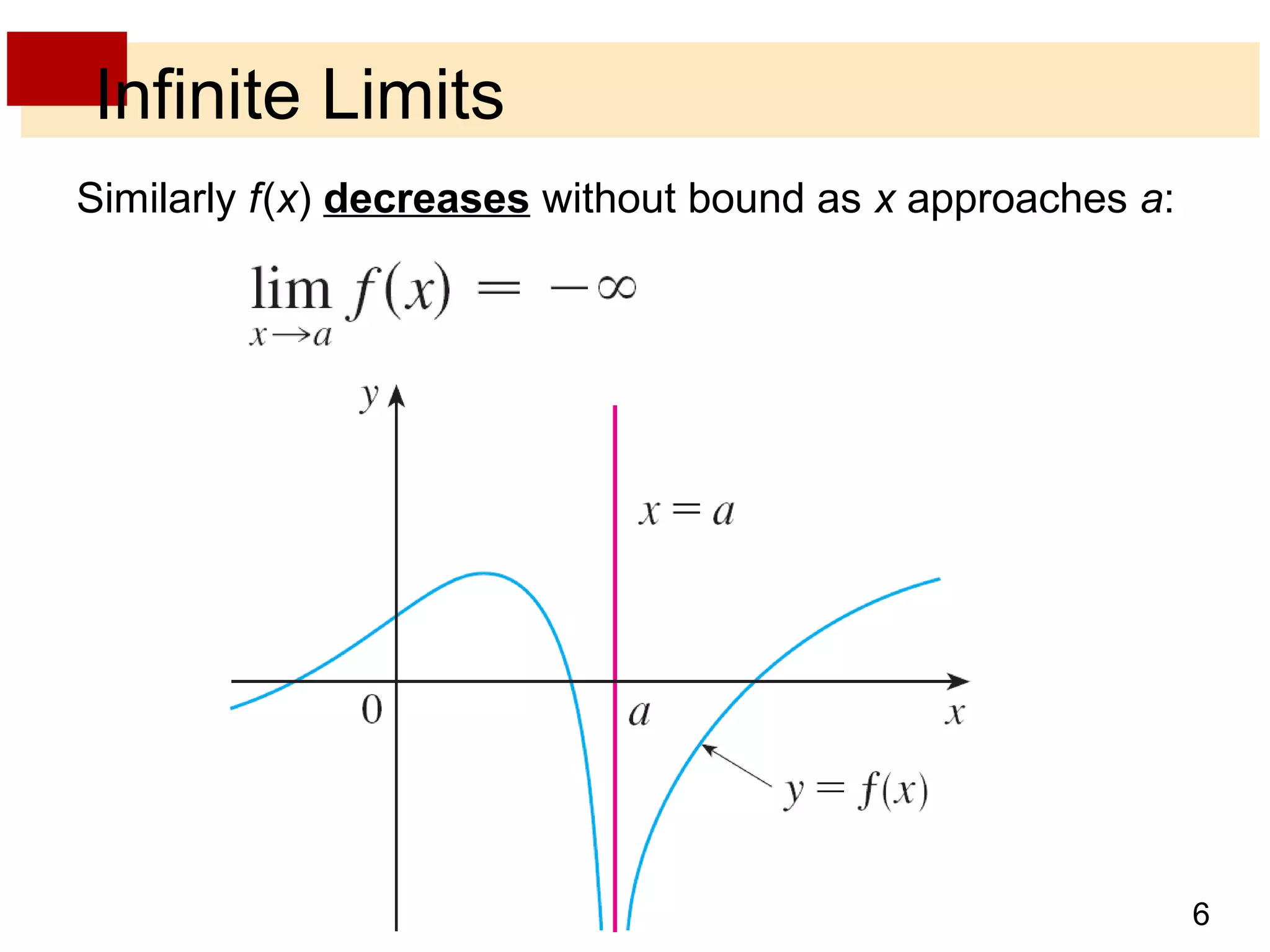
Similarly f (x) decreases without bound as x approaches a:
7 
One-Sided Infinite Limits 
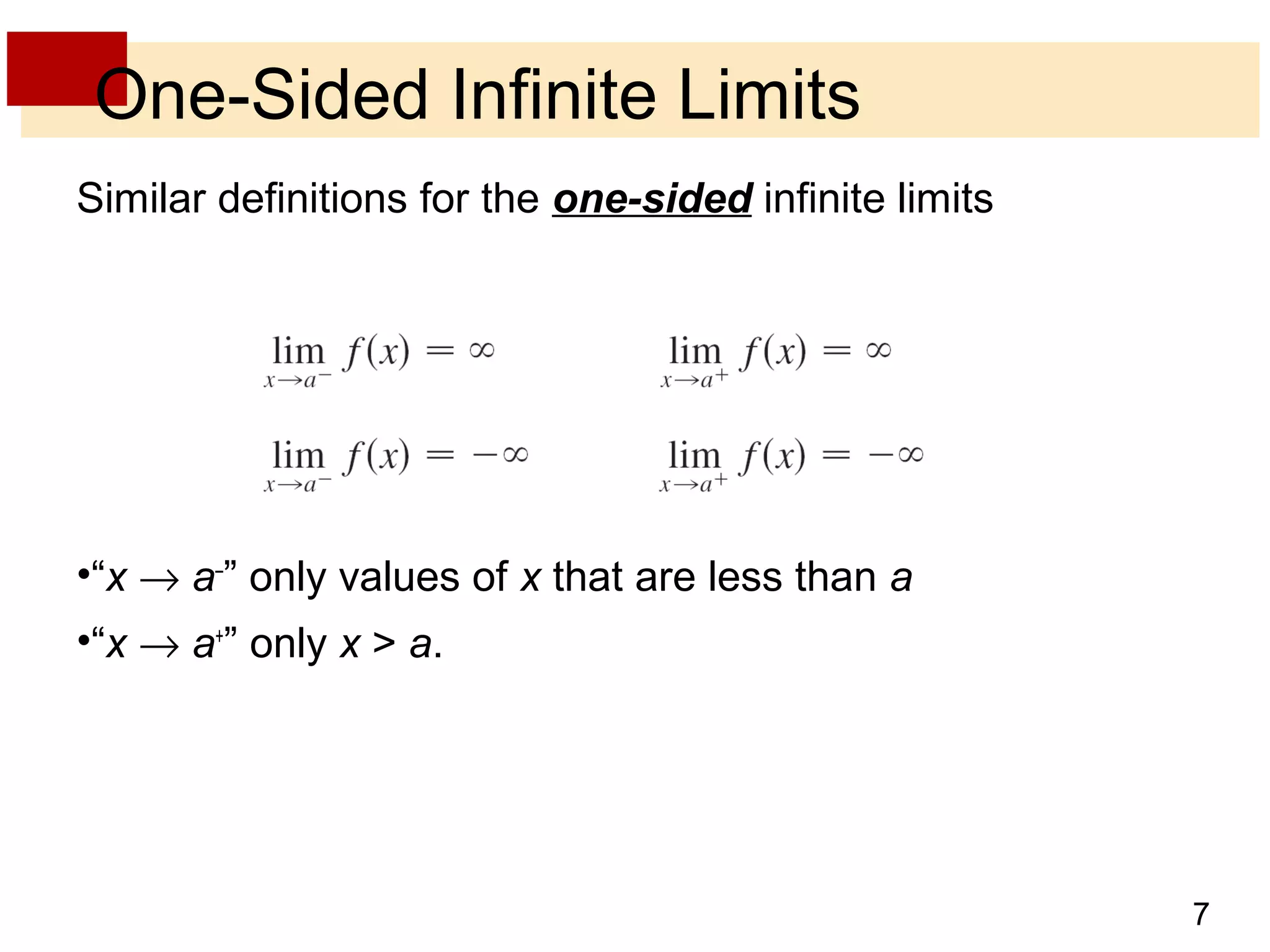
Similar definitions for the one-sided infinite limits 
•“x ® a–” only values of x that are less than a 
•“x ® a+” only x > a.
8 
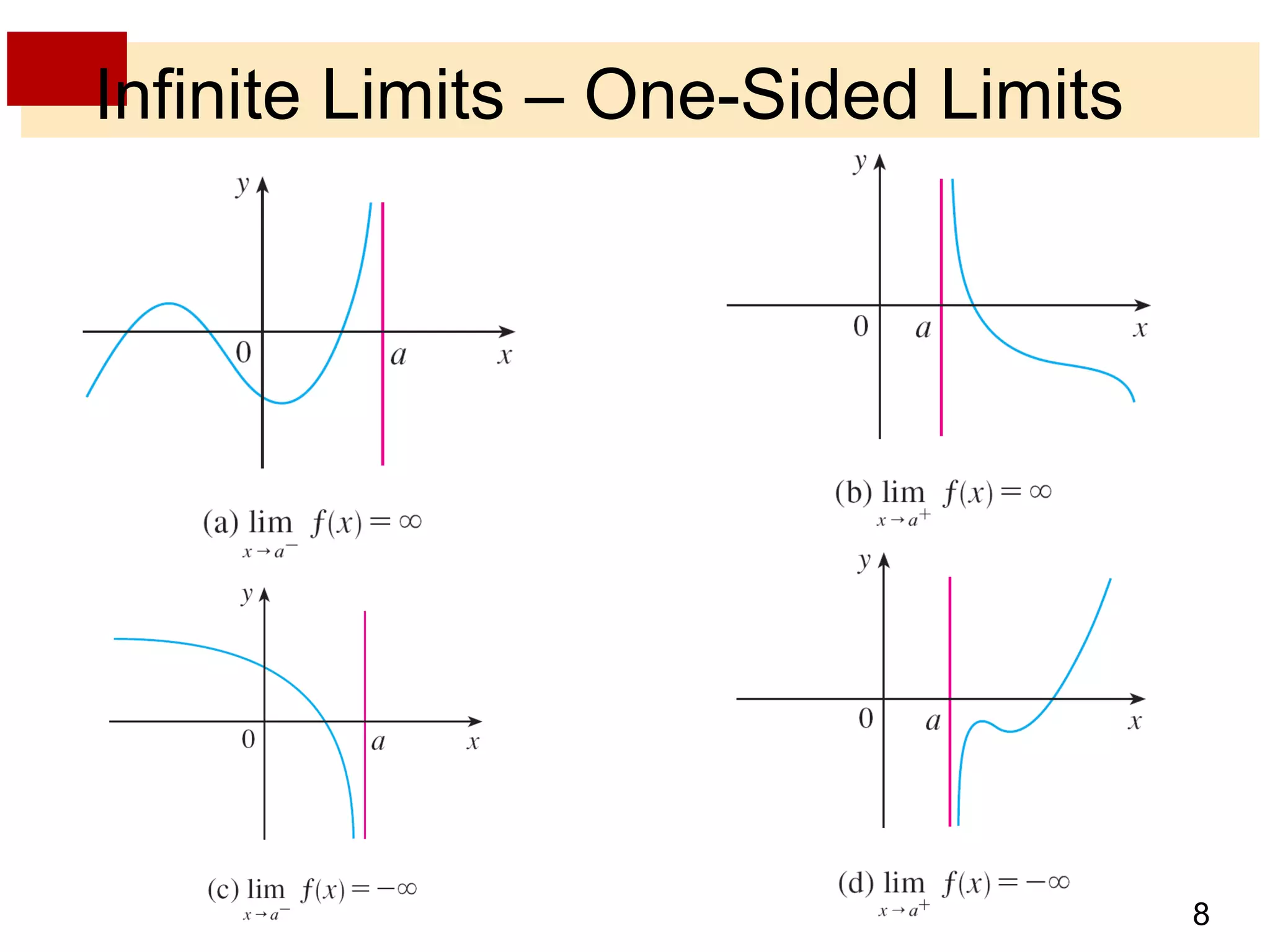
Infinite Limits – One-Sided Limits
9 
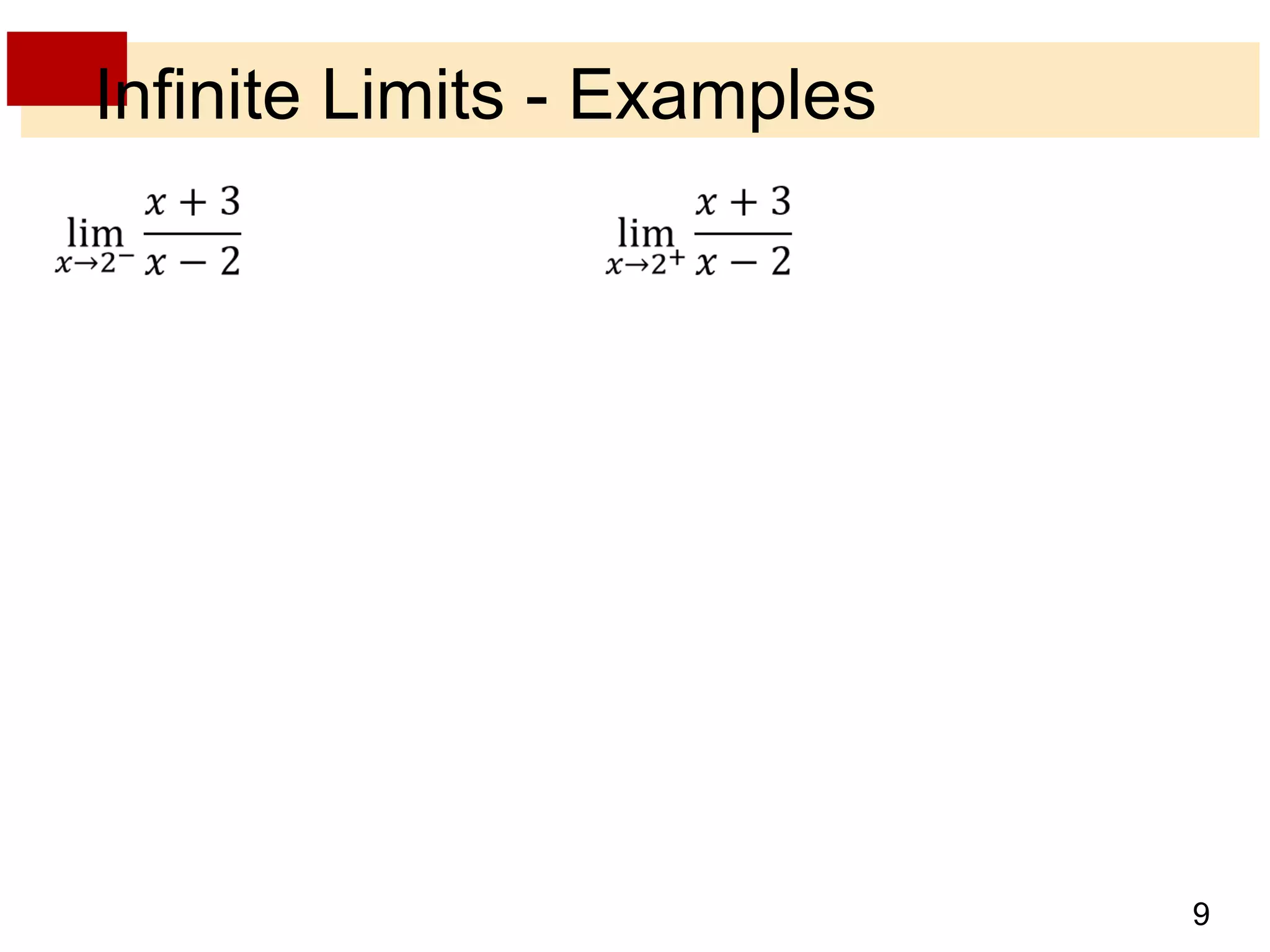
Infinite Limits - Examples
10 
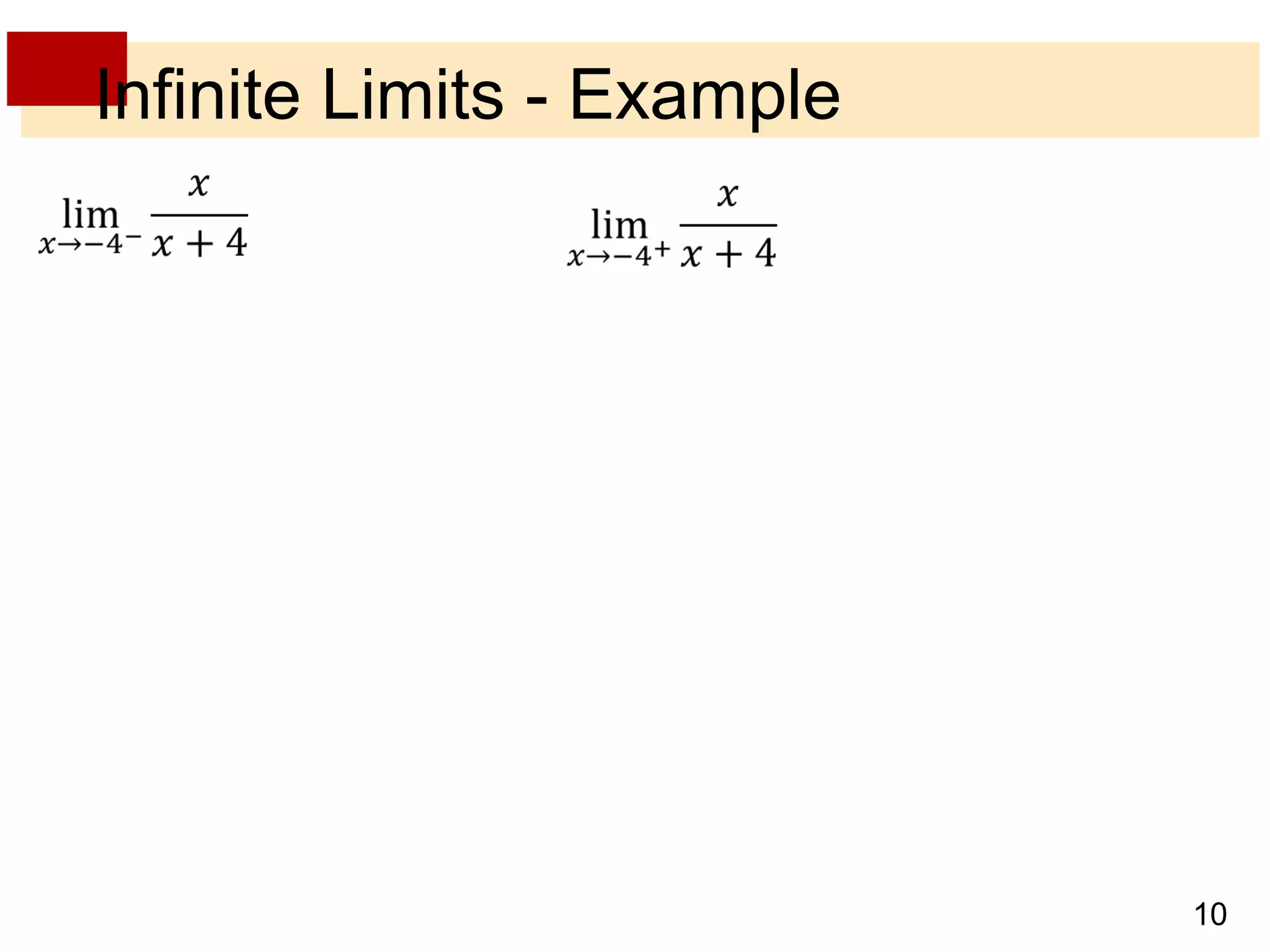
Infinite Limits - Example
11 
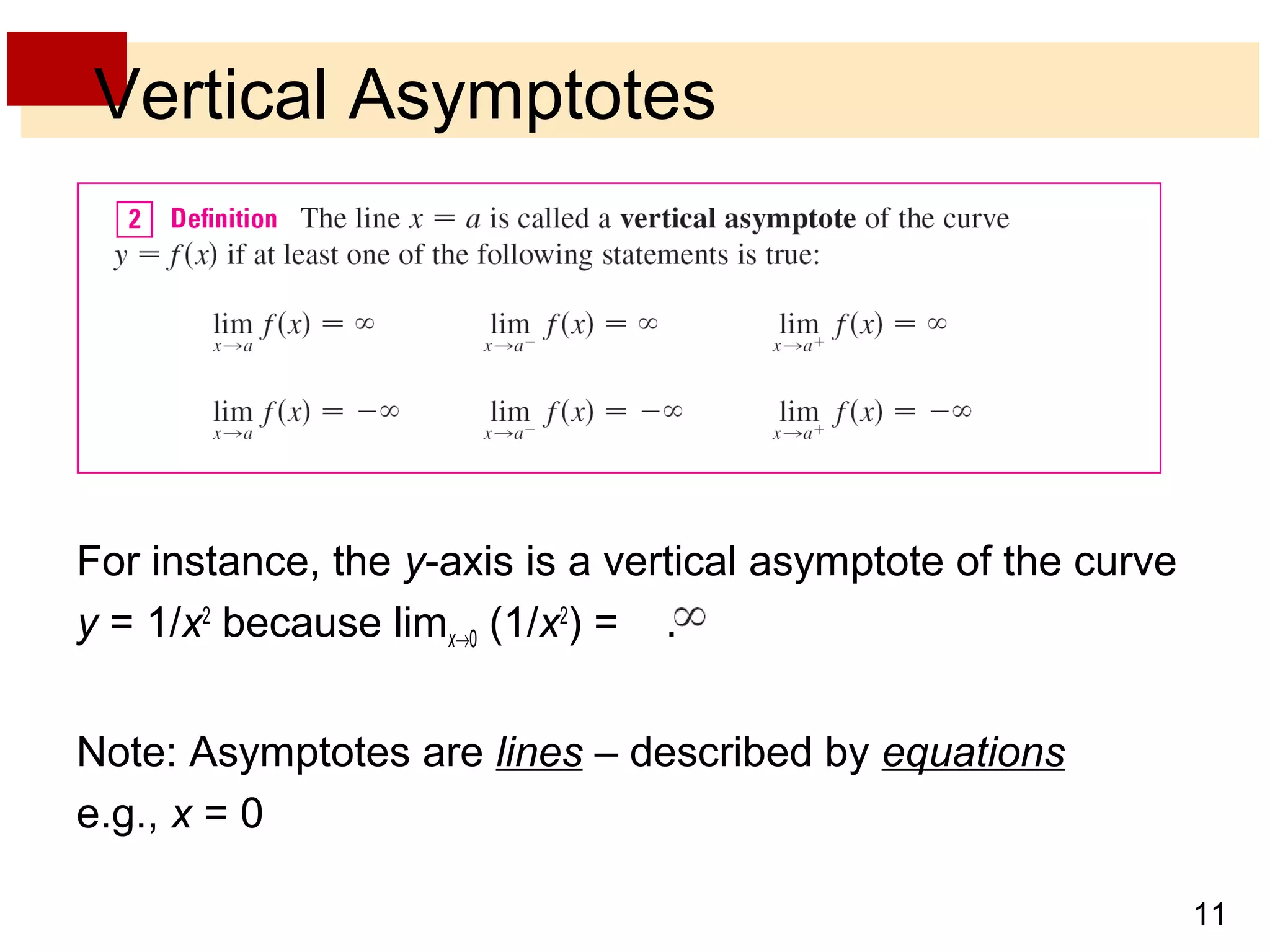
Vertical Asymptotes 
For instance, the y-axis is a vertical asymptote of the curve 
y = 1/x2 because limx®0 (1/x2) = . 
Note: Asymptotes are lines – described by equations 
e.g., x = 0
Example 1 – Evaluating One-sided Infinite Limits 
12 
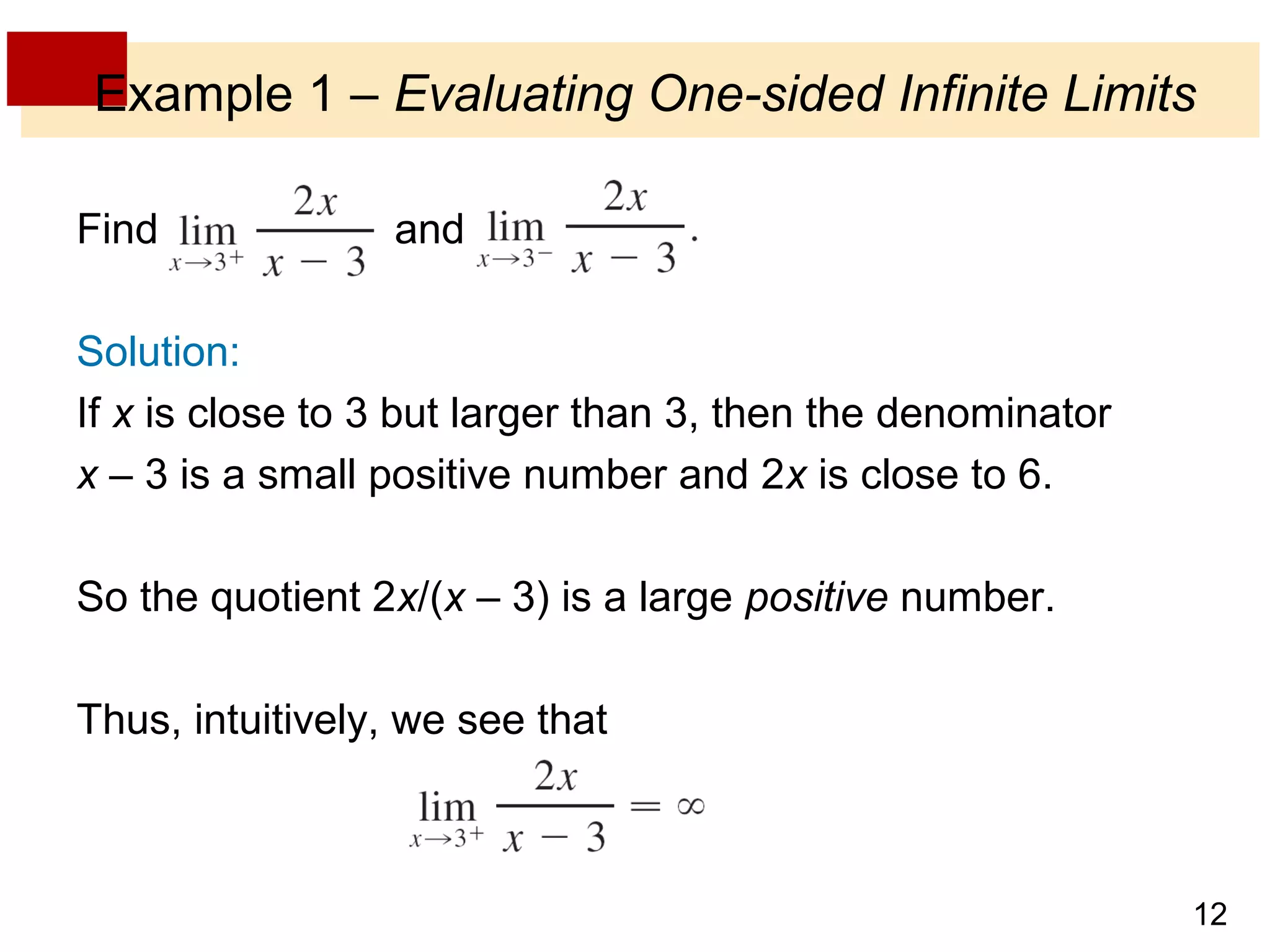
Find and 
Solution: 
If x is close to 3 but larger than 3, then the denominator 
x – 3 is a small positive number and 2x is close to 6. 
So the quotient 2x/(x – 3) is a large positive number. 
Thus, intuitively, we see that
13 
Example 1 – Solution 
Likewise, if x is close to 3 but smaller than 3, then x – 3 is a 
small negative number but 2x is still a positive number 
(close to 6). 
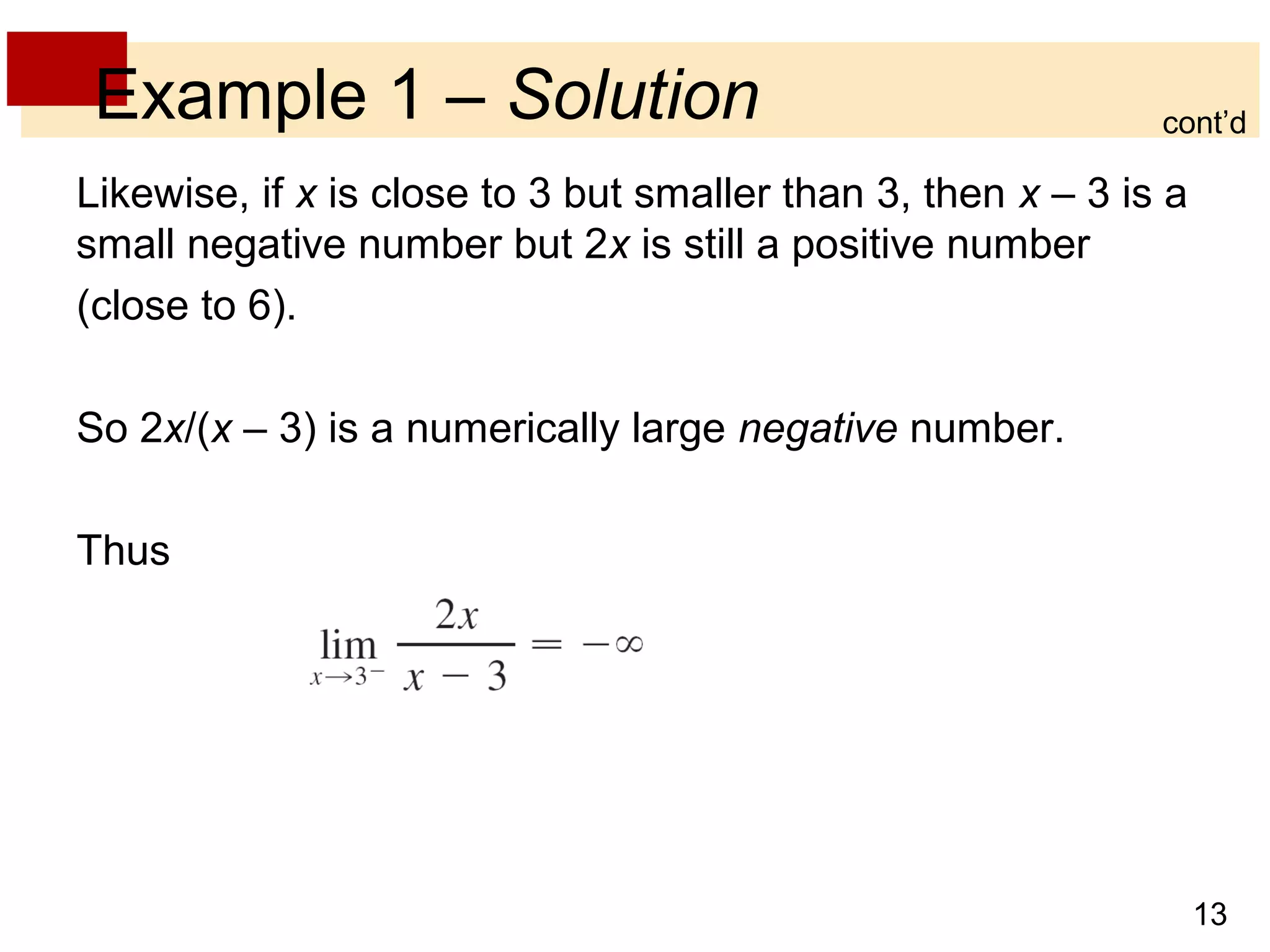
So 2x/(x – 3) is a numerically large negative number. 
Thus 
cont’d
14 
Example 1 – Solution 
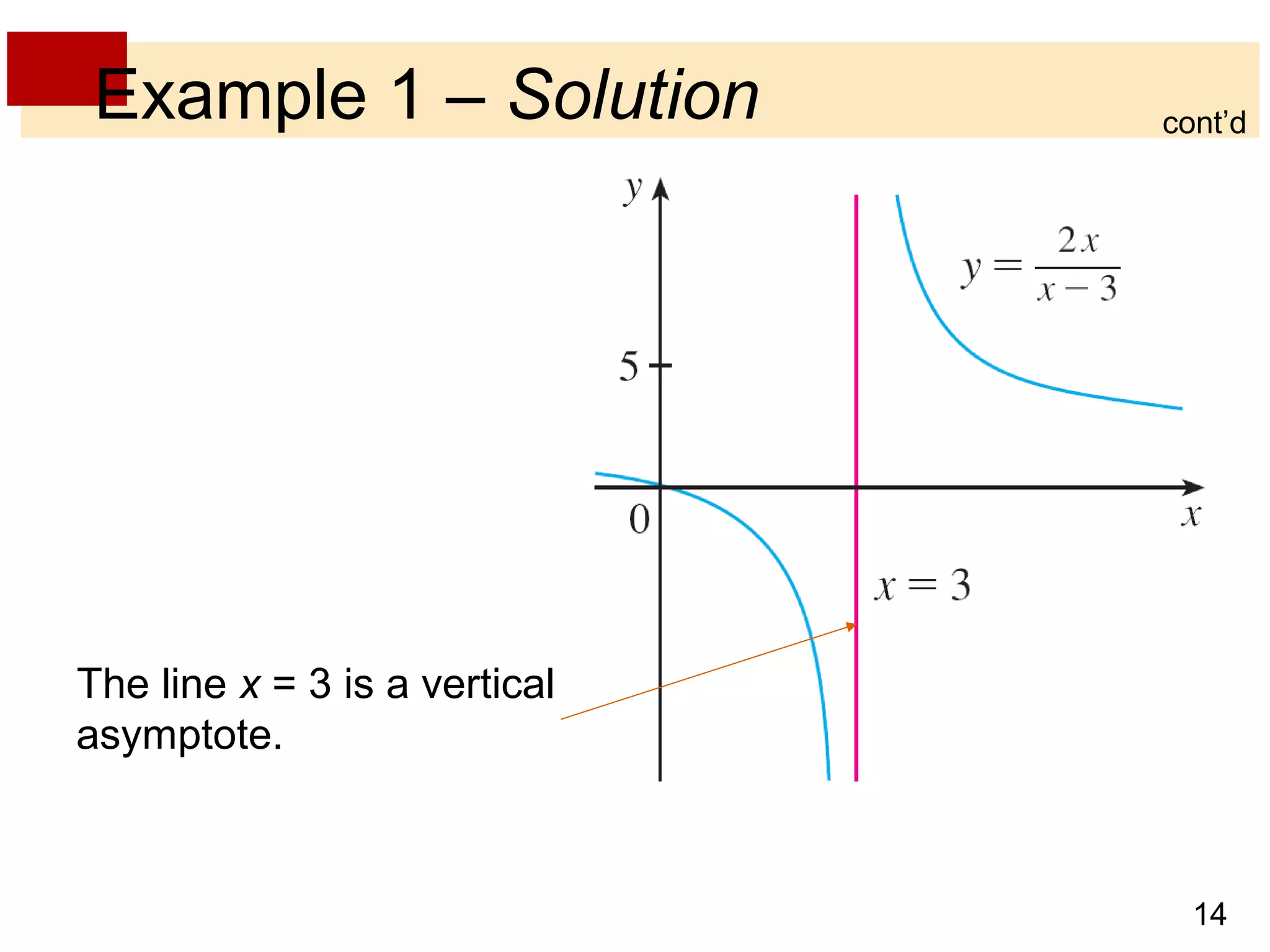
The line x = 3 is a vertical 
asymptote. 
cont’d
15 
Vertical Asymptote of ln(x) 
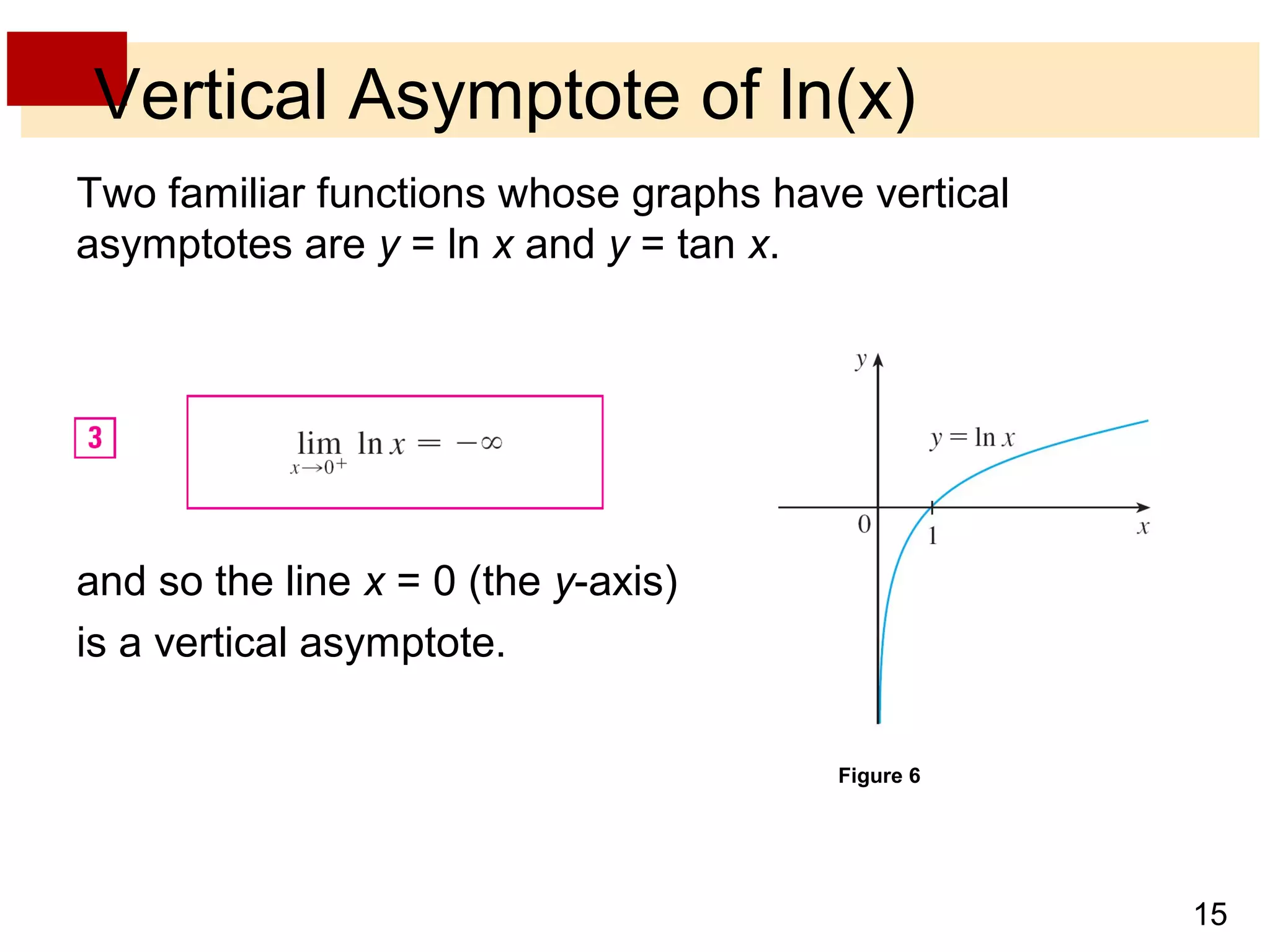
Two familiar functions whose graphs have vertical 
asymptotes are y = ln x and y = tan x. 
and so the line x = 0 (the y-axis) 
is a vertical asymptote. 
Figure 6
16 
Vertical Asymptotes of tan(x) 
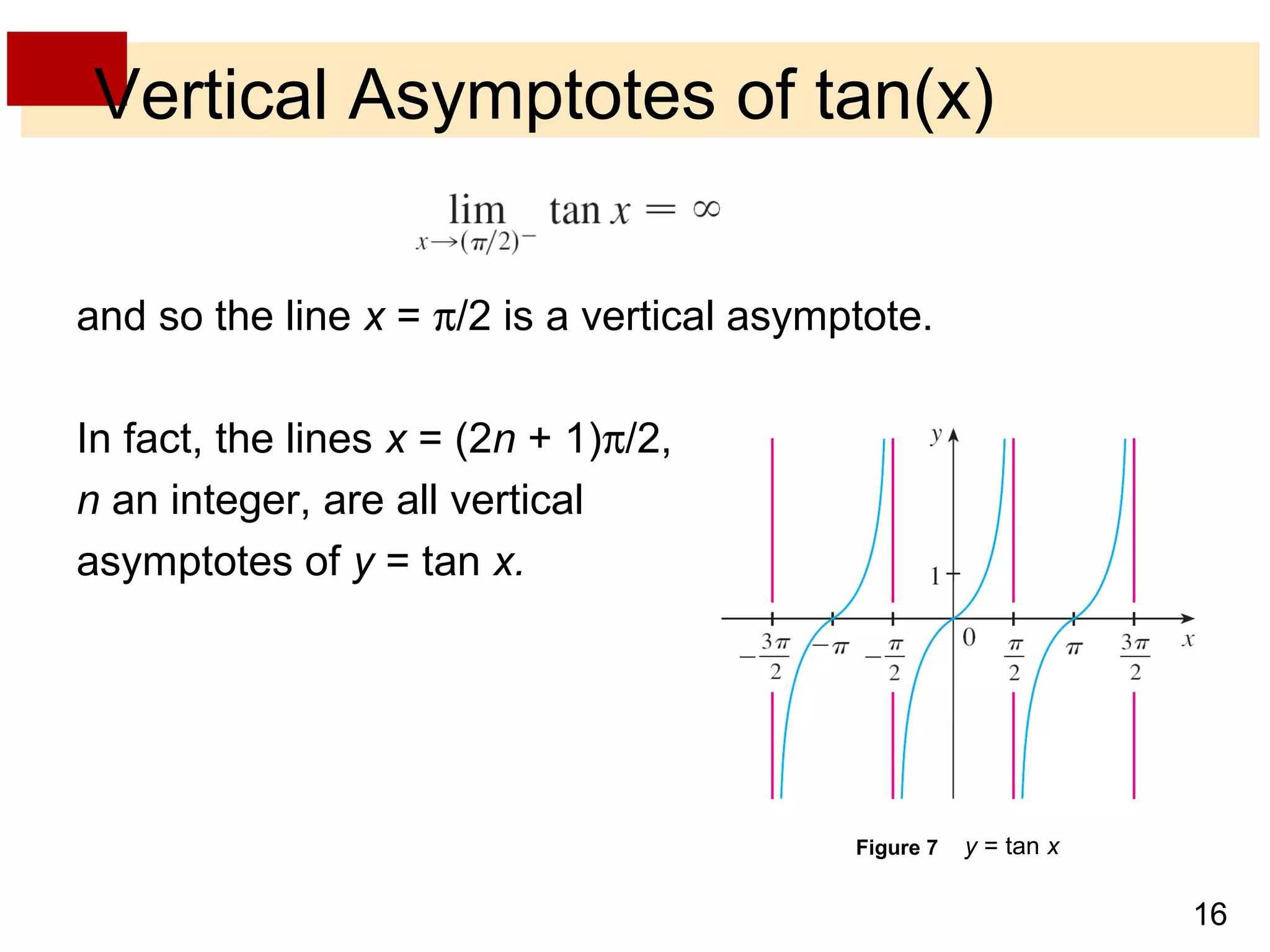
and so the line x = p/2 is a vertical asymptote. 
In fact, the lines x = (2n + 1)p/2, 
n an integer, are all vertical 
asymptotes of y = tan x. 
Figure 7 y = tan x
17 
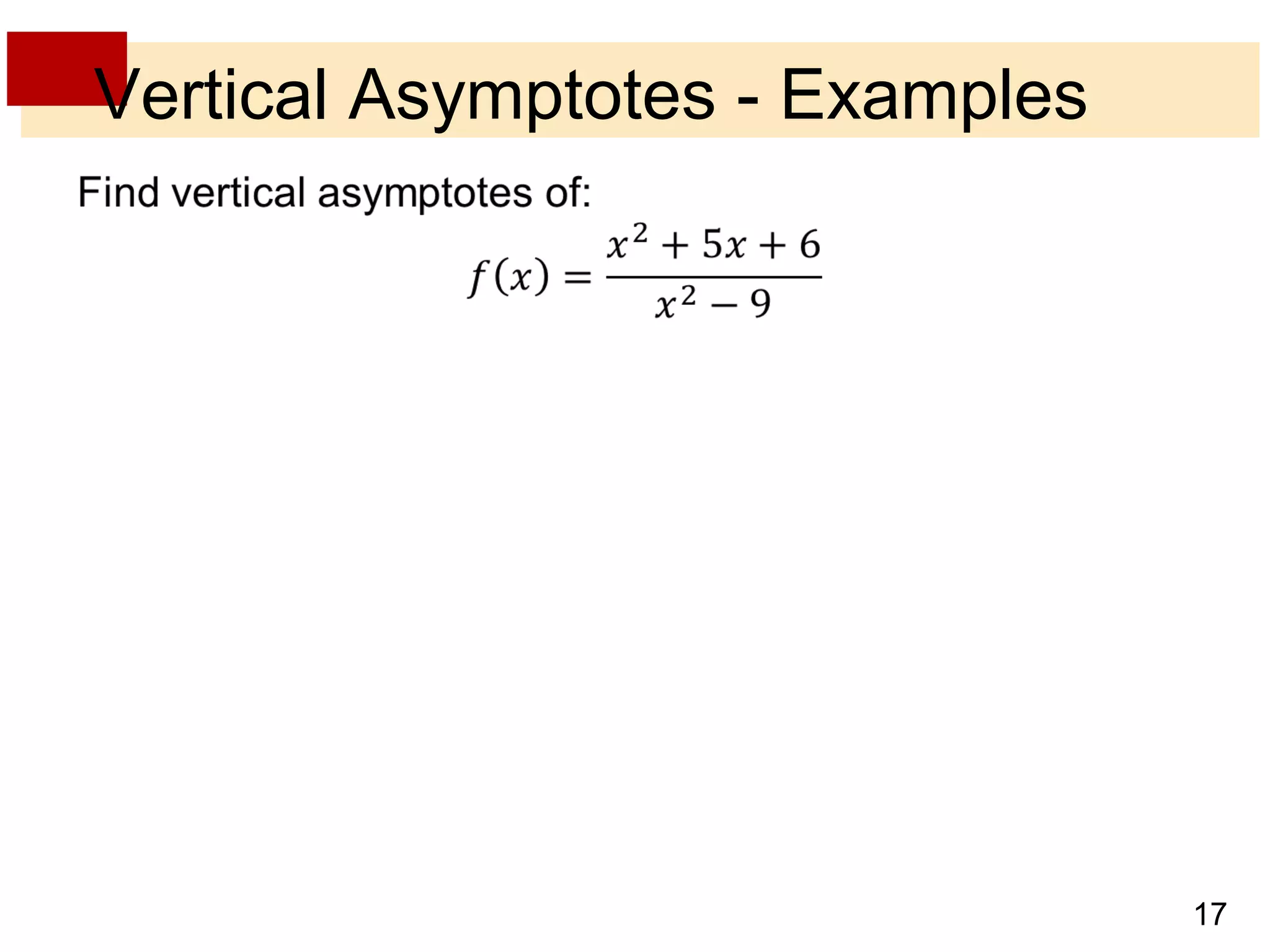
Vertical Asymptotes - Examples
18 
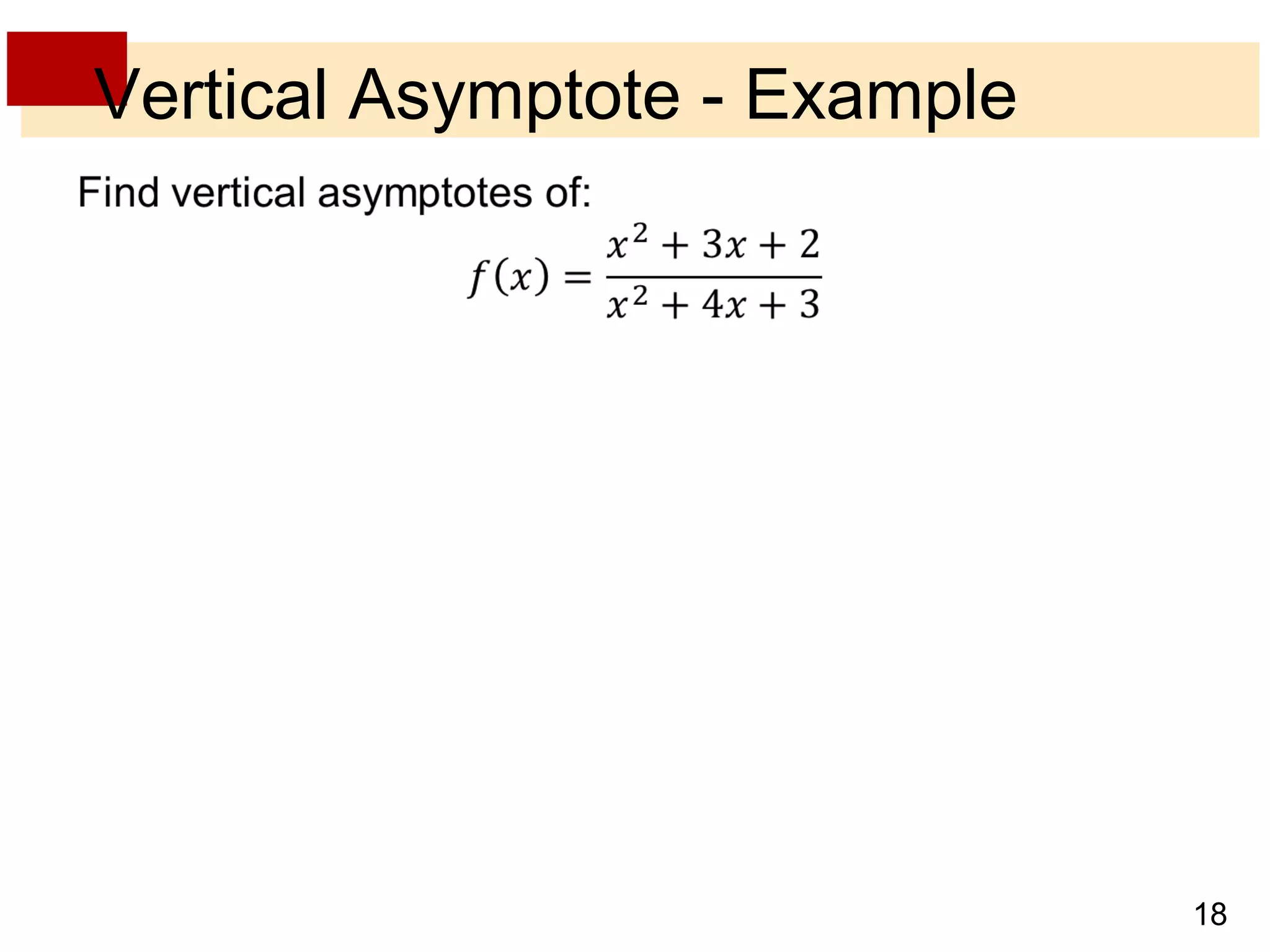
Vertical Asymptote - Example
19 
Limits at Infinity
20 
Limits at Infinity 
Here we let x become arbitrarily large (positive or negative) 
and see what happens to y. 
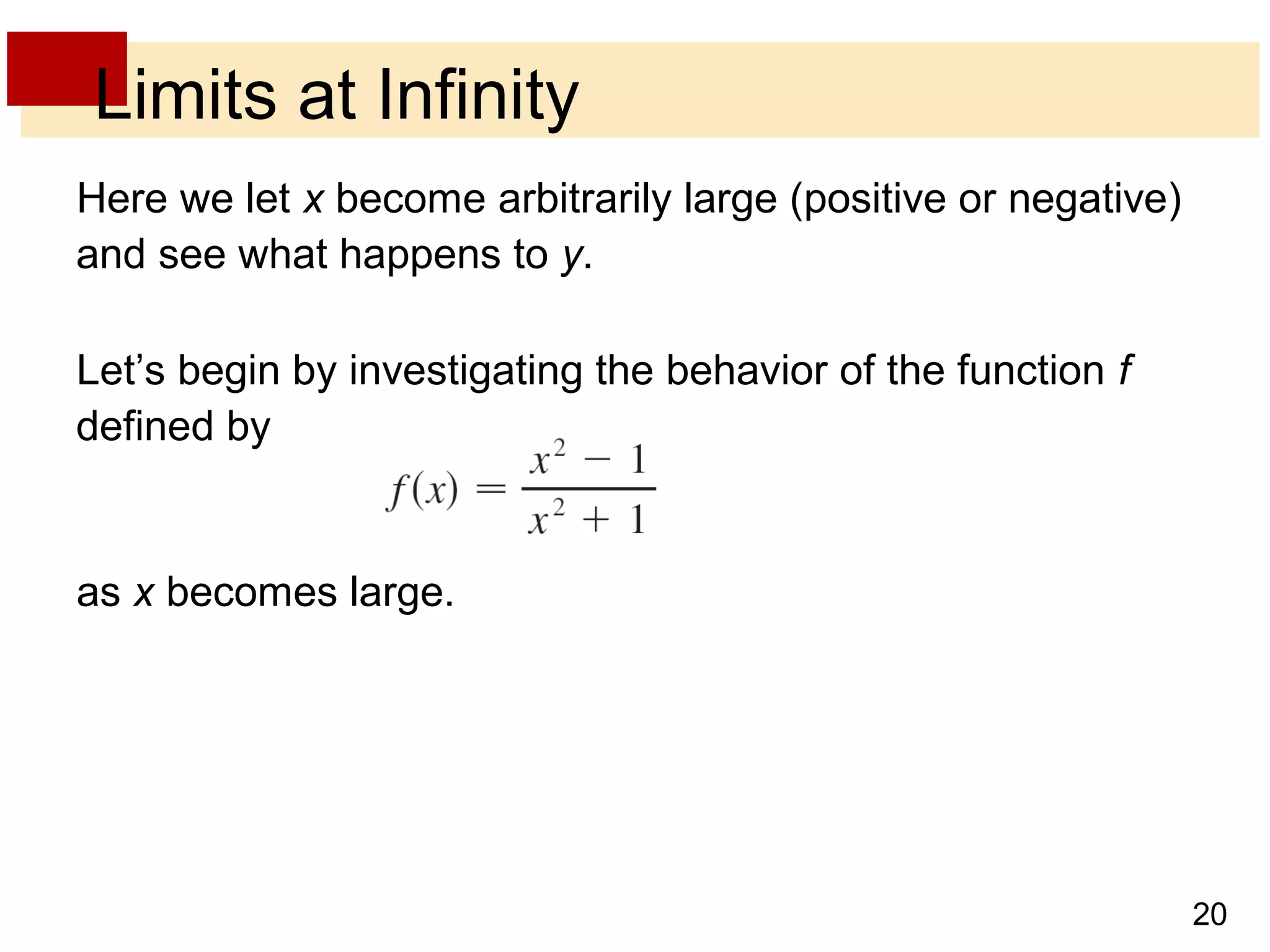
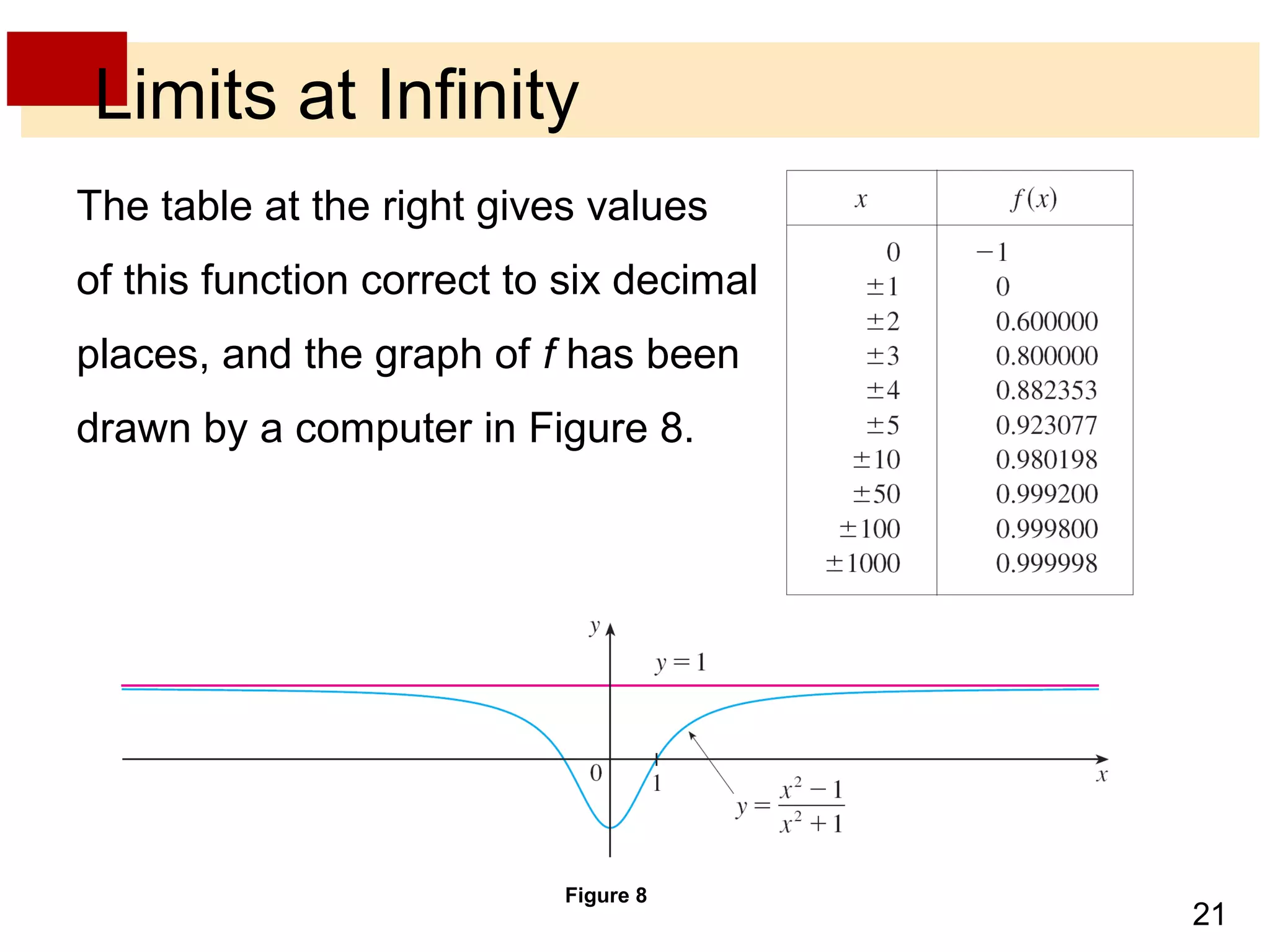
Let’s begin by investigating the behavior of the function f 
defined by 
as x becomes large.
21 
Limits at Infinity 
The table at the right gives values 
of this function correct to six decimal 
places, and the graph of f has been 
drawn by a computer in Figure 8. 
Figure 8
22 
Limits at Infinity 
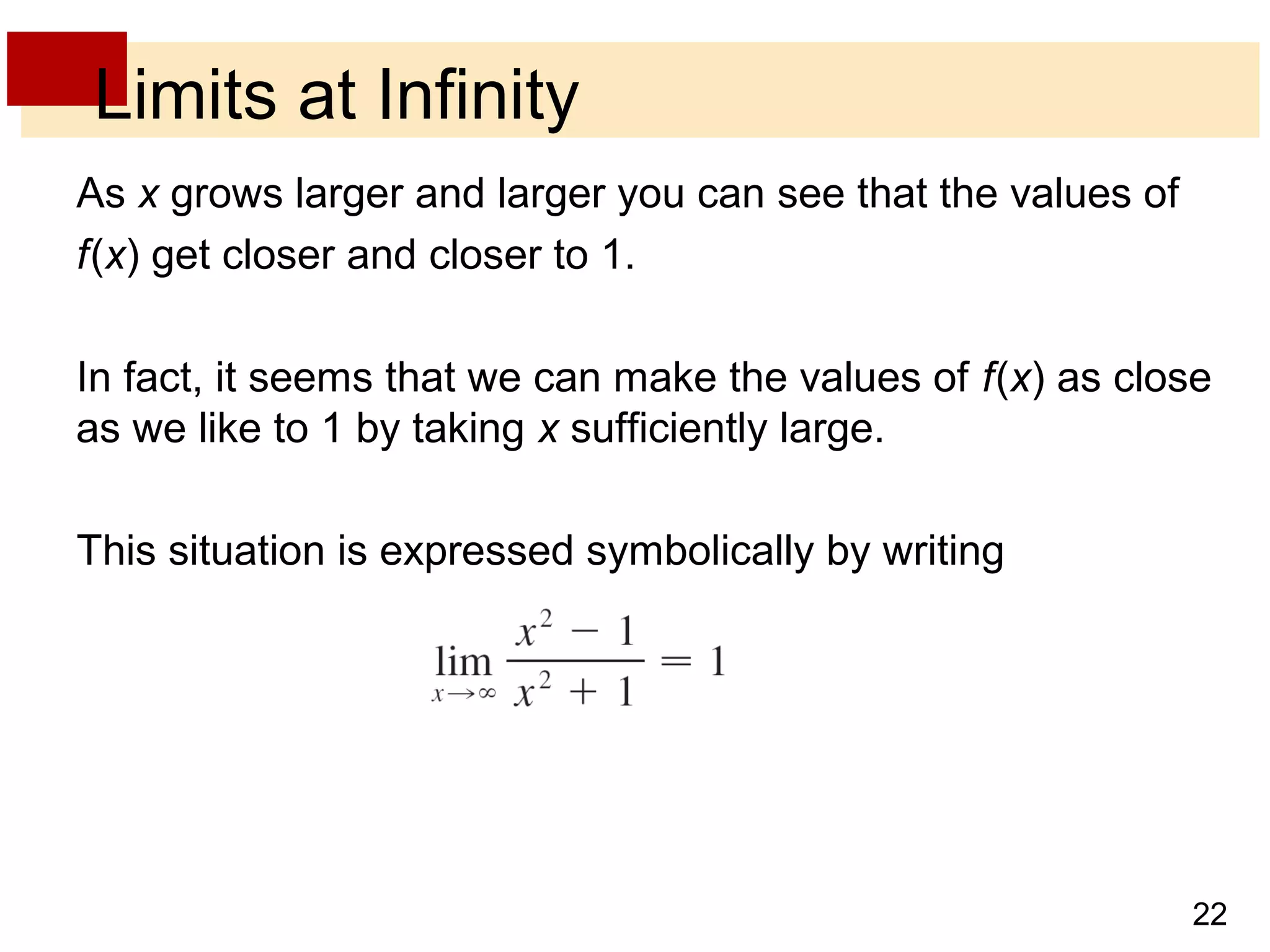
As x grows larger and larger you can see that the values of 
f (x) get closer and closer to 1. 
In fact, it seems that we can make the values of f (x) as close 
as we like to 1 by taking x sufficiently large. 
This situation is expressed symbolically by writing
23 
Limits at Infinity 
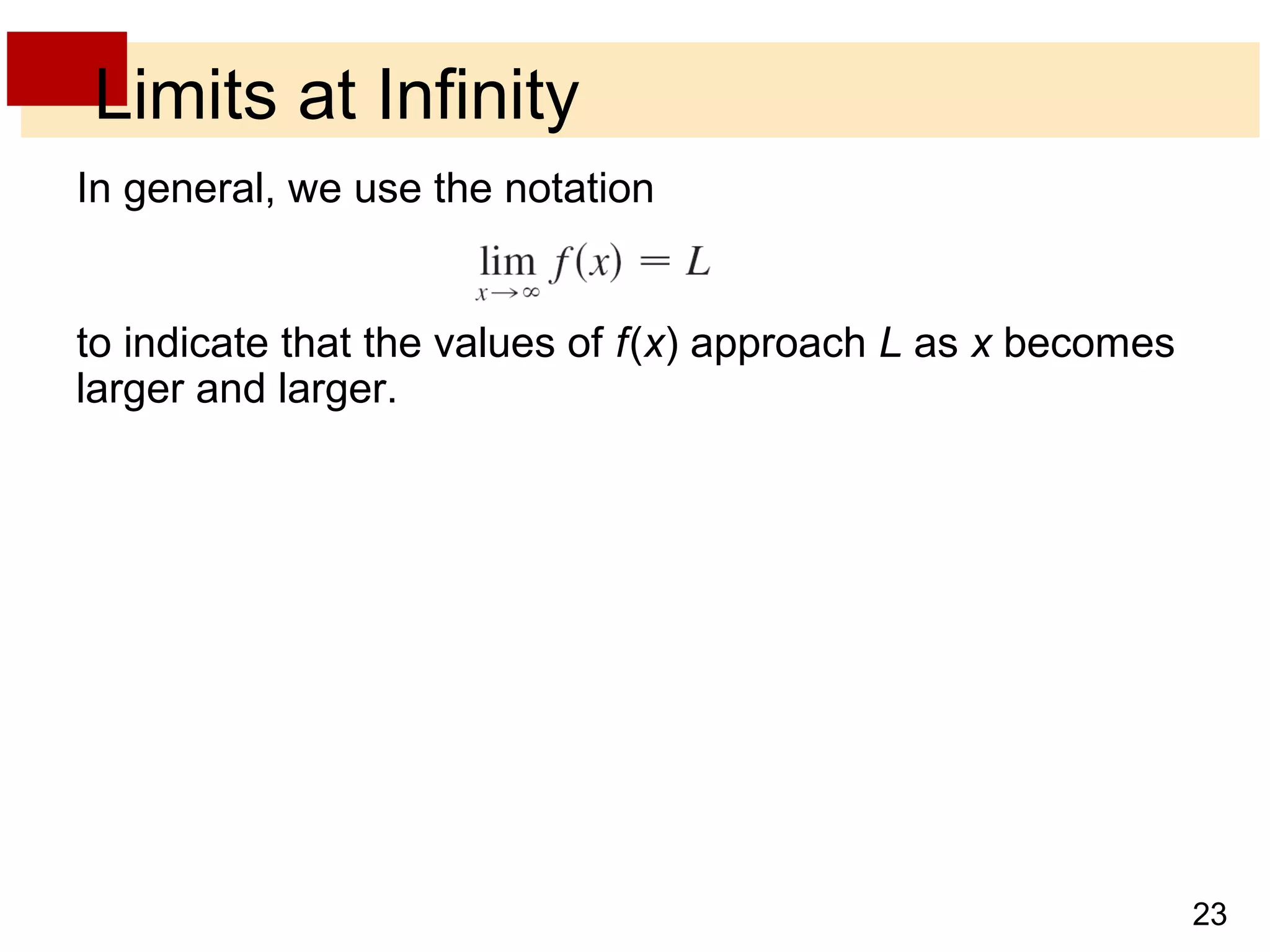
In general, we use the notation 
to indicate that the values of f (x) approach L as x becomes 
larger and larger.
24 
Limits at Infinity 
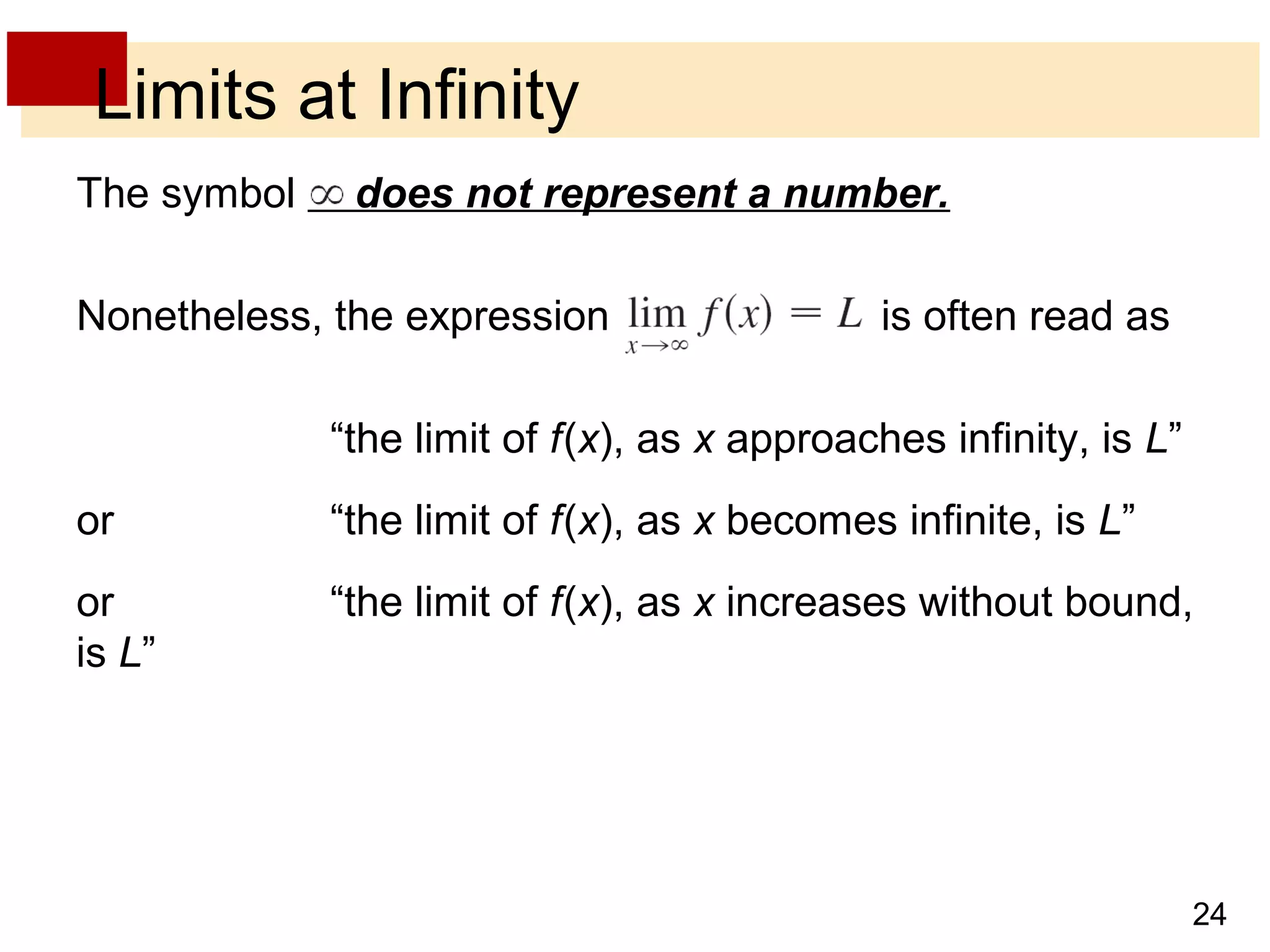
The symbol does not represent a number. 
Nonetheless, the expression is often read as 
“the limit of f (x), as x approaches infinity, is L” 
or “the limit of f (x), as x becomes infinite, is L” 
or “the limit of f (x), as x increases without bound, 
is L”
25 
Limits at Infinity 
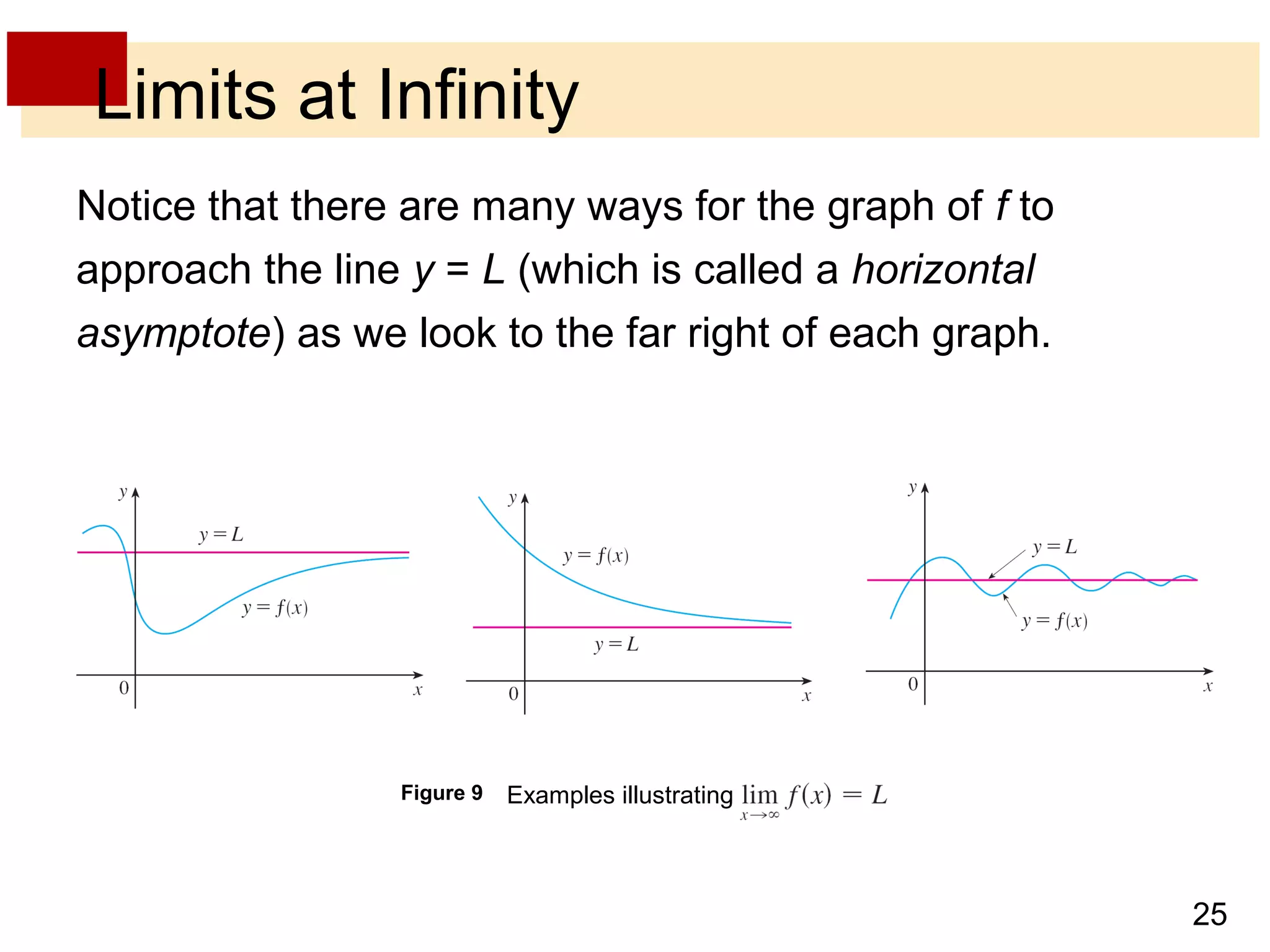
Notice that there are many ways for the graph of f to 
approach the line y = L (which is called a horizontal 
asymptote) as we look to the far right of each graph. 
Figure 9 Examples illustrating
Limits at Infinity 
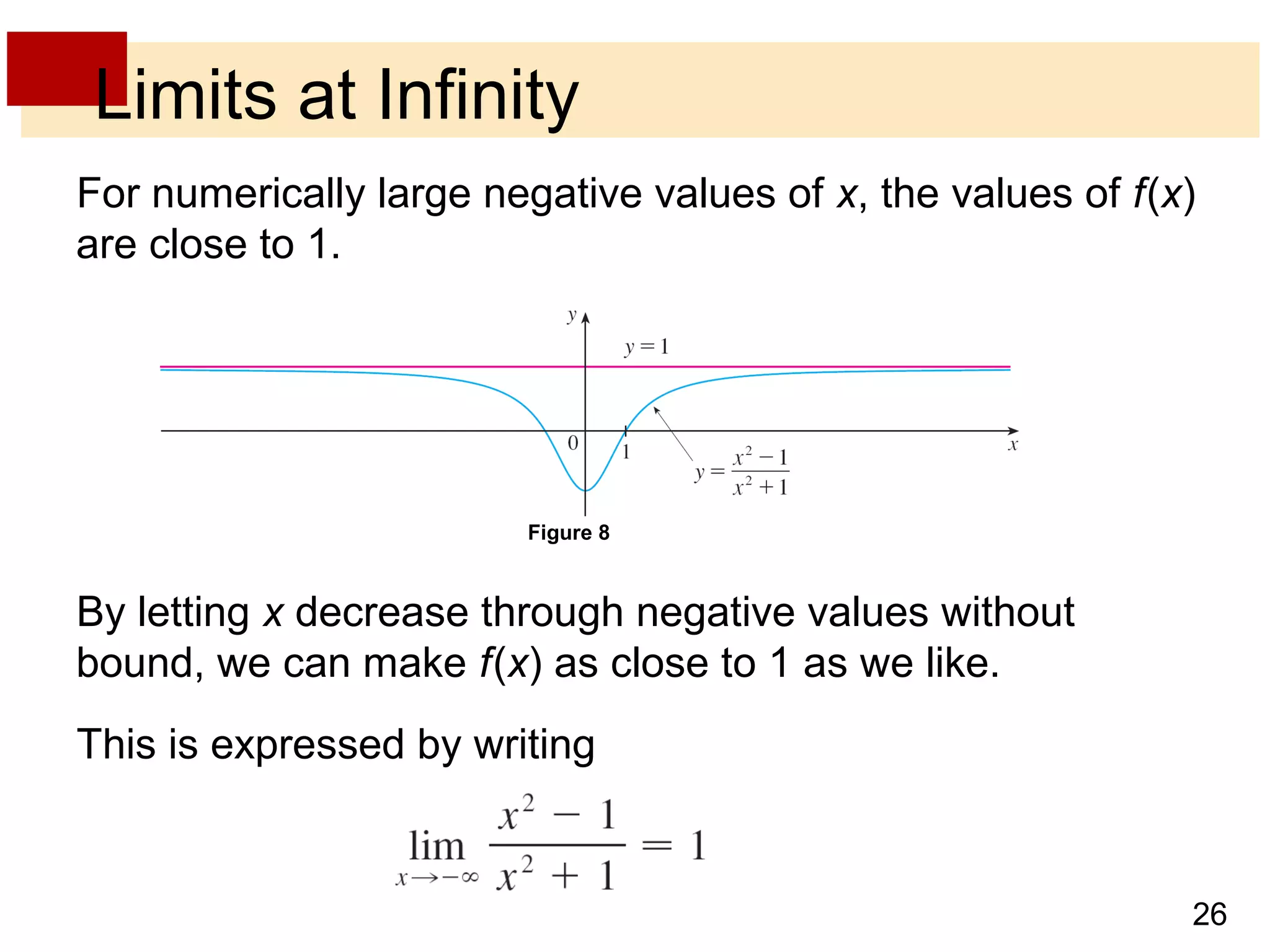
For numerically large negative values of x, the values of f (x) 
are close to 1. 
26 
Figure 8 
By letting x decrease through negative values without 
bound, we can make f (x) as close to 1 as we like. 
This is expressed by writing
27 
Limits at Infinity 
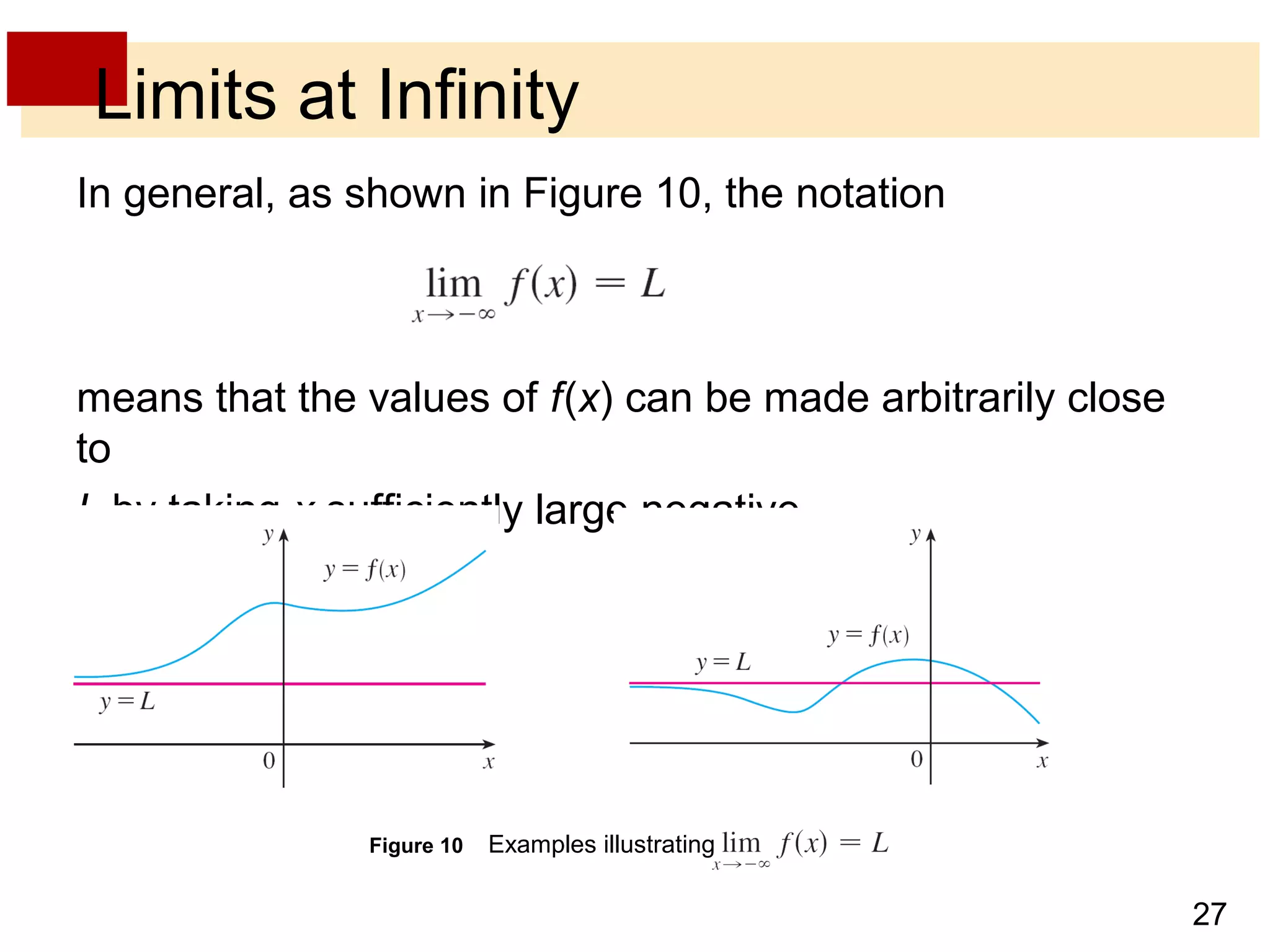
In general, as shown in Figure 10, the notation 
means that the values of f (x) can be made arbitrarily close 
to 
L by taking x sufficiently large negative. 
Figure 10 Examples illustrating
28 
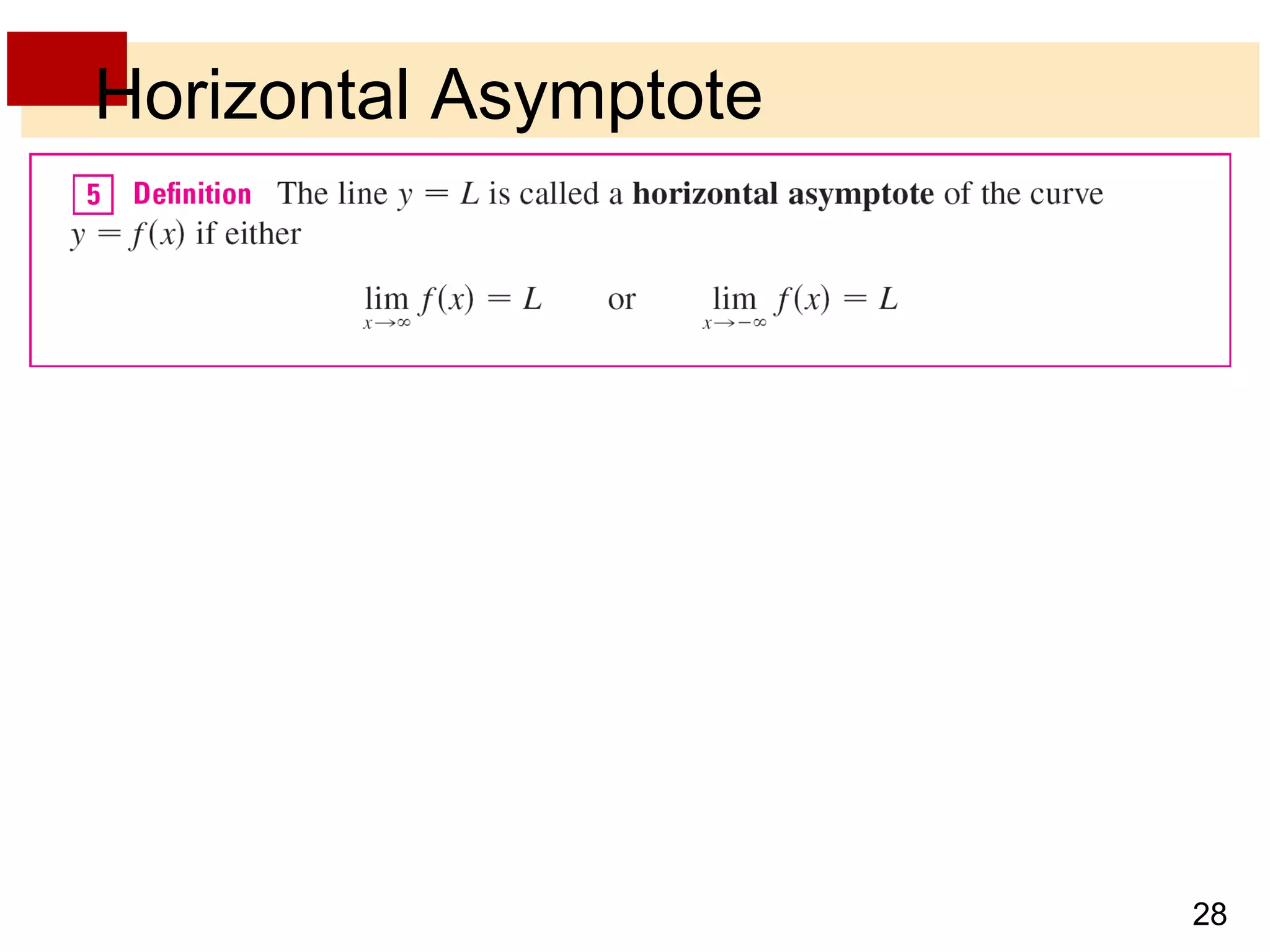
Horizontal Asymptote
29 
Horizontal Asymptote - Graphically 
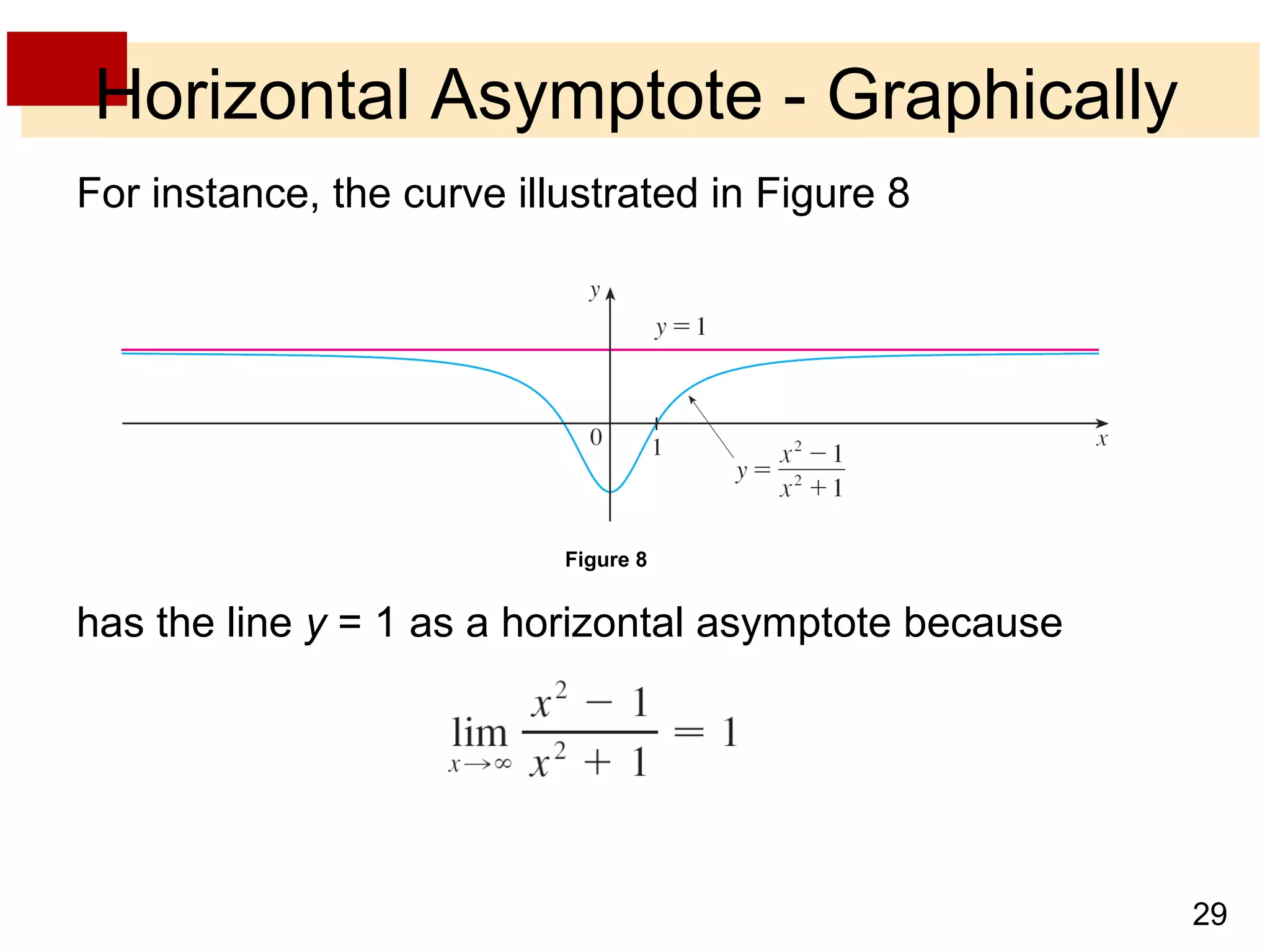
For instance, the curve illustrated in Figure 8 
Figure 8 
has the line y = 1 as a horizontal asymptote because
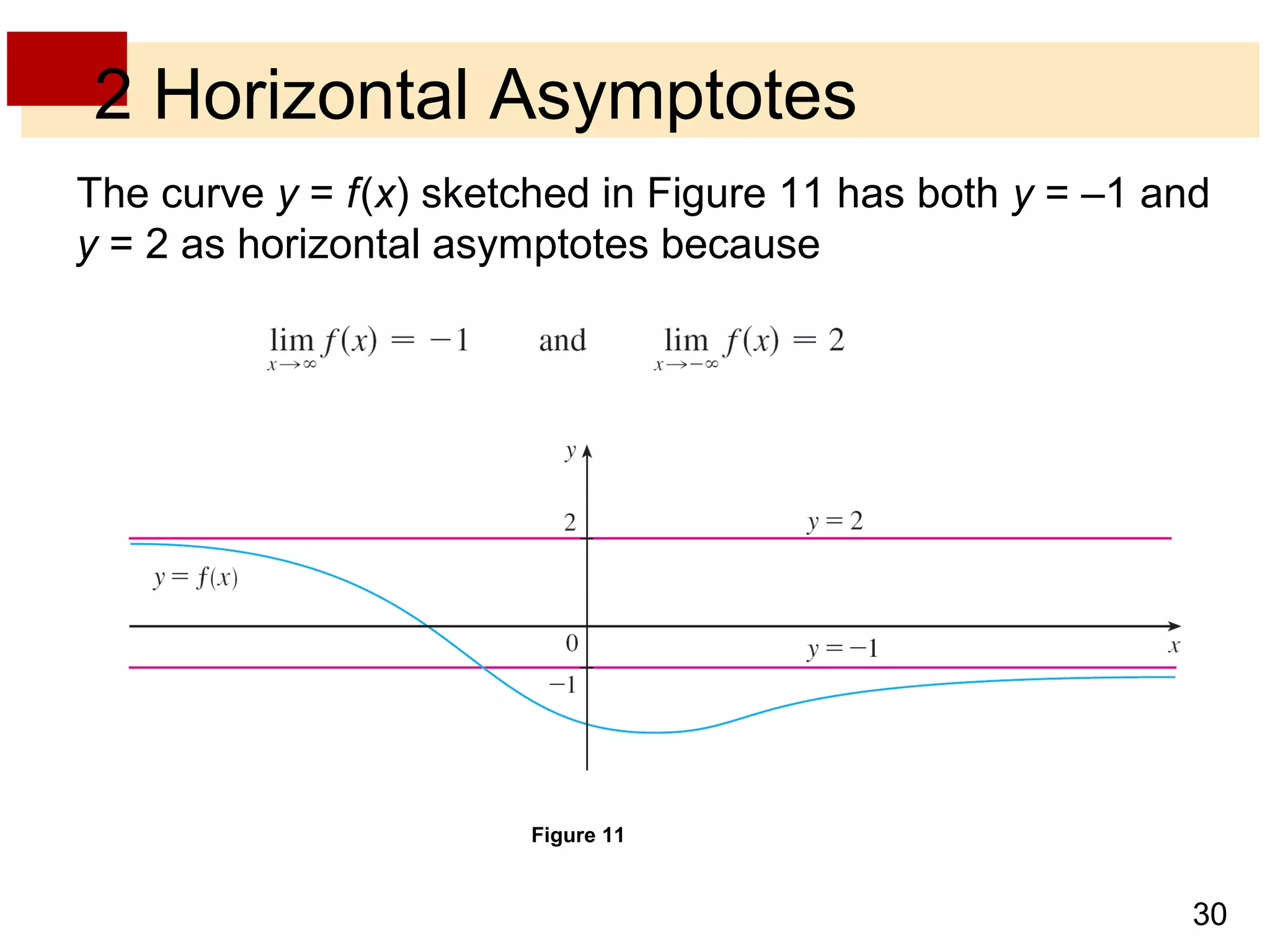
2 Horizontal Asymptotes 
The curve y = f (x) sketched in Figure 11 has both y = –1 and 
y = 2 as horizontal asymptotes because 
30 
Figure 11
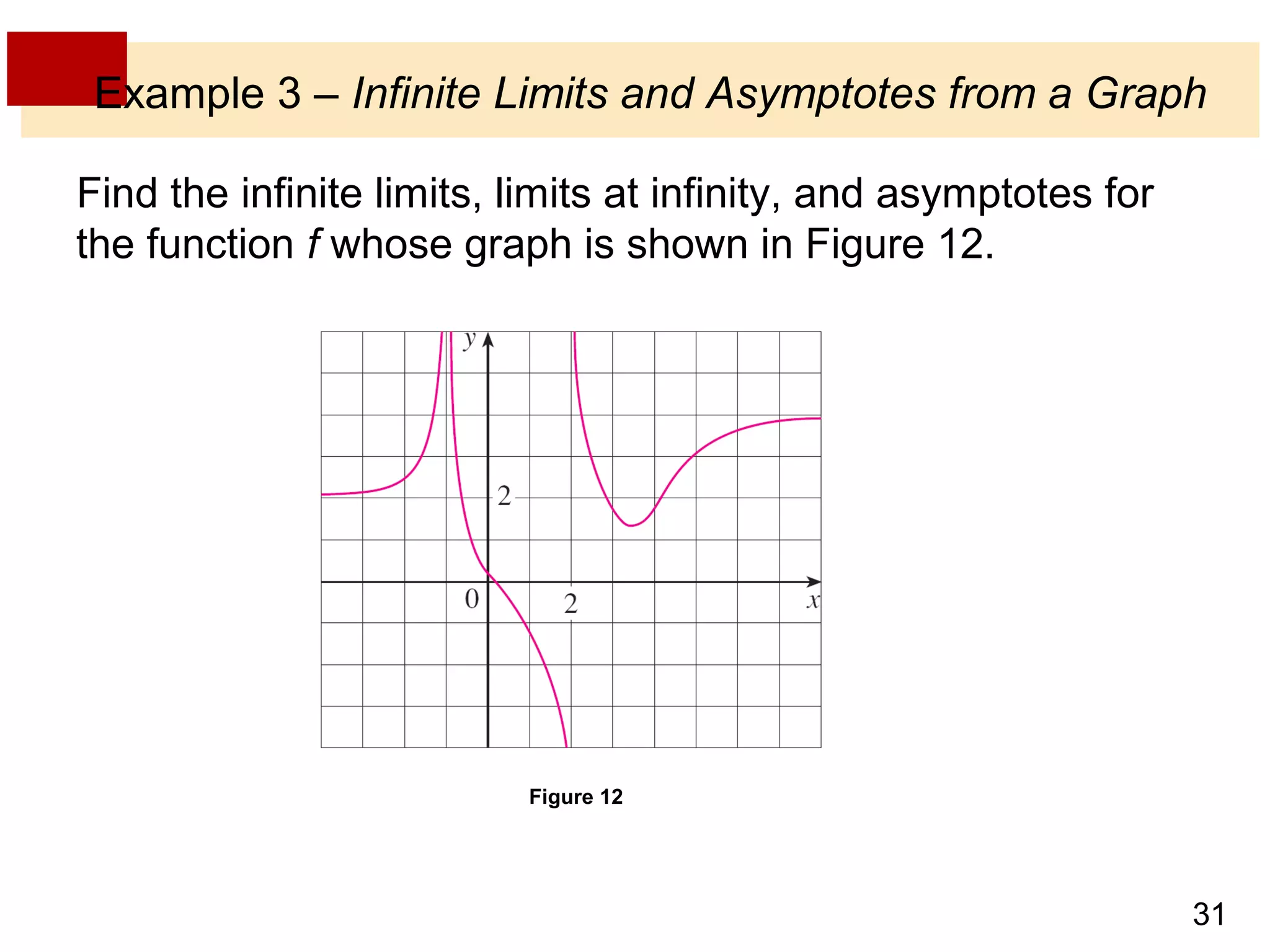
Example 3 – Infinite Limits and Asymptotes from a Graph 
Find the infinite limits, limits at infinity, and asymptotes for 
the function f whose graph is shown in Figure 12. 
31 
Figure 12
Example 3 – Solution 
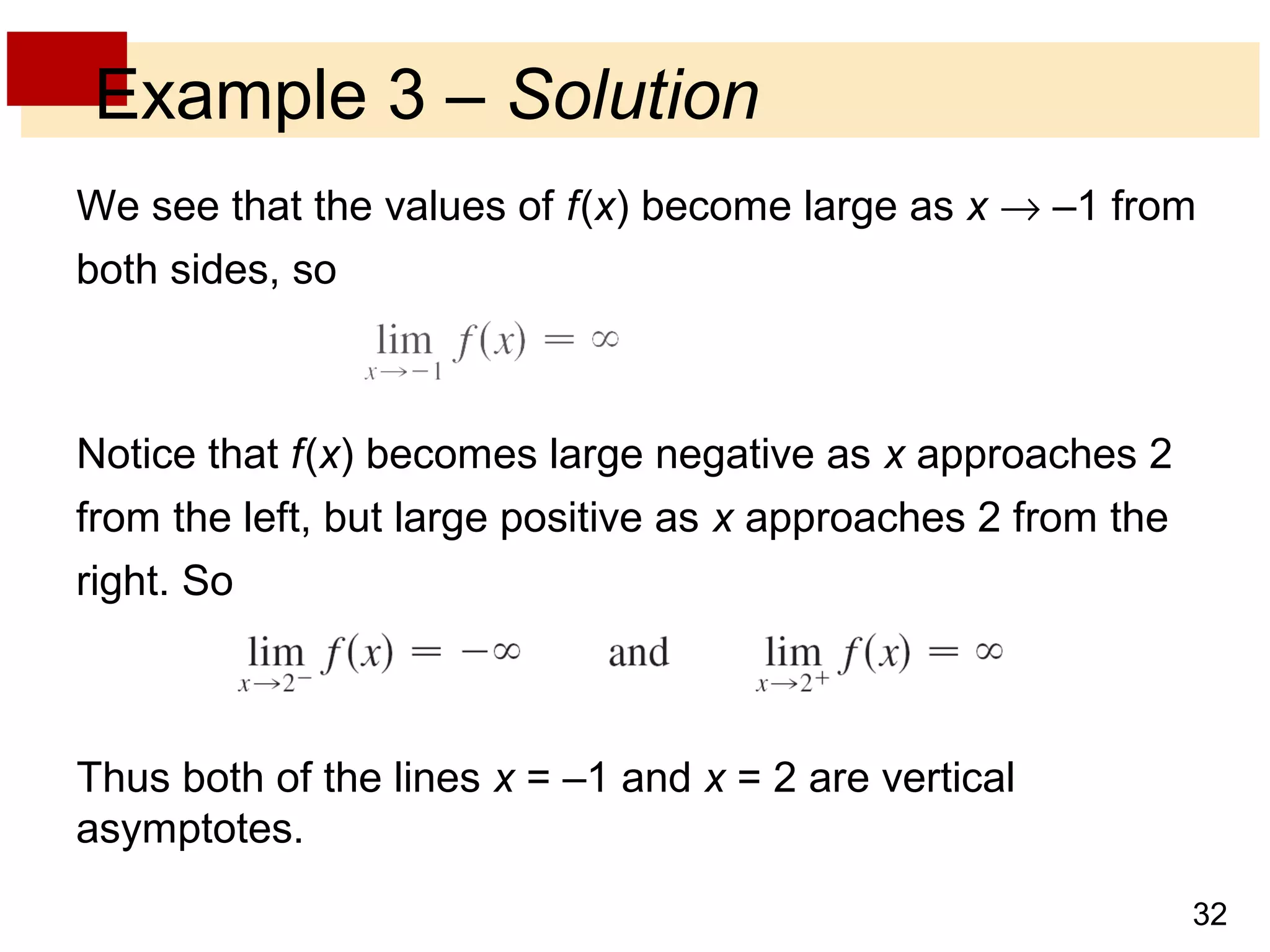
We see that the values of f (x) become large as x ® –1 from 
both sides, so 
32 
Notice that f (x) becomes large negative as x approaches 2 
from the left, but large positive as x approaches 2 from the 
right. So 
Thus both of the lines x = –1 and x = 2 are vertical 
asymptotes.
33 
Example 3 – Solution 
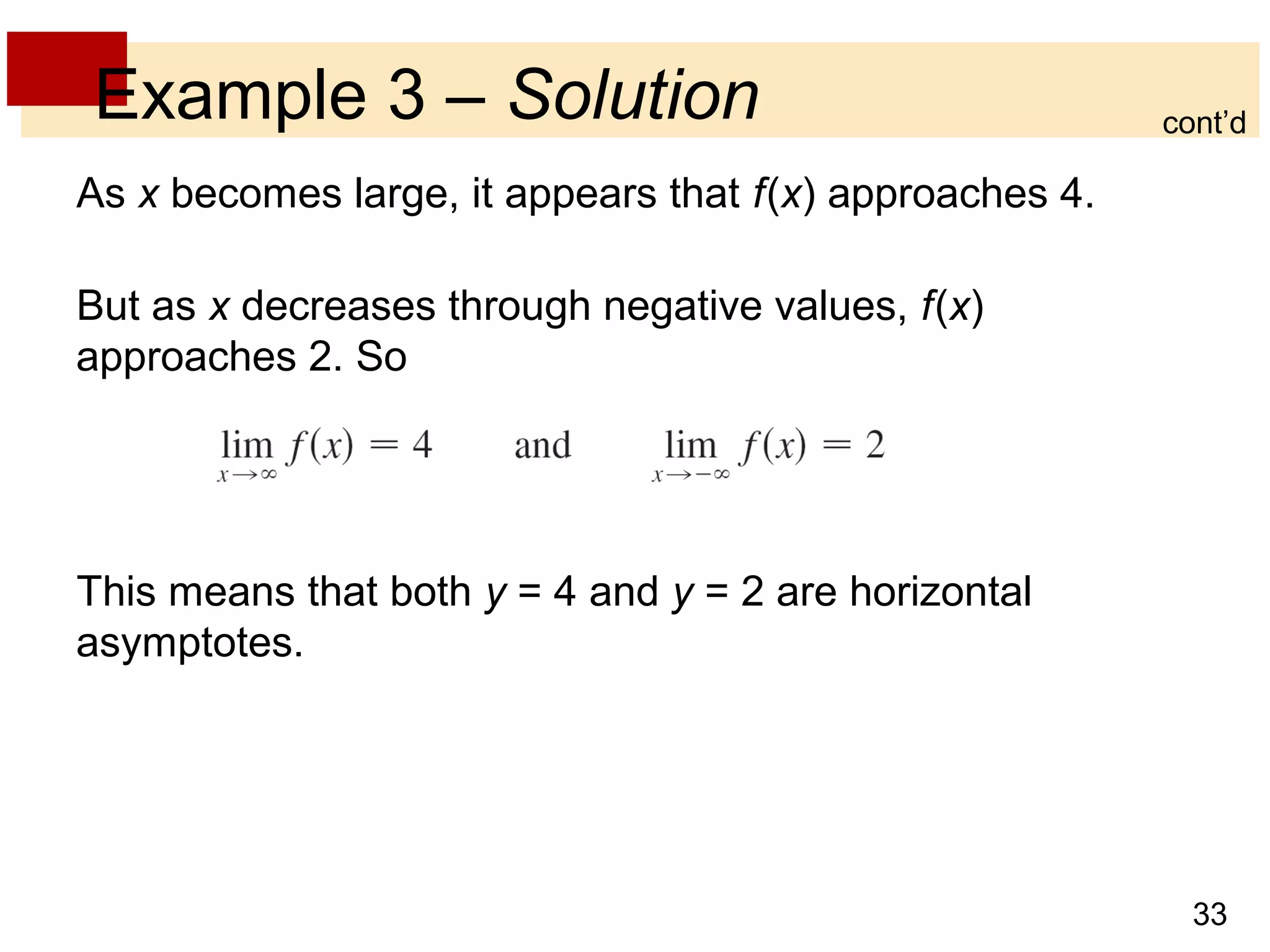
As x becomes large, it appears that f (x) approaches 4. 
But as x decreases through negative values, f (x) 
approaches 2. So 
This means that both y = 4 and y = 2 are horizontal 
asymptotes. 
cont’d
34 
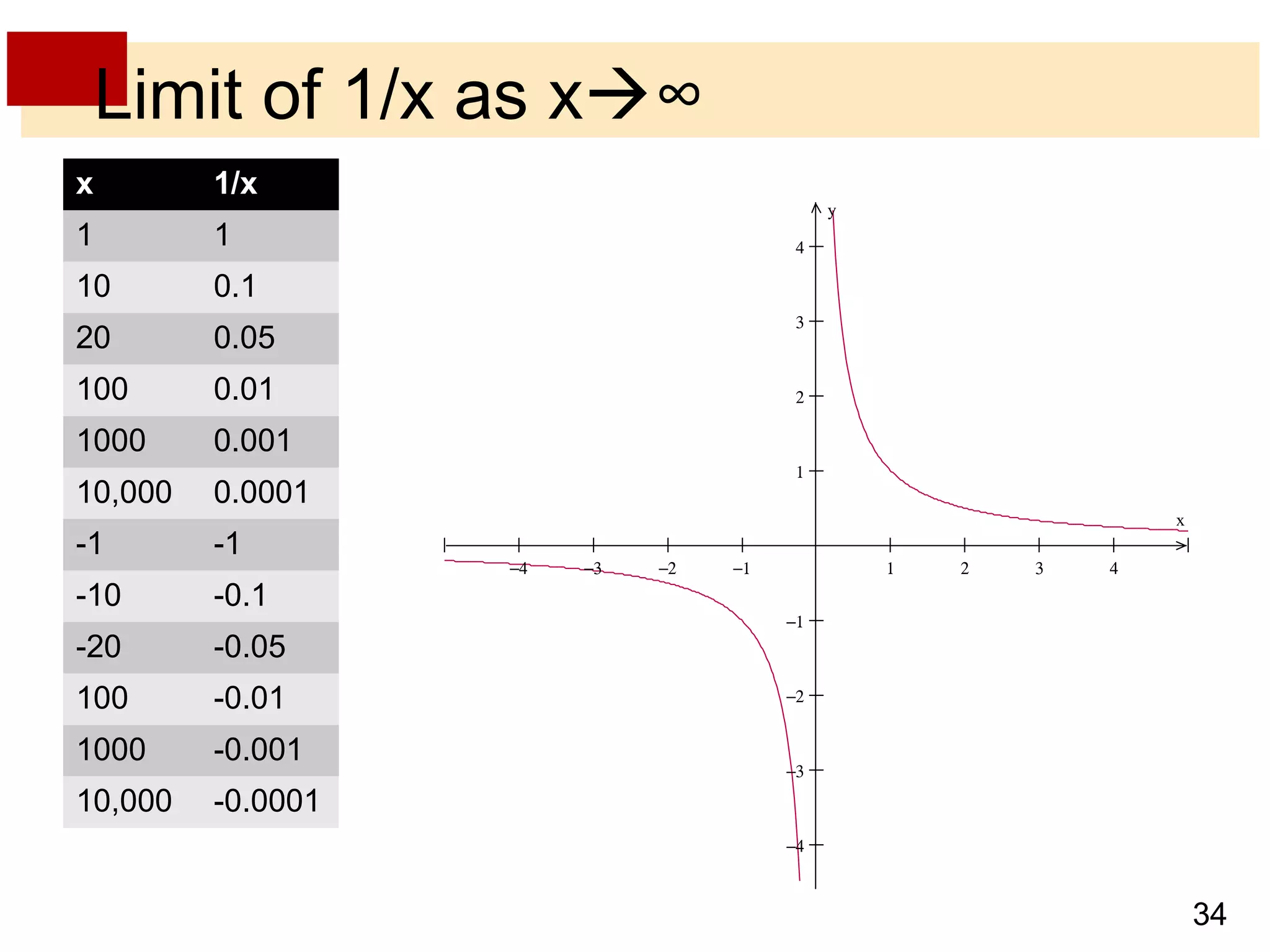
Limit of 1/x as x∞ 
x 1/x 
1 1 
10 0.1 
20 0.05 
100 0.01 
1000 0.001 
10,000 0.0001 
-1 -1 
-10 -0.1 
-20 -0.05 
100 -0.01 
1000 -0.001 
10,000 -0.0001 
4 
3 
2 
1 
-4 -3 -2 -1 1 2 3 4 
-1 
-2 
-3 
-4 
x 
y
35 
Limits at Infinity 
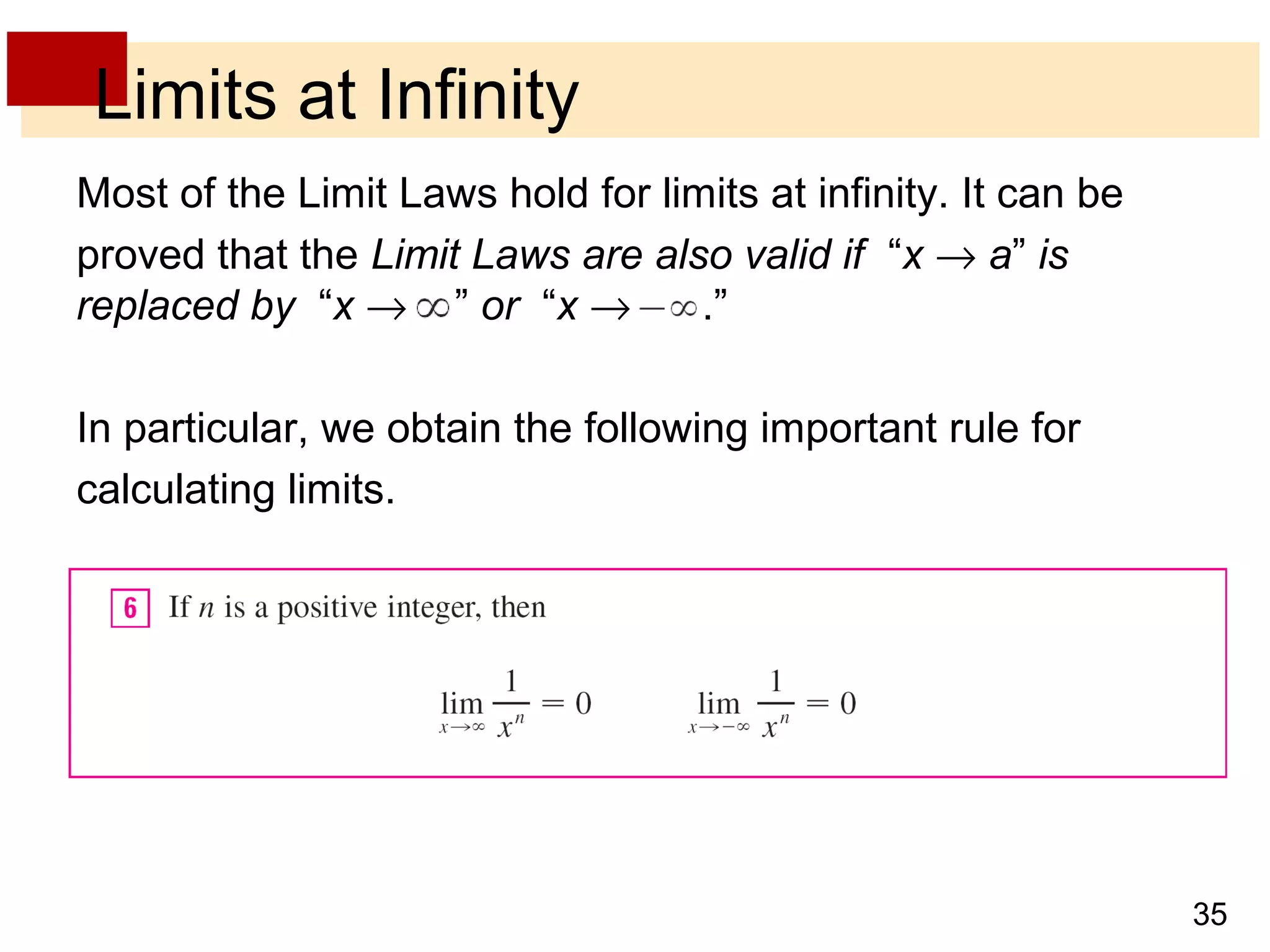
Most of the Limit Laws hold for limits at infinity. It can be 
proved that the Limit Laws are also valid if “x ® a” is 
replaced by “x ® ” or “x ® .” 
In particular, we obtain the following important rule for 
calculating limits.
36 
Limits at Infinitely - Algebraically 
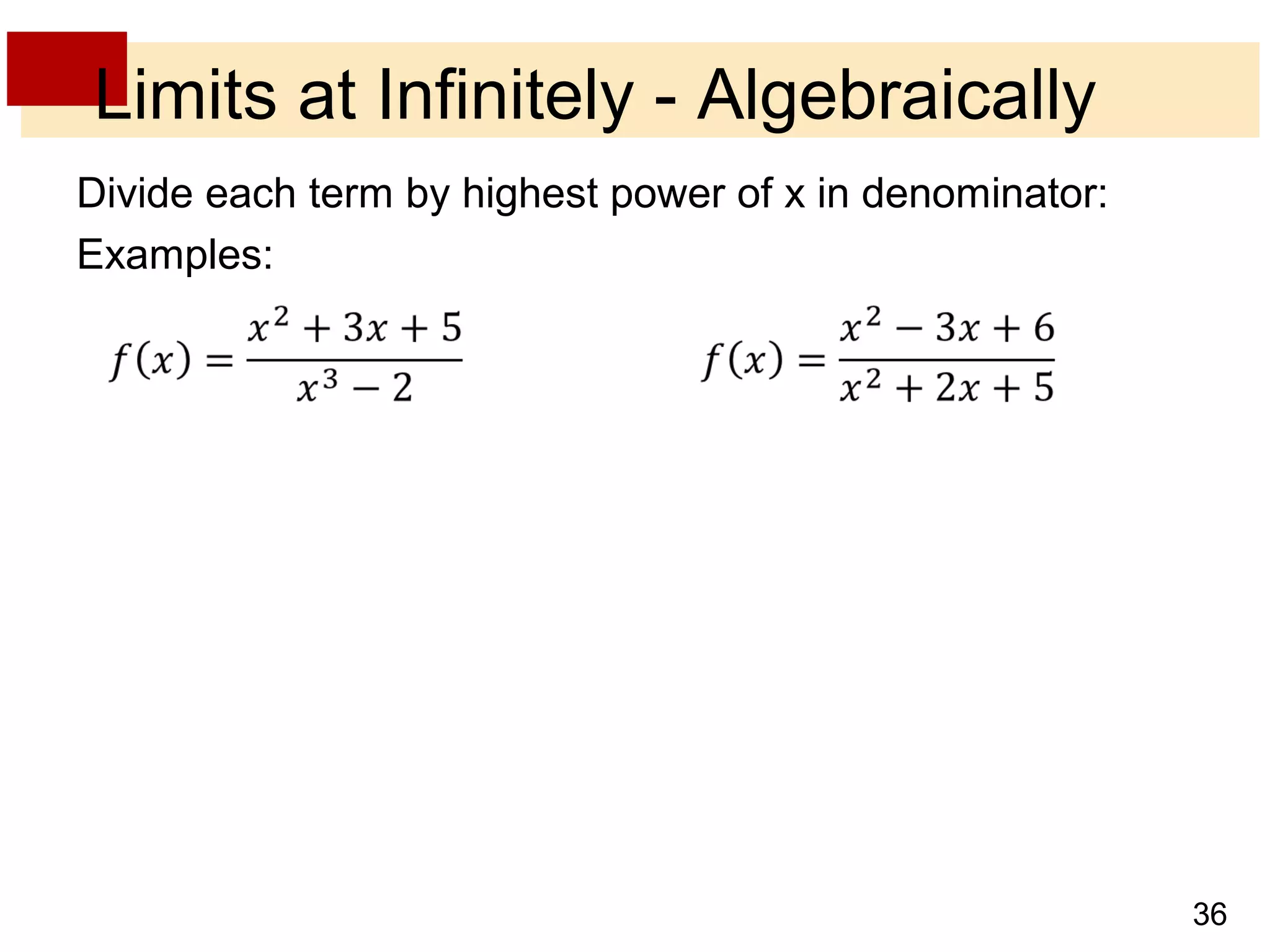
Divide each term by highest power of x in denominator: 
Examples:
37 
Limits at Infinity 
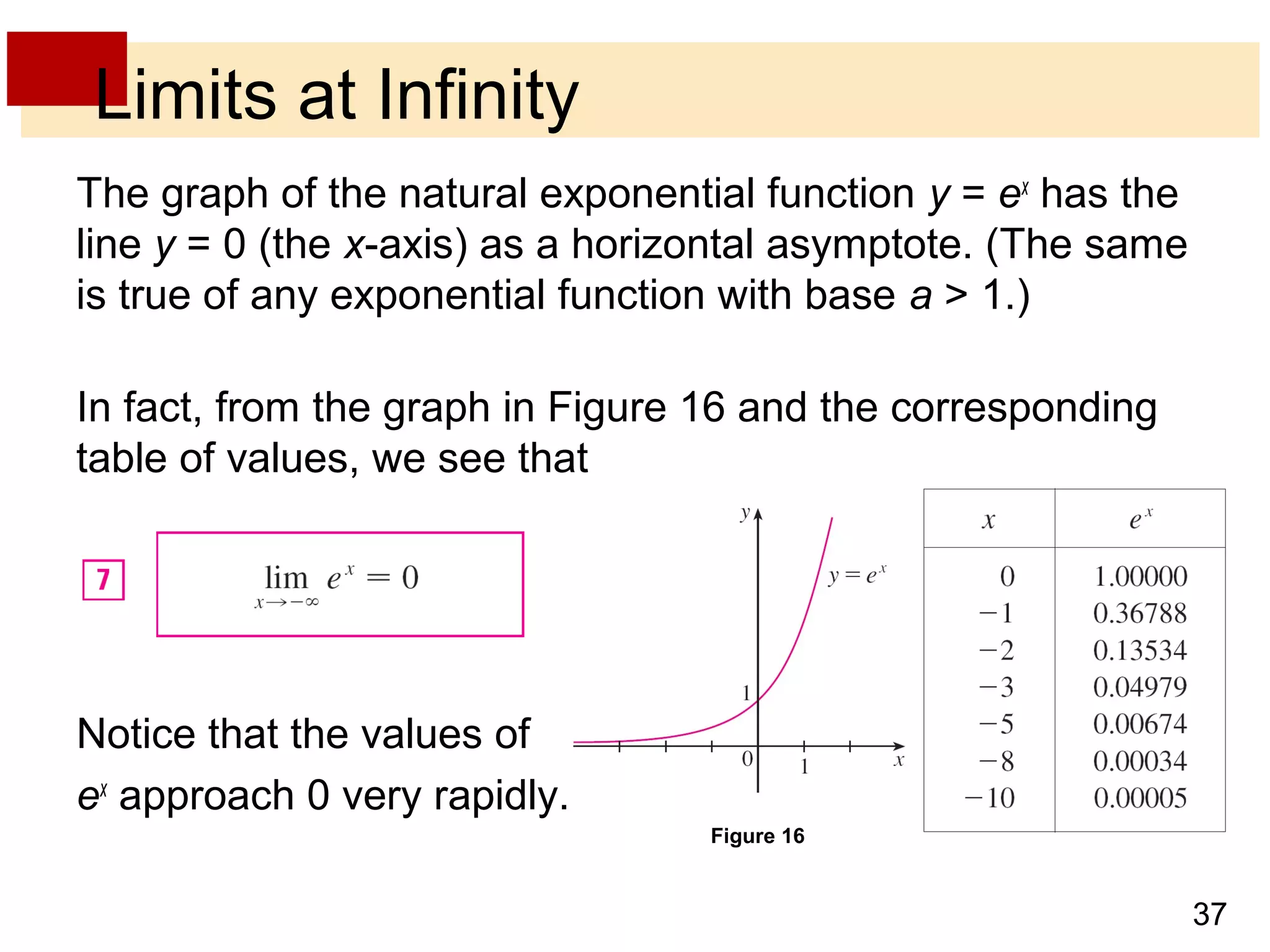
The graph of the natural exponential function y = ex has the 
line y = 0 (the x-axis) as a horizontal asymptote. (The same 
is true of any exponential function with base a > 1.) 
In fact, from the graph in Figure 16 and the corresponding 
table of values, we see that 
Notice that the values of 
ex approach 0 very rapidly. 
Figure 16
38 
Infinite Limits at Infinity
39 
Infinite Limits at Infinity 
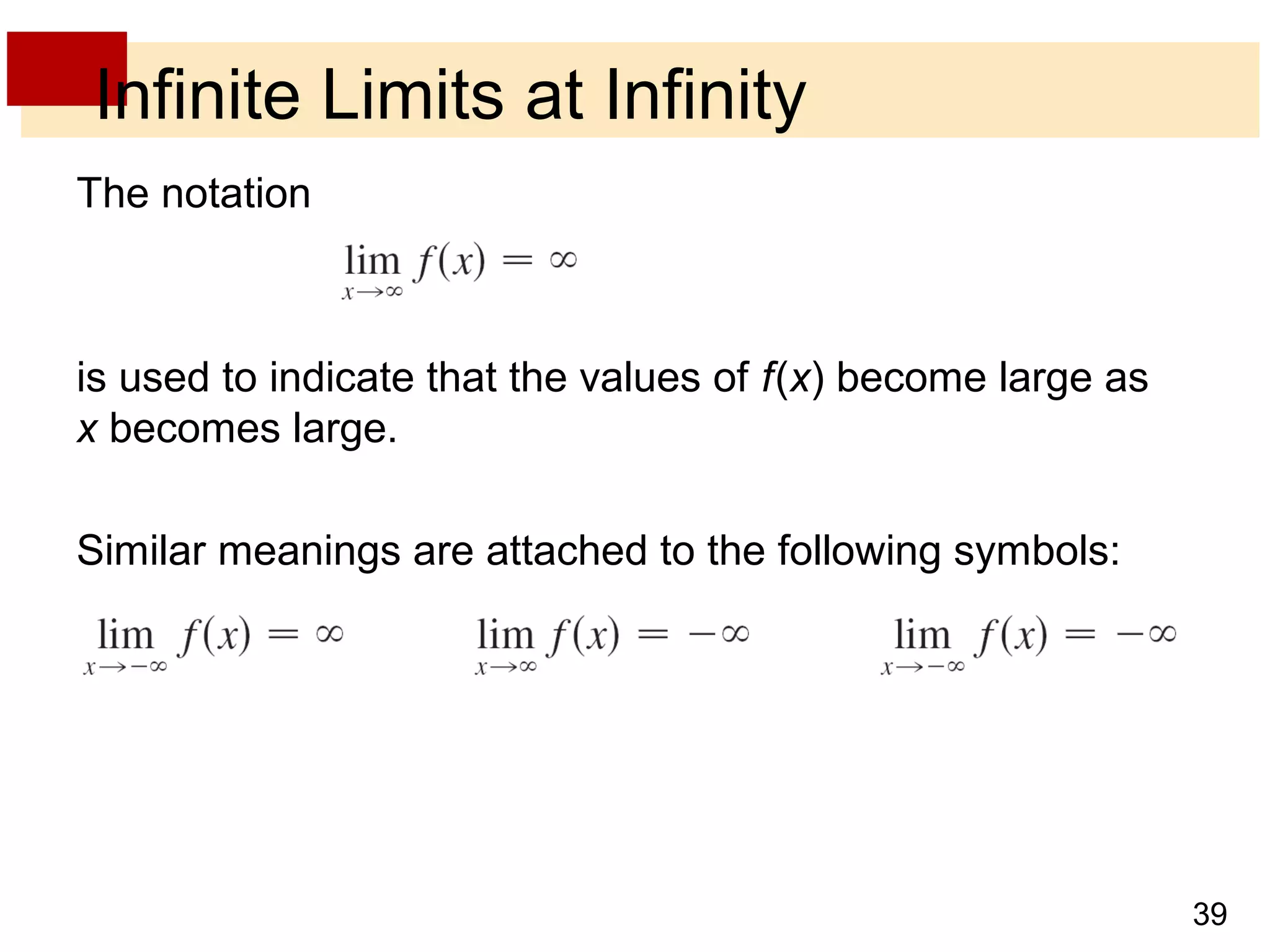
The notation 
is used to indicate that the values of f (x) become large as 
x becomes large. 
Similar meanings are attached to the following symbols:
40 
Infinite Limits at Infinity 
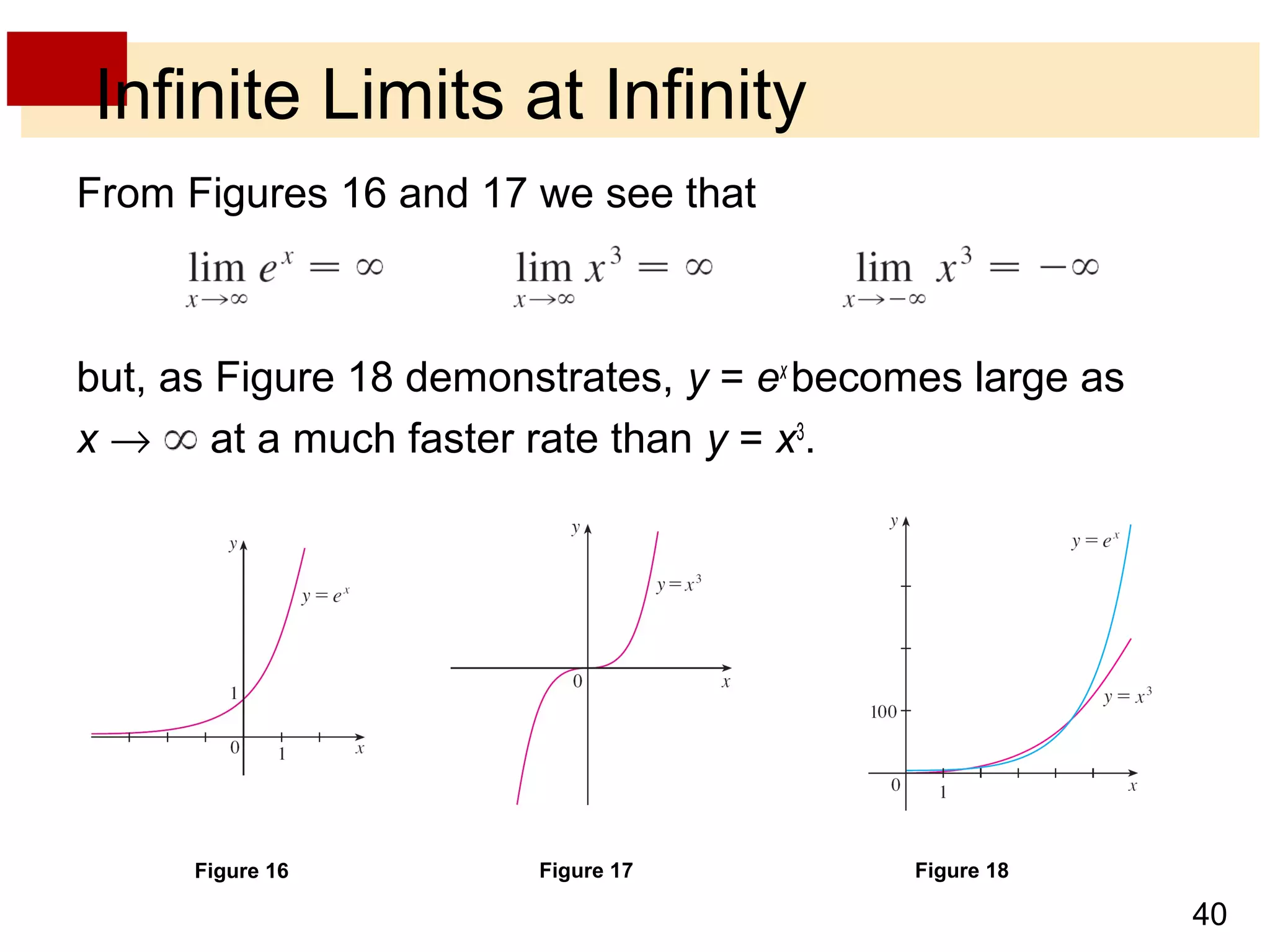
From Figures 16 and 17 we see that 
but, as Figure 18 demonstrates, y = ex becomes large as 
x ® at a much faster rate than y = x3. 
Figure 16 Figure 17 Figure 18
41 
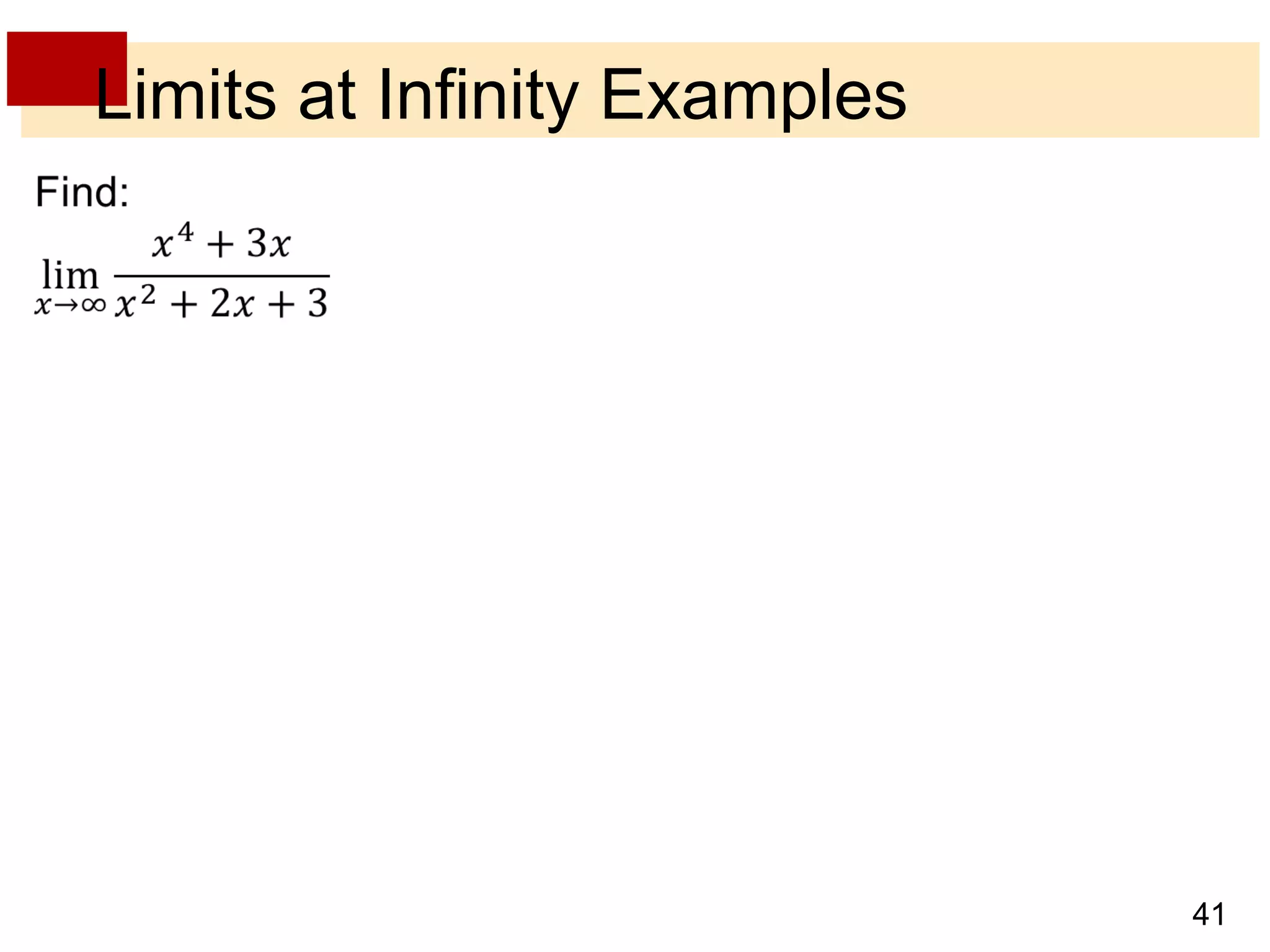
Limits at Infinity Examples
42 
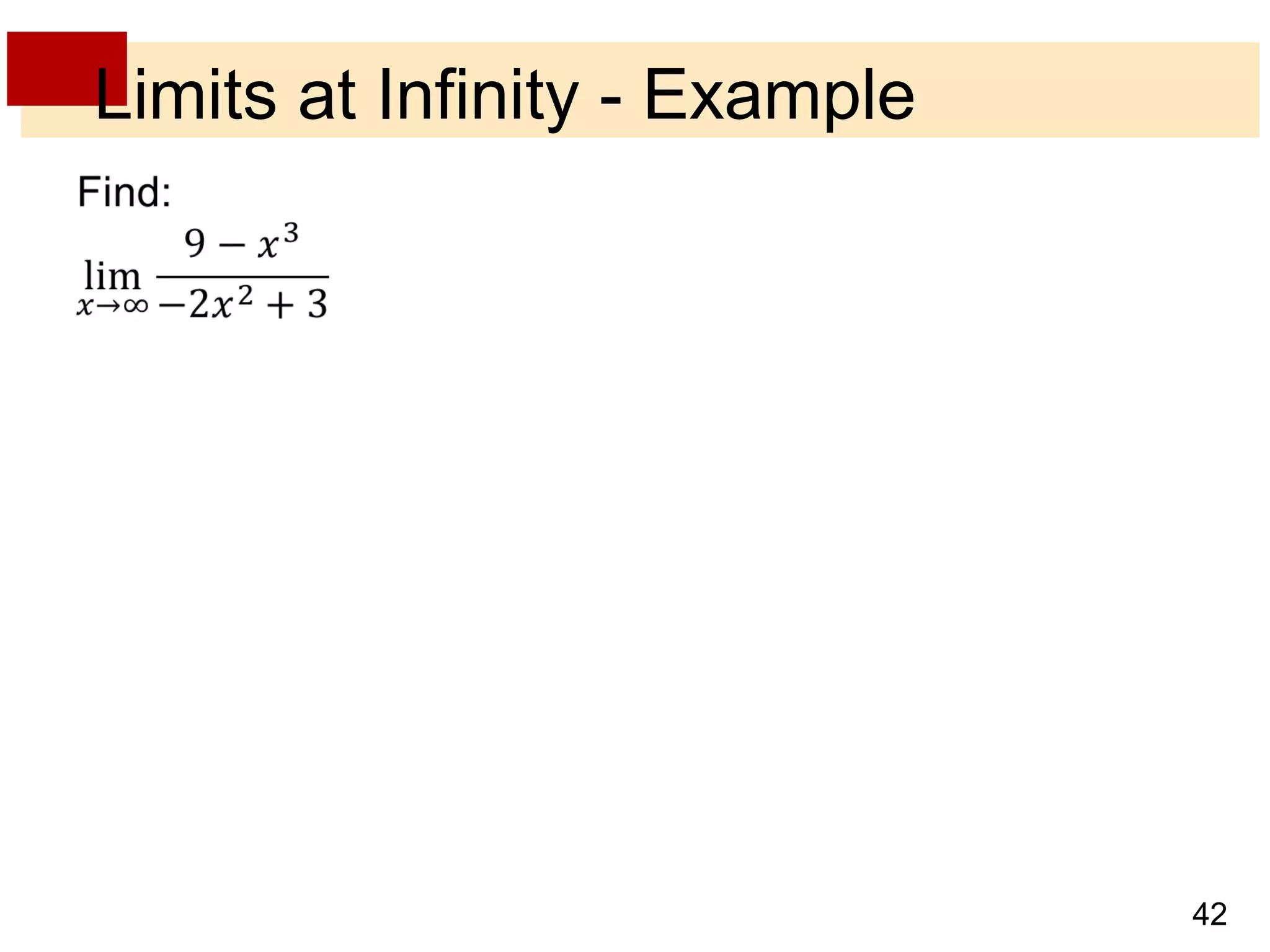
Limits at Infinity - Example

Lecture 6 limits with infinity

  • 1.
  • 2.
  • 3.
    3 Infinite Limits does not exist
  • 4.
    4 Infinite Limits As x  0, f(x) gets bigger and bigger without bound To indicate this kind of behavior we use the notation
  • 5.
    5 Infinite Limits Again, the symbol is not a number, but the expression limx®a f (x) = is often read as “the limit of f (x), as x approaches a, is infinity” or “f (x) becomes infinite as x approaches a” or “f (x) increases without bound as x approaches a” This definition is illustrated graphically in Figure 2. Figure 2
  • 6.
    6 Infinite Limits Similarly f (x) decreases without bound as x approaches a:
  • 7.
    7 One-Sided InfiniteLimits Similar definitions for the one-sided infinite limits •“x ® a–” only values of x that are less than a •“x ® a+” only x > a.
  • 8.
    8 Infinite Limits– One-Sided Limits
  • 9.
  • 10.
  • 11.
    11 Vertical Asymptotes For instance, the y-axis is a vertical asymptote of the curve y = 1/x2 because limx®0 (1/x2) = . Note: Asymptotes are lines – described by equations e.g., x = 0
  • 12.
    Example 1 –Evaluating One-sided Infinite Limits 12 Find and Solution: If x is close to 3 but larger than 3, then the denominator x – 3 is a small positive number and 2x is close to 6. So the quotient 2x/(x – 3) is a large positive number. Thus, intuitively, we see that
  • 13.
    13 Example 1– Solution Likewise, if x is close to 3 but smaller than 3, then x – 3 is a small negative number but 2x is still a positive number (close to 6). So 2x/(x – 3) is a numerically large negative number. Thus cont’d
  • 14.
    14 Example 1– Solution The line x = 3 is a vertical asymptote. cont’d
  • 15.
    15 Vertical Asymptoteof ln(x) Two familiar functions whose graphs have vertical asymptotes are y = ln x and y = tan x. and so the line x = 0 (the y-axis) is a vertical asymptote. Figure 6
  • 16.
    16 Vertical Asymptotesof tan(x) and so the line x = p/2 is a vertical asymptote. In fact, the lines x = (2n + 1)p/2, n an integer, are all vertical asymptotes of y = tan x. Figure 7 y = tan x
  • 17.
  • 18.
  • 19.
    19 Limits atInfinity
  • 20.
    20 Limits atInfinity Here we let x become arbitrarily large (positive or negative) and see what happens to y. Let’s begin by investigating the behavior of the function f defined by as x becomes large.
  • 21.
    21 Limits atInfinity The table at the right gives values of this function correct to six decimal places, and the graph of f has been drawn by a computer in Figure 8. Figure 8
  • 22.
    22 Limits atInfinity As x grows larger and larger you can see that the values of f (x) get closer and closer to 1. In fact, it seems that we can make the values of f (x) as close as we like to 1 by taking x sufficiently large. This situation is expressed symbolically by writing
  • 23.
    23 Limits atInfinity In general, we use the notation to indicate that the values of f (x) approach L as x becomes larger and larger.
  • 24.
    24 Limits atInfinity The symbol does not represent a number. Nonetheless, the expression is often read as “the limit of f (x), as x approaches infinity, is L” or “the limit of f (x), as x becomes infinite, is L” or “the limit of f (x), as x increases without bound, is L”
  • 25.
    25 Limits atInfinity Notice that there are many ways for the graph of f to approach the line y = L (which is called a horizontal asymptote) as we look to the far right of each graph. Figure 9 Examples illustrating
  • 26.
    Limits at Infinity For numerically large negative values of x, the values of f (x) are close to 1. 26 Figure 8 By letting x decrease through negative values without bound, we can make f (x) as close to 1 as we like. This is expressed by writing
  • 27.
    27 Limits atInfinity In general, as shown in Figure 10, the notation means that the values of f (x) can be made arbitrarily close to L by taking x sufficiently large negative. Figure 10 Examples illustrating
  • 28.
  • 29.
    29 Horizontal Asymptote- Graphically For instance, the curve illustrated in Figure 8 Figure 8 has the line y = 1 as a horizontal asymptote because
  • 30.
    2 Horizontal Asymptotes The curve y = f (x) sketched in Figure 11 has both y = –1 and y = 2 as horizontal asymptotes because 30 Figure 11
  • 31.
    Example 3 –Infinite Limits and Asymptotes from a Graph Find the infinite limits, limits at infinity, and asymptotes for the function f whose graph is shown in Figure 12. 31 Figure 12
  • 32.
    Example 3 –Solution We see that the values of f (x) become large as x ® –1 from both sides, so 32 Notice that f (x) becomes large negative as x approaches 2 from the left, but large positive as x approaches 2 from the right. So Thus both of the lines x = –1 and x = 2 are vertical asymptotes.
  • 33.
    33 Example 3– Solution As x becomes large, it appears that f (x) approaches 4. But as x decreases through negative values, f (x) approaches 2. So This means that both y = 4 and y = 2 are horizontal asymptotes. cont’d
  • 34.
    34 Limit of1/x as x∞ x 1/x 1 1 10 0.1 20 0.05 100 0.01 1000 0.001 10,000 0.0001 -1 -1 -10 -0.1 -20 -0.05 100 -0.01 1000 -0.001 10,000 -0.0001 4 3 2 1 -4 -3 -2 -1 1 2 3 4 -1 -2 -3 -4 x y
  • 35.
    35 Limits atInfinity Most of the Limit Laws hold for limits at infinity. It can be proved that the Limit Laws are also valid if “x ® a” is replaced by “x ® ” or “x ® .” In particular, we obtain the following important rule for calculating limits.
  • 36.
    36 Limits atInfinitely - Algebraically Divide each term by highest power of x in denominator: Examples:
  • 37.
    37 Limits atInfinity The graph of the natural exponential function y = ex has the line y = 0 (the x-axis) as a horizontal asymptote. (The same is true of any exponential function with base a > 1.) In fact, from the graph in Figure 16 and the corresponding table of values, we see that Notice that the values of ex approach 0 very rapidly. Figure 16
  • 38.
    38 Infinite Limitsat Infinity
  • 39.
    39 Infinite Limitsat Infinity The notation is used to indicate that the values of f (x) become large as x becomes large. Similar meanings are attached to the following symbols:
  • 40.
    40 Infinite Limitsat Infinity From Figures 16 and 17 we see that but, as Figure 18 demonstrates, y = ex becomes large as x ® at a much faster rate than y = x3. Figure 16 Figure 17 Figure 18
  • 41.
    41 Limits atInfinity Examples
  • 42.
    42 Limits atInfinity - Example