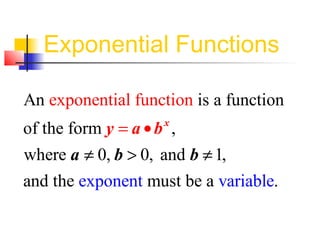
Exponential Functions 
An expone 
ntial f 
unction 
is a function 
of the form y = a 
· 
b 
x 
, 
where a 
¹ 0, b 
> 0, and b 
¹ 
1, 
and t 
he exponent must be a variab 
le 
.
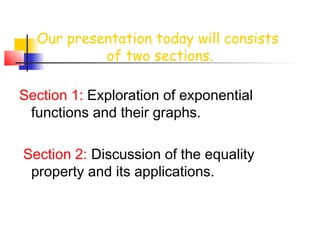
Our presentation today will consists 
of two sections. 
Section 1: Exploration of exponential 
functions and their graphs. 
Section 2: Discussion of the equality 
property and its applications.
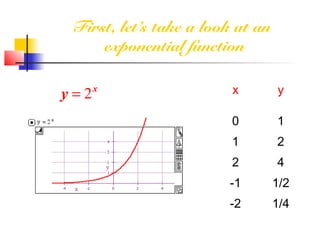
First, let’s take a look at an 
exponential function 
y = 2x x y 
0 1 
1 2 
2 4 
-1 1/2 
-2 1/4
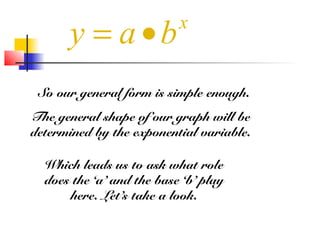
y = a ·bx 
So our general form is simple enough. 
The general shape of our graph will be 
determined by the exponential variable. 
Which leads us to ask what role 
does the ‘a’ and the base ‘b’ play 
here. Let’s take a look.
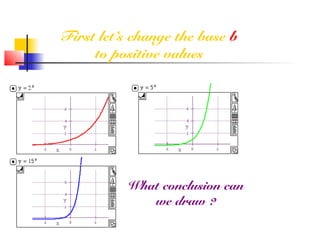
First let’s change the base b 
to positive values 
What conclusion can 
we draw ?
Next, observe what happens when b 
assumes a value such that 0<b<1. 
Can you explain why 
this happens ?
What do you think 
will happen if ‘b’ is 
negative ?
Don’t forget our 
definition ! 
Any equation of the form: 
y = a · bx , where a ¹ 0, b > 0 and b ¹ 1 
Can you explain why ‘b’ is restricted 
from assuming negative values ?
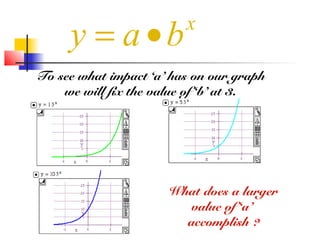
y = a ·bx 
To see what impact ‘a’ has on our graph 
we will fix the value of ‘b’ at 3. 
What does a larger 
value of ‘a’ 
accomplish ?
Shall we speculate as to what 
happens when ‘a’ assumes negative 
values ? 
Let’s see if you are correct !
y = a ·bx where a ¹ 0, b > 0 and b ¹ 1
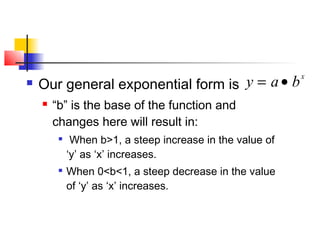
 Our general exponential form is 
 “b” is the base of the function and 
changes here will result in: 
y = a · bx 
 When b>1, a steep increase in the value of 
‘y’ as ‘x’ increases. 
 When 0<b<1, a steep decrease in the value 
of ‘y’ as ‘x’ increases.
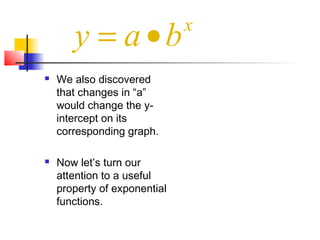
y = a ·bx 
 We also discovered 
that changes in “a” 
would change the y-intercept 
on its 
corresponding graph. 
 Now let’s turn our 
attention to a useful 
property of exponential 
functions.
Section 2 
The Equality Property of Exponential 
Functions
We know that in exponential functions the 
exponent is a variable. 
When we wish to solve for that variable we have two 
approaches we can take. 
One approach is to use a logarithm. We will learn about 
these in a later lesson. 
The second is to make use of the Equality 
Property for Exponential Functions.
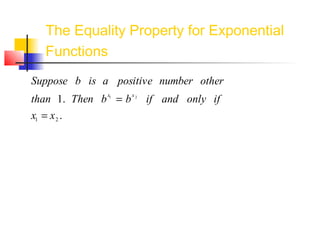
The Equality Property for Exponential 
Functions 
Suppose b is a positive number other 
than 1. Then bx1 = bx 2 if and only if 
x1 = x2 . 
Basically, this states that if the bases are the same, then we 
can simply set the exponents equal. 
This property is quite useful when we 
are trying to solve equations 
involving exponential functions. 
Let’s try a few examples to see how it works.
Example 1: 
32x-5 = 3x + 3 
(Since the bases are the same we 
simply set the exponents equal.) 2x - 5 = x + 3 
x - 5 = 3 
x = 8 
Here is another example for you to 
try: 
Example 1a: 
1 
23x-1 = x + 5 
2 
3
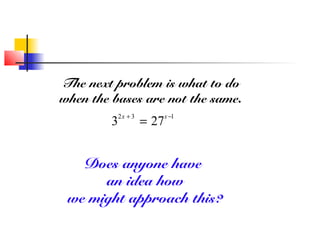
The next problem is what to do 
when the bases are not the same. 
3 2x + 3 = 27x-1 
Does anyone have 
an idea how 
we might approach this?
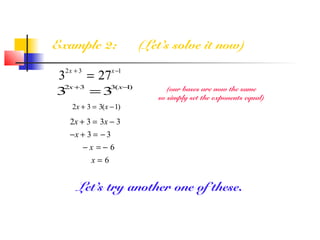
Our strategy here is to rewrite the 
bases so that they are both the same. 
Here for example, we know that 
33 = 27
Example 2: (Let’s solve it now) 
32x + 3 = 27x-1 
32x+3 =33(x-1) (our bases are now the same 
so simply set the exponents equal) 
2x + 3 = 3(x -1) 
2x + 3 = 3x - 3 
-x + 3 = - 3 
- x = - 6 
x = 6 
Let’s try another one of these.
Example 3 
16x +1 = 
1 
32 
24(x +1) = 2- 5 
4(x +1) = - 5 
4x + 4 = - 5 
4x = - 9 
x = - 
9 
4 
Remember a negative exponent is simply 
another way of writing a fraction 
The bases are now the same 
so set the exponents equal.
By now you can see that the equality property is 
actually quite useful in solving these problems. 
Here are a few more examples for you to try. 
Example 4: 32x-1 = 1 
9 
Example 5: 4x + 3 = 82x +1

Exponential functions

  • 1.
    Exponential Functions Anexpone ntial f unction is a function of the form y = a · b x , where a ¹ 0, b > 0, and b ¹ 1, and t he exponent must be a variab le .
  • 2.
    Our presentation todaywill consists of two sections. Section 1: Exploration of exponential functions and their graphs. Section 2: Discussion of the equality property and its applications.
  • 3.
    First, let’s takea look at an exponential function y = 2x x y 0 1 1 2 2 4 -1 1/2 -2 1/4
  • 4.
    y = a·bx So our general form is simple enough. The general shape of our graph will be determined by the exponential variable. Which leads us to ask what role does the ‘a’ and the base ‘b’ play here. Let’s take a look.
  • 5.
    First let’s changethe base b to positive values What conclusion can we draw ?
  • 6.
    Next, observe whathappens when b assumes a value such that 0<b<1. Can you explain why this happens ?
  • 7.
    What do youthink will happen if ‘b’ is negative ?
  • 8.
    Don’t forget our definition ! Any equation of the form: y = a · bx , where a ¹ 0, b > 0 and b ¹ 1 Can you explain why ‘b’ is restricted from assuming negative values ?
  • 9.
    y = a·bx To see what impact ‘a’ has on our graph we will fix the value of ‘b’ at 3. What does a larger value of ‘a’ accomplish ?
  • 10.
    Shall we speculateas to what happens when ‘a’ assumes negative values ? Let’s see if you are correct !
  • 11.
    y = a·bx where a ¹ 0, b > 0 and b ¹ 1
  • 12.
     Our generalexponential form is  “b” is the base of the function and changes here will result in: y = a · bx  When b>1, a steep increase in the value of ‘y’ as ‘x’ increases.  When 0<b<1, a steep decrease in the value of ‘y’ as ‘x’ increases.
  • 13.
    y = a·bx  We also discovered that changes in “a” would change the y-intercept on its corresponding graph.  Now let’s turn our attention to a useful property of exponential functions.
  • 14.
    Section 2 TheEquality Property of Exponential Functions
  • 15.
    We know thatin exponential functions the exponent is a variable. When we wish to solve for that variable we have two approaches we can take. One approach is to use a logarithm. We will learn about these in a later lesson. The second is to make use of the Equality Property for Exponential Functions.
  • 16.
    The Equality Propertyfor Exponential Functions Suppose b is a positive number other than 1. Then bx1 = bx 2 if and only if x1 = x2 . Basically, this states that if the bases are the same, then we can simply set the exponents equal. This property is quite useful when we are trying to solve equations involving exponential functions. Let’s try a few examples to see how it works.
  • 17.
    Example 1: 32x-5= 3x + 3 (Since the bases are the same we simply set the exponents equal.) 2x - 5 = x + 3 x - 5 = 3 x = 8 Here is another example for you to try: Example 1a: 1 23x-1 = x + 5 2 3
  • 18.
    The next problemis what to do when the bases are not the same. 3 2x + 3 = 27x-1 Does anyone have an idea how we might approach this?
  • 19.
    Our strategy hereis to rewrite the bases so that they are both the same. Here for example, we know that 33 = 27
  • 20.
    Example 2: (Let’ssolve it now) 32x + 3 = 27x-1 32x+3 =33(x-1) (our bases are now the same so simply set the exponents equal) 2x + 3 = 3(x -1) 2x + 3 = 3x - 3 -x + 3 = - 3 - x = - 6 x = 6 Let’s try another one of these.
  • 21.
    Example 3 16x+1 = 1 32 24(x +1) = 2- 5 4(x +1) = - 5 4x + 4 = - 5 4x = - 9 x = - 9 4 Remember a negative exponent is simply another way of writing a fraction The bases are now the same so set the exponents equal.
  • 22.
    By now youcan see that the equality property is actually quite useful in solving these problems. Here are a few more examples for you to try. Example 4: 32x-1 = 1 9 Example 5: 4x + 3 = 82x +1