2-5: Inequalities
© 2007 Roy L. Gover (www.mrgover.com)
Learning Goals:
•Use interval notation
•Solve linear and compound
linear inequalities
•Find exact solutions of
quadratic and factorable
inequalities
Important Idea
In previous sections, we
have been solving equalities,
or equations. Now we are
going to solve inequalities.
The methods of solving
equalities and inequalities
are similar but there are
important differences.
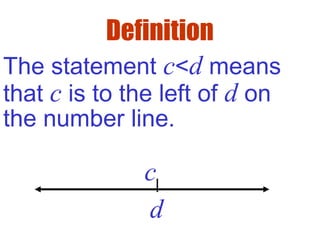
Definition
The statement c<d means
that c is to the left of d on
the number line.
d
c
Definition
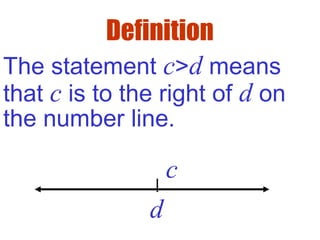
The statement c>d means
that c is to the right of d on
the number line.
d
c
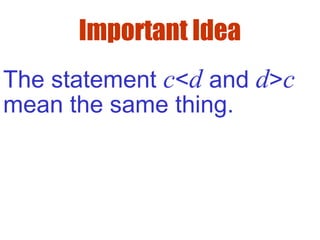
Important Idea
The statement c<d and d>c
mean the same thing.
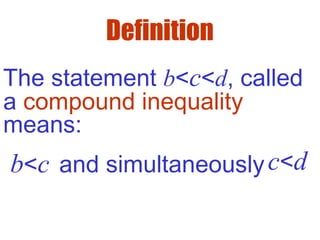
Definition
The statement b<c<d, called
a compound inequality
means:
b<c and simultaneouslyc<d
Definition
( ),c d c x d⇔ < <
( ],c d c x d⇔ < ≤
Interval Notation:Let x,c & d
be real numbers with c<d:
[ ],c d c x d⇔ ≤ ≤
[ ),c d c x d⇔ ≤ <
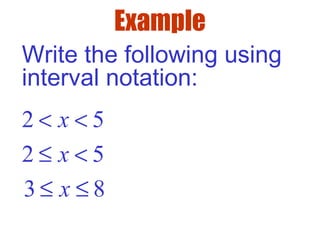
Example
Write the following using
interval notation:
2 5x< <
2 5x≤ <
3 8x≤ ≤
Try This
Write the following using
interval notation:
3 8x< ≤
( ]3,8
Try This
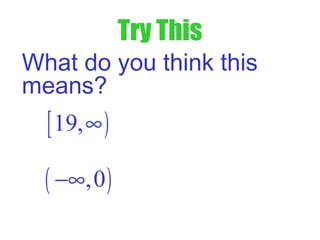
What do you think this
means?
[ )19,∞
( ),0−∞
Important Idea
Principles for solving
inequalities:
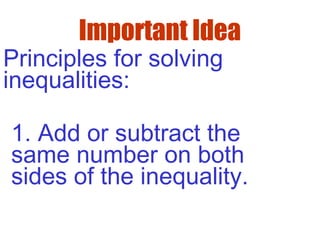
1. Add or subtract the
same number on both
sides of the inequality.
Important Idea
Principles for solving
inequalities:
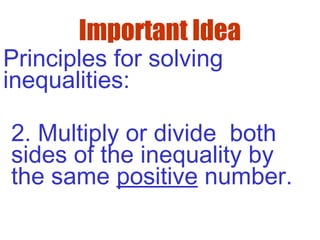
2. Multiply or divide both
sides of the inequality by
the same positive number.
Important Idea
Principles for solving
inequalities:
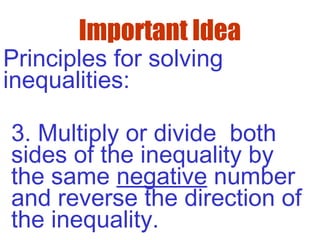
3. Multiply or divide both
sides of the inequality by
the same negative number
and reverse the direction of
the inequality.
Example
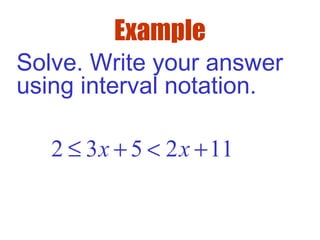
2 3 5 2 11x x≤ + < +
Solve. Write your answer
using interval notation.
Try This
5 2 1 7x x− ≤ − ≤ +
[ ]2,8−
Solve. Write your answer
using interval notation.
Example
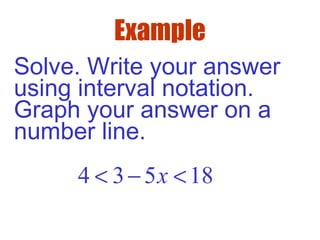
4 3 5 18x< − <
Solve. Write your answer
using interval notation.
Graph your answer on a
number line.
Try This
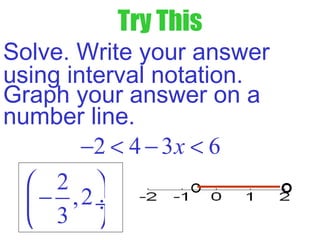
Solve. Write your answer
using interval notation.
Graph your answer on a
number line.
2
,2
3
 
− ÷
 
2 4 3 6x− < − <
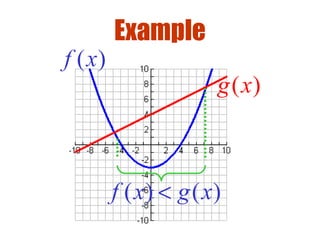
Important Idea
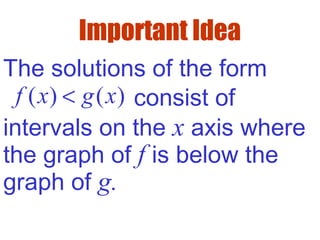
The solutions of the form
( ) ( )f x g x< consist of
intervals on the x axis where
the graph of f is below the
graph of g.
Example
( )f x
( )g x
( ) ( )f x g x<
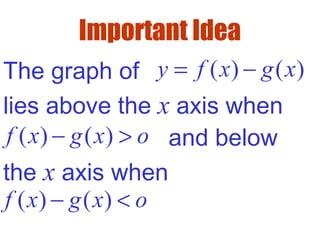
Important Idea
The graph of ( ) ( )y f x g x= −
lies above the x axis when
( ) ( )f x g x o− > and below
the x axis when
( ) ( )f x g x o− <
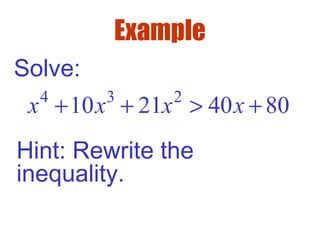
Example
Solve:
4 3 2
10 21 40 80x x x x+ + > +
Hint: Rewrite the
inequality.
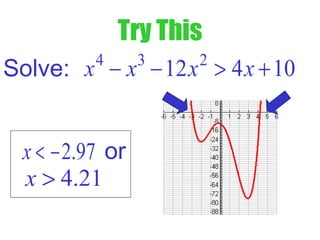
Try This
Solve: 4 3 2
12 4 10x x x x− − > +
2.97x < − or
4.21x >
Important Idea
Solving an inequality
depends only on knowing
the zeros of the function
and where the graph is
above or below the x-
axis. The zeros are where
the function touches the x
axis.
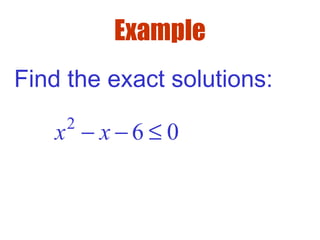
Example
Find the exact solutions:
2
6 0x x− − ≤
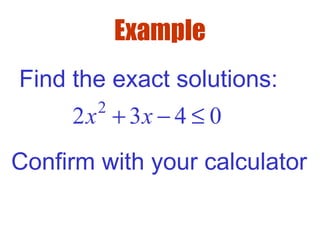
Example
Find the exact solutions:
2
2 3 4 0x x+ − ≤
Confirm with your calculator
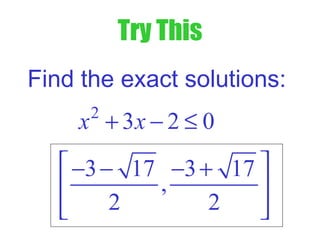
Try This
2
3 2 0x x+ − ≤
Find the exact solutions:
3 17 3 17
,
2 2
 − − − +
 
 
Example
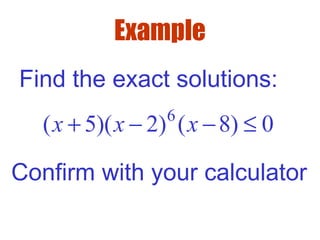
Find the exact solutions:
Confirm with your calculator
6
( 5)( 2) ( 8) 0x x x+ − − ≤
Important Idea
Steps for solving inequalities:
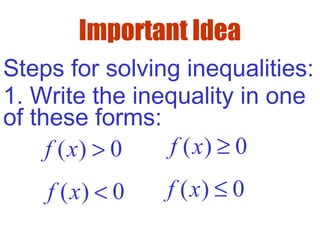
1. Write the inequality in one
of these forms:
( ) 0f x > ( ) 0f x ≥
( ) 0f x < ( ) 0f x ≤
Important Idea
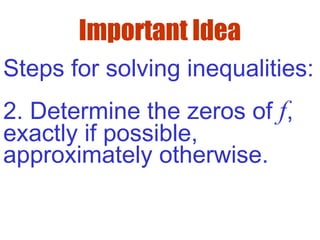
Steps for solving inequalities:
2. Determine the zeros of f,
exactly if possible,
approximately otherwise.
Important Idea
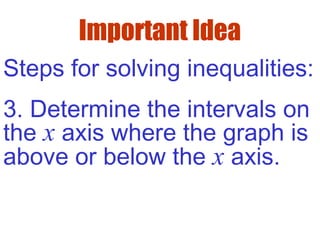
Steps for solving inequalities:
3. Determine the intervals on
the x axis where the graph is
above or below the x axis.
Example
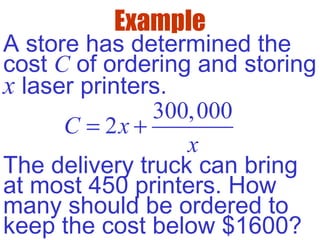
A store has determined the
cost C of ordering and storing
x laser printers.
300,000
2C x
x
= +
The delivery truck can bring
at most 450 printers. How
many should be ordered to
keep the cost below $1600?
Lesson Close
Tell me everything you
know about solving
inequalities.

Hprec2 5

  • 1.
    2-5: Inequalities © 2007Roy L. Gover (www.mrgover.com) Learning Goals: •Use interval notation •Solve linear and compound linear inequalities •Find exact solutions of quadratic and factorable inequalities
  • 2.
    Important Idea In previoussections, we have been solving equalities, or equations. Now we are going to solve inequalities. The methods of solving equalities and inequalities are similar but there are important differences.
  • 3.
    Definition The statement c<dmeans that c is to the left of d on the number line. d c
  • 4.
    Definition The statement c>dmeans that c is to the right of d on the number line. d c
  • 5.
    Important Idea The statementc<d and d>c mean the same thing.
  • 6.
    Definition The statement b<c<d,called a compound inequality means: b<c and simultaneouslyc<d
  • 7.
    Definition ( ),c dc x d⇔ < < ( ],c d c x d⇔ < ≤ Interval Notation:Let x,c & d be real numbers with c<d: [ ],c d c x d⇔ ≤ ≤ [ ),c d c x d⇔ ≤ <
  • 8.
    Example Write the followingusing interval notation: 2 5x< < 2 5x≤ < 3 8x≤ ≤
  • 9.
    Try This Write thefollowing using interval notation: 3 8x< ≤ ( ]3,8
  • 10.
    Try This What doyou think this means? [ )19,∞ ( ),0−∞
  • 11.
    Important Idea Principles forsolving inequalities: 1. Add or subtract the same number on both sides of the inequality.
  • 12.
    Important Idea Principles forsolving inequalities: 2. Multiply or divide both sides of the inequality by the same positive number.
  • 13.
    Important Idea Principles forsolving inequalities: 3. Multiply or divide both sides of the inequality by the same negative number and reverse the direction of the inequality.
  • 14.
    Example 2 3 52 11x x≤ + < + Solve. Write your answer using interval notation.
  • 15.
    Try This 5 21 7x x− ≤ − ≤ + [ ]2,8− Solve. Write your answer using interval notation.
  • 16.
    Example 4 3 518x< − < Solve. Write your answer using interval notation. Graph your answer on a number line.
  • 17.
    Try This Solve. Writeyour answer using interval notation. Graph your answer on a number line. 2 ,2 3   − ÷   2 4 3 6x− < − <
  • 18.
    Important Idea The solutionsof the form ( ) ( )f x g x< consist of intervals on the x axis where the graph of f is below the graph of g.
  • 19.
    Example ( )f x ()g x ( ) ( )f x g x<
  • 20.
    Important Idea The graphof ( ) ( )y f x g x= − lies above the x axis when ( ) ( )f x g x o− > and below the x axis when ( ) ( )f x g x o− <
  • 21.
    Example Solve: 4 3 2 1021 40 80x x x x+ + > + Hint: Rewrite the inequality.
  • 22.
    Try This Solve: 43 2 12 4 10x x x x− − > + 2.97x < − or 4.21x >
  • 23.
    Important Idea Solving aninequality depends only on knowing the zeros of the function and where the graph is above or below the x- axis. The zeros are where the function touches the x axis.
  • 24.
    Example Find the exactsolutions: 2 6 0x x− − ≤
  • 25.
    Example Find the exactsolutions: 2 2 3 4 0x x+ − ≤ Confirm with your calculator
  • 26.
    Try This 2 3 20x x+ − ≤ Find the exact solutions: 3 17 3 17 , 2 2  − − − +    
  • 27.
    Example Find the exactsolutions: Confirm with your calculator 6 ( 5)( 2) ( 8) 0x x x+ − − ≤
  • 28.
    Important Idea Steps forsolving inequalities: 1. Write the inequality in one of these forms: ( ) 0f x > ( ) 0f x ≥ ( ) 0f x < ( ) 0f x ≤
  • 29.
    Important Idea Steps forsolving inequalities: 2. Determine the zeros of f, exactly if possible, approximately otherwise.
  • 30.
    Important Idea Steps forsolving inequalities: 3. Determine the intervals on the x axis where the graph is above or below the x axis.
  • 31.
    Example A store hasdetermined the cost C of ordering and storing x laser printers. 300,000 2C x x = + The delivery truck can bring at most 450 printers. How many should be ordered to keep the cost below $1600?
  • 32.
    Lesson Close Tell meeverything you know about solving inequalities.