ALGEBRA Algebra is a branch of  mathematics  concerning the study of  structure ,  relation  and  quantity .
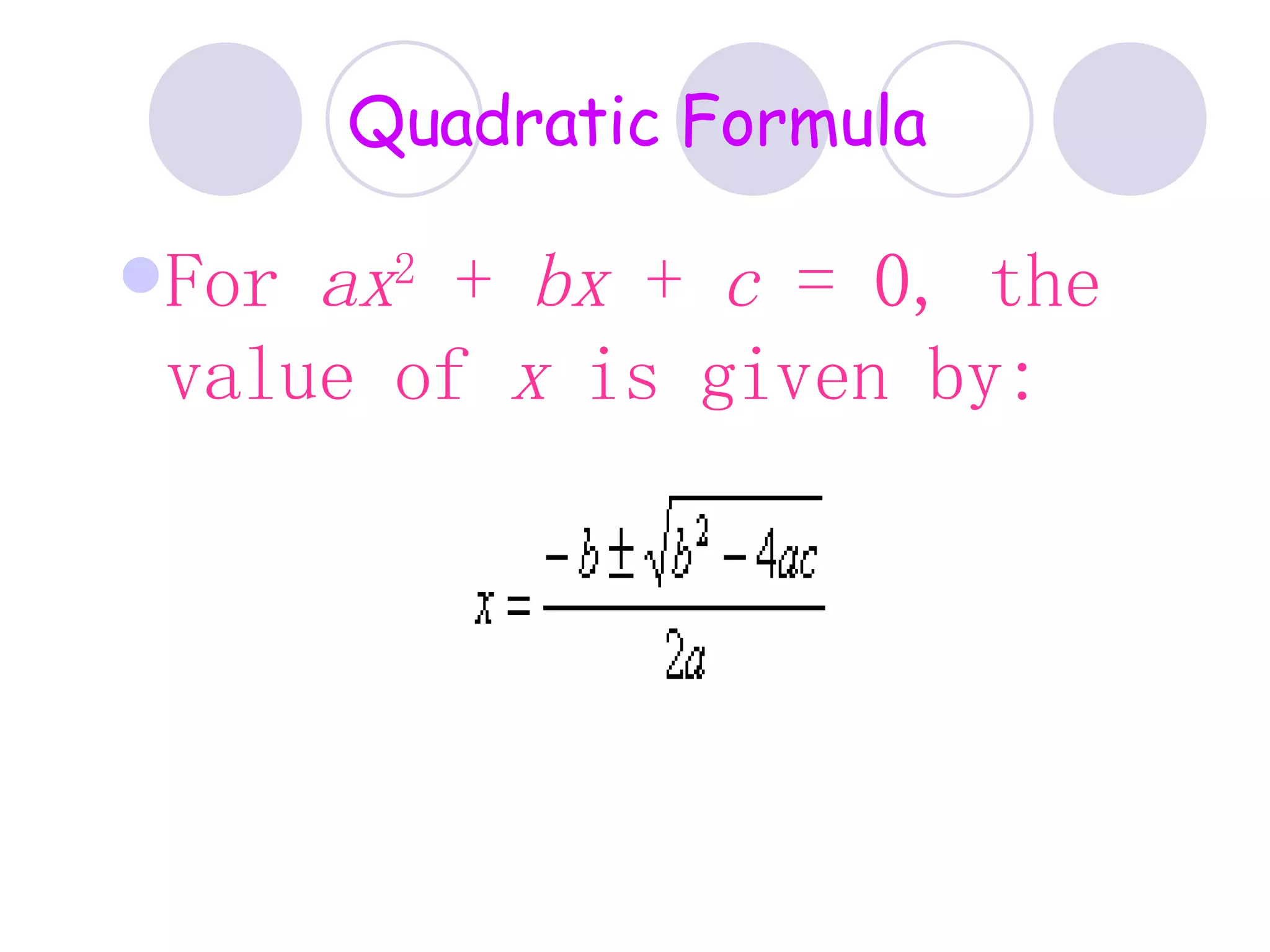
Quadratic Formula For  ax 2  +  bx  +  c  = 0, the value of  x  is given by:                              
Quadratic Formula The Quadratic Formula uses the " a ", " b ", and " c " from " ax 2  +  bx  +  c ", where " a ", " b ", and " c " are just numbers. Solve  x 2  + 3 x  – 4 = 0   Note first that this quadratic happens to factor: x 2  + 3 x  – 4 = ( x  + 4)( x  – 1) = 0 ...so  x  = –4 and  x  = 1. How would this look in the Quadratic Formula? Using  a  = 1,  b  = 3, and  c  = –4, it looks like this: Then, as expected, the solution is  x  = –4,  x  = 1
3 ways to get the “x” By Factoring Ex. x 2  –x-12=0 (x-4)(x+3) X=4 : x=-3 B.   By Completing the Square And  C. Quadratic Formula
Imaginary Numbers In  mathematics , an  imaginary number  (or  purely imaginary number ) is a  complex number  whose  square  is a  negative  real number.  Properties of i: i 2 = - 1  and I =  √-1 Note: i is not available like x, y. It never changes. Example: √ -2=  i√2 5+√-8 = 5+ i√8 =  5+ 2i√2
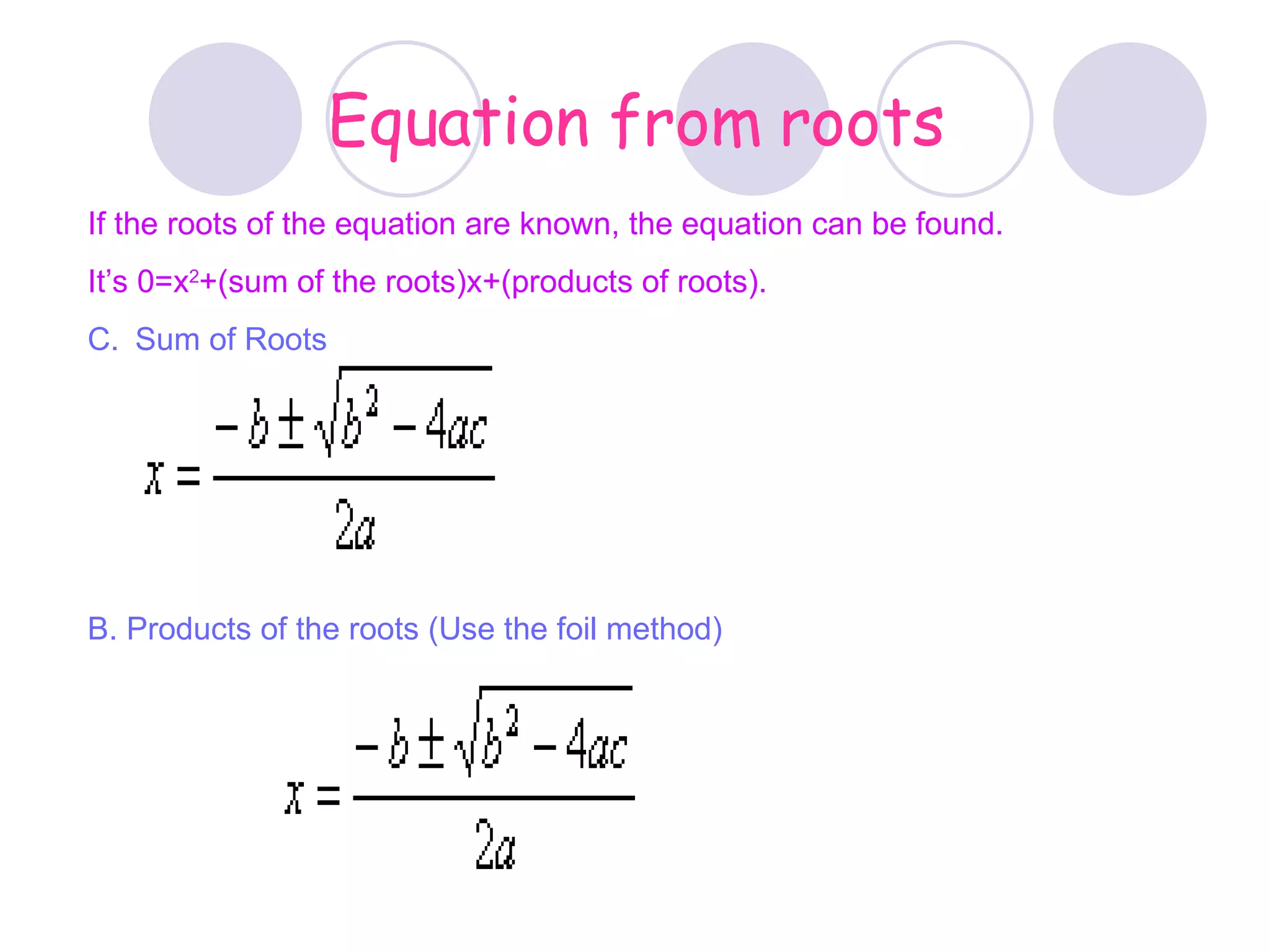
Equation from roots If the roots of the equation are known, the equation can be found.  It’s 0=x 2 +(sum of the roots)x+(products of roots). Sum of Roots B. Products of the roots (Use the foil method)
Equation from roots Note: Sum of the roots = -b/a Product of the roots = c/a (-2, 4) -2+4=2  : -b/a= -2 b. (-2)(4)= -8 : c/a= -8 c. x 2 +(-2)x+(-8)=0 0=x 2 -2x-8
Radical Equation A "radical" equation is an equation in which the variable is stuck inside a radical. For instance, this is a radical equation:       ...but this is not:     Examples: A.                                                  
Absolute Value Equation The absolute value  of a number must be positive. Examples: Simplify | –8 |.   | –8 | =  8     Simplify | 0 – 6 |.   | 0 – 6 | = | –6 | =  6 Simplify | 5 – 2 |.   | 5 – 2 | = | 3 | =  3 Simplify | 2 – 5 |.   | 2 – 5 | = | –3 | =  3 Simplify | 0(–4) |.   | 0(–4) | = | 0 | =  0
Absolute Value Equations Why is the absolute value of zero equal to "0"? Ask yourself: how far is zero from 0? Zero units, right? So | 0 | = 0. Simplify | 2 + 3(–4) |.   | 2 + 3(–4) | = | 2 – 12 | = | –10 | =  10 Simplify –| –4 |.   – | –4| = –(4) =  –4 Simplify –| (–2)2 |.   – | (–2)2 | = –| 4 | =  –4 Simplify –| –2 |2   – | –2 |2 = –(2)2 = –(4) =  –4 Simplify (–| –2 |)2.   (–| –2 |)2 = (–(2))2 = (–2)2 =  4
Rational Equation Factor if possible. Determine the LCD Determine the restricted values- Only applies to the denominator Multiply each term by LCD- This will eliminate the denominator Solve algebraically for variable
Rational Equation -While adding and subtracting rational expressions is a royal pain, solving rational equations is much simpler. (Note that I don't say that it's "simple", just that it's "simpler".) This is because, as soon as you go from a rational expression (with no "equals" sign in it) to a rational equation (with an "equals" sign in the middle), you get a whole different set of tools to work with. In particular, you can multiply through on both sides of the equation to get rid of the denominators.   Solve the following equation:   This equation is so simple that I can solve it just by looking at it: since I have two-thirds equal to  x -thirds, clearly  x  = 2. The reason this was so easy to solve is that the denominators were the same, so all I had to do was solve the numerators. x  = 2
Rational Equation Solve the following equation:   To solve this, I can convert to a common denominator of 15: Now I can compare the numerators:  x  – 1 = 6  x  = 7
Rational Equation Note, however, that I could also have solved this by multiplying through on both sides by the common denominator:  x  – 1 = 2(3)  x  – 1 = 6  x  = 7   When you were adding and subtracting rational expressions, you had to find a common denominator. Now that you have equations (with an "equals" sign in the middle), you are allowed to multiply through (because you have two sides to multiply on) and get rid of the denominators entirely. In other words, you still need to find the common denominator, but you don't necessarily need to use it in the same way.

Algebra Project Period 4

  • 1.
    ALGEBRA Algebra isa branch of mathematics concerning the study of structure , relation and quantity .
  • 2.
    Quadratic Formula For ax 2 + bx + c = 0, the value of x is given by:                            
  • 3.
    Quadratic Formula TheQuadratic Formula uses the " a ", " b ", and " c " from " ax 2 + bx + c ", where " a ", " b ", and " c " are just numbers. Solve x 2 + 3 x – 4 = 0 Note first that this quadratic happens to factor: x 2 + 3 x – 4 = ( x + 4)( x – 1) = 0 ...so x = –4 and x = 1. How would this look in the Quadratic Formula? Using a = 1, b = 3, and c = –4, it looks like this: Then, as expected, the solution is x = –4, x = 1
  • 4.
    3 ways toget the “x” By Factoring Ex. x 2 –x-12=0 (x-4)(x+3) X=4 : x=-3 B. By Completing the Square And C. Quadratic Formula
  • 5.
    Imaginary Numbers In mathematics , an imaginary number (or purely imaginary number ) is a complex number whose square is a negative real number. Properties of i: i 2 = - 1 and I = √-1 Note: i is not available like x, y. It never changes. Example: √ -2= i√2 5+√-8 = 5+ i√8 = 5+ 2i√2
  • 6.
    Equation from rootsIf the roots of the equation are known, the equation can be found. It’s 0=x 2 +(sum of the roots)x+(products of roots). Sum of Roots B. Products of the roots (Use the foil method)
  • 7.
    Equation from rootsNote: Sum of the roots = -b/a Product of the roots = c/a (-2, 4) -2+4=2 : -b/a= -2 b. (-2)(4)= -8 : c/a= -8 c. x 2 +(-2)x+(-8)=0 0=x 2 -2x-8
  • 8.
    Radical Equation A"radical" equation is an equation in which the variable is stuck inside a radical. For instance, this is a radical equation:      ...but this is not:   Examples: A.                                                 
  • 9.
    Absolute Value EquationThe absolute value of a number must be positive. Examples: Simplify | –8 |. | –8 | = 8    Simplify | 0 – 6 |. | 0 – 6 | = | –6 | = 6 Simplify | 5 – 2 |. | 5 – 2 | = | 3 | = 3 Simplify | 2 – 5 |. | 2 – 5 | = | –3 | = 3 Simplify | 0(–4) |. | 0(–4) | = | 0 | = 0
  • 10.
    Absolute Value EquationsWhy is the absolute value of zero equal to "0"? Ask yourself: how far is zero from 0? Zero units, right? So | 0 | = 0. Simplify | 2 + 3(–4) |. | 2 + 3(–4) | = | 2 – 12 | = | –10 | = 10 Simplify –| –4 |. – | –4| = –(4) = –4 Simplify –| (–2)2 |. – | (–2)2 | = –| 4 | = –4 Simplify –| –2 |2 – | –2 |2 = –(2)2 = –(4) = –4 Simplify (–| –2 |)2. (–| –2 |)2 = (–(2))2 = (–2)2 = 4
  • 11.
    Rational Equation Factorif possible. Determine the LCD Determine the restricted values- Only applies to the denominator Multiply each term by LCD- This will eliminate the denominator Solve algebraically for variable
  • 12.
    Rational Equation -Whileadding and subtracting rational expressions is a royal pain, solving rational equations is much simpler. (Note that I don't say that it's "simple", just that it's "simpler".) This is because, as soon as you go from a rational expression (with no "equals" sign in it) to a rational equation (with an "equals" sign in the middle), you get a whole different set of tools to work with. In particular, you can multiply through on both sides of the equation to get rid of the denominators. Solve the following equation: This equation is so simple that I can solve it just by looking at it: since I have two-thirds equal to x -thirds, clearly x = 2. The reason this was so easy to solve is that the denominators were the same, so all I had to do was solve the numerators. x = 2
  • 13.
    Rational Equation Solvethe following equation: To solve this, I can convert to a common denominator of 15: Now I can compare the numerators: x – 1 = 6 x = 7
  • 14.
    Rational Equation Note,however, that I could also have solved this by multiplying through on both sides by the common denominator: x – 1 = 2(3) x – 1 = 6 x = 7 When you were adding and subtracting rational expressions, you had to find a common denominator. Now that you have equations (with an "equals" sign in the middle), you are allowed to multiply through (because you have two sides to multiply on) and get rid of the denominators entirely. In other words, you still need to find the common denominator, but you don't necessarily need to use it in the same way.