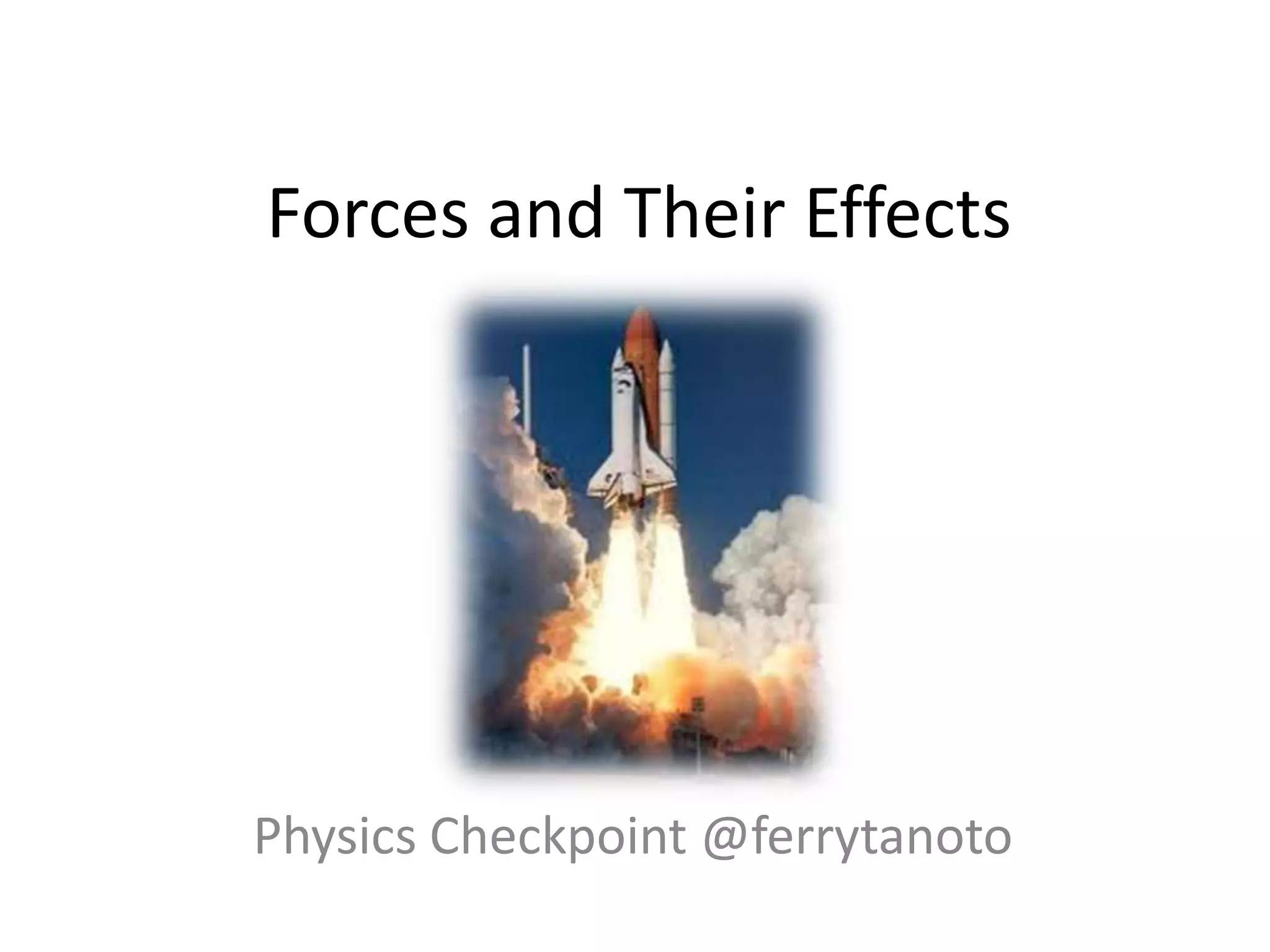
Forces and Their EffectsPhysics Checkpoint @ferrytanoto
You cannot see a force but you can see what it does. You can also feel the effect of a force on your body.
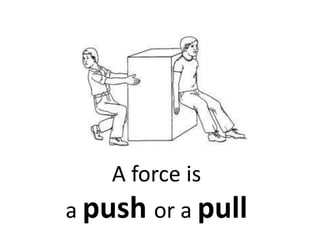
A force is a pushor a pull
What can a force do?
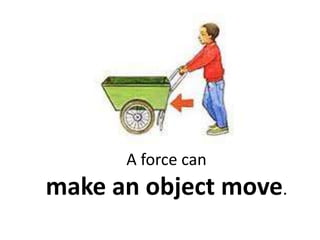
A force can make an object move.
A force can make a moving object stop.
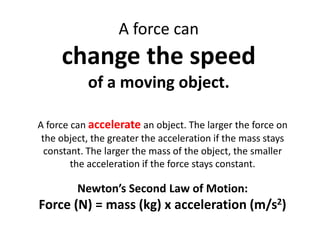
A force can change the speed of a moving object.A force can accelerate an object. The larger the force on the object, the greater the acceleration if the mass stays constant. The larger the mass of the object, the smaller the acceleration if the force stays constant.Newton’s Second Law of Motion:Force (N) = mass (kg) x acceleration (m/s2)
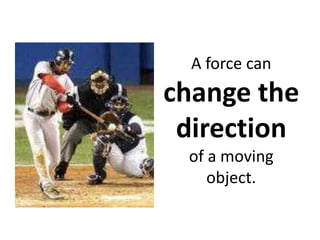
A force can change the direction of a moving object.
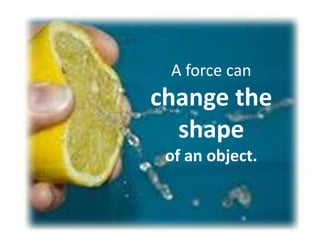
A force can change the shapeof an object.
How to measure a force?
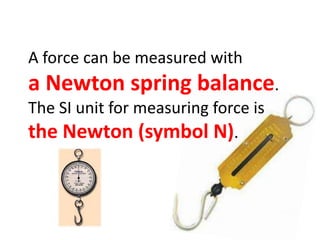
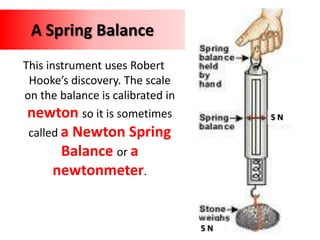
A force can be measured with a Newton spring balance.The SI unit for measuring force is the Newton (symbol N).
There are two main types of forces: contact forces and non-contact forces.
A contact force occurs when the object or material exerting the force touches the object or material on which the force acts.
A non-contact force occurs when the objects or materials do not touch each other.
Contact ForcesImpact forceWhen a moving object collides with a stationary object an impact force is exerted by one object on the other.Strain force	When some materials are squashed, stretched, twisted or bent they exert a force which act in the opposite direction to the force acting on them. These materials are called elastic materials and the force they exert when they are deformed is called a strain force.
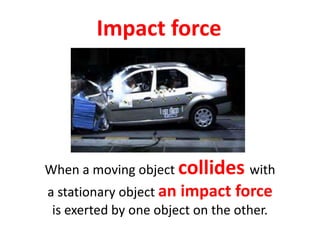
Impact forceWhen a moving object collideswith a stationary object an impact force is exerted by one object on the other.
Strain forceWhen some materials are squashed, stretched, twisted or bent they exert a force which act in the opposite direction to the force acting on them. These materials are called elastic materials and the force they exert when they are deformed is called a strain force. When the force applied to the material is removed the strain force exerted by the material restore the deformed material to its original shape.
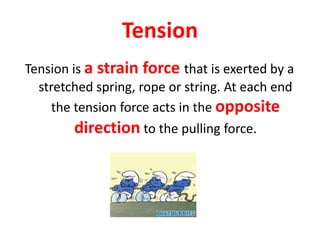
TensionTension is a strain force that is exerted by a stretched spring, rope or string. At each end the tension force acts in the opposite direction to the pulling force.
Non-contact ForcesThey all exert their force without having to touch the objectMagnetic forcesElectrostatic forcesGravitational forces
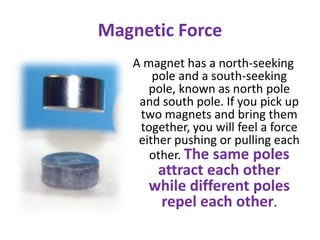
Magnetic ForceA magnet has a north-seeking pole and a south-seeking pole, known as north pole and south pole. If you pick up two magnets and bring them together, you will feel a force either pushing or pulling each other. The same poles attract each other while different poles repel each other.
Magnetic ForceA magnet can also exert a non-contact force on objects made ofiron, steel, cobalt or nickel. Either pole of the magnet exerts a pulling force on these magnetic materials. The strength of the force increases as the magnet and the magnetic material are brought closer together.
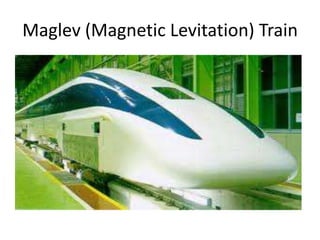
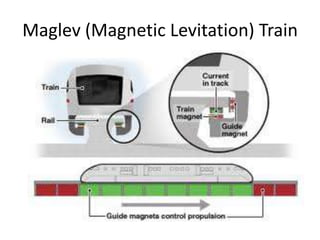
Maglev (Magnetic Levitation) Train
Electrostatic ForceIf certain electrical insulator materials are rubbed an electrostatic charges (positive charge and negative charge) develop on them. Similar charges repel each other while opposite charges attract each other.
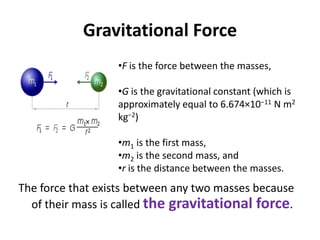
Gravitational ForceF is the force between the masses,
G is the gravitational constant (which is approximately equal to 6.674×10⁻¹¹ N m2 kg−2)
m1 is the first mass,
m2 is the second mass, and

Forces and their effects pps

  • 1.
    Forces and TheirEffectsPhysics Checkpoint @ferrytanoto
  • 2.
    You cannot seea force but you can see what it does. You can also feel the effect of a force on your body.
  • 3.
    A force isa pushor a pull
  • 4.
    What can aforce do?
  • 5.
    A force canmake an object move.
  • 6.
    A force canmake a moving object stop.
  • 7.
    A force canchange the speed of a moving object.A force can accelerate an object. The larger the force on the object, the greater the acceleration if the mass stays constant. The larger the mass of the object, the smaller the acceleration if the force stays constant.Newton’s Second Law of Motion:Force (N) = mass (kg) x acceleration (m/s2)
  • 8.
    A force canchange the direction of a moving object.
  • 9.
    A force canchange the shapeof an object.
  • 10.
  • 11.
    A force canbe measured with a Newton spring balance.The SI unit for measuring force is the Newton (symbol N).
  • 12.
    There are twomain types of forces: contact forces and non-contact forces.
  • 13.
    A contact forceoccurs when the object or material exerting the force touches the object or material on which the force acts.
  • 14.
    A non-contact forceoccurs when the objects or materials do not touch each other.
  • 15.
    Contact ForcesImpact forceWhena moving object collides with a stationary object an impact force is exerted by one object on the other.Strain force When some materials are squashed, stretched, twisted or bent they exert a force which act in the opposite direction to the force acting on them. These materials are called elastic materials and the force they exert when they are deformed is called a strain force.
  • 16.
    Impact forceWhen amoving object collideswith a stationary object an impact force is exerted by one object on the other.
  • 17.
    Strain forceWhen somematerials are squashed, stretched, twisted or bent they exert a force which act in the opposite direction to the force acting on them. These materials are called elastic materials and the force they exert when they are deformed is called a strain force. When the force applied to the material is removed the strain force exerted by the material restore the deformed material to its original shape.
  • 18.
    TensionTension is astrain force that is exerted by a stretched spring, rope or string. At each end the tension force acts in the opposite direction to the pulling force.
  • 19.
    Non-contact ForcesThey allexert their force without having to touch the objectMagnetic forcesElectrostatic forcesGravitational forces
  • 20.
    Magnetic ForceA magnethas a north-seeking pole and a south-seeking pole, known as north pole and south pole. If you pick up two magnets and bring them together, you will feel a force either pushing or pulling each other. The same poles attract each other while different poles repel each other.
  • 21.
    Magnetic ForceA magnetcan also exert a non-contact force on objects made ofiron, steel, cobalt or nickel. Either pole of the magnet exerts a pulling force on these magnetic materials. The strength of the force increases as the magnet and the magnetic material are brought closer together.
  • 22.
  • 23.
  • 24.
    Electrostatic ForceIf certainelectrical insulator materials are rubbed an electrostatic charges (positive charge and negative charge) develop on them. Similar charges repel each other while opposite charges attract each other.
  • 25.
    Gravitational ForceF isthe force between the masses,
  • 26.
    G is thegravitational constant (which is approximately equal to 6.674×10⁻¹¹ N m2 kg−2)
  • 27.
    m1 is thefirst mass,
  • 28.
    m2 is thesecond mass, and