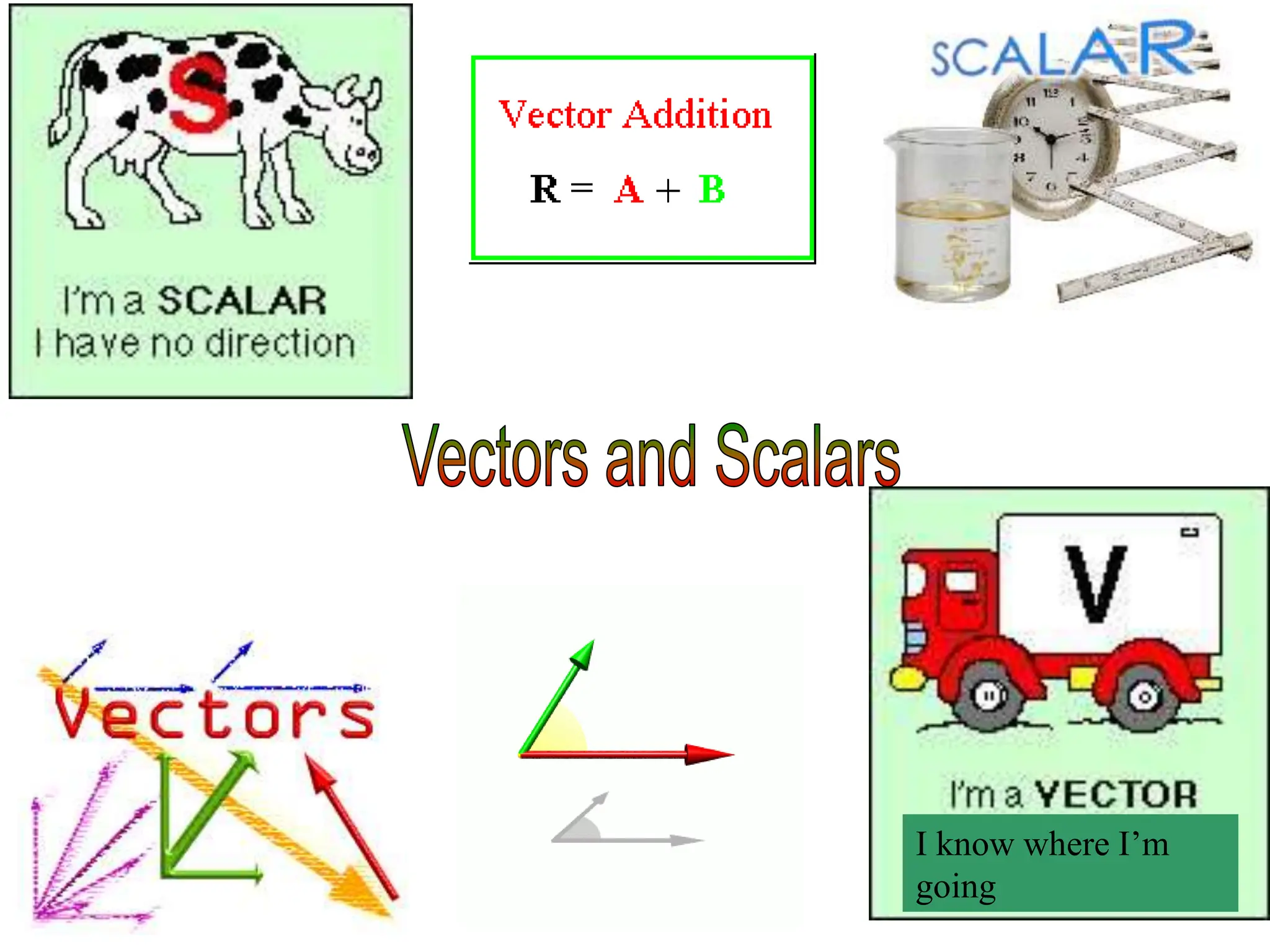
I know where I’m
going
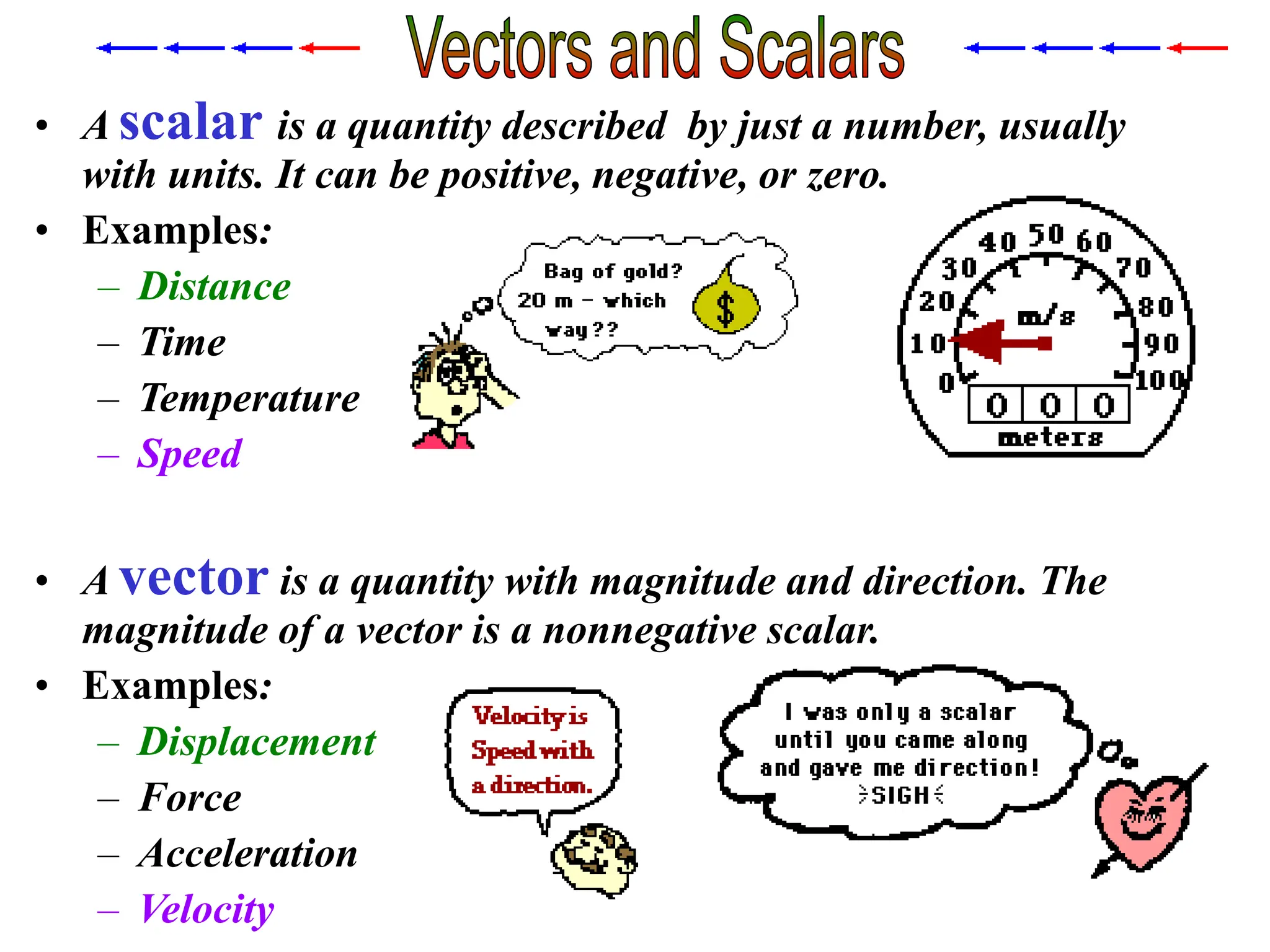
• A scalar is a quantity described by just a number, usually
with units. It can be positive, negative, or zero.
• Examples:
– Distance
– Time
– Temperature
– Speed
• A vector is a quantity with magnitude and direction. The
magnitude of a vector is a nonnegative scalar.
• Examples:
– Displacement
– Force
– Acceleration
– Velocity
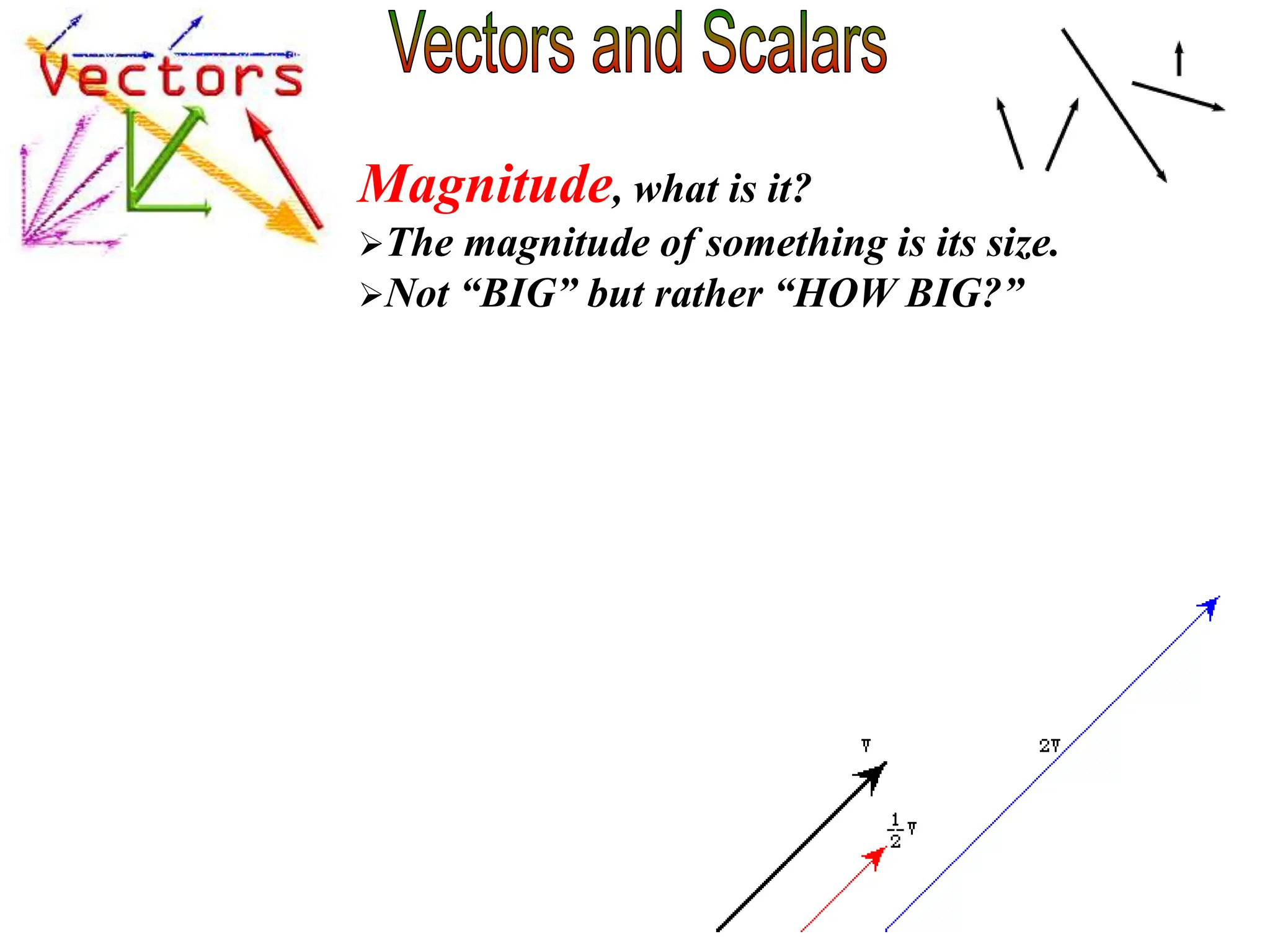
Magnitude, what is it?
The magnitude of something is its size.
Not “BIG” but rather “HOW BIG?”
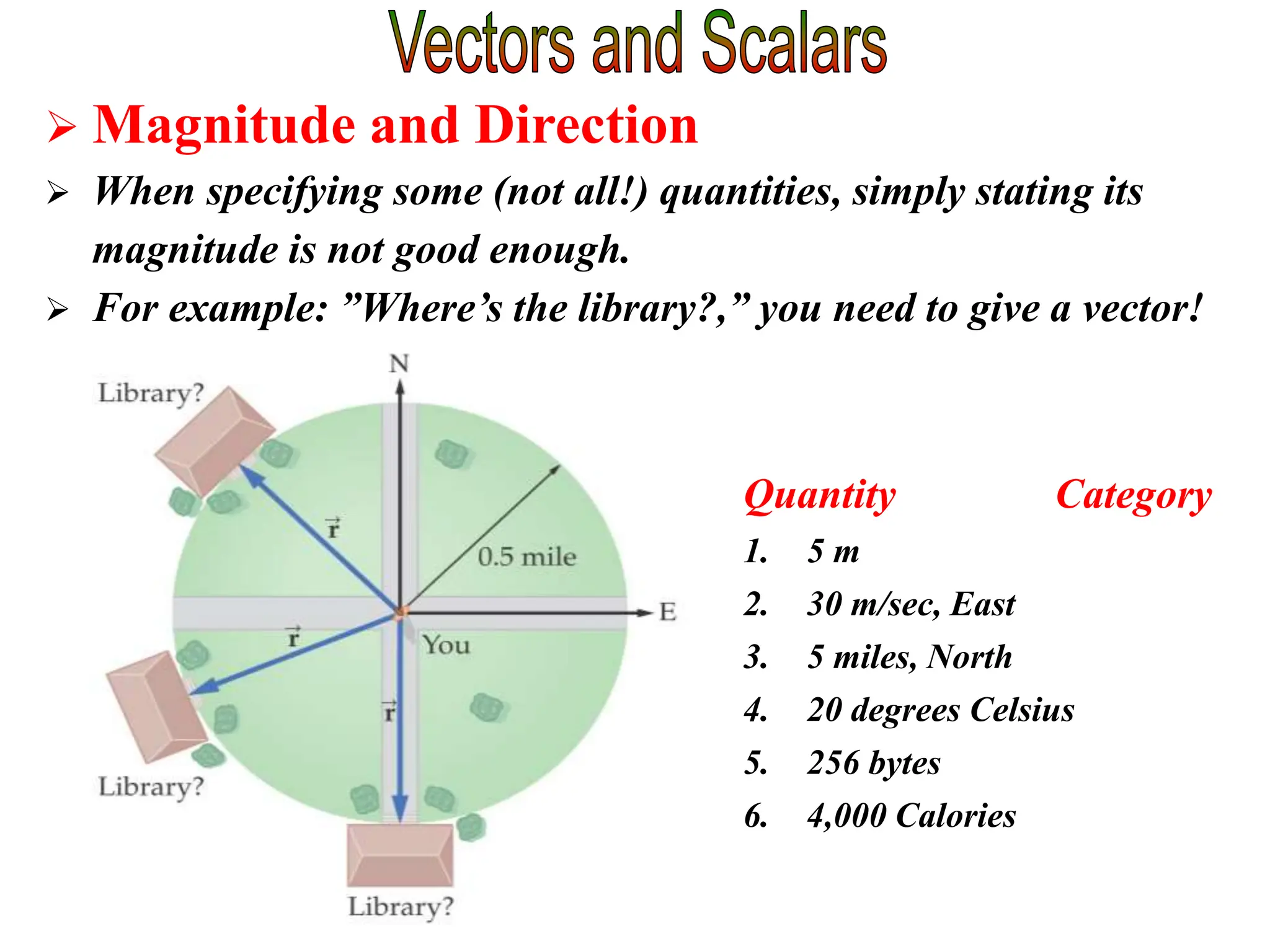
 Magnitude and Direction
 When specifying some (not all!) quantities, simply stating its
magnitude is not good enough.
 For example: ”Where’s the library?,” you need to give a vector!
Quantity Category
1. 5 m
2. 30 m/sec, East
3. 5 miles, North
4. 20 degrees Celsius
5. 256 bytes
6. 4,000 Calories
 Magnitude and Direction
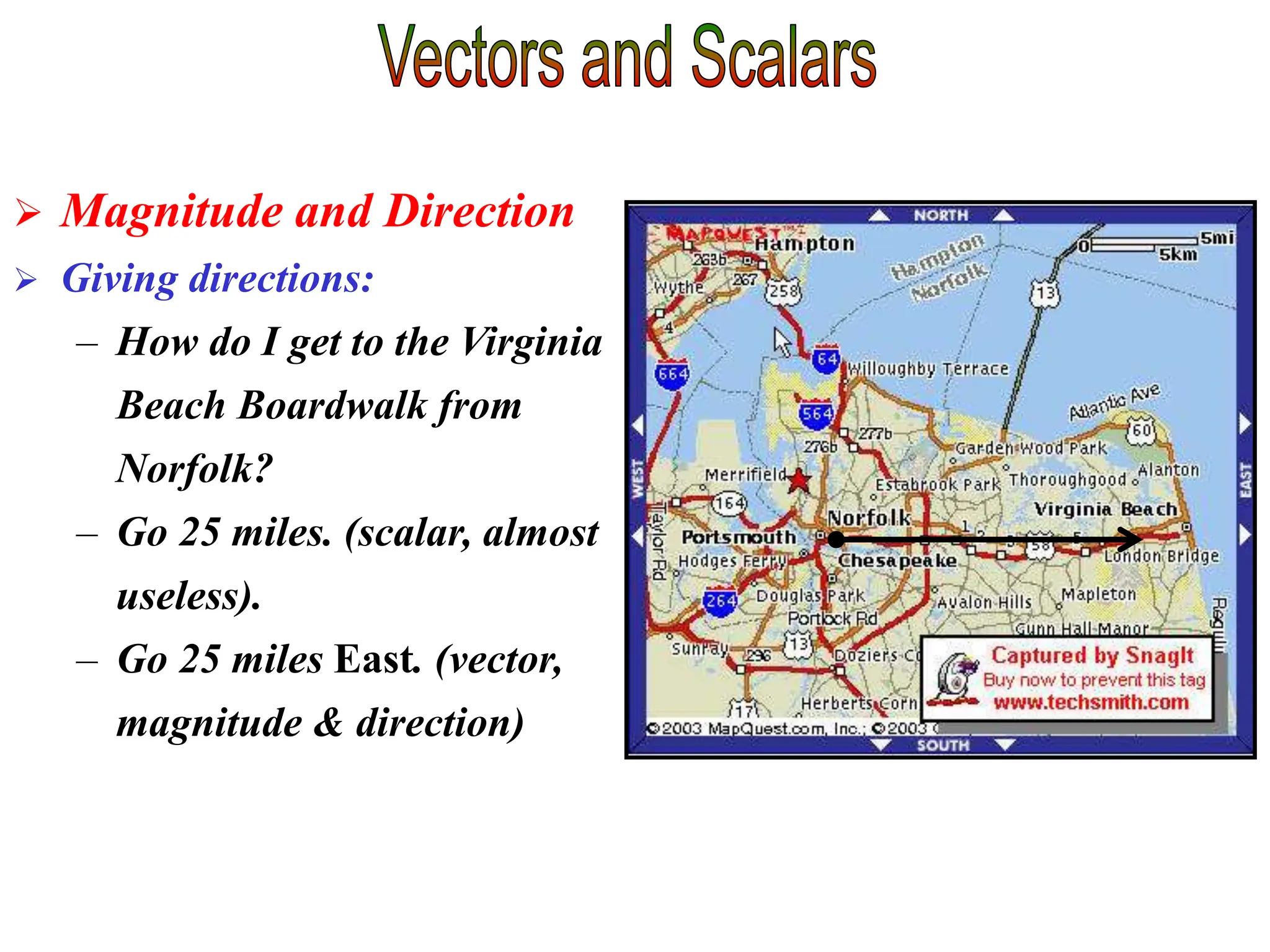
 Giving directions:
– How do I get to the Virginia
Beach Boardwalk from
Norfolk?
– Go 25 miles. (scalar, almost
useless).
– Go 25 miles East. (vector,
magnitude & direction)
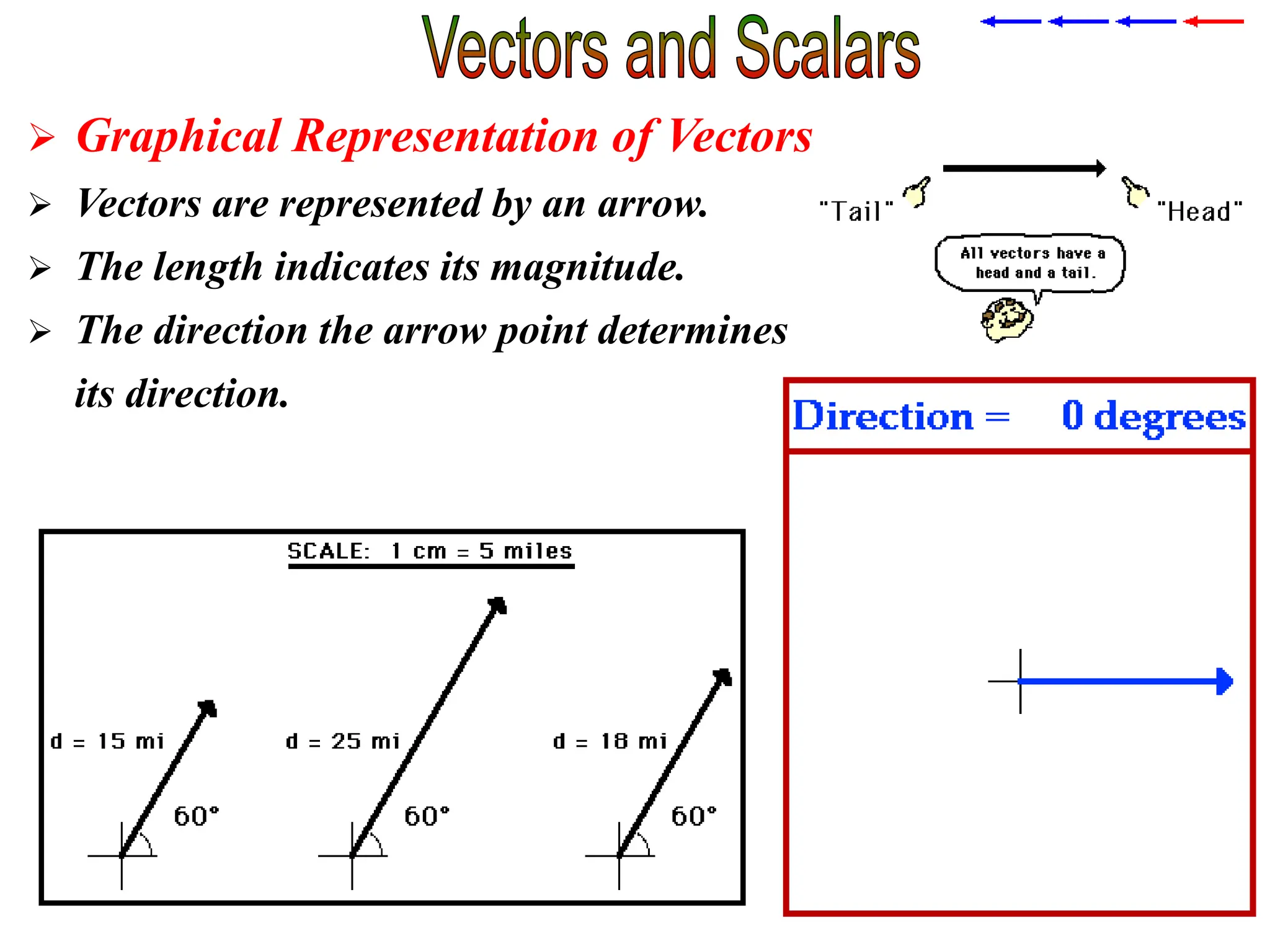
 Graphical Representation of Vectors
 Vectors are represented by an arrow.
 The length indicates its magnitude.
 The direction the arrow point determines
its direction.
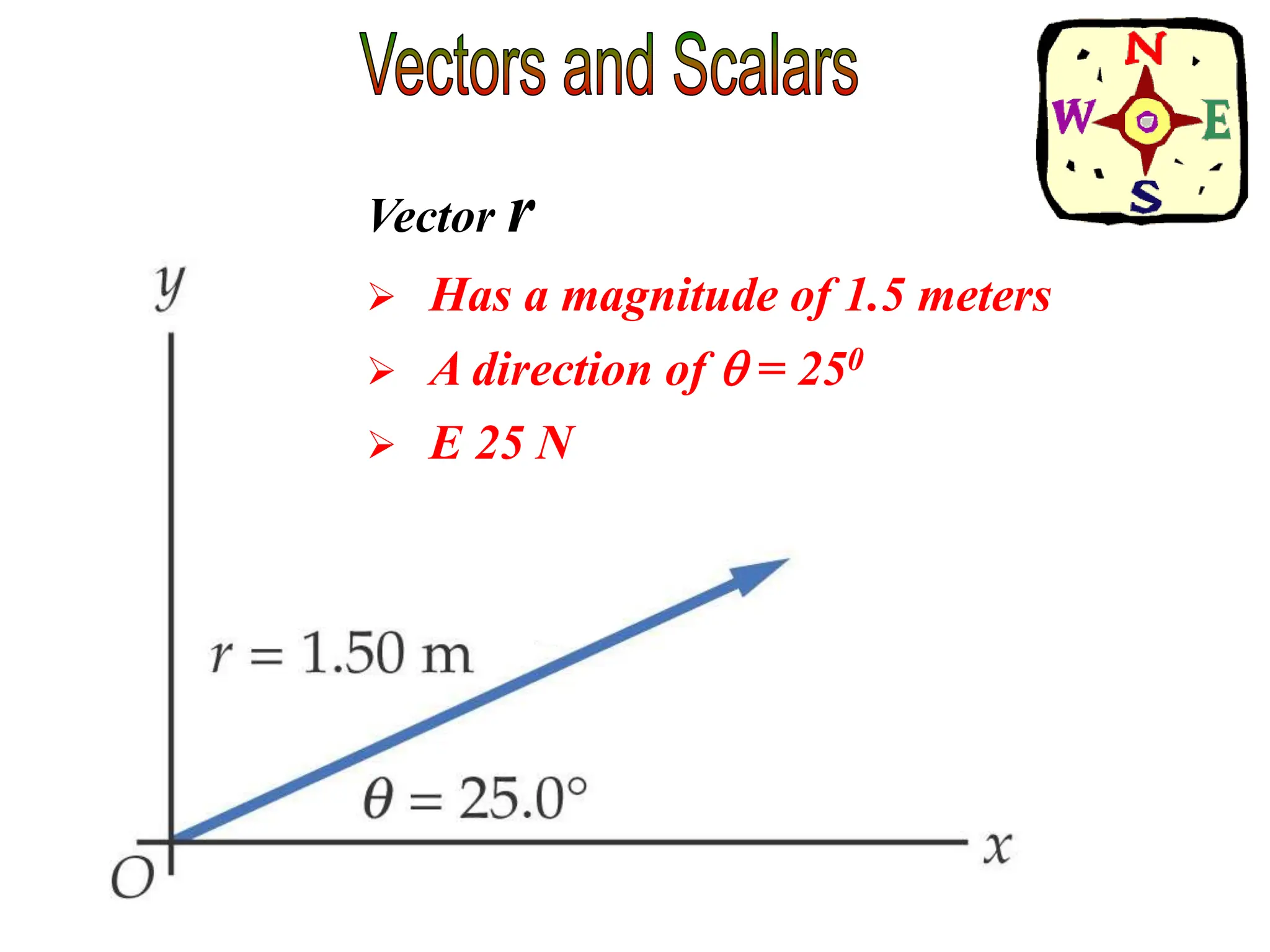
Vector r
 Has a magnitude of 1.5 meters
 A direction of  = 250
 E 25 N
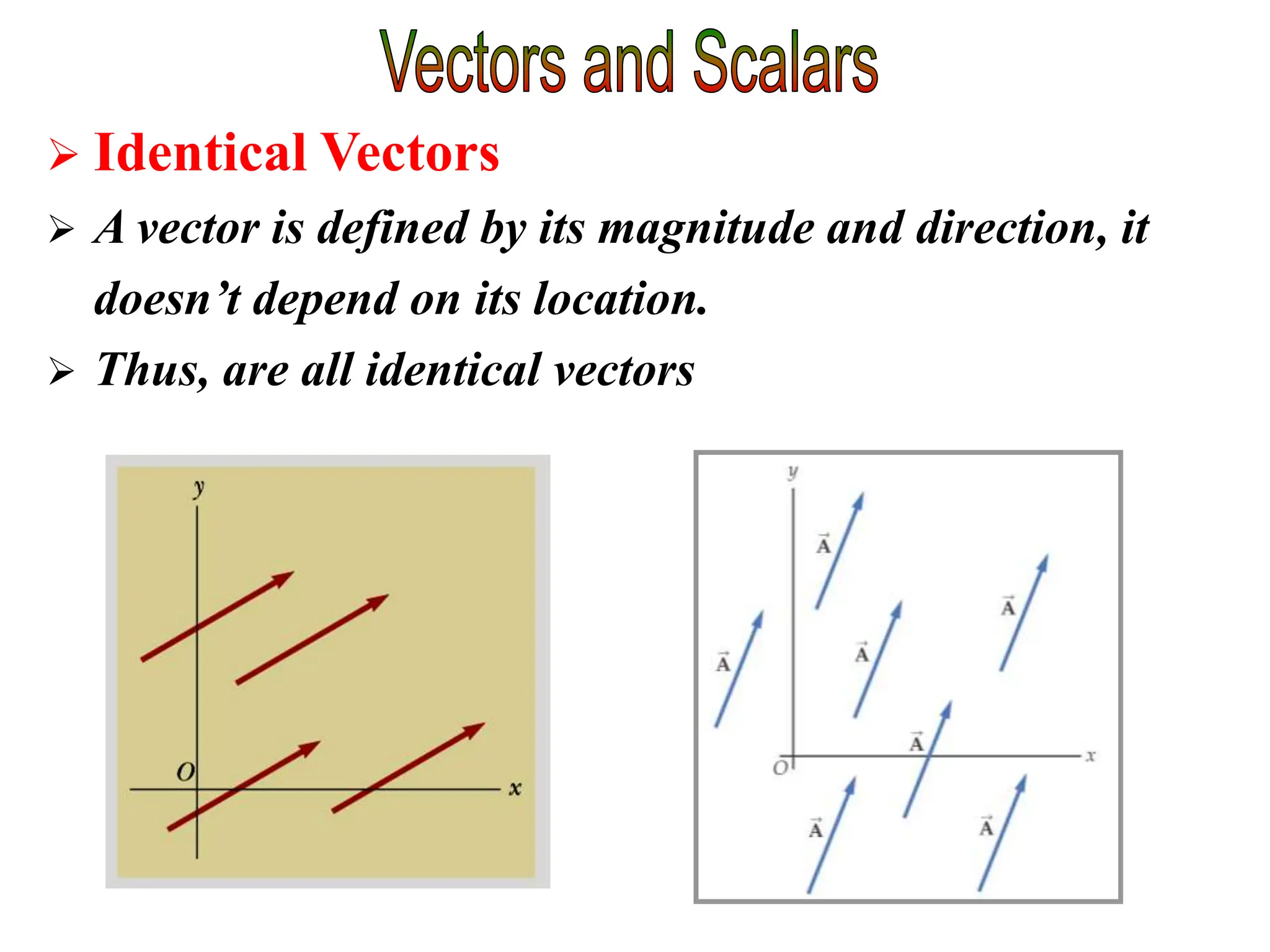
 Identical Vectors
 A vector is defined by its magnitude and direction, it
doesn’t depend on its location.
 Thus, are all identical vectors
 Properties of Vectors
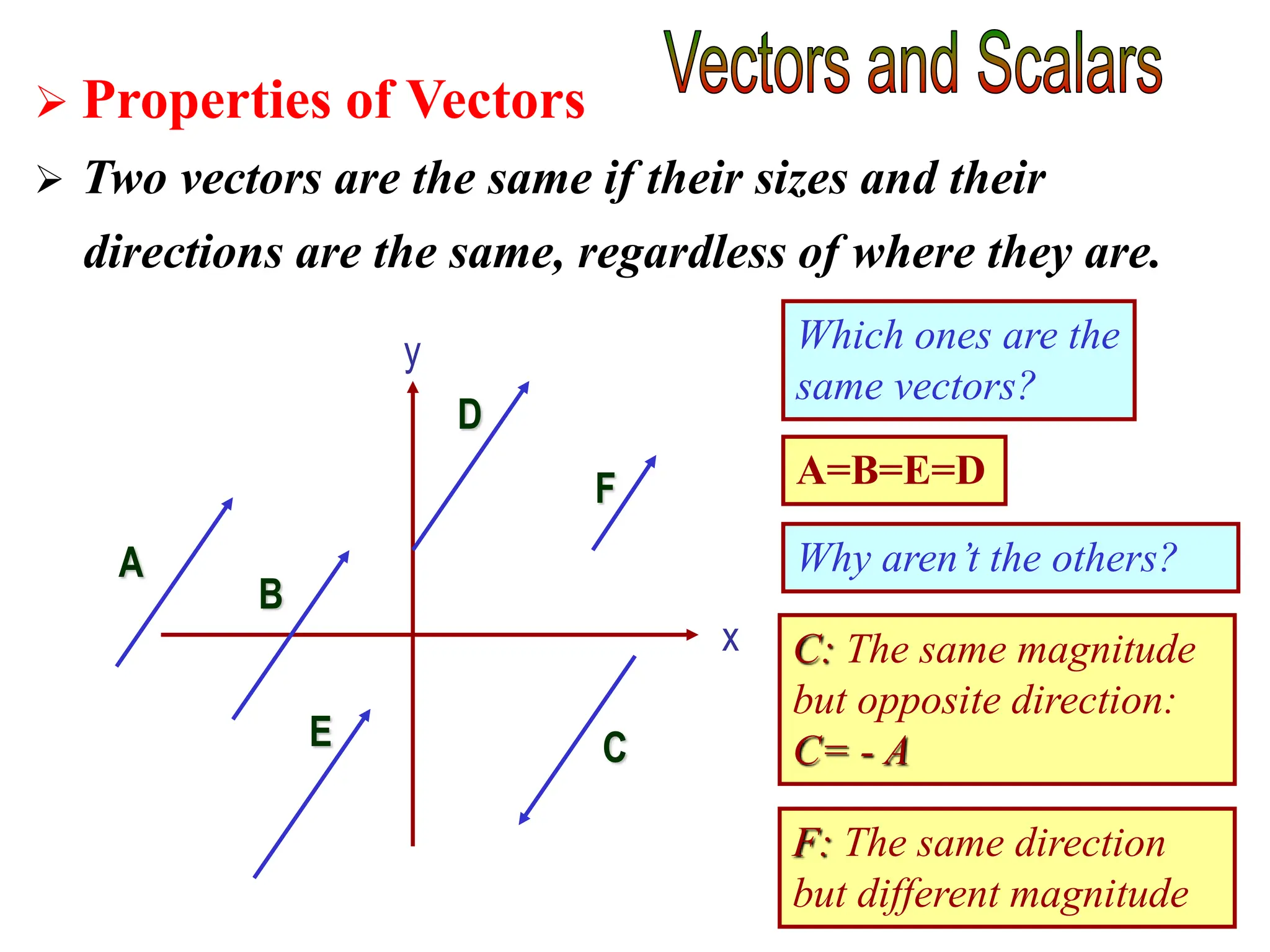
 Two vectors are the same if their sizes and their
directions are the same, regardless of where they are.
x
y
A
B
E
D
C
F
Which ones are the
same vectors?
A=B=E=D
Why aren’t the others?
C: The same magnitude
but opposite direction:
C= - A
F: The same direction
but different magnitude
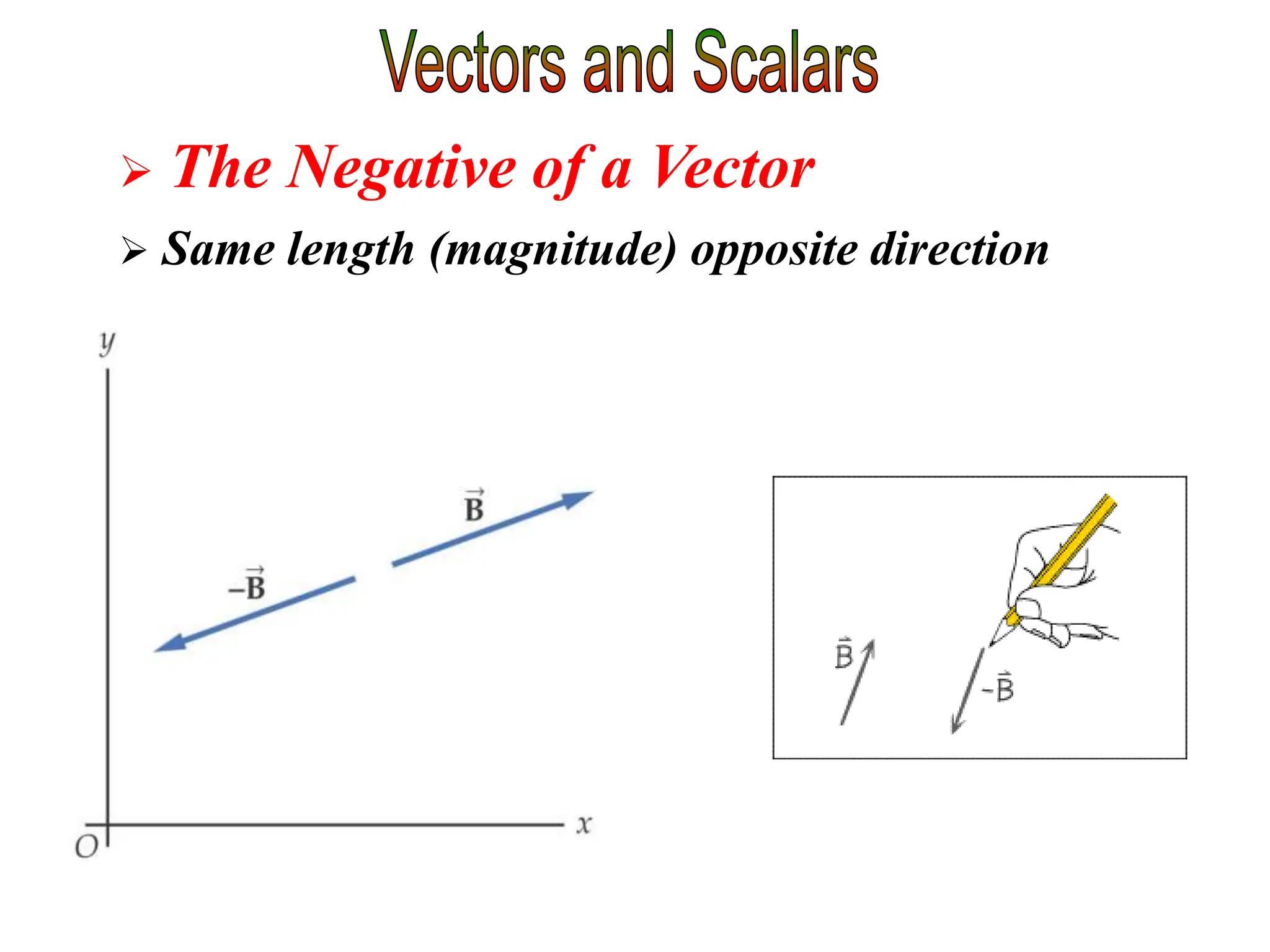
 The Negative of a Vector
 Same length (magnitude) opposite direction
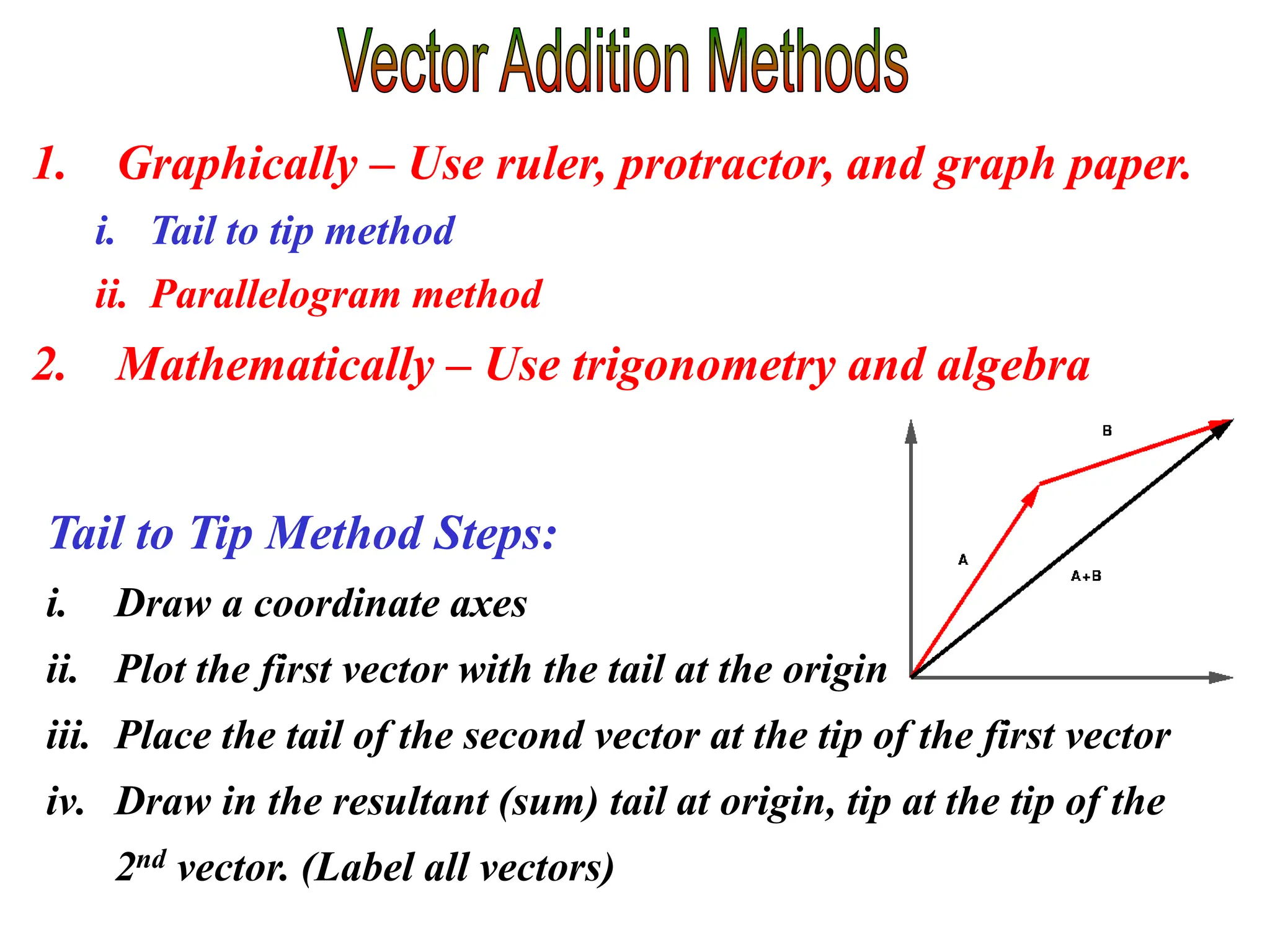
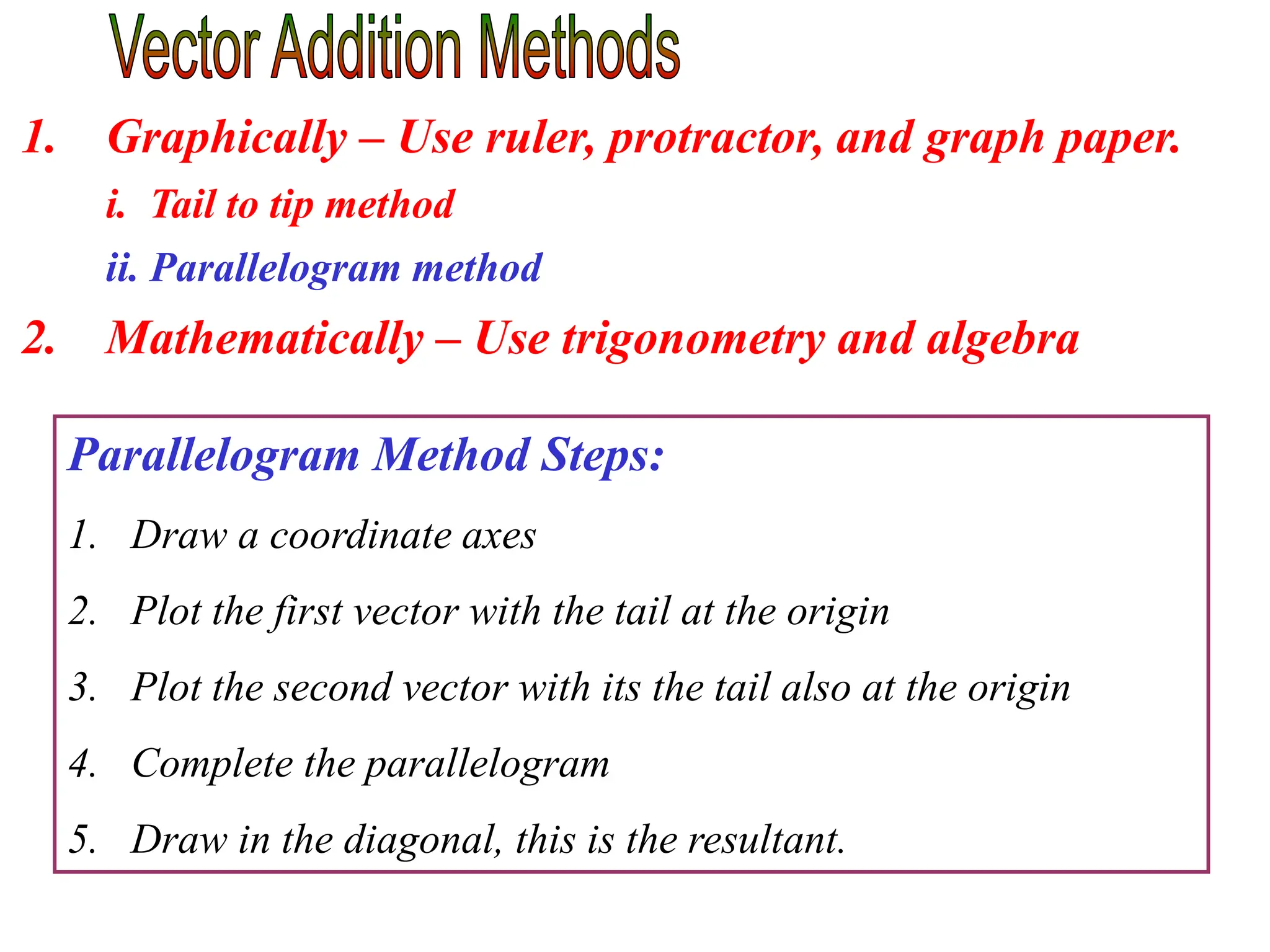
Tail to Tip Method Steps:
i. Draw a coordinate axes
ii. Plot the first vector with the tail at the origin
iii. Place the tail of the second vector at the tip of the first vector
iv. Draw in the resultant (sum) tail at origin, tip at the tip of the
2nd vector. (Label all vectors)
1. Graphically – Use ruler, protractor, and graph paper.
i. Tail to tip method
ii. Parallelogram method
2. Mathematically – Use trigonometry and algebra
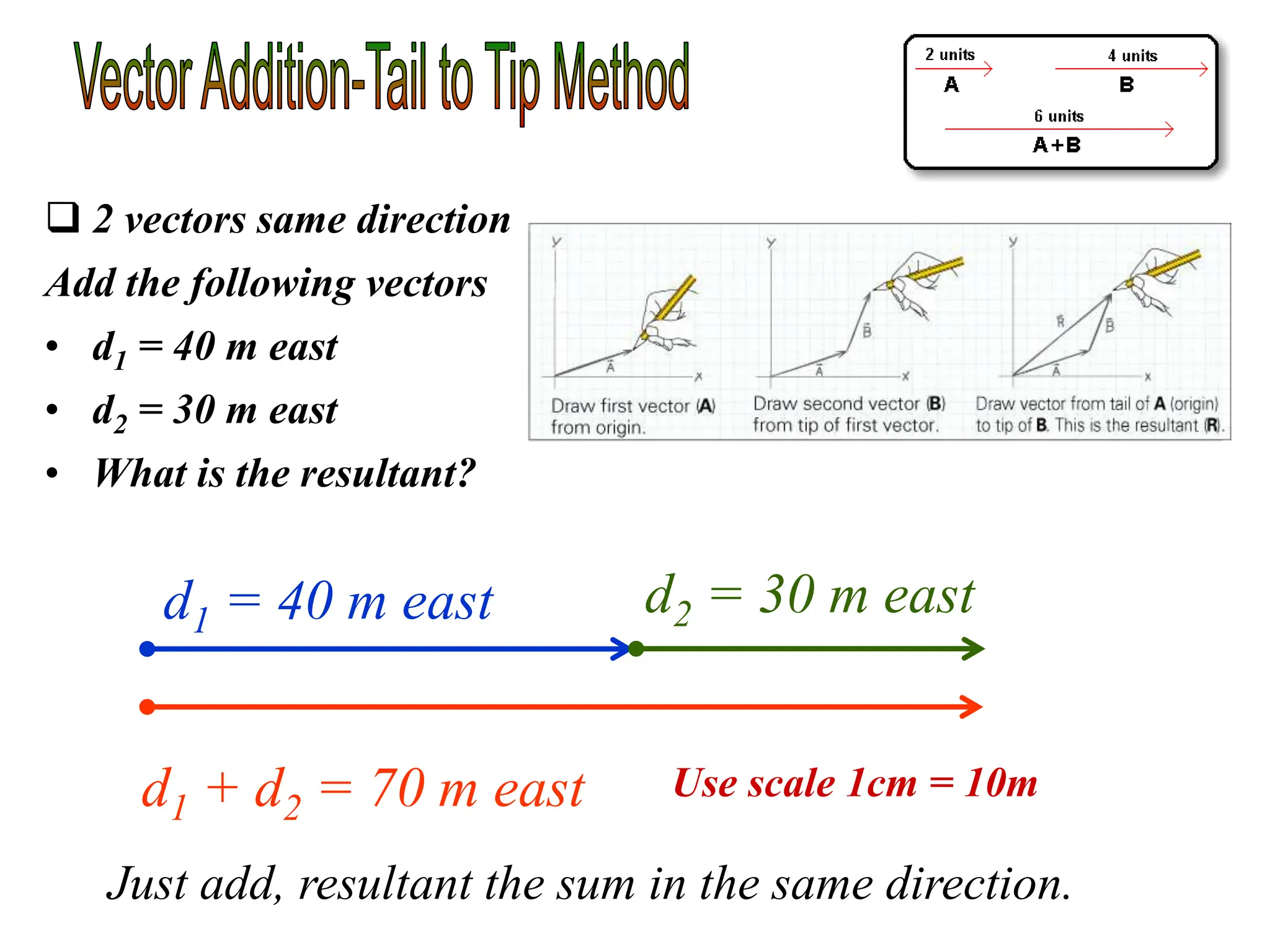
 2 vectors same direction
Add the following vectors
• d1 = 40 m east
• d2 = 30 m east
• What is the resultant?
d1 = 40 m east d2 = 30 m east
d1 + d2 = 70 m east
Just add, resultant the sum in the same direction.
Use scale 1cm = 10m
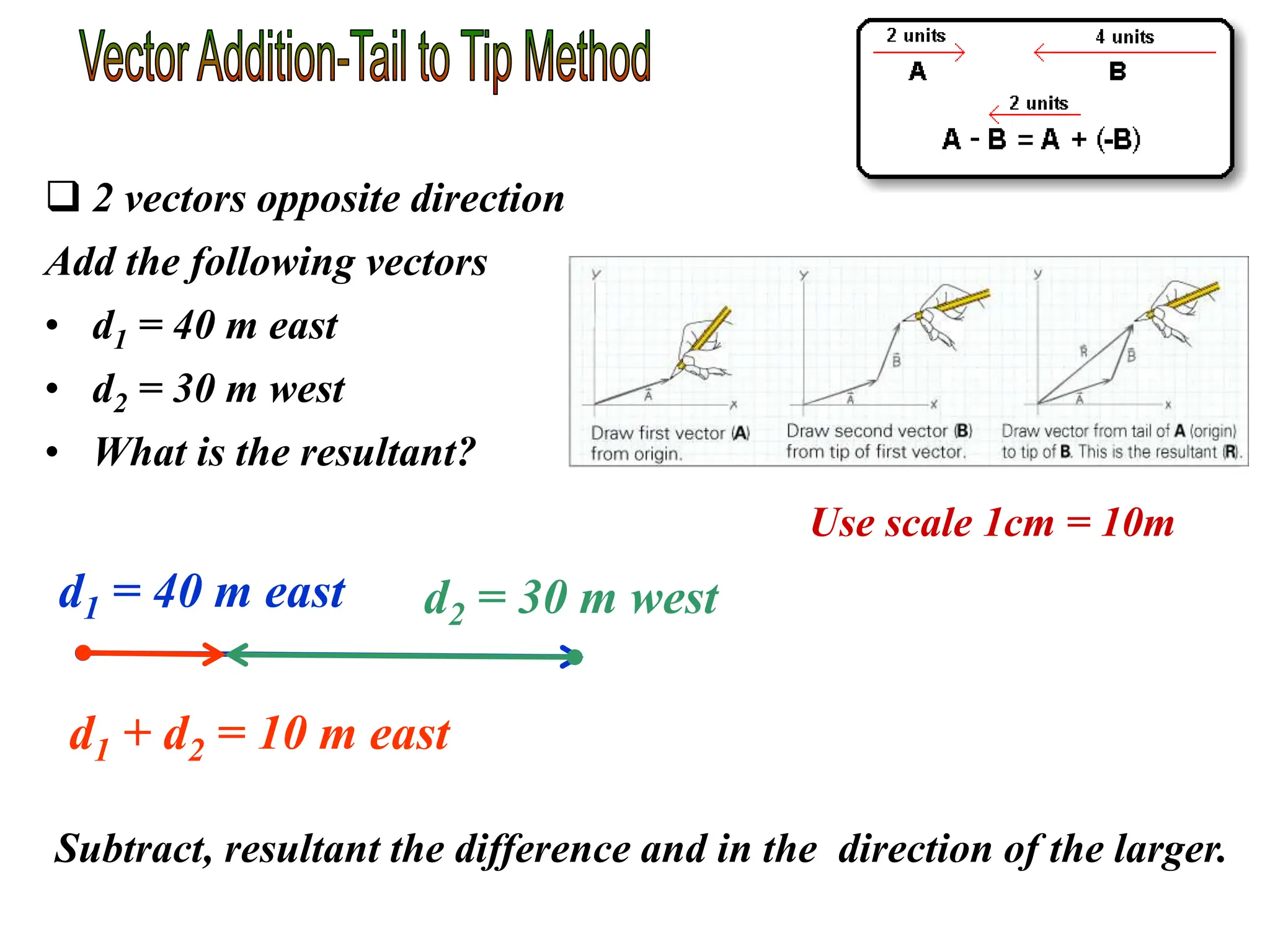
d1 = 40 m east d2 = 30 m west
d1 + d2 = 10 m east
Subtract, resultant the difference and in the direction of the larger.
 2 vectors opposite direction
Add the following vectors
• d1 = 40 m east
• d2 = 30 m west
• What is the resultant?
Use scale 1cm = 10m
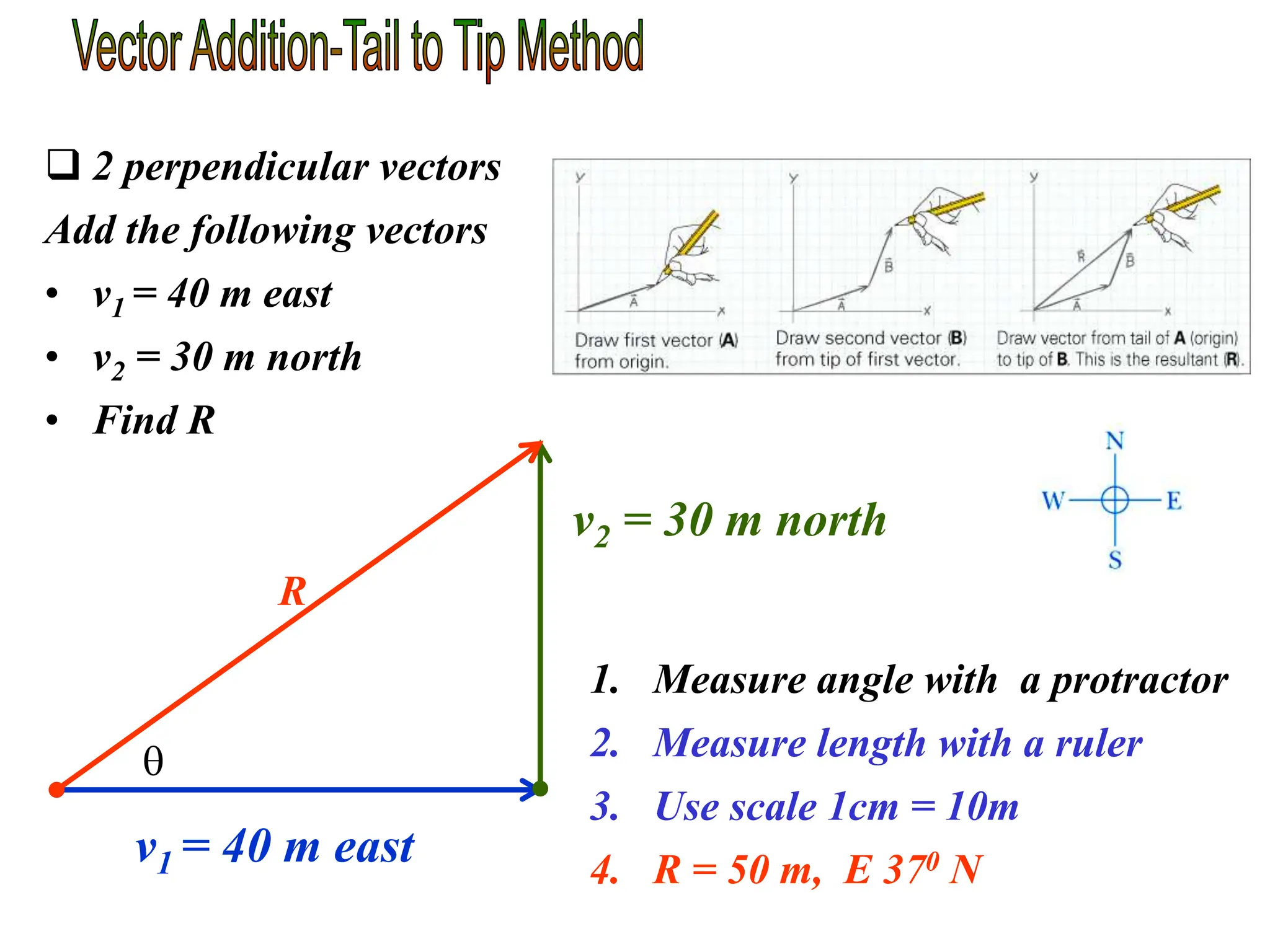
 2 perpendicular vectors
Add the following vectors
• v1 = 40 m east
• v2 = 30 m north
• Find R
v1 = 40 m east
v2 = 30 m north
R

1. Measure angle with a protractor
2. Measure length with a ruler
3. Use scale 1cm = 10m
4. R = 50 m, E 370 N
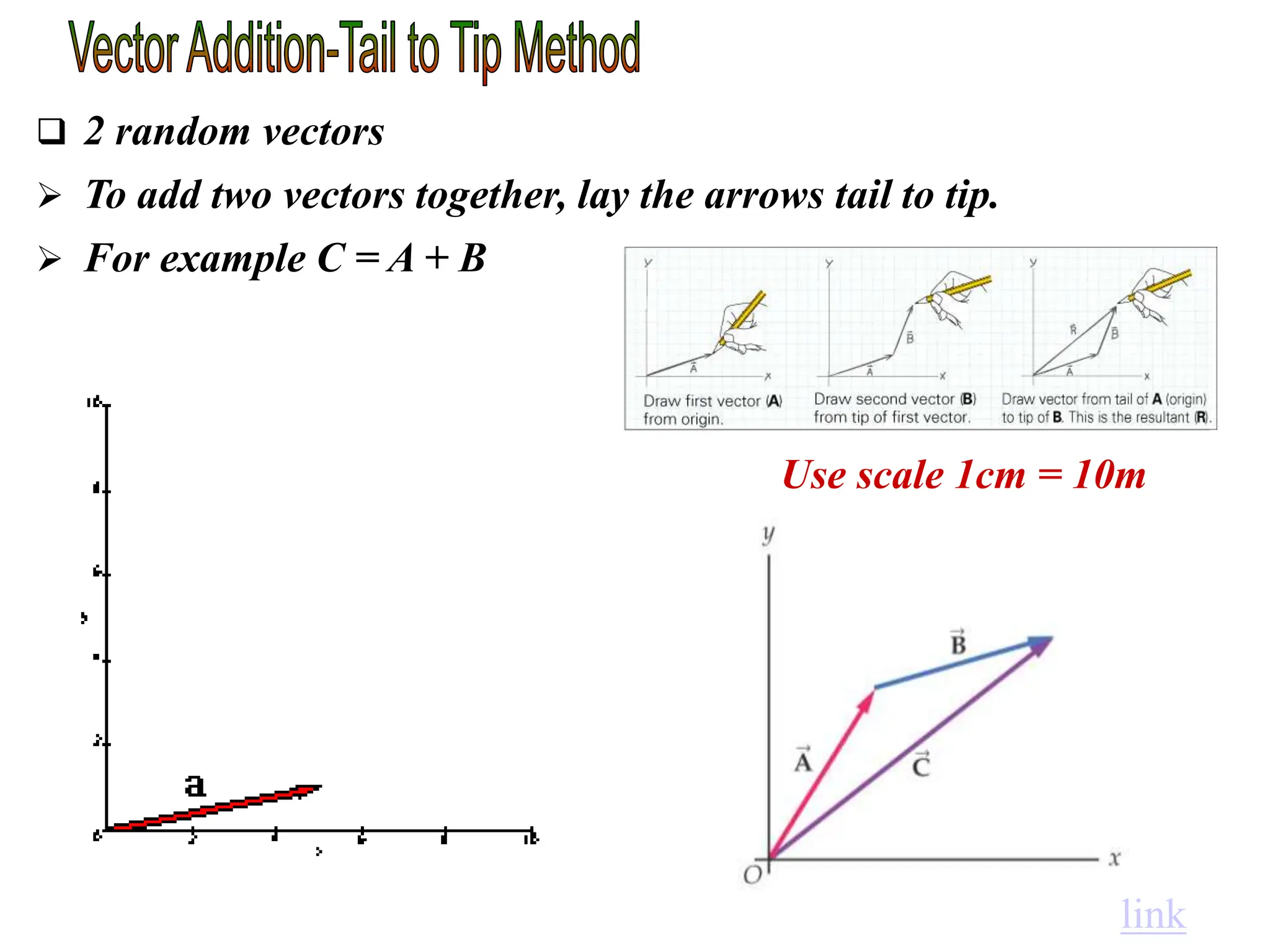
 2 random vectors
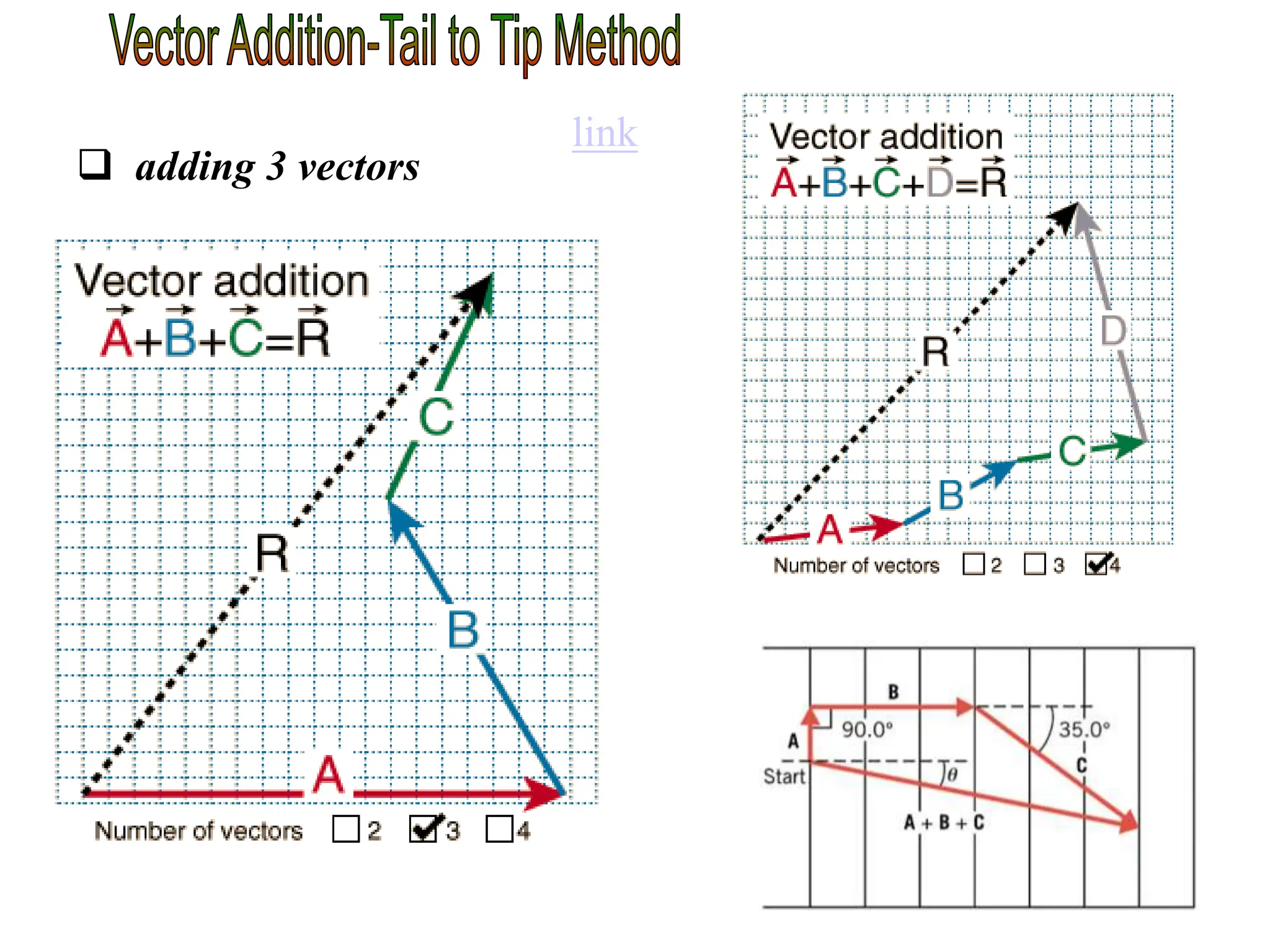
 To add two vectors together, lay the arrows tail to tip.
 For example C = A + B
link
Use scale 1cm = 10m
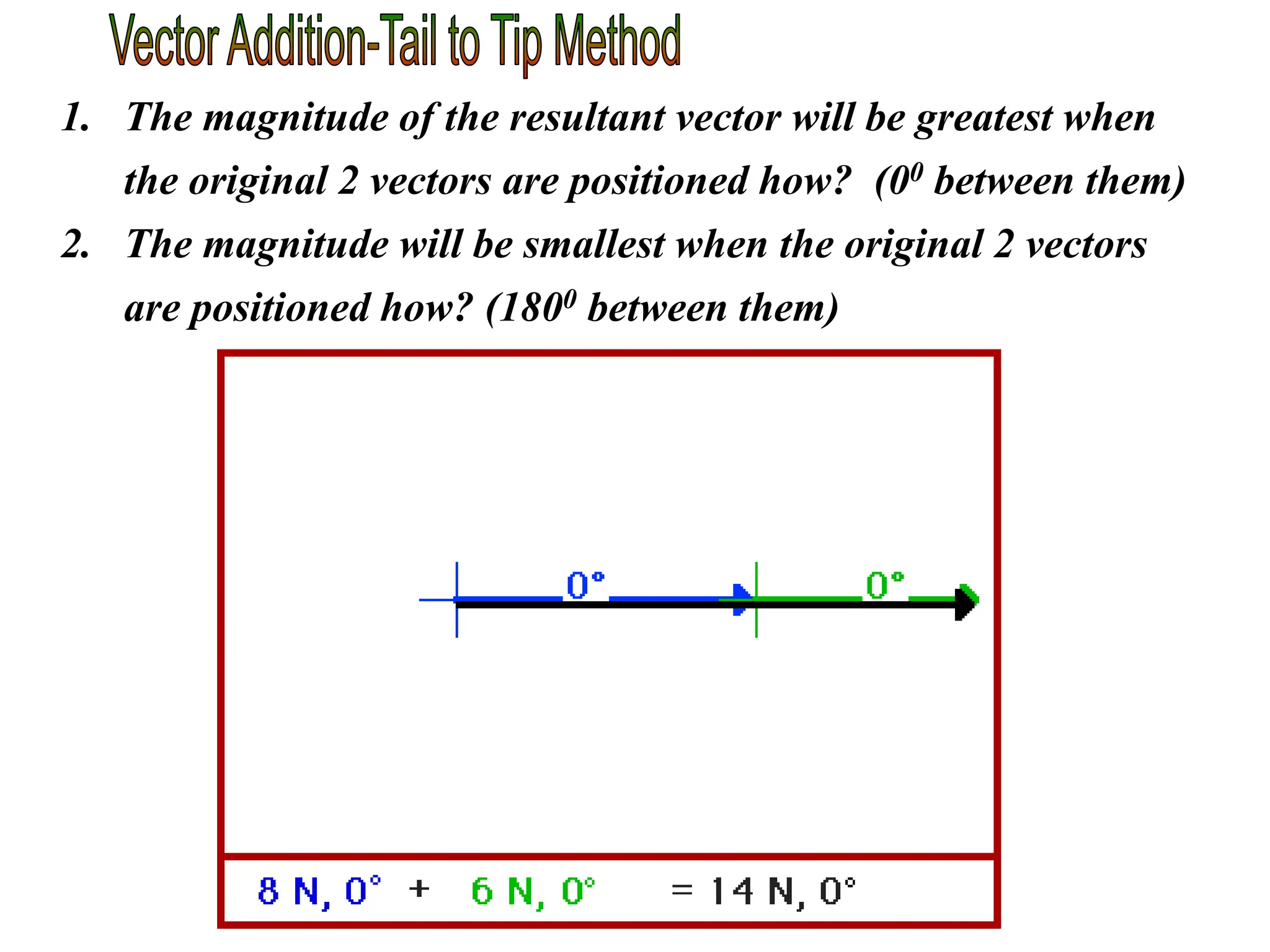
1. The magnitude of the resultant vector will be greatest when
the original 2 vectors are positioned how? (00 between them)
2. The magnitude will be smallest when the original 2 vectors
are positioned how? (1800 between them)
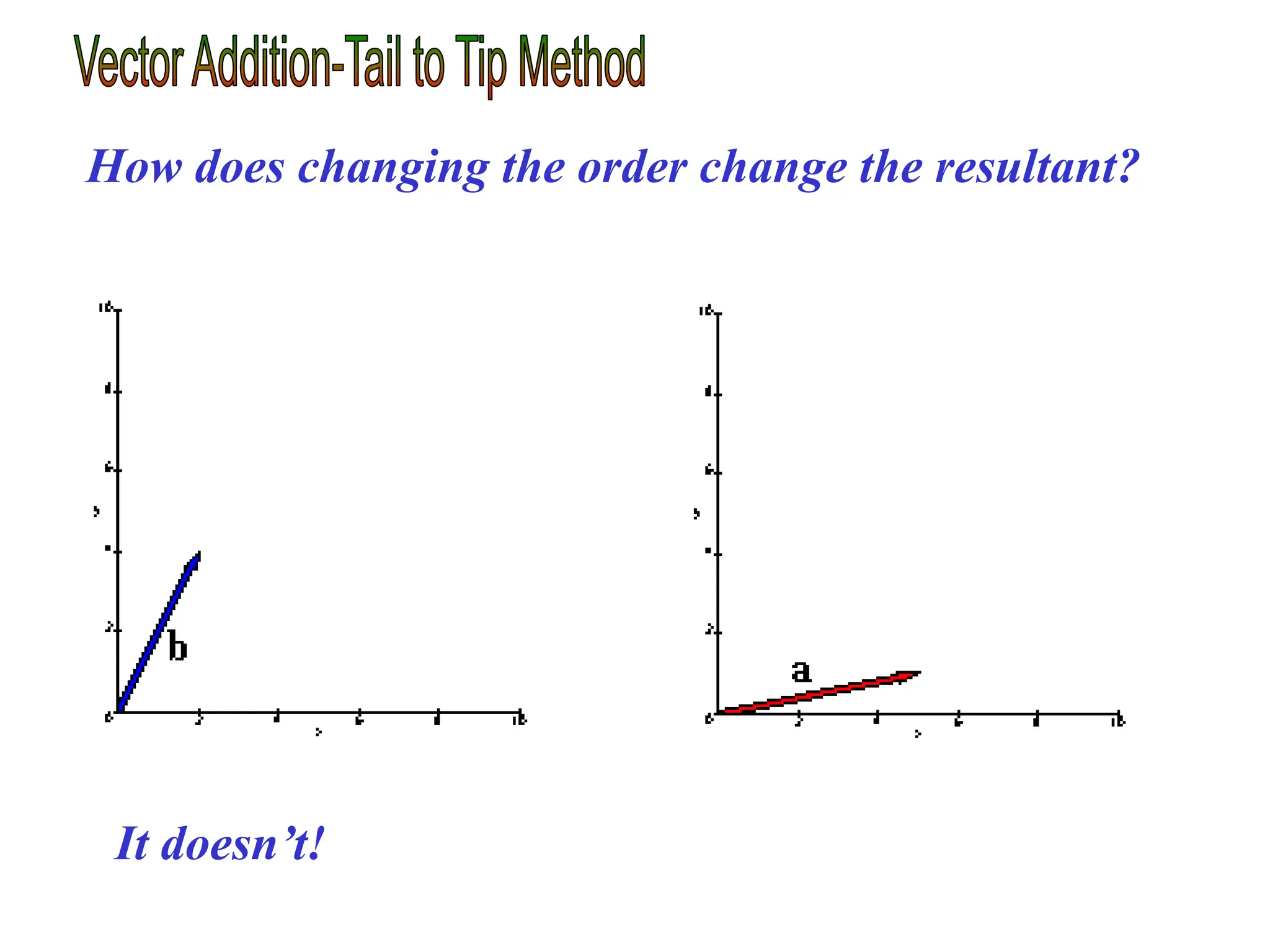
How does changing the order change the resultant?
It doesn’t!
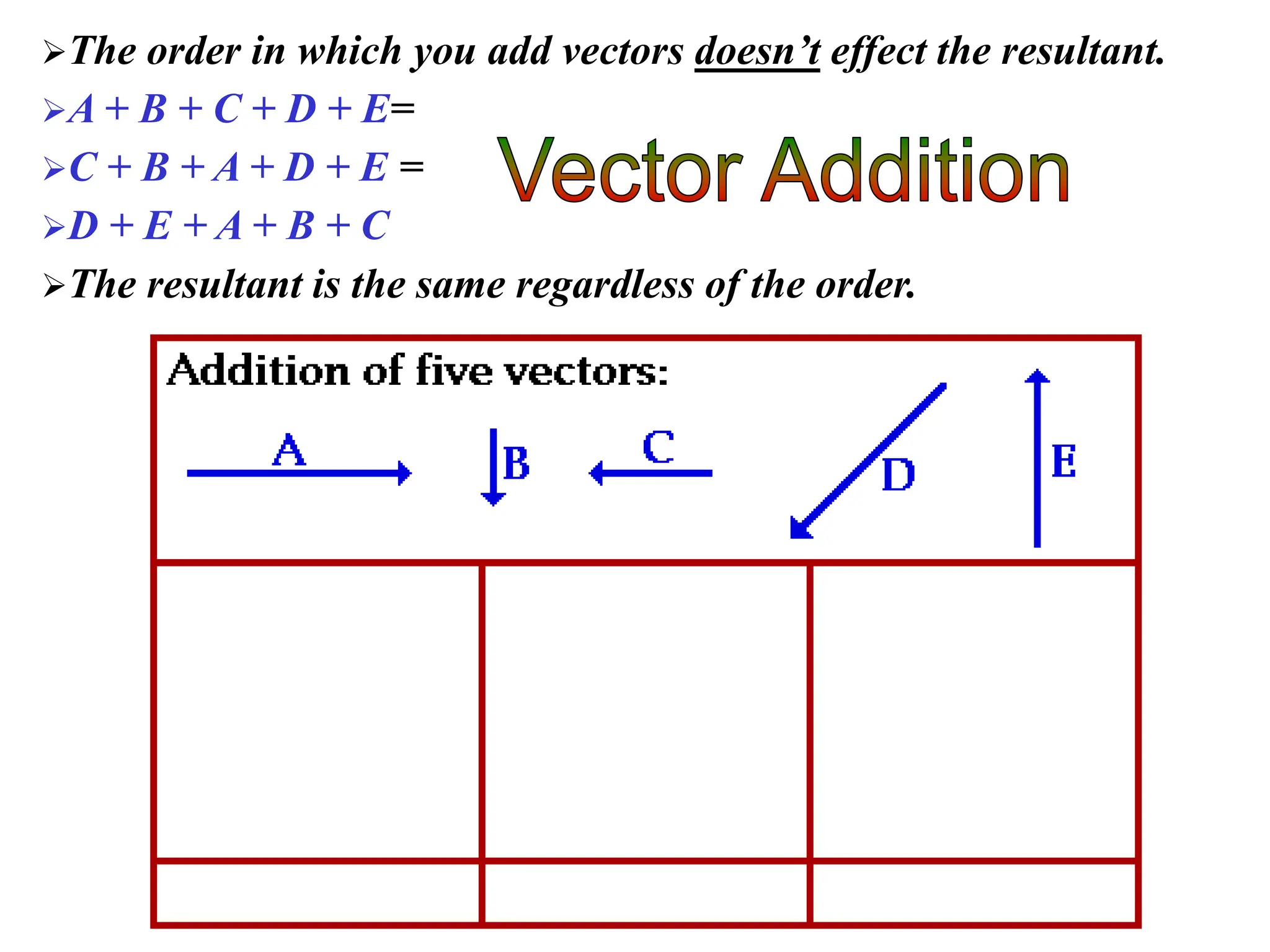
The order in which you add vectors doesn’t effect the resultant.
A + B + C + D + E=
C + B + A + D + E =
D + E + A + B + C
The resultant is the same regardless of the order.
link
 adding 3 vectors
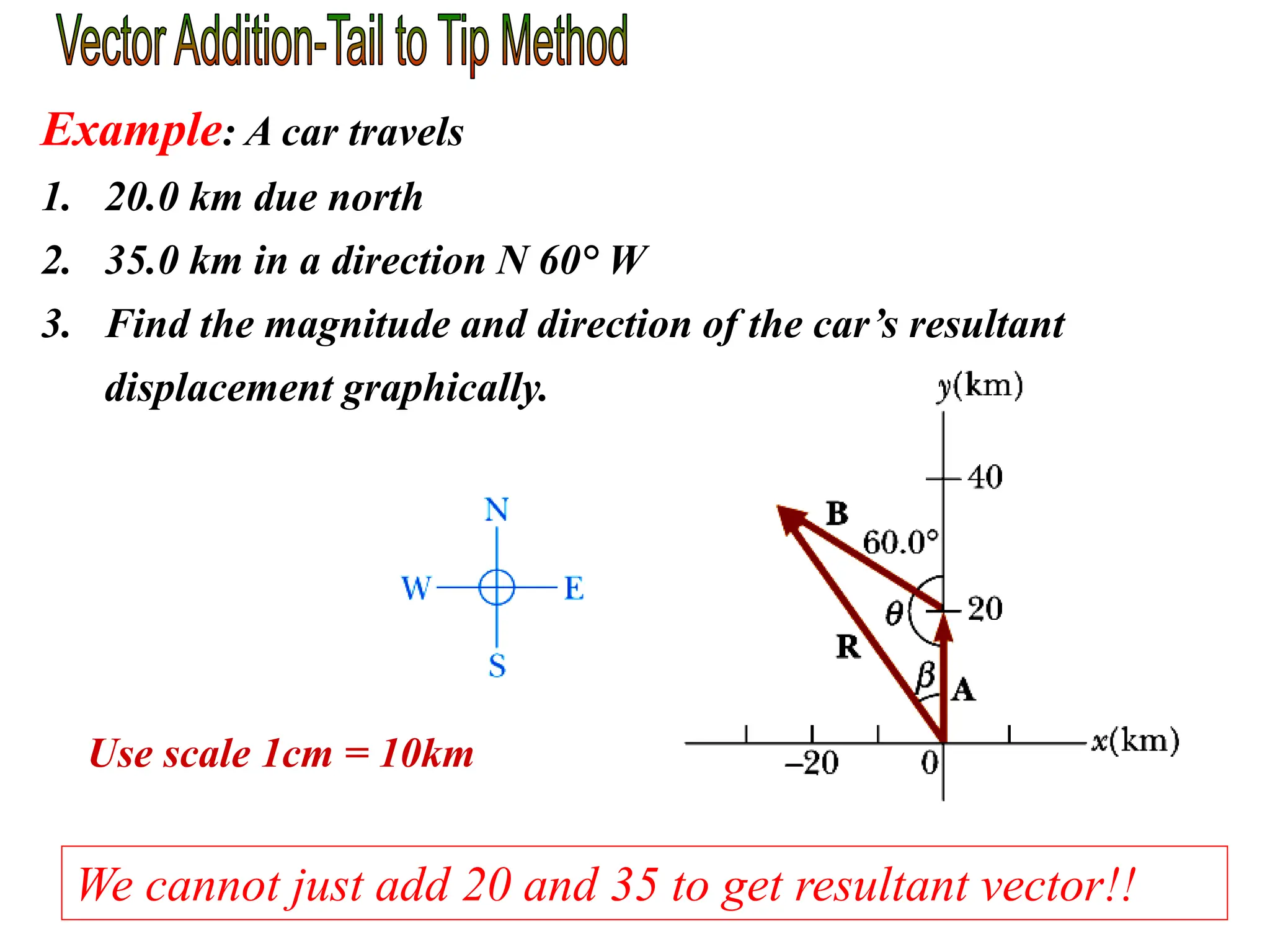
We cannot just add 20 and 35 to get resultant vector!!
Example: A car travels
1. 20.0 km due north
2. 35.0 km in a direction N 60° W
3. Find the magnitude and direction of the car’s resultant
displacement graphically.
Use scale 1cm = 10km
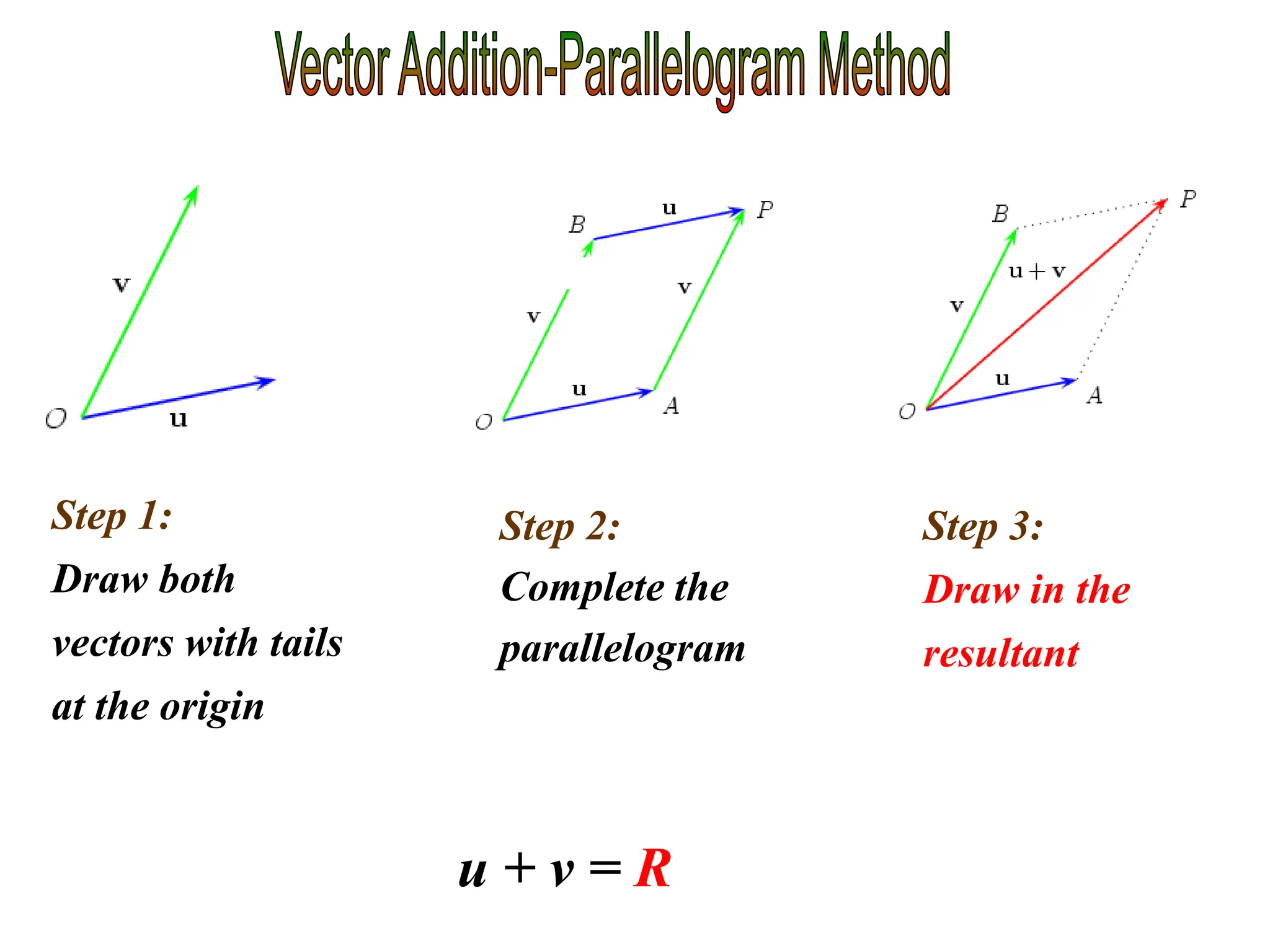
Parallelogram Method Steps:
1. Draw a coordinate axes
2. Plot the first vector with the tail at the origin
3. Plot the second vector with its the tail also at the origin
4. Complete the parallelogram
5. Draw in the diagonal, this is the resultant.
1. Graphically – Use ruler, protractor, and graph paper.
i. Tail to tip method
ii. Parallelogram method
2. Mathematically – Use trigonometry and algebra
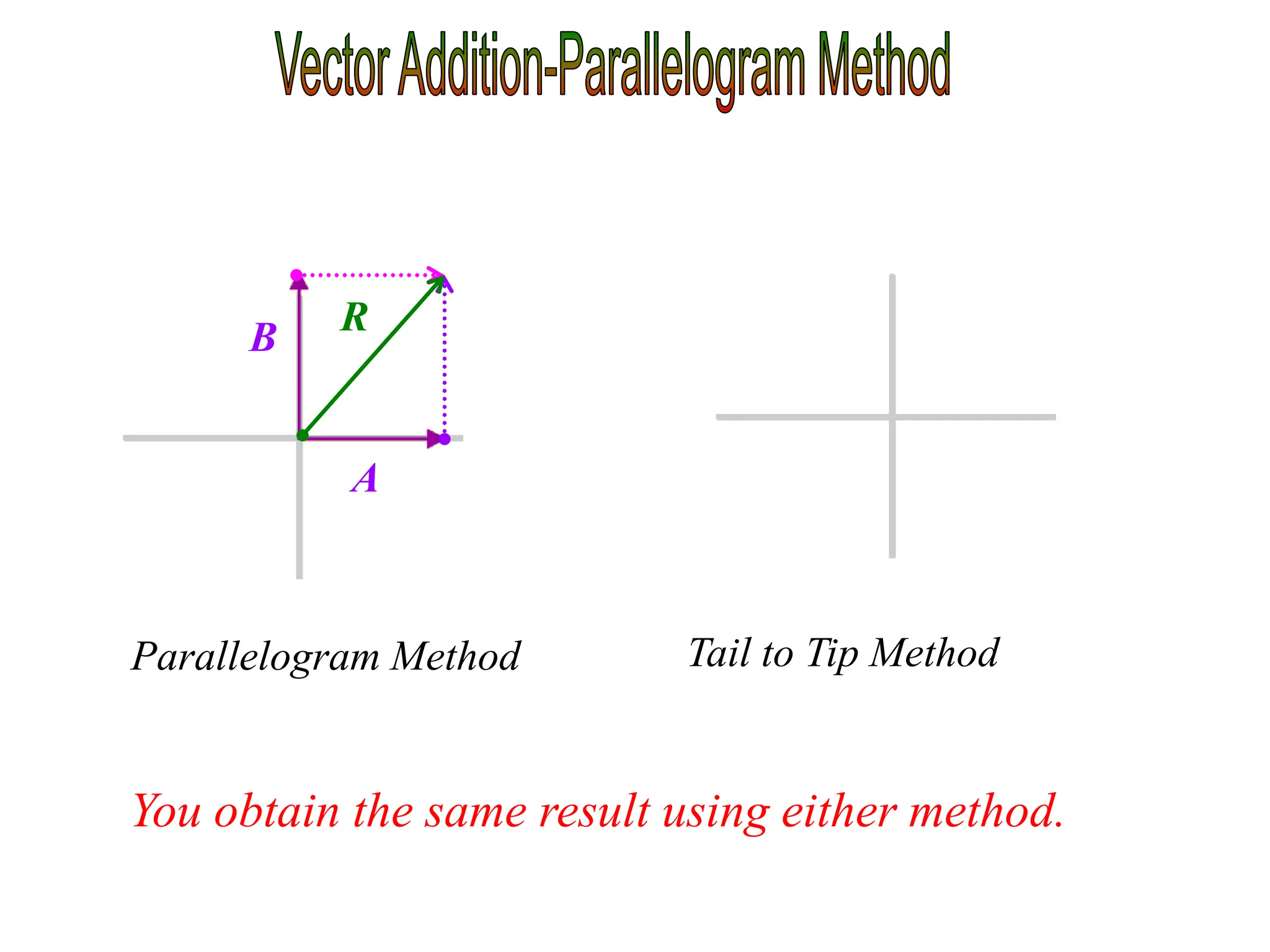
A
B R
You obtain the same result using either method.
Tail to Tip Method
Parallelogram Method
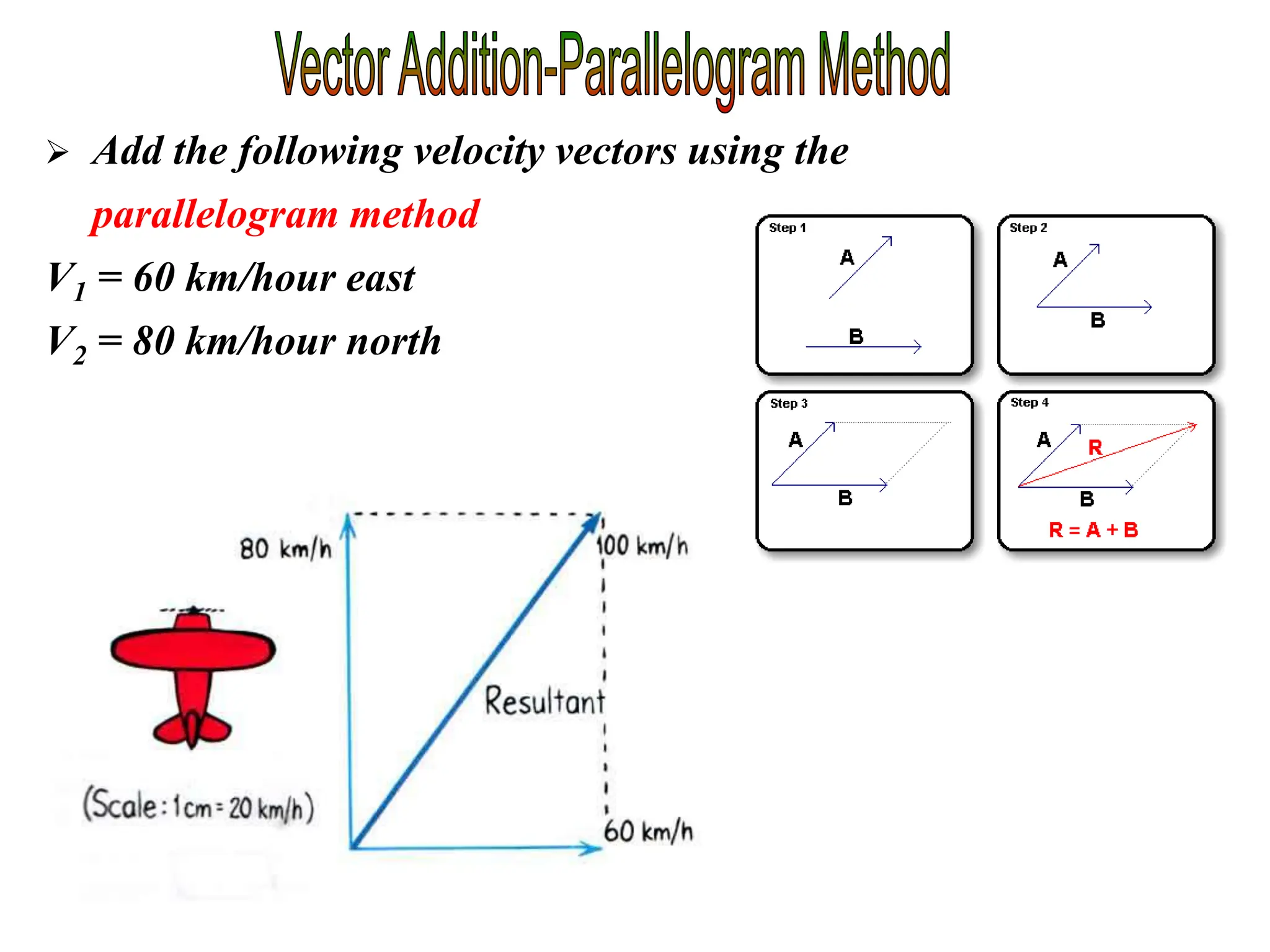
 Add the following velocity vectors using the
parallelogram method
V1 = 60 km/hour east
V2 = 80 km/hour north
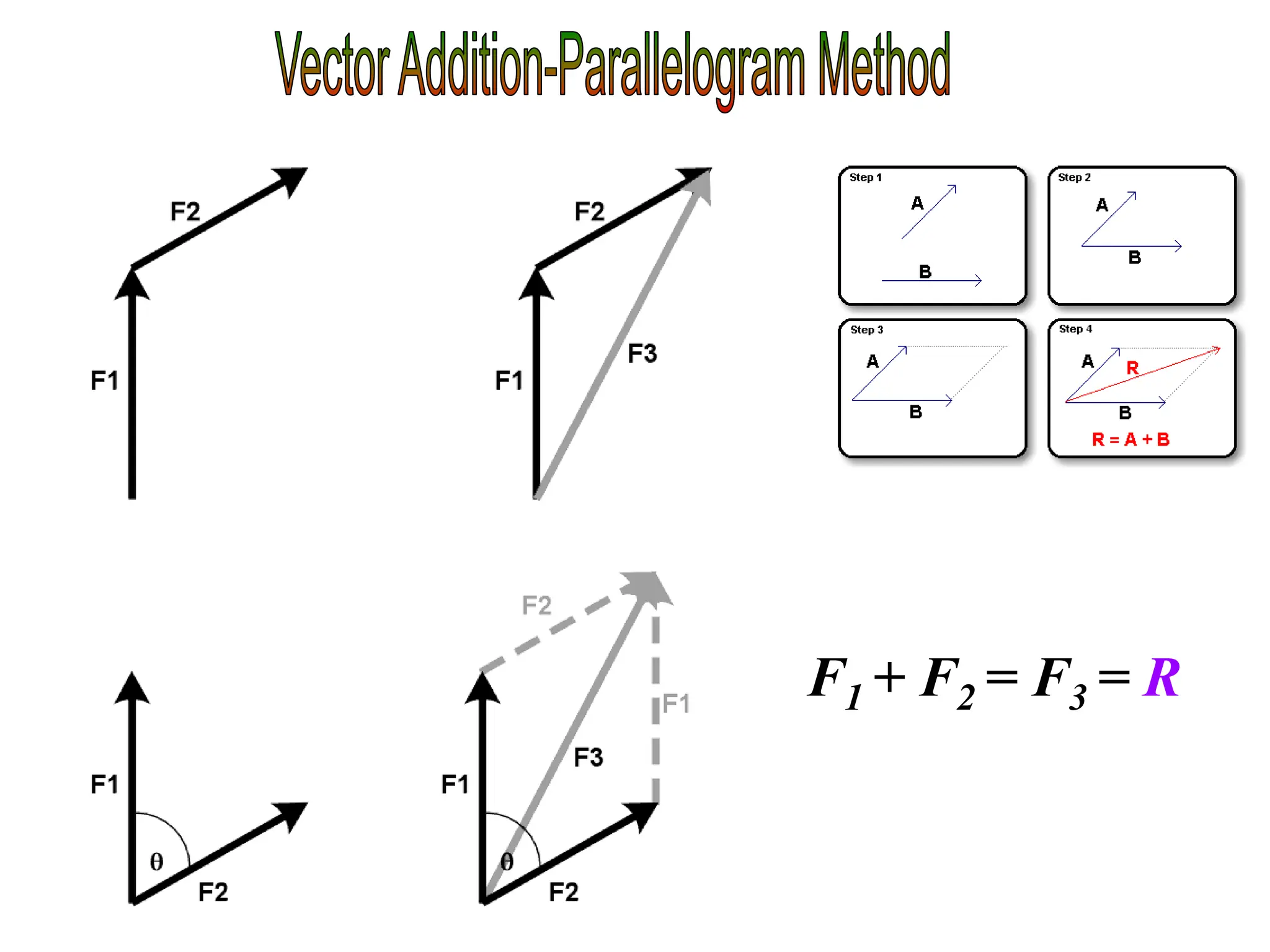
F1 + F2 = F3 = R
u + v = R
Step 1:
Draw both
vectors with tails
at the origin
Step 2:
Complete the
parallelogram
Step 3:
Draw in the
resultant
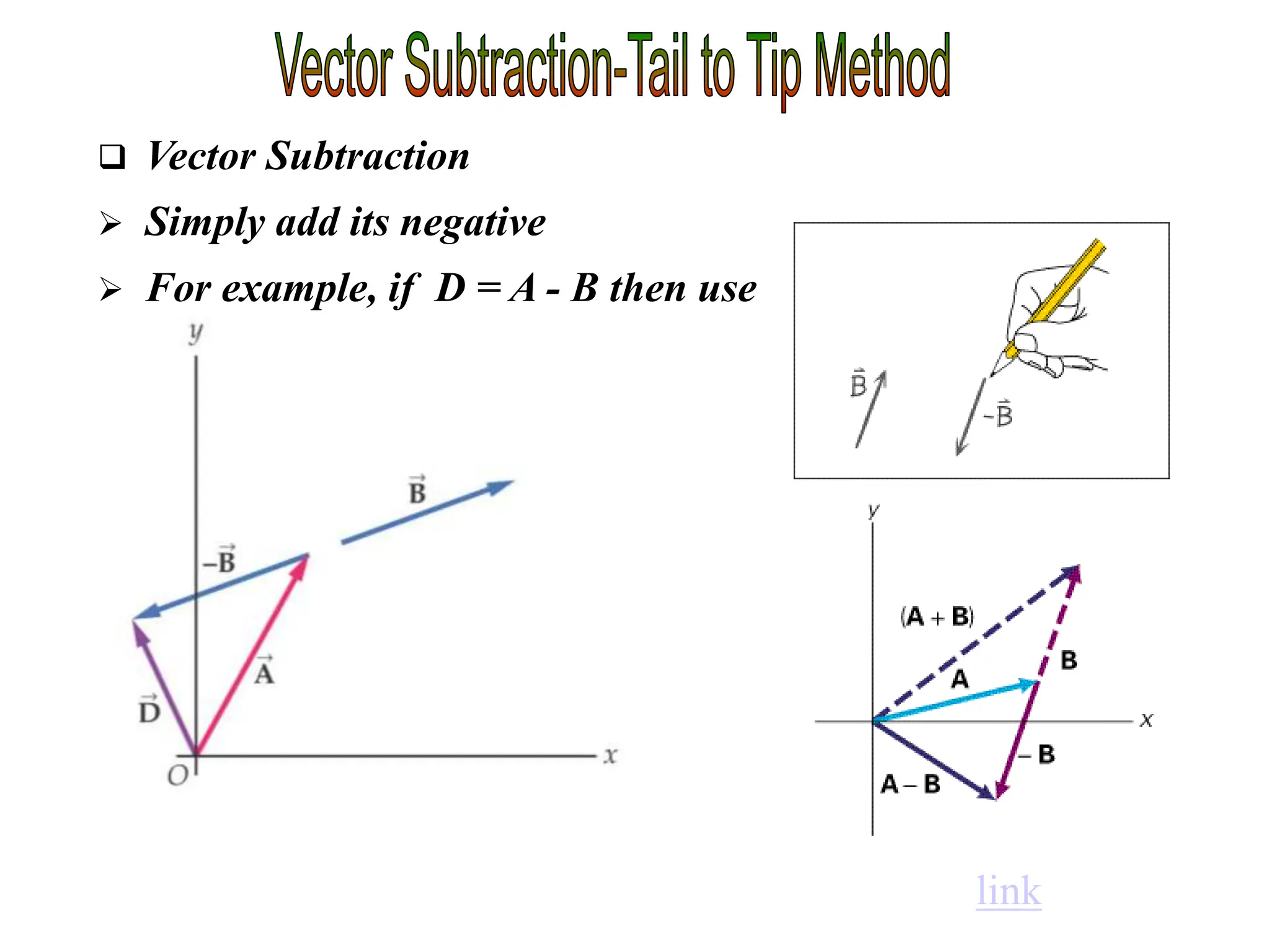
 Vector Subtraction
 Simply add its negative
 For example, if D = A - B then use
link
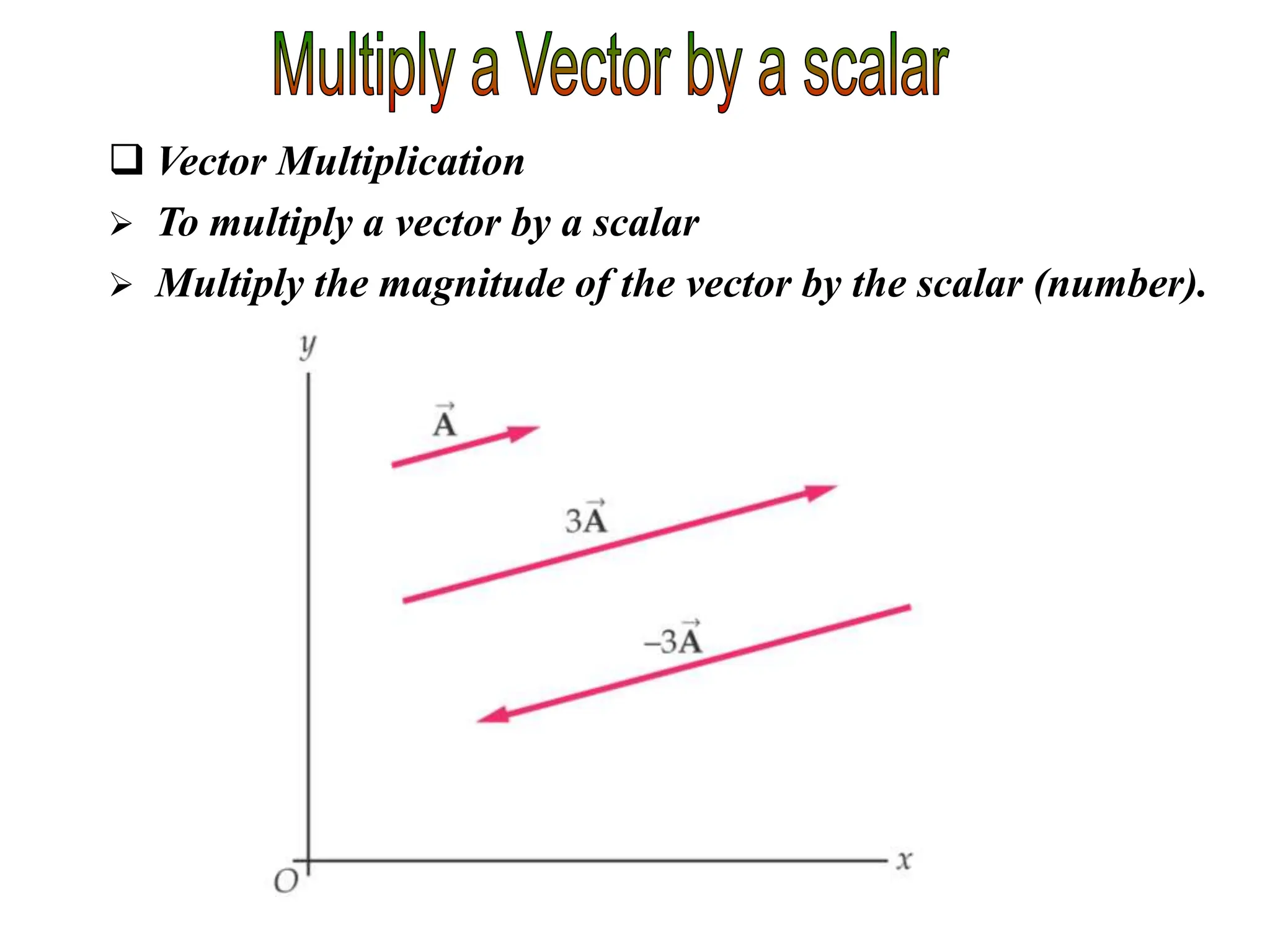
 Vector Multiplication
 To multiply a vector by a scalar
 Multiply the magnitude of the vector by the scalar (number).
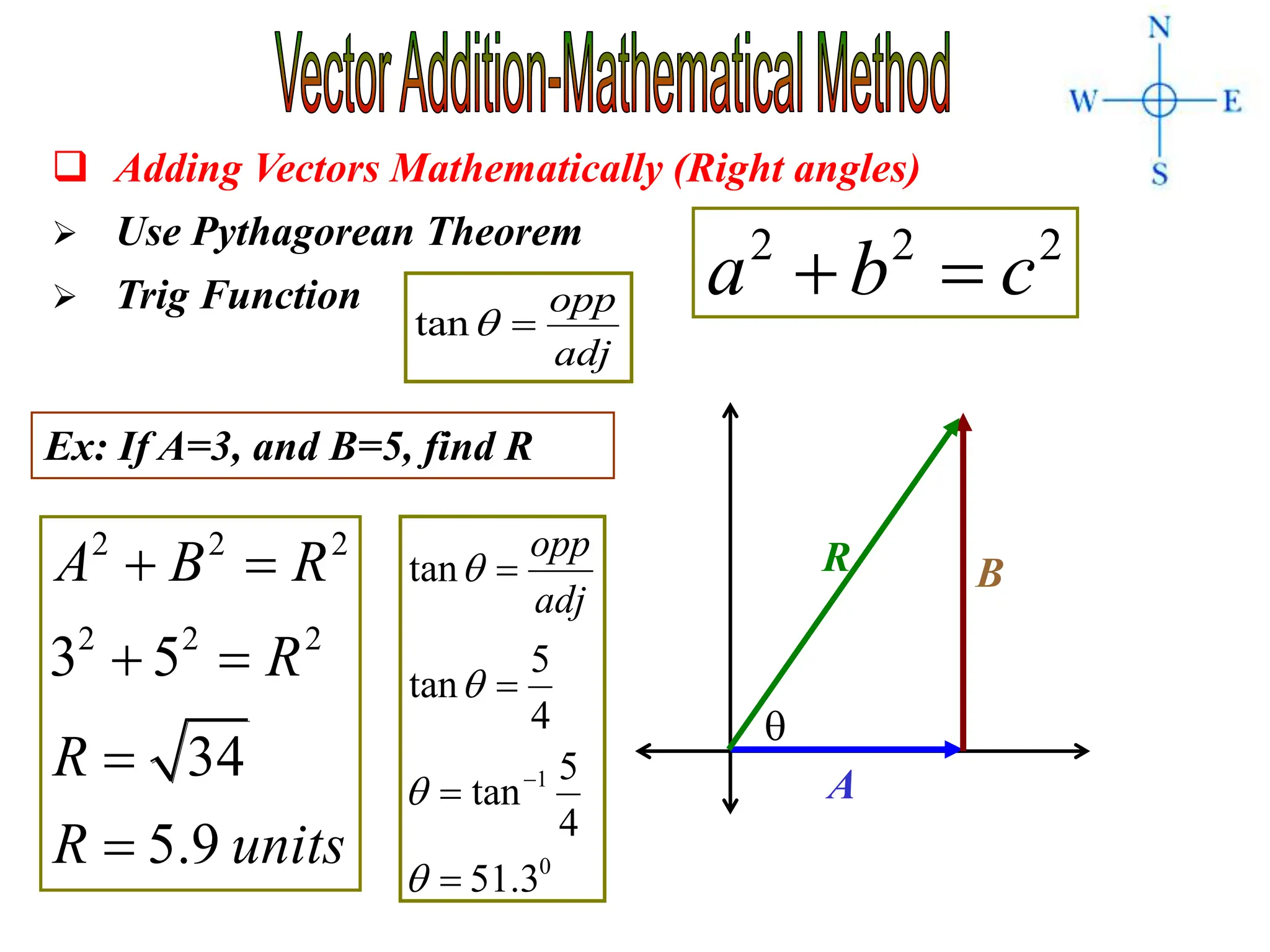
 Adding Vectors Mathematically (Right angles)
 Use Pythagorean Theorem
 Trig Function
2 2 2
a b c
 
tan
opp
adj
 
A
B
R
2 2 2
2 2 2
3 5
34
5.9
A B R
R
R
R units
 
 


1
0
tan
5
tan
4
5
tan
4
51.3
opp
adj









Ex: If A=3, and B=5, find R

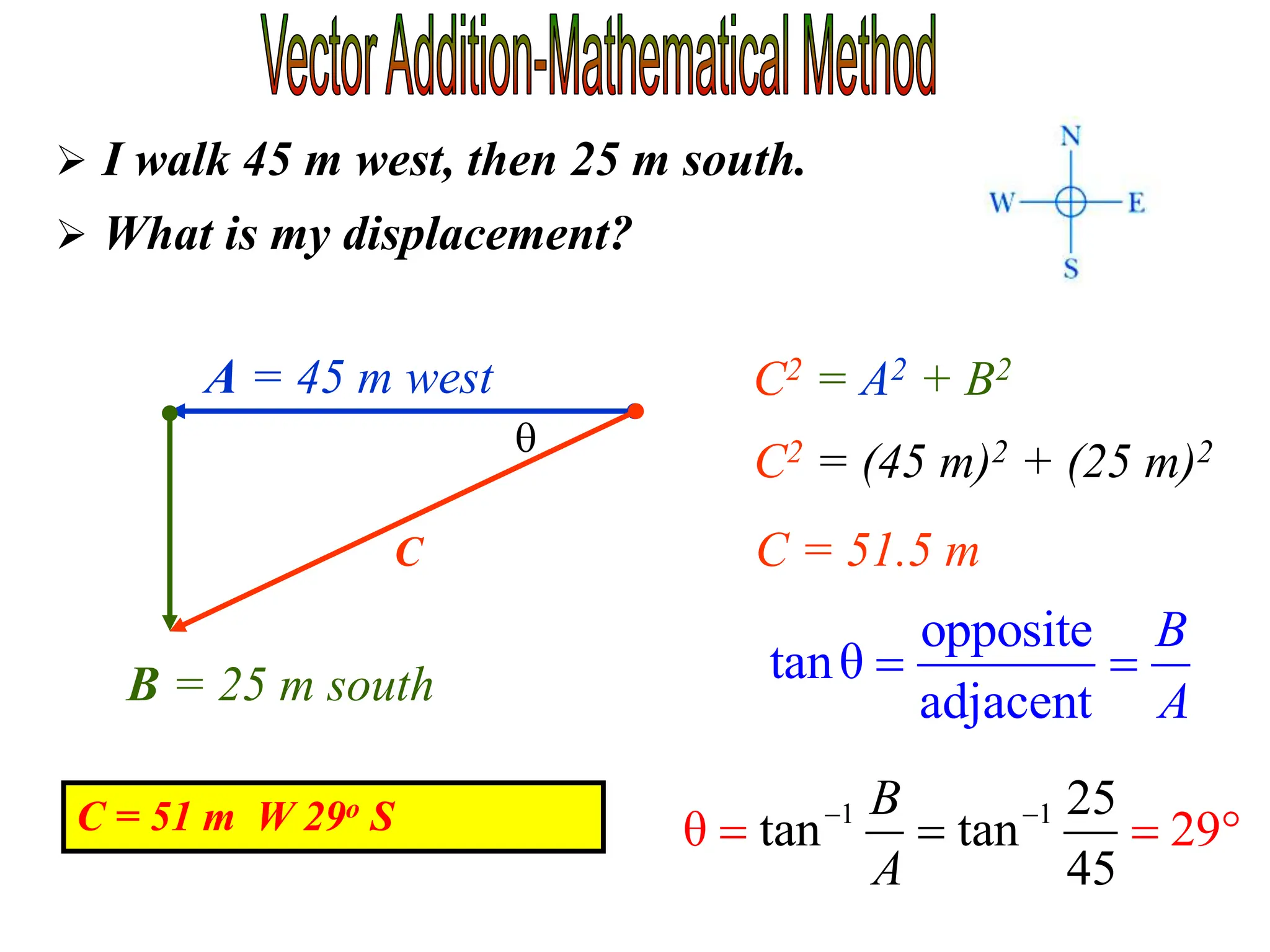
 I walk 45 m west, then 25 m south.
 What is my displacement?
A = 45 m west
B = 25 m south
C
C2 = A2 + B2
C2 = (45 m)2 + (25 m)2
C = 51.5 m

opposite
tanθ
adjacent
B
A
 
1 1 25
tan ta 9
5
θ n
4
2
B
A
 
 
 
C = 51 m W 29o S
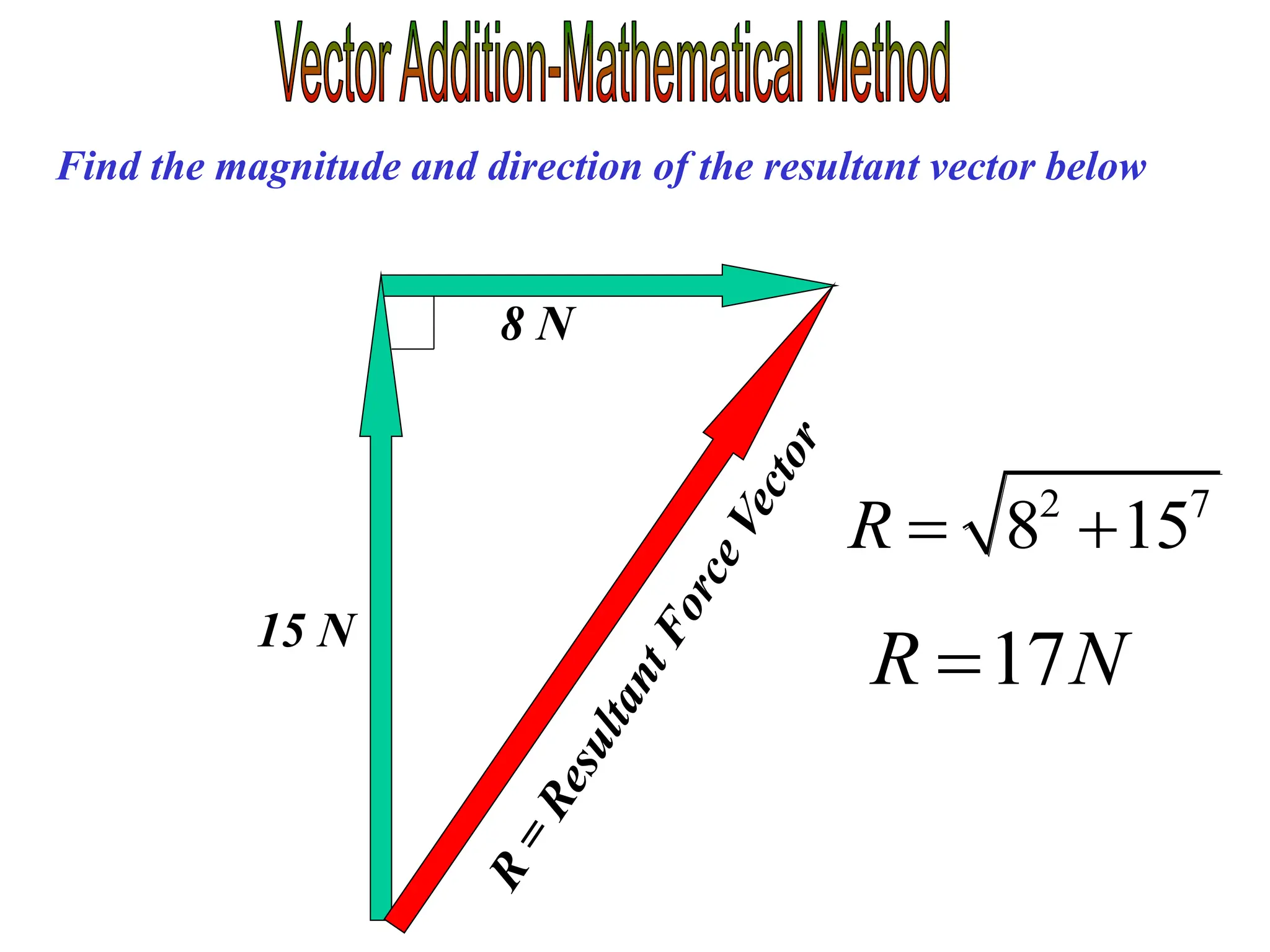
Find the magnitude and direction of the resultant vector below
2 7
8 15
R  
8 N
15 N
17
R N

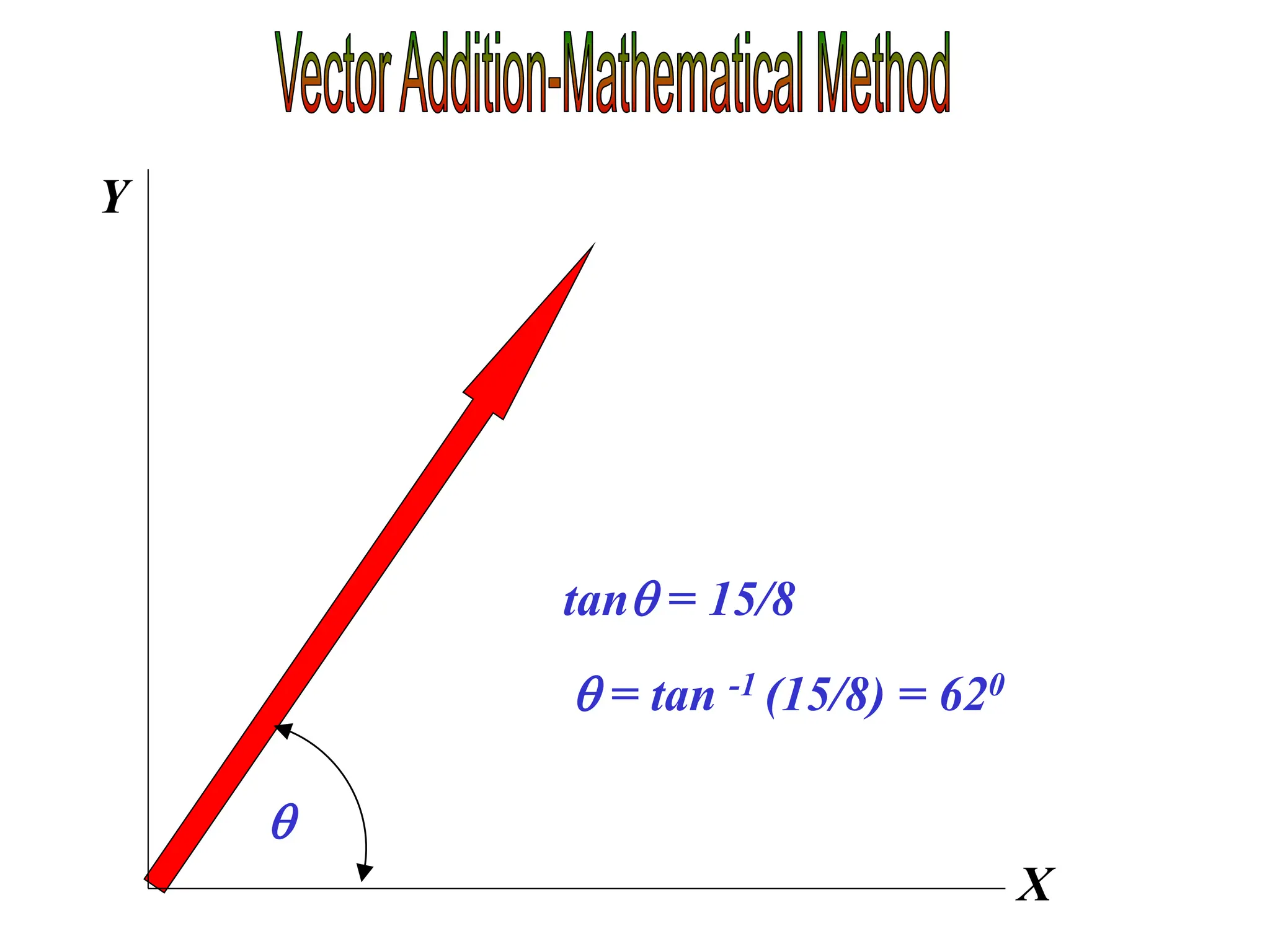
X
Y

tan = 15/8
 = tan -1 (15/8) = 620
Addition and Subtraction of Vectors.ppt

Addition and Subtraction of Vectors.ppt

  • 1.
    I know whereI’m going
  • 2.
    • A scalaris a quantity described by just a number, usually with units. It can be positive, negative, or zero. • Examples: – Distance – Time – Temperature – Speed • A vector is a quantity with magnitude and direction. The magnitude of a vector is a nonnegative scalar. • Examples: – Displacement – Force – Acceleration – Velocity
  • 3.
    Magnitude, what isit? The magnitude of something is its size. Not “BIG” but rather “HOW BIG?”
  • 4.
     Magnitude andDirection  When specifying some (not all!) quantities, simply stating its magnitude is not good enough.  For example: ”Where’s the library?,” you need to give a vector! Quantity Category 1. 5 m 2. 30 m/sec, East 3. 5 miles, North 4. 20 degrees Celsius 5. 256 bytes 6. 4,000 Calories
  • 5.
     Magnitude andDirection  Giving directions: – How do I get to the Virginia Beach Boardwalk from Norfolk? – Go 25 miles. (scalar, almost useless). – Go 25 miles East. (vector, magnitude & direction)
  • 6.
     Graphical Representationof Vectors  Vectors are represented by an arrow.  The length indicates its magnitude.  The direction the arrow point determines its direction.
  • 7.
    Vector r  Hasa magnitude of 1.5 meters  A direction of  = 250  E 25 N
  • 8.
     Identical Vectors A vector is defined by its magnitude and direction, it doesn’t depend on its location.  Thus, are all identical vectors
  • 9.
     Properties ofVectors  Two vectors are the same if their sizes and their directions are the same, regardless of where they are. x y A B E D C F Which ones are the same vectors? A=B=E=D Why aren’t the others? C: The same magnitude but opposite direction: C= - A F: The same direction but different magnitude
  • 10.
     The Negativeof a Vector  Same length (magnitude) opposite direction
  • 11.
    Tail to TipMethod Steps: i. Draw a coordinate axes ii. Plot the first vector with the tail at the origin iii. Place the tail of the second vector at the tip of the first vector iv. Draw in the resultant (sum) tail at origin, tip at the tip of the 2nd vector. (Label all vectors) 1. Graphically – Use ruler, protractor, and graph paper. i. Tail to tip method ii. Parallelogram method 2. Mathematically – Use trigonometry and algebra
  • 12.
     2 vectorssame direction Add the following vectors • d1 = 40 m east • d2 = 30 m east • What is the resultant? d1 = 40 m east d2 = 30 m east d1 + d2 = 70 m east Just add, resultant the sum in the same direction. Use scale 1cm = 10m
  • 13.
    d1 = 40m east d2 = 30 m west d1 + d2 = 10 m east Subtract, resultant the difference and in the direction of the larger.  2 vectors opposite direction Add the following vectors • d1 = 40 m east • d2 = 30 m west • What is the resultant? Use scale 1cm = 10m
  • 14.
     2 perpendicularvectors Add the following vectors • v1 = 40 m east • v2 = 30 m north • Find R v1 = 40 m east v2 = 30 m north R  1. Measure angle with a protractor 2. Measure length with a ruler 3. Use scale 1cm = 10m 4. R = 50 m, E 370 N
  • 15.
     2 randomvectors  To add two vectors together, lay the arrows tail to tip.  For example C = A + B link Use scale 1cm = 10m
  • 16.
    1. The magnitudeof the resultant vector will be greatest when the original 2 vectors are positioned how? (00 between them) 2. The magnitude will be smallest when the original 2 vectors are positioned how? (1800 between them)
  • 17.
    How does changingthe order change the resultant? It doesn’t!
  • 18.
    The order inwhich you add vectors doesn’t effect the resultant. A + B + C + D + E= C + B + A + D + E = D + E + A + B + C The resultant is the same regardless of the order.
  • 19.
  • 20.
    We cannot justadd 20 and 35 to get resultant vector!! Example: A car travels 1. 20.0 km due north 2. 35.0 km in a direction N 60° W 3. Find the magnitude and direction of the car’s resultant displacement graphically. Use scale 1cm = 10km
  • 21.
    Parallelogram Method Steps: 1.Draw a coordinate axes 2. Plot the first vector with the tail at the origin 3. Plot the second vector with its the tail also at the origin 4. Complete the parallelogram 5. Draw in the diagonal, this is the resultant. 1. Graphically – Use ruler, protractor, and graph paper. i. Tail to tip method ii. Parallelogram method 2. Mathematically – Use trigonometry and algebra
  • 22.
    A B R You obtainthe same result using either method. Tail to Tip Method Parallelogram Method
  • 23.
     Add thefollowing velocity vectors using the parallelogram method V1 = 60 km/hour east V2 = 80 km/hour north
  • 24.
    F1 + F2= F3 = R
  • 25.
    u + v= R Step 1: Draw both vectors with tails at the origin Step 2: Complete the parallelogram Step 3: Draw in the resultant
  • 26.
     Vector Subtraction Simply add its negative  For example, if D = A - B then use link
  • 27.
     Vector Multiplication To multiply a vector by a scalar  Multiply the magnitude of the vector by the scalar (number).
  • 28.
     Adding VectorsMathematically (Right angles)  Use Pythagorean Theorem  Trig Function 2 2 2 a b c   tan opp adj   A B R 2 2 2 2 2 2 3 5 34 5.9 A B R R R R units       1 0 tan 5 tan 4 5 tan 4 51.3 opp adj          Ex: If A=3, and B=5, find R 
  • 29.
     I walk45 m west, then 25 m south.  What is my displacement? A = 45 m west B = 25 m south C C2 = A2 + B2 C2 = (45 m)2 + (25 m)2 C = 51.5 m  opposite tanθ adjacent B A   1 1 25 tan ta 9 5 θ n 4 2 B A       C = 51 m W 29o S
  • 30.
    Find the magnitudeand direction of the resultant vector below 2 7 8 15 R   8 N 15 N 17 R N 
  • 31.
    X Y  tan = 15/8 = tan -1 (15/8) = 620