Downloaded 798 times
![What is a vector?
Vectors are quantities that have magnitude (size)
AND direction.
For example:
35 m is a scalar quantity.
35 m [East] is a vector quantity.
Quantities like temperature, time, mass and
distance are examples of scalar quantities.
Quantities like force, velocity, and displacement
are examples of vector quantities.](https://image.slidesharecdn.com/1-151015024715-lva1-app6891/85/1-1-vectors-3-320.jpg)
![Describing Vectors
Consider a gravitational force of 65 N [down]
magnitude unit direction
Vectors are graphically represented by arrows:
Length = magnitude
Drawn to scale
F](https://image.slidesharecdn.com/1-151015024715-lva1-app6891/85/1-1-vectors-4-320.jpg)
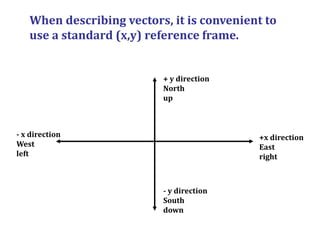
![In physics, convention dictates vector direction
(angle) is measured from the x axis of the frame of
reference.
+ y direction
North
up
- y direction
South
down
- x direction
West
left
+x direction
East
right
30o
S
[right, 30o above horizontal]
[30o N of E]
[E, 30o upwards]](https://image.slidesharecdn.com/1-151015024715-lva1-app6891/85/1-1-vectors-6-320.jpg)
![In math it is common to describe direction differently:
For example:
To a physicist, the direction of
this vector is [60o S of W]
OR . . . measure the angle of
direction in a counter clockwise
direction from East. The same
vector direction is now described as
[240o] This method has advantages.](https://image.slidesharecdn.com/1-151015024715-lva1-app6891/85/1-1-vectors-7-320.jpg)
![Addition and Subtraction of Vectors
Part 1: Parallel vectors
Example 1: Blog walks 35 m [E], rests for 20 s and
then walks 25 m [E]. What is Blog’s overall
displacement? (what is displacement??)
Solve graphically
by drawing a scale
diagram.
1 cm = 10 m
Place vectors head to
tail and measure
resultant vector.
1s
2s
60 m [E]s](https://image.slidesharecdn.com/1-151015024715-lva1-app6891/85/1-1-vectors-9-320.jpg)
![Solve algebraically by adding the two magnitudes.
WE CAN ONLY DO THIS BECAUSE THE VECTORS ARE
IN THE SAME DIRECTION.
SO 35 m [E] + 25 m [E] = 60 m [E]
Solve Graphically
1 2x x
1x
2x
10 m [E]x
Example 2: Blog walks 35 m [E], rests for 20 s and
then walks 25 m [W]. What is Blog’s overall
displacement?
resultant](https://image.slidesharecdn.com/1-151015024715-lva1-app6891/85/1-1-vectors-10-320.jpg)
![Algebraic solution, we can still add the two
magnitudes. WE CAN ONLY DO THIS BECAUSE THE
VECTORS ARE PARALLEL!
WE MUST MAKE ONE VECTOR NEGATIVE TO
INDICATE OPPOSITE DIRECTION.
SO 35 m [E] + 25 m [W]
= 35 m [E] + – 25 m [E]
= 10 m [E]
Note that 25 m [W] is the same as – 25 m [E]](https://image.slidesharecdn.com/1-151015024715-lva1-app6891/85/1-1-vectors-11-320.jpg)
![Addition and Subtraction of Vectors
Part 2: Perpendicular Vectors
Example 3: Blog walks 30 m [N], rests for 20 s and
then walks 40 m [E]. What is Blog’s overall
displacement?
Solve Graphically
1 2x x
1x
2x
length 50 m
37o
o
x 50 m [37 N of E]](https://image.slidesharecdn.com/1-151015024715-lva1-app6891/85/1-1-vectors-12-320.jpg)
![Addition and Subtraction of Vectors
Part 2: Perpendicular Vectors
Algebraic solution: use trigonometry.
Diagram does not need
to be to scale.
2 2
30 40 50 mx
1x
2x
o
x 50 m [37 N of E]
1 1 30
tan tan 37
40
oy
x
](https://image.slidesharecdn.com/1-151015024715-lva1-app6891/85/1-1-vectors-13-320.jpg)
![Part 3 - Adding multiple vectors (method of components)
Consider the following 3 displacement vectors:
A student walks
3 m [45o N of E]
6 m [N]
5 m [30o N of W]
Vectors are illustrated here to scale.
To determine the resultant displacement, add the
individual vectors graphically by drawing them head to
tail.](https://image.slidesharecdn.com/1-151015024715-lva1-app6891/85/1-1-vectors-14-320.jpg)
![The resultant displacement is 11 m [102o] OR 11 m [78o N of W]
Show scale diagram solution here](https://image.slidesharecdn.com/1-151015024715-lva1-app6891/85/1-1-vectors-15-320.jpg)

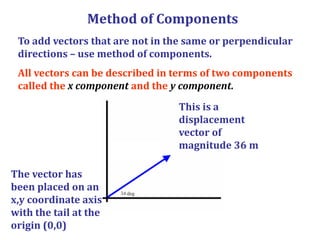

![Method of Components
You may have noticed that the original vector is just the sum
of the two vector components
x
y
+
36 m [34o N of E]
There is NO
difference in
displacement
between walking
36 m [34o N of E]
and walking x m
[E] followed by y m
[N]](https://image.slidesharecdn.com/1-151015024715-lva1-app6891/85/1-1-vectors-19-320.jpg)
![Now consider this vector
18 m [45o S of E]
36 m [34o N of E]
Graphically added
to a second vector
Resultant
We can’t use algebra to add
these vectors directly BUT
we could use algebra to add
their components.](https://image.slidesharecdn.com/1-151015024715-lva1-app6891/85/1-1-vectors-20-320.jpg)
![18 m [45o S of E]
x1
y1
36 m [34o N of E]
To get the same resultant
x2
y2
x1 x2
y1
y2](https://image.slidesharecdn.com/1-151015024715-lva1-app6891/85/1-1-vectors-21-320.jpg)

![Examples:
Resolve the following vectors into x and y components
Vector X Y
15.2 m [27o N of E]
12.7 ms-1 [56o]
45.0 N [48o N of W]
725 m [205o] -657 m -306 m
7.1 ms-1 10.5 ms-1
13.5 m 6.90 m
-30.1 N 33.4 N](https://image.slidesharecdn.com/1-151015024715-lva1-app6891/85/1-1-vectors-25-320.jpg)
![Solving vector problems
Example: Blog starts his walk at the old oak tree.
He walks 55 m [42o S of E] to Point A. He then
walks 75 m [185o] to Point B. He then walks a final
62 m [78o N of W] to Point C. What is Blog’s overall
displacement?
Step 1 (always)
Sketch a diagram
(does not have to be to
scale but it helps) A
B
C](https://image.slidesharecdn.com/1-151015024715-lva1-app6891/85/1-1-vectors-26-320.jpg)
![Solving vector problems
Step 2: Resolve vectors into x and y components
and add them.
Vector X Y
55 m [42o S of E] 40.9 -36.8
75 m [185o] -74.7 -6.54
62 m [78o N of W] -12.9 60.6
55cos(42) 75cos(185) 62cos(78)
40.9 74.7 12.9
46.7
x x x x
x
x
x
s A B C
s
s
s
](https://image.slidesharecdn.com/1-151015024715-lva1-app6891/85/1-1-vectors-27-320.jpg)
![Solving vector problems
Step 2: Resolve vectors into x and y components
and add them.
Vector X Y
55 m [42o S of E] 40.9 -36.8
75 m [185o] -74.7 -6.54
62 m [78o N of W] -12.9 60.6
55sin(42) 75sin(185) 62sin(78)
36.8 6.54 60.6
17.3
y y y y
y
y
y
s A B C
s
s
s
](https://image.slidesharecdn.com/1-151015024715-lva1-app6891/85/1-1-vectors-28-320.jpg)
![Solving vector problems
Step 3: Use sum of components to determine
resultant.
Sx = -46.7 m OR 46.7 m [W]
Sy = 17.3 m or 17.3 m [N]
Sy = 17.3 m
Sx = - 46.7 m
Use trig to find length and
direction of resultant.
49.8 m [20.3o N of W]](https://image.slidesharecdn.com/1-151015024715-lva1-app6891/85/1-1-vectors-29-320.jpg)

1) Vectors are quantities that have both magnitude and direction, unlike scalars which only have magnitude. Common vector quantities include force, velocity, and displacement. 2) Vectors can be described by their magnitude, direction, and reference frame. Direction is measured in degrees from the x-axis. 3) Vector operations like addition, subtraction, multiplication and division can be performed graphically or using components and trigonometry. Parallel vectors can be added/subtracted algebraically but others require using components. 4) To add vectors using components, each vector is broken into x and y components using trigonometry. The x and y components can then be added separately and combined to find the overall resultant vector.


